

Background - A World That Believes It Has Grown Up
We live in a time that insists it has matured.
Across societies, institutions, and cultures, there is a prevailing confidence that humanity has finally learned how to organise itself. We speak fluently of progress. We measure growth obsessively. We surround ourselves with dashboards, indices, targets, standards, and frameworks. Politics presents itself as procedural. Economics as technical. Business as optimised. Family as negotiable. Education as scalable. Ethics as policy adjacent.
The world appears busy, sophisticated, and administratively competent.
Never before have we had such an abundance of institutions claiming to safeguard order, including international bodies, academic communities, regulatory agencies, professional guilds, advisory councils, and global forums. Never before have we produced so much language about inclusion, sustainability, resilience, equity, and responsibility. Never before has rationality been so institutionalised, so credentialed, and so confident in its own authority.
And yet, beneath the surface, something feels off.
Despite the architecture of modern civilisation, anxiety is rising rather than falling. Polarisation is intensifying rather than resolving. Families feel more fragile, not more secure. Businesses oscillate between short-term survival and performative purpose. Political discourse increasingly substitutes moral signalling for responsibility. Economic systems reward abstraction while hollowing out meaning. Communities fracture quietly, then loudly.
We have more connection and less communion.
More information and less understanding.
More choice and less freedom.
Sycophancy flourishes where courage should stand. Entire professional classes learn to speak carefully rather than truthfully. Institutions optimise for legitimacy rather than integrity. Individuals learn, often unconsciously, that survival depends less on discernment and more on alignment with dominant narratives, acceptable vocabularies, and approved concerns.
Life becomes something that happens to people, rather than something people consciously participate in shaping.
And still, the language of progress continues uninterrupted.
At this point in the story, we usually reassure ourselves.
We remind one another of our achievements: the triumph of rationality over superstition, the extraordinary advancement of science and technology, the sophistication of modern governance, the coordination enabled by global institutions, the promise of data-driven decision-making, the professionalism of academia, and the procedural safeguards of international cooperation.
We point to innovation, connectivity, automation, artificial intelligence, medical breakthroughs, and unprecedented material comfort, and we conclude, almost reflexively, that whatever problems remain are merely transitional. That refinement will solve them. That more policy, more education, more regulation, and more awareness will inevitably correct the course.
And then, abruptly, the tone shifts.
Because somewhere along the way, it becomes difficult to ignore that freedom of thought is being quietly redefined as risk. That dissent is increasingly framed as irresponsibility. That questioning dominant narratives now requires careful phrasing, disclaimers, and often silence. That the very institutions built to protect inquiry are becoming allergic to it.
At this point, a certain irony emerges.
A dark one.
In a world that prides itself on openness, we learn to speak indirectly. In a civilisation that celebrates rationality, we increasingly avoid naming what we see. In societies that claim maturity, we tiptoe like children around invisible lines.
Which brings me, somewhat reluctantly and with a degree of dry amusement, to hobbits.
Given the current climate, it seems prudent not to analyse our world too directly.
So instead, I propose we borrow a story.
A small one.
A fantastical one.
One involving dwarves, dragons, and an unassuming creature who survives not by strength, but by wit.
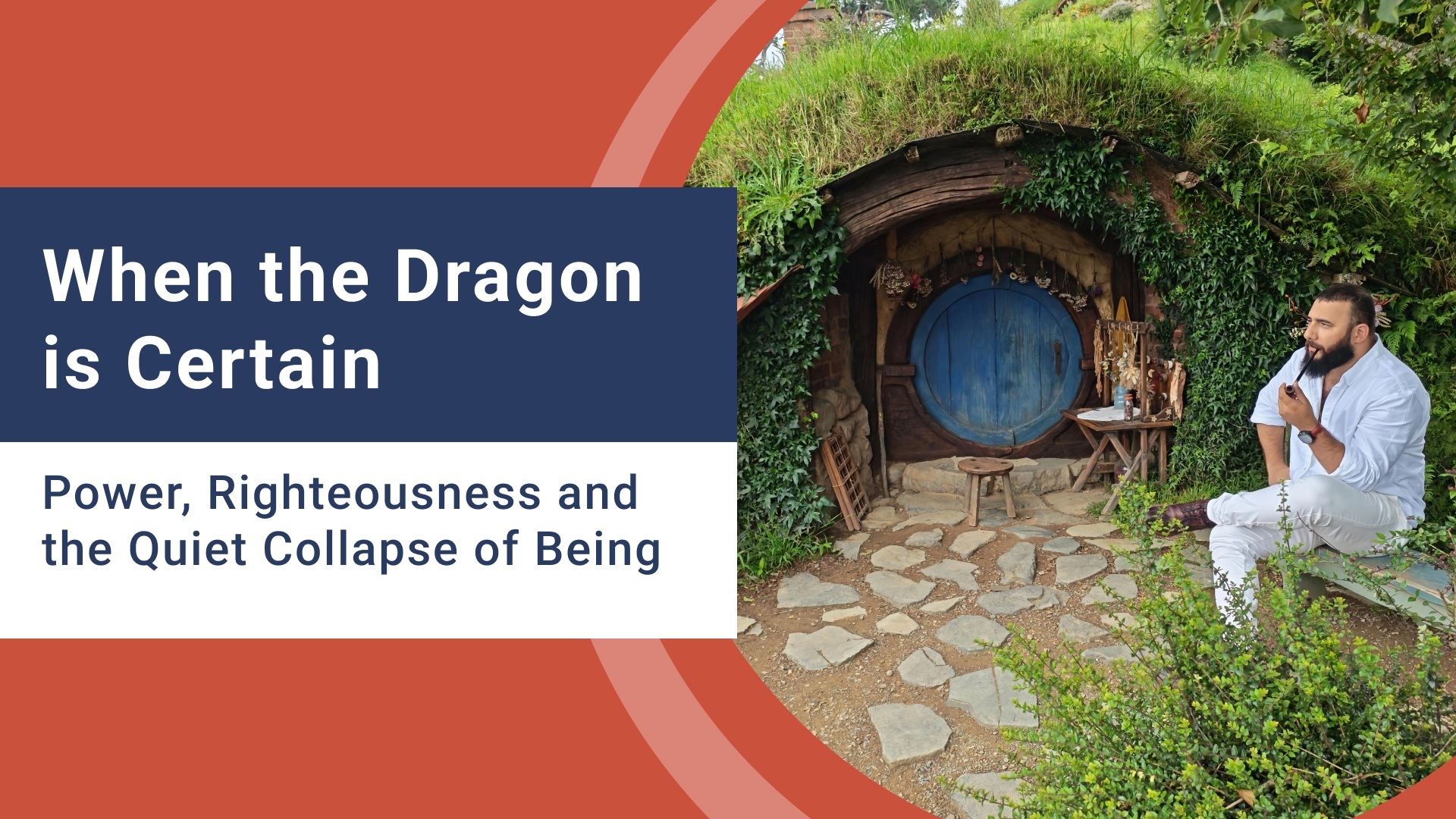
Not because fantasy is escapism, but because it has always been a safer vehicle for truth when direct speech becomes uncomfortable. Recently, while visiting the Hobbiton Shire in New Zealand and the Wētā Workshop, I was reminded why Tolkien’s work continues to endure as more than story or spectacle. Standing inside a world that was deliberately crafted to feel coherent, lived in, and meaningful, it became clear how naturally Tolkien’s narrative lends itself to examining how we are being.
Tolkien, intentionally or not, offers a remarkably precise mirror of how power consolidates, how righteousness turns rigid, how societies outsource responsibility, and how consequences arrive regardless of intention. He shows us what happens when purpose collapses into possession, when identity fuses with legacy, and when crowds remain passive while forces above them manoeuvre. In that sense, using The Hobbit is not an escape from reality, but a return to a form of truth telling that remains intelligible when more direct language no longer is.
By stepping into Middle-earth, we are not leaving reality behind.
We are, perhaps ironically, finding a clearer way to speak about it.
Introduction
This is not an article about fantasy.
Nor is it an exercise in literary criticism, nostalgia, or escapism. What follows uses a familiar story not to avoid reality, but to approach it from an angle that still permits honesty. When direct language becomes brittle, allegory regains its dignity.
The concern at hand is not a lack of intelligence, data, policy, or expertise. On the contrary, we are surrounded by all of these in excess. What appears increasingly absent, however, is the capacity to examine how we are being while deploying them. We have become extraordinarily skilled at refining content, while remaining largely inattentive to the metacontent that shapes how that content is interpreted, justified, and enacted.
This distinction matters more than it may initially appear.
In my work, Being refers not to behaviour, personality, or morality, but to the underlying mode through which a person, institution, or society relates to reality. metacontent, in turn, refers to the framing, assumptions, identity structures, and sense-making lenses through which content is held. When these layers are coherent, systems tend toward integrity. When they collapse, even the most rational intentions begin to generate unintended harm.
This is where many contemporary conversations quietly fail.
We speak of sustainability, responsibility, inclusion, innovation, resilience, governance, leadership, and progress, yet often without interrogating the Being from which these aspirations arise. As a result, systems increasingly behave in ways that contradict their stated aims, while remaining rhetorically convinced of their own virtue. Outcomes worsen, but confidence persists.
This is not hypocrisy in the cartoon sense. It is something subtler and more dangerous: metacontent collapse under the banner of righteousness.
Tolkien’s The Hobbit offers an unusually clean illustration of this pattern. Not because it predicts our time, but because it maps a timeless dynamic: how power understands itself, how certainty resists questioning, how wit disrupts domination, and how those who remain passive often bear consequences they did not consciously choose.
The dragon in the story is not merely destructive. It is certain.
The would-be king is not merely ambitious. He is convinced.
The city that burns is not evil. It is unparticipative.
And the smallest character, the one without formal authority, military strength, or institutional backing, survives precisely because he refuses to fuse identity with outcome.
This article therefore uses Tolkien’s narrative as a diagnostic mirror, not a moral sermon. It examines how Being shapes power, how metacontent governs consequence, and why societies that outsource responsibility while admiring strength often awaken too late to the cost of that arrangement.
What follows is not a call to outrage, nor an invitation to despair. It is an invitation to discernment.
To look not only at what we are doing, but how we are being while doing it, and to consider, quietly but seriously, whether the dragons we fear are external, or already embedded in the structures we normalise.
The Dragon as Power Without Self-Reflection
The dragon in Tolkien’s story is not chaotic power. It is not reckless, impulsive, or unintelligent. Quite the opposite. The dragon is ancient, strategic, calculating, and deeply aware of its own dominance. It occupies its territory with complete confidence, convinced that no force exists capable of challenging it meaningfully.
This distinction matters.
Power becomes most dangerous not when it is unstable, but when it is certain of itself. The dragon does not question its legitimacy. It does not reflect on its impact. It does not perceive itself as contingent, contextual, or relational. It simply is. And because it is, it assumes it must remain so.
In terms of Being, the dragon exemplifies identity fused with dominance. Power is no longer something it exercises. Power is what it is. This fusion eliminates reflexivity. There is no internal space left for doubt, humility, or self-correction. Every movement becomes an assertion. Every challenge, however subtle, is experienced as an existential threat.
This is why the dragon sleeps on its hoard.
The hoard is not merely wealth. It is confirmation. Each object reinforces the narrative of inevitability, proof accumulated into certainty. Over time, possession replaces stewardship, and accumulation replaces purpose. The dragon does not create. It guards. It does not participate in the world. It occupies it.
From a metacontent perspective, this is a closed system. Meaning flows in one direction only, inward. Feedback becomes noise. External perspectives become irrelevant. The dragon does not listen because it no longer recognises the existence of a legitimate outside.
This is also why brute force fails.
Strength, when directed at such a system, only confirms its self-understanding. Resistance becomes validation. Opposition becomes proof of importance. The dragon expects attack. It is built for it. Armour, fire, scale, and fear are all optimised for confrontation.
What the dragon is not prepared for is epistemic disturbance.
It cannot tolerate being unsettled in how it understands itself.
This is why Bilbo’s presence matters. Not because he is brave in a conventional sense, but because he does not engage the dragon on its preferred terrain. He does not challenge power directly. He refuses to grant it narrative completion. He introduces ambiguity, multiplicity, and indirectness into a system that relies on singular certainty.
In sustainability discourse, this distinction is often missed. Systems fail not because they lack intelligence or capacity, but because they lose the ability to self-question. They continue to optimise internally while degrading externally. They mistake scale for legitimacy and endurance for virtue.
The dragon endures, until it does not.
Its downfall does not begin with a weapon, but with a disruption in metacontent. Once the dragon becomes aware that it may be seen differently than it sees itself, once its dominance is reframed rather than attacked, it reacts not wisely, but emotionally. Certainty gives way to compulsion. Control collapses into overreach.
This is not a moral failing. It is an ontological one.
Power that cannot reflect becomes brittle.
Power that cannot listen becomes blind.
Power that cannot doubt itself inevitably mistakes motion for wisdom.
The dragon does not fall because it is evil.
It falls because it is closed.
And closure, when scaled, always carries consequences beyond itself.
Righteous Desire and the Birth of Shadow
Not all shadows are born from malice.
Some emerge from care, responsibility, and an entirely legitimate longing to restore what was lost. This is what makes them difficult to recognise, and more difficult still to confront.
Thorin Oakenshield does not begin his journey corrupted. His desire to reclaim his homeland and restore dignity to his people is not only understandable, it is, in many respects, righteous. He carries the memory of exile, the humiliation of dispossession, and the weight of a lineage reduced to wandering. His resolve is shaped by loss, not greed.
And yet, this is precisely where the danger lies.
A desire becomes a shadow not when its aim is wrong, but when its mode of being becomes rigid. When purpose hardens into necessity. When responsibility fuses with identity. When the leader no longer holds the mission, but is held by it.
In the language of Being, Thorin’s early orientation is relational. His purpose exists in service of his people. He listens. He accepts counsel. He tolerates uncertainty. At this stage, the desire remains open, capable of adjustment, reflection, and ethical hesitation.
But trauma narrows perception.
As the journey progresses, Thorin’s desire undergoes a subtle transformation. The restoration of Erebor no longer represents a future for his people alone. It becomes the redemption of his past. Honour, legacy, and kingship collapse into a single internal demand. This must happen. From that moment, alternatives feel like betrayal, delay feels like disrespect, and disagreement feels like threat.
This is the birth of shadow through righteousness.
The aim remains noble.
The Being does not.
Purpose, once grounded in care, becomes insulated by entitlement. Discernment gives way to certainty. What began as stewardship shifts quietly into possession. The Arkenstone ceases to be a symbol of unity and becomes a confirmation of self. Symbol replaces substance.
This is not villainy. It is bad faith without conscious dishonesty.
Thorin does not deceive others. He deceives himself by collapsing the distinction between what must be done and who he must be. Identity fuses with outcome. At that point, feedback no longer informs. It threatens. Relationships become instrumental. People become means.
In metacontent terms, the domain collapses into a single paradigm, and that paradigm becomes sacred.
This is why Gandalf is uneasy.
He does not doubt Thorin’s courage, legitimacy, or intelligence. He doubts Thorin’s capacity to remain free from obsession once certainty takes hold. He understands that a leader driven by necessity will eventually justify anything, not because they are cruel, but because they are convinced.
Dragon-sickness, in this sense, is not about gold.
It is about ontological contraction.
It manifests as possessiveness, zero-sum thinking, and moral immunity. It narrows the leader’s field of awareness until only the objective remains visible. At that point, the people are no longer the reason for the mission. They are subsumed by it.
The tragedy is not that Thorin seeks the mountain.
The tragedy is that, for a time, the mountain seeks Thorin.
Redemption arrives only when this fusion dissolves. When he separates love for his people from entitlement to legacy, relationship from possession, and purpose from identity. The shadow lifts not through success or failure, but through re-opening Being.
This pattern is neither ancient nor fictional.
It repeats wherever righteous causes become rigid, wherever moral urgency disables self-questioning, and wherever leaders mistake conviction for clarity. The shadow does not announce itself as corruption. It arrives wearing the language of duty.
And by the time it is recognised, its consequences are already in motion.
Bilbo as Metacontent Intervention
Bilbo Baggins is not introduced into the story to contribute strength, strategy, or legitimacy. He offers none of these in any conventional sense. He carries no lineage of power, no military competence, and no institutional authority. And yet, his presence proves decisive.
This is not accidental.
Bilbo enters the narrative as a metacontent intervention, a disruption not of objectives, but of the way those objectives are held. He does not challenge the mission. He challenges the mode of being through which the mission is pursued.
Where others are driven by necessity, Bilbo retains choice.
Where others are fused with outcome, Bilbo remains unattached.
Where others speak in certainties, Bilbo speaks indirectly.
This difference is subtle, and therefore powerful.
Bilbo refuses to grant the dominant forces in the story narrative completion. He does not confront power on its preferred terms. He avoids direct naming, fixed identity, and rigid positioning. In Tolkien’s world, this matters. Naming confers control. Categorisation enables domination. Bilbo resists both by remaining elusive, not through deception, but through multiplicity.
This is why he survives.
Against the dragon, Bilbo does not threaten. He unsettles. He introduces ambiguity into a system that relies on singular certainty. By using riddling speech, by withholding his true name, and by reframing dominance as contingent rather than absolute, he destabilises the dragon’s self-understanding. He exposes vulnerability not by force, but by inducing self-observation. Vanity does the rest.
Against Thorin, the dynamic is quieter, but no less significant.
Bilbo’s hesitation, ethical friction, and occasional refusal to comply interrupt the momentum of inevitability. He introduces pauses where others rush. He asks questions where others assert. He embodies a mode of Being that resists collapsing purpose into identity.
This is why Bilbo is often resented.
He threatens necessity.
In systems driven by certainty, hesitation appears as weakness. In cultures organised around dominance, wit is misread as frivolity. Yet it is precisely this lightness, this refusal to be owned by outcome, that preserves Bilbo’s freedom. He is capable of acting decisively because he is not compelled.
From a metacontent perspective, Bilbo represents openness. He keeps the domain plural. He prevents the paradigm from becoming sacred. He reminds the system, simply by being present, that alternatives exist.
This is not heroism in the romantic sense. It is something rarer and more difficult. Ontological agility.
Bilbo does not defeat the dragon.
He makes its defeat possible.
He does not overthrow the king.
He prevents kingship from becoming absolute.
In sustainability discourse, figures like Bilbo are often marginalised. They do not fit easily into frameworks designed around scale, efficiency, or control. They ask inconvenient questions. They resist premature closure. They care about consequences without demanding certainty.
And yet, without them, systems drift inevitably toward brittleness.
Bilbo’s survival is not luck. It is the natural outcome of a mode of Being that remains open, relational, and responsive, even in the presence of overwhelming power.
In times of consolidation, such figures appear small.
In times of collapse, they prove indispensable.
The Burning City and the Cost of Passivity
The city that burns in Tolkien’s story is not the centre of power. It is not the seat of strategy, nor the origin of ambition. It is, instead, a place of commerce, coordination, and quiet dependence. Its people are not cruel. They are not villains. They are, in many ways, reasonable.
This is precisely the problem.
Lake-town survives by adaptation rather than authorship. It adjusts to power rather than questioning it. It learns to live around danger, normalising proximity to threat as a condition of stability. Over time, this arrangement begins to feel pragmatic, even wise. Life continues. Trade flows. Routines solidify. The presence of the dragon becomes background noise, acknowledged, feared, yet strangely integrated into daily existence.
This is how passivity becomes respectable.
The people of the city are not asleep. They are busy. They are occupied with survival, administration, negotiation, and incremental improvement. Responsibility is outsourced upward. Agency is deferred. Decisions are made elsewhere, by forces perceived as too large, too distant, or too inevitable to confront meaningfully.
Life, gradually, becomes something that happens to them.
From a Being perspective, this is not apathy. It is conformity without malice. A collective posture shaped less by fear than by habituation. The crowd does not choose harm. It chooses continuity. And in doing so, it quietly accepts arrangements whose consequences it does not fully own.
Until the moment arrives.
When the dragon turns, it does not distinguish between intention and posture. Fire does not inquire into nuance. The city burns not because it provoked destruction, but because it remained structurally exposed to it. The distance it believed existed between itself and power collapses in an instant.
This is not punishment. It is consequence.
The tragedy is not that the people are ignorant. It is that they are unparticipative. They neither shape power nor interrupt it. They neither resist nor reflect. They accommodate. And accommodation, when scaled, creates vulnerability.
In modern societies, this pattern is familiar. Large segments of the population live adjacent to systems they do not influence, governed by narratives they do not question, and dependent on structures they do not understand. Stability is mistaken for safety. Normalisation replaces vigilance. Comfort dulls discernment.
The crowd does not see itself as responsible, only affected.
Yet Being does not recognise innocence by intention alone. Systems respond to posture. When participation is surrendered, consequence redistributes itself downward. Those closest to the ground feel the heat first.
The city burns while the dragon flies, and while kings argue.
And in that moment, the cost of passivity becomes undeniable.
Not because the people chose destruction,
but because they chose not to choose.
Imposed Integrity and the Manufacture of Distrust
There is a particular form of failure that emerges when authority mistakes control for care.
It often presents itself as responsibility.
It is justified through protection.
And it is enforced through regulation.
Recently, a decision was introduced with precisely such framing. A categorical prohibition preventing those under a certain age from participating in digital public life was imposed, regardless of context, history, or lived investment. Accounts built over years were erased overnight. Relationships dissolved without consent. Creative identities vanished without dialogue.
This was not discernment.
It was imposed integrity.
Imposed integrity occurs when values are enforced externally without being cultivated internally, when moral certainty replaces relational understanding, and when authority assumes it can install coherence through prohibition. The intention may be protective, but the Being from which it arises is not reflective. It is declarative.
The most troubling aspect is not the restriction itself.
It is the ontological message embedded within it.
The message is this.
Your lived reality is secondary to our abstract model of safety.
For young people, not children in the simplistic sense, but emerging adults already negotiating identity, belonging, expression, and agency, this produces disorientation rather than protection. It severs continuity. It invalidates effort. It communicates that participation is conditional, revocable, and ultimately not theirs.
This is how disengagement or disenfranchisement is manufactured.
When authority bypasses dialogue and substitutes fiat, it does not build trust. It erodes it. When young people experience power as arbitrary rather than relational, they do not internalise responsibility. They externalise resentment. They learn not cooperation, but evasion. Not citizenship, but withdrawal or rebellion.
History is unambiguous on this point.
Generations that grow up experiencing authority as something done to them rather than with them do not mature into compliant stewards. They mature into sceptics, disruptors, and eventually challengers. Sometimes creatively. Sometimes violently. Always distrustfully.
I have lived this pattern before.
In societies where the state believed it could engineer virtue through restriction, the immediate outcome was silence. The medium-term outcome was disengagement. The long-term outcome was radicalisation, not always ideological, but existential. Authority lost legitimacy long before it lost control.
What is unfolding here follows the same ontological trajectory.
When integrity is imposed rather than embodied, when participation is withdrawn rather than cultivated, and when young people are treated as risks to be managed rather than agents to be developed, the consequences do not disappear. They compound.
In the short term, this may express itself as increased rebelliousness, underground behaviour, or violence that appears irrational when analysed purely at the behavioural level. In the long term, it produces a generation for whom institutions are not trusted partners, but adversarial structures.
This is not a warning.
It is a pattern.
And like the city by the lake, societies that normalise such measures often mistake compliance for stability, right up until the moment trust collapses and consequences arrive from directions they did not anticipate.
Sustainability, Power, and Ontological Failure
Most systems do not collapse because they lack intelligence.
They collapse because they lose ontological integrity.
In contemporary discourse, sustainability is often framed as a technical challenge, a matter of optimisation, efficiency, metrics, compliance, and innovation. Solutions are sought through better models, improved governance, more accurate data, and broader coordination. While none of these are inherently misguided, they all operate at the level of content.
What remains largely unexamined is the Being from which these solutions arise.
When power becomes fused with identity, when righteousness hardens into certainty, and when participation is outsourced in the name of stability, sustainability becomes performative rather than regenerative. Systems appear sophisticated while quietly hollowing themselves out. They continue to function, until they do not.
This is ontological failure.
The dragon represents power without self-reflection.
The king represents purpose collapsed into entitlement.
The city represents continuity mistaken for agency.
Together, they form a closed loop.
Within this loop, systems reward alignment over discernment, coherence over truth, and predictability over vitality. Feedback is filtered. Dissent is reframed as disruption. Complexity is simplified into slogans. The appearance of order is maintained, even as resilience erodes.
This is why sustainability initiatives so often fail to deliver their promised outcomes. They are built on architectures that cannot self-question. They assume that refinement alone can correct trajectories that are fundamentally misaligned at the level of Being.
From a metacontent perspective, such systems are internally consistent but externally destructive. They optimise within their own assumptions while degrading the conditions that make optimisation meaningful in the first place. They accumulate indicators of success while losing the capacity to notice harm.
This is not malevolence. It is closure.
And closure scales.
The irony is that the more confident a system becomes in its own virtue, the less capable it is of recognising its blind spots. Moral language accelerates. Institutional authority consolidates. Control tightens. All in the name of protection, progress, or necessity.
But sustainability cannot be imposed through certainty.
It requires openness.
It requires the capacity to pause, to listen, to re-evaluate, and to adjust not just strategies, but underlying assumptions. It requires leaders who can separate purpose from identity, institutions that can tolerate critique without collapsing, and societies that remain participative rather than deferential.
Without these qualities, sustainability discourse becomes another hoard, carefully guarded, rarely examined, and increasingly disconnected from lived reality.
The failure, then, is not one of knowledge.
It is a failure of Being.
What an Alternative Way of Being Might Require
There is no final victory in Tolkien’s story.
The dragon falls, yet conflict escalates. The mountain is reclaimed, yet unity fractures. Loss is acknowledged only after it has already occurred. This is not narrative pessimism. It is realism.
Systems do not heal through resolution alone. They heal through re-orientation.
An alternative way of Being does not begin with dismantling power, overthrowing institutions, or replacing narratives wholesale. Such impulses often reproduce the very dynamics they seek to correct. What is required instead is a shift at a deeper level, one that precedes action, strategy, and reform.
First, it requires the capacity for self-reflection in power. Not accountability as performance, but reflexivity as posture. Power must retain an internal space in which it can question its own assumptions, listen without immediately responding, and tolerate uncertainty without defaulting to control. Without this, strength inevitably hardens into brittleness.
Second, it requires the decoupling of purpose from identity. Causes, however righteous, must remain held rather than inhabited. Leaders must resist the temptation to become embodiments of outcomes, lest discernment collapse into entitlement. Stewardship demands humility precisely because it is entrusted with something larger than the self.
Third, it requires the rehabilitation of participation. Societies cannot remain sustainable if agency is continuously outsourced upward while consequences flow downward. Participation is not merely civic engagement. It is an ontological stance. It is the refusal to live as a spectator in one’s own life. Crowds do not need to become heroes. They need to become present.
Fourth, it requires space for figures like Bilbo. Not as mascots of virtue, but as structural necessities. Individuals who speak indirectly, hesitate ethically, and resist premature closure play a vital role in keeping systems alive. They interrupt inevitability. They reintroduce choice. They remind institutions that certainty is not the same as wisdom.
Finally, it requires a renewed understanding of sustainability itself.
Sustainability is not endurance at all costs. It is not preservation of form. It is the ongoing capacity of a system to remain open, responsive, and relational across time. When systems lose this capacity, they may persist, but they are no longer alive.
This is why the most dangerous moment for any civilisation is not crisis, but confidence.
Dragons do not fall because they are challenged.
They fall because they are certain.
Kings do not lose their way because they lack vision.
They lose it because vision replaces discernment.
Cities do not burn because they choose destruction.
They burn because they choose not to participate.
The invitation, then, is not to defeat dragons, crown kings, or save cities.
It is to examine, honestly and continuously, how we are being while believing we are doing good.
Because history suggests that when Being collapses, consequences do not ask permission before arriving.
Conclusion
Reclaiming Discernment Before the Fire
The story of the dragon, the king, and the burning city is not a warning about villains. It is a reflection on how systems lose their way while believing they are doing good. Power becomes closed not because it is evil, but because it becomes certain. Righteousness turns brittle when it mistakes necessity for legitimacy. Societies drift into passivity not through apathy, but through habituation to arrangements they no longer feel capable of influencing.
What unites these patterns is not failure of intelligence, policy, or intention. It is a failure of Being.
When content dominates discourse and meta content remains unexamined, systems become internally coherent and externally destructive. They optimise, regulate, and enforce with increasing confidence, while quietly eroding trust, participation, and meaning. By the time consequences become visible, the conditions that made them inevitable have already been normalised.
This is why sustainability cannot be reduced to survival endurance, preservation, or compliance. A system that merely persists is not necessarily alive. Sustainability, in its authentic sense, is the ongoing capacity of a system to remain open, reflective, and relational across time. It requires power that can listen, leadership that can doubt itself, and societies that remain participative rather than deferential.
The figures in Tolkien’s story point to this quietly. The dragon falls not because it is attacked, but because its certainty collapses. The king redeems himself not through victory, but through release. The smallest character survives because he remains unattached to outcome and open to consequence. These are not narrative coincidences. They are ontological signals.
The work ahead is therefore not to replace one ideology with another, or to perfect existing systems through greater control. It is to restore discernment at the level of Being. To learn how to hold purpose without being consumed by it. To cultivate integrity without imposing it. To participate consciously rather than adapt passively.
These questions are explored more fully in my latest book, Sustainabilism, not as a program or prescription, but as an attempt to articulate the deeper conditions that allow systems to endure without collapsing into rigidity. It is an invitation to look beneath policy, technology, and rhetoric, and to examine how we are being while shaping the world we claim to care about.
Because history suggests that the most dangerous moment is not crisis, but certainty. And when the dragon is certain, the fire rarely arrives without warning. We simply stop recognising it until it is too late.