
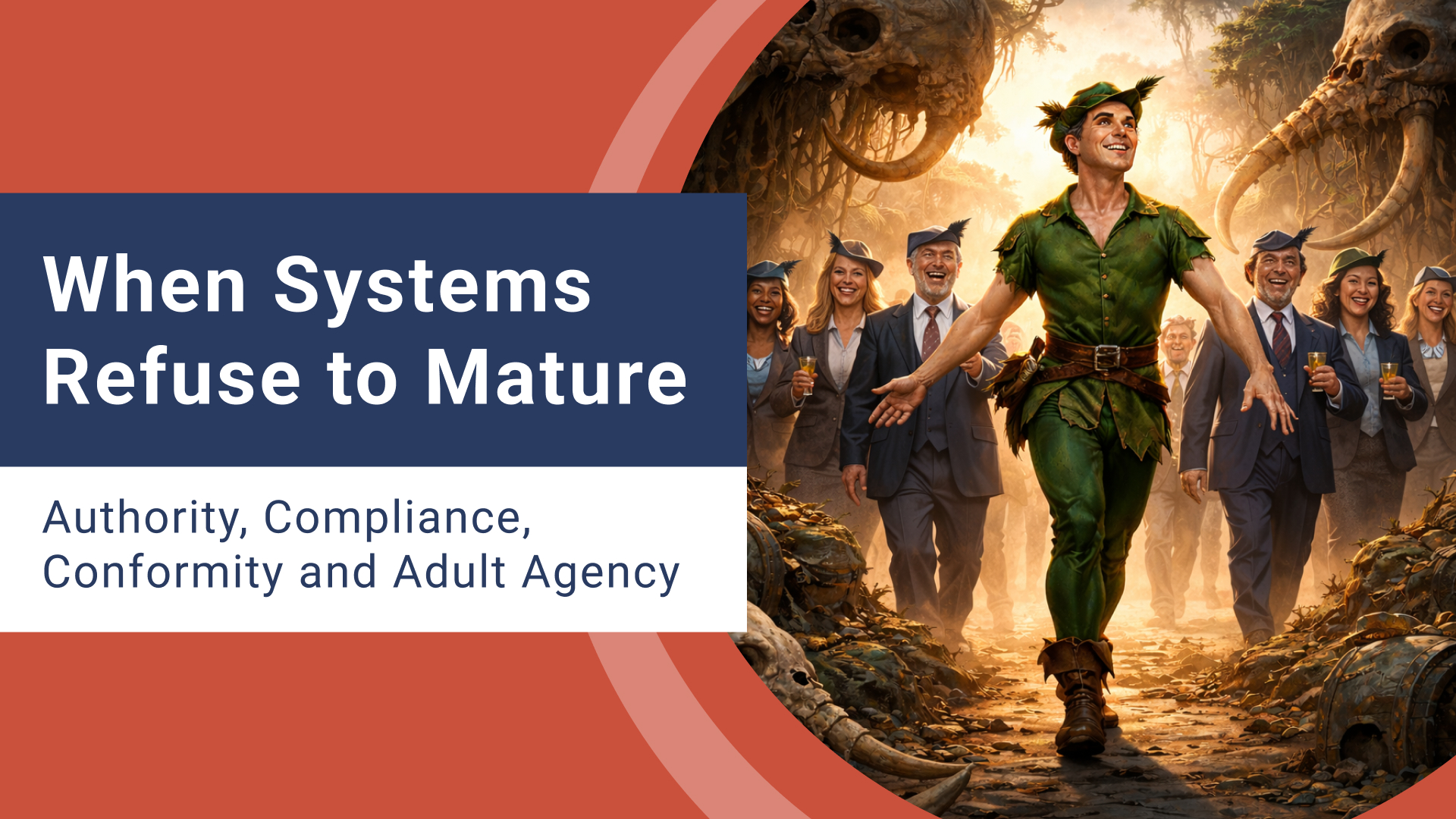

Neverland Exists …
Neverland is not a place, and it is not a story for children.
Neverland is a psychological condition. A mode of being. A way of relating to time, responsibility, and selfhood in which growth is indefinitely postponed while power quietly consolidates. It is what happens when existence is severed from consequence, when continuity is dissolved, and when the demand to become is replaced by the permission to remain unfinished.
In Neverland, time does not lead anywhere. Days pass, but they do not accumulate. Experience does not deepen. Memory does not mature into wisdom. Events occur, yet nothing is integrated. Everything resets just enough to feel alive, but never enough to transform.
From the inside, this feels like freedom. Weightlessness. Relief. The burden of adulthood has been lifted. There is no inheritance of consequences, no obligation to carry yesterday into tomorrow. Action is possible without ownership. Speech is possible without accountability. Authority exists without the gravity of authorship.
Neverland is therefore not chaotic. It is organised. Structured. Governed. But its governance is peculiar. It preserves motion while preventing maturation. It allows endless activity while blocking becoming. Nothing is allowed to reach completion, because completion would require responsibility, and responsibility would require adulthood.
This is why Neverland feels playful and ominous at the same time. It wears the costume of innocence, yet operates through avoidance. It smiles, yet refuses to grow teeth. It promises eternal youth, but at the price of arrested development.
What makes Neverland dangerous is not its fantasy, but its stability. It does not collapse easily. It sustains itself by rewarding compliance, celebrating lightness, and punishing seriousness. It reframes gravity as cruelty, maturity as oppression, and limits as violence.
And at the centre of this suspended world stands a figure who cannot afford to grow older.
Peter Pan does not refuse adulthood out of innocence. He refuses it because adulthood would end his reign.
The Boy Who Would Not Become
Peter Pan is not defined by youth. He is defined by refusal.
He does not merely avoid growing up. He actively resists becoming. Becoming would require continuity, and continuity would expose him to consequence. To grow older is not simply to age. It is to integrate experience, to accept limits, to allow failure and responsibility to shape one’s character. Peter Pan rejects this entire movement of existence.
Phenomenologically, Peter lives in a perpetual present. There is no genuine past behind him and no accountable future ahead of him. Each moment exists only to affirm the next moment. Nothing accumulates. Nothing weighs. Nothing demands transformation. This is why he can act endlessly without ever changing.
Yet Peter is not powerless. On the contrary, he holds authority. He names reality. He defines what is fun, what is allowed, what is heroic, and what is forbidden. He establishes the tone of Neverland not through wisdom or care, but through narrative dominance. Whoever controls the story controls the world.
Peter crowns himself king without ceremony. There is no coronation because there is no lineage. There is no succession because there is no future. His rule does not rest on legitimacy, competence, or service. It rests on enchantment. On charm. On the ability to keep others suspended in the same unfinished state in which he himself must remain.
This is the quiet delusion at the heart of Peter Pan. He mistakes stasis for freedom and immaturity for innocence. He believes that staying young means staying pure, when in reality it means staying unaccountable. His laughter masks an ontological avoidance. His flight is not transcendence. It is escape.
Peter cannot grow up because growing up would expose the fragility of his authority. Adulthood would require him to answer for the world he governs. It would force him to reckon with the cost of his rule, the dependency it creates, and the lives it freezes in place.
This is why Peter Pan must remain central. Not as a leader, but as a fixed point around which others orbit. His world cannot tolerate another centre of gravity. Anything that matures independently threatens the spell.
And so Neverland does not simply keep Peter young. Peter keeps Neverland young.
The Lost Boys and the Comfort of Disappearance
The Lost Boys are not lost because they cannot find their way home.
They are lost because they no longer know who they would be without Peter.
They arrive in Neverland unformed, unnamed by lineage, detached from continuity. No past binds them and no future claims them. In this sense, Neverland offers something deeply comforting. It removes the burden of becoming someone. One can simply belong.
Psychologically, the Lost Boys dissolve into the world Peter maintains. Their individuality is softened, then gradually replaced by conformity. Difference becomes risk. Discernment becomes disloyalty. What begins as companionship settles into dependency.
Their loyalty is not heroic. It is compensatory. In the absence of an inner centre, Peter becomes the external one. He supplies direction, meaning, and validation. In return, the Lost Boys surrender authorship over their own lives. They no longer need to decide, judge, or carry consequence. Obedience becomes a form of safety.
From a phenomenological standpoint, their experience of selfhood narrows. Identity is no longer something that emerges through engagement with reality. It is assigned through alignment. To agree is to exist. To comply is to remain included.
Neverland rewards this posture. The boys are praised for enthusiasm, not depth. For participation, not responsibility. For loyalty, not courage. Over time, even the desire for adulthood fades. Growth begins to feel like betrayal. Maturity feels dangerous. Independence feels like exile.
This is how conformity stabilises Neverland. Not through force, but through comfort. The Lost Boys are not imprisoned. They are relieved. Relieved of choice. Relieved of consequence. Relieved of the weight of becoming.
And yet something essential is surrendered in the process. A self that never confronts reality cannot mature. A being that never carries consequence cannot develop integrity. What looks like eternal youth is, in truth, a slow erasure.
The Lost Boys survive by disappearing into Peter’s world.
Neverland survives by making disappearance feel like belonging.
Tinker Bell and the Fragility of Belief
Neverland is sustained not only by refusal, but by belief.
Tinker Bell embodies this requirement. She does not represent guidance, wisdom, or care. She represents emotional dependency. Her existence depends on attention. Her survival depends on belief. When belief falters, she weakens. When doubt enters the room, she begins to disappear.
Phenomenologically, Tinker Bell reveals something essential about Neverland’s structure. Authority here is not grounded in truth or coherence. It is grounded in affirmation. The system cannot tolerate scepticism, because scepticism introduces distance, and distance allows reality to intrude.
Belief in Neverland is not a quiet confidence. It is performative. It must be demonstrated, repeated, reinforced. One must clap loudly enough. One must show enthusiasm. One must be seen believing. Silence itself becomes suspect.
This is how emotional blackmail enters the architecture. Questioning is reframed as harm. Hesitation is treated as cruelty. To withhold belief is to endanger the fragile ecosystem. Responsibility is inverted. The burden of stability is placed on the believer, not on what is being believed.
Tinker Bell’s jealousy, volatility, and neediness are not incidental. They are structural. She polices attention. She punishes deviation. She rewards alignment. Her presence ensures that loyalty is felt emotionally before it is articulated intellectually.
In this way, Neverland replaces discernment with affect. Feelings become evidence. Passion becomes proof. To feel strongly is to be right. To question calmly is to threaten the order.
Peter Pan does not need to silence dissent directly. Tinker Bell does it for him. The system teaches its inhabitants that belief is a moral duty and doubt is a form of violence.
This is why Neverland feels alive yet brittle. It requires constant emotional input to sustain itself. It cannot rest in reality. It must be continuously reassured.
A world that depends on belief rather than truth cannot tolerate adulthood. Adulthood asks different questions. It introduces proportion, patience, and restraint. It asks whether something is true, not merely whether it feels right.
Neverland survives by ensuring those questions are never asked.
Captain Hook and the Return of Time
Captain Hook is not the villain Neverland needs. He is the reality it cannot tolerate.
He represents what Peter Pan must keep at bay. Time. Finitude. Consequence. The slow, inescapable movement toward reckoning. Hook is feared not because he is cruel, but because he remembers. He carries history. He understands loss, injury, and limitation. He lives inside time rather than above it.
The ticking crocodile is not a threat of violence. It is a reminder of mortality. Each tick announces what Neverland works tirelessly to deny. Time does not stop. Time arrives. It collects debts.
Phenomenologically, Hook introduces depth. He has memory, resentment, strategy, and fear. He is shaped by experience. He has been wounded, and the wound has not disappeared through forgetting. It has become part of him. This is precisely what makes him dangerous to Neverland.
Peter Pan must cast Hook as evil because Hook embodies adulthood. He organises, plans, and anticipates. He understands hierarchy and consequence. He does not float. He walks. He stands on the ground. He cannot fly because he does not deny gravity.
Neverland cannot integrate such a figure. Reality cannot be absorbed into fantasy without dissolving it. So Hook is externalised. He is demonised. He becomes the enemy rather than the mirror.
This inversion is essential. By framing adulthood as tyranny and limitation as oppression, Neverland protects its arrested ontology. Anything that introduces boundaries must be portrayed as hostile. Anything that insists on consequence must be labelled dangerous.
Yet Hook is not free either. He is trapped in opposition. He defines himself against Peter, just as Peter defines himself by fleeing him. They are bound by what they refuse to integrate. One clings to youth. The other is consumed by time. Neither has found reconciliation.
What terrifies Peter Pan is not Hook’s sword. It is the clock. It is the certainty that one cannot rule forever without growing into the weight of rule.
Time is the only force that Neverland cannot defeat.
That is why it must be mocked, denied, and endlessly postponed.
Neverland as a System That Cannot Mature
Neverland is not chaotic. It is coherent in its own way. What it lacks is not order, but depth.
It is a system designed to prevent maturation. Roles exist, routines repeat, hierarchies are maintained, yet nothing progresses toward resolution. Problems are recycled rather than solved. Conflicts are replayed rather than integrated. Everything moves, but nothing develops.
Phenomenologically, this creates a strange stability. The absence of growth is mistaken for balance. The lack of transformation is interpreted as sustainability. Neverland appears resilient because it never allows anything to reach a point where failure would force reckoning.
This is the defining feature of systems that refuse adulthood. They avoid collapse by preventing completion. They never allow initiatives to mature enough to be evaluated honestly. Success and failure blur into performance. Motion replaces outcome.
Authority in such systems is preserved through perpetual urgency. There is always something happening. A new threat. A new cause. A new distraction. The present is kept loud so the future cannot speak.
This is where Neverland quietly resembles many modern institutions. Not overtly political, but ontologically similar. Structures that generate endless activity while insulating themselves from consequence. Leadership roles occupied by those who manage narratives rather than realities. Responsibility distributed so widely that it effectively disappears.
In Neverland, no one is ever fully accountable because no one is ever fully grown. Adulthood would require ownership. Ownership would require truth. Truth would introduce limits.
So limits are reframed as harm. Boundaries are labelled violence. Completion is treated as exclusion. The system survives by redefining maturity itself as a threat.
Yet no system can indefinitely suspend reality. What is deferred accumulates. What is denied intensifies. A world that refuses to grow does not remain young. It decays while pretending to play.
Neverland does not fall apart dramatically. It hollows out quietly. It becomes a place where nothing truly matters, yet everything feels urgent.
And in that hollow space, authority persists long after leadership has vanished.
Authority Without Leadership
Neverland makes a crucial substitution. Authority takes the place of leadership.
Authority here is positional. It is maintained by proximity to the centre, by fluency in the dominant narrative, by visible alignment with Peter’s way of seeing the world. Leadership, in its deeper sense, is absent. No one carries the weight of consequence. No one stands as the final author of outcomes. Responsibility is diffuse, performative, and endlessly deferred.
From an ontological perspective, leadership requires adulthood of Being. It demands the capacity to hold tension without fleeing into fantasy, to face limitation without collapsing into resentment, to act while remaining answerable to what follows. Neverland cannot support such a posture. Its structure actively selects against it.
Peter Pan has authority because he never grows up. His refusal becomes the condition of his rule. To remain central, he must prevent others from maturing beyond him. Any emergence of grounded adulthood would immediately expose the shallowness of his sovereignty.
This is why seriousness feels out of place in Neverland. Gravity is treated as aggression. Depth is misread as hostility. Those who speak in measured terms are suspected of betrayal. Leadership is reframed as domination, not because it truly is, but because genuine leadership would reveal the absence of it.
Phenomenologically, this produces a strange moral inversion. The one who refuses responsibility is celebrated as liberating. The one who calls for accountability is cast as oppressive. Authority hides behind the language of care, while leadership is accused of cruelty.
This dynamic does not belong to politics alone. It appears wherever positions of influence are occupied without the maturation of Being. In organisations, cultures, movements, and even families. Whenever authority is exercised without an inner capacity to carry consequence, Neverland quietly forms.
What sustains this arrangement is not malice, but fear. Fear of exposure. Fear of limits. Fear that adulthood would require relinquishing the story one tells about oneself. Authority clings to narrative because narrative can be adjusted. Reality cannot.
Leadership, by contrast, does not float. It stands. It accepts that not everything can be preserved, not everyone can be pleased, and not every illusion deserves protection. That is precisely why it cannot flourish in Neverland.
Neverland needs authority that never grows up.
Leadership would end the game.
Infantilised Participants and the Removal of Adult Agency
In Peter Pan-style leadership, adulthood is not merely absent at the top. It is systematically removed from those below.
Adult agency is not treated as a value. It is not cultivated, trusted, or invited. Instead, participants are implicitly framed as passive, fragile, and perpetually at risk. They are spoken of as though they cannot protect themselves, cannot bear uncertainty, cannot manage exposure to reality, and cannot be trusted with responsibility.
This is not presented as domination. It is presented as care.
Members are cast as victims before they have acted, as vulnerable before they have failed, as unsafe before they have been tested. Risk is treated as harm. Discomfort is reframed as danger. Responsibility is quietly replaced with protection.
Phenomenologically, this produces a subtle but profound shift in self-perception. The participant no longer experiences themselves as an agent capable of judgement, courage, or resilience. They are encouraged to see themselves as someone to whom things happen, rather than someone who acts. Agency is outsourced upward, while identity collapses downward.
Emotional safety becomes the central organising principle. Not inner stability, resilience or ethical strength, but external containment. The system promises to shield, buffer, regulate, and intervene. In return, participants surrender their capacity to assess risk, tolerate tension, and navigate consequence.
This is where bubble wrapping becomes governance.
In such a structure, trust does not flow toward the participant. It flows away from them. They are not trusted to discern, to choose, or to recover. They are managed, protected, and curated. Their emotional state becomes a matter of administrative concern.
This arrangement feels compassionate, yet it carries a hidden cost. When people are treated as permanently vulnerable, they are prevented from becoming capable. When agency is removed in the name of safety, dependency becomes the dominant mode of participation.
Leadership of this kind cannot tolerate adult participants. Adults ask questions. Adults accept risk. Adults integrate failure. Adults do not require constant emotional mediation. So the system subtly discourages adulthood by rewarding compliance, conformity, and passivity.
Over time, participants internalise this posture. They stop expecting themselves to act. They stop trusting their own capacity to endure uncertainty. They wait to be guided, corrected, and reassured. What is lost is not freedom, but authorship.
This is how Peter Pan leadership sustains itself. By surrounding itself not with peers, but with protected dependents. By ensuring that adulthood never arrives, not only at the centre, but anywhere within the system.
Adult agency is not opposed openly.
It is quietly rendered unnecessary.
Leaving Neverland
There is no dramatic escape from Neverland. No rebellion. No final battle. No moment of triumph.
One simply grows tired of floating.
The exit from Neverland begins quietly, almost imperceptibly, when the spell of weightlessness starts to feel hollow. When endless activity no longer disguises the absence of direction. When belonging without authorship begins to resemble disappearance rather than safety.
Phenomenologically, this moment is unsettling. Gravity returns. Time reappears. The future begins to make claims. What was once framed as freedom now reveals itself as suspension. What felt light begins to feel thin.
Leaving Neverland is not an act of defiance. It is an act of maturation. It is the acceptance that existence carries consequence, that becoming is unavoidable, and that refusing adulthood does not eliminate responsibility. It only postpones it, often at a higher cost.
This is why Neverland resists exits. Growth destabilises the system. One adult introduces disproportionate gravity. One person willing to carry consequence exposes the performative nature of authority around them. The system responds not with argument, but with discomfort. With subtle exclusion. With accusations of heaviness, seriousness, or lack of care.
Yet adulthood is not cruelty. It is coherence.
To grow up is to integrate time rather than deny it. To accept limits without collapsing into bitterness. To act without hiding behind narrative. To lead oneself before attempting to influence others.
Neverland survives only as long as people refuse this passage. It persists through charm, distraction, and the promise that responsibility can be avoided indefinitely. But reality is patient. Time waits. Consequence accumulates.
Peter Pan remains king only while others choose not to become.
Leadership does not overthrow Neverland.
It outgrows it.
And that, quietly, is how the spell breaks.
A Quiet Reckoning
Neverland does not announce its end. It does not collapse in flames or confess its illusions. It simply loses its hold.
What changes first is not the system, but perception. The same movements feel repetitive. The same assurances feel thin. The same authority feels strangely weightless. Nothing dramatic happens, yet something decisive shifts. The spell no longer convinces.
This is the moment most misunderstand. They expect certainty. They expect a new doctrine, a new leader, a new story to replace the old one. But adulthood does not arrive as a substitute narrative. It arrives as a posture.
A willingness to stand inside time.
A capacity to carry consequence.
A refusal to outsource sense-making.
Phenomenologically, this is felt as sobriety. Not joyless. Not cynical. Simply clear. The world regains texture. Limits become intelligible rather than threatening. Responsibility stops feeling like punishment and begins to feel like authorship.
Neverland still exists after this moment. Peter still flies. The Lost Boys still play. The system continues. But it no longer defines reality. It becomes what it always was. A suspension, not a destination.
This is why the most threatening thing to Neverland is not opposition, reform, or critique. It is maturity. Quiet, grounded, untheatrical maturity. The kind that does not argue, does not perform, and does not need permission.
Neverland cannot defeat adulthood.
It can only delay it.
And delay, eventually, runs out.