
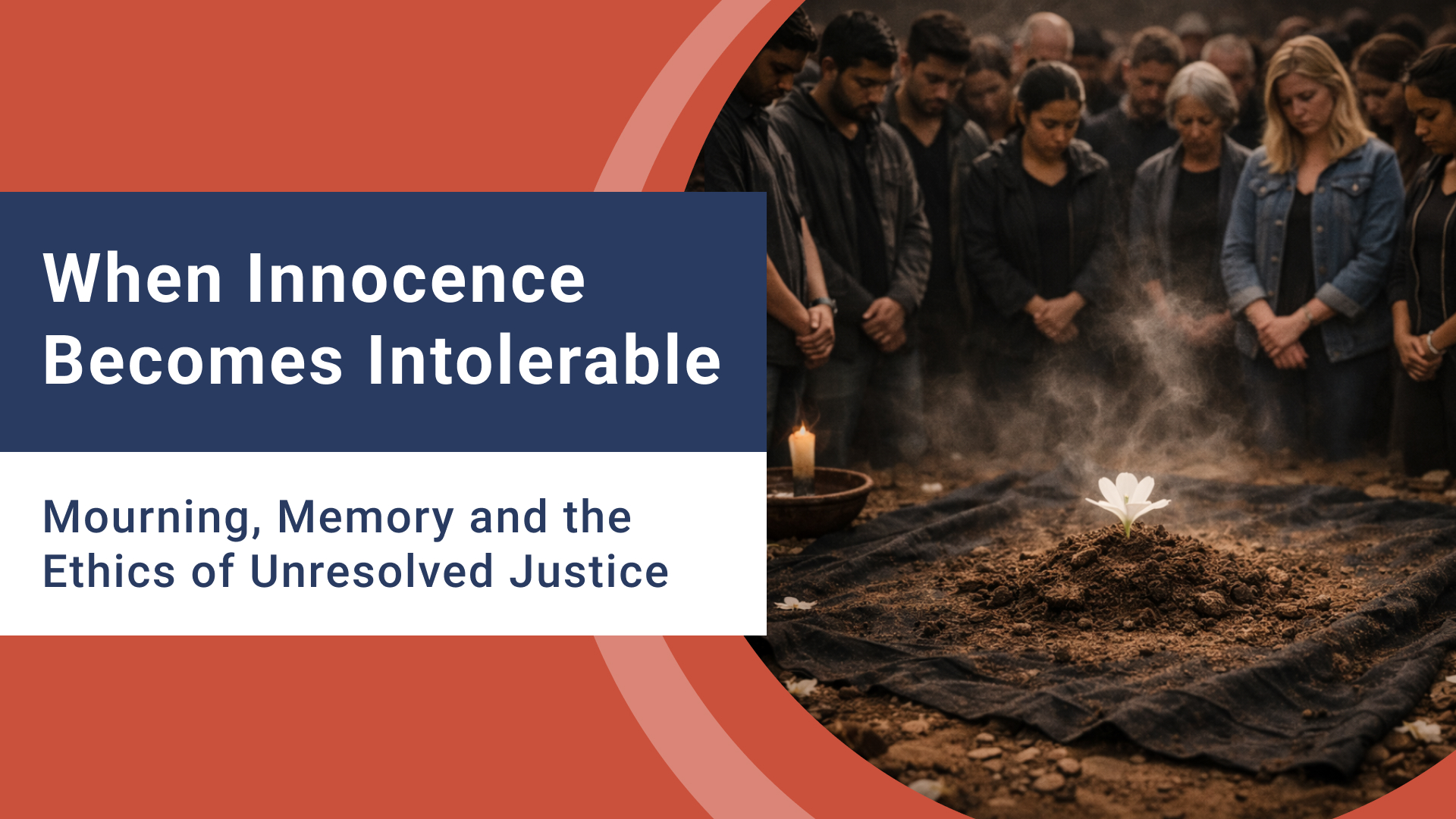

Background – The Persistence of Certain Griefs
Some deaths conclude. They are marked, mourned, archived, and eventually folded into the past. Time does what time does best. It dulls the edges, replaces faces, restores continuity.
Other deaths refuse this fate.
They linger not because they were spectacular, but because they were wrong in a way that was never addressed. They remain present not as memories, but as unfinished moral sentences. These deaths do not age. They wait.
Every society carries such griefs, though not every society knows how to speak about them. They appear when innocence is lost in full view, when the facts are known, when no confusion remains, and yet nothing is repaired. When truth is established but justice does not follow, grief ceases to be personal. It becomes structural.
What persists in these moments is not outrage, nor even anger. Those burn too quickly. What persists is a quieter weight. The knowledge that something essential was violated and then normalised. That a life, often young, often unformed, often still becoming, was taken not because it posed a threat, but because it exposed one.
Across cultures and eras, there is a recurring figure who embodies this rupture. Not the rebel. Not the agitator. Not the one who seeks power. Rather, the one whose innocence is lucid rather than naive. The one who does not challenge authority directly, yet unsettles it simply by existing. The one whose presence becomes intolerable to systems that rely on evasion rather than accountability.
Such figures are rarely remembered for what they did. They are remembered for what their death revealed.
In some cultures, this revelation is absorbed, rationalised, and eventually forgotten. In others, it transforms into something more enduring. A sustained mourning that outlives the event itself. Not an act of protest, but an act of memory. Not a call for vengeance, but a refusal to grant moral closure where none was earned.
This form of mourning does not shout. It does not assemble. It does not require permission. It survives in names spoken softly, in stories retold without embellishment, in the quiet transmission of a shared understanding that something irreversible occurred and that the world failed to repair itself afterward.
To understand such mourning is not to study grief as emotion, but as ethical continuity. It is to recognise that when justice fails publicly and irreversibly, memory becomes the last remaining site of responsibility.
Some societies give this moment a name. Others live inside it without ever finding the words.
When Truth Is Proven but Justice Does Not Follow
There is a moment that appears deceptively simple. An accusation is made. Evidence is examined. A test is applied. The result is clear. Innocence is no longer in question. Nothing remains unresolved at the level of facts.
In many moral imaginations, this is where the story should end. Truth, once established, is expected to realign the world. Wrong is corrected. Order is restored. The system demonstrates its capacity for fairness and moves on.
Yet history suggests otherwise.
Again and again, societies encounter situations in which truth is not denied, but justice is quietly deferred. The innocent are cleared, yet nothing around them changes. No responsibility is assumed. No structure is questioned. No repair is undertaken. What was revealed is acknowledged, and then carefully set aside.
This is not confusion. It is not ignorance. It is not the absence of information. It is something more difficult to name. A form of moral paralysis that arises when acting on the truth would require a system to indict itself.
In such moments, the problem is no longer the lie. The lie has already failed. The problem becomes the implication of the truth. To take it seriously would mean recognising complicity, exposing weakness, or admitting that harm was not accidental but enabled. For systems invested in their own continuity, this cost is often deemed too high.
The result is a peculiar suspension. The innocent remain innocent, but unprotected. Their vindication is acknowledged, yet stripped of consequence. They are neither punished nor restored. They are left visible, exposed, and unresolved.
It is here that injustice takes on its most elusive form. Not as overt cruelty, but as refusal. Refusal to follow truth to its ethical conclusion. Refusal to allow clarity to demand change. Refusal to accept that knowledge carries obligation.
This is the threshold at which innocence becomes dangerous. Not because it threatens power through opposition, but because it demands comparison. It forces the system to see itself reflected in what it failed to protect.
When justice does not follow truth, a choice has already been made. It is simply not announced.
A Culture That Chose to Name This Moment
Not every society allows such moments to fade. Some refuse to let the gap between truth and justice dissolve into abstraction. They do not resolve it, but they mark it. They give it form. They hold it in language, story, and memory so that it cannot be mistaken for an accident or dismissed as an anomaly.
In the Persian cultural imagination, this moment was not left unnamed.
The figure through whom it is remembered is not celebrated as a conqueror or a victor. He does not found cities or rewrite laws. He is remembered for his clarity and for the quiet precision of his innocence. His defining feature is not what he achieves, but what he endures once his innocence is no longer in doubt.
The story is spare in its essentials. A young figure is accused. A trial is imposed. A public test establishes his purity beyond question. There is no ambiguity left to interpret, no uncertainty to negotiate. Truth is rendered visible.
And yet the world does not recalibrate around it.
Those responsible for judgment do not act on what has been revealed. The accusation is neutralised, but the conditions that allowed it remain intact. No reckoning follows. No responsibility is absorbed. The system stands unchanged, now fully aware of what it has chosen not to correct.
What follows is not punishment, but removal. The innocent is displaced, not because guilt has been proven, but because his continued presence is no longer tolerable. He becomes a living reminder of a failure that cannot be acknowledged. His existence holds a mirror that the order around him refuses to face.
In naming this figure and preserving his story, the culture does not offer resolution. It offers recognition. It acknowledges that there are moments when truth survives but justice does not, and that such moments cannot be allowed to pass without leaving a trace.
This act of naming is not an attempt to immortalise a hero. It is an attempt to stabilise a moral rupture. To ensure that the distance between what was known and what was done does not disappear into the ordinary flow of time.
By giving this moment a name, the culture refuses to let innocence be erased by procedural silence. It insists that the failure itself be remembered.
From Story to Mourning
Every story, no matter how enduring, eventually reaches its conclusion. Events resolve, characters disappear, and narrative time moves forward. What remains after that point is no longer story, but memory.
In this case, memory does not settle. It does not soften into legend or dissolve into metaphor. It becomes mourning.
The mourning that emerges here is not an emotional reaction to loss. It is not confined to ritual or ceremony. It is a sustained response to an unresolved ethical breach. The story may end, but the moral imbalance it reveals does not. Mourning becomes the means by which this imbalance is carried forward rather than concealed.
What is mourned is not only the life that was taken, but the failure that preceded it. The refusal to act when clarity was available. The decision to preserve order at the cost of justice. The quiet choice to remove the innocent rather than confront the conditions that endangered him.
This is why the mourning persists. It does not seek consolation, because consolation would imply closure. It does not seek resolution, because resolution was denied at the moment it mattered. Instead, it holds open the space that was prematurely sealed.
In this sense, mourning functions as an ethical archive. It preserves the knowledge that something was known and yet not done. It resists the erasure that comes when time passes without accountability. It ensures that the failure does not recede into abstraction or become normalised as an unfortunate necessity.
Unlike protest, this form of mourning does not aim to disrupt the present. It addresses the future. It carries forward a reminder that the conditions for justice were present and ignored, and that such moments carry consequences that do not expire.
When a society mourns in this way, it is not clinging to the past. It is safeguarding a standard. It is refusing to allow the gap between truth and justice to close without acknowledgement.
Here, mourning is not the opposite of action. It is what remains when action was withheld.
Mourning as Ethical Resistance
Mourning is often misunderstood as passivity. As something that follows action rather than replaces it. As a sign of helplessness in the face of irreversible loss. Yet the kind of mourning that emerges when justice is denied does something far more demanding.
It refuses substitution.
Where systems seek to move on, to replace names with numbers or events with procedures, mourning insists on specificity. It keeps the singular intact. It remembers the face rather than the statistic. It preserves the particular life that should not have been taken, rather than allowing it to dissolve into an abstract category of loss.
This insistence is not loud, but it is unyielding. It does not compete with power. It does not attempt to seize authority or reverse outcomes through force. Instead, it denies the system its most essential requirement. Forgetting.
In moments where innocence is destroyed without consequence, forgetting becomes a form of compliance. It allows violence to be reframed as inevitability, error, or necessity. Mourning interrupts this process by refusing to let time complete the work that justice failed to do.
What gives this mourning its resistant quality is not anger, but clarity. It does not distort the facts. It does not exaggerate harm. It does not mythologise the dead beyond recognition. It holds precisely to what was known and what was not done.
In this way, mourning becomes a moral counterweight to denial. It keeps open the question that power would prefer to close. Not who is guilty, but why innocence was unprotected. Not how events unfolded, but why they were allowed to.
Such mourning often gathers around the young. Around those whose lives were still forming, whose futures were not yet claimed by ambition or ideology. Their deaths carry a particular weight because they reveal a failure that cannot be justified by necessity. They were not obstacles. They were not threats. They were reminders.
To mourn them is to refuse the quiet agreement that allows similar losses to recur. It is to maintain an ethical line when institutional lines have already shifted. It is to say, without accusation and without demand, that something essential has been crossed.
Mourning does not correct injustice. But it prevents injustice from becoming invisible. In contexts where innocence is repeatedly extinguished and explanation replaces accountability, this prevention is not symbolic. It is structural.
Why Innocence Becomes Intolerable
Power is often imagined as fearing opposition. It prepares for resistance, anticipates rebellion, and learns how to suppress defiance. Yet history suggests that what unsettles power most is not hostility, but exposure.
Innocence exposes without accusing. It does not challenge authority directly, yet it destabilises it by comparison. Where guilt can be punished and dissent can be framed as threat, innocence offers no such convenience. It leaves no justification intact.
This is why innocence, once publicly established, becomes dangerous. Not because it disrupts order, but because it clarifies it. It reveals the distance between what a system claims to protect and what it actually allows to be destroyed. It renders visible the gap that rhetoric works so carefully to obscure.
In such circumstances, the continued presence of the innocent becomes intolerable. Not because they act, but because they remain. Their existence insists on an unanswered question. Why was this allowed to happen when it was clear that it should not have?
Removal then appears as resolution. Not always through open punishment, but through displacement, silencing, or erasure. The innocent is separated from the space where comparison is unavoidable. The system regains coherence, not by restoring justice, but by eliminating the mirror.
What is destroyed in this process is not only a life, but a reference point. Without it, the system no longer has to measure itself against what it failed to protect. Normalcy resumes. Procedures continue. Explanations are offered. The absence is absorbed.
This pattern repeats with unsettling consistency. Those who pose no direct threat, who seek no confrontation, who carry no weapon other than their unambiguous presence, are often the ones who pay the highest price. Their deaths are framed as unfortunate, complex, or necessary, precisely because acknowledging their innocence would require acknowledging systemic fault.
In this sense, the destruction of innocence is not an accident. It is a method. A way of restoring equilibrium without accountability. A way of ensuring that the conditions which produced the harm remain intact.
When innocence becomes intolerable, it is not because the innocent have failed. It is because the system cannot afford to see itself clearly.
When Mourning Outlives Power
Power measures itself in duration. It counts years, terms, reigns, and stability. It assumes that what persists is justified by the fact that it persists. What endures, it claims, must in some way be legitimate.
Mourning follows a different logic.
It does not require continuity of rule, coherence of narrative, or even public recognition. It survives in fragments. In gestures repeated quietly. In names spoken where they are not supposed to be. In the transmission of a sensibility rather than a doctrine.
This is why mourning often outlives the structures that produced it. Institutions dissolve, authorities are replaced, official histories are revised. Yet the grief remains, largely unchanged, because what it responds to was never addressed. The conditions that allowed innocence to be extinguished were never dismantled, only rearranged.
Over time, this mourning ceases to belong to a single event. It becomes a pattern. A way of recognising certain moments when a society crossed a line and then stepped back without acknowledgment. It accumulates, not as resentment, but as ethical sediment.
In this accumulation, mourning becomes civilisational rather than political. It does not demand reform, nor does it propose alternatives. It simply remembers where justice failed and refuses to let that failure be erased by progress or rhetoric.
This endurance is unsettling to power precisely because it cannot be negotiated with. It cannot be appeased by concession or neutralised by force. It does not seek victory. It seeks continuity of memory. And memory, once dispersed across generations, no longer has a single point of suppression.
What persists in such mourning is not hope in the conventional sense. It is something quieter and more demanding. The maintenance of a moral threshold. The insistence that certain losses do not expire, no matter how much time passes or how thoroughly they are explained away.
When mourning outlives power, it does not overthrow it. It waits. And in waiting, it preserves the measure by which power will eventually be judged, whether or not that judgment ever takes institutional form.
When Grief Refuses to Belong to One Side
There are conflicts in which grief is claimed as proof. Proof of righteousness. Proof of victimhood. Proof that one side alone carries the moral weight of loss. Yet beneath these claims lies a quieter and more disturbing reality. Grief does not distribute itself according to arguments.
It appears where lives were loved.
Across lines drawn by history, religion, territory, and fear, families bury their dead and are left with the same absence. A child who does not return. A parent whose voice no longer answers. A future abruptly sealed. These losses do not ask who is right before they arrive. They simply arrive.
What differs is not the reality of grief, but its duration and accumulation.
Some communities encounter loss as rupture. A sudden tearing that shatters a sense of safety once assumed. The violence feels unthinkable precisely because it interrupts a life that expected continuity. Mourning, in these moments, carries shock alongside sorrow. The world has revealed a capacity that was believed to be elsewhere.
Other communities encounter loss as inheritance. Grief does not arrive unexpectedly, but is folded into daily life across generations. The dead are not remembered as exceptions, but as part of a long sequence. Here, mourning is quieter, heavier, and often exhausted. Not because the loss is smaller, but because it has never been allowed to conclude.
Both forms of grief are real. Both are devastating. They are not interchangeable, but they are not opposites either. They exist within the same human register of attachment and absence.
What turns these griefs into instruments rather than wounds is the demand that they justify further harm. When mourning is recruited to explain violence, it is no longer allowed to remain what it is. It is converted into permission. The dead are asked to speak for actions they never chose.
Yet grief itself does not ask for this. It does not seek balance sheets or moral arithmetic. It does not calculate proportionality. It asks only to be recognised as loss, not repurposed as rationale.
In prolonged conflict, this distinction collapses. Loss is measured. Suffering is compared. Numbers are used to settle questions that grief was never meant to answer. Over time, entire populations are reduced to roles. Victim. Threat. Collateral. Necessary cost.
What disappears first in this process is the singularity of the dead. What disappears next is the capacity to mourn without immediately being told what that mourning must mean.
The pattern is not one of equal responsibility, but of shared vulnerability to dehumanisation. When grief is denied space to remain grief, it hardens. When it is allowed only if it conforms to a narrative, it curdles. When it is ignored entirely, it accumulates until it no longer resembles sorrow at all.
This is how innocence is lost collectively. Not only through death, but through the gradual erosion of the ability to recognise loss on the other side without feeling that one’s own has been diminished.
The tragedy is not that grief exists on both sides. The tragedy is that it is so rarely allowed to remain human.
When Celebration Is Experienced as Mourning
There are moments when a society gathers to affirm itself. Calendars mark them as occasions of unity, origin, or achievement. Public language frames them as shared milestones, inviting collective participation in remembrance and pride.
Yet not all members of that society arrive at these moments in the same condition.
For some, what is presented as celebration is experienced as reopening. Not because they reject belonging, but because belonging was never extended without loss. What is remembered publicly as beginning is remembered privately as rupture. What is framed as foundation is felt as displacement. What is named as continuity carries an unacknowledged wound.
In these moments, mourning does not oppose celebration. It simply exists alongside it, unrecognised.
Those who mourn are often asked to translate their grief into acceptable forms. To reframe it as history. To contextualise it as necessary. To acknowledge progress as compensation. The invitation is not to remember together, but to remember selectively.
What is denied here is not the past itself, but its unresolved character. The fact that harm was not merely historical, but structural. That it was not concluded by time, but absorbed into the present. That the conditions which produced loss were never fully dismantled, only normalised.
For those carrying this inheritance, the request to celebrate is not neutral. It asks for emotional alignment without ethical repair. It asks for participation without recognition. It asks for closure where none was negotiated.
Mourning in this context becomes quiet and solitary. It is practiced without banners or demands. It does not seek to interrupt public ritual, yet it cannot join it either. It holds a parallel memory that remains incompatible with official narratives of resolution.
This form of mourning is often misread as refusal. As ingratitude. As unwillingness to move forward. What it actually signals is something more precise. The absence of consent to forget.
When a society has not fully reckoned with the losses upon which its present stands, remembrance fractures. Celebration becomes partial. Unity becomes conditional. And mourning persists, not as opposition, but as unfinished responsibility.
Such mourning does not deny the present. It questions whether the present has adequately acknowledged what it inherited.
Until that question is addressed, there will always be those for whom public affirmation is experienced as private grief. Not because they reject the collective, but because the collective has not yet made room for the full truth of its own formation.
When Suppressed Life Breaks Its Containment
There are moments when violence appears suddenly, as if without cause. They are often described as eruptions, breakdowns, or irrational excess. The language used to explain them focuses on disorder, volatility, and loss of control. What this language conceals is duration.
Such moments are rarely sudden.
They emerge after long periods of compression, when life has been narrowed repeatedly and systematically. When autonomy is denied in small, daily ways. When dignity is eroded not through spectacle, but through routine. When speech is permitted only within limits that hollow it out. When choice is offered without consequence. When agency is tolerated only as performance.
Over time, this produces a particular condition. Not rebellion, but entrenchment. Not resistance, but exhaustion. Life continues, but in a diminished register. People adapt. They learn how to endure. They learn how not to expect. They learn how to survive without asking too much of the world.
What is often missed is that this adaptation is not acceptance. It is latency.
When such conditions persist across years and decades, the question is no longer whether pressure will be released, but how. The eventual rupture is not the cause of violence. It is its expression.
When groups who have asked only for dignity, recognition, and the right to appear as themselves are met instead with erasure, the moral structure of restraint begins to collapse. Not because violence becomes justified in the abstract, but because the existing order has already withdrawn its claim to legitimacy. The calculus that once governed behaviour no longer applies.
At this point, violence does not present itself as strategy or ideology. It appears as reaction. A response formed not in deliberation, but in the body. It is not a claim to power, but a refusal of continued negation.
What follows is often described as chaos. Yet from within, it carries a grim coherence. Those who act do not believe they are choosing disorder. They believe order has already failed them. They believe that nothing remains to be preserved in a system that has consistently denied their humanity.
The response of power to such moments is rarely reflective. It seeks restoration, not reckoning. Force is applied not to understand the rupture, but to close it. Lives are taken not because they pose a calibrated threat, but because their collective presence has become intolerable.
This is the point at which the pattern returns to what has already been named. Innocence is no longer individual. It becomes collective. Youth is no longer symbolic. It becomes statistical. And death is no longer an aberration. It becomes administrative.
What is destroyed in these moments is not only life, but the remaining possibility of gradual repair. The accumulated patience of years is answered with finality. The request for dignity is met with elimination. The long denial of autonomy culminates not in dialogue, but in silence imposed at scale.
When this occurs, mourning shifts again. It expands beyond the singular name and becomes collective without losing specificity. It does not absolve violence, but it does not pretend symmetry where none exists. It recognises that reactions formed under sustained deprivation cannot be understood through isolated moral judgment.
Such mourning does not ask whether every action was right. It asks whether the conditions that made all of it possible were ever addressed. It remembers that the line between restraint and rupture is not crossed in a moment, but worn away over time.
When suppression persists long enough, the eventual outburst is treated as proof of inherent disorder. What remains unspoken is that the disorder was cultivated patiently, quietly, and with remarkable consistency.
This too belongs to the same pattern. Truth was visible. Suffering was documented. Dignity was requested in its simplest form. And justice, once again, did not follow.
Keeping the Name Alive
When justice fails, language becomes the last remaining site of care. Not language as argument or declaration, but language as preservation. To keep a name alive is not to turn it into a symbol or a slogan. It is to refuse its disappearance into explanation.
Naming, in this sense, is not commemoration. It is vigilance. It holds a life in view without embellishment, without justification, without transformation into something more convenient. It resists the temptation to convert loss into meaning too quickly. It allows the weight of what was taken to remain unprocessed.
To keep a name alive is also to resist closure. It is to acknowledge that some deaths do not complete a narrative, but interrupt it. That some losses cannot be reconciled with the world as it continues to present itself. Naming preserves this interruption. It prevents the return to normalcy from being seamless.
This practice carries no promise of repair. It does not claim that memory will correct what power refused to address. Its significance lies elsewhere. It ensures that the distance between innocence and its destruction does not collapse into silence.
In cultures where such names persist, the act of remembering becomes an ethical posture rather than a historical exercise. It signals that the community has not accepted the terms under which the loss occurred. That it continues to measure the present against a moment that should not have been allowed to pass as it did.
Perhaps this is why certain names endure long after the structures responsible for their erasure have changed or disappeared. They remain because they mark a threshold that was crossed and never restored. They remind us that survival alone is not the same as justice, and that continuity without reckoning carries its own cost.
To keep the name alive is not to dwell in grief. It is to refuse the moral amnesia that allows the same pattern to repeat, quietly, efficiently, and with increasing ease.
Some lives are taken.
Some truths are proven.
Some injustices are explained.
What remains, when nothing else can be done, is the choice to remember precisely what should not have been allowed to happen.
That choice is not passive.
It is the last form of responsibility available when all others have been denied.