
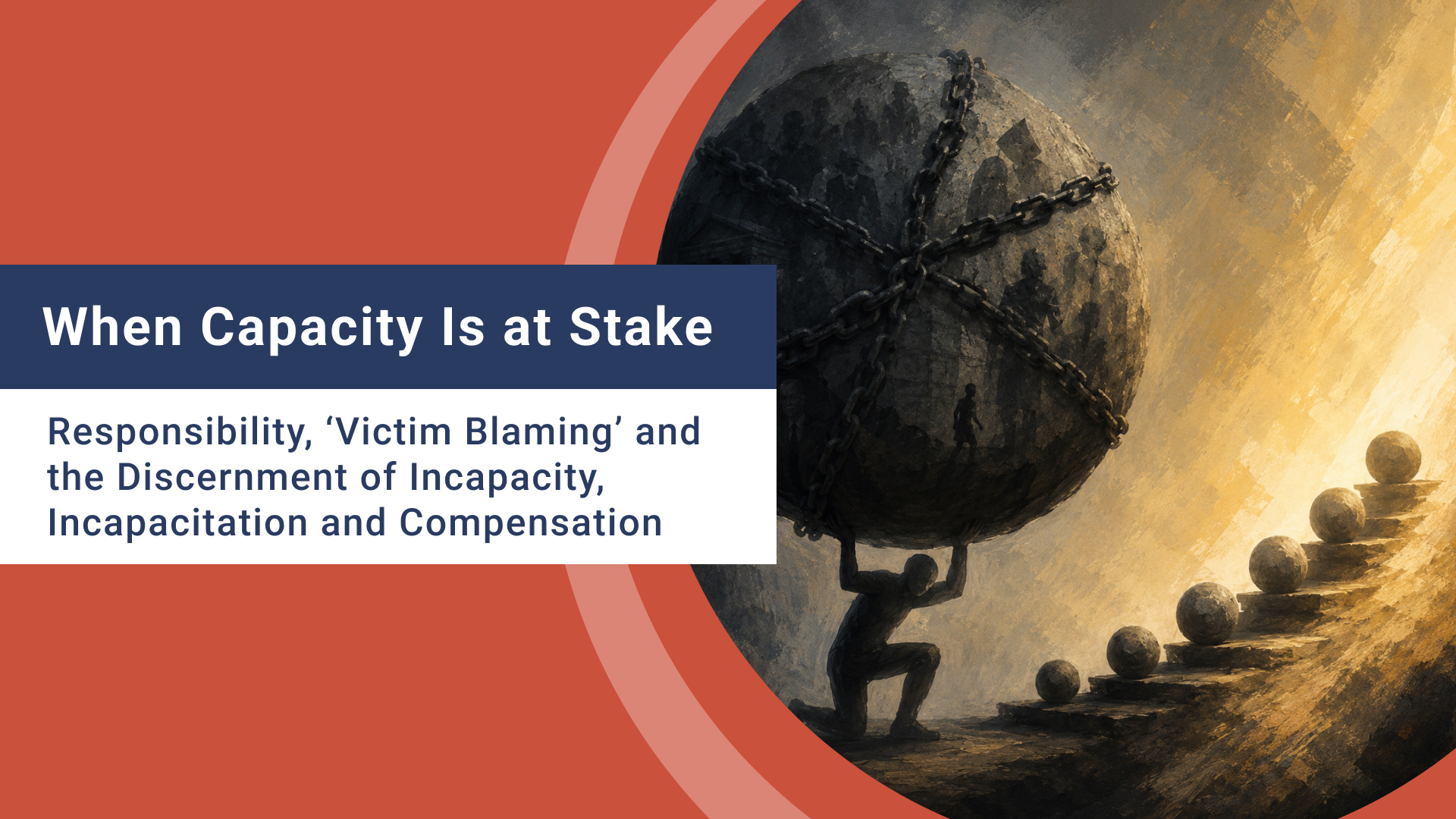

There are few subjects more morally confused than the relationship between victimhood and responsibility. One side says, ‘People must take responsibility’. The other side replies, ‘You are blaming the victim’. Both can be right. Both can also become intellectually lazy, morally sentimental or quietly cruel.
The problem is not responsibility itself. Properly understood, responsibility is one of the conditions of freedom. Without it, human beings remain objects of circumstance, history, trauma, systems, institutions, families, markets, governments or whatever else has arrived with muddy boots and decided to renovate their lives without consent. Responsibility becomes dangerous when it is demanded without discernment. It becomes a slogan thrown at people whose capacity has been damaged, undeveloped or actively crushed.
This is where a capacity discourse becomes necessary. We cannot speak responsibly about responsibility unless we first ask what capacity is present, what capacity is missing, what capacity is being exceeded and what forces may be preventing capacity from being expressed. Otherwise, we collapse very different conditions into the same moral judgement. We tell the abused person to ‘just leave’, the poor community to ‘just work harder’, the traumatised person to ‘just move on’, the colonised people to ‘just govern better’ and the weaker nation to ‘just negotiate responsibly’, while ignoring the conditions under which their agency has been narrowed, threatened or dismantled.
The opposite error is just as destructive. Some people really have been harmed, oppressed, betrayed, abused or overpowered. That must be acknowledged without hesitation. Yet the fact of being victimised does not automatically make victimhood a permanent moral identity, nor does it remove every future responsibility. A wound can be real and still become a throne. A person can be genuinely harmed and still later participate in the continuation of their own diminishment. History may explain the prison, but it does not always justify polishing the bars and calling it home.
The real task is not to choose between compassion and responsibility. The task is discernment. We must learn to distinguish between incapacity, incapacitation, exceeded capacity and the refusal to take up available responsibility. Without that discernment, compassion becomes enabling, responsibility becomes blame and victimhood becomes either denied or worshipped.
Responsibility Is Not Blame
Responsibility is often confused with fault. This is one reason the conversation becomes so clumsy. The moment responsibility is mentioned, many people hear accusation. They hear, ‘This happened because of you’. They hear, ‘You should have known better’. They hear, ‘Your suffering is your own fault’. In many cases, this is exactly how responsibility has been weaponised.
Yet responsibility does not mean blame. Within the Being Framework, responsibility concerns being primary cause in relation to the matter life brings to us, regardless of where that matter came from. It does not require that we caused the original harm. It asks what we can now cause, restore, protect, transform or bring into being in response to what has happened.
Blame looks backward and asks who should be condemned. Responsibility looks towards participation and asks what can now be caused. Blame is preoccupied with fault. Responsibility is concerned with agency, capacity and the possibility of becoming cause again.
This distinction matters because many of the most important responsibilities in life are not connected to things we caused. We may not have caused the family we inherited, the body we were born into, the country we came from, the betrayal we suffered, the violence we encountered, the historical conditions surrounding us or the institutions that shaped our possibilities. Yet these still become part of the matter life brings to us. At some point, the question is not only where it came from. The question is what we can now bring to it.
That question cannot be asked abstractly. It cannot be asked with the enthusiasm of someone giving life advice from a safe distance, usually with a cup of coffee, a podcast microphone and no real consequences. Responsibility must be asked in relation to capacity. Otherwise, it becomes a moral demand placed upon people who may not yet have, or may not currently be allowed to exercise, the capacity required to respond.
Capacity, Incapacity and Incapacitation
Capacity concerns what a participant is able to bring to participation. This includes emotional regulation, courage, discernment, bodily safety, practical skill, access to resources, relational support, moral clarity, social standing, institutional access and the ability to act without being destroyed by the consequences. Capacity is never merely an inner attitude. It is not a motivational poster trapped inside the nervous system. It is a real condition of participation.
Incapacity concerns the gap between what participation requires and what the participant can presently bring. Life may require courage, but the person has not yet developed it. A situation may require discernment, but the person is still captured by confusion, fear or dependency. A role may require leadership, but the person lacks the necessary stability, skill or sense-making. In such cases, the issue is not necessarily fault. It is a developmental gap.
Incapacitation is different. Here the person, group or nation is not merely lacking capacity. Their capacity is being blocked, suppressed, eroded or overwhelmed by an external force. This may happen through coercive control, violence, domination, economic dependency, institutional exclusion, occupation, manipulation, humiliation or systems that continually weaken the very capacities they then condemn people for lacking.
The distinction is simple but load-bearing. Incapacity means the required capacity has not yet been built. Incapacitation means the capacity that could be built or expressed is being actively restricted, crushed or overridden. One calls primarily for development. The other calls first for protection, intervention, justice or the removal of the incapacitating force.
If we fail to make this distinction, we will misread the human condition. We will treat the undeveloped as guilty, the dominated as lazy, the traumatised as irrational, the abused as foolish and the historically weakened as morally defective. We will also make the opposite mistake, treating every failure of responsibility as evidence of oppression and every refusal to grow as proof that someone has been harmed. Both errors destroy discernment.
When Capacity Is Exceeded
Another condition must be named. Sometimes a person, group, institution or nation is not simply incapable, nor are they always being directly incapacitated by an obvious external force. Sometimes the demand placed upon them exceeds their current capacity. The situation requires more discernment, courage, truthfulness, emotional regulation, strategic intelligence, moral strength or relational maturity than they can presently bring.
When this happens, human beings rarely say, ‘This exceeds my current capacity’. That would already require a fairly developed capacity for truth. More often, compensatory mechanisms appear. These mechanisms are not always conscious. They are attempts to reduce the pressure of reality when reality has become too large, too complex or too threatening for the current level of Being.
One common compensation is oversimplification. When people cannot hold complexity, they reduce the situation into something small enough to manage. A difficult marriage becomes ‘he is the problem’ or ‘she is crazy’. A geopolitical crisis becomes ‘good people versus bad people’. A social problem becomes ‘just work harder’ or ‘the system is entirely to blame’. Oversimplification gives temporary relief because it shrinks reality to fit existing capacity. The cost is that truth is sacrificed for manageability.
Another compensation is denial. If the situation cannot be metabolised, it may simply be refused. The person denies the abuse, the failure, the corruption, the dependency, the danger, the wound or the responsibility now required. Denial is not always stupidity. Often it is the psyche protecting itself from a reality it does not yet have the capacity to face. What protects in the short term can imprison in the long term.
A third compensation is projection, especially in the form of blame and finger-pointing. When people cannot bear their own incapacity, fear, shame or responsibility, they locate the whole matter elsewhere. Everything becomes the fault of the partner, the parent, the government, the foreign power, the market, the institution, the younger generation, the older generation or some conveniently available villain. Projection allows the person to preserve a sense of innocence while avoiding the painful work of participation.
This is where victim blaming and victimhood mentality can secretly mirror each other. The victim blamer projects responsibility onto the harmed person so they do not have to confront the incapacitating forces at play. The person trapped in victimhood may project all responsibility outward so they do not have to confront the next available step of their own development. In both cases, projection protects someone from a reality that exceeds their capacity.
Another compensation is manipulation. When direct, truthful participation feels impossible, people may attempt to control the field indirectly. They manage impressions, distort information, mobilise sympathy, exaggerate helplessness, provoke guilt, weaponise moral language or frame the situation in ways that secure advantage without requiring transformation. Manipulation often emerges where responsibility is too threatening and honesty is too costly.
These compensatory mechanisms matter because they show us that incapacity is rarely passive. When capacity is exceeded, people do not merely fail to respond. They often generate substitute responses. They simplify, deny, blame, control, perform, moralise or manipulate. These responses may reduce immediate pressure, but they also prevent capacity from expanding. They make the person feel safer while keeping them less free.
The reconstructive task is not to shame people for compensating. Most human beings compensate when they reach the edge of their development. The task is to help them tell the truth about the compensation, identify the capacity that is missing and begin building it. Oversimplification must give way to discernment. Denial must give way to contact with reality. Projection must give way to responsibility. Manipulation must give way to truthful participation.
When Responsibility Becomes Victim Blaming
Responsibility becomes victim blaming when it ignores incapacity, incapacitation or exceeded capacity. This is especially dangerous when the person making the demand has more safety, power, distance or capacity than the person being judged. From the outside, life often looks simpler than it is. The observer sees an obvious solution because they do not have to pay the cost of attempting it.
Domestic violence is one of the clearest examples. From the outside, people ask why the person stays, returns, minimises, defends the abuser, delays action or struggles to leave. These questions are not always malicious. Sometimes they arise from genuine confusion. But when asked without understanding coercive control, fear, financial dependence, shame, isolation, children’s safety, legal uncertainty, threats and the risk of escalation, they become a form of disguised accusation.
In such cases, ‘take responsibility’ can become grotesque if it is reduced to ‘just leave’. The person may indeed need to leave. But the capacity to leave safely may have been systematically eroded. Their access to money may be controlled. Their relationships may have been damaged. Their confidence may have been degraded. Their perception of reality may have been manipulated. Their nervous system may be living in a state of threat. The act that looks simple from the outside may require a whole architecture of restored capacity.
Responsibility cannot be separated from the conditions that make responsible action possible. In situations of coercive control, responsibility may begin long before the visible act of leaving. It may begin in telling the truth to one trusted person, recovering a small measure of reality, documenting what is happening, accessing legal support, securing money, protecting children or rebuilding enough internal steadiness to act without triggering greater danger.
To demand responsibility from the incapacitated without addressing the force that incapacitates them is not wisdom. It is blame with better vocabulary. It allows the observer to preserve a fantasy of moral order, where good people make good choices, bad outcomes reveal bad decisions and suffering can be explained by someone’s failure to behave properly. That fantasy is comforting. It is also often false.
When Victimhood Becomes a Refusal of Responsibility
The rejection of victim blaming must not become the worship of victimhood. A person can be victimised. A group can be harmed. A nation can be invaded, exploited or weakened by external powers. These realities must be named clearly. Denying them is not maturity. It is cowardice with a clean shirt.
Being victimised, however, is not the same as making victimhood the organising principle of one’s identity. Victimhood can become a shelter from responsibility, a source of moral leverage, a way of avoiding development or a justification for remaining incapable. The original harm may not have been chosen. The ongoing refusal to relate responsibly to what is now possible may become a different matter.
This does not make the choice simple. Even the refusal of responsibility can be shaped by incapacity. A traumatised person may not yet have the capacity to imagine life beyond the wound. A community weakened for generations may not immediately possess the institutions, trust or leadership needed for renewal. A person who has been humiliated may cling to grievance because grievance has become their last remaining structure of meaning.
Still, we must be honest. Sometimes victimhood becomes profitable, not always financially, but existentially. It gives the person an explanation, an identity, a moral position and immunity from challenge. Some people do not want healing. They want a permanent diplomatic passport issued by their wound, preferably one that grants priority boarding on every conversation about suffering.
This is where compassion must grow a spine. If responsibility is demanded too early, it becomes blame. If it is never demanded, it becomes abandonment. To leave people permanently organised around their wound is not kindness. It is a subtler form of contempt because it assumes they are incapable of becoming more than what happened to them.
The Discernment of Capacity
The central question is not whether someone is a victim or responsible. Human beings are often both. The deeper question is what configuration of capacity is actually present. What does the situation require? What can the person or group presently bring? What capacity is missing? What capacity is being exceeded? What capacity is being actively suppressed? What responsibility is genuinely available now?
This is why discernment is the key word. Discernment refuses the laziness of moral shortcuts. It does not flatten every case into ‘personal responsibility’, nor does it dissolve every responsibility into victim status. It asks what is true in this situation, at this time, with these forces, these capacities and these consequences.
A serious discernment of capacity must ask what life is demanding from this person, group or nation. It must ask what capacities would be required to meet that demand well, whether those capacities are currently present and whether they can be built through development, support, practice, coaching, education, protection or institutional reform. If the capacities are present, it must also ask whether they are being used. If they are not being used, it must ask what is preventing their expression.
A further question must be asked: what compensatory mechanisms are appearing? When people simplify reality too aggressively, deny what is obvious, project blame onto others, manipulate the emotional field or moralise in place of participating, these may be signs that the situation exceeds their current capacity. The compensation should not be mistaken for the truth of the situation. It is a clue. It tells us where the person or group cannot yet metabolise reality and where capacity must be strengthened.
The most important distinction remains whether the participant is merely lacking capacity or being incapacitated. This distinction changes the ethical response. If someone lacks capacity, the work is development. If someone is being incapacitated, the work is not simply development. The incapacitating force must be named, constrained, removed or transformed. You do not ask someone to develop confidence while someone else is standing on their throat and taking notes for a leadership seminar.
Discernment also requires us to ask what responsibility is actually available. Not theoretically available. Not spiritually available in a slogan. Actually available. A person in immediate danger may have the responsibility to survive and seek safety, not to perform emotional maturity for observers. A group under domination may have the responsibility to preserve coherence and resist disintegration, not to instantly demonstrate the institutional maturity of a peaceful, well-resourced society. A person with enough capacity and support may have the responsibility to stop hiding behind the past and begin rebuilding.
Different Conditions Require Different Responses
When the issue is incapacity, the response is capacity-building. This means development, education, coaching, practice, discipline, truthful feedback, relational support and gradual exposure to greater responsibility. The person is not blamed for lacking capacity, but neither are they frozen in their current limits. They are invited into transformation.
This is the humane middle ground. We can say, ‘You are not guilty for lacking this capacity’, while also saying, ‘This capacity must now be built’. That is not blame. It is respect. It treats the person as someone capable of development rather than as a permanent object of sympathy.
When the issue is incapacitation, the response must begin differently. Protection may be required. Intervention may be required. Justice may be required. The external force that is crushing capacity must be addressed. Otherwise, any talk of transformation becomes theatrical. It asks the person to perform agency under conditions designed to destroy it.
This matters in families, organisations, communities and international relations. An employee cannot simply ‘be more courageous’ in an organisation that punishes truth. A citizen cannot simply ‘participate responsibly’ under a regime that criminalises dissent. A victim of coercive control cannot simply ‘choose freely’ while threats, fear and dependency govern the field of action. Capacity-building becomes real only when the conditions of participation are also reconstructed.
When capacity is exceeded, the response is neither accusation nor indulgence. The compensatory mechanism must be identified, but not worshipped. Oversimplification must be met with better sense-making. Denial must be met with enough safety and truth for reality to be faced. Projection must be met with a return to participation. Manipulation must be met with boundaries, clarity and a demand for more direct responsibility.
When the issue is the refusal of available responsibility, the response is challenge. This is where many compassionate people become nervous because challenge can sound like blame. But challenge is not blame when it is grounded in discernment. If a person has enough capacity, support and safety to take the next responsible step, then endlessly affirming their helplessness becomes damaging.
The same sentence, ‘take responsibility’, can be liberating, useless or abusive depending on whether we are dealing with capacity, incapacity, incapacitation or exceeded capacity. In one context, it awakens agency. In another, it misunderstands the developmental gap. In another, it becomes cruelty. In another, it fails to see that the person is compensating because reality has exceeded what they can presently hold. The moral quality of the statement depends on the discernment beneath it.
Domestic Violence and the Recovery of Agency
Domestic violence reveals the danger of simplistic responsibility language. A person experiencing coercive control may be judged for failing to act in ways that appear obvious from the outside. But coercive control is not only physical violence. It is often the gradual colonisation of perception, confidence, options, relationships, money and bodily safety. It narrows the person’s world until even ordinary decisions become dangerous.
In such conditions, agency does not usually disappear all at once. It is eroded. The person may still make decisions, but the field of decision has been manipulated. They may still speak, but speech has consequences. They may still leave, but leaving may escalate risk. They may still see the truth, but seeing it clearly may threaten the fragile arrangement by which they have survived.
This does not mean the person has no responsibility. It means responsibility must be located properly. Their first responsibility may be to recover contact with reality. Then to establish safety. Then to seek support. Then to protect children. Then to develop a plan. Then to leave, if leaving is the necessary and safest path. Responsibility is not absent. It is sequenced according to capacity and danger.
The compensatory mechanisms also appear here. A person may deny the seriousness of what is happening because the truth is too terrifying to face all at once. They may oversimplify the situation by saying, ‘It is not that bad’, because the fuller truth would demand action they do not yet have the capacity to take. They may project blame onto themselves because blaming themselves gives them the illusion of control. They may manipulate appearances, not because they are morally corrupt, but because direct truth feels unsafe.
The worst response is to stand outside the situation and moralise from a safe distance. The second worst response is to treat the person as permanently helpless. A reconstructive response does neither. It acknowledges the incapacitating force, recognises the compensatory responses, protects against danger and supports the gradual recovery of agency. It does not blame the person for being trapped, but it also does not mistake entrapment for their final identity.
International Relations and Collective Incapacitation
The same distinction applies at the collective level. Communities, peoples and nations can also have capacity, lack capacity, exceed capacity or be actively incapacitated. This is why the language of responsibility in international relations must be handled with extraordinary care. Powerful actors often describe weaker groups as unstable, corrupt, immature or incapable while ignoring the histories and structures through which their capacity has been undermined.
A nation may be told to govern responsibly after decades of external interference, extraction, sanctions, invasion, imposed borders, proxy conflict or institutional sabotage. A people may be told to demonstrate civility while living under conditions that continually produce humiliation, insecurity and rage. A community may be condemned for dependency after being systematically deprived of the means of self-determination.
None of this means internal responsibility disappears. External incapacitation does not explain everything. Groups can also destroy themselves from within through corruption, poor leadership, ideological possession, tribalism, dependency, resentment and the inability to build trustworthy institutions. The fact that a group has been harmed does not mean every future failure is externally caused.
The reverse is equally true. The fact that responsibility remains necessary does not mean incapacitation can be ignored. A serious analysis must hold both. It must ask what capacity has been damaged from outside, what capacity has failed to develop inside, what reality now exceeds the group’s current level of coherence, what compensatory mechanisms are appearing and what conditions must be reconstructed for meaningful participation to occur.
This is where much political commentary becomes shallow. It either romanticises the weak or excuses the powerful. It either blames oppressed peoples for the consequences of their oppression or treats them as permanently innocent. Neither approach helps. The reconstructive question is more demanding: what would it take for this person, group or nation to become genuinely capable of responsible participation?
The Reconstructive Response
A reconstructive response begins by refusing both cruelty and sentimentality. It does not blame victims for the forces that harmed them. It does not preserve victimhood as a sacred identity. It asks what must be protected, what must be developed, what must be confronted and what must be rebuilt.
Where there is incapacity, we build capacity. This may require education, coaching, practice, discipline, mentoring, institutional design, economic support, emotional development and the restoration of meaning. The aim is not to shame the person for what they cannot yet bring. The aim is to increase what they can bring.
Where there is incapacitation, we address the incapacitating force. This may require boundaries, law, intervention, protection, resistance, reform or the removal of coercive power. The aim is not to pretend the participant is already free. The aim is to create the conditions in which agency can become real again.
Where capacity has been exceeded, we identify the compensatory mechanisms and develop the missing capacities beneath them. The point is not to moralise against denial, projection, oversimplification or manipulation as though we are dealing with demons who accidentally discovered LinkedIn. The point is to understand that these behaviours often emerge where reality exceeds capacity, then to strengthen the person or group enough to relate to reality more truthfully.
Where there is refusal of available responsibility, we challenge. This challenge should not be contemptuous. It should be exact. It should say, ‘This may not have begun with you, but what happens next cannot be surrendered entirely to what happened before’. That is not victim blaming. It is the invitation to become cause again.
This is the heart of the capacity discourse. Responsibility must be understood through capacity. Capacity must be understood in relation to participation. Participation must be understood in relation to the real conditions that either enable, disable or overwhelm human agency. Without this, responsibility becomes moral theatre and compassion becomes a velvet-lined cage.
Becoming Cause Again
The question of victim blaming and responsibility is ultimately a question of freedom. Freedom is not created by blaming the victim. Nor is it created by preserving the victim as victim. Freedom begins when incapacitation is confronted, incapacity is developed, compensatory mechanisms are transformed and responsibility becomes possible again.
To be responsible after harm does not mean pretending the harm did not happen. It does not mean declaring oneself untouched, unbroken or magically sovereign. It means gradually recovering the capacity to participate in life as more than the object of what occurred. It means becoming cause again, not in denial of the wound, but in response to it.
Some people need protection before responsibility can expand. Some need development before responsibility can be meaningfully expected. Some need help to face the compensations they have used to survive realities they could not yet metabolise. Some need challenge because the next available responsibility is already within reach. Discernment is what prevents us from confusing these conditions.
A mature culture would understand this. It would not throw responsibility at the incapacitated and call it strength. It would not freeze people in victimhood and call it compassion. It would not mistake every compensation for wickedness or every grievance for truth. It would protect where protection is needed, develop where capacity is missing, confront where evasion has taken hold and restore the possibility of responsible participation wherever it can be restored.
Responsibility is sacred precisely because it must not be cheaply demanded. It must be discerned. Where there is incapacity, we build. Where there is incapacitation, we protect and intervene. Where capacity is exceeded, we transform the compensatory mechanisms and develop what is missing beneath them. Where there is evasion, we challenge. Where responsibility becomes possible, we invite the person, the group or the nation back into participation, not as a permanent victim, not as a guilty object, but as a participant capable of becoming cause in life again.