

Your last meal
When I was growing up, visiting babushka always began the same way. She lived in the modest brick house my dido had built with my mother, one brick at a time, in the more affordable end of town where many immigrant families were building new lives. Every visit followed a familiar ritual. Three locks. Every time. One. Two. Three. As the final lock turned and the door slowly opened, something always arrived before my grandmother did.
The smell. Sometimes it was apple pie. Sometimes bottled pears. Sometimes herbs drying in the kitchen. Sometimes fresh bread or soup quietly simmering on the stove. I could never see what she had been making, but somehow I already knew it was there. For a few moments it became a game. Could I identify the meal before I turned the corner into the kitchen? The smell arrived first. The menu revealed itself later.
Only years afterwards did I realise those moments had very little to do with food. They were about recognition. Before I saw my grandmother, before I heard her voice or felt her embrace, something inside me already knew where I was.
Our senses have extraordinary memories. Think about biting into a slice of lemon. Even imagining it is often enough to make your mouth water. The body responds before the mind has caught up. Smell works in much the same way. A single aroma can collapse decades, carrying us back to kitchens, family gatherings, childhood holidays or someone we loved before we have consciously remembered any of them.
Let your memory choose for you.
Close your eyes for a moment. Don’t think about what you ate yesterday. Go back further. What food memory arrives first? Is it fresh bread still warm from the oven? Chocolate chip cookies cooling on the bench after school, cinnamon at Christmas or coffee drifting through the house before anyone else was awake? Maybe it was fish and chips wrapped in paper after a day at the beach, fresh seafood eaten on the deck of a fishing boat, your father’s Sunday barbecue, pierogies fried with onions, the first strawberries of summer or the bowl of chicken soup that somehow appeared whenever you were sick because someone who loved you knew exactly what comfort tasted like.
Notice what your memory is doing. It isn’t returning to calories, carbohydrates or protein. It is returning to people, places and moments of care. The meal is almost incidental. What we remember is being welcomed, celebrated, nourished and loved. Food has an extraordinary ability to collapse time. A single smell can carry us back decades before our minds have a chance to remember.
Food and human becoming
For most of human history, meals have done far more than satisfy hunger. They were one of humanity’s oldest forms of human infrastructure. Not the visible infrastructure of roads, bridges or electricity, but the invisible practices that quietly shaped the way human beings became human.
Long before children understand leadership, culture, identity or community, they begin learning them around a table. They discover that someone else is served before they are. They learn to wait, to pass the bread, to welcome guests, to thank the person who prepared the meal and to listen while another person speaks. They celebrate birthdays around cake, mourn loved ones over sandwiches and tea, and slowly come to understand that life is something shared rather than simply consumed.
Meals were where we first learned how to live with one another. Every shared meal quietly rehearsed life together. These rituals rarely announce themselves as education, yet they teach some of life's most enduring lessons. Meals become one of our first classrooms. Recipes become one of our first libraries. Recipes preserve far more than ingredients. Recipes record relationships.
A stained recipe card tucked inside a family cookbook tells us as much about a family as any photograph. The folded corner. The hurried note in the margin: Always make extra. The butter stain that has survived fifty Christmases. The substitution made after a family migrated halfway around the world because one ingredient was no longer available. These are far more than culinary instructions. They are traces of ordinary lives. They preserve care, adaptation, generosity and memory.
We often imagine culture being passed down through stories. Just as often, it is passed across a kitchen counter. When my daughters are older, I doubt they will remember every meal we shared together. But I suspect they will remember that whenever they were sick, magic chicken soup somehow appeared. They will remember waking to the smell of fresh bread baking through the house, sneaking cookie dough before it reached the oven and discovering that care often arrived disguised as dinner. Human infrastructure is rarely noticed while it is working. Meals have always done their best work like that.
Before we built cities
Long before we built cities, universities, corporations or governments, we gathered around meals. Before there were boardrooms, there were tables. Before there were diversity and inclusion strategies, there were feasts. Before leadership became something we studied, it was quietly practised through the ordinary rituals of welcoming guests, sharing bread, passing bowls, telling stories and making room for one more person. Food was never simply consumed. It organised human life.
Anthropologists have long recognised that shared meals are among the oldest and most universal social practices. Across human societies, rituals of gathering, preparing and sharing food appear with remarkable consistency. While the ingredients differ, the underlying pattern is remarkably consistent. Meals mark births and deaths, harvests and holy days, departures and homecomings, treaties and celebrations. Food accompanies almost every significant transition in human life because it has always done more than nourish our bodies. It has helped societies organise themselves.
Even the language remembers. We speak of breaking bread with someone, bringing something for the host, having a seat at the table or sharing a meal. These are not really expressions about eating. They are expressions about relationships. They describe what it means to be welcomed into a family, a friendship, a community or a common purpose.
This meaning may explain why food appears so consistently in our spiritual traditions. Across cultures and religions, meals are rarely rushed. They are blessed, shared and received with gratitude. Whether it is grace before dinner, a karakia before kai, the Jewish Passover Seder, the Muslim iftar during Ramadan, the Christian Eucharist, or the many ways Indigenous peoples give thanks for the gifts of the land, food becomes a reminder that we are sustained through relationships rather than through consumption alone. The food does not require blessing. We do.
The pause before a meal interrupts the illusion of self-sufficiency. It reminds us that no meal arrives without rain, soil, seed, labour, transport, preparation and generosity. Gratitude is not simply good manners; it is one of the ways human beings remember their dependence upon one another and upon the world that sustains them. It is why so many cultures continue to preserve food traditions with such care. They are not merely protecting recipes. They are protecting ways of living. Every culture, sooner or later, discovers the same truth. We do not become human alone.
Place on a plate
Every landscape eventually finds its way onto a plate. Olive groves become oil. Wheat fields become bread. Rice terraces become ritual. Coastlines become seafood. Volcanic soil becomes wine. Long before we understand the history of a place, we taste it. Food is geography made edible.
We often think of geography as something outside ourselves: mountains, rivers, coastlines or borders drawn on maps. Yet geography has always entered our lives in far more intimate ways. We smell it. We taste it. We gather around it. The land becomes cuisine, cuisine becomes culture, and culture quietly shapes identity before we are old enough to notice it happening.
Recipes are one of the ways a place survives. Families leave countries, but recipes travel with them. Ingredients change. Measurements adapt. Local produce replaces what could no longer be found. A Croatian family recipe prepared in New Zealand carries traces of two landscapes at once. A Ukrainian soup cooked in Canada remembers a different winter. The meal changes, but it refuses to forget where it came from. Recipes don’t preserve perfection. They preserve continuity.
I was reminded of this while presenting my research in Horta, in the Azores. During my visit I travelled to the UNESCO-protected vineyards on Pico Island. At first glance, it appeared UNESCO was preserving volcanic stone walls and centuries-old vines. It wasn’t. It was preserving a way of living. The vineyards only made sense because of everything that surrounded them. The harvest. The festival. The long tables. The music. The food. The wine. Children weaving between generations while neighbours greeted one another as they had for centuries. The landscape had become culture. Culture had become memory. Heritage isn’t only preserved in buildings. It is preserved in the ordinary rituals through which communities remember themselves. I’ve noticed the same pattern elsewhere.
A colleague living in Paris insisted we visit her favourite soufflé restaurant. There were no substitutions, no gluten-free reinterpretations or dairy-free alternatives. The restaurant wasn’t asking who I wanted it to become. It was inviting me into a tradition that had been carefully practised long before I arrived. I ate a cheese soufflé for my main, a chocolate soufflé for dessert, and afterwards we wandered to her favourite macaron shop before slipping into what could only be described as a food coma. I remember almost nothing about the meetings that brought me to Paris. I remember every detail of that meal.
The following morning I sat outside a small café with a warm croissant and an excellent coffee, watching Paris wake up. Nobody appeared to be in a hurry. Conversations drifted between tables. People watched one another rather than their phones. Opening a laptop would have felt almost embarrassing. The coffee wasn’t the point. The pause was.
In Croatia, I have often noticed something similar. The drive from Zagreb to my family’s village takes little more than an hour. I’ve commuted in Toronto double that distance daily. But arriving in Zagorje is similar to French choreography. Before anyone asks about the journey, before they ask how you’ve been or whether you’re tired, they ask: “Have you eaten?” Nobody is asking whether you’re hungry. They’re acknowledging you’ve arrived.
If landscapes become meals, it should not be surprising that meals have helped shape the world. History is often told through wars, kings, revolutions and inventions. Yet another story has always been unfolding alongside it. One written through bread, salt, wine, tea, coffee and spices. These ordinary ingredients crossed deserts and oceans, connected continents and quietly reshaped civilisation. Food did not simply travel through the world. It helped build it. Every meal has always depended upon invisible networks of land, labour, trust, trade and relationship. Even the most ordinary dinner is far more connected than it first appears.
For all the influence food has had on history, its greatest work has rarely happened in palaces or ports. It has happened around ordinary tables. A child steals cookie dough while their mother pretends not to notice. Soup arrives when someone is sick. Tea appears after a funeral. A new baby is welcomed with meals delivered in containers that somehow never seem to find their way home. Children set the table. Neighbours bring dessert. These small rituals rarely make history books, yet they have quietly held civilisations together for thousands of years. Every table tells a story. Not simply about food, but about what it means to belong.
Perhaps civilisation has always been built less by extraordinary events than by ordinary meals repeated across generations.
Coffee to go. Seriously?
One of the most remarkable things about modern life is not that we eat differently. We no longer eat together. We eat in cars. We eat standing up. We eat while answering emails. We eat alone in front of screens. Lunch has become something squeezed between meetings rather than a natural pause in the day. Even coffee has become portable, something carried from one appointment to the next in a paper cup, consumed while walking rather than shared while sitting. Efficiency has never been the same as nourishment. I often think back to the café in Paris. I had nothing more pressing to do than enjoy the theatre of the street unfolding around me. Conversation was not an interruption to productivity. It was one of the reasons people gathered in the first place.
The same rhythm appears in different forms around the world. Long lunches remain woven into the fabric of life across parts of France, Spain and Italy. In Croatia, no visit begins without something to eat or drink. In Japan, tiny neighbourhood restaurants become places of quiet ritual, where regulars return not only for the food but for the familiarity of the place and the people within it. The customs differ, yet they point towards the same truth. Meals organise more than hunger. They organise relationships. Much of modern life seems designed to dissolve those moments.
We invest millions in workplace wellbeing, culture and belonging. Then we schedule meetings over lunch, often eat at our desks, remove lunchrooms after hybrid working has made them inefficient, and wonder why relationships feel thinner than they once were. We run engagement surveys. We appoint culture committees. Meanwhile, one of humanity’s oldest technologies for building trust has been quietly disappearing from everyday life. No one decided meals no longer mattered. We just stopped noticing what they had been doing for us all along.
Before work, I’ll often fill the slow cooker and switch it on. While I’m beavering away for the day it quietly transforms a handful of ordinary ingredients into dinner. By the time I finish, the house smells as though someone has spent the entire afternoon caring for the meal. I love that. The technology hasn't replaced the ritual. In many ways, it has helped preserve it. But sitting alongside the slow cooker are air fryers, high-speed blenders and meal delivery apps promising dinner in minutes. Speed has become one of our highest values, even in the spaces that once invited us to slow down.
Technology isn’t the problem. The more interesting question is what happens if, in making meals faster, we lose the conversations, pauses and rituals they once created. In saving time, have we forgotten what the time was for in the first place?
Remembering what meals were for
We often imagine that culture lives in museums, monuments and historic buildings. Much of it lives in kitchens too. It lives in recipes folded into drawers and handwritten notes tucked inside family cookbooks. It lives in the smell of bread drifting through the house on a winter morning, in the soup that arrives when someone is sick, in the birthday cake that appears every year without anyone questioning why, and in the enduring rituals that become so familiar we almost stop seeing them.
In my Croatian family, visitors are still welcomed in much the same way they were when I was five years old. Before the luggage comes inside or you talk about the journey, the age old question arrives: “Have you eaten?” It’s never really been a question, but an invitation. Their way of saying, “You belong here.” I wonder what we lose when these invitations become less common.
Most of us will prepare dinner tonight without giving any of this a second thought. We’ll chop vegetables, set the table, pour a drink, pass the bread, clear the plates and wash up. Tomorrow we’ll probably do it all again. Ordinary things. Yet perhaps they have never been ordinary at all.
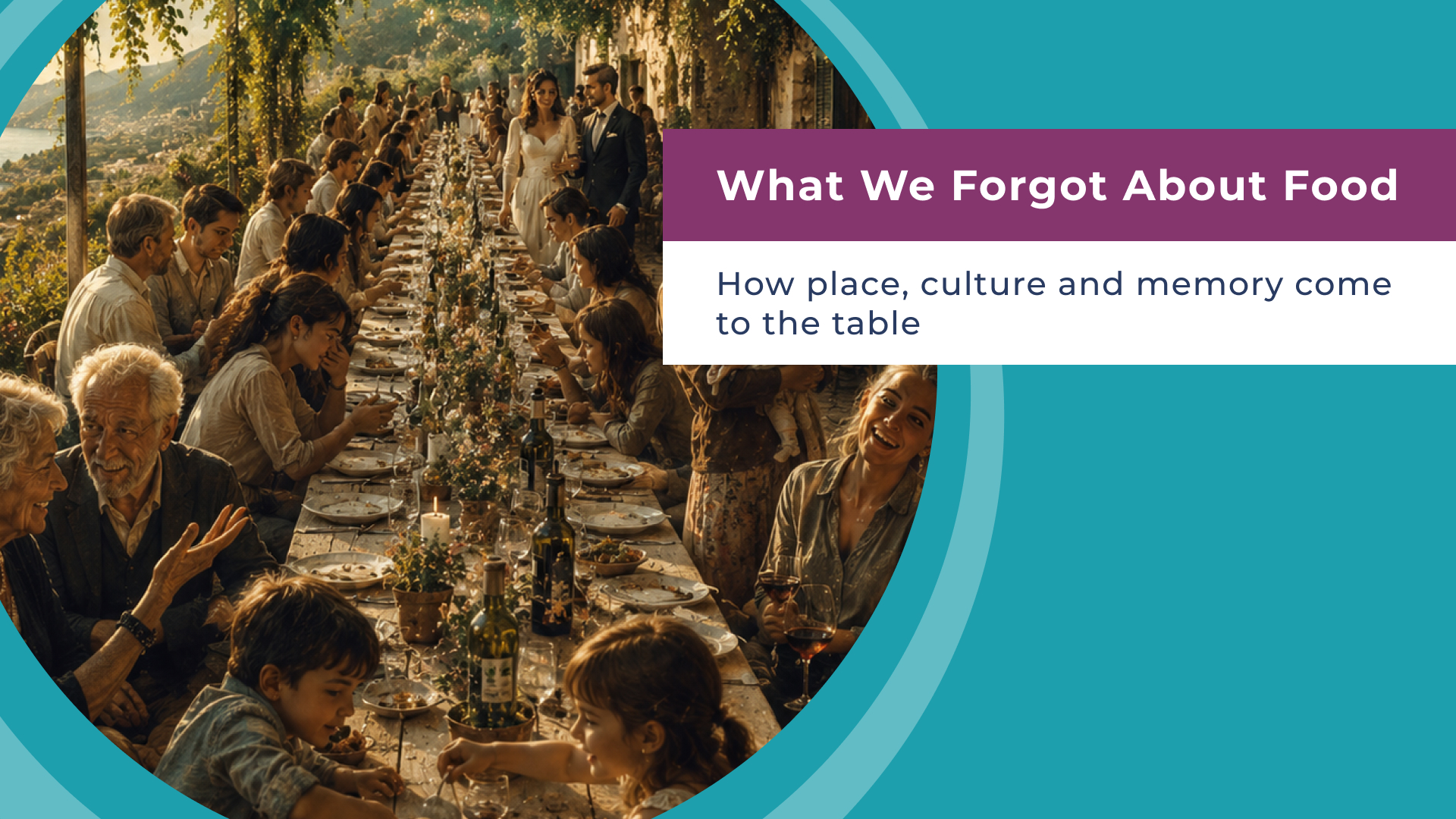
Every meal is far more crowded than it first appears. At first glance there may be four people sitting around the table. Look more closely. Grandparents are there. Migration stories. Harvest. Trade routes. Recipes. Faith traditions. Generations. Farmers and fishers. Bakers and neighbours. Vineyards and wheat fields. Celebrations and losses. Places that shaped us. People who loved us. Cultures that quietly taught us what it meant to welcome, share, give thanks and make room for one more.
Around every meal sit not only the people we can see, but also the countless lives, places and relationships that made the meal, and us, possible. Maybe we didn’t forget how to eat. Perhaps we simply forgot what meals were for.
Dr Jordan Marijana Alexander explores how identity, place, culture, and human systems shape participation in work, leadership, and contemporary life. She is the co-founder of RelateAble.Global. If this article has raised questions, sparked reflection, or highlighted something you're navigating as a leader or in your personal life, you're invited to book a conversation to explore it further. You can follow DrJMA on LinkedIn and Engenesis for ongoing insights, research, and practical resources.