
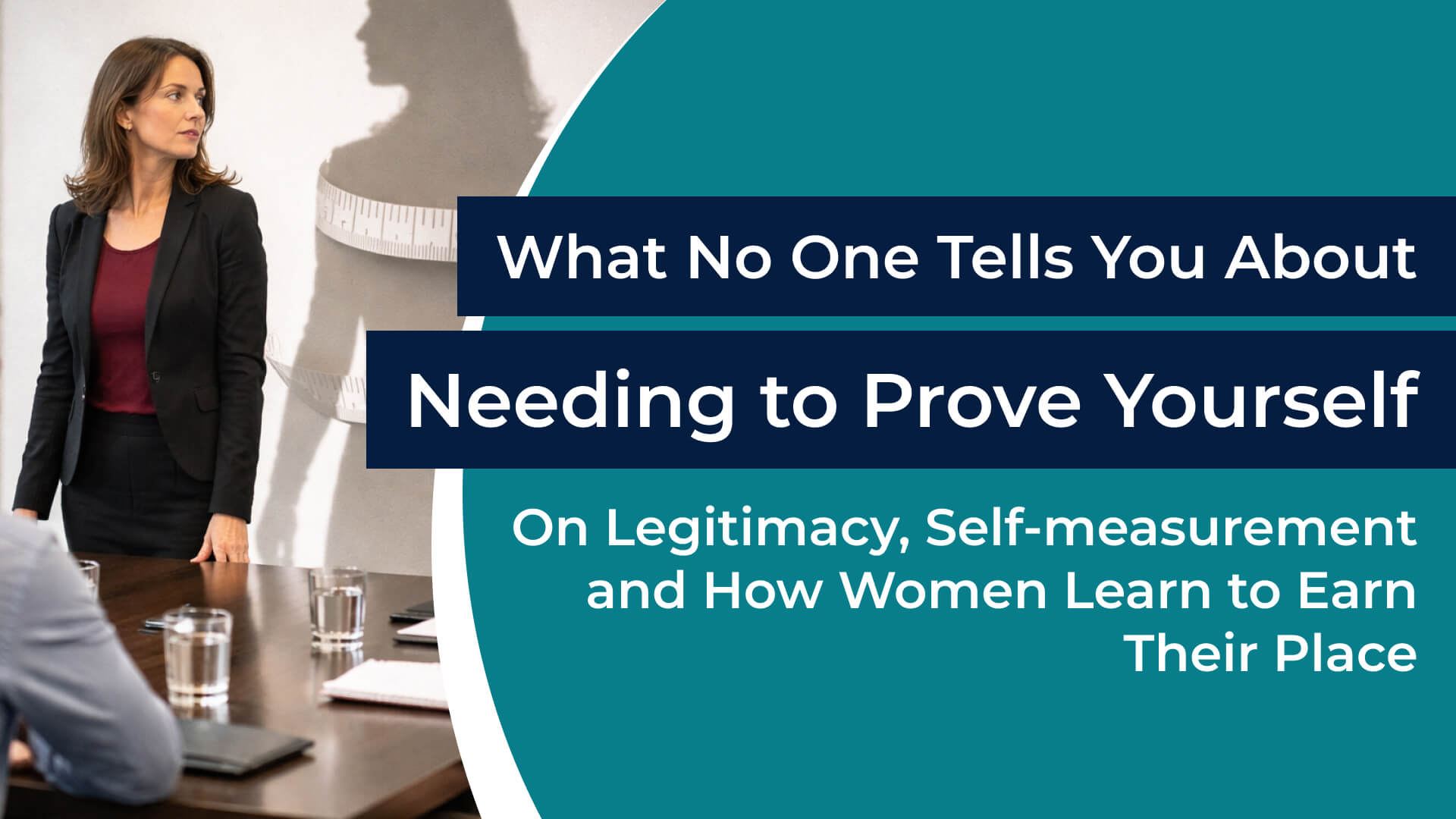

“Am I still allowed to be here as I am, in this role, at this level, in this moment?”
Many women who lead carry this question quietly, even after years of experience, contribution, and success.
It shows up like this: before speaking, you check yourself. You wonder whether what you’re about to say will make you look competent or difficult. You think about how it will land. You adjust your words. You explain more than you need to. You soften what you really mean. You make sure you sound reasonable, helpful, and safe.
Not because you don’t know what you’re doing.
But because somewhere inside, you’re still making sure you’re allowed to be there.
This is what it looks like to earn your place instead of occupying it.
When you don’t hold yourself as legitimate, leadership turns into performance. You don’t speak from “this is what I see.” You speak from “will this cost me?” You don’t act from authority. You act from approval. Your energy goes into staying acceptable rather than standing where you already are.
Legitimacy, in this article, means something very simple: believing you have the right to be in the room, to speak, to influence, and to take up space without having to prove it again. When that belief is missing, everything becomes careful. Tone is managed. Impact is calculated. Confidence is second-guessed.
Drawing on her work with women in leadership and organisational contexts, Jeanette Mundy examines how this quiet pressure to earn your place becomes normalised, how women end up carrying responsibility through self-editing and restraint, and why the cost is a slow loss of voice, choice, and leadership range. The article points toward a different way of holding authority, one that does not come from proving, but from recognising that you were already allowed to be here.
Background – Social Norms of Legitimacy and Belonging
Across my work with women in leadership, organisations, families, and communities, I see the same pattern repeat.
Highly capable women often reach a point where they no longer feel securely inside the spaces they once belonged to. Not because they lack skill, contribution, or credibility, but because something about how they are now showing up no longer fits the expectations that previously kept them included.
The question that begins to surface is simple and unsettling:
“Do I still belong here as I am?”
This is not a question about entry. It arises after a woman has already earned trust, carried responsibility, and been relied upon. She has history in the space. She has proven herself. And yet, as she grows more confident, more direct, and less willing to soften herself for others, she starts to feel the edges of belonging tighten.
What changes is not her competence.
What changes is how safely she fits.
As she begins to lead from a place of internal legitimacy, rather than relational adjustment, the environment responds. Often quietly. Through tone. Through feedback. Through subtle distancing. Through a sense that she is now slightly out of step with what is expected.
She may still be present, still performing, still contributing. But internally, she feels different. Less included. Less buffered by goodwill. More exposed.
This is where many women begin to feel like outsiders in spaces they once called home.
Most women have learned that belonging is not neutral. It comes with conditions. You are expected to be agreeable, considerate, emotionally steady, and easy to be around. These expectations are not usually spoken, but they are deeply felt and strongly reinforced.
That learning follows women everywhere. Into friendships, families, workplaces, leadership roles, and communities. It shapes how they speak, how they disagree, how visible they allow themselves to be, and how much of their authority they feel permitted to occupy.
Belonging is taught through response. Through what is welcomed. What is rewarded? What creates discomfort? What quietly costs standing.
From this, many women learn that authority must be carefully managed if they want to remain included. They learn to read the room before they speak. They learn to soften clarity. They learn to adjust tone and timing so they do not disrupt the relational order they depend on.
These adjustments are not dramatic. They are practical. They keep relationships intact and situations smooth. And because they work, they are reinforced.
Over time, self-editing comes to feel responsible. Carefulness looks like maturity. Adaptability is praised as professionalism.
Women who do this well are often trusted and relied upon. They are seen as capable, reasonable, and safe. But legitimacy is maintained through ongoing adjustment, not through standing fully in who they are.
This learning is rarely taught directly. No one explains it out loud. It is absorbed through repeated experience, through subtle corrections and quiet consequences.
The cost becomes visible later.
When a woman begins to hold herself as legitimate from the inside, rather than earning that legitimacy through accommodation, she often pays for it relationally. She may lose ease. She may lose approval. She may lose the sense of being effortlessly included.
This is why leading from legitimacy can feel lonely.
Not because she is wrong.
But because she is no longer organising herself around what keeps others comfortable.
This background matters because it explains why many women hesitate at this threshold. The cost of standing fully in one’s authority is not usually loss of competence. It is loss of belonging.
And that is the tension this article is concerned with.
Introduction – Staying Present When Belonging Is Questioned
When a woman begins to feel that her belonging is no longer secure, the situation usually presents itself as a binary choice. Either she adjusts herself back into what feels acceptable, or she disengages from the space altogether. She may soften again, explain more, or resume carrying what she had begun to put down. Alternatively, she may withdraw, emotionally or physically, and decide that the environment is no longer worth the cost.
Both responses are understandable. Both are familiar. Both reduce immediate discomfort. What is far less visible is a third option, not because it is unrealistic, but because it has rarely been named or supported.
The third option is to remain in the space without returning to self-containment. It is to stay in the role, the relationship, or the environment while holding oneself as legitimate, even as the response around her changes. It does not involve proving, persuading, or correcting others. It involves resisting the pull to adjust oneself back into safety or to step away entirely, and instead staying grounded in who one is becoming.
This option does not guarantee comfort. It does not promise approval. It does not depend on the environment responding well. It requires something quieter and more demanding: the ability to remain connected to oneself when the usual signals of acceptance begin to wobble. It asks whether a woman can allow tension to exist without rushing to smooth it over or escape from it, and whether she can continue to occupy her place without performing for it.
In my work with women across leadership, organisational, and relational contexts, this is the moment that matters most. It is not the moment of achievement or visibility. It is the moment when staying feels harder than leaving, and adapting feels easier than standing. This is where leadership stops being about managing oneself to survive and starts becoming about presence.
Staying in this way is not an act of force. It is not defiance, and it is not endurance. It is the decision to hold oneself as legitimate long enough to see what the environment actually does in response. Some spaces stretch and adapt. Some recalibrate slowly. Others reveal limits that were always there but previously hidden by a woman’s willingness to carry the strain.
That outcome is not hers to manage.
The responsibility here is simpler, and far more exacting. It is to remain with herself, to trust what she sees, and to stay present without shrinking to regain comfort or hardening to protect against loss. This is the option I support women to take when the environment is one they care about, and when the cost of leaving themselves would be greater than the discomfort of staying.
What Happens When She Holds Her Ground
This pattern is sustained by social norms that many women learn and carry everywhere. Expectations about how authority should be expressed. How much certainty is acceptable? How carefully must impact be managed in order to remain included and credible? These norms are rarely spoken, yet they organise behaviour powerfully.
When authority is inhabited clearly and directly, without softening, it often unsettles the relational order others have come to rely on.
For many women, legitimacy has been learned as something that must be maintained through calibration: being liked, being careful, staying relationally approved. Within that framework, authority is tolerated when it is moderated and questioned when it is simply taken up. Leading without apology exposes this distinction through presence alone. She stands where others are still negotiating whether they are allowed to stand at all.
What follows is rarely open opposition. It is organisation.
Her authority activates unresolved tension in those who are still organising legitimacy around approval and carefulness. Without conscious intent, the group moves to restore balance. She is expected to translate more, to carry relational weight, to absorb emotional labour, to demonstrate warmth alongside clarity, and to reassure others that her authority is safe.
These expectations do not arrive as direct demands. They arrive as assumptions.
Clarity is then filtered through a moral lens. Behaviour that would be read as decisive, efficient, or strong elsewhere is reframed as excessive, intimidating, or lacking empathy. This is not conscious hostility. It is norm correction. The environment moves to bring her back into acceptable range.
Direct challenge is replaced with relational signalling. Instead of naming disagreement openly, what appears are tone policing, side conversations, concerns framed as care, and subtle questions about her approach. Legitimacy erodes indirectly, not through confrontation, but through doubt and quiet withdrawal.
The impact does not stop with her.
Her presence reorganises how others organise themselves. Self-editing increases. Softening happens sooner. Clarity is avoided to reduce scrutiny. Instead of expanding the space for authority, the environment tightens, not because she has done something wrong, but because she has stepped outside the shared contract of self-containment.
This points to a deeper structure at work.
Legitimacy is often learned relationally rather than held internally. Authority is mirrored and adjusted, not inhabited. When someone stops earning legitimacy and begins occupying it, the measurement system others are still using is disrupted. The discomfort that follows is less about behaviour than about what that presence makes visible.
This is the moment many feel the pull to leave, to retreat, or to return to a familiar version of themselves.
It is also the moment where staying present becomes an act of leadership.
When Expression Becomes Risky
This pattern becomes most visible in how expression changes under pressure.
Many women are fully capable of being clear, firm, and direct. They can name what matters, set direction, and hold a position while remaining respectful of others. What becomes unstable is not this capacity, but access to it once legitimacy begins to feel uncertain.
When someone is no longer sure they are allowed to stand where they stand, expression starts to swing.
At one end, language softens. Words are qualified. Decisions are delayed. Explanations multiply. Impact is absorbed rather than created. At the other end, there is over-correction. Expression becomes forceful, sharp, or dominating in an attempt to secure ground quickly. Neither reflects centre. Both are responses to doubt.
This swing is not a personality flaw.
It is a regulatory response.
Once clarity has been questioned, moralised, or reframed, when firmness is read as aggression or decisiveness as a character problem, expression becomes risky. Attention shifts away from what is seen toward whether it is safe to say it and whether belonging might be affected.
From there, expression is no longer guided by internal authority.
It is guided by anticipation.
How much is too much?
What might provoke tightening?
Where caution is required.
This is how expression loses steadiness. Not because capacity disappears, but because it is reorganised around safety. What appears instead is oscillation: between holding back and pushing through, between accommodation and force.
The issue is not behavioural.
It is ontological.
When legitimacy is experienced as something that can be lost, expression cannot settle. It moves in response to perceived threat, and authority becomes something to negotiate rather than inhabit.
The Cost of Leading from Hesitancy
When leadership is shaped by hesitancy, the cost is not only reduced impact or fatigue. The deeper cost is authenticity, specifically the alignment between who someone knows herself to be and how she shows up in the world.
Every leader has a persona. Leadership requires one. But when a woman shapes that persona primarily around being acceptable, composed, relational, and responsible, it can slowly drift away from her unique being. The particular clarity, conviction, energy, and way of responding that are actually hers begin to sit in the background.
This does not happen because she is being dishonest or inauthentic by intent. It happens because her expression becomes organised around safety and belonging rather than accuracy. Before speaking or acting, she checks how something will land, what it might cost her relationally, and whether it will preserve her standing. Over time, those checks begin to run ahead of her own perception.
The shift is subtle but significant. She is no longer testing her understanding of a situation against what she genuinely sees and knows. She is testing it against possible reaction. What she expresses is no longer anchored in internal authority, but filtered through what feels permissible.
From the outside, she may still appear competent, thoughtful, and professional. Internally, a split forms. Her self-image and her persona no longer fully align. She begins to doubt her instincts, soften her clarity, and question whether she is allowed to stand where she stands without adjustment.
This is where many women begin to experience themselves as imposters, not because they lack capability, but because they are not fully inhabiting themselves. Others may sense this as well, not as dishonesty, but as hesitation or inconsistency. Trust weakens quietly when expression feels provisional rather than grounded.
Leadership requires more than composure and care. It requires accuracy: a clear relationship with reality and a willingness to express what is genuinely there to be expressed. When legitimacy feels uncertain, that accuracy is compromised. Hesitancy replaces clarity. Expression becomes cautious. Authority is carried carefully rather than inhabited.
The cost of leading from hesitancy is not only personal. It affects relationships, teams, and systems. Clarity is softened. Conviction is delayed. Decisions are shaped by what feels safe to say rather than by what is actually seen.
Over time, it becomes possible to succeed outwardly while losing access to the very qualities that make leadership distinct and trustworthy.
Pressure Exposes How Fragile That Self-control Really Is
When leadership is organised around being responsible, careful, and composed, it depends on constant self-management. Tone is monitored. Impact is anticipated. Expression is shaped by what feels acceptable.
In calm conditions, this can look like maturity and professionalism. Under pressure, it begins to unravel. Presence tightens. Responses become either overly controlled or unexpectedly sharp. Influence drops, not because capability is lost, but because authority was never fully owned from the inside.
What many women experience in these moments is not a failure of leadership, but the limit of holding themselves together through control rather than through an internally held sense of legitimacy.
What has been labelled responsibility is often self-containment. What has been praised as composure is often effort. And under pressure, effort collapses.
Summary: Legitimacy, Choice, and Leadership
Legitimacy means believing, deep down, that you are allowed to be here.
That you are allowed to speak.
That you are allowed to have ideas.
That you are allowed to take up space.
That you do not have to earn your right to exist in the room.
It means knowing that you matter before anyone agrees with you.
Imagine standing in a classroom.
When you feel legitimate, you put your hand up when you know something. You speak in your normal voice. You do not rush or apologise for talking. You do not scan the room first to check whether it is okay to speak. You might still feel nervous, but you know you are allowed to be there.
When you do not feel legitimate, something else happens.
Before you speak, questions run through your mind. What if I am wrong? What if I sound silly? What if someone does not like this? Maybe someone else should go first. So you soften your words. You apologise even when you have done nothing wrong. You wait longer than you need to. You make yourself smaller so no one gets uncomfortable. Not because you lack ideas, but because you are not sure you are allowed to use them.
This is why legitimacy matters.
When you believe you are allowed to be here, your choices are freer. Your voice is clearer. Your body is steadier. You do not disappear to keep other people comfortable.
When you do not believe that, your choices shrink. Your voice quietens. You begin shaping yourself around other people instead of standing as yourself.
And this is the most important part.
Legitimacy is not something grown-ups give you. It is not something you earn by being good, helpful, or agreeable. It is not something you lose when someone disagrees with you. You are legitimate because you are alive, because you are here, and because you have a mind, a body, and a point of view.
So when we say, “Legitimacy shapes how freely a person can exercise authority and choice within a space,” what it really means is this: when you know you belong, you can choose. When you are not sure you belong, you spend your energy trying to fit.
That difference changes everything.
If this article stirred something familiar, you might begin by noticing where you are still earning your place without realising it. Not to change it yet, just to see it. You may also want to read When a Woman’s Strength Becomes Her Armour, which explores how self-protection quietly shapes leadership long before behaviour changes. And if you find yourself at that third option this article names, wanting to stay present without shrinking or leaving, this is the work we support women to do at Relateable Global. Not to fix themselves, but to remain with who they are as they lead, choose, and stand more freely.