
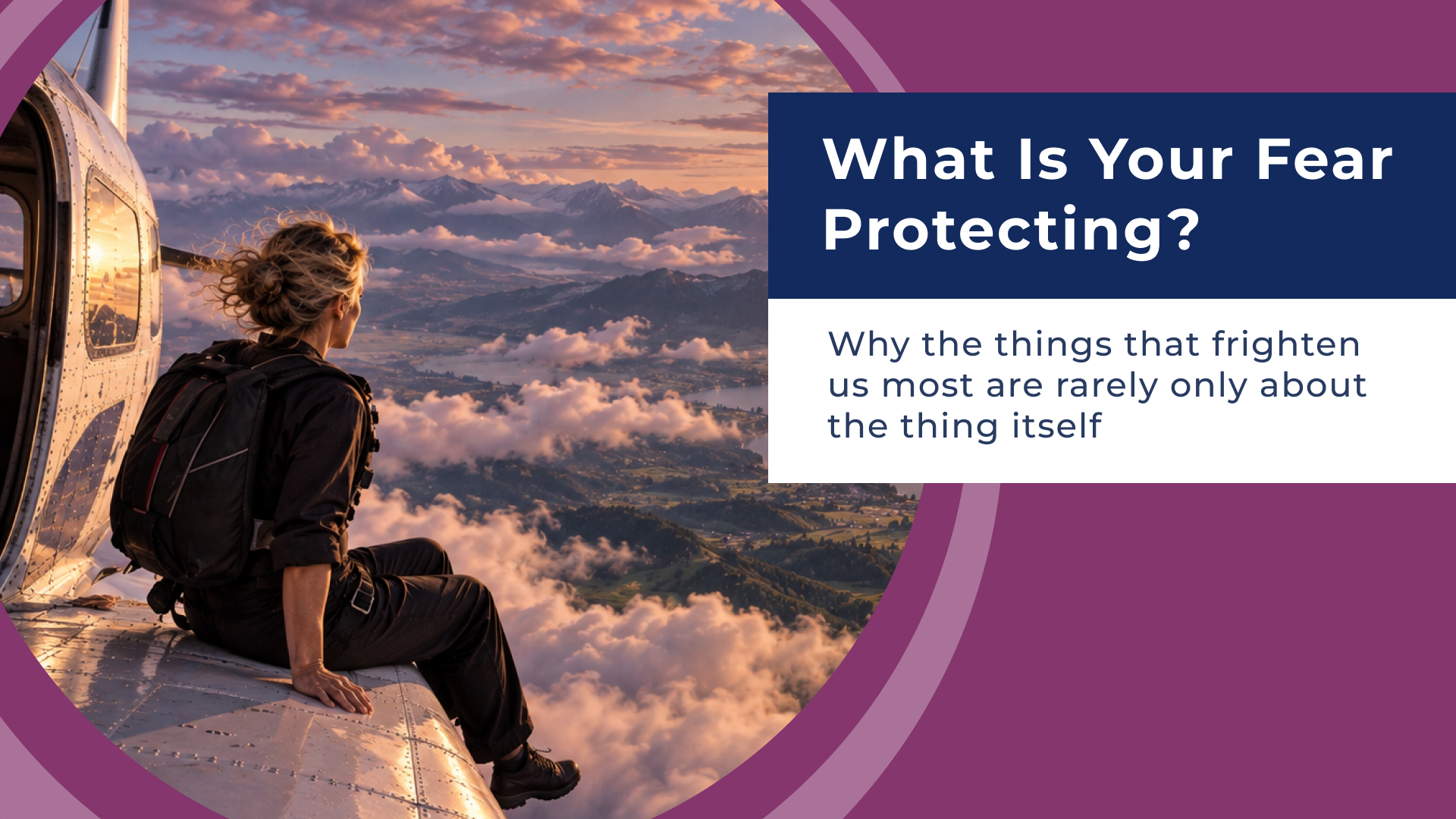

The peculiar intelligence of fear
Think of a time you were really scared. Not necessarily a moment when you were in physical danger, but one when you could feel fear in your body: the racing heart, the churning stomach, the sudden desire to find an excellent reason not to do whatever came next. What was happening? Now think of something quite different. What is something other people consider brave that barely frightens you at all? The gap between those two answers interests me.
I have thrown myself out of an airplane. There was a parachute involved, admittedly, but still: I stood at altitude, looked down at a perfectly serviceable patch of earth thousands of feet below me and voluntarily left the aircraft. When I was studying in Windsor, Ontario, I used to cross the border into Detroit for night classes. The advice I was given for driving through certain parts of the city was startlingly pragmatic. At a red light, slow down, check the intersection is clear and, if it is, proceed. Don’t sit there waiting. Apparently, I could live with that too.
I’ve travelled alone through unfamiliar countries, walked into rooms where I was the youngest and least experienced person at the table, and accepted jobs I wasn’t entirely certain I knew how to do yet. And yet I can get nervous parking my truck. A book launch can make my stomach flip. Some of the promotions I wanted most frightened me considerably more than staying in roles I had already outgrown.
You may have your own version of this. You can handle the crisis but dread the conversation. You can stand in front of hundreds of people but hesitate to show one person something you’ve created. You can carry considerable responsibility at work and still feel your body react to an email you know you need to send. Things other people consider brave may barely register, while an apparently ordinary moment can have your mind constructing extraordinarily persuasive reasons not to proceed.
Fear has a strange relationship with objective danger, which makes me curious about what it is actually responding to. Fear, of course, has an important job. It alerts us to perceived danger and helps keep us alive. Ashkan Tashvir makes a useful distinction in Human Being: fear has an object, while anxiety is more anticipatory, associated with uncertainty, perceived risk and what might happen in a future we cannot yet know. More interesting to me is the proposition underneath that distinction. The issue is not whether fear exists, but our relationship with it. Can we recognise what it is alerting us to and still make an appropriate judgement, or does fear begin making our choices for us?
It becomes particularly interesting when the apparent object isn’t very dangerous. At a book launch, nobody is trying to hurt me. Quite the opposite. People have presumably come because they care about me, the work, or hopefully both. Yet something is undeniably exposed. I wrote this. These words are mine. This mattered enough to me to put it into the world. And now you get to decide what you think of it. Perhaps the object of my fear is less about the book launch and more about being seen. It makes me wonder whether the question we usually ask about fear is too shallow. What am I afraid of? tells me where the fear has attached itself. It doesn’t necessarily tell me what feels threatened underneath it. A more revealing question might be: What is my fear protecting?
At the edge of growth
What if sometimes being scared isn’t evidence that something is wrong? What if it is evidence that something is moving?
I remember joining my first tier-two leadership team as the youngest person in the room and, to use the technical terminology, having fear up the wazoo. I had wanted the job. Someone had decided I was capable of doing it. Nobody around that table posed an obvious threat, and yet getting what I wanted frightened me. I can now see more clearly what might have been moving. I was leaving territory in which I knew how to be competent and entering a room whose expectations I did not yet completely understand. My sense of belonging was moving too; every new room carries some version of the question Am I one of you? Most of all, perhaps, my identity was moving. It is one thing to believe privately that you could operate at the next level and quite another to turn that hypothesis into a public experiment.
There is considerable safety in the self we already know how to be, even when we have outgrown the circumstances surrounding it. We know its capabilities, its relationships and its place in the world. Growth disturbs some of that. A promotion doesn’t merely add responsibilities to an otherwise unchanged human being. A relationship doesn’t simply slot neatly into an existing life. Publishing something changes the relationship between what was private and what is now available for other people to judge. Sometimes what we call an opportunity is also an invitation to become someone we have not yet practised being.
We spend an extraordinary amount of time talking about fear of failure, and understandably so. Failure can cost us money, reputation, opportunity and confidence. But I wonder whether some of the fear we attribute to failure belongs somewhere else entirely. We prepare ourselves for the possibility that the book won’t sell, the business won’t work, the promotion won’t come or the relationship won’t last. Less often do we examine the possibility that sits on the other side: what happens if it does?
Success has consequences too. It can increase expectations, alter relationships and change our place among people with whom we have belonged. It can make private ambition public reality and turn the question Could I? Into the rather more confronting Can I live this? Most unsettlingly, it can ask us to loosen our grip on an identity in which we already know how to live. Staying where we are may be limiting or frustrating, but at least we know who we are there.
There is an odd safety in unrealised potential. As long as the application remains unsent, the manuscript unfinished or the possibility unexplored, we can continue believing in what might have happened. Nobody can discover the limits of something we never fully test. Success removes that protection too. It turns possibility into reality, and reality asks something of us.
Perhaps fear of success isn’t really fear of success, then. Maybe we are afraid of what success might change: what it will ask us to relinquish, whether we will still belong, whether we can inhabit the life we have been imagining, and who we will be if the thing we say we want actually arrives. Suddenly, what is my fear protecting? becomes a much more interesting question.
What fear makes visible
Before you think about where fear is sitting in your life now, go backwards for a moment. Think about something in your life you would now describe as precious, important or transformational. It might be a marriage, the arrival of a child, a career opportunity, a move, something you created, or a decision to leave a life that no longer fits. Don’t start with the beautiful thing you know it became. Try to remember yourself immediately before it.
What were you afraid of then? Before a wedding, love can coexist with an extraordinary awareness of what commitment means. Before a child arrives, joy can sit alongside fears about whether we will cope and how profoundly life is about to change. The job that later transformed a career may once have produced a sleepless night and the unnerving suspicion that somebody had overestimated us. Even leaving something we know is wrong can be terrifying when we cannot yet see what will replace it.
We have a curious habit of editing fear out of our histories once we know how the story ends. We remember the wedding more readily than the uncertainty before the vows, the child rather than every fear before the birth, and the career we eventually built rather than the trembling uncertainty of entering its unfamiliar rooms. Once the flowers have bloomed, it can be difficult to remember how frightening the ground looked before we planted them.
It doesn’t mean the fear was foolish, nor does it mean everything we fear will turn into something beautiful. Some fears are alerting us to genuine danger, poor timing or risks that deserve serious attention. But our own histories may remind us of something equally important: the presence of fear is not, by itself, evidence of a bad future. Sometimes fear has accompanied the very things that later became inseparable from who we are.
Now come back to the present. Somewhere in your life there may be something you both want and fear: a possibility you keep circling, a change you can imagine but haven’t quite entered, or something that would expose more of you than remaining where you are. Rather than gathering all your fears into an inventory, find that one. The one where excitement and apprehension seem to have arrived together.
We are accustomed to asking fear’s favourite question: What if this goes badly? Perhaps it is worth allowing another possibility into the room. What if it goes well? Not as positive thinking, and not as a promise that everything will work out, but as a serious inquiry. If this succeeds, what changes? What might you have to leave behind, and what might you be asked to grow into? Seen that way, the fear may be telling you something not only about the risk ahead, but about the life, identity or belonging you are trying to preserve.
Fear may still tell you to stop. It may suggest that you prepare more carefully, wait, proceed differently or walk away. But before allowing it to make that decision for you, turn towards it long enough to understand what it has noticed. Your own life may already contain evidence that fear can grow in the same soil as things that later flower.
The question is not simply whether you are brave enough to take the next step. It is whether you can become curious enough to see what is standing there with you. What is your fear protecting, and who might you become if the thing you are afraid to hope for actually goes well?
Dr Jordan Marijana Alexander is an executive advisor, human systems strategist and writer exploring how identity, place, culture and living systems shape participation in the modern world. She works alongside leaders, boards and organisations navigating complex questions of leadership, change and participation, and is the co-founder of RelateAble.Global. If this article has raised questions, sparked reflection or highlighted a decision you’re carrying, you’re invited to book a confidential conversation. You can follow DrJMA on LinkedIn and Engenesis for ongoing essays, reflections and research exploring leadership, identity, belonging and participation.