

Just so you know...
You arrive at your first board meeting a little earlier than necessary. You’ve read the board papers, or at least you’ve done your best to make sense of them. Somewhere in the back of your mind is the suspicion that everyone else around the table understands far more than you do. You recognise a few names from the annual report. Perhaps the Chair has already called to welcome you. Someone believed you had something worthwhile to contribute. You hope they’re right.
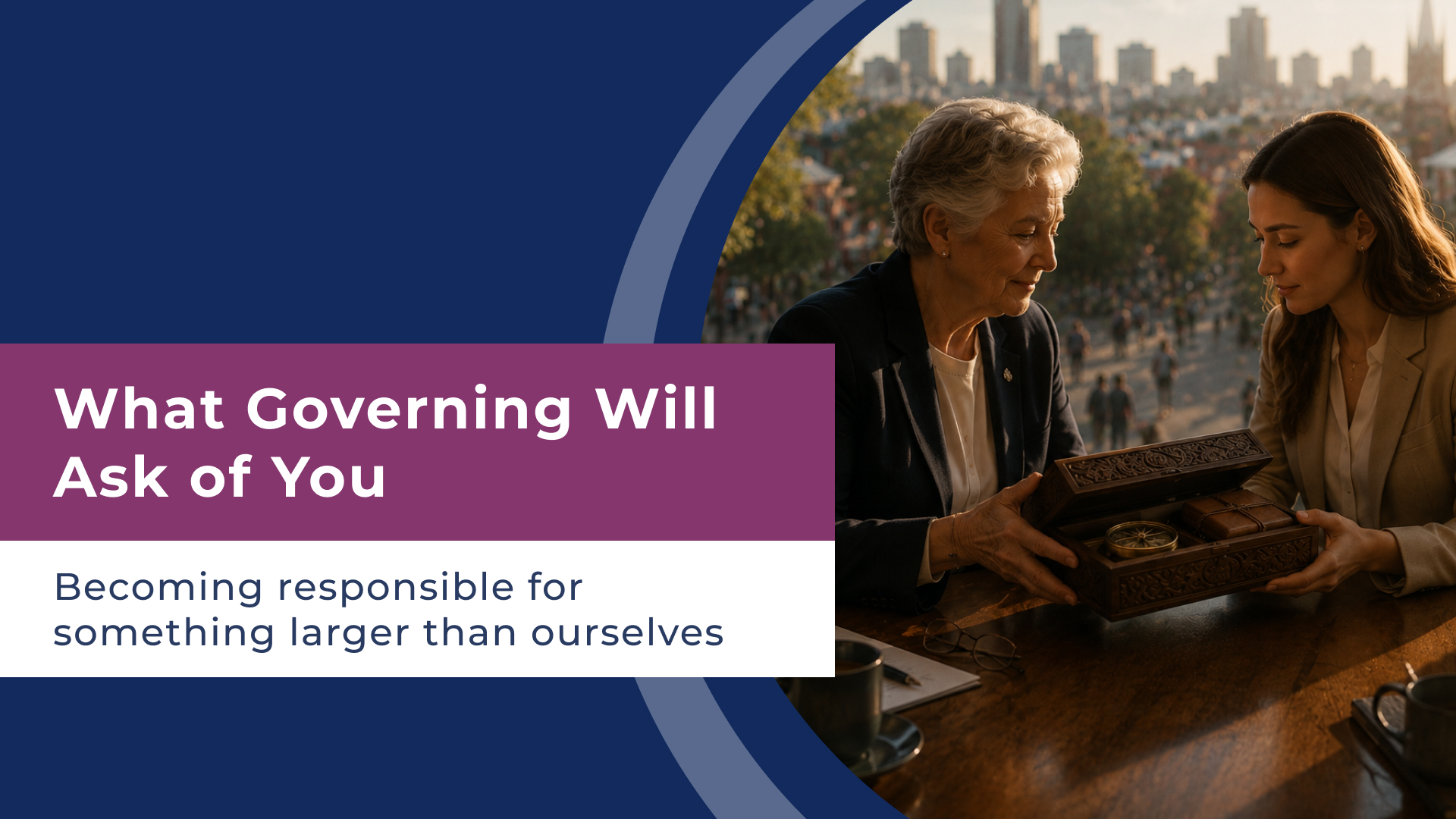
Someone hands you a coffee. The conversations before the meeting begin much as they do in every workplace. People ask about your journey, your family, how you became involved with the organisation. Laughter drifts across the room. The atmosphere is warm and surprisingly informal. Whatever nervousness you arrived with begins to ease. Then someone leans over and says quietly, almost conspiratorially, “Just so you know…” Watch out for him. She’s a little difficult. Finance always wins. Don’t bring that up just yet. We’ve always done it this way. Legal gets nervous. Marketing talks too much. The comments are offered generously. Nobody is gossiping or trying to manipulate the newest governor. Quite the opposite. They are trying to be helpful.
Every organisation develops its own shorthand over time, and this is simply one group of people trying to help another find their feet a little more quickly. At the time, it barely registers. The meeting begins. Papers are discussed. Reports are received. Decisions are made. You leave wondering whether you contributed enough, whether you asked sensible questions, whether you understood what everyone else seemed to understand so instinctively.
Much later, I began thinking about those first conversations. They were doing something I hadn’t recognised. Before I had really come to know the organisation, I had already inherited its stories. Other people’s interpretations of personalities, past decisions and longstanding relationships. Assumptions about what mattered, who carried influence, where conflict emerged and which conversations required caution. None of this appeared in the board charter or the constitution. It wasn’t part of the formal induction process, yet it was every bit as influential in helping me understand how the organisation worked.
I have found myself wondering whether every board has two induction programmes. The first is carefully documented. It includes governance manuals, constitutions, strategic plans, financial reports and policies. It explains the formal responsibilities of the role and introduces governors to the structures that support good governance. The second is almost entirely invisible. It happens over coffee before meetings, in conversations in the carpark afterwards, in quiet comments made during breaks and stories shared between agenda items. It is where culture is transmitted, where history is interpreted and where newcomers begin making sense of an organisation through the eyes of those who already belong.
Both inductions matter. Constitutions explain how authority is structured. Stories explain how that authority has been experienced. One provides the architecture of governance. The other introduces us to its lived reality. The second induction continues to intrigue me. Long before we have the opportunity to observe an organisation for ourselves, we begin seeing it through the interpretations of others. We inherit not only information but perspective. Without intending to, we begin carrying forward the stories that have shaped those around us. It is true of far more than governance. Families do it. Professions do it. Communities do it. Organisations do it. Every human system passes itself on through stories long before it passes itself on through policy.
It led me to a different question. Not simply how boards make decisions, but how governors themselves are formed. How does someone who begins with generosity and curiosity become the kind of governor they eventually become? What strengthens that journey? And what, almost imperceptibly, causes it to drift?
The more boards I have worked alongside, the less I have come to believe that governance succeeds or fails because of intelligence, capability or intent. Most governors I have met are thoughtful people who care deeply about the organisations they serve. If governance were simply a matter of good intentions, most boards would function exceptionally well. So why do they not always do so? If good people care deeply, work hard and genuinely want the best for the organisations they serve, how do boards gradually lose sight of the very purpose they were created to fulfil?
Why good people say yes
It is easy to become cynical about governance. Open any newspaper and boards appear most often when something has gone wrong. There is a governance failure, a financial crisis, a public disagreement, an investigation or a resignation. We become accustomed to thinking about boards through the lens of dysfunction, as though governance exists primarily to explain failure rather than enable flourishing. That has rarely been my experience.
Most governors I have met have accepted responsibilities that are demanding, time-consuming and, more often than not, entirely voluntary. They arrive after long days at work. They spend evenings reading board papers instead of being with their families. Weekends disappear into strategy days and planning sessions. Decisions that carry significant consequences are often made after hours, between the competing demands of careers, children, ageing parents and everyday life. People rarely join boards because they are seeking status. They join because they care.
Sometimes it is the local school their children attend. Sometimes it is a profession that shaped an entire career. Sometimes it is a charity whose work reflects their deepest values, or a community organisation they simply cannot imagine existing without. Others join because someone they respect asked them to help. They believe they have something useful to contribute. For many, accepting a board appointment feels less like accepting a position and more like accepting an invitation. An invitation to give something back. To contribute to something that matters. To leave an organisation a little stronger than they found it. There is something deeply hopeful about that.
Every community depends upon people willing to say yes. Schools do not govern themselves. Sporting clubs do not organise themselves. Professional bodies do not steward themselves. Charities, trusts, arts organisations, environmental groups and countless community initiatives all rely upon ordinary people making an extraordinary commitment to something larger than themselves. Although the contribution is often unpaid, it is by no means without cost. Every meeting attended, every paper read and every difficult decision considered represents time that cannot be spent somewhere else. Volunteer governance may never appear on a balance sheet, yet it represents a remarkable investment in the social fabric of our communities.
This is why I find governance so interesting. At its best, governance is one of the purest expressions of stewardship. It asks people to invest their time, judgement and experience in something they do not own and may never directly benefit from. For a season they become custodians rather than proprietors, holding an organisation in trust until it passes into the hands of those who come next. The motivations that bring us to governance also shape the way we participate once we arrive. The parent notices children. The founder protects what has been built. The accountant sees financial risk. The educator sees learning. None of these ways of seeing are weaknesses. They are often precisely why those individuals were invited onto the board in the first place. The challenge lies elsewhere.
Over time, the reason we said yes can quietly become the lens through which we see every decision. Without noticing, our commitment to one part of the organisation can begin competing with our responsibility for the whole. It is here that governance begins asking something different of us. Not simply whether we care. The deeper question is whether we can gradually shift from representing what first brought us to the table to stewarding everything that has now been entrusted to it. That is a much harder invitation. It is also, perhaps, where the real work of governance begins.
The quiet drift
Organisations rarely outgrow their purpose. More often, they outgrow the structures that once served them well. A school expands from a single campus to several. A charitable trust that was once run by a handful of volunteers begins managing millions of dollars in assets and delivering services across multiple communities. A professional association finds itself representing a profession that barely resembles the one it was created to support. New technologies emerge. Regulatory expectations increase. Relationships become more complex. Decisions that were once local now have system-wide implications.
The organisation evolves. The governance model often evolves more slowly. Not because governors resist change. Quite the opposite. Most boards work extraordinarily hard to keep pace with growing complexity. They establish committees, commission expert advice, improve reporting, strengthen policies and refine their decision-making processes. From the inside, it often feels as though everyone is working harder than ever. That is precisely what makes this pattern so difficult to recognise.
In one governance review I completed, I found myself mapping not only formal governance structures but also the countless hours of volunteer effort required to sustain them. Reading papers, preparing reports, attending meetings, travelling, and participating in committee work represented an extraordinary investment of time and goodwill. The point of the exercise was never to calculate an exact financial figure. It was to make visible something that had become almost invisible to those living it each day. Governance had become one of the organisation’s largest voluntary contributions, yet remarkably little of that effort was directed towards the uniquely governing work that only governors could do.
Many boards respond to increasing complexity by increasing activity. Papers become longer. Meetings become more frequent. Additional committees are established. More expert advice is sought. More consultation is undertaken. Each decision is made with good intentions and often for sensible reasons. No single change appears problematic in isolation. Collectively they begin creating a different experience of governance.
An unwritten belief slowly emerges that confidence is somehow proportional to the amount of information available. A two-hundred-page board pack feels more responsible than a twenty-page one. Another consultant’s report feels safer than exercising judgement amid uncertainty. Another meeting creates the reassuring sense that due diligence has been done. Yet reading is not governing, just as information is not judgement. Expertise is invaluable, but it cannot replace discernment. This is one of governance’s quiet paradoxes. The harder boards work to keep pace with complexity, the easier it becomes to mistake activity for stewardship.
Drift rarely announces itself. It is almost never the consequence of one poor decision or one ineffective governor. It accumulates through dozens of entirely understandable accommodations. A difficult conversation is postponed until next month because there isn’t enough time. A committee continues long after its original purpose has passed because disbanding it feels uncomfortable. A report is accepted without much discussion because everyone trusts the expertise behind it. By the time anyone senses that something is no longer working, there is often no obvious point at which things went wrong. There is only the unsettling realisation that the organisation has changed while the habits of governance have remained remarkably familiar.
It is here that the most important work of governance begins. Not in working harder, producing more information or attending more meetings, but in recognising the subtle difference between movement and direction. Organisations do not need boards that simply keep pace with activity. They need governors capable of stepping back far enough to ask whether the work of governance itself is still serving the organisation that now exists, rather than the one it once was.
The becoming of a governor
Every role shapes the person who inhabits it. We recognise this instinctively in other parts of life. Few people become teachers, doctors, judges or parents without discovering that the role itself gradually changes them. They acquire new habits of attention. They notice things they once overlooked. Situations that once felt uncertain become familiar, while familiar situations begin to reveal new layers of complexity. Over time, they are not simply performing a role. The role is quietly participating in their becoming.
A governor is not appointed to stop being an educator, lawyer, accountant or founder. Nor are they expected to leave behind the knowledge and wisdom accumulated over a lifetime. Each perspective enriches the conversation because each allows the board to see something it might otherwise miss. The difficulty arises when those perspectives become destinations rather than starting points. Governance asks them to hold those identities lightly enough that another identity can emerge alongside them. The invitation is not to represent a particular interest but to cultivate a responsibility for the whole. The transition is rarely discussed.
Most governance development focuses, quite appropriately, on understanding fiduciary duties, financial oversight, strategy, risk, legal obligations and effective decision-making. These are essential. Yet alongside these technical capabilities sits another form of learning that receives far less attention. It concerns the gradual formation of judgement.
Judgement cannot be downloaded from a governance manual. Nor is it acquired simply by attending more meetings or reading thicker board papers. It develops through experience, reflection and conversation. It is strengthened by recognising our own assumptions, noticing the lenses through which we interpret situations and becoming increasingly comfortable holding competing truths without rushing to premature certainty. This is why governance can feel so demanding.
The questions confronting boards are seldom technical alone. They are often questions for which there is no perfect answer, only competing goods. How much should an organisation preserve its traditions while adapting to changing expectations? When does financial prudence become excessive caution? At what point does loyalty to the past begin limiting the future? How should today’s needs be weighed against tomorrow’s possibilities?
No policy can answer questions such as these. Neither can expertise on its own. They require governors capable of inhabiting uncertainty without becoming paralysed by it, of listening deeply without losing clarity, and of disagreeing respectfully without fragmenting relationships. They require people willing to keep asking what serves the organisation as a whole, even when that answer sits uneasily alongside their own preferences or experience. I have become more interested in whether boards are creating the conditions in which collective judgement can emerge. Expertise helps us understand the pieces. Judgement helps us discern the pattern they create together. One informs governance. The other is governance.
Perhaps this is what becoming a governor really means. Not the gradual accumulation of authority. Nor even the accumulation of knowledge. The patient development of the capacity to see beyond our own perspective without losing the wisdom it offers. To hold an organisation, its people and its future with enough care that our first instinct is no longer, What do I think? but, What is this situation asking of us now?
Honouring the past. Stewarding the future.
I thought I was writing about boards when I started this piece. Somewhere along the way, I realised I was writing about something much older. Every generation inherits institutions it did not create. Schools, charities, professional bodies, sporting clubs, churches, iwi, universities, businesses and community organisations all existed long before any one of us arrived. Each carries a history shaped by countless decisions, sacrifices and acts of generosity made by people whose names we may never know. We inherit not only their successes but also the assumptions, structures and traditions they leave behind. Some continue serving us well. Others quietly outlive the circumstances that first gave them meaning.
The deeper work of governance is standing for a moment between those who came before and those who will come after. It is an unusual position to occupy. We look backwards with gratitude and forwards with responsibility. We are asked to honour the intentions of those who built the organisation while recognising that the future will almost certainly require different answers to different questions. We cannot simply preserve the past, nor can we disregard it.
Stewardship requires us to discern what is essential enough to carry forward, and what must evolve if the organisation is to remain faithful to its purpose. It is demanding and rarely comfortable. Traditions often provide stability, identity and continuity. They remind us who we have been and why we exist. Every tradition was once an innovation. A response to the circumstances of its own time. The practices that served an organisation faithfully for thirty years may not serve it equally well over the next thirty. Remaining faithful to purpose sometimes requires changing the very structures through which that purpose has previously been expressed.
Governance can never be reduced to compliance. Compliance asks whether we have fulfilled our obligations. Governance asks whether we have fulfilled our responsibility. The distinction matters. An organisation can satisfy every legal requirement and still fail to prepare itself for the future. Equally, a board can spend countless hours doing governance without creating the space to ask the questions that matter most: What is changing around us? What are we no longer noticing? Which assumptions continue to serve us? Which have quietly become habit? What conversations are we avoiding because they are difficult rather than unnecessary?
These are not questions that belong only in the boardroom. They belong wherever people gather to care for something that matters. Families ask them. Communities ask them. Professions ask them. Nations ask them. This is why governance continues to fascinate me. It is one of the clearest places in which we can observe a much broader human challenge.
How do we receive something with gratitude without becoming captive to it?
How do we exercise influence without confusing it with ownership?
How do we honour those who came before us while remaining accountable to those who are yet to come?
There are no permanent answers to questions such as these. Each generation must discover them again. That is why every board meeting matters a little more than we realise. Beneath the agenda papers, the financial reports and the motions being considered sits a quieter question that rarely appears in the minutes:
What kind of organisation are we helping to become?
And alongside it sits another. One that may be even more important.
What kind of governors are we becoming in the process?
Dr Jordan Marijana Alexander is a writer, executive advisor and human systems strategist exploring how identity, place, culture and living systems shape participation in the modern world. She is the co-founder of RelateAble.Global. If this article has raised questions, sparked reflection, or highlighted something you’re navigating as a leader or in your personal life, you’re invited to book a conversation to explore it further. You can follow DrJMA on LinkedIn and Engenesis for ongoing insights, research, and practical resources.