

About this series
More Than Money explores how definitions of wealth are shaped by identity, power, and history, and why what we choose to value determines who thrives, who pays the invisible cost, and what becomes sustainable over time. Moving beyond money as the sole measure of success, the series examines how gender, culture, time, and place influence value systems globally, organisationally, and personally.
The geography of value and power
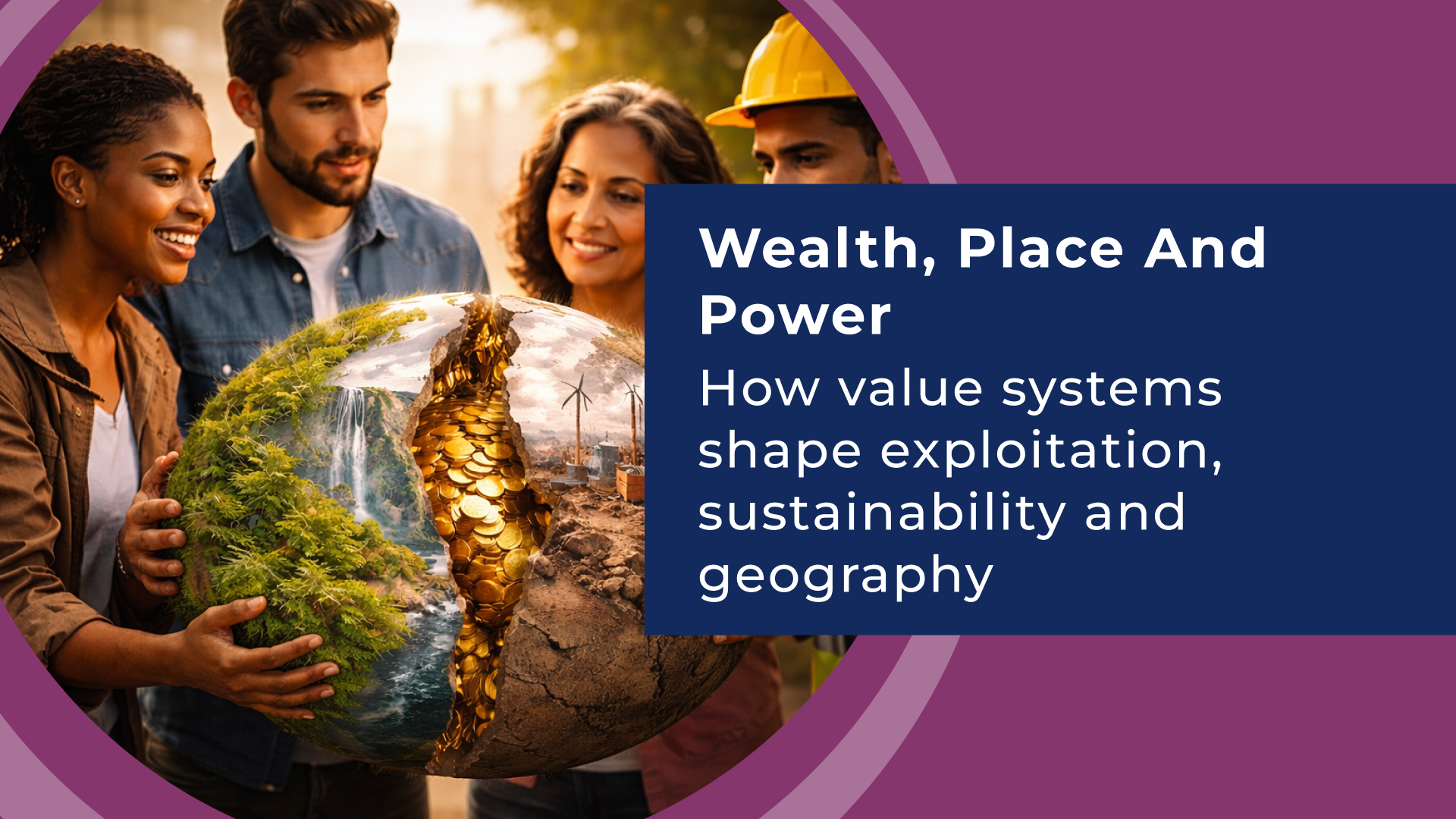
If wealth is not neutral, then neither is the world it produces. Value systems do not float above geography. They settle into land, labour, and bodies. They shape which places are developed and which are depleted, whose work is monetised and whose is absorbed, which environments are protected and which are sacrificed. To understand how wealth operates globally, we have to look not only at markets, but at place. Not place as location, but place as power.
How place became an input
Modern economic systems were built alongside expansion, extraction, and colonisation. Land was not encountered as relationship, but as resource. Labour was not understood as human continuity, but as unit cost. Wealth accumulation depended on the ability to separate value from place and move it elsewhere. This separation required stories.
Some stories framed land as empty or underutilised, some cast extraction as progress, others treated displacement as necessary collateral. Over time, these narratives hardened into systems. Raw materials flowed from certain regions. Profits accumulated in others. Environmental cost was localised. Financial gain was globalised. Place became an input.
The consequences of this framing are still with us. Regions rich in natural resources often experience less long-term wealth. Communities closest to extraction bear the greatest environmental and social cost. The places that sustain global prosperity are frequently the ones least able to protect themselves. This is not accidental. It is the result of how value has been defined and measured.
Before markets, there was meaning
Long before wealth was measured in currency, it was measured in continuity. In pre-industrial societies, value was tied to land, kinship, season, and survival across time. Wealth meant having enough to endure winter. Enough seed to plant again. Enough relationship to be held by the community when things failed. What mattered was not accumulation, but balance. It did not make these societies utopian or peaceful, but rather meant that value was relational rather than abstract. Land could not be separated from people without consequence. Extraction was constrained by proximity. You lived with the effects of what you took.
The shift toward modern economic systems required a different kind of story. As trade expanded and empires formed, wealth slowly detached from place. Value became mobile. Portable. Comparable across distance. This abstraction made scale possible. It also made consequence easier to defer.
Over time, markets began to take on a role once held by cosmology. They told us what mattered, rewarded certain behaviours, and promised order, growth, and salvation through progress. The market did not simply organise exchange. It became a moral system. What increased value was good. What slowed growth was suspect. What could not be priced was often dismissed as sentimental, spiritual, or inefficient. Land became an asset, labour a cost, and time something to optimise. In this worldview, wealth was no longer something you stewarded. It was something you pursued. Place, once sacred or ancestral, became negotiable.
This is not a critique of markets themselves. It is an observation about how thoroughly they have shaped our sense of meaning. When economic logic replaces relational logic, value detaches from responsibility. What follows is predictable. Extraction accelerates, care becomes invisible, cost is externalised, and repair is postponed until the system begins to collapse under what it has learned to ignore.
Gender, labour, and the geography of care
The same pattern appears in the global organisation of labour. Much of the world’s care work is performed by women, often in informal or underpaid economies. This labour sustains families, communities, and entire workforce systems, yet rarely registers as wealth creation. Migrant care workers leave their own communities to support others. Domestic labour enables formal employment elsewhere. Emotional and relational labour stabilises households under economic pressure.
The issue is not that this work exists. It is that it is systematically undervalued. Care is treated as background, as a cultural expectation and something that does not require replenishment. When value systems fail to recognise the labour they rely on without protecting it, the result is a global care deficit that mirrors environmental depletion. The same logic applies. Extract now and deal with consequences later.
Sustainability as an accounting problem
Climate change is often framed as a moral or political issue. At its core, it is also an accounting failure. Environmental systems have been treated as external to wealth creation. Forests, water, soil, and biodiversity have been consumed without being recognised as assets that require stewardship. When ecosystems collapse, the costs appear suddenly. Floods. Fires. Food insecurity. Displacement. These are not external shocks. They are delayed invoices.
Sustainability becomes urgent only when the cost can no longer be deferred. This pattern reveals something important. Wealth systems that ignore place eventually destabilise themselves. They consume the conditions that make wealth possible.
Alternative worldviews we marginalised
Not all cultures have organised value this way. Many Indigenous worldviews understand land not as property, but as relationship. Wealth is measured through continuity, balance, and responsibility across generations. Stewardship is not a moral add-on but the foundation of value. In these systems, extraction without regeneration is not progress. It is failure.
These perspectives were not dismissed because they lacked sophistication. They were sidelined because they conflicted with expansion-based economic models. They challenged the idea that value could be endlessly accumulated without consequence. The irony is that many of these worldviews now offer precisely the insight modern systems lack. They understand what happens when place is treated as expendable.
When geography becomes destiny
Place also shapes whose lives are buffered from risk and whose are exposed to it. Climate vulnerability, economic instability, and environmental degradation do not distribute evenly. They follow historical patterns of power. Communities with fewer resources absorb greater volatility. Regions with less political influence carry greater environmental burden. Migration, displacement, and insecurity become structural outcomes rather than isolated crises.
Wealth, in this context, is not just about income. It is about insulation. Who can move, adapt or absorb shock, and who cannot. When value systems privilege mobility and accumulation, those rooted in place often carry the cost.
Why this still feels invisible
One reason these dynamics remain difficult to see is that wealth is often discussed abstractly. Numbers move and markets fluctuate. Growth is tracked. The lived consequences of these movements, however, remain distant from decision-making centres. Place disappears from view. When consequences surface, they are framed as unfortunate side effects rather than predictable outcomes of how value has been defined. This abstraction allows systems to continue functioning while the cost is paid elsewhere.
Revaluing wealth through place
If wealth is to be revalued, place cannot remain peripheral. This does not mean rejecting globalisation or economic exchange. It means accurately accounting for what those systems require and consume. It means recognising that sustainability is not an ethical preference. It is a measure of whether a value system can endure. When place is acknowledged as central to wealth creation, different questions emerge. Who bears the cost of this value? Over what time horizon? With what capacity for repair? These questions shift decision-making. They change what looks profitable and redefine what success means.
The strategic implication
For organisations and governments alike, this is not a philosophical concern. It is a strategic one. Systems that ignore place create risk. They depend on externalising costs until that cost returns as instability. Those that integrate place into value creation build resilience. They invest in continuity over extraction. They measure success not only by output, but by what remains intact. This shift need not be perfect. It does need accuracy.
What comes next
In the next article, the focus will move closer to home. From global systems to organisational life. From geography and history to balance sheets, leadership models, and performance frameworks. Because the same dynamics that shape global wealth also operate inside companies. Value is created, extracted, and mismeasured every day. Until organisations learn to see what they are actually relying on, they will continue to leak value while believing they are optimising it.
Revaluing wealth begins with recognising that place matters. Not as a backdrop, but as a foundation.
What we choose to value determines what we are willing to deplete, what we are prepared to protect, and what we assume will absorb the cost. Place records those choices long after the language used to justify them has faded.
Wealth is never abstract. It always leaves a footprint. The only question is whether we are willing to see where it lands.
Dr Jordan Marijana Alexander works at the intersection of identity, leadership, and organisational systems. She is the co-founder of RelateAble.Global If this series has surfaced questions for you or your organisation, she welcomes thoughtful conversation and inquiry.