

Note to the Reader
This article is intentionally written at a level of abstraction so that the underlying structures shaping recognition can be examined clearly and applied across many different contexts. Its purpose is to lay out the conceptual architecture behind observer capacity, exposure, and recognition without limiting the discussion to a single event or domain. While the ideas presented here are highly applicable to real-world situations, the focus of this article is on clarifying the structure of the models themselves. Readers interested in seeing how these frameworks can be applied in a tangible societal situation may wish to read the accompanying case study article, “When Societies Drift Toward War: A Case Study Using the Observer Capacity Exposure Model.” That article applies the same frameworks to a concrete real-world scenario, demonstrating how the dynamics explored here can unfold across governments, institutions, alliances, organisations, and citizens when signals accumulate but recognition remains fragmented.
Background
Modern culture often assumes that truth reveals itself automatically once enough information becomes available. If evidence accumulates, if contradictions become visible, if the facts are exposed clearly enough, people will eventually recognise what is happening. Reality, in this view, is expected to behave like a room gradually filling with light. Once the illumination becomes strong enough, everything inside it should become visible.
Yet human experience repeatedly contradicts this assumption. Reality may be exposed and still remain unseen. Evidence may be visible and still remain unrecognised. Signals pointing towards what is true may accumulate over time, yet the recognition we expect never arrives. In many situations, the problem is not the absence of information. People may be surrounded by information and still fail to see what is unfolding in front of them.
This raises an uncomfortable but necessary question. Is it possible for a person to exist within a high-exposure environment, where the conditions suggest that distortions should become visible and contradictions should surface, and yet still fail to recognise what is happening? The answer is yes. Not only is this possible, it is remarkably common.
When this occurs, at least two different dynamics may be at play. In some cases, the person lacks the capacity to recognise the signals around them. Their conceptual tools may be limited, their awareness may be narrow, or their interpretive ability may be insufficient to assemble the available signals into a coherent understanding. In other cases, the issue is not capacity but willingness. The person may possess the ability to see, yet something in them resists recognition. Seeing clearly may threaten an identity, disturb a cherished belief, unsettle belonging, or expose implications they do not wish to face.
An old saying captures this distinction well. If someone is asleep, you can wake them. But if someone is pretending to sleep, waking them becomes almost impossible. From the outside, the two situations may look similar. In reality, they arise from very different relationships with what is being revealed.
To understand this phenomenon, we need to distinguish several layers of the problem. First, there is the question of exposure itself: how distortions, inconsistencies, and gaps between narrative and reality become increasingly difficult to sustain as interactions accumulate. This is the domain of the Exposure Probability Model (EPM). Second, there is the question of human perception: what qualities shape whether an observer can actually register and interpret what exposure reveals. This is where the Exposure Triangle, introduced in the Being Framework, becomes essential. Third, there is the broader question of how perception is refined across different domains of reality, a question further illuminated by the notion of Authentic Awareness within the Metacontent discourse.
Taken together, these perspectives reveal something both simple and profound. Exposure does not guarantee recognition. Reality may become increasingly visible, yet recognition still depends on the observer. It depends on whether the person has the capacity to see and, just as importantly, the willingness to accept what seeing demands. Truth may be present, yet the burden of recognising it is not always easy to carry.
Seeing Yet Not Seeing – The Lemon Juice Bank Robber
A striking case from psychology illustrates how people can fail to recognise reality even when it appears obvious. In 1995, a man named McArthur Wheeler robbed two banks in Pittsburgh in broad daylight without wearing a mask or any form of disguise. Surveillance cameras captured his face clearly as he walked into the banks and committed the robberies.
When police arrested him later that day and showed him the footage, Wheeler appeared genuinely confused. According to reports, he responded with disbelief, saying, “But I wore the lemon juice.” Wheeler had convinced himself that rubbing lemon juice on his face would prevent surveillance cameras from capturing his identity, because lemon juice can be used as invisible ink. The reasoning was deeply flawed, yet to him it felt entirely coherent.
The incident later inspired well-known research in psychology, but the deeper lesson extends beyond questions of competence or ignorance. The case reveals something fundamental about the human relationship with reality. People can look directly at events unfolding around them and still fail to recognise what is visible to everyone else.
At first glance, it may be tempting to dismiss this case as an exception. One might assume that Wheeler must have been unusually unintelligent, irrational or mentally unstable. Yet that interpretation misses the deeper point. Wheeler was not considered clinically insane, nor was the case treated as evidence of a rare psychological disorder. What made the incident so intriguing to psychologists was precisely the opposite. It demonstrated how an apparently ordinary individual could construct a belief that felt entirely reasonable to him while being fundamentally disconnected from reality.
In other words, the signals were present. The exposure was clear. Yet recognition failed to occur.
The lesson is important because situations like this are not confined to isolated incidents. In everyday life, people often encounter environments where contradictions accumulate, signals become increasingly visible and evidence begins to challenge existing narratives. Yet even in such environments, recognition may still fail to occur.
The problem, therefore, is not always the absence of information. Sometimes the signals are present and exposure is high, yet individuals still fail to assemble those signals into understanding. To understand why this happens, we must examine both sides of the equation: the environmental conditions that produce exposure and the human capacities through which exposure is interpreted.
The first of these is captured by the Exposure Probability Model, which explains how distortions gradually become visible as interactions accumulate.
High Exposure Yet No Seeing – Leveraging The Exposure Probability Model
To understand why truth can remain unseen even when it becomes visible, we must first examine the conditions under which reality becomes exposed. This is precisely what the Exposure Probability Model (EPM) seeks to explain. The model describes how distortions, inconsistencies and inauthenticities gradually become visible as interactions accumulate. The more interactions occur, the more opportunities arise for contradictions to surface and for the gap between narrative and reality to reveal itself.
At its core, the Exposure Probability Model focuses on exposure as an environmental phenomenon. When distortions exist between what is claimed and what is actually occurring, each interaction between narrative and reality creates the possibility that the inconsistency will surface. Over time, repeated interactions make it increasingly difficult for distortions to remain hidden. Patterns begin to emerge, signals appear and small inconsistencies accumulate until they form a recognisable structure. The environment itself begins to expose what is happening.
In environments where visibility is high and interactions are frequent, maintaining a narrative that is disconnected from reality becomes increasingly difficult. The longer the distortion persists, the more interactions occur in which the gap between narrative and reality may become visible. In such conditions, the probability that contradictions will surface increases significantly.
At this stage, the Exposure Probability Model describes how exposure emerges in the environment, independent of whether anyone actually recognises what is being revealed. Exposure, in this sense, is a structural dynamic. Distortions generate tension between narrative and reality, and interactions gradually bring that tension to the surface.
However, further development of the model introduces an additional question. If exposure is increasing in the environment, why does recognition sometimes fail to occur?
This question led to the development of what may be referred to as the Expanded Exposure Probability Model, explored further in the unpublished book Capacity. The expanded model builds on the original framework by introducing an additional variable: Observer Capacity (C). While the core model explains how exposure emerges through environmental interactions, the expanded model recognises that exposure alone does not guarantee recognition. Someone must still possess the capacity to interpret the signals that exposure produces.
Observer capacity refers to the ability of an individual to interpret the signals generated through exposure. The environment may reveal patterns and contradictions, yet the observer must still be able to assemble those signals into a coherent understanding of what is happening. Without sufficient observer capacity, signals may remain visible but unrecognised. Evidence may exist yet fail to produce recognition.
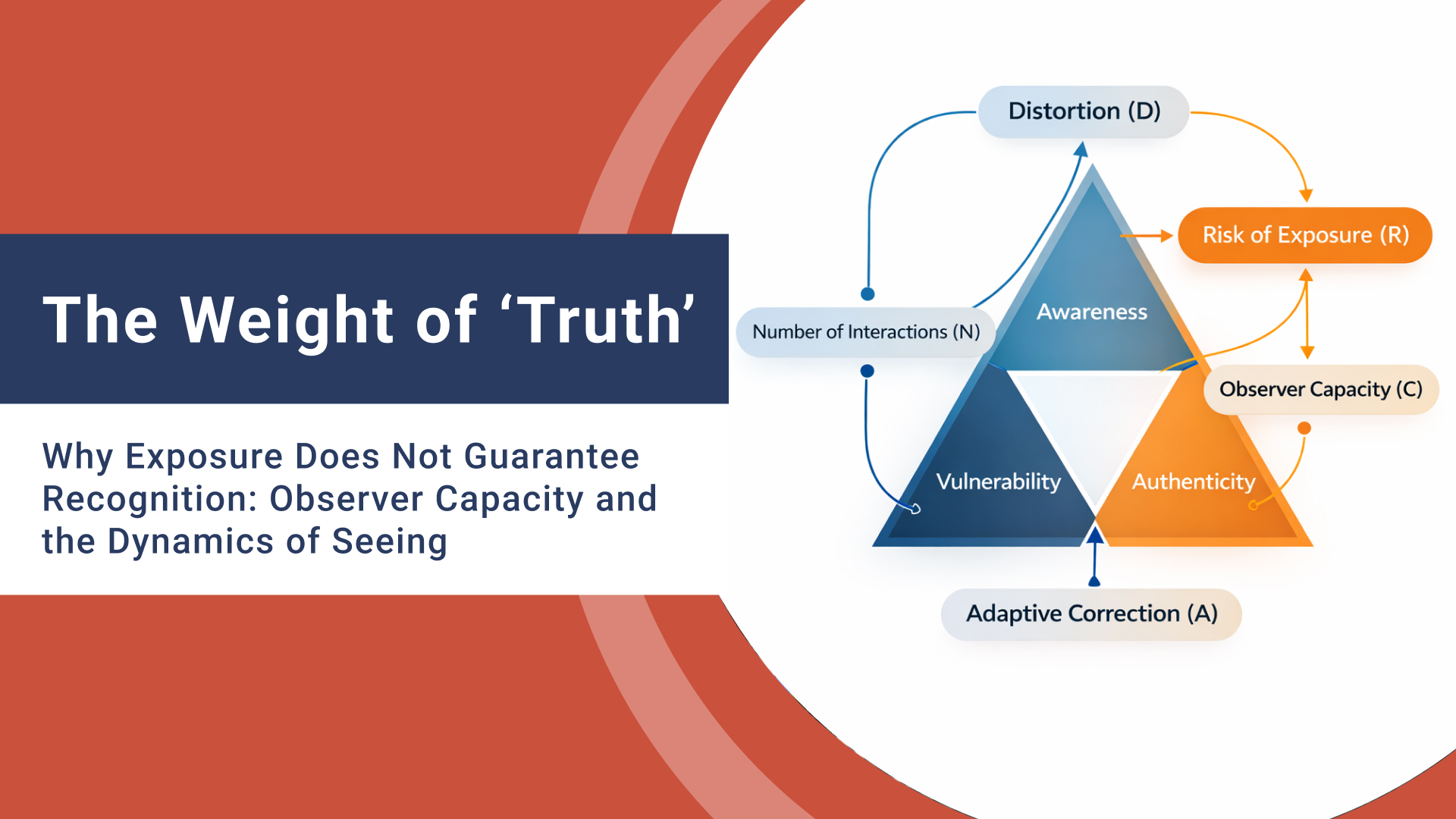
The Expanded Exposure Probability Model ,therefore, describes exposure as the interaction of several key variables. The first variable is Distortion (D). Distortion refers to the gap between reality and the narrative used to describe it. The greater the distortion, the greater the tension between what is claimed and what is actually occurring. The second variable is the Number of Interactions (N). Interactions include events, decisions, communications and encounters through which narrative meets reality. Each interaction creates another opportunity for inconsistencies to surface. The third variable is Visibility (V). Visibility describes how observable those interactions are. In highly transparent environments, interactions are easier to examine and compare with the claims being made.
When distortion exists and interactions accumulate in visible environments, the Risk of Exposure (R) increases. The system gradually generates signals that reveal underlying inconsistencies. The expanded model introduces a fifth variable: Observer Capacity (C). Even when distortion generates signals and exposure risk becomes high, recognition will only occur if observers possess the capacity to assemble those signals into meaningful understanding.
When these variables interact, exposure becomes increasingly likely. Distortion (D) creates tension, Number of Interactions (N) generates opportunities for that tension to surface, Visibility (V) allows signals to be observed and the Risk of Exposure (R) rises. Yet recognition ultimately depends on Observer Capacity (C). Without it, exposure may occur without producing understanding.
This insight explains why individuals can sometimes exist in environments where exposure is extremely high while still failing to recognise what is occurring. From an external perspective, the signals may appear obvious. Contradictions seem visible and evidence appears abundant. Yet the observer does not assemble those signals into recognition because the internal capacity required to interpret them is insufficient.
At this point, the Exposure Probability Model naturally connects to a second framework developed within the Being discourse. While the EPM explains how exposure occurs in the environment, the Exposure Triangle explains the internal qualities that determine whether a human being can actually perceive that exposure. In other words, the EPM describes how reality becomes visible, while the Exposure Triangle explains whether the observer can see it.
This connection becomes even clearer when considered alongside the concept of Authentic Awareness developed in the Metacontent discourse. Authentic awareness recognises that human beings do not have unmediated access to reality. What we perceive is always shaped by how we interpret signals across three domains of existence: the objective domain of physical reality, the intersubjective domain of social constructs and shared meanings, and the subjective domain of personal experience.
When these perspectives are brought together, a powerful insight emerges. The environment may generate exposure through the dynamics described in the Exposure Probability Model. Yet whether that exposure leads to recognition depends on the observer. The individual must possess the internal qualities required to perceive the signals that reality is revealing.
To understand these internal qualities more clearly, we must now turn to the Exposure Triangle, which explains how human beings take the snapshots of reality through which recognition becomes possible.
The Exposure Triangle - How Human Beings Take Snapshots of Reality
If the Exposure Probability Model explains how reality gradually becomes visible through accumulating interactions, the next question becomes practical and immediate. What allows a human being to actually recognise what exposure is revealing? Why do some individuals detect emerging patterns early while others remain unaware even when the signals appear obvious?
This question leads directly to a framework introduced in the book Human Being, known as the Exposure Triangle. The model describes the internal qualities that shape how human beings perceive reality. It uses a simple analogy drawn from photography.

A camera captures an image depending on three interacting elements: aperture, shutter speed, and sensor sensitivity (ISO). These elements determine how much light enters the camera and how clearly the image is recorded. When they are balanced correctly, the camera produces a clear photograph. When they are misaligned, the image becomes distorted, underexposed, or blurred.
Human perception operates in a remarkably similar way. Each time we encounter events, signals from the environment, or interactions with other people, we are effectively taking snapshots of reality. The clarity of those snapshots depends on three fundamental qualities within our way of being: Awareness, Vulnerability, and Authenticity. Together, these qualities determine how clearly the signals revealed through exposure are received and interpreted.
Awareness
Awareness functions much like the aperture of a camera. It determines how much of reality enters our field of perception. When awareness is narrow, only a small portion of the available signals reaches our attention. Important patterns may exist in the environment yet remain outside the frame of perception. When awareness expands, more signals enter the field and the snapshot becomes richer and more informative.
Being Framework Ontological Distinction of Awareness
Awareness is the state of being intentionally conscious of your consciousness. It is how you relate to what you know and understand as well as what you don’t know and don’t understand. Awareness is always intentional and directed at something. It is to know and understand yourself, others and the world around you, in particular the impact of the world and others on you and the impact you have on the world and others. Awareness is your access to knowing and understanding and is required to fulfil your intentions.
A healthy relationship with awareness indicates that you have a clear understanding of your impact on others and on the world around you. You are not easily misled, coerced and/or manipulated. You are both self-aware and aware of how you are perceived by others. You are attentive, alert and rarely surprised or caught off guard. You can find your way forward despite uncertainty or not knowing, and are available to consider feedback, guidance and critique.
An unhealthy relationship with awareness indicates that you may choose to ignore or be oblivious to matters and the impact you have on others and the world around you and vice versa. You may often be confused and shocked by matters and how others respond to you and blindsided when they fail to live up to your expectations. You may deliberately choose to ignore what there is to see. Alternatively, you may freeze or find it difficult to progress in the face of uncertainty or not knowing as you are compelled to know everything before making decisions or taking action.
Reference: Tashvir, A. (2021). BEING (p. 109). Engenesis Publications.
Vulnerability
Vulnerability functions like the shutter speed of the camera. It determines how long we remain open to the signals that reach us. When vulnerability is low, the mind quickly closes the shutter. Signals that challenge our assumptions, beliefs, or identity may be dismissed before they are fully examined. When vulnerability is present, the shutter remains open long enough for those signals to be received and explored.
Being Framework Ontological Distinction of Vulnerability
Vulnerability impacts how you relate to the concerns you have with respect to how you are being perceived or thought of in different situations. It is how you are being when confronted or exposed to perceived threats, ridicule, attacks or harm (emotional or physical). Vulnerability is not being weak, agreeable or submissive. It is when you embrace your imperfections. It is considered the quality of being with your authentic self without obsessive concern over the impression you make.
A healthy relationship with vulnerability indicates that you are open as opposed to guarded or closed in receiving unfamiliar knowledge and feedback. You are willing to reveal your authentic self to others, regardless of what they may think of you or the prevailing circumstances. You may often leverage the power of being vulnerable to generate trust and build relationships. You acknowledge and embrace your imperfections to support your growth and influence. Rather than letting other people’s opinions of you hold you back, you learn from them to propel you to wholeness (integrity) and fulfilment.
An unhealthy relationship with vulnerability indicates that you are likely to defer or avoid taking action or making decisions when you feel they may impair your reputation. You may also avoid or put your guard up in situations where you could expose yourself to ridicule or look foolish. You are more concerned with being seen to do the right things, looking good or impressing others than actually doing the things you know to be right. You may be inclined to sacrifice your authentic self or image to project a fake persona that you consider more acceptable and impressive to others. You tend to take criticism personally. Alternatively, you may attempt to create unrealistic boundaries to maintain a ‘safe’ distance, avoiding the unknown and refusing to explore new territories. You may be overly controlling of others or your environment.
Reference: Tashvir, A. (2021). BEING (p. 233). Engenesis Publications.
Authenticity
Authenticity functions like the sensor sensitivity of the camera. It determines how responsive perception is to the light of reality itself. When authenticity weakens, perception becomes less responsive to subtle signals. Individuals may unconsciously reshape reality in order to protect preferred narratives. When authenticity is strong, perception becomes more aligned with what is actually occurring rather than with what we would prefer to believe.
Being Framework Ontological Distinction of Authenticity
Authenticity is how you relate to the reality of matters in life. It is the extent to which you are accurate and rigorous in perceiving what is real and what is not. It is also how sensitive and diligent you are to the validity of the knowledge you perceive. Authenticity is paramount for you to carefully consider that your conception of reality – including your beliefs and opinions – is congruent with how things are. When you are being authentic, you are compelled to express your Unique Being – what is there for you to express – while being consistent with who you say you are for others and who you say you are for yourself. It is the congruence or alignment of your self-image – who you know yourself to be – and your persona – who you choose to project to others.
A healthy relationship with authenticity indicates that you take the time to thoughtfully consider your beliefs and opinions, as the validity and accuracy of your conception of matters is important to you. You mostly experience yourself as being true to yourself and others. Others may consider you genuine, distinct and trustworthy, and that your actions are consistent with who and how you are and what you communicate.
An unhealthy relationship with authenticity indicates that there may be no solid foundation for your beliefs and opinions and how you choose to examine reality, and you are often lenient and fickle with how you express your views and the truth. You may consider yourself to be fake or an imposter and often question your own abilities. Others may consider you to be someone who lacks sincerity and often acts inconsistently with who you say you are. You are frequently uncomfortable with being yourself and being with yourself. Alternatively, you may be righteous, opinionated, biased or prejudiced, considering your ‘truth’ to be the only truth, and may be unwilling to give up being ‘right’.
Reference: Tashvir, A. (2021). BEING (p. 250). Engenesis Publications.
The Observer Determines the Clarity of Reality
Together, these three qualities determine the clarity of the snapshots through which we interpret reality. Even when exposure is high and signals are present, the observer must possess sufficient awareness, vulnerability, and authenticity to capture those signals accurately. Without these qualities, the snapshots through which reality is interpreted become incomplete, distorted, or selectively filtered. Reality may be revealing itself through exposure, yet the observer’s internal qualities determine whether those signals translate into recognition.
This is where the relationship between the Exposure Probability Model and the Exposure Triangle becomes clear. The Exposure Probability Model explains how distortions gradually become visible through accumulating interactions in the environment. The Exposure Triangle explains the internal qualities that determine whether a human being can actually perceive those signals once they appear.
However, one further question remains. Even when awareness allows signals to enter perception, vulnerability allows those signals to remain in view, and authenticity aligns perception with reality, how do those signals actually become understanding?
Human beings do not simply observe reality. They interpret it. Signals from the environment must pass through layers of interpretation before they become meaning. What we see is never raw reality alone but reality interpreted through conceptual structures, stories, mental models, and frameworks of understanding.
To fully understand how exposure becomes recognition, we must, therefore, look beyond perception itself and examine the deeper structure through which human beings assemble meaning from the signals they encounter. This structure is described in the Metacontent discourse through the Nested Theory of Sense-Making, which explains how human beings organise fragments of information into coherent understanding across multiple layers of interpretation.
The Exposure Triangle explains how clearly the observer can perceive the signals that exposure reveals. The Nested Theory of Sense-Making explains how those signals are assembled into understanding. Together, they provide the missing bridge between exposure and recognition.
In the next section, we examine this deeper structure and its relationship with Authentic Awareness.
Authentic Awareness and the Nested Theory of Sense-Making
Even when exposure occurs and even when an observer possesses awareness, vulnerability and authenticity, recognition is not automatic. Signals must still be interpreted. Events must be assembled into patterns. Observations must become understanding. Human beings do not encounter reality as a finished explanation but as fragments of information that must be organised into meaning.
This is where the Metacontent discourse introduces a deeper structure known as the Nested Theory of Sense-Making.
Human beings do not interpret reality through a single layer of understanding. Sense-making unfolds through multiple nested layers of meta-content that shape how signals from reality are interpreted. Each layer provides a structure through which information is organised, evaluated and integrated. The quality of our understanding, therefore, depends not only on what we observe but also on the structure of the meta-content through which we interpret what we observe.
The Nested Theory of Sense-Making describes seven layers through which signals from reality gradually become coherent understanding.

The diagram illustrates how signals from reality pass through several layers of interpretation before they become meaning. These layers are nested because each layer builds upon and shapes the layers above it.
The layers are as follows.
1. Initial Insight
Sense-making begins with a simple encounter with reality. A signal appears. An observation occurs. Something unexpected happens.
For example, a manager may notice that team morale has suddenly dropped. An investor may observe unusual behaviour in a financial market. A citizen may notice contradictions between public statements and observable events in political discourse.
At this stage the signal exists as a raw observation. It has not yet been fully interpreted.
2. Cognitive Maps
Cognitive maps are internal representations of how individuals believe the world works. They organise relationships between events, causes and consequences. Cognitive maps help individuals orient themselves within complex environments.
For example, a leader with a well-developed cognitive map of organisational dynamics may recognise that declining morale often reflects deeper cultural problems. An economist may interpret economic signals through a map of incentives and systemic pressures. A geopolitical analyst may interpret events through an understanding of historical power structures.
If cognitive maps are incomplete or distorted, signals may be misinterpreted because they are placed within an inaccurate structure of understanding.
3. Narratives
Human beings naturally organise events into narratives. Stories help explain what is happening, who the actors are and how events unfold over time.
For example, a leader might develop a narrative that a team is losing motivation because leadership has become disconnected from its people. In politics, a nation may construct narratives about progress, decline, threat or victory. In public discourse, narratives may frame conflicts as moral struggles between opposing forces.
Narratives help organise complexity but they can also become filters that shape perception. When individuals become strongly attached to particular narratives, they may unconsciously interpret signals in ways that preserve those stories even when reality contradicts them.
4. Mental Models
Mental models provide the causal logic through which systems are understood. They explain how things work.
For example, a systems thinker may interpret declining morale through a model of feedback loops and organisational incentives. An economist may interpret inflation through models of monetary policy and market behaviour. A strategist may analyse geopolitical tensions through models of deterrence and power balance.
Mental models allow observers to move beyond surface narratives and recognise deeper structures that generate observable patterns.
5. Perspectives
Perspective determines the vantage point from which a phenomenon is examined. Two observers may examine the same event yet reach entirely different conclusions because they approach the issue from different conceptual angles.
For example, inflation may be interpreted through an economic perspective focusing on monetary policy, a sociological perspective examining inequality, or a political perspective examining governance and power.
Perspective determines which signals are emphasised, which are ignored and how patterns are interpreted.
6. Domains
Domains represent the fields of knowledge through which problems are interpreted. Each domain provides specialised tools for understanding particular types of phenomena.
For example, a pandemic may be examined through the domains of medicine, economics, political science or ethics. A technological innovation may be analysed through engineering, business strategy or social impact.
Misidentifying the domain often leads to distorted conclusions because the analytical tools being used are not suited to the phenomenon being examined.
7. Paradigms within Domains
Within each domain individuals operate within paradigms, the dominant schools of thought that shape how problems are framed and what explanations are considered legitimate.
For example, in economics different paradigms such as Keynesian economics, neoliberal economics or institutional economics produce very different interpretations of the same economic signals. In science, paradigms such as Newtonian mechanics or quantum mechanics shape how physical phenomena are understood.
Paradigms influence what questions are asked, what evidence is prioritised and what conclusions appear reasonable.
Contextual Variables
Beneath these seven layers lie contextual variables that shape how sense-making unfolds in practice. Context influences how individuals interpret signals and which interpretations they consider acceptable.
Examples of contextual variables include incentives, biases, belonging, power structures, cultural norms and institutional pressures.
For instance, a financial analyst may interpret signals differently when incentives reward short-term market optimism. A political actor may interpret information differently when loyalty to a group or ideology shapes what can be acknowledged publicly. A researcher may unconsciously favour interpretations that align with the dominant paradigm within their discipline.
These contextual variables influence how signals move through the layers of sense-making. They can reinforce certain interpretations while suppressing others.
Why the Layers Matter
This nested structure reveals why exposure alone cannot guarantee recognition. Even when signals are visible and observers possess openness through awareness, vulnerability and authenticity, recognition still depends on the integrity of the interpretive structure through which those signals are processed.
Fragmented knowledge, patchwork understanding and biased conceptual structures can distort interpretation even when perception itself is functioning.
This is where Authentic Awareness becomes essential.
Authentic awareness refers to the disciplined effort to refine how individuals interpret reality across three domains of existence: the objective domain of physical reality, the intersubjective domain of social constructs and shared meanings, and the subjective domain of personal experience. Authentic awareness requires individuals to continuously refine the layers through which they interpret signals so that their understanding becomes progressively less distorted.
Seen in this light, observer capacity is not simply a matter of intelligence or access to information. It is a function of the structure and integrity of the meta-content through which individuals interpret reality.
The Exposure Probability Model explains how reality becomes visible.
The Exposure Triangle explains the qualities that allow perception.
The Nested Theory of Sense-Making explains how perception becomes understanding.
Only when these three structures interact does recognition become possible.
Observer Capacity Exposure Model (OCEM)
The Observer Capacity Exposure Model (OCEM) integrates three elements developed across the broader body of work: the Expanded Exposure Probability Model (EPM), the Exposure Triangle of Awareness, Vulnerability and Authenticity, and the concept of Authentic Awareness developed within the Metacontent discourse. Within this integration, Observer Capacity is no longer treated as an isolated variable but as the outcome of the interaction between these three structures.
The Expanded Exposure Probability Model explains how distortions between narrative and reality gradually become exposed as interactions accumulate. As the number of interactions (N) increases, the Risk of Exposure (R) rises. Distortions (D) encounter reality repeatedly through observable interactions (V), generating signals that may eventually reveal inconsistencies between what is claimed and what is actually occurring.
However, the Expanded EPM deliberately leaves one question unresolved. Exposure may increase, signals may accumulate and contradictions may become increasingly visible, yet recognition does not always occur. Individuals and societies may exist in environments where exposure conditions are extremely high while still failing to see what is unfolding.
The Observer Capacity Exposure Model addresses this question by linking exposure dynamics to the qualities of the observer. Rather than assuming that exposure automatically produces recognition, OCEM shows that recognition depends on Observer Capacity (C), and that this capacity emerges from the interaction of the Exposure Triangle and Authentic Awareness.
The Exposure Triangle describes the perceptual qualities that determine how signals from reality enter human awareness. Awareness determines how much of reality is allowed into perception. It reflects the openness of attention and the willingness to register signals that may contradict expectations or established narratives. Without sufficient awareness, many signals of distortion never enter the field of observation.
Vulnerability determines how long the observer remains open to what is being revealed. Exposure often involves discomfort, uncertainty or threats to identity. Vulnerability allows the observer to remain present long enough for signals to be examined rather than dismissed or avoided.
Authenticity determines the integrity of interpretation. Even when signals are perceived, observers may reinterpret them in ways that protect identity, ideology or status. Authenticity reduces defensive filtering and allows signals to be interpreted in a manner more aligned with reality.
While the Exposure Triangle explains the perceptual openness of the observer, Authentic Awareness explains the structure through which those signals become understanding. Authentic Awareness is not merely attentiveness. It is the disciplined refinement of how individuals interpret reality across the objective domain of material reality, the intersubjective domain of social constructs and shared meanings, and the subjective domain of personal experience.
The primary structure through which Authentic Awareness operates is the Nested Theory of Sense-Making described in the Metacontent discourse. This theory explains how human beings organise fragments of reality into coherent understanding through layered meta-content structures. Through these layers individuals develop increasingly sharp, comprehensive and congruent conceptions of various fragments of reality, including material entities, concrete things, constructs, abstract ideas and unfolding events.
Without such layered structure, knowledge often becomes fragmented and patched together. Individuals may accumulate isolated pieces of information yet lack the conceptual architecture required to assemble those fragments into coherent understanding. Signals revealed through exposure may, therefore, remain unrecognised or be interpreted in distorted ways.
Within OCEM, Observer Capacity, therefore, emerges from the interaction between three elements. The Expanded Exposure Probability Model explains how signals of distortion are generated through interactions. The Exposure Triangle determines whether those signals enter perception and remain present long enough to be examined. Authentic Awareness, supported by the Nested Theory of Sense-Making, determines whether those signals can be organised into coherent understanding.
When these elements operate together, Observer Capacity expands. As interactions accumulate, distortions become increasingly difficult to sustain and observers are capable of recognising the signals that exposure reveals. Recognition then enables Adaptive Correction (A), allowing individuals and systems to respond to the information revealed through interaction and restore alignment between narrative and reality.
When these elements are weak or absent, the opposite dynamic emerges. Interactions may accumulate and exposure conditions may intensify, yet recognition still fails to occur. Signals remain visible but unrecognised, or they are reinterpreted in ways that protect existing narratives. Under such conditions exposure does not produce correction but may instead lead to denial, escalation of distortion or defensive reinterpretation of reality.
OCEM, therefore, explains a phenomenon frequently observed in organisations, societies and political systems: environments characterised by high exposure yet limited recognition. Interactions are abundant, contradictions accumulate and signals of distortion become increasingly visible. Yet observers fail to recognise what is occurring because the capacity required to interpret those signals is insufficient.
The Observer Capacity Exposure Model thus clarifies the full relationship between the frameworks introduced in this article. The Expanded Exposure Probability Model explains how distortions become unstable as interactions accumulate. The Exposure Triangle explains the perceptual qualities that allow signals to enter human awareness. Authentic Awareness, supported by the Nested Theory of Sense-Making, provides the structured interpretive capacity through which those signals become coherent understanding.
Observer Capacity emerges from the interaction of these elements. Exposure may reveal reality, but recognition depends on the capacity of the observer to perceive, interpret and integrate what exposure makes visible.
The Architecture of Awareness - Reception, Perception and Conception
Within the Being discourse, awareness is not treated as a vague sense of attentiveness or a general state of mindfulness. Awareness has an internal architecture through which reality enters human understanding. This architecture can be described through three interconnected processes: Reception, Perception and Conception. Together, these processes explain how signals from reality travel through the human mind before they become beliefs, interpretations or decisions.
Reception is the first stage. It refers to the moment when signals from reality enter our field of attention. These signals may arise from events unfolding around us, interactions with other people, information sources or internal experiences. At the stage of reception nothing has yet been interpreted. Signals simply arrive within awareness in their raw form. Whether we notice them or ignore them depends on the openness of our awareness.
Perception is the next stage. Here the signals that have been received begin to take shape within our understanding. The mind starts to recognise patterns, relationships and distinctions between different signals. Perception allows us to organise what we are noticing and begin to interpret what those signals might indicate. However, perception does not yet produce stable explanations. It is the stage where interpretation begins to form while remaining open to further refinement.
Conception is the stage where perception becomes structured understanding. At this point the mind forms explanations, beliefs and narratives about what is occurring. Signals that were received and interpreted through perception are organised into conceptual structures that allow individuals to make sense of events, material entities, constructs and abstract ideas by integrating them into a broader understanding of the world.
When these three processes function coherently, awareness becomes capable of refining its relationship with reality. Signals are received openly, interpreted carefully and integrated into conceptions that remain flexible as new information emerges. Under such conditions awareness becomes a powerful instrument for reducing distortion and improving recognition.
However, distortion can enter this process in several ways. The opposite of awareness is not merely the absence of awareness. It is not simply a lack of information or a collection of misconceptions. Distortion may instead appear as fragmented or incoherent interpretations of reality, where different pieces of information fail to connect into a coherent understanding of events, material entities or abstract ideas.
Yet fragmentation is only one form of distortion. In some situations distortion does not arise accidentally. It arises through deception.
Deception occurs when the signals entering the process of reception are intentionally shaped so that perception and conception move in particular directions. Signals may be selectively presented, emotionally framed or strategically amplified so that certain interpretations appear more convincing than others. In such cases individuals may believe they are freely interpreting reality while the signals entering their awareness have already been structured to guide their conclusions.
Beyond deception lies a further dynamic: manipulation. Manipulation operates by influencing how perception organises incoming signals. Narratives may be repeated, reinforced or emotionally charged so that particular interpretations become dominant while alternatives fade from view.
Finally there exists an even more direct form of distortion: coercion. While manipulation influences interpretation indirectly, coercion attempts to control interpretation through pressure. In coercive environments individuals may feel compelled to adopt certain interpretations regardless of what their perception suggests. Fear, authority and social consequences begin to shape how reality is understood.
These dynamics reveal how distortion can enter the relationship between exposure and recognition. Even when reality generates signals through the dynamics described in the Exposure Probability Model, those signals must still pass through reception, perception and conception before recognition occurs. If distortion enters at any stage through fragmentation, deception, manipulation or coercion, the snapshots of reality that individuals assemble may become increasingly disconnected from what is actually happening.
This is precisely why the qualities within the Exposure Triangle remain essential. When awareness becomes disciplined, vulnerability allows signals to remain present long enough to be examined and authenticity anchors interpretation in a genuine relationship with reality. Individuals become more capable of recognising when distortion has entered the process.
Without these qualities the architecture of awareness becomes vulnerable to the very dynamics that allow deception, manipulation and coercion to flourish.
Yet even when individuals possess the perceptual capacity to see clearly, another factor begins to influence whether recognition actually occurs. This factor is not about perception itself but about the deeper orientation with which a person approaches reality. It concerns the difference between having the capacity to see and being willing to accept what is seen.
Capacity and Willingness - The Role of Intention
At this point an important distinction begins to emerge. A person may possess the capacity to see and still fail to recognise what is happening. The Exposure Probability Model explains how exposure in the environment increases the likelihood that reality will reveal itself. The Exposure Triangle explains the internal qualities that allow a person to perceive those signals clearly. The architecture of awareness further describes how signals move through reception, perception and conception before they become understanding. Yet even when these elements are present, recognition is still not guaranteed. This is because the relationship between human beings and reality is shaped not only by capacity, but also by willingness.
Capacity refers to whether the observer is able to perceive the signals that exposure generates. This capacity emerges through the qualities described in the Exposure Triangle: awareness, vulnerability and authenticity. When these qualities are developed, individuals become capable of taking clearer snapshots of reality. Signals that might otherwise remain unnoticed become visible, patterns begin to emerge and contradictions become easier to recognise. In such circumstances the environment may already be producing sufficient exposure conditions through repeated interactions, yet recognition still depends on whether the observer possesses the perceptual capacity required to register those signals.
Willingness, however, refers to something deeper. It concerns whether a person is prepared to accept the implications of what becomes visible once those snapshots are taken. Recognition may require acknowledging uncomfortable consequences, revising long-held assumptions or confronting the possibility that a narrative we relied upon is no longer sustainable. In such moments the mind may resist recognition not because the signals are invisible, but because accepting them carries psychological weight. A person may see fragments of contradiction, notice signals that something is not aligning with reality and yet quietly turn away from the implications of what those signals suggest.
This is where the quality of Intention becomes central. Within the Unified Ontology of Systemic Integrity, intention reflects the orientation with which a person approaches reality.
The Authentic Sustainability Framework Distinction of Intention
Intention is the directional life-force that propels you to strive, create and connect – the invisible force that drives your choices, ambitions and relationships – and it becomes the structure through which you channel your purpose into what you are committed to bringing into the world. Intention is not merely what you wish for or declare. It is how coherently you organise your perceptions, attention, behaviour and engagement in relation to your values and purpose over time. The same is true for all systems, including organisations, institutions, cultures and nations. Once awareness has revealed reality and meaning is drawn from it, intention becomes the framework through which that meaning is enacted. In both individuals and other systems, intention shapes priorities and determines what is protected and pursued.
A healthy relationship with intention indicates that your motives, actions and values remain aligned over time, regardless of circumstance. You don’t just speak about what matters – you live it, consistently and coherently. You resist the pull of convenience, ego or reactivity, remaining guided by more meaningful and enduring matters. When your intention is clear and structurally integrated, it generates resilience, trust and clarity in how you navigate challenge and complexity. You become someone others can count on – not because you are rigid, but because your direction is grounded. In other systems, such as families, organisations, institutions and communities, a healthy relationship with intention manifests as the ability and willingness to maintain coherence and stay the course under pressure. It shows up in the consistent prioritisation of purpose over convenience, the safeguarding of trust over expedience, and the capacity to adapt without abandoning what truly matters.
An unhealthy relationship with intention indicates that your words, actions and values are misaligned. You may chase validation or be driven by fear, ego or optics rather than clarity, losing sight of your purpose. You may declare what matters, but act in ways that contradict it. Over time, this dissonance erodes both your impact and your integrity. This pattern appears not only in individuals but also in larger systems. When intention loses its coherence, people and institutions may profess values while acting in opposition to them, pursue progress at the cost of exhaustion or burnout, or begin with sincerity only to drift into performance optics, betrayal or power-seeking. In these cases, intention loses its structural rigour and collapses into propaganda, leaving trust fractured and alignment eroded.
Intention determines whether an individual genuinely seeks to understand what is unfolding or whether they unconsciously prioritise the protection of identity, comfort, ideology or belonging. The signals revealed through exposure may be identical for many observers, yet the intention with which they approach those signals determines how they interpret them and whether recognition is allowed to occur.
Before expanding our capacity to see, our relationship with intention must, therefore, be examined. Intention must be anchored in something that genuinely matters. When intention is anchored in deeper meaning, individuals become more willing to encounter reality even when it challenges familiar assumptions. Truth is no longer approached merely as information but as something connected to responsibility and understanding. Without such grounding the willingness to face reality becomes fragile. When truth becomes uncomfortable the mind naturally seeks the easier path of avoidance, distortion or denial.
Human beings rarely resist reality because they lack intelligence. More often they resist because recognising what is true would threaten something they are protecting. It may challenge a cherished belief, expose an inconsistency, undermine an identity or require difficult change. When intention is not rooted in something that genuinely matters the mind naturally searches for interpretations that preserve existing narratives. Meaning, therefore, acts as a stabilising force that allows a person to remain open to reality even when its implications are inconvenient or painful.
When intention becomes distorted, perception itself begins to shift. Awareness may become selective, focusing only on signals that confirm existing beliefs. Vulnerability may diminish as the mind closes the shutter on information that challenges established narratives. Authenticity may weaken as individuals begin to manage appearances rather than engage honestly with what is emerging. The result is a subtle but powerful distortion in the relationship between the observer and reality, where the mechanisms that should allow recognition gradually become instruments for protecting illusion.
This dynamic is closely related to what philosophy describes as bad faith. Bad faith does not simply mean lying to others. It refers to situations in which individuals pretend not to know what they already suspect may be true. Recognition is avoided because the implications of seeing clearly would require a difficult shift in how one understands oneself or one’s environment. In these moments the mind quietly constructs explanations that allow the existing narrative to survive even when exposure is revealing something different.
The interaction between capacity and willingness, therefore, determines whether exposure leads to recognition or whether truth remains unseen. A person may possess high observer capacity yet lack the intention to confront what becomes visible. Alternatively someone may possess sincere intention yet lack the perceptual capacity required to interpret the signals correctly. Only when both elements are present does exposure translate into genuine recognition.
Understanding this distinction helps explain why truth can sometimes feel heavy. Recognition asks something of us. It may require us to reconsider our beliefs, adjust our behaviour or accept consequences that we would prefer to avoid. The weight of truth is, therefore, not only epistemic but also psychological. It challenges the relationship we have with ourselves and with the narratives through which we interpret the world. However, when recognition is repeatedly avoided the consequences rarely remain confined to individual perception. Over time the gap between reality and the narratives used to interpret it begins to grow, and that gap carries tangible costs.
The Cost of Avoiding Truth - When Exposure Is Ignored
When exposure increases but recognition does not follow, the consequences rarely remain abstract. The gap between reality and the narratives through which we interpret reality begins to widen, and that gap produces tangible effects. At first these effects may appear subtle. Signals are dismissed, contradictions are explained away and early warning signs are treated as temporary anomalies rather than meaningful indicators. Over time, however, the distance between what is happening and what we believe is happening grows larger. What initially appears as a minor inconsistency gradually develops into a structural misalignment between perception and reality, and the consequences begin to accumulate.
At the individual level this often appears as repeated misjudgment. Decisions are made based on incomplete or distorted snapshots of reality, while signals that should have prompted reflection are ignored or rationalised. Patterns that might have revealed deeper dynamics remain unseen because the observer continues to interpret events through familiar narratives. Eventually individuals encounter outcomes that feel surprising, unjust or inexplicable, even though the signals pointing toward those outcomes were present long before the consequences arrived. In such situations reality itself has not suddenly changed; rather, recognition has simply arrived too late.
At the relational level the cost frequently appears as the erosion of trust. When individuals repeatedly avoid recognising what exposure is revealing, conversations become strained and mutual understanding begins to weaken. People often sense that something important is being avoided even when it is never explicitly acknowledged. Over time this avoidance generates confusion and emotional distance, because relationships depend on a shared willingness to engage with reality rather than continually reinterpret it in ways that preserve comfort. When that willingness diminishes, relationships slowly lose the coherence that allows them to function constructively.
Within organisations and institutions the consequences become even more visible. Systems that repeatedly ignore signals of distortion tend to drift away from the conditions that sustain them. Early warnings are dismissed, contradictions are rationalised and decisions continue to be made based on narratives that no longer reflect reality. The outcome is rarely an immediate collapse. Instead, strain accumulates gradually as structural tensions grow beneath the surface. What appears externally as stability may in fact conceal growing fragility, until eventually the gap between narrative and reality becomes too large to sustain.
These dynamics reveal an important insight. Truth avoided does not disappear. Exposure may be ignored for a period of time, yet the underlying signals continue to accumulate. Reality continues to generate interactions, evidence and consequences regardless of whether recognition occurs. When individuals or systems repeatedly resist recognition, the eventual confrontation with reality often arrives with greater intensity because the accumulated gap between narrative and reality must eventually reconcile itself.
At the same time it would be misleading to assume that this pattern applies only to others. Every human being carries moments in which awareness narrows, vulnerability decreases or authenticity weakens. Each of us encounters situations in which the implications of truth feel heavier than we are immediately prepared to carry. The difference between individuals does not lie in the absence of these tendencies but in how they respond to them when they arise.
For this reason the conversation cannot remain only at the level of diagnosis. If the weight of truth sometimes becomes difficult to bear, the question becomes practical. What enables individuals to strengthen their relationship with reality so that exposure leads to recognition rather than avoidance?
Strengthening Our Relationship with Truth - From Avoidance to Practice
If the weight of truth can sometimes become difficult to bear, the practical question becomes unavoidable. What allows individuals to strengthen their relationship with reality so that exposure leads to recognition rather than avoidance? The answer returns to the two dimensions that have run throughout this discussion: capacity and willingness. Strengthening the relationship with truth requires attention to both. Capacity concerns the observer’s ability to perceive and interpret the signals that reality generates, while willingness concerns the deeper orientation with which a person approaches those signals once they become visible.
On the side of capacity, the developmental pathway is relatively clear in principle. Individuals must gradually strengthen the qualities described in the Exposure Triangle. Awareness must widen so that more signals from reality are allowed into the field of perception. Vulnerability must increase so that the mind remains open long enough for those signals to be examined rather than dismissed prematurely. Authenticity must deepen so that perception becomes increasingly aligned with what is actually occurring rather than shaped by narratives that protect identity, ideology or comfort. As these qualities develop, the observer’s ability to take clearer snapshots of reality improves. Signals that once appeared confusing begin to form patterns, and contradictions that once seemed isolated begin to reveal underlying dynamics. The environment may already be exposing reality through the processes described by the Exposure Probability Model, yet strengthened observer capacity allows those signals to translate into genuine recognition.
Yet capacity alone is not sufficient. A person may possess the perceptual ability to see clearly and still resist the recognition that follows. This is why the relationship with intention remains essential. Before expanding our capacity to see, our relationship with intention must be examined. Intention must be anchored in a deep-rooted meaning that truly matters. When intention is grounded in meaning, individuals become more willing to encounter reality even when its implications challenge familiar assumptions or unsettle long-held beliefs. Truth is no longer approached merely as information but as something connected to responsibility and understanding.
This orientation also helps address the distortions that arise through distorted intention and bad faith. Distorted intention appears when individuals unconsciously prioritise the protection of identity, belonging or comfort over the recognition of reality. Under such conditions perception itself begins to shift. Signals that support existing beliefs are amplified, while signals that challenge them are dismissed or reinterpreted. Bad faith deepens this distortion by allowing individuals to pretend not to recognise what they already suspect may be true. Recognition is quietly postponed in order to preserve narratives that feel safer or more convenient.
Strengthening the relationship with intention, therefore, becomes a central practice. Instead of approaching reality as something to defend against, individuals begin to approach it with curiosity and responsibility. Signals revealed through exposure become opportunities for refinement rather than threats to identity. The aim shifts from protecting a narrative to understanding what is actually unfolding.
In practical terms this involves cultivating a disciplined relationship with the qualities within the Exposure Triangle. Awareness expands through attentive observation and reflection. Vulnerability grows through the willingness to remain present with signals that challenge existing interpretations. Authenticity strengthens when perception is repeatedly realigned with reality rather than reshaped to fit preferred explanations. Through this practice, individuals gradually develop the capacity to engage with reality more honestly and more coherently.
The result is not a life free from discomfort. Strengthening the relationship with truth often means encountering realities that are inconvenient, humbling or demanding. Yet it also produces something far more valuable. Individuals become capable of recognising signals earlier, adjusting their understanding before distortions grow too large and engaging with reality in ways that remain grounded in what is actually occurring. When both capacity and willingness develop together, the weight of truth becomes easier to carry because recognition becomes part of an ongoing relationship with reality rather than a sudden confrontation with it.
However, the dynamics described so far do not remain confined to individual perception. When large numbers of people share similar distortions in their relationship with reality, these patterns can scale beyond individuals and begin to shape the behaviour of organisations, institutions and entire societies.
Collective Psychosis - When Societies Drift into Dissociation from Reality
While the dynamics explored so far often appear at the level of individuals, they can also evolve into a much larger phenomenon. In earlier work within the book Being, this condition was described as Collective Psychosis, a situation in which large portions of a society gradually become dissociated from reality. This does not imply that individuals suddenly lose their intelligence or their capacity to reason. Rather, it means that the shared interpretive environment through which people collectively make sense of reality becomes distorted. The conceptual frameworks, narratives and interpretive structures through which societies understand events begin to drift away from the signals that reality itself continues to generate.
In such environments exposure may still exist. Signals may still appear and contradictions may continue to accumulate through the interactions described in the Exposure Probability Model. Yet the collective ability to recognise those signals weakens. Narratives begin to dominate perception, emotional interpretations replace careful observation and ideological belonging gradually overrides the direct recognition of reality. Societies may continue functioning outwardly, institutions may still operate and public discourse may appear active, yet the relationship between collective perception and reality becomes increasingly fragile.
Part of this condition may arise intentionally. Throughout history systems of propaganda, narrative control and psychological influence have been deliberately used to shape how populations interpret events. When information channels are strategically curated, when emotionally charged narratives are amplified and when communication systems repeatedly reinforce particular interpretations, the collective perception of reality can gradually be steered in specific directions. In such conditions the signals entering the architecture of awareness are already shaped before they reach the stages of reception, perception and conception, making distortion easier to sustain at scale.
At the same time another part of this phenomenon evolves unintentionally. Social environments often drift toward simplified interpretations because they are easier to communicate, easier to mobilise and easier to defend. In complex environments where signals are ambiguous or difficult to interpret, individuals naturally gravitate toward narratives that reduce uncertainty and reinforce group belonging. Over time these narratives begin to reinforce themselves. Groups repeat interpretations that affirm their identity, while interpretations that challenge those narratives become increasingly difficult to consider. The interpretive environment gradually narrows, making it harder for alternative explanations to enter collective awareness.
It is at this point that the dynamics previously discussed at the level of individuals begin to scale to the level of societies. When large numbers of individuals possess limited observer capacity, the signals revealed through exposure remain difficult to interpret collectively. When the willingness to confront uncomfortable truths weakens because intention becomes distorted, societies become more receptive to narratives that protect identity rather than refine understanding. Under such conditions the qualities within the Exposure Triangle—awareness, vulnerability and authenticity—begin to weaken not only within individuals but within the collective discourse itself.
The result is a form of societal dissociation. Reality continues to generate signals through events, interactions and consequences, yet the shared capacity to interpret those signals deteriorates. Exposure remains present but recognition becomes fragmented. Competing narratives replace shared understanding and public discourse gradually shifts from inquiry toward ideological defence. This is the condition referred to as collective psychosis, where the relationship between society and reality becomes increasingly unstable.
Once such conditions emerge the environment becomes highly susceptible to manipulation. Leaders who rely on spectacle, ideological mobilisation or emotional polarisation can operate more effectively because the collective capacity to recognise distortion has already weakened. Narratives can be amplified more easily, contradictions can be reframed and emotionally charged interpretations can spread rapidly through communication systems. The dynamics that follow begin to reshape political and social landscapes in powerful ways, allowing distorted narratives to persist even as exposure continues to accumulate.
Narratives, Propaganda and the Exploitation of Low Capacity - When Distorted Perception Becomes Power
Once a society begins drifting toward dissociation from reality, the environment becomes particularly vulnerable to manipulation. When large numbers of people struggle either with the capacity to see or the willingness to accept what they see, narratives gradually begin to replace perception as the primary lens through which events are interpreted. At this point media narratives, propaganda systems and psychological influence mechanisms do not merely transmit information. They begin shaping how reality itself is interpreted. Instead of individuals interpreting events through direct engagement with signals emerging from reality, interpretations increasingly arrive pre-packaged through emotionally charged narratives that guide perception before observation has even occurred.
These systems operate most effectively when they interact with populations whose relationship with awareness, vulnerability, authenticity and intention has weakened. When observer capacity is low, individuals struggle to assemble the signals emerging from exposure into coherent understanding. Patterns that might otherwise reveal contradictions remain fragmented, and events that might otherwise invite deeper inquiry are absorbed into simplified explanations. When intention becomes distorted, individuals become more willing to accept interpretations that reinforce identity, belonging or ideological comfort rather than those that challenge them. In such conditions narratives gradually become substitutes for recognition, providing explanations that feel satisfying while quietly distancing perception from the underlying signals of reality.
Within such environments particular forms of leadership tend to flourish. One of these archetypes has been described elsewhere as the Lumpen Leader, a figure whose authority is built not on stewardship, competence or responsibility but on spectacle, audacity and emotional mobilisation. The lumpen leader thrives precisely in environments where exposure is high but recognition remains weak. When the public struggles to interpret reality clearly, spectacle easily replaces substance and emotional intensity becomes a substitute for thoughtful leadership. The leader’s ability to dominate attention becomes more influential than their ability to guide society responsibly through complex realities.
Closely related to this phenomenon is what has been described as Disleadership, a condition in which the outward signals of leadership remain present while the underlying capacity for responsible guidance has eroded. In disleadership the position of authority continues to exist, yet the qualities required to sustain genuine leadership are absent. Decision-making becomes reactive rather than reflective, narratives replace accountability and image management substitutes for long-term stewardship. Leadership becomes performative rather than structural, projecting confidence while gradually losing its connection with reality.
When these leadership dynamics intersect with large populations whose observer capacity remains underdeveloped, another phenomenon begins to emerge. In earlier work this condition has been described as Ideocy, a state in which collective reasoning becomes trapped within ideological loops that prevent individuals from recognising reality even when it becomes increasingly visible. Ideocy does not simply refer to ignorance or lack of education. Rather, it refers to situations in which groups continuously reinforce interpretations that shield them from confronting uncomfortable truths. Narratives become self-reinforcing systems that filter incoming signals, ensuring that exposure fails to translate into recognition.
Under such conditions manipulation becomes easier to sustain. Political actors, authoritarian figures and even leaders who may simply lack the competence to navigate complex realities can exploit the environment effectively. Emotional mobilisation replaces careful reasoning, simplified narratives dominate public discourse and spectacle becomes more persuasive than substance. Exposure continues to generate signals through events, consequences and interactions, yet the collective ability to interpret those signals remains weak.
The consequences of these dynamics rarely appear immediately, but they accumulate steadily. Decisions begin to be made based on distorted snapshots of reality. Institutions gradually drift away from the conditions that sustain them. Public discourse becomes increasingly polarised as competing narratives replace shared recognition of events. Over time the gap between narrative and reality grows wider, creating structural tensions that societies struggle to resolve.
Eventually the dynamics described in the Cycle of Consequences begin to unfold. Signals that were ignored continue to accumulate until reality imposes outcomes that can no longer be easily reinterpreted. What once appeared as manageable distortions gradually produces consequences that reshape the environment itself. When exposure has been ignored for long enough, the resulting confrontation with reality often arrives with far greater intensity.
Seen together these patterns reveal something important. Manipulation does not succeed solely because manipulative actors exist. It succeeds when large numbers of people lack the willingness or the capacity to recognise what exposure is revealing. The more fragile the relationship with awareness, vulnerability, authenticity and intention becomes, the easier it becomes for distorted narratives to dominate collective perception. In such environments truth does not disappear, but the pathways through which societies recognise it become obstructed.
This is why strengthening observer capacity is not merely a personal development exercise. It is also a societal safeguard. When individuals cultivate stronger relationships with authenticity, widen their awareness, remain vulnerable to signals emerging from reality and anchor their intention in meaningful engagement with truth, manipulation becomes significantly harder to sustain. Exposure begins to produce recognition rather than confusion, and societies become more resilient in their relationship with reality.
Yet even under such conditions the weight of truth does not disappear. Truth often arrives with consequences that challenge existing narratives, identities and assumptions. The question, therefore, is not whether truth carries weight, but how individuals and societies choose to relate to that weight once it becomes visible.
Mapping the Frameworks – Where These Ideas Fit
The ideas explored in this article do not exist in isolation. They are part of a broader body of work that examines how human beings make sense of reality, form meaning, and shape the systems they inhabit.
The Expanded Exposure Probability Model explains how reality gradually reveals itself through interactions, consequences, and accumulated signals. It describes the structural dynamics through which distortions between narrative and reality eventually become visible.
The Exposure Triangle addresses the internal capacities that allow individuals to interpret those signals clearly. Awareness, vulnerability, and authenticity shape the observer’s ability to perceive reality without prematurely closing the shutter on uncomfortable information.
The Architecture of Awareness, introduced in this article through the processes of reception, perception, and conception, describes how signals move through human cognition before they become structured understanding.
These dynamics operate within a broader framework of Authentic Awareness, which examines how individuals relate to reality across the objective, intersubjective, and subjective dimensions of life.
When these capacities weaken collectively, societies can drift into the condition described in earlier work as Collective Psychosis, where narratives increasingly replace direct engagement with reality. Within such environments, phenomena such as Lumpen Leadership, Disleadership, and Ideocy become more likely to emerge.
These frameworks form part of a larger body of work developed across several books:
Metacontent – exploring how human beings construct meaning and interpret reality through layered sense-making structures.
Being and Human Being – examining the qualities of human character and presence that shape perception and action.
Capacity – the forthcoming book from which this article is drawn, focusing on the development of observer capacity and the relationship between exposure, recognition, and truth.
Sustainabilism and Authentic Sustainability – exploring how distorted perception and weakened observer capacity can scale into systemic dysfunction across societies, institutions, and global systems.
Taken together, these frameworks aim to illuminate a central insight:
The health of human systems depends on the quality of human perception.
When observer capacity strengthens, exposure leads to recognition. When observer capacity weakens, narratives replace reality.
The Weight We All Carry - A Final Reflection
The dynamics explored throughout this article do not belong to any particular ideology, profession, or group of people. They belong to the human condition itself. Every individual lives within environments where exposure is constantly unfolding. Interactions accumulate, signals appear, patterns begin to emerge, and reality gradually reveals itself through the very dynamics described in the Expanded Exposure Probability Model. At the same time, every individual relies on internal capacities to interpret those signals. Awareness, vulnerability, and authenticity shape the snapshots we take of reality, while authentic awareness influences how those snapshots are integrated across the objective, intersubjective, and subjective dimensions of life.
Yet even when these capacities are present, recognition still depends on something deeper. The willingness to see is shaped by intention, and intention determines whether the signals revealed through exposure are allowed to transform our understanding or whether they are quietly reshaped to preserve familiar narratives. This is why the relationship between exposure and recognition is never purely technical. It is existential. Truth does not merely ask to be seen; it asks something of the person who sees it.
The weight of truth, therefore, becomes an inevitable part of living with authenticity. To encounter reality honestly often requires revisiting assumptions, acknowledging uncomfortable implications, and sometimes accepting that the narratives we once relied upon no longer hold. These moments can feel heavy because they challenge the stability of the stories through which we understand ourselves and the world. Yet they also open the possibility of alignment. When the relationship between perception and reality becomes more coherent, individuals gain the ability to respond to situations with greater clarity, responsibility, and discernment.
This is why the interplay between the Expanded Exposure Probability Model, the Exposure Triangle, and Authentic Awareness matters in practical life. Together they illuminate a simple but powerful insight. Exposure may reveal reality, but recognition depends on the observer. Capacity determines whether we can see. Intention determines whether we are willing to see. When both are present, the signals emerging from reality can be received and integrated with greater honesty.
None of us is entirely free from the tendency to narrow our awareness, close the shutter of vulnerability, or soften the sensitivity of authenticity when reality becomes uncomfortable. Each of us carries moments when the weight of truth feels heavier than we would prefer. Yet the practice of strengthening our relationship with awareness, vulnerability, authenticity, and intention gradually transforms that relationship. Instead of defending ourselves from exposure, we begin to engage with it more openly and more responsibly.
In doing so, we discover something important. The weight of truth does not disappear. Yet it becomes far easier to carry once we stop trying to escape it.