

The Problem of Seriousness
We are taught, explicitly and implicitly, that to live well is to take life seriously. Serious about our work. Serious about our responsibilities. Serious about truth, politics, identity, and purpose. And when the world becomes unstable, when war, conflict, and uncertainty intensify, the demand for seriousness only deepens. It becomes almost unquestionable. As if seriousness itself were a virtue. As if the weight we place on things is evidence of depth, clarity, or even integrity.
Yet something does not quite hold. The more serious things become, the more distorted our sense-making often appears. Narratives become rigid. Positions harden. People speak with certainty even as contradictions multiply. Systems present themselves as rational while behaving in ways that are increasingly irrational, and at times, plainly absurd. What is framed as critical becomes theatrical. What is presented as urgent becomes repetitive. And what is claimed to be meaningful often lacks any real depth when examined beyond its surface.
There is a particular kind of heaviness that emerges in this space. It is not the grounded weight that comes from responsibility or care. It is a density that collapses movement. A seriousness that removes flexibility, play, and perspective. In that state, awareness narrows. Everything becomes literal. Everything must be resolved, explained, defended, or opposed. The capacity to hold ambiguity weakens. The ability to see beyond immediate appearances diminishes. And ironically, the more seriously we take what is in front of us, the less capable we become of actually understanding it.
This raises a different kind of question. Not whether life contains serious matters, because clearly it does, but whether our way of relating to seriousness is itself part of the problem. Whether the insistence on maintaining a certain tone, a certain weight, a certain posture towards reality, is constraining our capacity to engage with it. Especially when reality itself begins to behave in ways that do not conform to our expectations of coherence, rationality, or order.
It is in these moments that something unexpected becomes relevant. Not as an escape, not as a dismissal, but as a different mode of engagement. Something that has often been trivialised, associated with childhood, or dismissed as irrelevant in serious discourse. Fantasy, imagination, and metaphor. Not as a retreat from reality, but as a way of reconfiguring our relationship to it. Not to deny what is happening, but to expand the space within which it can be held.
Before dismissing this as naive or indulgent, it is worth pausing. Because what appears ridiculous is not always devoid of value. And what appears serious is not always grounded in truth. The distinction between the two is not as stable as we might assume. And in a world where the lines between reality, narrative, and performance are increasingly blurred, the ability to move across different modes of sense-making may not be a luxury. It may be a necessity.
The question, then, is not whether we should take life seriously. It is whether seriousness, as we commonly relate to it, is sufficient for making sense of the world we are in. And if not, what other capacities are required to remain in contact with reality without collapsing under its weight?
The Scene That Grounds the Metaphor
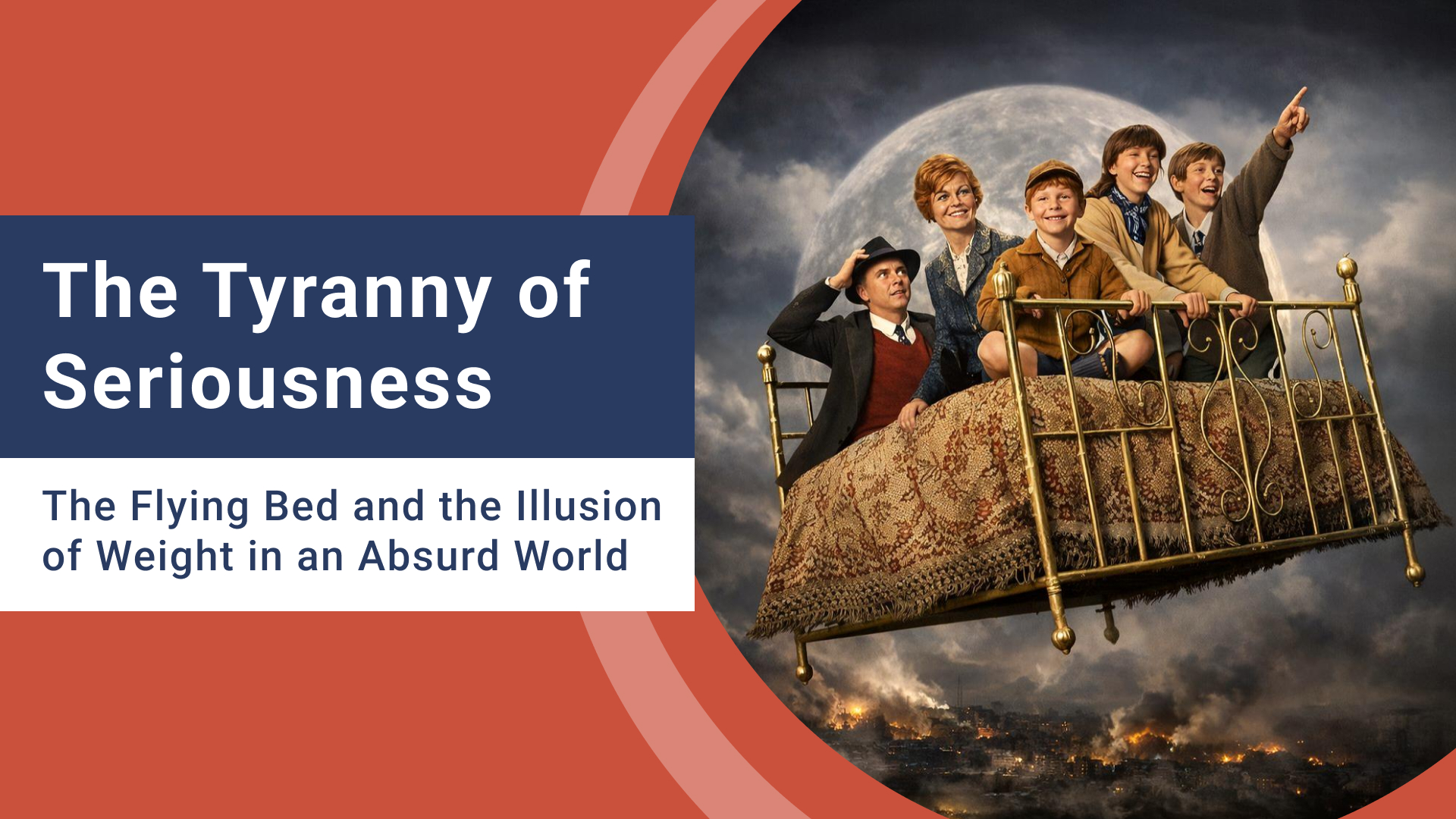
The image of the flying bed is not drawn from abstraction. It comes from Bedknobs and Broomsticks, a film set in the context of wartime Britain, where the disruption of ordinary life is already present. Children have been displaced from their homes and sent to the countryside for safety, carrying with them the instability and uncertainty of a world shaped by forces beyond their control. They find themselves in the care of a woman who is in the process of learning magic, not as a master of it, but as someone experimenting, attempting, and often failing. What she possesses is not certainty, but fragments, partial knowledge, and incomplete capability. Among these fragments is an ordinary object, a bedknob, which becomes the key to something unexpected.
When the bedknob is turned with intention, the bed does not remain what it was. It lifts, moves, and begins to travel, not randomly, but in response to direction. It carries its occupants across physical space, over land and water, and into environments that do not follow the same rules as the world they came from. At this point, the shift is already significant. Human beings, situated in a real and historically grounded context, are now moving through the world on an object that defies physical possibility. The bed itself introduces a first layer of imagination, a departure from the constraints of ordinary reality.
Yet what follows extends this even further. At certain points, the bed does not simply transport them to another place within the same reality. It carries them across the ocean to a remote island, which becomes the gateway into an entirely different register of experience. There, the film transitions into a fully animated world, where the characters themselves become part of a cartoon-like environment. They interact with animated creatures, exaggerated landscapes, and a reality that no longer follows physical or logical constraints in any familiar sense. The shift is not subtle. It is a complete transition into a symbolic and stylised domain, where meaning is not presented directly, but expressed through distortion, play, and exaggeration.
This layering is critical to what the scene reveals. The movement is not from reality to fantasy in a single step. It unfolds across layers. First, real human beings in a real historical context. Then, an imaginative device that allows them to move beyond physical constraints. And then, within that already imaginative frame, a further transition into a fully symbolic and animated domain. This is not merely escape, nor is it a replacement of reality. It is an expansion of the space within which reality can be engaged. The children are not removed from their circumstances in any permanent sense. The war does not disappear, and the conditions that led to their displacement remain fully intact. What changes is not the external situation, but the structure through which that situation is held.
The bed becomes a vehicle for movement, not away from existence, but within it. It allows engagement without being confined to a single, rigid frame, introducing flexibility where there was previously only constraint. The environment is no longer experienced solely as something that happens to them. It becomes something they can move through, explore, and relate to differently, even if only temporarily. This shift is subtle but profound, as it does not deny reality but alters the way in which reality is accessed and carried.
It would be easy to dismiss this as fantasy designed to soften difficulty, a cinematic device intended to make hardship more palatable. Yet that reading remains incomplete. The significance of the flying bed is not found in the presence of magic itself, but in what that magic enables. It introduces a shift in orientation, a loosening of constraints, and a way of holding reality that does not collapse under its weight. What appears as lightness is not avoidance, but a different mode of engagement.
This context is essential. The metaphor is not situated in comfort or triviality, but in a world already shaped by instability and uncertainty. Nothing is softened at the level of fact, and nothing about the external conditions is resolved. What changes is how that reality is accessed, how it is engaged, and how much of it can be carried without fragmentation. The flying bed, in this sense, is not significant because it removes difficulty, but because it reveals a way of remaining in contact with reality without becoming fixed under it.
The Flying Bed
While the previous section grounds the metaphor in a concrete scene, what it reveals is not limited to that moment or that film. What becomes visible through the image of the flying bed is a structural movement that extends beyond its cinematic expression.
What is at stake is not the presence of magic, but the shift in how reality is engaged. The scene illustrates that when the ordinary ways of relating to the world become insufficient, particularly under conditions of instability, uncertainty, or pressure, alternative modes of engagement can emerge. These modes do not replace reality, nor do they deny it. They alter the conditions under which it is held.
This is where the significance of the flying bed begins to deepen. It is not important because it allows movement across space, but because it enables movement within experience itself. The rigidity of circumstance is no longer absolute. The same conditions remain, yet the way they are accessed and carried changes. What was previously fixed begins to loosen. What felt inescapable becomes, at least partially, navigable.
This shift cannot be reduced to escapism. While it may appear as a departure from reality, it is in fact a reconfiguration of the relationship to it. The individual is not removed from existence, but is no longer confined to a single frame through which that existence must be interpreted. This introduces flexibility where there was previously compression, and movement where there was previously stagnation.
Seen in this way, the flying bed is not a narrative device, but a representation of a broader capacity. A capacity to remain in contact with reality without being fully constrained by the initial structure through which that reality presents itself. It points to the possibility that engagement does not require rigidity, and that contact with what is real does not necessitate collapse under its weight.
The question that follows is not whether such a mechanism exists in literal terms. It is whether, in moments where reality becomes dense, contradictory, or even absurd, there are capacities that function in a similar way. Not by denying what is, but by altering how it is held. Not by leaving the world, but by moving within it differently. And if such capacities exist, where do they sit in relation to awareness, to sense-making, and to the broader architecture through which we engage with reality?
Distinctions: Awareness and Meta-Awareness
At this point, it becomes necessary to introduce a distinction that is often blurred, yet structurally critical. Many conversations collapse awareness and meta-awareness into the same thing, treating them as different intensities of a single capacity. They are not. They operate at different levels, and more importantly, they perform different functions within how human beings come into contact with and relate to reality.
Awareness, as articulated within the Being Framework, is the state of being intentionally conscious of your consciousness. It is directed, always about something, and serves as the primary interface through which reality is encountered. Through awareness, you register what is happening externally, what is arising internally, and what is unfolding relationally. It allows you to be attentive, responsive, and present, even in conditions of uncertainty. It is not merely noticing in a passive sense, but an active openness that enables contact with what is.
Awareness is the state of being intentionally conscious of your consciousness. It is how you relate to what you know and understand as well as what you don’t know and don’t understand. Awareness is always intentional and directed at something. It is to know and understand yourself, others and the world around you, in particular the impact of the world and others on you and the impact you have on the world and others. Awareness is your access to knowing and understanding and is required to fulfil your intentions.
A healthy relationship with awareness indicates that you have a clear understanding of your impact on others and on the world around you. You are not easily misled, coerced and/or manipulated. You are both self-aware and aware of how you are perceived by others. You are attentive, alert and rarely surprised or caught off guard. You can find your way forward despite uncertainty or not knowing, and are available to consider feedback, guidance and critique.
An unhealthy relationship with awareness indicates that you may choose to ignore or be oblivious to matters and the impact you have on others and the world around you and vice versa. You may often be confused and shocked by matters and how others respond to you and blindsided when they fail to live up to your expectations. You may deliberately choose to ignore what there is to see. Alternatively, you may freeze or find it difficult to progress in the face of uncertainty or not knowing as you are compelled to know everything before making decisions or taking action.
Reference: Tashvir, A. (2021). BEING (p. 109). Engenesis Publications.
Meta-awareness, as articulated within the Authentic Sustainability Framework and grounded in the Nested Theory of Sense-Making, operates at a different order altogether. It is not simply awareness turned inward, nor a more intense form of reflection. It is the capacity to relate to the structures through which awareness itself is functioning. Where awareness gives access to what is being noticed, meta-awareness reveals how that noticing is being shaped, organised, and stabilised into meaning.
Meta-awareness is the extent to which you notice and relate to awareness itself. Where awareness gives you access to knowing, meta-awareness highlights the quality of awareness and ensures that access is not distorted. It is the reflective capacity that allows awareness itself to remain coherent. It is not just being conscious of your thoughts, feelings and perceptions, but also recognising how your awareness is being shaped, filtered and directed. Meta-awareness lets you see not only what you are noticing, but also how you are noticing it – and the hidden influences behind that, such as your habits, past experiences, assumptions and beliefs. This quality makes awareness intentional rather than automatic or reactive. It creates the capacity to observe the lenses through which you interpret yourself, others and the world, and to orient yourself with greater clarity and coherence.
A healthy relationship with meta-awareness indicates that you can step back and examine the filters and influences shaping your perceptions. You are able to recognise when your awareness is distorted and when impulses – rather than clear insight – are driving you, enabling you to intentionally adjust your orientation as circumstances change. You remain curious about how you make sense of matters without collapsing into self-doubt. This quality also supports anticipatory learning and adaptability in any domain, from personal and relational to organisational and societal. You have the foresight to recognise subtle shifts before they become crises, the capacity to pivot constructively as conditions evolve, and the resilience to transform disruptions into opportunities for growth and renewal. Others may consider you balanced, thoughtful and proactive. They may also know you as someone who is both a seeker of and open to feedback. Your awareness serves truth and coherence rather than ego, ideology or convenience.
An unhealthy relationship with meta-awareness indicates that you either lack the capacity to question your own assumptions or you may become paralysed by endless self-analysis. You may confuse first impressions or familiar narratives with the whole truth and react rigidly rather than adapting. Alternatively, you may retreat into analysis or purely cognitive frames of reference to avoid emotional engagement, lived experience or concrete action. In both cases, you miss the chance to see how your awareness is being shaped and risk mistaking output for effectiveness, charisma for wisdom or short-term alignment for long-term coherence. Individuals and manufactured systems – from relationships, teams and businesses to institutions, governments and societies – that lack meta-awareness often only learn in moments of crisis, when adaptation is forced rather than chosen. This reactive pattern breeds fragility: instead of evolving proactively, they calcify around old assumptions, mistaking rigidity for stability. Over time, this hardening becomes entrenchment, where change is resisted until collapse is unavoidable.
This distinction is essential. Awareness engages with content, while meta-awareness engages with the conditions under which that content is made sense of. Awareness tells you what appears to be happening. Meta-awareness allows you to question whether what appears is being made sense of through distortion, bias, habit, or inherited frames. Without meta-awareness, awareness can become highly confident yet fundamentally misaligned. With meta-awareness, even partial awareness remains open, adjustable, and capable of refinement.
The confusion between the two often leads to an overestimation of clarity. People assume that because they are aware of something, they understand it accurately. Yet awareness without meta-awareness is easily captured. It becomes reactive, rigid, and embedded within the very structures of sense-making it is attempting to navigate. Conversely, meta-awareness without grounded awareness risks detachment, where analysis replaces contact and sense-making floats without anchoring in what is actually present. The two are not interchangeable, nor hierarchically reducible. They are distinct capacities that must operate together if alignment with reality is to be maintained.
A simple example makes this distinction more concrete. Imagine a leader in a team meeting noticing that one of their senior team members has become unusually quiet and withdrawn. Through awareness, the leader registers what is present. The change in behaviour is noticed. There is attentiveness to tone, posture, and participation. Something is clearly different.
From this point, sense-making begins to form. Without meta-awareness, the leader may quickly conclude that the individual is disengaged, resistant, or perhaps dissatisfied with a recent decision. The awareness is real, the observation is not fabricated, but the sense-making that follows is shaped through prior experiences, existing narratives, or unexamined assumptions. The leader may respond accordingly, perhaps by becoming more directive, confronting the individual, or withdrawing trust. In this case, awareness is active, yet it has already been captured by a structure that is not being examined.
With meta-awareness present, a different movement becomes possible. The leader still notices the same behaviour, but now also recognises that the sense-making forming around it is not neutral. Questions begin to arise. Is this change necessarily disengagement, or could it be linked to something not visible in this context? Am I interpreting this through a prior experience with similar behaviour? What assumptions am I making about what this behaviour means? The leader does not abandon awareness, but begins to examine how that awareness is being organised into sense.
This creates space. Instead of reacting immediately to a fixed sense-making, the leader may choose to inquire, to check, or to remain open to multiple possibilities. What follows is not indecision, but a more grounded form of engagement. In some cases, the initial interpretation may still prove accurate. In others, it may be entirely misplaced. The difference is that the sense-making is no longer treated as reality itself.
This example illustrates the relationship clearly. Awareness brings something into view. Meta-awareness allows the way it is being made sense of to be questioned. Without awareness, nothing is seen. Without meta-awareness, what is seen is quickly stabilised into certainty.
The same pattern does not remain confined to interpersonal situations. It scales. What begins as an unexamined act of sense-making in a meeting can, under different conditions, become a stabilised narrative in an organisation, a dominant frame in public discourse, or a collective certainty in times of crisis. The structure remains the same. Something is noticed, sense is made of it, and that sense-making is rarely brought back into question. The more pressure increases, the more quickly sense-making solidifies, and the less space there is to examine how reality is being understood in the first place.
This is where the earlier question of seriousness begins to shift. Because seriousness, as it is commonly held, often intensifies awareness while neglecting meta-awareness. It narrows focus, amplifies urgency, and demands certainty, but rarely examines the structure of perception itself. It does not question whether what is being seen is already shaped by assumptions that are no longer valid. As a result, seriousness can deepen engagement while simultaneously reinforcing distortion.
To understand where imagination, fantasy, and metaphor sit, this distinction must be clear. They do not primarily operate at the level of awareness as content. They emerge within the space opened by meta-awareness. They require a loosening of fixed perception, a willingness to move beyond literal interpretation, and the capacity to hold multiple layers of meaning without collapsing them into a single frame. Without meta-awareness, fantasy appears as distraction. With it, fantasy becomes a function through which reality itself can be re-engaged.
Awareness, Meta-awareness and the Architecture of Distortion
Within the argument developed in this article, a central question quietly operates beneath the surface: how is it that human beings can encounter something, feel its weight, respond to its seriousness, and yet remain fundamentally misaligned with what is actually real? The answer does not lie simply in ignorance, nor in a lack of intelligence, nor even in the absence of information. It lies in how reality is encountered, how it is structured, and whether that structuring is ever brought back into question.
To understand this, the earlier distinction between awareness and meta-awareness must now be extended. The difference is not merely definitional; it becomes structural when placed within the full architecture of sense-making. Awareness determines whether reality is encountered at all. Meta-awareness determines whether the way that encounter is organised remains open to examination.
Awareness, as articulated in the Being Framework, is the capacity to be in direct contact with what is present. It allows a human being to register what is happening externally, internally, and relationally without immediately collapsing that contact into explanation or justification. It precedes narrative and sense-making. In this sense, awareness is ontological. It determines whether reality is actually encountered, or whether it is filtered, avoided, or replaced before contact is established.
This is why awareness spans across the layers of objective, intersubjective, and subjective reality. It does not structure these layers; it allows them to be seen. When awareness is compromised, distortion does not begin at the level of thinking. It begins at the level of contact. What is not seen clearly cannot be made sense of coherently, regardless of how sophisticated the subsequent reasoning may appear.
Once reality is encountered, it enters the domain of metacontent, where it becomes structured into intelligibility. Here, perception is organised into cognitive maps that define what things are, mental models that explain how they work, narratives that provide continuity across time, perspectives that position the observer, domains that determine relevance, and paradigms that anchor deeper assumptions. This is where most human engagement takes place, where sense is made and action is shaped. Yet this structure does not guarantee alignment with reality. It can stabilise clarity, but it can just as easily stabilise distortion.
Meta-awareness emerges precisely at this level, not as an extension of awareness, but as a shift in what is being observed. It brings the structures of metacontent into visibility. Where awareness allows reality to be seen, meta-awareness allows the system through which reality is made sense of to become observable. It reveals the narratives shaping sense-making, the perspectives limiting or enabling perception, the domains framing judgment, and the paradigms defining what is considered valid or real.
Without this second-order visibility, these structures are not experienced as constructions. They are experienced as reality itself. Narratives harden into certainty, perspectives become fixed positions, and domains are applied without regard for their limits. The individual does not experience themselves as making sense of reality; they experience themselves as responding to it, even when what they are responding to is already structured through distortion.
This is why awareness and meta-awareness are often confused. Both can feel like forms of reflection or stepping back, yet the similarity is only experiential. Functionally, they operate on different objects. Awareness detects reality. Meta-awareness detects how that reality is being organised into sense. One operates at the level of contact, the other at the level of structure.
Their relationship is sequential yet interdependent. Awareness brings reality into view. Metacontent organises that reality into intelligible structures of sense. Meta-awareness examines and recalibrates those structures when misalignment occurs. If awareness is absent, meta-awareness operates on already distorted input, giving the illusion of insight while remaining disconnected from what is actually present. If meta-awareness is absent, awareness is rapidly captured by unexamined structures, and what is seen is immediately stabilised into sense without scrutiny. In both cases, distortion is not corrected; it is reinforced.
At this point, the role of capacity becomes central. It is not enough for these layers to exist conceptually. The question is whether they can be held under real conditions, particularly under pressure, uncertainty, and emotional intensity. Capacity determines how much reality awareness can tolerate without avoidance, how much structural complexity can be held within metacontent without fragmentation, and how effectively meta-awareness can operate without collapsing into over-analysis or disengagement. Without sufficient capacity, awareness narrows, meta-awareness becomes intermittent or disappears, and the structures of sense-making harden into rigid patterns. With greater capacity, awareness deepens, meta-awareness stabilises, and the system remains adaptive rather than fixed.
This is precisely the mechanism underlying the phenomenon explored throughout this article. When awareness is weakened, reality is only partially encountered. When meta-awareness is absent, the structures through which that encounter is made sense of are never questioned. What follows is a condition in which seriousness becomes decoupled from reality. That which carries emotional weight, urgency, or social reinforcement is treated as real, while that which does not fit the existing structure may be dismissed, regardless of its actual validity.
This is how absurdity can present itself with conviction, and how conviction can be mistaken for truth.
Where Fantasy Sits: Not Outside Reality, But Within Meta-Awareness
With the distinction between awareness and meta-awareness clarified, the place of fantasy, imagination, and metaphor can now be located more precisely. The common assumption is that fantasy sits outside reality. That it is a departure, a distraction, or at best a temporary relief from what is actually happening. This assumption is grounded in a purely literal orientation to the world, where only that which is materially present or directly observable is granted legitimacy.
From within that frame, fantasy appears secondary, optional, or even indulgent. Something to be entertained in moments of leisure, but not something to be relied upon when matters become serious. Yet this view already presupposes a limitation. It assumes that reality is exhausted by what awareness directly encounters, without accounting for how that encounter is structured, filtered, and interpreted.
When meta-awareness is present, this assumption begins to loosen. Because meta-awareness reveals that what we take to be reality is always mediated. It is shaped through layers of sense-making, through language, narratives, mental models, and implicit assumptions that often remain invisible. Once this becomes apparent, the boundary between what is considered real and what is dismissed as imaginary is no longer as rigid as it first appeared.
Fantasy, in this context, is not the opposite of reality. It is a movement within meta-awareness that allows the reconfiguration of how reality is held. It introduces flexibility into perception. It creates distance without disengagement. It enables the individual to shift frames, to explore alternative interpretations, and to momentarily suspend the constraints imposed by a single, fixed narrative.
This does not mean that fantasy replaces reality. It means that it alters the conditions under which reality is accessed. It allows the individual to see that what appears fixed may in fact be contingent. That which appears absolute may be shaped by perspective. That what feels overwhelming may be held differently when not approached through a single, compressed lens.
There are at least three functions of fantasy that become visible from this vantage point. First, fantasy reduces false seriousness. Not everything presented as urgent, critical, or meaningful carries the weight it claims. In many cases, seriousness is amplified through repetition, authority, or collective reinforcement rather than through actual depth. Fantasy introduces a subtle disruption. It exposes exaggeration. It reveals the theatrical elements embedded within what is presented as objective or necessary. In doing so, it does not trivialise reality, but it prevents the inflation of what is not grounded.
Second, fantasy expands capacity. When reality becomes dense, contradictory, or difficult to reconcile, the absence of flexibility leads to collapse. Individuals become overwhelmed, rigid, or reactive. Fantasy, operating through meta-awareness, allows multiple layers to be held simultaneously. It enables contradiction without immediate resolution. It creates room for movement where previously there was only pressure. In this sense, fantasy is not an escape from reality but an expansion of the space within which reality can be engaged.
Third, fantasy restores play. Play is often misunderstood as something trivial or immature, yet it is one of the most adaptive capacities available to human beings. It allows experimentation without immediate consequence. It allows engagement without total identification. It introduces lightness without removing depth. In environments where conditions are unstable or irrational, the ability to play becomes a way of maintaining responsiveness without collapsing into seriousness that paralyses action.
Without meta-awareness, these functions are not accessible. Fantasy collapses into escapism, metaphor becomes decoration, and imagination loses its structural role. With meta-awareness, however, these same elements become tools. Not tools for avoiding reality, but for engaging it more coherently. They allow the individual to move across layers of sense-making, to question the given without immediately rejecting it, and to remain in contact with what is happening without being fully captured by it.
The flying bed, then, is not merely a symbol of escape. It is an illustration of what becomes possible when the rigidity of perception loosens. The children are still within the conditions of war, yet they are no longer confined to a single way of experiencing it. The bed does not remove the world. It repositions them within it. And that distinction is precisely where fantasy finds its place, not outside reality, but within the expanded space opened by meta-awareness.
Imagination vs Escapism: A Necessary Distinction
At this stage, a critical distinction must be made; otherwise, everything that has been said about fantasy risks being misunderstood or misapplied. The distinction is between imagination as a function within meta-awareness and escapism as a collapse of awareness altogether. These two are often conflated because, on the surface, both involve a movement away from immediate conditions. Yet structurally, they are fundamentally different.
Escapism is a withdrawal from reality. It is not a reconfiguration of relationship, but a suspension of engagement. When escapism is active, awareness itself begins to narrow or switch off. The individual is no longer in contact with what is present in a meaningful way. Instead, they seek relief, distraction, or emotional insulation. The movement is driven by overwhelm, fear, or an inability to hold the weight of what is being encountered. The result is not expansion, but reduction. Reality is not being reinterpreted. It is being avoided.
Imagination, by contrast, does not require the abandonment of awareness. It operates in the presence of awareness and, when grounded in meta-awareness, actually depends on it. Imagination allows the individual to remain in contact with reality while loosening the rigidity with which it is being held. It introduces alternative frames, symbolic representations, and non-literal pathways through which meaning can be explored. It does not deny what is happening. It changes how what is happening is engaged.
This is where the earlier distinction between awareness and meta-awareness becomes operational rather than conceptual. Awareness alone can recognise that something is difficult, overwhelming, or absurd. But without meta-awareness, the response to that recognition tends to polarise. Either one becomes overly serious, rigid, and consumed by the situation, or one withdraws into escapism. Both responses are understandable. Both are limited.
Meta-awareness introduces a third possibility. It allows the individual to notice not only what is happening, but how they are relating to it. It allows them to see when their awareness is becoming compressed, when seriousness is turning into rigidity, or when the impulse to disengage is beginning to take over. Within that space, imagination can emerge as a functional response rather than a defensive one.
The distinction can be stated simply, but it must be understood precisely. Escapism abandons reality. Imagination repositions the individual within it. Escapism reduces contact. Imagination preserves contact while expanding interpretive space. Escapism is driven by the need to avoid. Imagination is enabled by the capacity to engage without being overwhelmed.
This is why not all forms of fantasy are equal. The same activity, viewed externally, may appear identical. Watching a film, telling a story, engaging with a metaphor. Yet internally, the orientation can be entirely different. One person may be using it to disconnect, to numb, to avoid. Another may be using it to reflect, to explore, to reconfigure their relationship to what is unfolding. The difference is not in the content. It is in the structure of awareness and meta-awareness through which that content is engaged.
In environments where reality becomes increasingly complex, contradictory, or even irrational, this distinction becomes more than theoretical. It becomes practical. Without it, individuals oscillate between over-seriousness and disengagement. With it, there is the possibility of remaining present while not being constrained by a single, fixed interpretation of what is present.
The relevance of this to the earlier scene is now clearer. The flying bed does not remove the children from the war. It allows them to move within their circumstances differently. If it were purely escapism, it would sever their connection to what is happening. Instead, it creates a different mode of engagement, one that retains awareness while expanding the space in which that awareness operates. And that is precisely the function of imagination when it is grounded in meta-awareness rather than driven by the need to escape.
The Role of Metaphor: What the Flying Bed Is Actually Doing
If we return more carefully to Bedknobs and Broomsticks, the flying bed is not just a magical device that transports characters from one place to another. It is operating as a metaphor in motion. Not a decorative metaphor, but a structural one. It is doing something that language alone often fails to do. It is allowing multiple layers of reality to be held at once without collapsing them into a single frame.
The children are still in wartime England. That condition does not disappear. The threat, the displacement, and the instability all remain. Yet at the same time, they are travelling across oceans, entering animated worlds, encountering exaggerated forms of order and disorder that do not obey the same rules as their immediate environment. These are not random sequences. They are distortions, amplifications, and reconfigurations of reality. And in that distortion, something becomes visible that would otherwise remain hidden.
This is precisely what metaphor does when it is functioning properly. It does not replace reality. It refracts it. It bends it just enough to reveal structure. A purely literal engagement would keep everything fixed within its immediate presentation. War is war. Displacement is displacement. Fear is fear. But when those same elements are engaged through metaphor, they can be seen from angles that are otherwise inaccessible. The animated island is not separate from reality. It is a re-expression of it, freed from the constraints of literal representation.
This is where the issue with newer modes of thinking begins to surface. There is an increasing tendency toward literalism. A preference for what is directly stated, immediately verifiable, and concretely defined. While this has its place, it comes at a cost. The capacity to move across layers of meaning begins to weaken. Metaphor is either taken too literally and misunderstood or dismissed entirely as irrelevant. In both cases, something important is lost.
Without metaphor, meta-awareness loses one of its primary tools. Because meta-awareness requires the ability to see not just what is presented, but how it could be otherwise. It requires the capacity to shift frames, to hold symbolic representations, to recognise that a single expression can carry multiple meanings simultaneously. Metaphor enables that movement. It allows awareness to remain in contact with reality while not being confined to a single interpretation of it.
The flying bed, in this sense, is not an escape from the war. It is a way of metabolising it. It allows the children to engage with fear, uncertainty, and instability in a form that is not overwhelming. The exaggeration, the play, the distortion are not distractions. They are mechanisms through which something heavy becomes workable. Not by reducing its importance, but by altering how it is held.
This is also why metaphor often appears where direct language fails. In situations that are too complex, too contradictory, or too emotionally charged to be addressed in a purely literal way, metaphor provides access. It creates a bridge between what is known and what cannot yet be fully articulated. It allows movement without requiring immediate resolution.
If this capacity is lost, the consequences are not trivial. Reality becomes flattened. Everything must be taken at face value. Nuance disappears. Irony is missed. Contradictions become intolerable rather than informative. In such a landscape, seriousness increases, but understanding decreases. Because seriousness without the ability to move across layers becomes rigidity.
The film, whether intentionally or not, demonstrates this with clarity. The bed does not teach the children to ignore reality. It teaches them to move within it differently. To see that what appears fixed may not be absolute. That which feels overwhelming may be approached from another angle. And that meaning is not always found by staying within the confines of a single, literal frame.
Metaphor, then, is not an optional aesthetic layer added to communication. It is a functional capacity within meta-awareness. And the flying bed is one of its clearest expressions. Not because it is fantastical, but because it reveals something real that cannot be accessed directly without it.
Modern Wars, Modern Beds: From Blitz to the Feed
If we return again to Bedknobs and Broomsticks, but this time hold it more firmly in its historical context, something sharper begins to emerge. The children are not simply in a generic moment of difficulty. They are in the middle of World War II. They have been displaced because cities are being bombed. Their lives have already been interrupted by forces beyond their control. The instability is not theoretical. It is immediate, material, and existential.
In that environment, the flying bed is not a luxury. It is not entertainment in the casual sense. It becomes a way of holding reality without being consumed by it. The children do not stop knowing that war exists. They do not forget what is happening. But they are no longer confined to a single, overwhelming frame of experience. The bed creates movement where there would otherwise be only compression. It allows them to remain psychologically and existentially available in a context that could easily collapse them.
Now shift to the present. War has not disappeared. It has changed form, expanded in visibility, and multiplied in interpretation. Whether it is conflicts in Eastern Europe, the Middle East, or elsewhere, the modern individual is exposed to war not only through direct experience but through continuous streams of images, commentary, and competing narratives. The battlefield is no longer only physical. It is informational, psychological, and symbolic.
In this environment, something interesting happens. The equivalents of the flying bed have multiplied. They are no longer singular or obvious. They appear as platforms, feeds, narratives, and mediated experiences that allow individuals to move across different representations of reality. At any given moment, a person can shift from footage of destruction to humour, from political analysis to personal updates, from tragedy to distraction. The movement is constant. The transitions are immediate.
The question is not whether these are forms of escape. Some are. The more precise question is whether they function as capacity-expanding mechanisms or as numbing loops. Whether they allow individuals to remain in contact with reality while not being overwhelmed, or whether they gradually erode that contact altogether. The distinction is not in the medium itself. It is in how it is engaged, and from what structure of awareness and meta-awareness.
In the absence of meta-awareness, the modern “bed” becomes a trap rather than a tool. The constant movement across content does not expand capacity. It fragments it. Individuals move rapidly between frames without integrating them. Seriousness spikes and collapses in cycles. Outrage, humour, despair, and indifference begin to coexist without coherence. The result is not flexibility, but disorientation.
With meta-awareness, however, the same environment can be engaged differently. The movement across frames becomes intentional rather than reactive. The individual can recognise when something is being amplified, when a narrative is shaping perception, when emotional responses are being triggered without sufficient grounding. In that space, imagination and metaphor regain their function. They are not consumed passively. They are used actively to interpret, to reframe, and to maintain a relationship with reality that is neither rigid nor detached.
This brings us back to the earlier distinction between imagination and escapism, now situated within contemporary conditions. The children in wartime Britain did not have access to infinite streams of mediated reality. Their “bed” was singular, intentional, and shared. Today, the proliferation of such mechanisms creates both possibility and risk. The possibility of expanding capacity across multiple layers of reality. The risk of losing coherence entirely.
The parallel is not exact, but it is instructive. In both cases, individuals are faced with conditions that exceed ordinary sense-making. In both cases, there is a need for movement beyond a single, fixed frame. The difference lies in the structure of engagement. The flying bed in the film is guided, contained, and purposeful. Modern equivalents are often unbounded, continuous, and driven by external incentives.
The question that follows is not whether we should disengage from these environments. That would be neither practical nor desirable. The question is whether we can engage them with sufficient meta-awareness to prevent collapse into either over-seriousness or fragmentation. Whether we can retain the capacity to move across layers of reality without losing coherence. And whether imagination, metaphor, and even elements of fantasy can still function as tools for holding complexity, rather than mechanisms for avoiding it.
In that sense, the relevance of the film extends beyond nostalgia. It offers a simple but precise illustration. In the midst of war, the problem is not only what is happening. It is how it is held. The children are not protected by the absence of reality, but by their capacity to relate to it differently. And in a world where the scale and complexity of what is happening continues to expand, that capacity becomes increasingly central.
Where Imagination, Awareness and Meta-Awareness Meet
At this point, the elements can be brought together without collapsing their distinctions. Awareness gives access to reality. Meta-awareness shapes the quality and structure of that access. Imagination, fantasy, and metaphor emerge within the space that meta-awareness opens. They are not substitutes for reality, nor are they ornaments added to it. They are functional capacities that determine whether reality can be held without distortion or collapse.
When awareness operates without meta-awareness, engagement with reality tends to narrow. What is seen is taken as given. What is presented is accepted at face value. In stable conditions, this may be sufficient. In unstable or contradictory environments, it becomes a liability. Seriousness intensifies, but clarity does not necessarily follow. Individuals may feel more certain while becoming less accurate. The weight of what is encountered increases, but the capacity to move within it decreases.
When meta-awareness is present, awareness itself becomes examinable. The individual can notice the lenses through which perception is occurring. They can detect when narratives are shaping interpretation, when emotional responses are being amplified, and when apparent coherence is masking deeper inconsistency. This does not remove uncertainty. It changes how uncertainty is related to. It creates space where previously there was only pressure.
It is within this space that imagination becomes functional. Not as a departure from reality, but as a way of reorganising the relationship to it. Imagination allows multiple representations to coexist without immediate resolution. It allows symbolic and literal layers to interact. It enables movement across perspectives without collapsing into relativism. It introduces flexibility without requiring disengagement.
The flying bed provides a concrete illustration of this synthesis. The children are aware of their circumstances. They are not disconnected from the fact of war. Yet through a mechanism that operates metaphorically, they are able to reposition themselves within those circumstances. The bed does not change the external conditions. It changes the internal configuration through which those conditions are experienced. That shift is not arbitrary. It reflects a change in how awareness is structured.
In contemporary contexts, the same dynamic is present, though less visible. Individuals are continuously exposed to complex, layered, and often conflicting representations of reality. Awareness alone is insufficient to navigate this landscape coherently. Without meta-awareness, perception becomes reactive. Without imagination, it becomes rigid. The combination of the two allows for a form of engagement that is neither overly serious nor dismissive.
This synthesis also clarifies a common misunderstanding. The alternative to seriousness is not triviality. The alternative to literalism is not falsehood. The alternative to certainty is not confusion. What is being introduced is a different mode of coherence. One that does not depend on compressing reality into a single frame, but on maintaining the capacity to move across frames without losing orientation.
Imagination, in this sense, is not opposed to truth. It supports the conditions under which truth can be approached without distortion. Meta-awareness ensures that imagination does not drift into fabrication. Awareness ensures that imagination remains grounded in what is present. Together, they form a structure that allows reality to be engaged in a way that is both flexible and coherent.
The absence of any one of these elements leads to predictable outcomes. Awareness without meta-awareness leads to rigidity or reactivity. Meta-awareness without awareness leads to detachment or over-analysis. Imagination without either leads to escapism. The presence of all three creates the possibility of remaining in contact with reality while not being confined by a single interpretation of it.
This is not an abstract formulation. It has practical implications for how individuals relate to complexity, uncertainty, and contradiction in everyday life. It affects how decisions are made, how narratives are interpreted, and how meaning is constructed. It determines whether seriousness becomes a burden or whether depth can be maintained without losing flexibility.
In that sense, the question is not whether imagination should be taken seriously. It is whether seriousness, as commonly practised, can sustain engagement with reality without the support of imagination and meta-awareness. And the evidence, both historical and contemporary, suggests that it cannot.
The Weight of Reality and the Lightness of Movement
There is a tendency to assume that maturity requires gravity. That to understand the world properly, one must carry it with weight, speak about it with intensity, and approach it with a tone that signals importance. This assumption is rarely examined. It is reinforced in institutions, in public discourse, and in how individuals relate to their own lives. Seriousness becomes a posture, and over time, that posture is mistaken for depth.
What has been explored here points in a different direction. Not away from reality, and not away from responsibility, but away from the idea that heaviness is the only way to remain in contact with what matters. The distinction between awareness and meta-awareness makes this visible. Access to reality alone is not sufficient. The quality of that access determines whether what is encountered can be held coherently or collapses into distortion. Within that structure, imagination, fantasy, and metaphor are not distractions. They are part of what allows that coherence to be sustained.
The image of the flying bed, situated within the conditions of war, brings this into view in a way abstraction cannot. The children are not removed from difficulty. They are not protected by illusion. What changes is their relationship to what is present. The bed does not deny reality. It introduces movement within it. It allows engagement without compression into a single, overwhelming frame.
In contemporary life, the conditions differ in form but not in structure. Reality presents itself as complex, layered, and often contradictory. The common response is an escalation of seriousness, an attempt to stabilise understanding through intensity and certainty. Yet this often produces the opposite effect. Without meta-awareness, seriousness narrows perception and reinforces unexamined structures. Without imagination, it removes the possibility of movement, leaving individuals either rigidly attached or disengaged altogether.
The alternative is not to reject seriousness, but to reposition it. Seriousness has its place, but it cannot carry the full burden of relating to reality. Depth does not require heaviness, and clarity does not require rigidity. What is required is the capacity to remain in contact with what is real while allowing flexibility in how it is held. This is where imagination becomes structurally relevant, not as escape, but as a condition for sustained engagement without collapse.
It may seem counterintuitive that something as simple as a flying bed could reveal such a structure. Yet this is precisely the function of metaphor when it is properly engaged. It does not decorate reality. It exposes aspects of it that remain inaccessible through literal interpretation alone. It creates a shift in perspective through which what was previously implicit becomes visible. The significance of the image lies not in its fantasy, but in what it makes possible to see.
Some will continue to equate seriousness with responsibility, and lightness with avoidance. Others will begin to recognise that the ability to move, to reframe, and to engage across layers is not a weakness, but a form of capacity. The difference is not determined by circumstance, but by the structure through which reality is encountered and held.
In the end, the question is not whether reality is heavy. In many cases, it is. The question is whether we know how to carry that weight without becoming fixed under it. Whether we can remain in contact without becoming rigid, and allow for movement without losing coherence.
Because sometimes, the difference between collapse and capacity is not found in greater effort or deeper seriousness. It is found in the ability to shift how reality is held.
And occasionally, that shift begins with something that, at first glance, appears almost trivial.
A bed that flies.