

Transformation Is Not Delivered to a Passive Recipient
Coaching rests upon a powerful conviction: human beings are transformable. People can develop capacities previously unavailable to them, revise the meanings through which they interpret their lives and reconstruct patterns of participation. They can become more able to meet what reality requires rather than remaining permanently imprisoned within their present habits, limitations or circumstances.
Transformability should not, however, be confused with inevitability. A person does not stand outside their current way of Being and evaluate transformation from a neutral position. They encounter every developmental opportunity through an already organised world in which history, identity, relationships, expectations, fears and capacities shape what they notice, what they can tolerate and what they believe is possible.
The person who needs to change is also the person who must recognise that change is needed. The person whose judgement is constrained must judge whether developmental support is worthwhile, while the person whose agency has weakened must choose to exercise agency. Someone who struggles to sustain attention must participate in a process requiring sustained attention.
Coaching cannot therefore be understood as something the practitioner simply delivers to a client. The client is not raw material waiting to be transformed through professional expertise. Their participation is part of the mechanism through which coaching either becomes developmental or remains merely conversational.
The coach may bring a coherent method, powerful distinctions, experience, care and considerable skill. None of these can replace the participant whose transformation is at stake.
A Reconstructive View of Coaching
The Reconstructive School begins from participation. Human beings do not stand outside reality as detached observers. We inherit language, histories, institutions, relationships, expectations and circumstances that preceded us. We participate within worlds we did not create from nothing, yet our participation helps determine how those worlds continue and what becomes possible within them.
Reconstruction does not mean demolishing everything inherited or returning to an imagined pure past. It means recognising the gap between our present form of participation and what reality requires, then developing the capacity to participate more truthfully, responsibly and generatively.
This changes the central coaching inquiry. The coach asks not only, ‘What outcome do you want?’ but also, ‘How are you presently participating, what is that participation producing and what must be reconstructed for another possibility to emerge?’
The client’s difficulty is not sitting on a table between coach and client as an object awaiting repair. The client is already participating in the situation, often without fully recognising how, and the same participation may then appear inside the coaching relationship.
Someone who habitually gives away agency may ask the coach to decide for them. Someone who avoids responsibility may experience challenge as accusation. A client whose identity depends upon competence may perform insight rather than reveal uncertainty, while someone who struggles to sustain attention may participate enthusiastically during a session and disappear from the work between sessions.
The coaching relationship becomes another field in which the person’s wider way of participating appears.
This does not mean every client's difficulty should be reduced to personal contribution. People are shaped by systems, relationships and circumstances they did not create. They may face genuine injustice, constraint, grief or instability. A reconstructive approach does not deny context. It asks how the person is participating within that context, what remains possible and which capacities are required for a more truthful response.
Capacity as a Relationship
Capacity is often discussed as though it were a fixed quality contained within the individual. Somebody is described as capable or incapable in general terms. Capacity Discourse offers a more precise, contextual and relational account: capacity concerns what a participant is able to bring to participation, while incapacity concerns the gap between what participation requires and what the participant can presently bring.
A person may be highly capable in one domain and significantly incapacitated in another. A leader may possess strong commercial judgement while being unable to remain present during emotional conflict. A coach may be conceptually sophisticated but unable to challenge a client because they fear losing approval. Someone may display courage professionally while becoming avoidant within intimate relationships.
Capacity therefore concerns the relationship amongst the participant, the demands of the situation and the conditions within which participation occurs.
This allows the coach to name a real gap without reducing the person to it. The person may not presently be able to bring what the situation requires, and that gap may be producing serious consequences. It is nevertheless not the totality of who they are, nor does it establish that the limitation is permanent.
The developmental inquiry becomes: what capacity must be expanded for more capable participation to become possible?
This is more useful than asking whether the person is motivated enough. Motivation may be present and remain insufficient. Insight or opportunity may also be available without becoming enough. The person can understand what is required and still remain unable to bring it consistently.
Need Is Not the Same as Availability
A fundamental distinction follows: a person’s need for transformation is not the same as their availability for transformation.
Need concerns the gap between present participation and what the person’s life, role, relationships or circumstances require. Availability concerns whether they can recognise that gap, remain in contact with it and participate in its reconstruction.
A person may profoundly need development while remaining unavailable for it. A leader may urgently need to understand how their defensiveness is damaging trust, yet remain unable to hear feedback without experiencing it as an attack. A professional may need to develop greater agency while interpreting every difficult circumstance as evidence that meaningful action is impossible. Someone may need to reorganise their priorities while repeatedly allowing urgency and distraction to consume their attention.
From outside, the need may appear obvious. The person living within it may experience the situation very differently because present capacity shapes what becomes visible, what can be tolerated and which explanations remain acceptable.
The more threatening the gap becomes to identity, status or self-respect, the more strongly some people protect themselves from recognising it. A minor contradiction can be admitted, while one that threatens the person’s entire story may provoke blame, denial, withdrawal or elaborate justification.
Need and availability can therefore move in opposing directions. As the need for transformation grows, defensive participation may become more entrenched.
The Threefold Obstruction
The paradox becomes clearer when transformation is considered through three movements: recognising, choosing and sustaining. A developmental process depends upon all three, while incapacity may obstruct each of them differently.
Recognising What Requires Transformation
Before someone can intentionally transform, something about their present participation must become visible. Recognition becomes difficult where what must be seen threatens identity, innocence, status or belonging.
A leader may acknowledge that their team is disengaged while remaining unable to recognise how controlling behaviour contributes to the problem. They see the consequence but not their participation in producing it. A person may recognise repeated relationship breakdowns while locating every cause in the unreliability of others. Their account may contain truth, yet their withdrawal whenever vulnerability appears remains invisible.
A professional may seek confidence coaching because their career has stalled, while the deeper issue concerns a life organised around proving worth through achievement. More confidence techniques could strengthen rather than reconstruct the established pattern.
The presenting topic can therefore function as partial recognition. The client sees enough to seek support but not enough to encounter the deeper structure.
This does not always involve dishonesty. Human perception is selective. People recognise what fits their existing maps more readily than what threatens them. A person whose identity is organised around responsibility may struggle to see when responsibility has become control. Someone who understands themselves as caring may not recognise when care has become rescue.
Recognition also requires emotional capacity because seeing something is not only a cognitive event. The person must remain present with what the recognition means. A leader who sees their contribution to dysfunction may have to tolerate shame. A parent who recognises controlling behaviour may need to grieve its effects. A coach who sees that they have been rescuing clients may have to question an identity built around being helpful.
Some people do not lack information. They lack the capacity to remain in an honest relationship with what the information reveals.
Choosing Transformation
Recognition does not guarantee choice. A person may understand what is happening and still decline the process through which something different could emerge.
Transformation carries costs. It may require time, money, discomfort, uncertainty, practice or the loss of a familiar identity. It can disturb relationships that have adapted to the person’s current way of participating and require them to surrender an explanation that has protected their innocence or justified years of inaction.
People frequently want the outcome without wanting the conditions through which it becomes possible. A leader wants a self-managing team but does not want to tolerate the mistakes through which team members learn. A coach wants to build a practice but does not want to experience the vulnerability of inviting people into their work. Someone wants intimacy while avoiding exposure, while another wants meaningful work without the uncertainty involved in constructing it.
The contradiction does not make the desire false. Human beings carry competing commitments. They want freedom and certainty, intimacy and protection, agency and innocence. They want transformation while also wanting to preserve the self that transformation will disturb.
The choice is often between the familiar cost of remaining as one is and the unfamiliar cost of participating differently. The familiar cost may be painful, but it is organised. People know how to inhabit exhaustion, resentment, passivity or disappointment. Transformation introduces a future that cannot yet be inhabited with the same familiarity.
This is why a person may say, ‘It is not the right time.’ Sometimes that is entirely true. Illness, grief, financial pressure, caregiving responsibilities and serious existing commitments may rightly take precedence. At other times, ‘not the right time’ means, ‘I do not presently know how to bear what this participation would require.’
The coach should not assume which interpretation is correct. The task is to create enough space for honest discernment.
Sustaining Transformation
Some people recognise the need and choose to begin. The obstruction appears later, when transformation must be sustained.
Beginnings are often supported by hope, novelty, belonging and the presence of the coach. The person feels seen, new distinctions create relief and a future that appeared closed becomes imaginable. Then ordinary life returns.
The client re-enters the same workplace, relationships and pressures within which the original pattern developed. The insight remains real but is not yet durable.
A leader understands that control is driven by fear, then takes work back from the team during the next pressured week. A client recognises that they avoid difficult conversations, commits to speaking honestly and postpones the conversation when anxiety appears. A coach understands the distinction between support and rescue, then begins supplying answers and additional reminders when a client becomes distressed.
The person may conclude that the coaching did not work. What may have occurred is that insight did not become capacity.
Transformation requires repetition, consequence, learning, refinement and stabilisation. The person must continue when motivation is lower, established patterns return and the environment does not naturally support the new participation.
Sustenance also reveals whether the person has become the source of participation or remains dependent upon an external source. A coach can provide clarity, while a group can provide accountability and a programme can provide rhythm and belonging. These supports are legitimate because human beings develop relationally.
The question is whether support expands participation or replaces it. Can the person increasingly recognise the gap without waiting for the coach? Can they ask for support without surrendering agency, learn from consequence without immediate defence and return after interruption?
This is where transformation begins to become owned.
The Participatory Threshold
Every transformational process contains a participatory threshold. This is the minimum degree of honesty, attention, agency, responsibility and sustained engagement required for the work to become developmental.
The threshold need not be high at the beginning. Clients do not need to arrive fully aware, confident or disciplined. If they already possessed all the relevant capacities, much of the coaching would be unnecessary.
They must, however, bring enough participation for the relationship to have something to work with. They need enough honesty to acknowledge that something is not working, enough openness to consider that their own participation may be relevant, enough agency to undertake a real action and enough responsibility to return and examine what occurred.
Without this minimum participation, coaching becomes something performed around the person rather than undertaken with them. The coach then begins carrying both sides of the relationship.
When the client does not bring clarity, the coach provides increasingly elaborate interpretations. When they do not bring action, the coach designs more exercises. When they do not bring attention, the coach sends more reminders. When they do not bring belief, the coach becomes the primary source of hope.
The process may appear active, but its centre has shifted. The coach is carrying the transformation while the client remains adjacent to it.
Support can help someone cross the participatory threshold. It cannot cross the threshold for them.
Support Without Substitution
One of the most important distinctions within the Thrive Method is the difference between support and substitution.
Support helps the person bring more of themselves to participation. Substitution supplies what the person is not bringing and then mistakes the resulting movement for development.
A coach can offer presence, distinctions, challenge, structure, encouragement and accountability. They can help the client design practices, interpret consequences and recognise possibilities, but they cannot provide ownership on the client’s behalf.
The principle can be stated simply: we help people participate, but we do not participate for them.
This requires coaches to notice when care has become compensation. Repeated chasing, excessive reminders, continual redesign of commitments or indefinite availability without reciprocal engagement may all become substitution.
The coach’s support should strengthen participation rather than conceal its absence.
Between Direction and Abdication
The distinction between supporting and substituting raises another contested question within coaching: how much may the coach contribute?
One side of the profession moves too quickly towards instruction. The coach identifies the problem, determines the solution and tells the client what to do. Questions become a brief prelude to recommendations the practitioner has already formed. The client’s circumstances are interpreted through the coach’s experience, preferences and assumptions, while coaching gradually becomes mentoring, consultancy or advice without acknowledging that the relationship has changed.
This approach can produce action, particularly where the coach possesses relevant experience and the client wants guidance. It can also make the client increasingly dependent upon the coach’s judgement. The person may comply without developing the perception, discernment and responsibility required to make comparable decisions independently.
What appears to be progress may belong primarily to the coach’s capacity rather than the client’s expanding participation.
The danger is real, but the reaction against it has produced another serious distortion. Within some parts of the coaching profession, non-directivity has acquired an almost doctrinal status. Coaches are taught that their role is to ask questions while contributing as little as possible from their own perception, knowledge or experience. The client must discover everything independently. An observation from the coach is treated as overly directive, offering a distinction is regarded as contaminating the client’s thinking and bringing the coachee’s attention to something potentially important can become almost taboo.
This position is sometimes followed with a rigidity resembling allegiance to an orthodoxy rather than thoughtful professional judgement. Coaches learn a narrow image of purity in which anything beyond reflective listening and open questions risks being declared ‘not coaching’. They become anxious about offering a perspective even where something significant is occurring in plain view.
The result may appear respectful of agency while becoming a form of professional abdication.
A coach may notice a contradiction between what the client says and how they are participating, yet avoid naming it. They may recognise a pattern appearing repeatedly across the conversation but continue asking around it, hoping the client will eventually make the same connection. They may possess a distinction capable of making the situation more intelligible and withhold it because contributing anything from the coach is treated as an intrusion.
The client is then left to perceive through the very structures that may be constraining perception.
This becomes particularly problematic in light of the paradox of transformational participation. If the person’s present capacity limits what they can notice, a method insisting they must independently notice everything may quietly collude with that incapacity. The coach protects themselves from appearing directive while the client remains enclosed within the cognitive map, emotional protection or way of Being that makes the relevant reality difficult to perceive.
Questions alone do not guarantee agency, just as withholding the coach’s perception does not guarantee respect. A leading question can be more manipulative than a clearly stated observation. A sequence of apparently open questions can steer the client towards the practitioner’s preferred conclusion while preserving the fiction that the client arrived there independently. Conversely, an honest contribution offered transparently can preserve far more agency than covert direction concealed within questioning.
The issue is not whether the coach contributes. Every coach contributes. Questions direct attention, silences communicate significance and choices concerning what to reflect, pursue or leave untouched shape the conversation. Even radical non-directivity is a form of participation rather than its absence.
The more useful inquiry is how the coach can contribute without colonising the client’s participation.
The Thrive Position
The Thrive paradigm rejects the false choice between telling the person what to do and pretending the coach has nothing meaningful to bring.
The Thrive coach is neither an authority who determines the client’s life nor an empty mirror reflecting only what the client already sees. The coach is a disciplined participant within a developmental relationship.
They bring presence, perception, distinctions, methodological knowledge, contextual understanding and the capacity to notice patterns the client may not yet recognise. They also remain aware that their interpretation is partial, situated and fallible.
The client retains authorship of their choices. The coach retains responsibility for the integrity, relevance and timing of their contribution.
Bringing Attention Without Commanding Conclusion
A coach may direct attention without dictating what the client must conclude. They might say, ‘You have spoken several times about wanting greater autonomy, yet each option you consider depends upon somebody else giving you permission. I wonder whether that relationship is worth examining.’
The coach contributes an observation rather than announcing the final truth about the client. The observation creates an opening the person can examine, reject, refine or understand differently.
Contrast this with, ‘Your problem is that you give away your authority. You need to stop waiting for permission.’ The second statement closes the inquiry and moves towards prescription. It may occasionally contain truth, but it places the coach’s judgement above the client’s process of discernment.
Thrive coaching brings something into view while allowing the meaning of what has been noticed to remain open to investigation.
Offering Perception as Contribution, Not Verdict
A coach’s insight should be offered as a disciplined contribution rather than an unquestionable diagnosis. They may say, ‘I am noticing a tension between what you say you want and how you are organising your choices,’ or, ‘One interpretation available to me is that comparison is shaping what you believe is possible.’
Other useful formulations include, ‘I want to place something into the conversation for us to examine,’ and, ‘This may not fit, but I wonder whether responsibility and blame have become fused for you.’
Such language should not become empty politeness. Excessive qualification can weaken an observation until it no longer reaches the client. The purpose is not timidity. It is to distinguish perception from certainty.
The coach takes responsibility for what they see while preserving the client’s responsibility to examine it.
Contributing Distinctions That Expand Perception
Clients cannot always recognise what they cannot yet distinguish. A person may experience repeated discomfort without being able to differentiate fear from shame, responsibility from blame, care from rescue or commitment from compliance. Asking repeatedly what they notice may generate more description without producing greater discernment.
The coach can introduce a distinction: ‘There may be an important difference here between taking responsibility for your participation and accepting blame for everything that happened. At the moment, those two appear to have become fused.’
This does not tell the client which decision to make. It expands the perceptual field within which a more responsible decision may become possible.
Thrive coaches should not be ashamed of bringing conceptual resources into the relationship. The Being Framework, Capacity Discourse and the Thrive Method exist partly because distinctions can make previously unavailable realities perceivable.
The ethical question concerns whether the distinction serves the client’s encounter with reality or merely recruits them into the coach’s preferred conceptual system.
Making Role Transitions Explicit
There are circumstances in which the client genuinely seeks advice, technical guidance or mentoring. The coach may also possess knowledge that would be irresponsible to withhold.
Rather than pretending advice remains pure coaching, the practitioner can name the shift: ‘I can continue coaching you to develop your own response, or I can briefly step into an advisory role and share what my experience suggests. Which would be more useful?’
They may also say, ‘What I am about to offer is not a coaching question. It is a practical recommendation based upon my experience. You remain free to use or reject it.’
This preserves the integrity of the relationship.
The problem is not that a coach ever advises. Many effective developmental relationships contain moments of teaching, mentoring, challenge and guidance. Difficulty arises when these modes are confused, concealed or imposed.
A Thrive coach should be able to move amongst modes without losing awareness of which mode is active, why it is being used and where responsibility remains.
Contribution and Control
Coach contribution becomes controlling when the practitioner assumes their interpretation is definitive, treats disagreement as resistance or directs the client towards a preferred life choice. It also becomes controlling where psychological language invalidates refusal, solutions are supplied before the situation is understood or success is measured through compliance.
Contribution remains developmental where observations are made available for examination, interpretation is distinguished from fact and disagreement remains possible. It remains developmental when distinctions expand perception rather than close it, consequential choices stay with the client and the coach examines their own attachment to the outcome.
The difference cannot be reduced to whether the coach made a statement or asked a question. A question can control, while a statement can liberate. Ethical quality lies in how the contribution is made, what it serves and whether the client’s agency remains intact.
The False Neutrality of the Silent Coach
The non-directive ideal often assumes that the coach can remain neutral by withholding content. Genuine neutrality is largely impossible.
The coach selects which questions to ask, which words to reflect and which part of the client’s account deserves further exploration. They determine when to interrupt, when to remain silent and how the conversation unfolds through their presence.
A coach who refuses to name an observable contradiction has still made a choice. They have decided that withholding the observation is preferable to contributing it.
Sometimes that restraint is wise. The client may not yet possess enough trust or capacity to work with the observation. The coach’s interpretation may be too uncertain or the timing may be wrong.
At other times, restraint becomes avoidance. The practitioner fears being experienced as directive, dislikes relational tension or wants to remain within the safety of an accepted professional script.
A coach can hide behind questions as easily as another hides behind advice.
Thrive requires more judgement than either formula provides. It asks whether a contribution will expand the client’s capacity to perceive and participate or replace their discernment with the coach’s authority.
Reality-Aligned Challenge
Thrive coaching is reality-aligned. The coach therefore does not treat the client’s current story as sovereign merely because it belongs to the client.
The person’s experience must be respected, but experience is not infallible. Their account may omit consequences, exclude other participants, protect an identity or reproduce a distorted interpretation. Treating every client narrative as equally valid can become another form of avoidance.
A Thrive coach may say, ‘I understand that you experienced the decision as unavoidable. At the same time, you have described three moments in which alternatives were available and you chose not to act. I think we need to examine the claim that you had no choice.’
This is more direct than many conventional coaching scripts permit. It remains coaching when the purpose is to return the person to their own participation rather than impose a prescribed action.
The coach is not deciding what the client should do next. They are refusing to collude with an account excluding relevant reality.
Challenge becomes necessary where excessive openness allows distortion to remain unexamined.
Neither Oracle nor Empty Chair
The Thrive coach is neither an oracle nor an empty chair.
As an oracle, the coach assumes privileged access to the truth of the client’s life and delivers conclusions from above. The client becomes a recipient of insight and instruction.
As an empty chair, the coach suppresses their perception so thoroughly that the relationship offers little beyond a structured opportunity for the client to hear themselves speak. The person remains within the boundaries of what they can already notice and articulate.
Thrive offers another possibility. The coach participates with discipline. They inquire, observe, reflect, distinguish, challenge and sometimes teach, while remaining aware that every intervention enters a relationship with a participant whose agency must be preserved and whose reality cannot be fully known from outside.
Their contribution is active but not sovereign, their challenge clear but not coercive and their insight offered without being imposed. Their questions open inquiry without pretending that questions are the only legitimate form of coaching.
The more complete principle is therefore that when the very incapacity making transformation necessary also limits what the person can recognise, the coach should neither prescribe the person’s life nor withdraw into passive non-directivity. They bring disciplined attention, observation, distinctions and challenge into the relationship while leaving meaning, choice and ownership with the client.
Two Archetypes at the Threshold
The paradox becomes more tangible through two composite archetypes. They do not represent fixed personality types but reveal different ways in which a capacity gap can shape a person’s relationship with transformation.
The Displaced Aspirant
Daniel had spent years building a life alongside a partner whose professional confidence, relationships and direction gave structure to much of their shared world. Daniel contributed to that life but did not develop an independent professional direction with the same consistency.
After a major loss, Daniel remained drawn to the professional community that had surrounded his partner. He admired coaching and sometimes imagined contributing through it himself. When a developmental opportunity appeared, however, he declined.
His response was, ‘No amount of training will make me the person they were.’
The statement revealed that Daniel was interpreting development through comparison. The opportunity was not encountered as a pathway through which his own form of contribution might emerge. It became further evidence of the person he could never become.
The question had ceased to be, ‘What kind of coach might I become?’ It had become, ‘Can I become the person they were?’ Within that comparison, the answer could only be no.
Practical pressures also mattered. Daniel chose stable work in an area he already knew. The decision may have been entirely responsible, while also allowing the question of independent authorship to remain unresolved.
A coach encountering Daniel could make one of two errors. The first would be dismissal: he is not serious, so there is no reason to continue investing in him. The second would be rescue: opportunities should be created primarily to keep him close and protect him from uncertainty.
A legitimate role or opportunity could support development where it served a real need and required meaningful contribution. An opportunity created principally to rescue him could reproduce the weakened agency requiring reconstruction.
A reconstructive conversation might begin with the observation that Daniel’s loss affected more than the relationship itself because much of the structure through which his life had been organised had also changed. The coach could then name the role of comparison: ‘You seem to be interpreting your future through two possibilities, either becoming what the other person was or concluding that coaching is unavailable to you. Where is your own authorship within those alternatives?’
The coach is not persuading Daniel to join an offering. They are bringing attention to a structure he may not yet recognise.
Further inquiry might ask whether Daniel genuinely wants to coach or primarily wants to remain connected to the life and community he once shared. The coach may also explore what form of contribution would belong to him rather than reproduce another person’s path.
Daniel may discover that coaching is not his path. That could be a truthful decision. He may instead realise that he has never imagined a form of coaching belonging to him.
The next movement should then be proportionate. It might involve one supervised coaching conversation, a limited workshop or focused work on grief, comparison and authorship. The threshold can be lowered without removing responsibility.
The aim is not to secure Daniel’s participation in a programme. It is to help him choose from a clearer relationship with reality.
The Half-In Admirer
Leila is intelligent, articulate and genuinely moved by developmental work. She attends events, understands the distinctions and speaks enthusiastically about what she is learning, yet her participation remains fragmented.
She arrives late, leaves preparatory work incomplete and allows other commitments to displace the developmental process. She participates strongly during moments of inspiration and gradually withdraws when continuity is required.
It would be easy to conclude that Leila does not value the work. Her admiration may nevertheless be genuine, with the difficulty residing in the relationship between recognised value and enacted priority.
Leila’s life is organised by immediacy. Whatever becomes urgent receives attention, while commitments requiring protected time and sustained investment remain vulnerable to displacement.
The same capacity gap making development relevant also obstructs her participation in it. She may need a different relationship with attention, value and priority, yet any process capable of helping her already requires attention, value and priority.
A coach might respond by providing more material, reminders and flexible access. Leila would then remain near the work without becoming more able to carry it.
A reconstructive conversation could make the discrepancy visible: ‘You repeatedly say that this work matters to you, and I believe you. At the same time, it continues to receive fragments of your attention. What does that tell you about the relationship between what you admire and what you actually organise your life around?’
Leila may answer that she is busy, and the coach should not dismiss that response because her responsibilities may be real. The inquiry can continue by asking what determines which commitments survive her busyness, what she gains from remaining close to the work without fully entering it and what sustained participation would require her to confront about attention and priorities.
The next movement may be small. Leila might commit to one bounded practice for four weeks, attend one session with clear preparation requirements or track how her attention is allocated across what she says she values.
The threshold is lowered, but the standard remains.
If she does not undertake the action, the coach should not redesign the process endlessly. The non-participation itself becomes coaching material.
At some point, consequence may need to remain visible. Where an offering requires sustained participation and Leila repeatedly does not meet that threshold, access should not continue indefinitely. This is not punishment because developmental environments depend upon reciprocity.
The coach may say, ‘I continue to see the value of working with you. This particular process requires a form of participation that you are not presently bringing. When you are ready to meet that threshold, we can reconsider the next step.’
This is care without pursuit, clarity without condemnation and possibility without collusion.
Similar Behaviour, Different Capacity Gaps
Daniel and Leila may appear similar from outside. Both admire coaching, speak about development, hesitate or participate inconsistently and offer credible practical explanations.
Their underlying capacity gaps differ. Daniel’s participation is shaped by loss, comparison, identity and weakened authorship. Leila’s is shaped by attention, enacted value and unstable prioritisation.
Calling both resistant reveals little. Trying to persuade both more effectively would probably fail for different reasons.
Daniel does not primarily need more evidence that the offering is valuable. He needs to discover whether a future can belong to him without being organised by comparison. Leila does not principally need more compelling content. She needs to encounter the discrepancy between what she values and what receives authority within her life.
This is why Thrive coaching requires discernment rather than a standardised response.
A Thrive Response
The Thrive Transformation Cycle provides a practical structure for working with the paradox: Orient, Clarify, Discern, Apply, Track, Learn, Refine and Stabilise.
The cycle is not a script imposed mechanically upon the client. It is a disciplined architecture through which understanding meets reality.
Orient
Orientation helps the person locate themselves within reality. The coach examines what is occurring, what the client’s current participation is producing and where the existing direction is taking them.
Useful questions may concern what keeps happening despite the person’s desire for something different, which consequences are accumulating and where they presently stand in relation to the future they say they want. The coach may also ask which part of the situation has been most difficult to face.
An observation may need to be contributed where the person cannot yet perceive a relevant pattern. Orientation is not passive listening. It is the work of making the field more accurately encounterable.
Clarify
Clarification examines what the person genuinely wants. People often arrive with borrowed, compensatory or poorly differentiated goals. They may say they want coaching, leadership, confidence or freedom while actually seeking recognition, belonging, certainty or relief from discomfort.
The coach explores what the person is trying to bring about, what the desired outcome would make possible and what it means about who they would become. They may also examine which part belongs to the client and which part has been inherited from expectation, fear or comparison.
Clarification prevents the coach from assuming that a particular offering or outcome is automatically the answer.
Discern
Discernment examines the structure shaping participation. How is the person interpreting themselves? Which assumptions organise the situation? What are they protecting, and which capacity is absent or underdeveloped?
Several possibilities may emerge. Inability means the person cannot presently bring what is required. Unwillingness means they may be capable but do not wish to accept the cost. Unreadiness means capacity may partly exist, but timing or circumstances do not support full participation. Misalignment means the offering does not correspond with the person’s actual needs, while legitimate refusal means the person has chosen not to proceed.
A mature coach leaves all these possibilities available.
Apply
Application moves inquiry into reality through a proportionate action. The action should be substantial enough to reveal the pattern while remaining possible within the client’s present capacity. It may involve one conversation, a week of tracking, a supervised practice or a consequential choice.
Application tests understanding and allows reality to answer what conversation alone cannot.
Track
Tracking examines what actually occurred. The coach and client consider what the person did, what followed, where they withdrew and which emotions or interpretations became dominant.
This movement distinguishes observation from explanation. It returns the coaching process to reality rather than allowing the client’s preferred story to determine what the action meant.
Learn
Learning asks what the experience reveals. The person may interpret difficulty as evidence that transformation is impossible, and the coach helps interrupt that premature conclusion.
They explore what became visible that had not been recognised before, what the experience revealed about the capacity required and which part of the client’s participation became clearer.
Difficulty becomes developmental material.
Refine
Refinement alters the next participation in response to what has been learned. The client may need to revise behaviour, interpretation, environment, relationship or Being.
Refinement does not mean merely trying harder. It means participating differently because reality has made something new available.
Stabilise
Stabilisation asks how emerging participation becomes durable. Coach and client consider what supports repetition, what happens when motivation fades and how the person will recognise the old pattern returning.
They also examine what must increasingly come from the client. Stabilisation is where transformation begins to become owned.
The Coach Is Also Participating
The paradox does not concern only the client. Coaches bring their own needs, fears and identities into the relationship.
A coach may become attached to being the person who finally reaches a difficult client. They may experience refusal as a judgement upon their competence, derive significance from rescuing people or need the client’s transformation to confirm their own value.
Commercial contexts intensify this risk. When the coach is offering a paid process, every objection can begin to sound like a developmental pattern. Financial concern becomes scarcity thinking, lack of time becomes poor prioritisation, scepticism becomes fear and refusal becomes resistance.
Some of these interpretations may contain truth. The coach must still ask whether the interpretation serves the person’s encounter with reality or the practitioner’s desire for enrolment.
They should examine whether they are helping the person see something or trying to overcome a decision they dislike. They must consider whether the offering is genuinely appropriate, whether they have become more committed to the transformation than the client and whether their support expands capacity or rewards non-participation.
The coach is not outside the field. Their need to fix, save, impress or enrol can distort the relationship as readily as the client’s fear, avoidance or resignation.
When Refusal Is Not Resistance
A capacity-centred approach must never become a method for making refusal illegitimate.
A person may understand an offering clearly and decide that it is not right for them. They may prefer another method, coach or time. Their circumstances may make the investment irresponsible, and their refusal may represent discernment rather than incapacity.
A coach who interprets every refusal as fear or resistance creates a self-sealing system. Agreement proves the offering is valuable, while disagreement proves the person is too incapacitated to recognise its value.
This is intellectually dishonest and ethically dangerous. The paradox should deepen inquiry rather than become a sales technique.
The coach may ask how the decision was formed, what the person is protecting and which realities shape their choice. The answer must still remain theirs because need does not create consent.
Leadership Beyond Coaching
The same paradox appears in leadership. Leaders often encounter people who need development but resist feedback, training or responsibility. A person may need feedback while experiencing it as an attack, need agency while waiting for the leader to make every decision or need structure while interpreting structure as control.
The leader’s responsibility differs from the coach’s because they must also protect the role, team and organisation. Care for one person cannot indefinitely require everybody else to absorb the consequences of that person’s incapacity.
A reconstructive leader clarifies what the role requires, what is presently occurring and which gap must be addressed. They may provide mentoring, training, coaching, clearer expectations or a defined developmental period, but the person must still participate.
The leader should neither redesign the organisation indefinitely to protect someone from consequence nor dismiss them at the first sign of difficulty.
The leadership posture remains similar: do not abandon, rescue or carry. Create conditions for honest encounter, provide proportionate support and retain the reality of responsibility.
Knowing When to Stop
Commitment to somebody’s possibility does not require indefinite continuation.
A coaching relationship may reach a point where the client repeatedly declines to participate, avoids honest reflection, does not undertake agreed actions and expects the coach to carry the process. Continuing under those conditions may preserve the pattern.
The coach may need to say, ‘We have reached a point where this coaching requires a form of participation that you are not presently bringing. Continuing in the same way may not serve you.’
The client may then decide to alter their participation, pause or conclude the relationship.
Stopping is not always abandonment. It may allow the participatory threshold and its consequences to remain real. It also protects the integrity of coaching by refusing to call discussion, proximity or dependency transformation.
Transformation Must Become Owned
The deeper purpose of coaching is neither to produce a person who remains dependent upon coaching nor to create movement existing only while the practitioner supplies structure, energy and clarity.
Its purpose is to expand the client’s capacity to participate in reality with increasing awareness, integrity, effectiveness and responsibility.
Transformation becomes owned when the person increasingly carries the participation required to sustain it.
Owned transformation does not mean isolated transformation because human beings develop relationally. We need teachers, coaches, communities, feedback and support. Ownership means these supports strengthen participation rather than replace it.
The person becomes increasingly able to recognise a gap without waiting for another person to expose it. They can request support without surrendering authority, act without continuous encouragement and learn from consequence without immediate defence. They can refine participation without treating correction as proof of defectiveness.
Transformation begins to inhabit them.
The Coach at the Threshold
Some people standing before transformation will step forward. Others will hesitate, enter and withdraw or remain near the work for years, admiring it without fully participating. Some will decide truthfully that the pathway is not theirs.
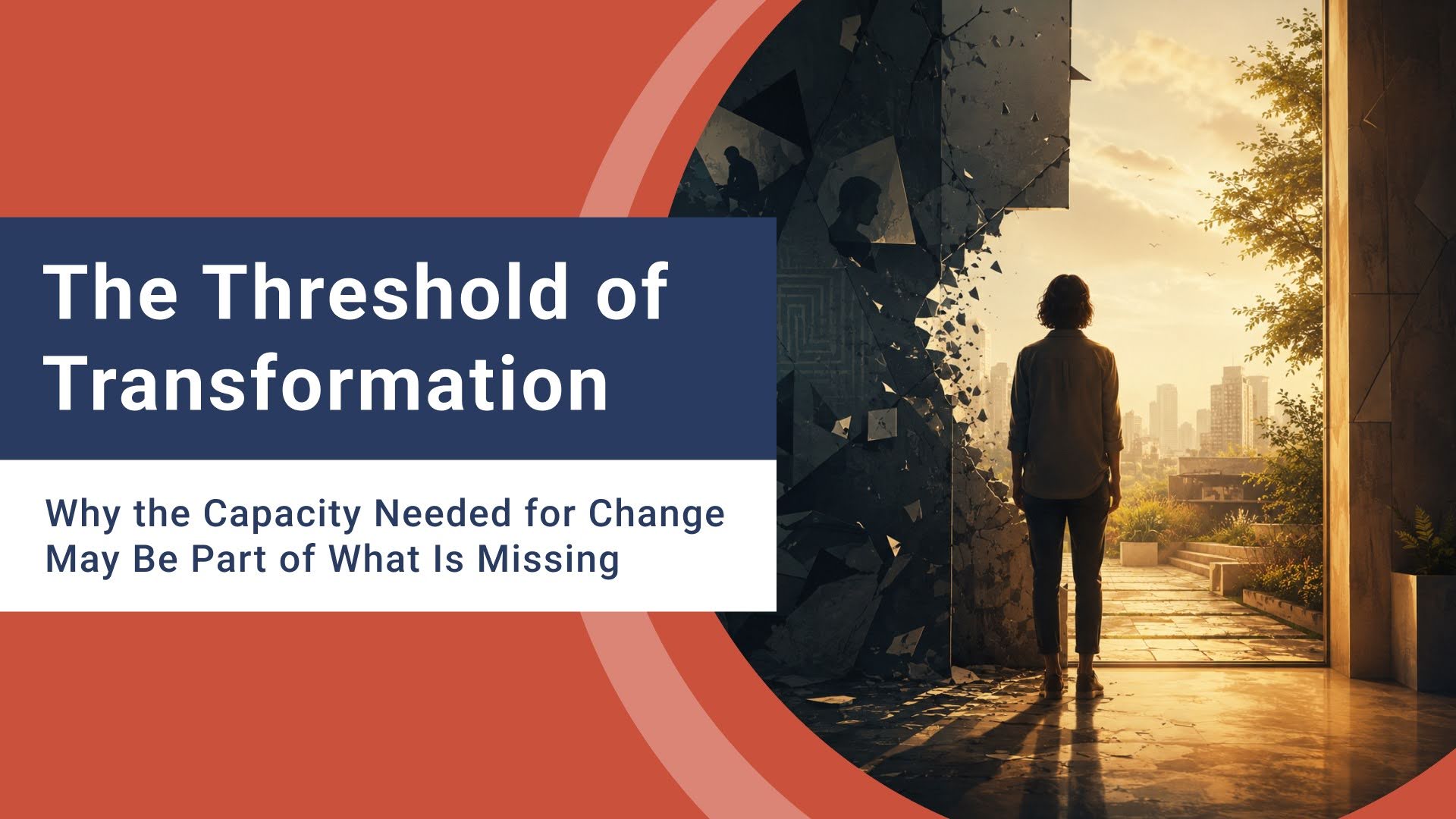
The coach cannot drag somebody through the doorway and call the result transformation, but neither should they close the door simply because the person does not cross it quickly.
The work is to make the threshold visible. The coach helps the person see where they are standing, what their present participation is producing, what reality requires and what the next movement may demand.
They bring disciplined observation, distinctions and challenge where those contributions expand perception. They refrain from imposing conclusions or prescribing the person’s life. Support remains proportionate to present capacity, while the coach refuses to substitute for the participation through which capacity develops.
This requires the practitioner to remain committed without becoming attached, compassionate without becoming indulgent, challenging without becoming coercive and active without becoming sovereign.
The central principle can therefore be stated in its fuller form: the very incapacity that makes transformation necessary can also prevent a person from recognising, choosing and sustaining the transformation available to them. The mature coaching response is neither dismissal nor rescue, neither prescriptive direction nor passive abdication. It is to create conditions in which the person can encounter their participation honestly, perceive what was previously unavailable, recognise the relevant capacity gap and undertake a proportionate next step they can increasingly own.
This is the threshold at which transformational coaching becomes serious.