
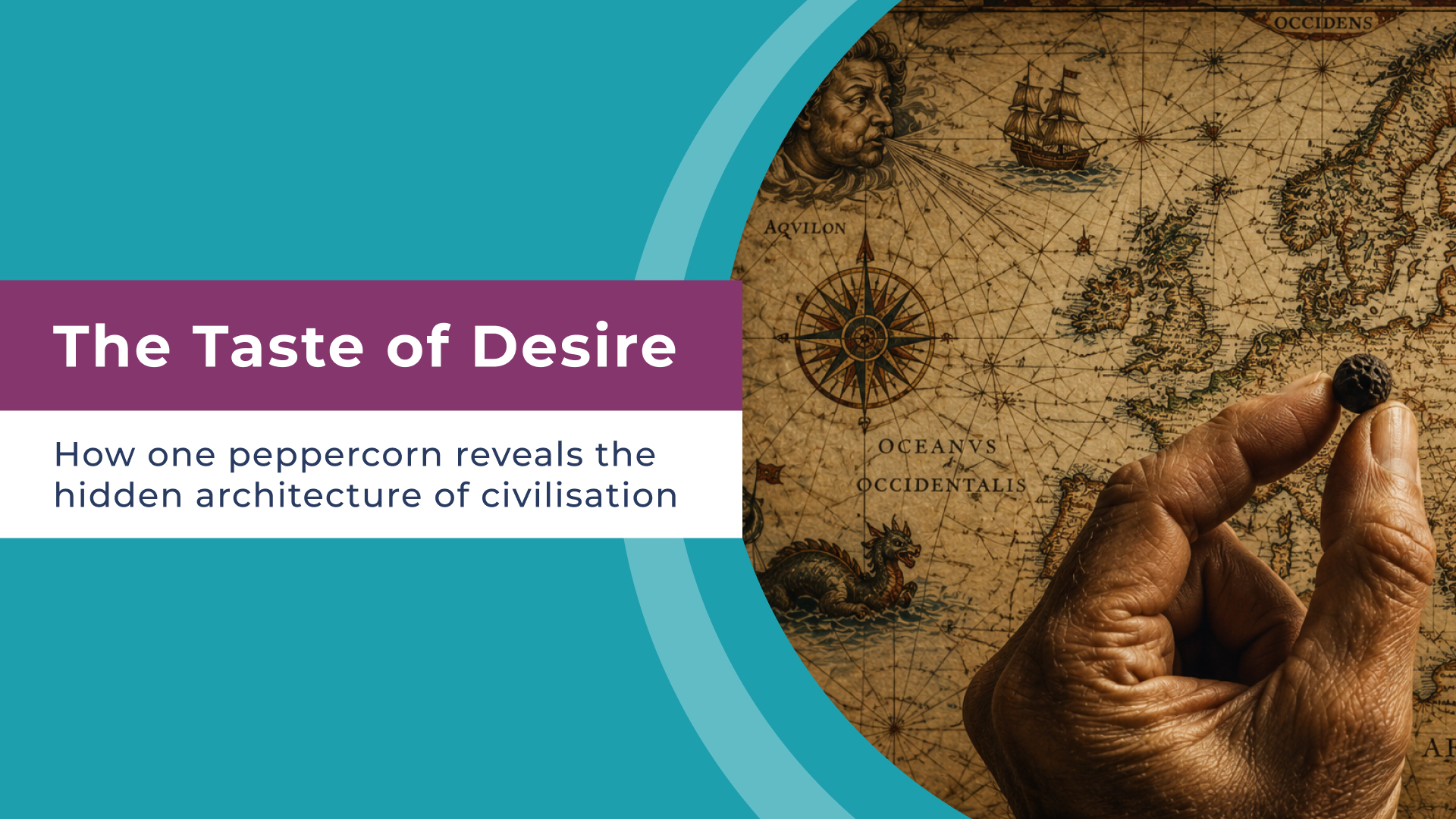

Everything begins with desire
Imagine, just for a moment, that someone placed a magic wand in your hand. Not three wishes. Just one. Whatever you ask for will simply appear. Before practicality, responsibility or cost have a chance to interrupt, allow your desire to answer. What did you wish for?
Perhaps it was a home overlooking the sea, financial freedom or a healthy child. A restored relationship, enough time with the people you love, a successful business or a world finally at peace. Maybe it was something much smaller. Fresh bread still warm from the oven. The perfect cup of coffee. A holiday you've postponed for years. Or perhaps, somewhere in the imagination of a child, it was a pony.
Whatever appeared, notice something. Your mind probably went straight to the wish itself. Almost certainly not to everything that would be required to bring it into being. That is hardly surprising. Desire has always worked this way. We imagine the destination long before we imagine the journey. We picture the home, not the timber. The coffee, not the hillside. The bridge, not the quarry. The pony, not the years of care. The pepper, not the generations of people who carried it across the world.
Desire itself is not the problem. It is one of the most profoundly human things about us. Long before there were markets, governments or multinational corporations, there were people imagining lives that were safer, richer, more beautiful, more meaningful or simply different from the ones they already knew. Desire has inspired exploration, discovery, invention and extraordinary acts of generosity. It has carried artists to their canvases, scientists into their laboratories and explorers across oceans. Without desire there would be no books, no music, no cathedrals, no universities and perhaps no civilisation at all.
There is something else about desire that we rarely stop to consider. A fulfilled desire is rarely as personal as it first appears. Every wish that becomes reality asks the world to respond. Time is allocated. Land is devoted to one purpose rather than another. Knowledge accumulates. Capital moves. Roads are built. Ships are launched. Attention shifts. Lives become organised around bringing what was once imagined into being. When enough people desire the same thing, desire becomes demand. Demand begins reshaping the world.
Civilisation has always grown this way. The spice trade is one of history's clearest examples. Most of us remember it as a story about exploration, empire and commerce. I have come to think of it differently. I think it is one of the greatest stories ever told about human desire. Somewhere inside the journey of a single ordinary peppercorn is a remarkable story about us. Not simply about trade or empire. But about how value is created. How power gathers. How risk is distributed. How leaders allocate finite resources. And how invisible webs of relationships over time create civilisation.
The becoming of value
Long before Europe fought over spices, before merchant fleets crossed oceans and kingdoms competed for trade, a climbing vine wound its way through the humid forests of India’s Malabar Coast. Beneath broad green leaves, clusters of tiny berries formed almost unnoticed among countless others growing nearby. One of them would eventually find its way to my dinner table.
Our peppercorn knew nothing of maps or monarchies. Nothing of Venice or Amsterdam. Nothing of fortunes, monopolies or empire. It simply grew, fed by tropical rain, anchored in rich soil and tended by generations of farmers. They understood the rhythms of monsoon, season and harvest far better than any European merchant ever would. When the berries reached the right moment, they were picked while still green and spread beneath the sun until their skins darkened, wrinkled and hardened into the familiar black peppercorns we recognise today. Gathered into baskets alongside thousands of others, they travelled to local traders before making their way towards the busy ports that lined India’s western coast. Their journey had barely begun. For most of history, movement demanded something altogether different from what it does today.
Time, perhaps, was the greatest investment of all. A peppercorn leaving the Malabar Coast in the sixteenth century did not simply travel across oceans. It surrendered itself to seasons. Ships waited for favourable monsoon winds before they could depart. Voyages stretched over many months and often well beyond a year. Storms delayed fleets. Disease spread through cramped wooden vessels. Navigation depended upon stars, currents and accumulated experience rather than satellites or weather forecasts. Families waited for ships to return. Merchants waited for cargo. Investors waited for profit. Monarchs waited for news from distant ports. Entire webs of relationships learned patience because geography demanded it.
The peppercorn itself was patient because it had no choice. The people carrying it paid the price. Yet they continued to come. Generation after generation, they accepted extraordinary uncertainty because by the time that same peppercorn reached Europe it had become something far more valuable than the berry itself suggested. Months, sometimes years, after leaving the Malabar Coast, our peppercorn finally arrived in Europe. It had crossed oceans, survived storms and passed through countless hands. It sat in warehouses, changed owners, crossed borders and eventually found its way onto the table of someone wealthy enough to afford it.
Nothing about the peppercorn itself had changed. It was still the same dried berry that had once hung on a climbing vine in southern India. Somewhere between the vine and voyage, however, people collectively decided that this small berry mattered. Meaning accumulated around it. Desire became demand. Demand became trade. Trade became wealth. Wealth attracted power. Every civilisation is built one ordinary desire at a time.
How do human beings collectively construct something so valuable that entire civilisations reorganise themselves around it? Today I can order pepper online before breakfast and expect it on my doorstep tomorrow. The pepper has changed very little. Our relationship with time has changed completely. Distance has shrunk. Waiting has almost disappeared. Convenience has become so ordinary that the remarkable web of relationships carrying everyday things across the world has once again become almost invisible. Perhaps that is why we need to look beyond the pepper grinder.
Beyond the pepper grinder
We often tell the history of the spice trade through the voyages of explorers, the ambitions of monarchs or the fortunes of merchants. Yet these are only the most visible expressions of something much larger. Hidden beneath every peppercorn lies a living system of people, places and relationships stretching across continents and centuries. If we could somehow peel back the layers surrounding that single peppercorn, an extraordinary world would slowly appear. Not one world. Many.
There is the farmer rising before dawn to inspect the vines after a night of heavy rain, hoping disease has not taken hold before harvest. There is the family whose livelihood depends upon the success of the season. Traders negotiate prices in bustling coastal markets. Labourers carry heavy sacks to waiting ships. Shipbuilders shape timber into vessels capable of surviving oceans few have crossed. Navigators study unfamiliar stars while cartographers redraw the known world one voyage at a time. Financiers advance capital for expeditions that may never return. Monarchs grant charters and claim distant territories. Dockworkers unload cargo. Translators move between languages. Cooks transform a spice into a meal. And somewhere, perhaps thousands of kilometres away, someone asks for another turn of the pepper grinder. None of these people are doing the same work. Most will never meet. Yet every one of them participates in the same story. The peppercorn isn't the ecosystem. It simply makes the ecosystem visible.
The remarkable thing is that almost no one within that living system can see the whole of it. The farmer understands the soil but not the markets of Venice. The navigator knows the sea but not the family tending vines on the Malabar Coast. The financier calculates risk from the safety of a counting house while sailors disappear beyond the horizon for months, sometimes years, uncertain whether they will ever return. The customer enjoys the flavour without ever imagining the extraordinary web of relationships resting beside the dinner plate. Perhaps civilisation works in a similar way.
Most of us understand the small part we inhabit while rarely seeing the countless relationships that make our own work, our meals and our lives possible. We see the bridge but not the negotiations that preceded it. We see the hospital but not the decades of policy, taxation, engineering and education that brought it into being. We see the school but not the generations of teachers, parents and communities shaping the lives unfolding within its walls. We see the coffee in our hand but not the hillside where it was grown, the picker who harvested it or the rainfall that made the crop possible.
We experience the visible outcome while remaining largely unaware of the invisible network quietly sustaining it. Perhaps this is one of the peculiar consequences of modern life. The more reliable a living system becomes, the less visible it appears. Electricity disappears until the lights go out. Water disappears until the taps run dry. Roads disappear until they close. Ports disappear until supermarket shelves begin to empty. The pepper grinder sitting on the dinner table feels wonderfully ordinary precisely because thousands of people, places and relationships have done their work so well.
No single form of capital carried the peppercorn across the world. Nature provided fertile soil, monsoon rains and the climate in which pepper could flourish. People cultivated and harvested the vines. Knowledge accumulated across generations of farming, navigation, astronomy and cartography. Roads, ports and ships connected distant places. Financial capital made long voyages possible, while political power negotiated access, established law and protected trade routes. Cultural capital transformed a dried berry into something worthy of royal tables. None of these forms of capital was sufficient on its own. Together they formed a living system that carried not only a peppercorn, but an idea of value from one side of the world to the other.
For more than thirty years I have worked in infrastructure, believing I was helping build roads, schools, ports and public institutions. Increasingly, I came to realise those visible structures were only expressions of something much deeper. Every road reflects a decision that connection matters. Every school embodies a belief that learning matters. Every hospital represents a commitment to health. Every port reveals that exchange matters. Infrastructure is not simply concrete, steel or asphalt. It is visible evidence of what a civilisation has collectively decided is worth building.
The movement of pepper, however, was only one thread in a much larger story. As people, plants, animals and ideas travelled across oceans, landscapes themselves began changing. Horses returned to the Americas. Potatoes transformed Europe. Tomatoes became inseparable from Italian cuisine despite originating in South America. Crops, diseases, beliefs and cultures travelled together. Every voyage became an act of mutual becoming between people and place. The peppercorn travelled across the world. Meaning travelled with it.
The price of desire
The peppercorn’s journey across continents tells us far more than how goods once moved around the world. It reveals something much deeper about how civilisations come to exist. Every fulfilled desire asks people, places and living systems to respond. Finite resources begin to move. Land is devoted to one purpose rather than another. Time is invested. Knowledge accumulates. Capital is committed. Attention shifts. Lives reorganise themselves around making what was once imagined become real.
This is true whether we are talking about a spice, a bridge or a family deciding to buy a pony. Imagine that child from the beginning of this essay finally getting her wish. The pony arrives. The excitement is real. Yet the story does not end there. The family budget changes. Holidays may be postponed. Weekends become organised around riding lessons, feed deliveries and veterinary visits. Time once spent elsewhere is now devoted to grooming, fencing and competitions. New friendships emerge. Different routines take shape. The pony is never simply a pony. It becomes a new centre of gravity around which family life gradually reorganises itself.
Governments understand this instinctively, even if they describe it differently. Every annual budget is an exercise in allocation. More investment in transport may mean less available for health. Increased spending on defence may delay new schools or housing. Resources are always finite, even when aspirations are not. Every decision answers two questions at once: What do we wish to bring into being? and What are we willing not to build in order to make that possible? Even choosing not to decide is still a decision, because finite resources continue to flow somewhere. Allocation never stops simply because we stop paying attention.
The spice trade makes this unusually visible. As Europe’s appetite for pepper grew, forests became timber for ships. Ports expanded. Roads connected inland producers with coastal markets. Capital flowed into merchant ventures rather than other enterprises. Generations devoted themselves to navigation, cartography and astronomy because those forms of knowledge suddenly became valuable. None of these developments occurred in isolation. Each represented a collective decision—sometimes conscious, often unconscious—about where a civilisation would invest its limited time, labour, ingenuity and wealth.
The remarkable thing is that nothing intrinsic about the peppercorn had changed. It remained exactly what it had always been: a small dried berry growing on a tropical vine. What changed was human meaning. People collectively decided it mattered. From that shared agreement, value emerged. Once enough people agreed something was worth pursuing, resources began to move. Capital followed. Knowledge expanded. Infrastructure appeared. Power gathered. Landscapes changed. The peppercorn stayed the same. The world around it did not.
The scales of power and risk
Power is often imagined as the ability to command. History suggests something different. Power is the capacity to influence where finite resources flow. Monarchs exercised it through royal charters. Merchant companies through capital. Navigators through specialised knowledge. Consumers through collective demand, although few would have recognised it as such. Every living system distributes power because every living system continually allocates attention, labour, money, knowledge and opportunity.
Power and risk, however, rarely travel together. The financier who backed a voyage risked losing a fortune. The sailor standing on the deck of a wooden vessel rounding the Cape of Good Hope risked something altogether different. Months from home, exposed to storms, disease, hunger and uncertain navigation, he wagered not merely wealth but existence itself. These are not equivalent risks, even if history often tells their stories as though they were. That asymmetry has never really disappeared.
Today I sit comfortably at my own dining table and ask someone to pass the pepper. I know, with complete honesty, that I would never have rounded the Cape of Good Hope in a sixteenth-century sailing ship. I would not have endured months at sea, uncertain whether I would ever see home again. Yet my enjoyment of pepper still places me within the same living system. I am not outside it simply because I arrived at the end rather than the beginning.
Consumers often imagine themselves as observers while corporations, governments and investors shape the world on their behalf. The peppercorn suggests something rather different. Markets do not desire. People do. Markets simply respond to what enough people desire together. Demand is collective desire made visible. Every purchase, however ordinary it may seem, participates in deciding what will be grown, transported, funded, protected and built next. The question, then, is not whether we participate. The question is whether we understand the living systems our participation continually reshapes.
Leaders allocate collective desire
The peppercorn reveals something else about civilisation. History often remembers great leaders for their vision, courage or decisive action. Yet beneath every celebrated decision sits something far more consequential. Every leader, whether governing a nation, leading an organisation or raising a family, is continually allocating finite resources. Time, money, land, knowledge, attention, labour and opportunity are never limitless. To choose one path is, inevitably, not to choose another.
Leadership has always been less about creating desire than deciding which desires deserve to become reality. The European monarchs who financed voyages did not invent the desire for spice. Merchants did not create curiosity. Sailors did not suddenly long for distant oceans. Those desires already existed. Leadership emerged in deciding whether they would be organised, financed, protected and pursued. Ships were commissioned. Ports expanded. Trade routes secured. Knowledge was cultivated. Institutions were established. Seen this way, a budget is never merely a financial document. It is a declaration of collective desire. An organisational strategy is not simply a plan but a statement about what will receive attention and what must patiently wait. A national infrastructure programme is not merely a collection of projects. It is a portrait of what a society has decided matters enough to build. Every allocation leaves a fingerprint of values. It reveals what we are willing to prioritise, and what we are prepared to leave undone.
Infrastructure has fascinated me for most of my professional life for this reason. I spent decades working across transport, housing, education, justice, health and public policy believing I was helping build roads, schools, organisations and institutions. Over time I realised I was watching something much deeper unfold. Every bridge reflected a decision that connection mattered. Every school embodied a commitment to future generations. Every hospital revealed a belief that health deserved collective investment. Every prison carried assumptions about justice, responsibility and safety. The structures themselves were never the whole story. They were simply its visible expression. The real infrastructure lived elsewhere—in the relationships, trust, shared values, decisions and agreements that made those structures possible and gave them purpose. Perhaps this is what leadership has always been: The allocation of finite resources in service of collective desire.
The peppercorn tells the same story. Societies do not simply build infrastructure. They build what they collectively choose to value. Every road built is another road postponed. Every investment made is another opportunity deferred. Every school funded is another project delayed. Allocation is never simply about what we choose to create. It is equally about what we decide can wait. Even choosing not to decide is still a decision, because finite resources continue to flow somewhere. Allocation never stops simply because we stop paying attention. This may be where power is most easily misunderstood.
We often associate power with authority, wealth or political office. Its most enduring form is hidden. Power is the capacity to influence where finite resources flow. Parents exercise it around the family dinner table. Teachers exercise it through attention. Executives exercise it through investment decisions. Citizens exercise it through their vote. Consumers exercise it every time they make a purchase. The scale differs enormously, but the underlying phenomenon remains remarkably similar. Every decision gently redirects the future. None of us controls the whole. All of us participate in shaping it. Perhaps that is the deeper invitation hidden inside the peppercorn. Leadership is not simply asking, What do I want to build? It begins with a different question: What kind of world does this allocation invite into being?
The ecosystem of your desire
Do you remember your wish? The one you made before we met the peppercorn. Desire is one of civilisation’s great creative forces. It inspires exploration, discovery and generosity. It builds bridges and universities, funds scientific breakthroughs and composes symphonies. It motivates parents to work harder for their children, communities to rebuild after disaster and strangers to imagine futures different from the present. Without desire there would be little reason to learn, create, love or hope.
The question has never been whether we should desire. The question is whether we understand what our fulfilled desires ask of the world. That question feels increasingly important because every generation has its own peppercorn. Yesterday it was spices. Then silk, gold and oil. Today it may be lithium, rare earth minerals, artificial intelligence, data or the convenience of next-day delivery. Tomorrow it will almost certainly be something else. The objects change. The living systems surrounding them do not. Every fulfilled desire still reallocates finite resources across those living systems. Someone says yes. Someone else lives with what that yes makes impossible. This is not a reason to stop wishing. It is an invitation to wish with greater awareness.
The peppercorn has become one of my great teachers because it reveals the same truth in miniature. It reminds me that ordinary things are rarely ordinary once we learn to see the living systems that sustain them. Beneath every object sits a constellation of relationships, decisions, sacrifices, knowledge and care stretching far beyond what first appears. We experience the visible outcome while remaining largely unaware of the invisible web that made it possible.
So before you return to the wish you made at the beginning of this essay, pause for just a moment. Hold it gently in your imagination as though it were a single peppercorn resting in the palm of your hand. Then ask yourself a different question. If this wish were fulfilled, what living system would it ask the world to create? Who would participate in bringing it into being? Which finite resources would be reallocated? And who would carry the cost?
Perhaps the old saying has been misunderstood all along: Be careful what you wish for. It was never just a warning about unintended consequences. It was an invitation to recognise that fulfilled desires are astonishingly creative. They ripple far beyond ourselves, drawing people, places and resources into relationships we may never fully see. Perhaps wisdom is not about desiring less. Perhaps it begins by seeing more. By recognising that there is no such thing as an isolated wish.
As I finish writing this, a cup of coffee sits quietly beside me. An hour ago it was simply coffee. Now it feels like something else entirely. I find myself wondering about the hillside where it was grown, the hands that harvested it and the countless relationships that gently carried it here. Perhaps that belongs to another story. I reach for the pepper. And remember that ordinary things are rarely as ordinary as they first appear.
Dr Jordan Marijana Alexander explores how identity, place, culture, and human systems shape participation, leadership, and contemporary life. She is the co-founder of RelateAble.Global. If this article has raised questions, sparked reflection, or highlighted something you’re navigating as a leader or in your personal life, you’re invited to book a conversation to explore it further. You can follow DrJMA on LinkedIn and Engenesis for ongoing insights, research, and practical resources.