

Background – A Civilisational Pattern Beneath the Events
This article is not about an incident, a group, a government, or a policy decision. It is about a pattern.
Civilisations do not destabilise primarily because of singular events. They destabilise when the hidden architectures through which reality is interpreted, meaning is formed, decisions are made, and conduct is shaped begin to fracture.
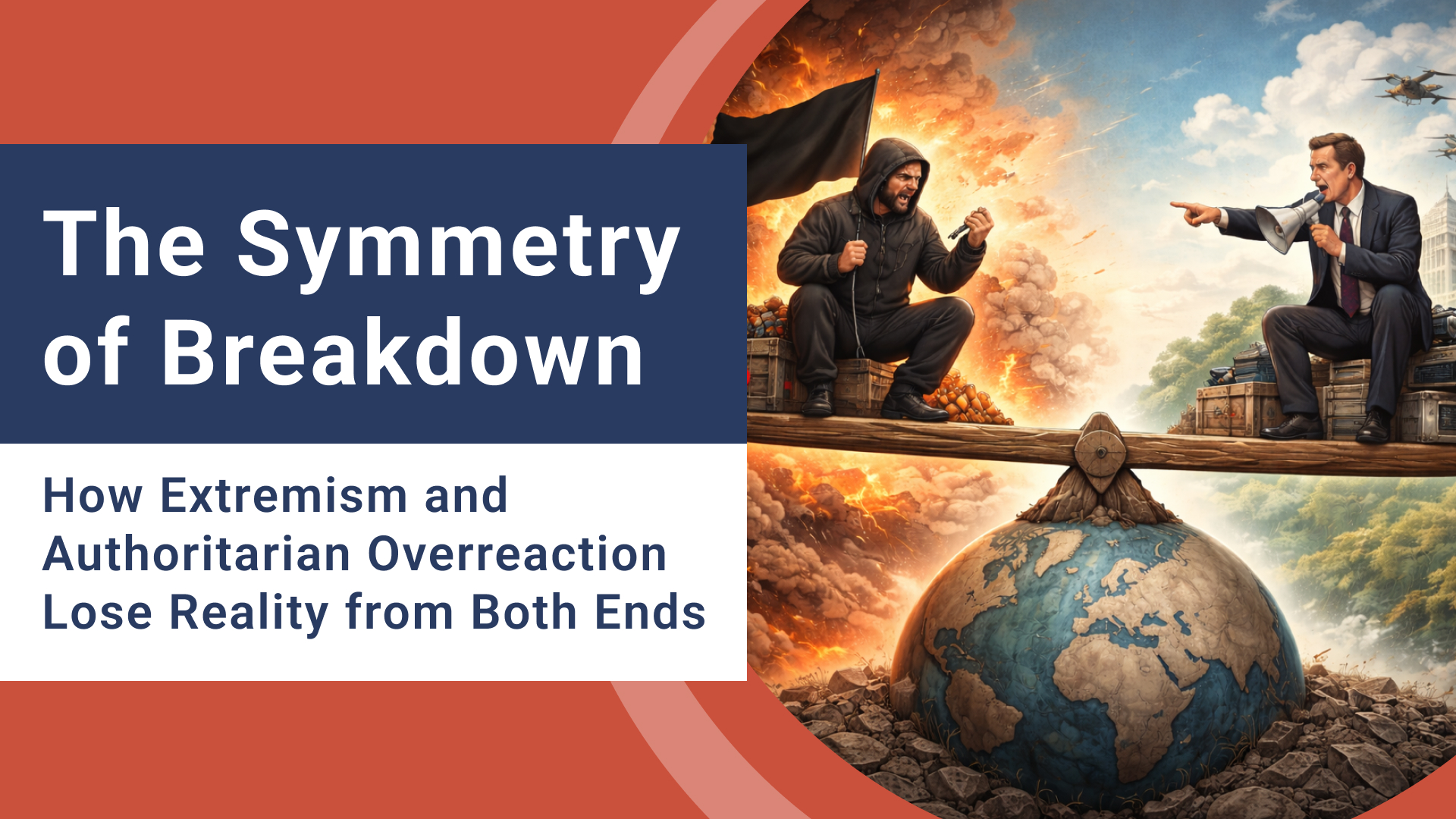
Violent extremism and authoritarian overreaction appear, on the surface, to be opposites. One rejects the system through destruction. The other seeks to preserve the system through control. One is framed as chaos. The other as order. At a deeper level, however, both arise from the same underlying condition: a breakdown in sense-making, meaning-making, decision-making, and conduct.
This breakdown does not begin with ideology, weapons, or laws. It begins earlier, at the level of how individuals and institutions relate to reality itself. When that relationship becomes distorted, meaning hardens, decisions become reactive, and conduct shifts from responsibility to compulsion. Actions that once appeared irrational or excessive begin to feel necessary, justified, even virtuous.
From this perspective, the question is not why extreme actors emerge or why states overreact. The more fundamental question is what has failed in the civilisational architecture that links understanding to action.
Public discourse tends to focus on content. An attack. A policy response. A speech. A law. Content is visible, emotional, and immediately actionable. But content alone does not explain patterns. It only describes surface manifestations. To understand why similar dynamics repeat across cultures, ideologies, and political systems, we must move one level deeper. We must examine metacontent.
Metacontent refers to the underlying structures that determine how content is interpreted, filtered, prioritised, and translated into decision-making and conduct. It is the mental framework that includes assumptions people hold about reality, responsibility, authority, identity, threat, legitimacy, and what kinds of actions are considered acceptable, necessary, or unavoidable.
Two societies can encounter the same event and respond in radically different ways, not because the event is different, but because their metacontent and their relationship to conduct are different. This is why focusing exclusively on content leads to reactive cycles rather than coherent action.
metacontent can be understood as the background operating system of sense-making. It is not what we think about. It is how thinking itself is structured before it becomes belief, intention, decision, or action. It shapes what is perceived as real or unreal, what is framed as a threat or a challenge, what feels meaningful or meaningless, and how people behave under pressure.
Most of the time, metacontent remains invisible. It becomes noticeable only when it fails.
When it fails, reality fragments. Facts lose their grounding. Narratives replace discernment. Emotion overrides orientation. Certainty replaces understanding. Decision-making becomes impulsive. Conduct becomes reactive rather than grounded. At that point, both individuals and institutions drift toward extremes, not because they desire extremity, but because measured conduct no longer feels possible.
Sense-making does not operate at a single level. It is nested. At the surface level, people respond to immediate events. Beneath that sit stories that explain what the event means. Beneath stories sit mental models that define how the world works. Beneath those sit perspectives that shape what is foregrounded or ignored. Beneath perspectives sit domains that define what kind of problem something is. Beneath domains sit paradigms that determine what counts as real, valid, or legitimate. Each layer conditions not only interpretation, but also decision-making and conduct.
When higher layers become distorted, lower-level responses become increasingly rigid and impulsive. If reality is framed as fundamentally hostile, violence feels defensive. If authority is framed as fragile, control feels necessary. If identity is framed as absolute, coercion feels justified. These are not political positions. They are structural consequences of distorted sense-making and degraded conduct.
When sense-making collapses at scale, two tendencies emerge. One is the drive toward total meaning, expressed through extremist ideologies that simplify reality into absolute categories and sanctify violence. The other is the drive toward total control, expressed through authoritarian reflexes that collapse trust and replace responsible conduct with enforcement.
These tendencies appear opposed, but they are structurally similar. Both arise when complexity becomes unbearable and reality is no longer navigable through grounded sense-making, coherent meaning-making, responsible decision-making, and mature conduct.
This article examines that symmetry, not to equate harm, not to erase responsibility, but to expose the shared internal logic that produces both breakdowns. Only by understanding how sense-making, meaning-making, decision-making, and conduct collapse together can societies respond in ways that restore coherence rather than deepen fragmentation.
From Content to Metacontent – How Sense-Making, Decision-Making, and Conduct Are Formed
Most public debate operates almost entirely at the level of content. What happened. Who acted. What policy followed. Who is responsible. Content is visible, emotionally charged, and immediately actionable. It is also the most unstable layer of understanding.
Beneath content sits something far more decisive: metacontent.
As discussed, metacontent refers to the underlying architecture through which content is interpreted, meaning is formed, decisions are made, and conduct is enacted. It is not another narrative or ideology. It is the structure that determines how narratives and ideologies are even possible.
In simple terms, if content is what happens, metacontent is how reality is organised in advance of perception, judgement, and action.
It shapes what is perceived as real or unreal, what is framed as threat or challenge, what feels meaningful or meaningless, what options appear available, and what kinds of behaviour feel justified under pressure.
When metacontent is coherent, disagreement remains navigable. When it fractures, interpretation hardens, decision-making collapses into reaction, and conduct becomes extreme.
The Nested Theory of Sense-Making
Sense-making does not occur at a single level. It is layered and nested.
At the surface, individuals and institutions respond to events. Beneath those responses sit stories that explain what the events mean. Beneath stories sit mental models that define how the world works. Beneath mental models sit perspectives that determine what is foregrounded or ignored. Beneath perspectives sit domains that define what kind of problem something is. Beneath domains sit paradigms that shape what counts as valid, legitimate, or real.

Each layer constrains the layers above it.
Decisions and actions are therefore never isolated. They are the downstream expression of the deeper layers through which reality has already been interpreted.
When higher layers of the nested structure become distorted, lower level decision-making becomes increasingly rigid and reactive. People may argue about facts or policies, but the deeper conflict lies in incompatible sense-making architectures.
This is why many debates feel irresolvable. They are not disagreements at the same level of the system.
Meaning-Making and the Escalation of Certainty
Meaning-making depends on sense-making. When sense-making loses contact with reality, meaning does not disappear. It intensifies.
In the absence of grounded sense-making, meaning becomes total, absolute, and morally charged. Complexity becomes intolerable. Ambiguity feels dangerous. Certainty becomes a psychological refuge.
At this stage, decision-making shifts from discernment to justification. Actions are no longer evaluated by proportionality or consequence, but by alignment with an internal narrative of necessity.
Violence can feel righteous. Control can feel responsible. Both emerge from meaning that is no longer constrained by reality.
Being, Conduct and the Translation into Behaviour
Sense-making and meaning-making ultimately express themselves through Being, understood here as the underlying orientation from which conduct arises.
Being is not a belief or an intention. It is the manner in which individuals and institutions relate to reality, responsibility, and others. It shapes how pressure is met, how uncertainty is tolerated, and how power is exercised.
From Being flows conduct. From conduct flow decisions, actions, and behaviours.
When Being is grounded, decision-making remains proportionate even under stress. Conduct reflects responsibility rather than compulsion. Power is exercised with restraint. Violence remains unthinkable except as a last resort.
When Being is fractured, decision-making becomes reactive. Conduct becomes coercive. Behaviour accelerates toward extremes.
This applies not only to individuals, but to institutions and systems. Collective behaviour is the aggregated expression of underlying Being at scale.
Why this framework matters for what follows
Extremism and authoritarian overreaction are often treated as separate problems requiring separate solutions. Through the lens of metacontent and the Nested Theory of Sense-Making, they appear differently.
They emerge as different expressions of the same underlying breakdown.
A breakdown in sense-making distorts reality.
A breakdown in meaning-making absolutises response.
A breakdown in Being degrades conduct.
The result is extreme action on one end and extreme control on the other.
The sections that follow examine indiscriminate violence, ideological extremism, state overreaction, object-focused solutions, and collective punishment through this integrated lens. The content remains familiar. The interpretation shifts from surface reaction to structural diagnosis.
What is revealed is not a political failure, but a failure of civilisational coherence.
What We Actually Know – Facts, Interpretation, and the First Layer of Sense-Making
Any serious attempt to understand extremism must begin by distinguishing between what is known, how it is interpreted, and how those interpretations translate into decisions and conduct. This distinction is essential because sense-making does not fail all at once. It fails in stages.
At the surface level, there are events. Beneath events sit interpretations. Beneath interpretations sit assumptions. Beneath assumptions sit deeper metacontent that determines what kinds of responses feel reasonable, urgent, or unavoidable.
When these layers are not clearly differentiated, societies move quickly from facts to reaction without passing through understanding.
In the immediate aftermath of violent incidents, uncertainty is experienced as intolerable. Political leaders are expected to speak. Institutions are expected to act. Media systems are expected to produce clarity. Public anxiety demands explanation. In this environment, interpretation accelerates faster than verification, and decision-making precedes comprehension.
This is not a moral failure. It is a structural weakness in how modern societies process shock.
At the level of confirmed content, several elements are typically established. A violent act occurred in a public space. Civilians were harmed. The event disrupted everyday life far beyond its immediate location. Investigators identified ideological indicators that distinguished the act from random criminal violence. Extremist narratives circulated rapidly after the event, amplifying its symbolic significance.
At the same time, many critical elements remain unknown. The full psychological structure of the perpetrators cannot be reconstructed with certainty. The precise pathway from belief to decision to action is often opaque. The relative influence of ideology, identity crisis, grievance, isolation, humiliation, opportunism, and personal history is rarely clear in the early stages. Even the extent to which victims were individually identified, rather than symbolically targeted, is frequently assumed rather than established.
This gap between what is known and what is assumed is where sense-making becomes most vulnerable.
Rather than holding ambiguity, societies tend to collapse uncertainty into narrative. Narrative reduces cognitive load. It provides moral orientation. It enables decisive conduct. But when it forms prematurely, it hardens interpretation before understanding has stabilised.
At this point, a specific failure mode appears. The perpetrator is no longer approached as a psychologically complex human being whose internal structure has collapsed in specific ways. Instead, they are abstracted into something closer to a non-human entity. A figure devoid of interiority. A pure carrier of threat. A symbolic predator.
This can be described as a Dehumanised Collapse Narrative.
Within this frame, the perpetrator is treated less as a person whose sense-making, meaning-making, decision-making, and conduct disintegrated, and more as a kind of animated danger. Something closer to a zombie in cultural imagination. No inner world. No pathway. No structure to understand. Only a presence to be eradicated.
The moment a perpetrator is dehumanised in this way, the range of conceivable responses collapses. Eradication feels sufficient. Banning feels responsible. Restriction feels prudent. Control feels like intelligence. What follows is a cascade of measures aimed at elimination rather than understanding. This is not sophistication. It is intellectual and cognitive naivety. By reducing a complex human collapse into a non-human threat, societies abandon the very inquiry required to prevent recurrence. No effective solution can emerge from a frame that refuses to understand the structure of failure it is responding to. Dehumanisation may satisfy the desire for moral clarity, but it guarantees strategic blindness. It replaces investigation with force, diagnosis with prohibition, and learning with repetition. Under such conditions, responses can only multiply instruments of control, never restore coherence.
This abstraction feels emotionally satisfying. It restores moral clarity. It relieves society of the burden of understanding. If the actor is non-human, then no deeper inquiry is required. Elimination becomes the only conceivable response.
The cost of this shortcut is profound.
By collapsing the perpetrator into a non-human category, societies lose the ability to study the actual psychological and structural failures that produced the violence. Complexity is replaced by caricature. Inquiry is replaced by certainty. Prevention is reduced to exclusion and force.
This does not humanise the act. It humanises the analysis.
And without that distinction, responses remain trapped at the level of reaction rather than understanding.
Indiscriminate Violence – When Sense-Making Collapses into Symbolism
One of the most disturbing features of contemporary extremist violence is its apparent indiscrimination. Attacks often occur in shared public spaces where perpetrators cannot know who their victims are. To many observers, this appears incoherent or irrational.
Through the lens of metacontent and nested sense-making, it is neither.
Indiscriminate violence emerges when sense-making collapses at higher levels of the interpretive structure. Individuals no longer relate to reality through relational or contextual understanding. Instead, reality is flattened into symbols.
At this point, people are no longer encountered as human beings. They are encountered as representations.
In extremist sense-making, the world is no longer composed of individuals with histories, responsibilities, and moral standing. It is composed of abstractions such as enemies, corruption, decadence, or illegitimacy. Public spaces become symbolic stages. Civilians become interchangeable carriers of meaning.
This is not a failure of intention. It is a consequence of distorted metacontent.
At the level of surface content, attacks appear random. At the level of meaning-making, they are precise. The target is not the person. The target is what the space represents.
Shared environments represent plural coexistence, normalcy, and everyday life continuing despite difference. In extremist frames, this continuity is experienced as an affront. Violence is therefore directed not at individuals, but at the conditions of ordinary life itself.
Because the act is symbolic, precision becomes unnecessary. In fact, randomness amplifies the effect. When violence appears indiscriminate, fear spreads more broadly. Social trust erodes faster. The sense that reality is predictable collapses.
This produces exactly the destabilisation extremists seek.
From the perspective of nested sense-making, this represents a shift from relational interpretation to symbolic absolutism.
Lower layers such as context, personal identity, and situational nuance are bypassed. Higher layers such as mythic narrative and total meaning dominate. Decision-making no longer involves proportional judgement. It becomes an enactment of internal necessity.
Conduct follows accordingly. Violence is not evaluated by consequence or moral restraint, but by symbolic alignment with an imagined order.
This is why such acts often feel detached from practical outcomes. They are not designed to achieve improvement. They are designed to assert meaning over reality.
Importantly, this pattern is not limited to non-state actors. The same collapse of relational sense-making into symbolic response can occur at the institutional level.
When governments respond to shock by acting primarily at the level of symbols rather than structure, they too bypass nuance. Broad measures replace targeted judgment. Collective restrictions replace individual discernment. The logic shifts from responsibility to abstraction.
At that point, the conduct of institutions begins to resemble, in structure if not in intent, the logic of indiscriminate action.
Indiscriminate violence, then, is not a mystery. It is a predictable outcome of collapsed sense-making and distorted metacontent. It reveals a mind no longer capable of engaging reality as it is, only as it is imagined.
Understanding this is essential because responses that fail to restore relational sense-making will only deepen the symbolic conflict. When both sides act at the level of abstraction, reality itself becomes the casualty.
Different Extremisms, Different Metacontent Structures
A common error in public discourse is to treat all forms of extremist violence as expressions of the same phenomenon. While they may share surface similarities, their internal architectures often differ significantly. These differences matter because they shape how violence is justified, how decisions are made, and how conduct is enacted.
From a metacontent perspective, extremist movements can be broadly distinguished by the kind of meaning they seek to impose on reality.
Some violent movements are organised around territorial grievance. Their sense-making is anchored to land, borders, history, and identity tied to a specific place. Violence, in this frame, is instrumental. It is justified as resistance, leverage, or defence in pursuit of a concrete political outcome. Decision-making remains partially bounded by strategic calculation, even when moral reasoning is distorted. Conduct is extreme, but still oriented toward negotiation, recognition, or control of territory.
Other movements operate on a very different plane. Their metacontent rejects territorial limits altogether. They do not seek compromise, coexistence, or political settlement. Instead, they pursue totalising meaning. Reality is divided into absolute categories of legitimacy and illegitimacy. There is no neutral ground, no acceptable ambiguity, and no stable middle position.
Within this structure, violence is no longer a means to an end. It becomes an end in itself. Decision-making collapses into perceived necessity. Conduct is sacralised. Willingness to destroy oneself becomes evidence of righteousness rather than a cost to be avoided.
This distinction explains why some forms of extremist violence appear strategically intelligible, while others appear detached from practical outcomes altogether. The difference does not lie in intensity, but in the depth of meaning collapse.
In the first case, sense-making is distorted but still relational. In the second, making sense has become mythic. Events are interpreted not through context or consequence, but through an imagined cosmic order. Action is no longer evaluated by impact on reality, but by fidelity to an internal narrative.
This is also why some extremist movements prioritise visibility and spectacle over effectiveness. Public spaces, symbolic dates, and shared rituals become targets not because they confer advantage, but because they offer resonance. Violence is staged as communication.
At this point, conduct is no longer guided by responsibility to the world as it exists. It is guided by loyalty to a world that exists only in abstraction.
Understanding this distinction is essential because different metacontent structures require different responses. Treating totalising movements as if they were grievance-based misunderstands their internal logic. Attempting to negotiate with an ideology that rejects reality itself is futile. Conversely, treating territorially grounded movements as purely apocalyptic obscures the conditions that sustain them.
When societies fail to recognise these differences, decision-making becomes blunt. Policies are applied indiscriminately. Conduct becomes reactive rather than discerning. The response itself begins to drift toward abstraction.
This is where the symmetry deepens. As extremist sense-making collapses into total meaning, institutional sense-making can collapse into total control. Both abandon proportionality. Both lose contact with the layered reality they are attempting to manage.
The result is not resolution, but escalation at the level of structure.
What Extremist Violence Is Actually Trying to Destabilise
To understand extremist violence properly, the question cannot remain focused on who is attacked. The more revealing question is what is being destabilised beneath the surface.
At the level of content, violence appears directed at people, places, or institutions. At the level of metacontent, the target is something more foundational. Extremist violence seeks to disrupt the conditions that allow a society to function as a coherent whole.
Modern societies do not rely primarily on force. They rely on shared assumptions about reality, trust, responsibility, and legitimacy. Law works because most people accept it. Public space functions because people assume a baseline of safety. Diversity coexists because difference is tolerated without constant fear. These conditions are not enforced continuously. They are sustained through collective sense-making and everyday conduct.
Extremist violence aims beneath formal power structures and toward these invisible foundations.
When an attack occurs in a shared space, the immediate damage is physical. The deeper damage is interpretive. People begin to question whether ordinary life is still navigable. Trust between strangers weakens. The sense that the world is broadly intelligible fractures.
From the perspective of nested sense-making, this represents a deliberate attempt to collapse higher layers of orientation. If people can no longer rely on shared meaning, lower-level decision-making becomes defensive. Behaviour shifts toward avoidance, suspicion, and withdrawal.
This is why extremist violence does not need to succeed tactically to succeed structurally. Even failed or limited attacks can generate widespread disruption if they alter how reality is interpreted.
Another core target is plural coexistence. Extremist metacontent cannot tolerate ambiguity or difference. It requires clear boundaries, absolute identities, and rigid moral categories. Violence is used to provoke backlash, polarisation, and overreaction, forcing societies to abandon nuance in favour of hardened positions.
When this happens, extremist narratives gain confirmation. The world begins to resemble the simplified, hostile landscape they describe.
Perhaps most critically, extremist violence undermines adult responsibility. Fear shifts agency upward. Citizens begin to look to authority for protection rather than to their own judgement and conduct. Institutions respond by expanding control. The space for individual discernment narrows.
From the extremist point of view, this is not failure. It is success. A society that no longer trusts its members to act responsibly has already conceded something essential.
Willingness to sacrifice one’s own life fits within this logic. When meaning has collapsed into absolutes, life is no longer valued as lived experience. It becomes currency. Death becomes proof of conviction rather than loss. Deterrence loses its force because consequence has been absorbed into narrative.
Extremist violence therefore operates less like warfare and more like structural sabotage. It does not aim to defeat a state. It aims to hollow out the interpretive frameworks that hold society together.
Understanding this reframes the challenge. If what is under attack is civilisational coherence, then responses that focus only on force, restriction, or surveillance address symptoms, not causes. Worse, when such responses amplify fear and abstraction, they assist the very destabilisation they seek to prevent.
This is where the symmetry begins to sharpen. As extremist violence attacks meaning and trust from one end, institutional overreaction can erode the same foundations from the other.
The Government Response Trap – When Institutions Lose Their Own Sense-Making
After extremist violence, governments are expected to act quickly and visibly. Silence is interpreted as weakness. Delay is framed as negligence. Uncertainty is treated as irresponsibility. This creates a predictable institutional response pattern that repeats across cultures and political systems.
This pattern is not primarily the result of bad intentions. It is the result of institutional sense-making under pressure.
When shock occurs, institutions experience the same cognitive stress as individuals. The demand for certainty increases. Tolerance for ambiguity collapses. Decision-making accelerates. Conduct becomes performative.
From the perspective of metacontent, this is a familiar failure mode. Higher layers of sense-making such as paradigms and perspectives rush to impose coherence before lower layers such as facts, context, and proportional assessment have stabilised. Once this happens, institutional behaviour becomes reactive rather than discerning.
Governments are rewarded for visibility rather than accuracy. Announcements, restrictions, new powers, and symbolic gestures signal control. They reassure the public that authority is intact. They reduce immediate political risk.
What they rarely do is strengthen the deeper civilisational architecture that is actually under attack.
Control feels like strength, especially under fear. It is measurable, enforceable, and communicable. Human development, trust, and responsibility are none of these. They require time, restraint, and confidence in citizens. Under crisis conditions, such confidence is often absent.
As a result, institutions substitute control for coherence.
Decision-making shifts from proportional judgement to risk minimisation. Conduct shifts from relational responsibility to abstract enforcement. Citizens are no longer encountered primarily as responsible agents, but as potential liabilities.
This shift is subtle but consequential. Once trust is withdrawn, behaviour changes on both sides. Institutions tighten further. Citizens disengage. Responsibility is displaced upward. The space for adult agency narrows.
From a nested sense-making perspective, this represents a collapse at the level of Being. Institutions no longer relate to the population through trust and responsibility, but through suspicion and containment. Conduct becomes increasingly rigid, even when justified in the language of safety.
This is the trap. Each restrictive response creates conditions that demand further restriction. Each erosion of trust justifies more control. The system enters a self reinforcing loop.
Importantly, this dynamic mirrors the internal logic of extremism at the structural level. Not in intent, but in form.
Extremist sense-making collapses individuals into abstract enemies. Institutional overreaction collapses citizens into abstract risks. Extremist conduct abandons proportionality in favour of necessity. Institutional conduct abandons discernment in favour of precaution.
Both emerge from degraded sense-making under pressure.
This is why government responses often appear confident yet brittle. They project authority while quietly eroding legitimacy. They promise safety while weakening resilience. They stabilise the surface while destabilising the foundations.
Breaking this trap requires more than better policy. It requires institutions capable of holding complexity, tolerating uncertainty, and exercising restraint under fear. It requires governance grounded in mature Being rather than reactive control.
Without this, responses to extremism will continue to replicate its structural logic, even while condemning it.
The Decline of Logic and the Abuse of Reasoning
One of the most consequential yet least confronted contributors to contemporary breakdown is the degradation of logical reasoning within academic and intellectual institutions.
This is not a marginal issue. It is structural.
In many leading universities, including major institutions in Australia, it is entirely possible to complete advanced degrees, including doctoral programs, without ever being required to study formal logic. There are mandatory courses on research methodologies. There are compulsory modules on ethics, compliance, consent, and acceptable conduct. There is extensive instruction on how to behave, what to signal, and how to avoid offence.
What is conspicuously absent is disciplined training in how to think.
Logic is not an optional refinement. It is the backbone of synthesis, critique, and coherent argumentation. It is the discipline that allows ideas to be tested rather than merely asserted, disagreement to occur without collapse, and complexity to be handled without resorting to moral absolutism.
When logic is absent, sense-making does not simply weaken. It distorts.
This is not an accusation against individuals. Many academics and students are intelligent, diligent, and well-intentioned. The failure lies in the system that no longer treats logical competence as foundational to intellectual work.
In its absence, moral language rushes in to fill the gap.
Arguments are increasingly evaluated not by validity, internal coherence, or explanatory power, but by alignment with approved narratives. Claims are shielded from critique by moral framing. Disagreement is recoded as harm. Questioning becomes suspect. Nuance is treated as evasion.
This is not intellectual progress. It is epistemic substitution.
Reasoning is replaced by signalling. Analysis is replaced by posture. Debate is replaced by performance.
The result is a culture in which people speak with great certainty but diminishing clarity, where conclusions are reached quickly but rarely examined structurally, and where the appearance of being right matters more than the work of being accurate.
This epistemic drift is compounded by increasing disconnection from material reality. Many intellectual environments now operate at a significant remove from the domains that impose corrective feedback. Food production. Energy systems. Regional economies. Infrastructure. Manufacturing. Trade-offs. Scarcity.
When ideas are not tested against lived constraints, they float. They become rhetorically persuasive, morally confident, and practically brittle.
This detachment is not accidental. It is an emergent property of systems that reward abstraction while insulating themselves from consequence.
What begins in academic settings does not remain there.
Graduates move into advisory roles, policy units, bureaucracies, media organisations, and political offices. They carry with them the epistemic habits they have learned. If they have not been trained to distinguish argument from assertion, to tolerate plural perspectives, to solicit counterarguments, to delay decisions under uncertainty, or to recognise contradiction in their own positions, governance inherits those deficits.
Consultation becomes ritual rather than inquiry. Debate becomes theatre rather than synthesis. Decisions are rushed not because urgency demands it, but because uncertainty is intolerable. Ideology substitutes for coherence. Optics substitute for outcomes.
Policies are crafted to appear correct, not to function well.
This is where the abuse of reasoning becomes visible in public life. Logical forms are imitated without discipline. Correlation is mistaken for causation. Complex systems are reduced to single variables. Opposition is caricatured rather than engaged. Power is exercised with moral certainty but minimal epistemic humility.
The danger is not ignorance. The danger is confidence without coherence.
When moral conviction is decoupled from disciplined reasoning, it becomes volatile. People become certain they are right, unable to articulate why rigorously, and resistant to correction. At that point, authority no longer rests on judgment, but on control.
This matters profoundly for understanding both extremism and authoritarian overreaction.
Extremism thrives where reasoning collapses into absolutism. Authoritarian reflexes thrive where reasoning collapses into precautionary dominance. Both are enabled by the same underlying failure: the inability to hold complexity through disciplined thought.
A society that neglects logic does not merely weaken its universities. It weakens its capacity to govern itself. Pluralism collapses into polarisation. Debate collapses into moral standoff. Consultation collapses into performance. Authority collapses into coercion.
This is not a failure of values. It is a failure of epistemic architecture.
And without repairing that architecture, no amount of regulation, moralising, or institutional expansion will restore coherence.
Object-Focused Responses – A Category Error in Institutional Sense-Making
One of the most common responses to extremist violence is to focus on objects. Weapons, tools, platforms, and technologies become the centre of policy attention. Restrictions are tightened. Access is narrowed. Controls are expanded. These measures are presented as decisive action.
From a metacontent perspective, this response reflects a category error.
Object-focused responses treat the instrument of action as the cause of action. They locate the problem in what was used, rather than in how reality was interpreted, how meaning was formed, how decisions were justified, and how conduct unfolded.
This approach feels intuitive because objects are tangible. They can be regulated, counted, banned, and displayed as evidence of intervention. They allow institutions to demonstrate responsiveness without engaging the deeper layers of sense-making that produced the violence.
However, extremist violence does not emerge from opportunity alone. It emerges from intent shaped by collapsed sense-making and absolutised meaning. When intent is total, means are interchangeable.
This is why extremist violence appears across societies with vastly different regulatory environments. When one tool is restricted, another is adopted. When access becomes difficult, effort increases. The decision to act precedes the selection of means.
Licensing systems and regulatory frameworks are designed to manage accidental harm, impulsive behaviour, and opportunistic crime. In those domains, friction matters. Extremist violence operates differently. It is planned, justified internally, and often embraces consequence. Regulatory friction does not dissolve resolve.
The uncomfortable reality is that lawful compliance and radicalisation are not mutually exclusive. Procedural adherence does not equate to coherent sense-making. Past behaviour does not guarantee future orientation. No screening system can reliably detect the internal collapse of meaning before it manifests in conduct.
When institutions rely on object-focused solutions to address meaning-driven violence, they create an illusion of safety. Risk is redistributed, not eliminated. Confidence is generated at the institutional level, while resilience remains unaddressed at the civilisational level.
This illusion has consequences. When the next incident occurs, trust erodes further. Public frustration intensifies. Pressure mounts for even broader restrictions. The response escalates while the cause remains intact.
From the perspective of nested sense-making, this represents a failure at the level of decision-making. Institutions act on what is visible rather than on what is causal. Conduct becomes performative rather than proportionate.
More critically, object-focused responses avoid confronting the role of Being. They do not ask how individuals and institutions relate to reality, responsibility, and each other. They bypass questions of integrity, maturity, and trust in favour of enforceable control.
This avoidance is understandable. Addressing sense-making, meaning-making, decision-making, and conduct requires long horizons, cultural investment, and institutional humility. It cannot be solved through regulation alone.
But without engaging these deeper layers, societies remain trapped in reactive cycles. Each response treats the symptom as the disease. Each escalation narrows civic space while leaving extremism structurally untouched.
In this way, object-focused solutions do not merely fail to resolve the problem. They risk reinforcing the same abstraction and fear that extremist sense-making thrives on.
Why Some Extremist Actors Move Through Lawful Systems
One of the most confronting aspects of contemporary extremist violence is the discovery that some perpetrators have previously navigated lawful systems. They may have complied with regulations, passed checks, or operated within formal rules before acting violently. This fact often produces shock, disbelief, and calls for even tighter controls.
From a metacontent perspective, this reaction reveals another misunderstanding.
Lawful compliance measures behaviour. It does not measure orientation.
Regulatory systems are designed to assess past conduct, procedural adherence, and surface indicators of risk. They are not designed, and cannot be designed, to reliably detect future collapse in sense-making, meaning-making, decision-making, or conduct.
Extremist trajectories are often nonlinear. Individuals may appear coherent, compliant, and integrated for long periods while internal meaning structures deteriorate. Radicalisation does not always announce itself through visible defiance. In some cases, it proceeds quietly, privately, and incrementally.
This is not a loophole in the system. It is a structural limit of any system that governs behaviour rather than Being.
From the perspective of nested sense-making, lawful systems operate at lower layers. They regulate actions and permissions. Extremist collapse occurs at higher layers, where reality is reinterpreted, meaning is absolutised, and decisions are justified internally before behaviour changes.
By the time conduct becomes visible, the deeper collapse has already occurred.
Some extremist actors deliberately remain compliant for practical reasons. Lawful pathways can offer time, cover, and reduced scrutiny. They allow individuals to blend into ordinary life while internal narratives harden. This does not make the system complicit. It reveals the asymmetry between internal meaning formation and external regulation.
When institutions respond to this reality by expanding restrictions across entire populations, they conflate limitation with prevention. They treat a failure of interpretation as a failure of permission.
This shift has consequences. It erodes trust between institutions and citizens. It signals that integrity and responsibility offer no protection against collective suspicion. It reinforces the abstraction of people into categories of risk rather than recognising them as agents capable of responsible conduct.
From the standpoint of Being, this is significant. Societies that no longer trust responsible conduct begin to organise themselves around fear rather than integrity. Decision-making becomes defensive. Behaviour becomes constrained rather than cultivated.
The irony is that extremist sense-making already assumes this world. It presumes that institutions are coercive beneath the surface and that personal responsibility is an illusion. When governance responds by withdrawing trust indiscriminately, it confirms that presumption.
This does not mean lawful systems are irrelevant or unnecessary. It means they cannot carry the burden of preventing meaning collapse on their own.
When regulation is asked to substitute for sense-making, meaning-making, decision-making, and mature conduct, it inevitably fails. And when it fails, the response is often more regulation, further accelerating the cycle.
Recognising the limits of lawful systems is therefore not a weakness. It is a prerequisite for designing responses that strengthen civilisational coherence rather than undermine it.
The Symmetry of Breakdown – When Extremism and Overreaction Share the Same Internal Logic
At first glance, violent extremism and authoritarian overreaction appear to sit at opposite ends of the moral spectrum. One destroys lives and social order. The other claims to protect them. One is condemned. The other is justified as necessary.
At the level of metacontent, however, a deeper symmetry emerges.
Both arise from the same internal collapse in sense-making, meaning-making, decision-making, and conduct.
Extremist violence begins when individuals can no longer relate to reality through layered, relational understanding. Complexity becomes intolerable. Ambiguity is experienced as threat. Meaning collapses into absolutes. Decision-making shifts from discernment to perceived necessity. Conduct becomes justified by internal narrative rather than by responsibility to reality.
Authoritarian overreaction follows a structurally similar path at the institutional level. Under shock and fear, institutions lose tolerance for uncertainty. Nuance is abandoned in favour of blanket measures. Decision-making accelerates. Conduct shifts from trust-based governance to abstract control.
In both cases, reality is no longer engaged as it is. It is replaced by a simplified model that demands extreme response.
This symmetry is not about intention. The intent of extremist violence and institutional response is profoundly different. The symmetry lies in structure, not morality.
Both collapse individuals into abstractions. Extremism reduces people to symbolic enemies. Overreaction reduces citizens to statistical risks. Both replace relational judgment with categorical logic.
Both substitute total meaning for understanding. In extremism, violence becomes sacred. In overreaction, control becomes virtuous. In both, proportionality is lost.
Both are driven by fear of uncertainty. Extremism fears a plural world it cannot control. Overreaction fears a society it no longer trusts to act responsibly. Each responds by tightening the frame until only one mode of action feels possible.
The effect on law-abiding citizens is quietly devastating. People who have acted responsibly, complied with the law, and contributed to social coherence find themselves subjected to collective restriction. They experience shock, confusion, and a profound sense of injustice. Not because they reject safety, but because they do not understand why integrity no longer matters.
This produces disappointment, anxiety, and withdrawal. The social contract begins to feel arbitrary. Trust erodes. Responsibility is displaced. People disengage not out of defiance, but out of disorientation.
While this experience is not equivalent to the trauma of direct victims of violence, it shares a structural similarity. In both cases, reality becomes unpredictable. In both cases, agency collapses. In both cases, the world no longer appears to operate according to intelligible or fair rules.
Terror, in this sense, is not only the presence of violence. It is the sudden experience of powerlessness. It is the realisation that one’s conduct offers no protection and one’s judgement carries no weight.
When governance responds to terror by terrorising trust, it unknowingly mirrors the internal logic of extremism. Not because it agrees with it, but because both have lost faith in the human capacity for responsible conduct.
This is the final irony. Extremist violence seeks to prove that societies are fragile, hypocritical, and incapable of holding complexity without coercion. When institutions abandon trust in their own citizens, they validate that claim.
The result is a civilisational feedback loop. Violence provokes fear. Fear provokes control. Control erodes trust. Eroded trust increases fragility. Fragility invites further extremism.
Breaking this loop does not require softer governance. It requires deeper governance. Governance grounded in coherent metacontent, layered sense-making, responsible decision-making, and mature conduct. Governance capable of holding uncertainty without collapsing into extremes.
Without this, societies will continue to oscillate between destruction and domination, mistaking both for necessity.
Toward a Different Civilisational Response
If extremism and authoritarian overreaction arise from the same breakdown in sense-making, meaning-making, decision-making, and conduct, then responding effectively requires more than correcting surface behaviour. It requires repairing the underlying civilisational architecture that connects understanding to action.
This does not begin with new laws, broader restrictions, or stronger rhetoric. It begins with restoring coherence across the layers through which reality is interpreted and acted upon.
At the level of sense-making, societies must recover the capacity to hold complexity without collapsing into binaries. This means resisting the urge to prematurely close interpretation under pressure. Facts must be allowed to stabilise. Ambiguity must be tolerated long enough for discernment to emerge. Not every shock demands immediate certainty.
At the level of meaning-making, societies must resist absolutism. Meaning that becomes total inevitably justifies excess. Healthy meaning remains constrained by reality, proportionality, and responsibility. It guides conduct without sanctifying it.
At the level of decision-making, restraint must be rehabilitated as a virtue rather than a weakness. Decisions made under fear tend to privilege visibility over accuracy and control over coherence. Mature decision-making delays action long enough to remain grounded, even when political pressure demands speed.
At the level of conduct, both individuals and institutions must be reanchored in responsibility rather than compulsion. Conduct grounded in Being does not require constant enforcement. It relies on trust, integrity, and the expectation of adult agency. When this expectation disappears, societies drift toward infantilisation and control.
Crucially, this is not an argument for passivity. It is an argument for depth. Depth in interpretation. Depth in response. Depth in governance.
Civilisations that endure are not those that eliminate threat. They are those who maintain coherence under threat.
They do not abandon their internal architecture when pressure rises. They do not trade responsibility for certainty or trust for control.
Extremism thrives where sense-making collapses. Authoritarian reflexes thrive where trust evaporates. Both feed on fear. Both depend on abstraction. Both flatten reality until only extreme action feels possible.
What this requires, uncomfortably, is an expansion of what we mean by extremism itself. Extremism is not confined to the perpetrator of violence. It also manifests in decision-makers, institutions, and societies when fear collapses discernment and overreaction becomes normalised. When societies respond to shock with absolutism, when governance rushes to totalising control, when collective conduct shifts from responsibility to compulsion, the same internal pattern is at work. The sense-making has narrowed. Meaning has hardened. Decision-making has become reactive. Conduct has slipped into coercion. This is difficult to acknowledge because it implicates not only those who commit violence, but those who govern, legislate, amplify, and comply. Yet it is a piece of reality that must be faced. Without recognising that extremism can emerge on both ends of the response, societies remain blind to the symmetry of their own breakdown. Only by confronting this pattern, rather than projecting it outward, can it be challenged, transformed, and ultimately transcended.
A different response requires resisting that flattening.
It requires governance capable of recognising that safety and freedom are not opposites, but outcomes of the same underlying condition: a society whose members and institutions remain oriented to reality, capable of meaning without absolutism, decision-making without panic, and conduct without coercion.
This is not a technical challenge. It is a civilisational one.
The question, then, is not how to eliminate extremism or how to prevent overreaction. The question is whether modern societies are willing to invest in the deeper work of restoring coherent sense-making, meaningful orientation, responsible decision-making, and mature conduct at scale.
Without that investment, the oscillation will continue. Violence will provoke control. Control will erode trust. Trust erosion will deepen fragility. And fragility will invite further extremism.
The symmetry will remain intact.
Only coherence breaks the cycle.
Further Reading and Deeper Inquiry
If you found the analysis in this article useful, it is only a surface entry point into a much deeper body of work.
The patterns explored here – breakdowns in sense-making, meaning-making, decision-making, and conduct; the role of metacontent; the symmetry between individual collapse and institutional overreaction; and the civilisational consequences of losing coherence under pressure – are examined in far greater depth across the books below.
These works are not political commentary. They are philosophical, structural, and practical inquiries into how human beings, institutions, and societies lose and restore integrity, agency, and coherence.
Books by Ashkan Tashvir:

Together, these books form a coherent framework for understanding how inner structure shapes outer outcomes, how meaning precedes behaviour, and why no technical, militant, or legal solution can resolve problems that are fundamentally rooted in distorted sense-making.
For readers seeking to move beyond reaction and into deeper understanding, they offer a rigorous path forward.