
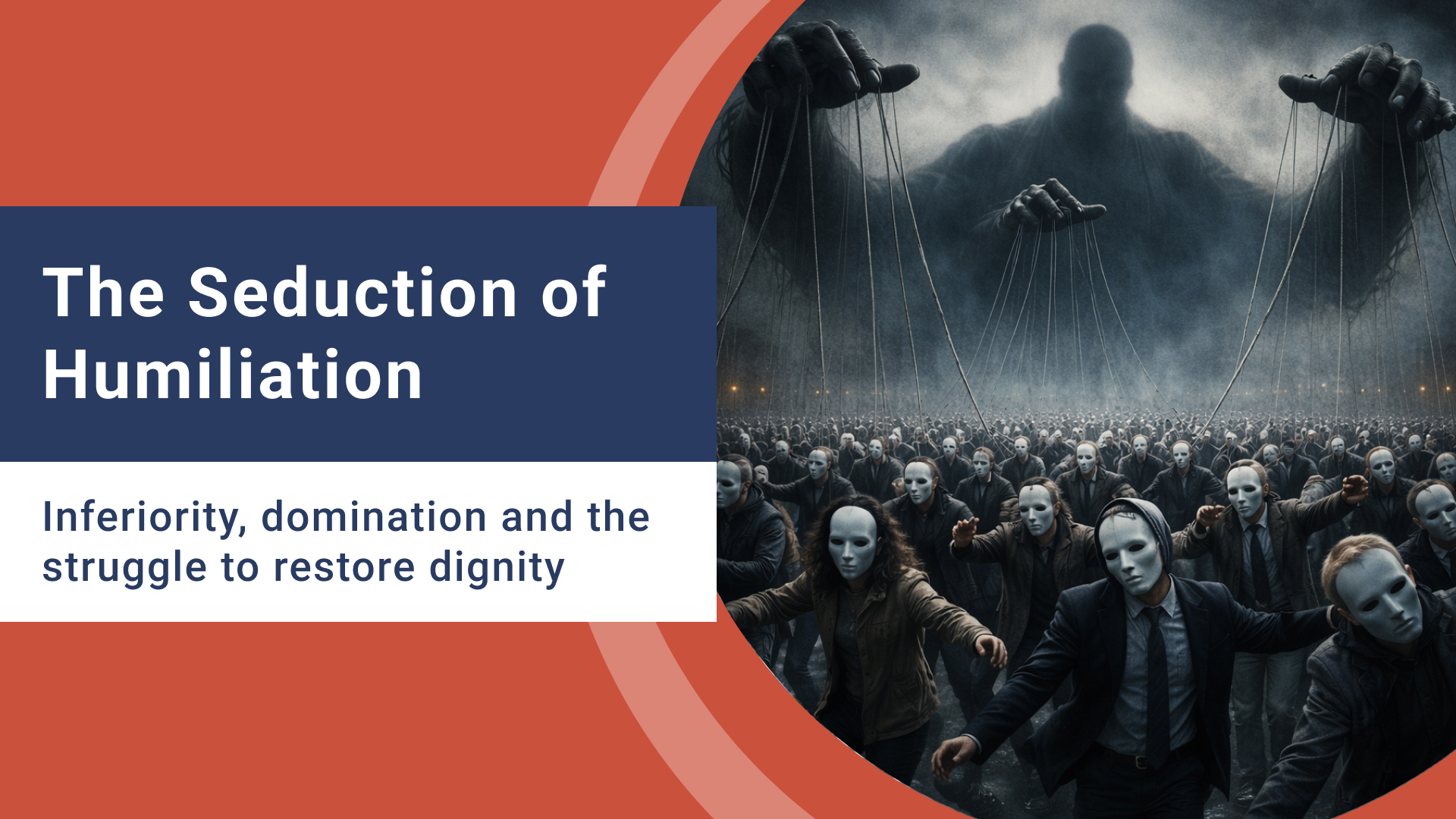

The deepest humiliation is not domination itself, but the moment the dominated believe they deserve it.
Background
Across history, societies have experienced humiliation. Conquest, domination, corruption of leadership, economic collapse, and the gradual erosion of sovereignty have repeatedly fractured the confidence of nations. Yet humiliation alone does not explain what sometimes follows.
A more disturbing phenomenon occasionally appears in its aftermath. Instead of resisting humiliation, parts of a population begin to internalise it. They repeat the narratives of those who dominate them, adopt the moral vocabulary of their humiliators, and in extreme cases even begin to celebrate the very forces that degrade them.
This phenomenon cannot be understood purely through political analysis or psychological diagnosis. It is not simply ideology, nor merely propaganda. It reflects a deeper transformation in how people experience themselves, how they interpret power, and how they relate to dignity.
When such a transformation takes hold, humiliation is no longer recognised as humiliation. It becomes reframed as progress, necessity, pragmatism, or even salvation. Understanding this condition, therefore, requires looking beneath politics and beyond rhetoric. It requires examining how prolonged experiences of disempowerment reshape a society’s sense-making, its interpretation of meaning, and ultimately the way people inhabit themselves as human beings.
Introduction - The Strange Sight
There are moments in history when something deeply unsettling comes into view. A people applaud the hand that strikes them. They praise the power that humiliates them and defend the forces that treat them with open contempt.
At first, the reaction to such scenes is disbelief. Yet when one looks more closely, the phenomenon reveals a pattern that has appeared in many civilisations across time. The question is not whether humiliation exists, but how it transforms those who experience it repeatedly.
When humiliation persists for long enough, it does not only wound pride. It begins to alter perception itself. The categories through which people interpret power, dignity, competence, and legitimacy slowly shift. Strength becomes indistinguishable from domination. Submission begins to resemble pragmatism. Humiliation starts to masquerade as enlightenment.
What we are witnessing in such moments is not merely political confusion. It is the emergence of a deeper condition: a collective inferiority complex. This is not the everyday insecurity of individuals, but a civilisational posture in which a people gradually lose the ability to see themselves with dignity.
The Phenomenology of Inferiority
Inferiority rarely begins as an idea. It begins as experience. Repeated defeats, recurring humiliation, and the persistent sense of powerlessness accumulate over time in the emotional memory of a society. These experiences shape how people interpret events long before conscious analysis begins.
At first humiliation provokes resistance. Anger, defiance, and the desire to restore dignity arise naturally. But when humiliation becomes prolonged and seemingly inescapable, another transformation can occur. Confidence begins to fracture. People start questioning the worth of their own civilisation, their own institutions, and even their own culture.
What was once understood as dignity may begin to appear as stubbornness. What once represented independence can start to look like backwardness. Gradually the relationship to power changes. Power is no longer evaluated ethically but psychologically. The powerful are admired not because they are just, but because they appear invincible.
At this stage, a subtle shift occurs. The humiliator begins to appear superior, not only in strength but in legitimacy. The oppressed begin measuring themselves against the image of those who dominate them. Inferiority thus becomes more than a belief about weakness; it becomes a distorted relationship with dignity itself. People no longer simply acknowledge the strength of others. They begin to suspect that their own dignity is somehow undeserved.
The Fracturing of Collective Self-Respect
The transition from humiliation to inferiority rarely happens suddenly. It unfolds slowly, often across years or generations, through the gradual erosion of collective self-respect. A society does not wake up one day believing itself inferior. Rather, it is worn down through repeated experiences that weaken its confidence in its own capacity to stand with dignity.
Internal failures often play a role. Corrupt leadership, repression, economic hardship, or the abuse of power by those who claim to represent the nation can leave deep scars. When people suffer under their own institutions, frustration and anger naturally follow. Yet when these experiences accumulate without resolution, they can produce something more corrosive than anger: a quiet loss of faith in the possibility of self-governance and self-correction.
In such circumstances, the narrative of failure begins to expand beyond the behaviour of particular leaders or policies. It starts to attach itself to the society as a whole. What begins as criticism of a government gradually turns into suspicion toward the civilisation itself. People begin to speak about their own history, culture, or identity as though it were the source of their problems rather than part of their inheritance.
This shift marks a critical fracture. The distinction between legitimate criticism and civilisational self-contempt begins to blur. Instead of seeking reform while preserving dignity, some individuals begin to believe that dignity itself is unwarranted. The nation becomes something to distance oneself from rather than something to repair.
When collective self-respect fractures in this way, the search for legitimacy often moves outward. If confidence in one’s own institutions disappears, legitimacy is sought elsewhere – in external powers, external narratives, or external approval. The gaze turns outward not simply for cooperation or dialogue, but for validation.
This is the moment when admiration for external power can begin to replace confidence in internal capacity. Strength is no longer something to cultivate within one’s own society; it becomes something to admire in others. The more powerful the outsider appears, the more convincing the contrast becomes.
At first, this admiration may appear pragmatic. People argue that aligning with power is realistic, that resistance is futile, that survival requires adaptation. Yet beneath this language, a deeper transformation is occurring. The psychological centre of gravity shifts away from dignity and toward dependency.
Once this shift takes hold, humiliation becomes easier to rationalise. If one has already lost faith in one’s own worth, the humiliation imposed by others can begin to appear almost logical, even deserved. And from there, the final step becomes possible: humiliation itself begins to be interpreted as a form of necessary correction, rather than as a violation of dignity.
The Seduction of Power
Once collective self-respect fractures, a subtle psychological attraction begins to form around power itself. Power, particularly when displayed with confidence and certainty, carries a seductive quality. It promises order where there has been chaos, decisiveness where there has been confusion, and strength where there has been perceived weakness.
For individuals who have lived through prolonged frustration with their own institutions, this contrast can become deeply compelling. External power begins to appear not merely as force, but as competence. The actions of powerful actors are interpreted through the lens of effectiveness rather than through the standards of dignity or justice.
In this stage, admiration often replaces resentment. The humiliator is no longer seen primarily as a violator, but as a figure of strength who has achieved what the humiliated society believes it has failed to achieve for itself. This psychological shift does not require explicit loyalty. It operates more subtly, through a quiet alignment of perception.
People begin to speak about powerful outsiders with a tone of reluctant respect. They describe them as disciplined, organised, modern, or pragmatic. In contrast, their own society becomes characterised as disordered, emotional, incapable, or backward. The comparison gradually reinforces the perception that domination reflects superiority.
This dynamic is reinforced by the human tendency to seek association with strength. When individuals feel powerless within their own environment, they may begin to identify psychologically with those who appear powerful elsewhere. Aligning oneself with strength, even symbolically, offers temporary relief from the discomfort of perceived weakness.
Over time, this alignment can become so normalised that the humiliating behaviour of powerful actors is no longer interpreted as humiliation at all. Instead, it is reframed as correction, discipline, or the inevitable behaviour of those who hold authority. The moral evaluation of power disappears, replaced by a pragmatic acceptance of its dominance.
In this environment, gratitude can emerge where resentment might once have existed. Acts that degrade dignity are interpreted as interventions, necessary adjustments, or even acts of reluctant benevolence. What would once have been experienced as insult becomes interpreted as assistance.
At this point, the inferiority complex has reached a mature form. The relationship between dignity and power has been inverted. Instead of asking whether power respects dignity, people begin asking whether dignity has the right to resist power.
The Normalisation of Capitulation
When admiration for power replaces confidence in oneself, a further transformation begins to unfold. What was once experienced as humiliation gradually becomes normalised as strategy. Capitulation is reframed as pragmatism, and submission is interpreted as maturity.
This transformation rarely occurs through a single dramatic moment. It develops through a series of incremental adjustments in how people speak about power, sovereignty, and dignity. The language of independence begins to sound naïve. The language of accommodation begins to sound wise.
In this environment, entire societies may begin reorganising their posture toward power. Instead of asking how to cultivate strength within their own institutions, they begin asking how to align themselves with those who already possess it. Sovereignty is quietly traded for convenience, autonomy for security, and dignity for access.
The justification often appears reasonable on the surface. People argue that survival requires adaptation, that resistance is costly, that aligning with dominant powers brings stability and prosperity. The language of realism becomes the dominant narrative. It presents capitulation not as surrender, but as strategic intelligence.
Yet beneath this reasoning lies a deeper shift in civilisational psychology. A society that has internalised inferiority begins to see dignity itself as impractical. Independence appears burdensome. Self-respect begins to look like an obstacle to comfort and convenience.
In some places, this process unfolds so gradually that it becomes invisible to those living within it. Agreements are signed, arrangements are made, and new dependencies quietly form. The symbols of sovereignty may remain intact, yet the posture of the society has changed. Decisions increasingly orbit around the preferences and expectations of external power.
What makes this transformation particularly revealing is that it rarely produces the stability it promises. Capitulation does not necessarily remove humiliation. It merely alters its form. The society may gain temporary convenience, but the deeper psychological condition remains unresolved.
The result is a paradox. A population that has accepted humiliation in exchange for security may discover that neither dignity nor security has truly been restored. Instead, a pattern emerges in which dependency deepens, confidence weakens further, and the need for external validation continues to grow.
At this stage, the inferiority complex is no longer simply a reaction to external power. It has become a structural feature of the society’s relationship with itself.
The Fetish of Humiliation
When inferiority becomes internalised deeply enough, humiliation no longer appears merely tolerable. In some cases, it begins to take on a strange psychological attraction. What once would have provoked outrage starts to produce fascination, and occasionally even a form of satisfaction.
This phenomenon is difficult to understand unless one considers the role humiliation plays in shaping identity. When individuals or societies experience repeated degradation, the emotional wound it creates demands explanation. If dignity cannot be restored through resistance, another strategy often emerges: reinterpretation.
Instead of seeing humiliation as an injustice imposed by power, it becomes interpreted as proof of one’s own inadequacy. In this way, humiliation acquires meaning. It confirms the narrative that others are superior and that one’s own society is somehow deficient. The pain becomes psychologically organised within a framework that appears coherent.
Over time, this reinterpretation can become habitual. Each new episode of humiliation reinforces the same narrative: the powerful dominate because they deserve to, and the humiliated suffer because they are flawed. In this inverted logic, domination appears rational and submission appears appropriate.
The result is a subtle but powerful transformation in emotional orientation. People begin to watch displays of power not with anger but with a kind of reluctant admiration. The humiliator appears decisive, confident, capable of shaping events. In contrast, the humiliated society appears weak, fragmented, incapable of asserting itself.
At this stage, humiliation can even become performative. Some individuals begin demonstrating their rejection of their own society by publicly aligning themselves with those who degrade it. The act of praising the humiliator becomes a symbolic declaration that one has escaped the supposed deficiencies of one’s own people.
This behaviour is rarely recognised by those who perform it as a form of humiliation fetish. It is usually framed as intellectual honesty, realism, or moral clarity. Yet beneath these justifications lies a deeper dynamic: the desire to distance oneself from a collective identity that has come to feel shameful.
The paradox is that this distancing rarely produces genuine liberation. Instead, it reinforces the very inferiority it seeks to escape. By affirming the superiority of those who humiliate them, individuals strengthen the narrative that their own dignity is undeserved. The cycle of humiliation and internalised contempt, therefore, continues, becoming increasingly self-sustaining.
In this condition, the tragedy is no longer merely that humiliation exists. The deeper tragedy is that humiliation has become integrated into the psychological architecture of the society itself.
The Addiction to Domination
Once humiliation becomes internalised deeply enough, another troubling pattern can emerge. What begins as resignation may gradually evolve into a form of psychological dependency. A society can become accustomed to domination in the same way individuals become accustomed to certain destructive habits.
On the surface, people may speak passionately about freedom, sovereignty, and liberation. The language of independence may appear frequently in public discourse. Yet beneath these declarations, a different psychological reality can persist. When the experience of domination has shaped perception for long enough, the absence of domination itself can feel unfamiliar, even unsettling.
This paradox resembles the dynamics of addiction. The addict may sincerely wish to escape the substance that harms them, yet the body and mind remain conditioned by its presence. Moments of withdrawal produce anxiety, confusion, and uncertainty. In such moments, the addict often returns to the very habit they claim to reject, not because it brings joy, but because it provides familiarity.
A similar pattern can appear in societies shaped by prolonged humiliation. When one source of domination disappears, the psychological structure that expects domination may still remain intact. Instead of rebuilding genuine sovereignty, people may unconsciously gravitate toward new forms of dependency. The names change, the actors change, but the posture remains the same.
In this condition, the struggle for freedom becomes entangled with the comfort of submission. Individuals may reject one authority only to seek validation from another. Political loyalties shift rapidly from one powerful actor to the next, not because a clear vision of sovereignty has emerged, but because the deeper structure of dependency remains unresolved.
This pattern reveals how deeply humiliation can penetrate the human condition. Domination ceases to be merely an external reality; it becomes part of the psychological architecture of the society. Even when people speak the language of liberty, their instincts may still orient toward authority, validation, and protection from stronger powers.
Breaking such cycles requires more than the removal of a particular oppressor. Just as addiction recovery demands more than abstaining from a substance, societies must confront the underlying habits of perception that sustain dependency. Without this deeper transformation, the promise of freedom may remain superficial, while the patterns of domination quietly reproduce themselves under new forms.
The challenge, therefore, lies not only in resisting domination but in rediscovering how to inhabit freedom itself. A society must relearn the posture of sovereignty, responsibility, and dignity. Otherwise, it risks moving endlessly from one form of submission to another, mistaking each new dependency for liberation.
The Abusive Relationship
Perhaps the closest human analogy to this phenomenon can be found in the tragic dynamics of abusive relationships.
Across the world, psychologists and social workers have long observed a painful pattern in cases of domestic violence. Victims who suffer repeated abuse often struggle to leave the relationship, even when external support, legal protection, and opportunities for escape exist. Friends, family members, and observers frequently find this behaviour bewildering. Why would someone return again and again to the very person who harms them?
Research on intimate partner violence has documented this pattern extensively. Studies across multiple countries show that victims often leave abusive relationships several times before permanently breaking free. Some estimates suggest that survivors attempt to leave an abusive partner an average of seven times before separation becomes permanent. In the United States alone, millions experience intimate partner violence each year, and many cycles of abuse continue for years despite intervention from authorities and support networks.
This does not occur because victims enjoy the violence. It occurs because abuse gradually reshapes the psychological landscape of the victim. Repeated humiliation erodes self-confidence. Emotional manipulation confuses the interpretation of events. Moments of kindness from the abuser create temporary hope that the situation will change. Over time, the victim’s perception of normality shifts.
What outsiders see as cruelty may begin to feel, to the victim, like a complicated mixture of punishment, affection, dependency, and inevitability. The victim may begin questioning their own judgment. They may blame themselves for provoking the abuse. They may believe they cannot survive independently. In some cases, they begin defending the very person who harms them.
The tragedy of these situations lies not only in the violence itself but in the transformation it produces. The victim’s sense of dignity becomes entangled with the relationship that humiliates them. Leaving the relationship requires more than physical escape; it requires a psychological reconstruction of self-worth.
When observed through this lens, the collective dynamics of humiliation become easier to understand. Societies, like individuals, can become trapped in relationships with power that resemble abusive partnerships. Repeated experiences of domination, humiliation, and dependency reshape perception. What should provoke resistance may instead produce rationalisation or reluctant acceptance.
Just as victims of domestic abuse sometimes defend the partner who harms them, populations living under prolonged humiliation may begin explaining or even praising the actions of those who degrade them. The logic appears irrational from the outside, yet it follows a recognisable psychological pattern.
The purpose of recognising this analogy is not to condemn those caught within such dynamics, but to illuminate the depth of the wound humiliation creates. Breaking free from such patterns requires more than external support. It requires the slow rebuilding of dignity and self-trust that prolonged humiliation has eroded.
When Escape Becomes Self-Destruction
The tragedy of abusive dynamics becomes even clearer when we imagine a darker possibility.
Consider a victim trapped in a violent household. The abuse has been severe and humiliating. Over time, the victim gathers the courage to leave. Friends, neighbours, and support networks encourage the escape. The instinct to flee the humiliation is entirely understandable.
But imagine if, in desperation to escape that single abusive partner, the victim runs directly into the arms of a group of violent men who are known gang rapists. The victim may justify the decision by saying: “At least they are not the person who hurt me before.”
Yet the outcome would be catastrophic. Escaping one abuser by surrendering oneself to even greater brutality is not liberation. It is a tragic misdirection of desperation.
This image is disturbing, but it illuminates a pattern that appears repeatedly in human affairs. When people experience prolonged humiliation, their desire to escape it can become so intense that they lose the ability to judge where they are running. The urgency to flee one source of degradation blinds them to the dangers of the next.
In such moments, the pursuit of dignity is replaced by the pursuit of distance. The goal becomes simply to move as far away as possible from the previous humiliation, even if the new destination carries its own forms of domination.
But genuine liberation requires something more difficult than escape. It requires transformation.
When individuals strengthen the qualities of their own being – courage, responsibility, authenticity, resilience, and clarity – their relationship with power begins to change. They no longer respond to humiliation with panic or dependency. Instead, they develop the capacity to confront destructive dynamics without surrendering their dignity.
This transformation does not mean that every difficult relationship must be abandoned or destroyed. In many cases, the problem lies not with fundamentally abusive actors but with patterns of behaviour that have become unhealthy, manipulative, or domineering. When individuals cultivate strength of character and clarity of being, these dynamics can sometimes be transformed rather than merely escaped.
The same principle applies at the level of societies and institutions. States, institutions, and political systems are not abstract machines floating above human life. They are, in large part, manifestations of human character, collective habits, and the moral quality of the societies that sustain them. Attempting to escape these realities entirely – imagining that they exist somewhere outside ourselves, often leads to further disillusionment.
When a society refuses to acknowledge its own shadows, it risks projecting them outward and imagining that the problem belongs exclusively to others. Yet the work of renewal requires the opposite posture: the willingness to recognise how collective behaviour, cultural patterns, and shared assumptions shape the institutions that govern us.
This recognition does not mean accepting oppression or excusing abuse. It means understanding that transformation begins not only by confronting external power but also by cultivating strength within ourselves and within our communities.
As individuals and societies become more grounded in responsibility, courage, and authenticity, the systems they inhabit begin to evolve as well. Leadership becomes more participative, institutions more responsive, and power less dependent on coercion. Gradual transformation replaces the desperate search for escape.
The path forward, therefore, lies not in running from one source of domination to another, but in developing the inner strength that allows dignity to endure regardless of the pressures surrounding it. When the quality of being matures in this way, people no longer trade one humiliation for another. They become capable of reshaping the relationships and systems in which they live.
The Long Shadow of Domination
While inferiority can emerge from recent experiences, in many societies the roots of humiliation stretch far deeper. The history of conquest, colonial domination, forced subjugation, and cultural suppression has left marks that do not disappear within a single generation.
Entire populations have lived for decades, sometimes centuries, under conditions where their language, institutions, traditions, and political autonomy were undermined or dismantled. Such experiences do not simply affect those who lived through them directly. They shape the emotional and cultural inheritance of future generations.
Some communities carry wounds that manifest through despair and disintegration. The loss of autonomy and the erosion of dignity can lead to cycles of poverty, social fragmentation, and self-destructive behaviour. In various parts of the world, one can observe communities that endured prolonged humiliation and now struggle with substance abuse, violence, and loss of cultural continuity. These outcomes are not simply moral failures; they are often the lingering psychological consequences of generations of disempowerment.
Yet history reveals another possibility as well. In some societies, prolonged persecution has produced a different reaction. Instead of disintegration, the experience of victimhood becomes transformed into fierce determination. The collective memory of suffering becomes a powerful organising force, shaping national identity and political behaviour.
But this transformation carries its own dangers. People who have suffered deeply may begin interpreting the world primarily through the lens of threat and survival. Historical trauma can lead them to justify actions that mirror the very forms of domination they once endured. The language of self-defence may gradually expand until it legitimises behaviours that impose humiliation on others.
This paradox reveals a difficult truth about the human condition. Prolonged injustice can produce two very different outcomes. It can crush the spirit of a people, leading to fragmentation and despair. Or it can harden the spirit so intensely that the formerly oppressed begin reproducing patterns of domination themselves.
Both responses emerge from the same wound: the experience of humiliation carried across generations. Recognising this complexity allows us to approach such histories with sobriety rather than simplistic judgment. The legacy of domination is rarely linear. It shapes societies in ways that are often contradictory, leaving behind both fragility and fierce determination.
The Third Path: The Work of Being
Yet history also reveals a third possibility.
Some individuals and societies pass through humiliation without collapsing into inferiority and without transforming their suffering into domination. Instead of surrendering dignity or reproducing oppression, they undertake the more demanding path of integration and renewal.
This path requires confronting humiliation without allowing it to define identity. It requires acknowledging wounds without allowing resentment to become the organising principle of collective life. Those who follow this path refuse both submission and revenge.
They choose responsibility.
They recognise that the past cannot be erased, but they also refuse to allow it to imprison the future. Instead of surrendering agency, they reclaim it. Instead of repeating cycles of domination, they focus on rebuilding the qualities that sustain dignity and flourishing.
This work begins at the level of human character. Societies that recover from humiliation are sustained by individuals who choose to cultivate courage rather than fear, authenticity rather than imitation, and responsibility rather than blame. They commit themselves to being reliable, accountable, and resourceful even when circumstances remain difficult.
Such individuals do not forget the past. They remember it clearly, yet they refuse to be governed by resentment. They do not seek revenge, nor do they hold grudges that perpetuate cycles of humiliation. Instead, they focus on healing, rebuilding, and moving forward with clarity.
This posture requires commitment and perseverance. It demands resilience in the face of adversity and the willingness to remain proactive even when progress is slow. It requires individuals to refuse the temptation of cynicism and to act with integrity even when others do not.
At the deepest level, this path is not merely political or economic. It is ontological. It concerns the way human beings inhabit themselves and the qualities they choose to embody.
This is why the work of renewal ultimately returns to the question of Being. The strength of a society does not arise only from its institutions or its resources. It arises from the qualities embodied by its people: courage, responsibility, authenticity, resilience, accountability, and commitment.
These qualities are not abstract ideals. They are the sources from which genuine power emerges. Not the power of domination or coercion, but the power of integrity and agency.
To be empowered is often understood as gaining influence or authority. But empowerment alone can remain fragile if it depends entirely on external circumstances. To be powerful in a deeper sense means something different. It means possessing the inner capacity to remain authentic, responsible, and courageous even when pressure encourages submission or conformity.
This is why the work of Being matters. Being is the source of power. A society that cultivates these qualities in its people cannot easily be domesticated, coerced, or manipulated. It develops the capacity to stand with dignity without needing to imitate those who dominate it.
The path of Being, therefore, offers a way beyond both inferiority and domination. It invites individuals and societies to reclaim sovereignty over their own character, to rebuild dignity through responsibility, and to move forward without surrendering authenticity to the pressures of the moment.
The Distortion of Sense-Making
When humiliation becomes internalised, it does not only affect emotions or identity. It begins to distort the very process through which people interpret reality. The ability to make sense of events becomes filtered through the lens of inferiority.
In a healthy condition, societies evaluate power through multiple dimensions. They ask whether actions are just, whether they respect dignity, whether they contribute to long-term stability and flourishing. Power is not admired simply because it is powerful; it is judged by the standards of legitimacy and integrity.
However, when an inferiority complex takes hold, these evaluative standards begin to collapse. The dominant criterion becomes effectiveness. Power is no longer examined ethically but functionally. If an actor appears strong, decisive, and capable of shaping outcomes, that strength becomes its own justification.
This shift profoundly alters perception. Actions that would normally be recognised as coercive or humiliating are interpreted instead as necessary interventions. Displays of domination are framed as demonstrations of competence. The moral dimension of power disappears behind the psychological attraction to its apparent effectiveness.
At the same time, the humiliated society becomes interpreted through an increasingly negative lens. Failures and dysfunctions are magnified and generalised. Instead of recognising complexity, people begin describing their own civilisation in simplified and dismissive terms. The narrative becomes one of inherent incapacity rather than temporary crisis.
This distorted sense-making produces a powerful cognitive asymmetry. The actions of external powers are interpreted charitably, often with elaborate explanations that justify their behaviour. Meanwhile, the actions of one’s own society are interpreted harshly, frequently stripped of context and nuance.
Over time, this asymmetry becomes self-reinforcing. Each new event is processed through the same interpretive framework, strengthening the belief that domination reflects competence and that humiliation reflects deserved weakness. The inferiority complex, therefore, reproduces itself not only through emotion but through the structure of interpretation itself.
When sense-making becomes distorted in this way, the society loses its ability to see reality clearly. Power is mistaken for legitimacy, humiliation for correction, and submission for wisdom. What remains is a worldview in which dignity appears unrealistic and dependency appears rational.
In such a condition, the challenge is no longer merely political or economic. It becomes epistemic. The society must rediscover the capacity to interpret power and dignity through clearer, more grounded forms of understanding.
The Corruption of Meaning
When sense-making becomes distorted, the next layer of transformation occurs at the level of meaning. Human beings do not only interpret events; they assign significance to them. They construct narratives about what suffering means, what power represents, and what dignity requires. When inferiority takes hold, this process of meaning-making becomes deeply compromised.
Events that would normally be understood as violations begin to acquire new interpretations. Humiliation is reframed as discipline. Domination is interpreted as competence. Submission becomes associated with wisdom or modernity. The language used to describe reality slowly reorganises itself around these altered meanings.
This shift has profound consequences for how societies interpret their own history and identity. Instead of viewing their struggles as part of the complex trajectory of civilisation, people begin to read them as evidence of permanent deficiency. Failures are no longer seen as moments that demand reform or renewal. They become confirmation that the society itself is fundamentally flawed.
As this narrative spreads, dignity begins to appear suspicious. Those who speak about self-respect or sovereignty may be dismissed as naïve, emotional, or unrealistic. Meanwhile, those who advocate submission to stronger powers are often described as pragmatic, enlightened, or forward-looking. The inversion of meaning becomes so normal that it is rarely recognised as an inversion.
The psychological consequences of this shift are considerable. A society that loses confidence in the meaning of its own struggles begins to detach from its own moral centre. People no longer believe that their suffering carries lessons worth learning or values worth preserving. Instead, suffering becomes interpreted simply as proof that others were right about their inferiority.
This corruption of meaning deepens the inferiority complex because it removes the possibility of dignified interpretation. Every event is read through the same narrative: power belongs to others, while weakness belongs to oneself. In such a framework, humiliation no longer requires justification. It appears self-evident.
Recovering from this condition requires more than correcting individual perceptions. It requires restoring the ability to interpret reality through meanings that honour dignity, responsibility, and the possibility of renewal. Without such restoration, even clear evidence of injustice may fail to provoke resistance, because the society has already accepted the story that it deserves its humiliation.
The Deformation of Being
When humiliation reshapes sense-making and corrupts the interpretation of meaning, the consequences eventually reach the deepest layer of human life: the way people inhabit themselves as human beings. Inferiority then ceases to be merely an opinion about power or a narrative about history. It becomes embodied in character, posture, and everyday conduct.
A society living under prolonged humiliation begins to exhibit certain recurring traits. Authenticity weakens because expressing dignity feels risky. Courage diminishes because standing with self-respect appears futile. Responsibility becomes confused because agency itself seems limited. Gradually, a subtle dependency takes root in the psychological landscape.
In such a condition, people may begin distancing themselves from their own collective identity. Speaking critically about one’s society is natural and often necessary, but when inferiority becomes internalised, criticism evolves into contempt. The language people use to describe their own civilisation becomes increasingly harsh, sometimes more severe than the language used by its adversaries.
This posture creates an unusual emotional tension. Individuals attempt to escape the discomfort of belonging to something they perceive as weak by aligning themselves symbolically with what appears strong. Admiration for powerful outsiders becomes a way of relieving the burden of self-contempt. By praising those who dominate, one feels momentarily closer to power and further removed from perceived weakness.
Yet this strategy rarely resolves the underlying tension. The more individuals distance themselves from their own society, the more fragmented their sense of belonging becomes. They no longer feel fully connected to their own people, yet they remain outsiders to those they admire. The result is a psychological displacement in which identity itself becomes unstable.
At the level of being, the deepest loss is dignity. Dignity is not merely pride or national sentiment; it is the quiet recognition that one’s humanity carries inherent worth. When inferiority dominates the inner landscape, this recognition becomes difficult to sustain. People begin questioning whether dignity itself is justified.
The tragedy of such a condition is that it weakens the very qualities required for renewal. Societies recover from crises when individuals embody courage, responsibility, and clarity. But when humiliation has reshaped the way people inhabit themselves, these qualities struggle to find expression.
Restoring dignity, therefore, requires more than political change or economic improvement. It requires a transformation in how people relate to themselves as human beings. Without this restoration at the level of being, external changes alone cannot dissolve the deeper structures of inferiority.
The Machinery of Narratives
Inferiority rarely sustains itself on experience alone. Over time, it becomes supported by narratives that explain, justify, and normalise the condition. These narratives circulate through media, intellectual discourse, cultural commentary, and everyday conversation. Gradually, they form an interpretive environment in which humiliation appears not only understandable but inevitable.
In such an environment, certain stories become dominant. The society is portrayed as uniquely dysfunctional, uniquely incapable and uniquely resistant to reform. Its failures are repeated endlessly while its complexities and achievements fade from view. The narrative becomes increasingly totalising: the problem is not particular institutions or leaders, but the civilisation itself.
Once this framework takes hold, external power is easily cast in the role of correction. Domination is interpreted as the intervention of a more competent order. Even when the actions of powerful actors are openly coercive or dismissive, they are explained through a vocabulary of necessity, discipline, or reluctant responsibility.
What makes this narrative machinery powerful is that it often appears under the guise of sophistication. Those who repeat it present themselves as realistic observers, free from emotional attachment or national sentiment. By distancing themselves from their own society, they claim the authority of objectivity.
Yet the appearance of neutrality can conceal a deeper imbalance. Narratives that emphasise the failures of one’s own society are rarely matched by equal scrutiny of the powers being admired. Their actions are interpreted with generous explanations, their motives assumed to be rational or strategic. The imbalance of interpretation reinforces the perception that domination reflects competence rather than interest.
Over time, these narratives shape the emotional atmosphere of the society. Younger generations encounter them long before they develop their own understanding of history. The language of self-doubt becomes normal, while the language of dignity sounds exaggerated or unsophisticated.
This narrative environment does not require deliberate conspiracy to function. It operates through repetition and social reinforcement. Individuals absorb the interpretive habits that surround them, often without recognising how those habits shape their perception of themselves and others.
The result is a culture in which inferiority becomes intellectually respectable. Humiliation is no longer merely endured; it is rationalised through arguments that present submission as realism and dignity as illusion. In such a landscape, recovering clarity requires more than rejecting particular narratives. It requires rebuilding the capacity to examine them critically and to recognise how they shape the way a society understands itself.
Ramifications
When a society internalises humiliation to this extent, the consequences reach far beyond momentary political reactions. The effects spread through the cultural, intellectual, and psychological life of the population, shaping how people relate to power, to their own institutions, and ultimately to themselves.
One of the first consequences is civilisational fragmentation. When confidence in collective dignity erodes, the bonds that hold a society together begin to weaken. Individuals no longer see themselves as participants in a shared project of renewal. Instead, they begin to distance themselves from the fate of the society altogether. The problems of the nation become something to escape rather than something to confront.
This fragmentation creates fertile ground for manipulation. External actors quickly recognise when a society has lost confidence in itself. A population that doubts its own worth becomes easier to influence, not necessarily through force but through narratives that reinforce its self-perception. When people already believe their own society is incapable, they are more willing to accept external authority as the only viable source of order.
Another consequence is the erosion of agency. If the dominant belief becomes that salvation must come from outside, the motivation to cultivate internal capacity diminishes. Political reform, institutional renewal, and cultural confidence all require a belief that change is possible from within. Inferiority undermines this belief by convincing people that meaningful solutions must arrive from elsewhere.
This erosion of agency also produces moral confusion. Acts that diminish dignity may be welcomed as necessary interventions, while attempts to restore sovereignty may be dismissed as unrealistic or dangerous. The ethical compass of society becomes unstable because the standards used to judge power have already been distorted.
Perhaps the most troubling consequence is the gradual disappearance of responsibility. When individuals no longer believe they have meaningful influence over their own collective destiny, responsibility becomes difficult to sustain. Cynicism grows, participation declines, and the social fabric becomes increasingly fragile.
Yet the deepest consequence remains psychological. A society that internalises humiliation begins to live in a state of quiet resignation. The belief that dignity is unattainable slowly settles into the collective imagination. And once that belief takes root, the possibility of renewal becomes harder to envision, even when opportunities for change begin to appear.
Recognising these ramifications is not an exercise in pessimism. On the contrary, it is the first step toward recovery. Only by understanding how humiliation shapes perception, meaning, and identity can a society begin the work of restoring clarity, dignity, and agency.
Restoring Dignity
The recovery from internalised humiliation does not begin with political change or with the arrival of a new external order. It begins with a transformation in how a society understands itself. Before institutions can be repaired or sovereignty strengthened, the deeper fracture in dignity must be addressed.
Restoring dignity does not mean denying failures or romanticising the past. Every civilisation carries its share of mistakes, injustices, and moments of profound error. Honest self-criticism is not only necessary but healthy. What must be avoided, however, is the collapse of criticism into contempt. A society capable of renewal is one that can recognise its failures while still affirming its inherent worth.
The first step in this restoration is the recovery of clear perception. When humiliation has distorted sense-making, events are interpreted through the lens of inferiority rather than through balanced judgment. Rebuilding clarity requires learning once again to evaluate power ethically rather than merely psychologically. Strength must be distinguished from domination, and competence from coercion.
The second step involves restoring the integrity of meaning. Societies must reclaim the ability to interpret their own struggles with dignity. Suffering, crisis, and historical setbacks do not automatically signify civilisational failure. In many cases, they are the very conditions through which renewal becomes possible. When meaning is restored in this way, humiliation no longer appears as confirmation of inferiority but as a challenge that demands responsible response.
Finally, restoration requires a shift in the way individuals inhabit themselves. Dignity is ultimately a lived quality. It appears in the courage to speak honestly, in the willingness to accept responsibility for renewal, and in the refusal to surrender self-respect even under difficult circumstances. When individuals begin embodying these qualities, the collective atmosphere of a society gradually changes.
This process cannot be imposed from outside. External power can influence events, but it cannot restore dignity to those who have ceased to believe in it. The work of recovery must emerge from within the society itself, through a gradual reawakening of confidence in its own capacity for reform, creativity, and resilience.
History offers many examples of societies that have passed through periods of profound humiliation and yet regained their footing. What distinguishes those who recover is not the absence of hardship, but the refusal to accept humiliation as their final identity. Renewal begins the moment people rediscover the courage to see themselves clearly and to stand again with dignity.
Conclusion: Beyond Humiliation
Humiliation becomes most dangerous not when it is inflicted, but when it is accepted as a permanent description of who we are. A society can endure external pressure, political crises, and even long periods of hardship without losing its future. What proves far more damaging is the moment when people begin to believe that their dignity itself is unwarranted.
The phenomenon of inferiority reveals how deeply the experience of humiliation can penetrate the human condition. It reshapes perception, distorts interpretation, and eventually alters the way individuals inhabit themselves. The humiliator no longer needs to insist on superiority when the humiliated begin repeating the narrative themselves.
Yet history also shows that this condition is not irreversible. Civilisations have repeatedly rediscovered their footing after moments of profound disorientation. The path to such renewal does not lie in denial, nor in blind pride, nor in the imitation of those who appear powerful. It begins with a quieter and more demanding task: the recovery of truthful self-understanding.
A society must learn to see itself neither through the exaggerations of pride nor through the distortions of contempt. It must recognise its failures without surrendering its dignity, and acknowledge its vulnerabilities without accepting narratives of permanent inferiority.
When this balance is restored, the fascination with humiliation begins to fade. Power is no longer admired simply because it is powerful, and dignity no longer appears naïve simply because it resists domination. The society regains the capacity to judge power clearly and to pursue renewal through its own agency.
The deepest form of liberation, therefore, does not come from the triumph of one power over another. It comes from the moment when a people refuse to measure their worth through the gaze of those who humiliate them. At that moment, humiliation loses its hold, and dignity quietly returns to the centre of collective life.