
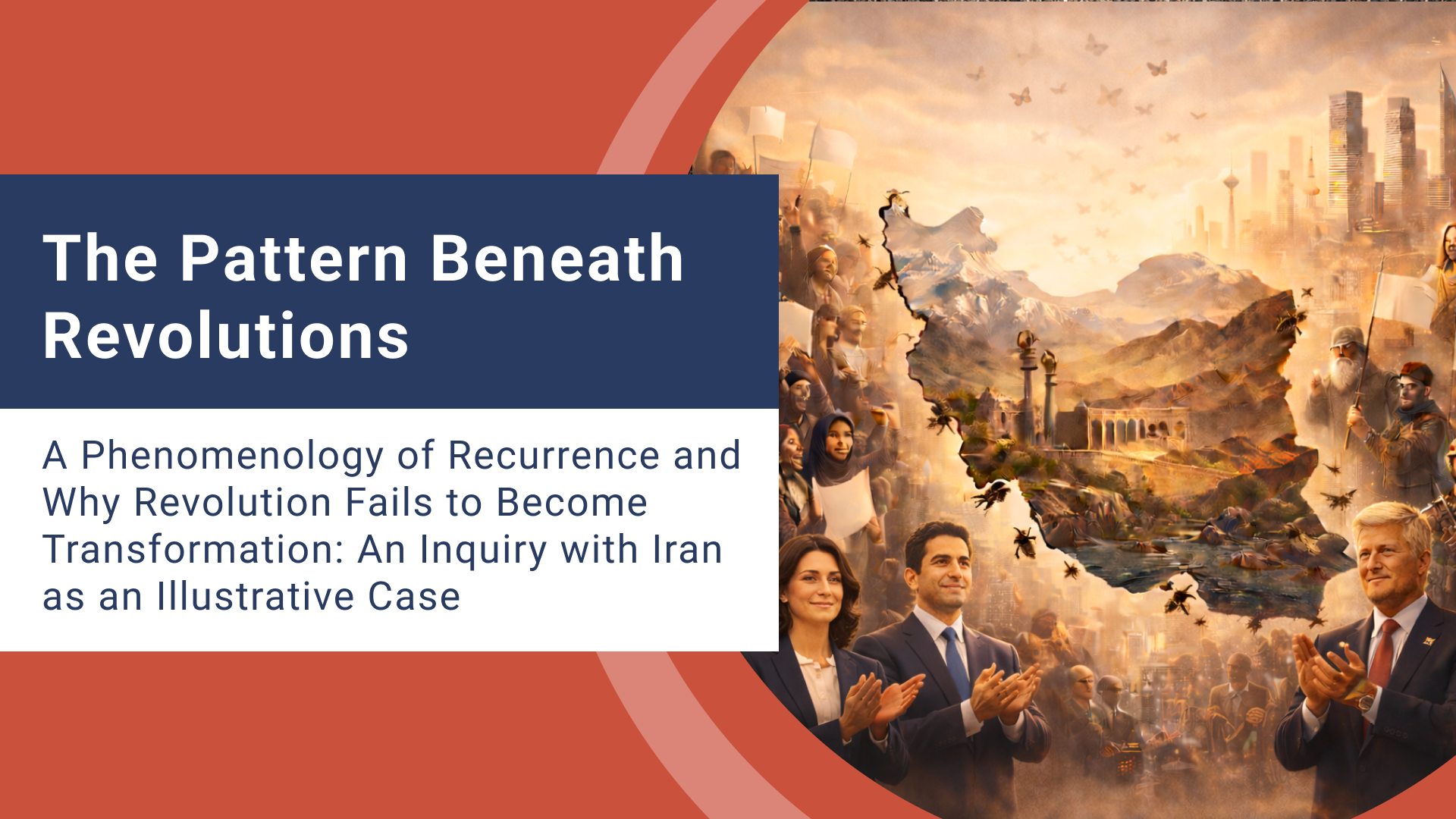

Introduction: Systems in Motion and the Patterns Beneath Upheaval
Every system, whether a family, an organisation or a civilisation, exists in a state of continuous motion. No system is ever static. It transitions through phases of coherence and disintegration in a pattern that resembles the limniscate (∞). This fluidity means that stability is never a fixed state, but a moment within an ongoing movement. What determines the quality of these transitions is not external events alone, but the collective awareness, discernment and sense-making of the people within the system.
We often underestimate how much influence we have over the systems we inhabit. We imagine ourselves as observers of history rather than participants who modulate its direction. Yet every choice, every assumption, every unexamined emotion becomes part of the systemic field. Systems are not shaped by events in isolation. They are shaped by how people interpret those events and how they respond to them. When a community’s understanding of reality is distorted, the system’s transitions become erratic. When sense-making is shallow or inauthentic, modulation breaks down.
This is why sense-making is the starting point of systemic integrity. Decisions made purely from anger, fear or sentimentalism may feel righteous in the moment, but they rarely align with long-term reality. Emotions are real and deserve recognition, yet civilisational choices are most effective when they are not driven by immediacy. Without clarity of perception and depth of understanding, systems lean towards reaction rather than modulation. Reaction creates turbulence. Modulation creates coherence.
It is within this context that we explore a recurring pattern found not only in single nations, but across history and across cultures. This pattern is not political. It is phenomenological. It concerns how human beings interpret the world, how they construct meaning under pressure and how they respond when systems begin to fracture. Iran becomes one illustrative example, not the centre of the analysis. The deeper inquiry is into a mode of experience that reappears across generations and across civilisations, even when the ideologies and symbols seem entirely different on the surface.
This pattern is what can be referred to as Revolutionary Being. It refers to a particular way of experiencing the world, one that emerges whenever sense-making collapses, dualities intensify and emotion replaces discernment. It is a mode of Being that appears in moments of upheaval, not because of ideology, but because of a deeper human tendency to interpret crisis through the lens of confrontation and urgency. Revolutionary Being exists long before it becomes a slogan or a political project. It begins as a structure of perception.
To understand why systems fall into cycles of upheaval and recurrence, we must first understand this mode of Being. Only then can we recognise why societies that see themselves as opposites often behave as reflections of one another and why transitions that promise liberation end up reproducing the same underlying pattern in a different form.
If this pattern is not recognised, the system continues to move along the same trajectory. Without authentic sense-making, no amount of desire for change can modulate the system towards coherence. The world is full of revolutions of force. What it lacks is transformation of Being.
Revolutionary Being: A Phenomenology of Patterned Breakdown
Revolutionary Being is not an ideology. It is not limited to specific political groups, historical periods or particular nations. It is an archetype, a pattern of experiencing reality, a structure of awareness that emerges whenever systems enter moments of pressure, fracture or transition. It is a way of interpreting the world that feels empowering in the moment, yet often contributes to deeper cycles of dysfunction and collapse.
At its core, Revolutionary Being arises when sense-making collapses into dualities. The world is no longer seen in its complexity. It is divided into forces of good and evil, purity and corruption, liberation and oppression. These distinctions may carry emotional truth, yet they also simplify the rich layers of reality into binaries that cannot hold the nuance a system requires for coherent modulation.
Within this mode of Being, identity becomes anchored in opposition. A person comes to know themselves not through discernment or self-understanding, but through what they reject. Being for something becomes secondary to being against something. This dynamic is not limited to those in power or those resisting power. It appears on both sides whenever complexity becomes unbearable and simplicity becomes seductive. Authorities define themselves by naming external “enemies”, and citizens define themselves by positioning the authorities as the “enemy”. The identity of each group becomes shaped less by authentic purpose and more by the opposition they cling to.
Revolutionary Being also brings a sense of urgency that overrides reflection. Action becomes instinctive rather than intentional. The feeling of momentum becomes more important than the quality of judgment. Emotions become the primary navigators, which means that anger and hope alike can distort perception. This does not invalidate emotional experience. It simply recognises that emotion without context or reflection narrows our field of awareness.
Another feature of Revolutionary Being is the belief that willpower can override reality. This manifests as the expectation that sheer determination or moral conviction should reshape the world on demand. When events do not conform to these expectations, frustration intensifies and the cycle accelerates. This is why moments of societal upheaval are rarely moments of genuine transformation. They often repeat the very patterns they seek to overthrow.
This phenomenological pattern is universal. It appears in the French Revolution, the Arab Spring, Latin American uprisings and countless other historical moments. It is not tied to religion, ideology or geography. It emerges from the human tendency to interpret crisis through confrontation rather than comprehension. It is a pattern that intensifies when systems are already transitioning along the disintegration side of the limniscate and when collective sense-making has been eroded.
Although the term “revolutionary” is often associated with Iran’s authorities in recent decades, it is crucial to understand that Revolutionary Being existed long before that context and exists far beyond it. Iran will be used as a case study in the coming sections to illustrate the pattern, not to define it. The deeper argument is that whenever systems are modulated through reaction rather than awareness, Revolutionary Being becomes the dominant ontology – the deep structure driving how a society thinks, feels and acts. And once internalised, it is transmitted across generations, sometimes in opposition to the very structures that first cultivated it.
Recognising this pattern is essential for breaking cycles of upheaval. If Revolutionary Being remains invisible, societies continue to reproduce the same modes of collapse, even while believing they are pursuing change. The path out requires an entirely different mode of Being, one that does not collapse under pressure but deepens its sense-making in the face of it.
Systemic Integrity, Dynamic Transitions and the Limits of Awareness
Every system is in motion. It transitions through phases of coherence and disintegration in a continuous loop that resembles the limniscate. The health of a system depends on how consciously these transitions are modulated. When individuals and institutions interpret reality accurately, transitions remain adaptive. When awareness becomes distorted, transitions become turbulent and unpredictable.
Systemic integrity is not a fixed condition. It is the ongoing alignment between a system’s purpose, its structures and the behaviours of the people who inhabit it. When this alignment slips, the system begins to lean toward disintegration. This shift can occur slowly or abruptly, yet it is rarely random. It reflects the quality of sense-making at both individual and collective levels.
Distorted awareness is one of the primary forces that accelerates disintegration. When people misinterpret events, when emotions override discernment or when assumptions become substitutes for understanding, the system loses its capacity for modulation.
Modulation is the ability to influence transitions intentionally rather than being swept along by them.
Without accurate sense-making, modulation becomes impossible. What remains is reaction, and reaction amplifies instability rather than resolving it.
This is why moments of upheaval are rarely moments of genuine transformation. If a system enters a transition on the disintegrating side of the limniscate and if the people within it are navigating reality through distorted awareness, even well-intentioned actions can lead to deeper fracture. Emotions are valid, yet without context they can become unreliable guides. They often create an illusion of clarity that narrows the field of perception.
This is NOT a call to suppress emotion. It is an invitation to recognise its limits. Emotions signal significance, not direction. A system that treats anger or hope as its compass will repeatedly misread its environment. It will become reactive rather than responsive. It will mistake momentum for progress and urgency for insight. Decisions made in this state often produce short-term catharsis at the expense of long-term coherence.
When systemic integrity weakens, societies begin to latch onto simple narratives. Complexity becomes threatening and dualities become comforting. This is the environment in which Revolutionary Being thrives. Not because people consciously seek confrontation, but because the collapse of authentic sense-making makes confrontation feel like the only reliable strategy. People fall back into patterns that seem decisive, even when those patterns repeat the very cycles that brought the system to crisis in the first place.
This section sets the foundation for understanding why certain historical patterns repeat themselves. It also clarifies why Iran is introduced not as the subject of analysis but as an example of how a system’s internal sense-making, or lack thereof, shapes its transitions across generations. Before examining that case, we must recognise the universal mechanism: systems falter when awareness falters, and systems regenerate when awareness deepens.
When collective awareness collapses into reaction and emotion becomes the primary lens, systems slip further into disintegration. When awareness expands and people see reality with greater fidelity, modulation becomes possible. In this distinction lies the difference between cycles of upheaval and pathways to renewal.
The Pattern in History: Iran as an Illustration of Recurring Revolutionary Being
Iran provides a vivid case study of how Revolutionary Being appears and reappears across generations, even as symbols, ideologies and political actors change. This section does not examine Iran as an exception. It examines Iran as an example of a universal pattern in which systems that fail to cultivate authentic sense-making repeatedly cycle through forms of collapse rather than transition into coherence.
1. The Qajar Era (1789 - 1925): Collapse of Sense-Making and the Longing for a Strong Hand
During the late Qajar period, foreign interference, internal fragmentation and widespread misalignment created a deep fracture in systemic coherence. Decision-making became reactive rather than reflective, and crises were interpreted through short-term interests rather than long-term vision. The result was a collective sense of helplessness. This psychological vacuum made society receptive to the belief that salvation would arrive through a forceful figure who could impose order. The desire for a ‘strong hand’ was not ideological. It was an understandable response to the collapse of sense-making. This same archetype appears in many societies today, where people, exhausted by complexity, begin to demand leaders who promise control without considering the long-term consequences. The fire they call for may bring temporary relief, yet it often grows into the flame that later consumes their own house.
2. Reza Shah (1925 - 1941) : Modernisation Through Coercion and the Embedding of Violence
Reza Shah emerged as exactly that strong figure. His modernisation efforts reshaped Iran’s infrastructure and institutions, yet the underlying grammar of change was coercive. Cultural reforms were imposed rather than cultivated. The language of violence became normalised because it seemed effective. One of the most symbolic examples was the removal of the veil by force. It was progress in appearance, delivered through domination rather than societal evolution. This embedded an ontological message in the collective psyche: power expresses itself through force and change is achieved through confrontation.
3. Mossadegh and the 1953 Coup: A Brief Emergence of Authentic Sense-Making
The early 1950s marked a rare moment in which a substantial part of Iranian society began to experiment with independent sense-making. Mossadegh’s nationalisation of oil and his attempts to rebuild sovereignty and limit the executive power of the King were grounded in discernment rather than reaction. Yet the system was not structurally ready. Internal fragmentation, ideological rivalry and external intervention converged. MI6 and the CIA played decisive roles in the 1953 coup, but the deeper issue was that the society had not yet cultivated the systemic coherence required to protect a reform movement. The collapse that followed sent a powerful subconscious message: independent sense-making is dangerous.
4. Pahlavi II and SAVAK (1953 to 1979): Institutionalising Fear and Narrowing Meaning
After the 1953 coup restored Mohammad Reza Shah to full power, the environment shifted into a state of chronic tension. The country entered a period of rapid modernisation, and many surface-level freedoms expanded. Urban life saw the rise of beaches, discos, bars, cinemas, cultural liberalisation and visible expressions of Western lifestyle, including women wearing miniskirts and participating more openly in public life. Significant infrastructural projects were also undertaken, from roads and dams to industrial expansion and national development programs.
Yet beneath this visible modernity, the system became increasingly centralised and insulated. SAVAK, the National Intelligence and Security Organisation, grew into a powerful instrument of control. Created with foreign assistance, it monitored citizens, infiltrated communities, censored ideas and used severe methods of intimidation, including unlawful detention, torture and forced disappearances. While modern life flourished on the surface, people understood that speaking freely could carry real consequences. As a result, the collective vocabulary shrank. With meaning suppressed, society gravitated toward simplistic binaries. In this atmosphere, Revolutionary Being began to form beneath the surface long before it acquired a religious expression.
5. The 1979 Revolution: A Reactive Power Shift Rather Than a Transformation of Being
When the revolution erupted, it was framed as liberation. Yet the ontology of the revolution resembled the ontology of the system it opposed. The energy was reactive, fuelled by confrontation and dualism. Violence had been normalised as a path to change. What differed were the symbols, not the underlying Being. Reza Shah had removed the veil by force. The Islamic Republic would later impose it with the same force. The content shifted. The grammar remained.
6. The Islamic Republic: Reversing the Symbols While Preserving the Logic
After 1979, Revolutionary Being became institutionalised as doctrine. The word revolutionary came to signify ideological purity and resistance. In English media it is often translated as revolutionary fervour or the revolutionary line. Yet the deeper structure did not begin in 1979. It was inherited from an older pattern.
The leaders of the Islamic Republic were themselves shaped by the very conditions they later reproduced. Ayatollah Khomeini had been arrested by the Pahlavi state in 1963 and was sent into exile in 1964, spending more than fourteen years in Turkey, Iraq and France. Ali Khamenei, the current leader, was arrested several times before the revolution, including in 1963 and 1974, with historical accounts describing interrogation and mistreatment by SAVAK. Both men had lived through systems that used coercion, censorship and violence as tools of maintaining control.
This experience forged their identity through struggle. Their sense of mission was carved in opposition to an oppressive authority or at least what they perceived as one. Revolutionary Being became not only a political rallying cry but an internalised mode of existence. Once they came to power, the same underlying ontology persisted. Power continued to express itself through force. Identity continued to be organised through opposition. The system reversed the symbols of the previous regime, yet the logic remained the same. The continuity was not political. It was phenomenological.
7. Today’s Youth: Rejecting the System While Reflecting Its Ontology
A striking development has emerged in recent decades. Many young Iranians reject the Islamic Republic strongly. They oppose its ideology, its governance and its symbols. Yet their mode of engagement often reflects the very structure the system instilled in them. The language of confrontation, the reliance on binaries, the moral urgency, the collapse of complexity and the belief that sheer force or emotion can produce systemic change all echo Revolutionary Being. The target has changed. The ontology has not.
This is not a criticism of the youth. It is an observation of a systemic pattern. People internalise the grammar of the field in which they are raised. When a society is shaped for generations by Revolutionary Being, its logic becomes familiar, intuitive and unavoidable. Even those who seek freedom often do so through the same patterns that produced the very system they resist.
8. The Deeper Lesson: Iran as a Mirror for the Universal Pattern
Iran’s modern history is a layered illustration of how a society repeatedly enters cycles of upheaval when sense making collapses and when systems are steered through reaction rather than awareness. The Iranian case is not unique. It simply reveals the underlying mechanism with unusual clarity. The pattern appears across many civilisations whenever the ontology of force is transmitted from one generation to the next.
This is a crucial lesson for nations that see themselves as developed or mature. Systemic integrity is not a fixed achievement. It is not a destination that, once reached, guarantees stability. Integrity and disintegration do not sit at opposite ends of a single linear spectrum. They are both ongoing possibilities within a living continuum. A society sustains its integrity only through continued modulation and wise leadership that understands long-term consequences, not only short-term pressures.
Even in countries that assume they have moved past the risk of systemic breakdown, reactive governance can initiate patterns that future generations will inherit in damaging ways. When authorities restrict speech too heavily, limit personal freedoms, impose wide bans or introduce rapid punitive measures, pass knee-jerk legislations, they may believe they are protecting society. Yet from an ontological perspective, these actions can also seed future mistrust, resentment and oppositional identity. Over time, they may give rise to counter-movements that express themselves through political violence, social unrest or deeper forms of fragmentation.
These patterns are visible globally. Governments that step over international laws may believe they are acting from necessity. Yet violations of collective norms create long-term ripples. They teach younger generations that force, not coherence, is the grammar of action. The Islamic Republic provides a vivid illustration. It banned all alcohol consumption, imposed compulsory dress codes and used severe punishment to enforce compliance. Decades later, these measures not only failed to create alignment, they intensified resistance. The ontological principle remains constant. Integrity cannot be imposed. It must be cultivated.
The same holds for consumer restrictions, speech controls or attempts to limit cultural behaviours, whether justified or not. Even when a policy is ethically motivated or well intentioned, the phenomenology does not change. Direct force applied to complex social fields rarely produces sustainable outcomes. It often creates adaptive resistance, hidden resentment and long-term instability.
This section prepares us to map the pattern more formally through the Systemic Subversion Cycle. The SSC reveals that these historical phases were not isolated events. They were sequential movements within a recurrent loop of breakdown. The lesson is universal. Societies either modulate their transitions consciously, or they are pulled into recurring cycles of force, reaction and decay.
Mapping Iran’s History onto the Systemic Subversion Cycle
The Systemic Subversion Cycle is a diagnostic lens that helps us recognise that systemic breakdown does not occur randomly. It unfolds through a predictable sequence of phases that reinforce one another. When applied to Iran, the SSC reveals that what often appears as a series of disconnected historical disruptions is, in fact, a repeating loop of disintegration shaped by the same underlying pattern of sense-making collapse.
Iran’s modern history, when viewed through this lens, becomes a vivid example of how a society can move through the SCC again and again without realising it, because the ontological conditions that generate the cycle remain unexamined. The purpose here is not to provide political commentary. It is to demonstrate how the SSC explains the recurrence of Revolutionary Being across different eras.

Figure 1: Systemic Subversion Cycle from the Sustainabilism Book
1. Crisis Trigger: The Disruptive Shock That Exposes Systemic Fragility
In the Qajar period, the triggers included external pressure, territorial losses and economic disruption. These shocks did not create dysfunction on their own. They revealed an existing weakness in sense-making and governance. Later triggers included the nationalisation of oil, the pressures of the Cold War and the protests that preceded the 1979 revolution. Each shock increased uncertainty and pushed the system into a reactive posture.
2. Structural Breakdown: Institutions Lose Coherence and Direction
As uncertainty intensified, institutions struggled to maintain alignment. Qajar governance fractured under foreign pressure. Pahlavi institutions fluctuated between development and coercion, eroding trust. After 1953, the restored monarchy relied heavily on centralised authority and surveillance. After 1979, post-revolutionary institutions hardened around ideological purity rather than adaptability. In every era, meaning-making weakened and structures lost their capacity to respond coherently.
3. Displacement and Resource Strain: Pressure on the Social and Economic Fabric
Each phase of instability placed pressure on vulnerable groups. Under Qajar rule, displacement emerged through financial collapse and foreign intervention. Under Pahlavi rule, rapid modernisation and rural to urban migration strained communities. After the revolution, economic volatility and international isolation intensified resource pressure. Displacement was not only physical. It was also psychological as people struggled to find stable identity in a system that was constantly redefining itself.
4. Escalation and Fractures: Polarisation and Confrontation Intensify
In all eras, unresolved tension gave rise to deep social fractures. Divisions grew between secular and religious groups, traditionalists and modernists, elites and ordinary citizens, insiders and outsiders. Complexity collapsed into binaries. This was the ideal environment for Revolutionary Being to intensify. Groups defined themselves by opposition. Confrontation replaced reflection. Social cohesion weakened and conflict became more attractive than dialogue.
5. Exploitation and Entrenchment: Power Groups Amplify the Crisis
Whenever systems enter prolonged instability, actors in positions of influence often exploit the situation. During the Pahlavi period, those aligned with power used the climate of modernisation and fear to consolidate their positions. After the 1979 revolution, new groups did the same, using the language of ideology to justify consolidation. External powers also played roles at different moments for political or strategic gain. These actions deepened the cycle and locked the system into dysfunction.
6. Institutional Inertia and Inaction: Systems Fail to Correct Themselves
Across the eras, institutions failed to reform themselves meaningfully. Under Qajar rule, the state was paralysed by internal fragmentation. Under Pahlavi II, bureaucratic inertia and dependence on central authority prevented adaptive governance. After the revolution, ideological commitments often overrode practical needs. When inertia sets in, even systems with potential for renewal become resistant to corrective action. Without modulation, the system slides further into disintegration.
7. Self-Perpetuation and Recurrence: The Cycle Repeats with New Symbols and New Actors
Once the SSC reaches this stage, crises no longer appear as isolated events. They become culture. The logic of Revolutionary Being, the language of force and the reliance on binaries reproduce themselves. The symbols may change, yet the ontology remains the same. The revolutionary being that emerged in opposition to one system becomes the logic of the next system. The same cycle that brought down the Qajars contributed to the fall of the Pahlavis, and the same pattern now appears in the behaviours of those resisting the Islamic Republic.
The SSC helps us see that the Iranian case is not a story of different kinds of revolutions or different types of regimes. It is the story of a cycle of disintegration repeated because the underlying intellectual substrates for sense-making (metacontent) does not change. Iran is not alone in this. It simply illustrates the pattern with unusual clarity.
In the next section, we turn from diagnosis to a deeper phenomenological insight: why systems that see themselves as opposites often behave as mirrors of one another.
Why Opposites Mirror Each Other: The Blind Symmetry of Revolutionary Being
One of the most striking insights that emerges when we examine systems through the SSC and the lens of phenomenology is that opposing groups often mirror each other far more deeply than they realise. This mirroring is not ideological. It is ontological. It is rooted in the mode of Being through which people interpret reality during moments of systemic disintegration.
In Iran, as in many societies that have experienced repeated cycles of upheaval, the ruling establishment and significant segments of the opposition view themselves as fundamentally different. They perceive their values as opposed, their aspirations as incompatible and their identities as mutually exclusive. Yet when we step beneath the surface and examine the lived structure of their awareness, the same pattern emerges on both sides.
At the core of this symmetry is Revolutionary Being. This mode of experiencing the world creates a sense of moral urgency that collapses complexity into binary frames. It shifts identity formation from self-understanding to antagonism. It elevates emotion over discernment, immediacy over reflection and force over modulation. When a system teaches its population, through decades of socialisation, that change is achieved through confrontation, it unintentionally conditions its own opposition to adopt the same ontology.
This mirroring is easiest to see in moments when anger and urgency overpower reflection. In such states, people believe that pushing harder will compensate for the absence of clarity. Action becomes a substitute for comprehension. The system’s language of force becomes internalised even by those who reject the system’s ideology. The content is rejected, yet the structure is preserved.
This phenomenon appears in many countries. It is not specific to Iran. The French Revolution, the Egyptian uprising of 2011, and several Latin American shifts of power illustrate the same pattern. When sense-making collapses, opposing forces adopt the same emotional logic even as they believe they are pursuing different futures. The result is that systems fall into cycles of replacement rather than transformation.
In Iran’s case, decades of governance shaped by a confrontational ontology normalised the idea that legitimacy is proven through resistance and that identity is strengthened through opposition. This logic is visible in the state, where terms like “revolutionary spirit” and “revolutionary steadfastness” are used to signal authenticity. It is also visible in those who resist the state, where moral purity is often defined in terms of unwavering opposition. Both sides express certainty. Both collapse nuance. Both rely on emotional intensity to guide action. Both distrust complexity.
The consequence is a shared vulnerability. When both sides operate from the same ontological pattern, the system becomes locked in a loop. Each side believes the other is the source of dysfunction, yet both are participating in the same underlying structure that perpetuates it. This is why disintegration becomes self-reinforcing. Opposites reproduce each other’s shadows while believing they are escaping them.
The father and child analogy helps illustrate this point. A parent who normalises harshness and confrontation as a way of interacting with the world often raises a child who eventually uses the same language of force against them. The child is not simply rebelling. They are expressing the ontology they were taught. The behaviour is different in direction, but identical in structure. The systemic pattern continues because the underlying mode of Being has not changed.
This blind symmetry is not a moral judgement on either side. It is a phenomenological diagnosis of how systems, when shaped by distorted awareness and a collapse of sense-making, produce mirrored expressions of Revolutionary Being. When a system becomes disintegrated, everyone within it becomes susceptible to the same ontological pattern, even when they disagree about everything else.
Understanding this symmetry is essential. Without it, societies misinterpret their crises as contests between right and wrong rather than recognitions of deeper structural vulnerabilities. Misdiagnosis leads to misalignment, and misalignment leads to further cycles of collapse.
Breaking this loop requires a shift in ontology. It requires moving beyond the pattern that both sides unknowingly share. That is where the next section leads us: to the danger of recurrence when Being remains unchanged.
The Danger of Endless Recurrence When Being Remains Unchanged
When a system repeatedly moves through the stages of the SSC and when Revolutionary Being becomes the dominant mode of experience on all sides, the most significant risk is not collapse itself. The deeper danger is recurrence. Systems do not simply fall apart once. They fall apart in patterns. They fail in familiar shapes. They reconstitute themselves with new symbols but the same ontology. This is the essence of civilisational stagnation. It is not the absence of change. It is the repetition of the same pattern under the illusion of change.
Recurrence happens when systems remain on the disintegrating side of the limniscate. The system enters a transition, but instead of modulating through coherence, it spirals deeper into reactivity. Each cycle reinforces the next. Every generation inherits not only the unresolved fractures of the one before, but the underlying mode of Being that produced those fractures. Without a shift in awareness, the cycle becomes cultural. It becomes the default grammar through which meaning is constructed and through which crisis is interpreted.
This is how societies fall into collective psychosis. Not because people are irrational, but because distorted awareness becomes normal. People grow up within meaning systems that reward certainty over discernment, urgency over reflection and confrontation over comprehension. In such environments, emotional momentum is mistaken for moral clarity. Complexity becomes intolerable because it threatens identity. When the underlying pattern remains invisible, even constructive efforts to create change can become expressions of the same disintegrated ontology.
This dynamic is not unique to Iran, although Iran illustrates it clearly. It appears in countries that cycle through strongman leadership, populist uprisings, ideological revolutions or polarised power shifts. It appears wherever systems weaken their sense-making capacity and fall into the belief that force is the only reliable instrument of transformation. It appears wherever emotional reaction becomes a substitute for systemic understanding.
When Being remains unchanged, systems recreate the very conditions that produced their initial collapse. This is why some societies alternate between authoritarian and revolutionary phases. Each phase sees itself as the answer to the previous one, yet both share the same underlying structure. They reproduce each other’s ontological shadow while believing they are escaping it. Both arrive at the same point because they begin from the same mode of awareness.
This is the logic behind the observation that societies fall from one pit into another. They do not descend because of ideology or political failure alone. They descend because the pattern governing their awareness has not evolved. They rely on the same sense-making that generated the last crisis. The surface changes. The structure persists.
The result is a civilisation that becomes highly reactive and poorly modulated. It lives in cycles of turbulence rather than pathways of renewal. It mistakes collapse for transition and revolution for transformation. It repeatedly attempts to solve systemic dysfunction with the same ontology that produced it.
Recognising recurrence is critical, because recurrence is the point at which systems begin to lose their capacity for regeneration. When a system enters multiple loops of the SSC without shifting its underlying Being, disintegration becomes embedded. The system stabilises not in coherence, but in dysfunction. This is when institutions fail to restore trust, social bonds weaken and the population loses confidence in the possibility of renewal. The cycle becomes self fulfilling.
Breaking recurrence requires more than new leadership, new ideology or new institutions. It requires a shift in the mode of Being through which a society interprets reality. Without that shift, every attempt at reform risks amplifying the very patterns it hopes to correct.
The next section turns towards the beginning of that shift. It introduces a framework that moves beyond reaction and toward reconstruction. This is where the Reconstructive Ontology of Sustainability enters the conversation.
Breaking the Cycle: Introducing the Reconstructive Ontology of Sustainability (ROS)
If Revolutionary Being fuels the Systemic Subversion Cycle and if distorted awareness keeps systems trapped in loops of recurrence, then the path out cannot be another political shift, ideological replacement or emotional surge. The path out must be ontological. It must transform the way a society understands itself, perceives reality and modulates its transitions within the limniscate. This is where the Reconstructive Ontology of Sustainability becomes essential.
The Reconstructive Ontology of Sustainability is not another model for crisis management. It is a way of reshaping the very conditions that allow coherence to emerge in human systems. It begins with the premise that systemic transformation is impossible when the underlying mode of Being remains reactive or emotionally driven. ROS addresses the foundation from which systems think, act and evolve. It shifts the field of awareness that shapes sense-making, and therefore the field of possibility for modulation.
The first principle of ROS is that renewal begins with perception. Systems cannot change what they cannot see. When awareness is distorted, and when meaning is constructed through binaries or emotional urgency, the system loses its ability to modulate. ROS brings attention back to the quality of sense-making. It invites individuals and collectives to reconstruct their relationship with reality in a way that is aligned, coherent and attuned to complexity.
The second principle is that systems become sustainable only when the people within them can distinguish between reaction and reconstruction. Reaction is immediate, emotionally charged and often driven by the belief that force will correct misalignment. Reconstruction is deliberate and grounded. It involves understanding the system’s purpose, diagnosing its fractures accurately and designing interventions that restore integrity rather than intensify fragmentation. ROS guides this process by providing a structure for reorienting attention toward what is essential and away from what is merely urgent.
The third principle is that sustainable systems require the cultivation of capacities that Revolutionary Being suppresses. Reflection, discernment, integrative thinking and the ability to tolerate complexity become central. These capacities are not luxuries. They are the conditions that allow systems to remain on the coherent side of the limniscate. ROS provides a framework for embedding these capacities at every level of a system, from individuals to institutions.
The fourth principle is that reconstruction must be anchored in alignment, not antagonism. Systems that define themselves through opposition remain vulnerable to recurrence. Transformation requires shifting identity from what a society rejects to what it is building. This does not mean ignoring injustice or abandoning accountability. It means understanding that sustainable change arises not from defeating an enemy, but from reconstructing the foundations of Being that allowed dysfunction to take hold.
The Reconstructive Ontology of Sustainability (ROS) is a framework for rebuilding the deep foundations of how a system understands itself, makes sense of reality and guides its own evolution. It does not fix crises on the surface. It transforms the underlying mode of Being that produces them.
When applied to Iran as an illustrative case, ROS does not offer a political solution. It offers a philosophical pathway for breaking the centuries long recurrence of Revolutionary Being. It invites a shift from confrontation to comprehension, from reaction to modulation and from collapse to coherent regeneration. It demonstrates that the future of any nation is shaped not by the intensity of its uprisings, but by the depth of its sense-making and the maturity of its ontology.
ROS integrates everything that the SSC exposes. Where the SSC maps the sequence of disintegration, ROS provides the architecture for reconstruction. It bridges diagnosis and renewal. It addresses not only the patterns that keep systems trapped in cycles of collapse, but the deeper human tendencies that make those patterns possible. It is a framework for building systemic resilience that does not rely on force or ideology, but on awareness, integrity and alignment with reality.
Applied to the Iranian context, ROS points to something very concrete. It suggests that real change will not come from another uprising, another shift of power or another ideological replacement. It calls for reconstructing the shared way Iranians perceive themselves, interpret the world and respond to complexity. This would mean cultivating a culture that values discernment over emotional urgency, reflection over reaction and modulation over confrontation. It would mean teaching a generation to move beyond identity formed through opposition and instead build identity around coherence, purpose and alignment. In practice, this looks like creating environments where dialogue is possible, where disagreement is not a threat, where institutions are designed to learn rather than enforce and where leaders emerge from participation rather than force. ROS does not prescribe a political model. It outlines the ontological shift that would allow any political model to become sustainable.
In simple, tangible terms: what ROS is actually encourage people to do
Many often say, “We are angry because we do not have those prerequisites.” ROS agrees. The whole point is that change must be built upstream, long before collapse. So what does that actually mean in real life?
1. Stop feeding the cycle by reacting in the same grammar as the system.
When a system uses force, people instinctively respond with force. This is how Revolutionary Being reproduces itself. ROS says: break the mirror. Do not become the pattern you want to escape. Shouting back when the system shouts only reinforces the ontology you oppose. This is not submission. It is upstream leadership.
2. Create small pockets of coherence before escalation.
Instead of waiting for collapse and then erupting, ROS focuses on building local environments where clarity, dialogue and discernment are practised. Micro-communities, small forums, youth circles and relational spaces that model reflective behaviour seed the ontology of transformation.
3. Replace emotional urgency with accuracy.
Anger makes everything feel urgent. ROS asks for something practical: do not act until the picture is accurate. Verify information. Understand the structure of the problem. Pause long enough to see the pattern, not just the trigger. This breaks the amplification loop that turns frustration into chaos.
4. Build identity around purpose, not opposition.
Revolutionary Being says, “I know who I am because I know who I oppose.” ROS shifts identity toward what a society is building. Define the outcomes you want, not the enemies you reject. Articulate coherent visions rather than slogans. This stops anger from becoming the centre of identity.
5. Redirect energy from destruction to construction.
Anger wants to break. ROS wants to build. Construction means designing small initiatives, strengthening trust networks, cultivating critical thinking, and creating projects that model integrity. Building is the opposite of collapsing.
6. Demand modulation instead of explosions.
When people react explosively, they confirm the system’s logic. ROS says: do not let the system dictate the tempo. Set a tempo that is reflective yet effective, strategic rather than episodic, deliberate rather than volatile. Sustainable pressure, not emotional eruption, moves systems upstream.
In one practical sentence:
ROS asks people to stop mirroring the system, start building coherence early, and shift from reactive opposition to constructive, upstream leadership that changes the ontology of the field.
This section prepares the ground for the conclusion, where the implications of this shift are brought together. It clarifies that the only revolution capable of breaking cycles of disintegration is not a revolution of force, but a transformation of Being.
Transformation and Modulation: The Path Beyond Revolutionary Action
While revolutions promise change, they rarely produce transformation. Revolutions act upon systems. Transformation acts within them. Revolutions attempt to replace structures. Transformation renews the ontology that gives rise to structures. Revolutions express force. Transformation expresses awareness. This distinction matters because sustainable systems cannot be built through reaction. They depend on modulation, a participatory process in which individuals and institutions consciously influence the system’s transitions upstream, before fractures become crises.
Transformation begins with a shift in Being. It requires reconstructing sense-making so that complexity becomes navigable rather than overwhelming. It deepens awareness so that systems can modulate their transitions rather than be swept along by them. Modulation is the opposite of uprising in response to crisis. It is the ongoing capacity of a population to influence the evolution of its institutions, norms and structures from within. It is bottom up, but not in the reactive sense. It is bottom-up because it arises from the maturation of the collective psyche.
Participative leadership is central to this process. It involves the distribution of awareness, responsibility and decision influence across the system. Not as populism and not as decentralised chaos, but as a culture in which individuals are capable of seeing how their choices, assumptions and interactions shape the systemic field. Participative leadership does not wait for dysfunction to intensify. It intervenes upstream. It identifies misalignments before they harden. It restores coherence by cultivating the conditions that prevent crises rather than reacting to them.
In contrast, revolutionary action tends to occur downstream, after fractures have already deepened. It becomes a concentrated expression of reactive energy. Revolutions may remove a leader or overthrow institutions, yet they rarely reconstruct the ontological conditions that produced dysfunction. This is why revolutions so often reproduce the same dynamics under new symbols. They are responses to disintegration, not the foundations of regeneration.
Modulation, by contrast, is regenerative. It aligns individual agency with systemic coherence. It empowers communities not through force, but through clarity of perception and integrative awareness. It is the practice of influencing the system’s evolution through ongoing, participatory engagement that strengthens integrity rather than accelerating collapse.
Transformation requires a field of Being that can hold nuance and withstand uncertainty. Revolutionary Being collapses nuance and weaponises uncertainty. Transformation requires upstream work on sense-making, meaning and identity. Revolution often amplifies the very distortions that destabilised the system in the first place. This is why systems that aspire to genuine renewal must cultivate modulation as a civic capacity. Without it, every attempt at change risks becoming another turn of the same cycle.
By embedding participative leadership and modulation into the collective psyche, societies develop the resilience to evolve without recurring upheaval. This is the essence of transformation. It is slow enough to be sustainable, yet powerful enough to reshape the very conditions that give rise to crises. Transformation is not quieter than revolution. It is deeper. It is not less ambitious. It is more aligned with reality. It does not overthrow. It reconstructs.
To break the cycle of recurrence, societies must shift from revolutionary action to transformational modulation. Only then can change become durable. Only then can systems evolve beyond the pattern beneath revolutions.
Conclusion: The Only ‘Revolution’ Worth Pursuing
Across history and across cultures, systems collapse not because people lack passion or moral outrage, but because they lack the depth of awareness required to modulate their transitions. Iran’s modern history illustrates this with unusual clarity, yet it is not an Iranian story alone. It is the story of any society that repeatedly attempts to solve systemic dysfunction with the same ontology that produced it.
The Systemic Subversion Cycle shows how crises reinforce one another when collective sense making becomes shallow. Revolutionary Being explains why opposing groups, despite believing they are fighting for different futures, often mirror each other in structure and emotion. The limniscate reminds us that systems are never static and that every moment is a transition, either toward coherence or toward deeper disintegration.
When awareness collapses, societies fall into patterned recurrence. They replace regimes, symbols and narratives, yet reproduce the same ontological conditions that shape their behaviour. They mistake momentum for progress. They confuse catharsis with clarity. They move from one turbulence to the next, believing they are escaping their history while carrying its structure within them.
This lesson does not belong to Iran alone. Even societies that see themselves as developed or stable are not insulated from recurrence. Some have cultivated antibodies in the form of strong institutions, distributed integrity and civic maturity, yet none are entirely immune. When human capacities are neglected, when ethical and professional standards erode, when sense making becomes reactive and when ontological capacities weaken, even the most “civilised” societies can descend into fragmentation. Integrity must be safeguarded continuously. It is not an inheritance. It is a practice.
Breaking the cycle requires a revolution that does not resemble any past revolution. It requires a revolution of Being (Transformation of Being to be exact). It demands a shift from reaction to reflection, from confrontation to comprehension and from emotional immediacy to systemic discernment. It requires the courage to question the ontology through which we interpret ourselves and the world.
The Reconstructive Ontology of Sustainability offers this alternative. It does not promise rapid transformation. It offers something more durable. It provides a path for rebuilding the conditions of coherence by restoring the foundations of sense making, integrity and alignment with reality. It teaches that sustainable systems are not built from opposition, but from understanding, modulation and deliberate reconstruction. It shifts attention from overthrowing what is wrong to reconstructing what is possible.
Iran serves here as a case study for a universal lesson. The forms may change. The actors may change. The ideologies may change. Yet systems remain trapped when the underlying mode of Being does not evolve. Every society faces the same choice and every generation confronts the same question. Not how to resist power or overthrow dysfunction, but how to shift the ontology that produces them.
The future belongs to those who can see beyond the pattern, who can recognise the symmetry between apparent opposites and who can cultivate the awareness required to modulate systems toward coherence rather than collapse. The revolution humanity needs is not one of force or fury, but one of depth, humility and authentic discernment. This is the revolution that breaks recurrence. This is the revolution that sustains. This is the revolution that transforms.
If you are interested in exploring these ideas in greater depth, including the Systemic Subversion Cycle, the Reconstructive Ontology of Sustainability and the broader Authentic Sustainability Framework, you can access the book Sustainabilism through the following link:
https://ashkantashvir.com/sustainabilism
It expands these concepts with the full philosophical, systemic and practical foundations that underpin this article.