

Care is Not the Problem
There is a tendency to assume that when things go wrong, it is because people do not care enough. That individuals are careless, that organisations are negligent, or that systems have lost their moral compass. Yet when one looks more closely across different domains, a different pattern begins to emerge. People do care. They invest time, energy, resources, and attention. Organisations act with urgency and intent. Nations make deliberate strategic choices. The issue is rarely the absence of care.
The issue is the order of care.
What is treated as important first, what is deferred, and what is neglected altogether forms a hidden structure beneath action. This structure is not always visible, yet it determines whether what is being built can endure. A person may invest in comfort before securing stability. A startup may invest in visibility before establishing value. A system may optimise for efficiency while neglecting resilience. In each case, effort is present, commitment is present, and even intelligence may be present. What is misaligned is the sequence.
Care, within the Being Framework, is not simply an emotional state or a preference. It is a way of relating to reality that directs attention, allocates resources, and shapes commitment over time. It determines what is pursued, what is protected, and what is sacrificed. When care is coherent, it aligns with what is foundational, time-sensitive, and necessary for long-term viability. When it is misaligned, it becomes fragmented, reactive, or prematurely expressed.
This is where axiology becomes practical rather than abstract. In simple terms, axiology is a branch of philosophy concerned with value. It examines what we consider important, what we prioritise, and what we are willing to sacrifice for. Yet beyond identifying what we value, a more critical question often goes unexamined, which is how those values are structured in relation to one another. Not everything that matters matters in the same way or at the same time. Some things are foundational. Others are conditional. Others are expressions that only become meaningful once the foundations are in place.
When this order is coherent, what is built has the capacity to endure. When this order is distorted, even well-intentioned effort leads to fragility.
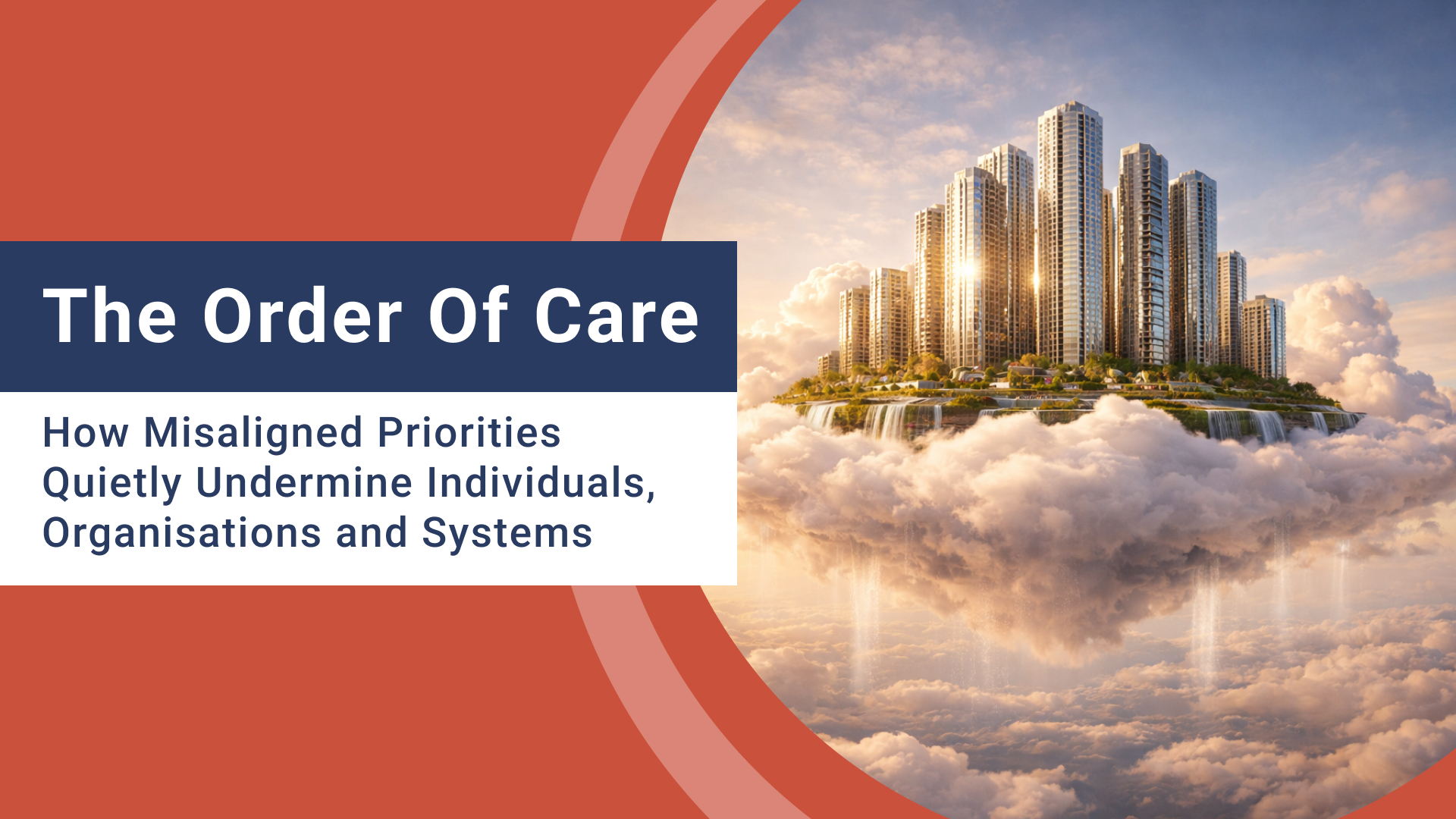
There are times we build our house on sand, where the foundation exists but cannot withstand the pressures placed upon it. And there are times we build our house on clouds, where what we believe to be a foundation never had contact with reality to begin with. In both cases, the failure is not in the absence of effort, but in the misalignment between what is being built and what is required for it to endure and to sustain itself.
This is not a matter of intelligence, nor is it resolved by simply trying harder. It is a matter of how care is structured, how priorities are formed, and whether what is treated as urgent is truly what is essential.
Care, Normativity, and Higher Purpose
At this point, a further distinction becomes necessary, not to complicate the discussion, but to prevent a subtle collapse of meaning that often occurs when different layers of human functioning are treated as if they were the same.
In everyday language, people speak about caring, purpose, and values almost interchangeably. Yet within the Being Framework and the Unified Ontology of Systemic Integrity, these operate at different levels, and it is precisely their relationship that determines whether priorities become coherent or distorted.
To understand how systems, individuals, and societies arrive at either sustainability or fragility, we must distinguish and then reconnect three elements: Care, Normativity, and Higher Purpose.
Care: The Activation of What Matters
Care is the starting point.
It is what brings something into focus. It is what makes something matter.
Without care, nothing is prioritised. Nothing is sustained. Nothing is protected or developed. In this sense, care functions as the activation mechanism of value. It determines where attention goes, where energy is invested, and what becomes worthy of action.
Yet care, on its own, does not discriminate. It does not determine whether what is being cared about is appropriate, sufficient, or even relevant in the broader structure of reality. One can care deeply about something that is secondary while neglecting something foundational.
This is why care can be both powerful and dangerous.
When the relationship with care is healthy, it allows for clarity in what matters and enables appropriate allocation of time, attention, and resources. When it is unhealthy, care can become scattered, biased, avoidant, or overwhelmed, leading either to neglect of important matters or overextension across too many.
Care impacts how you relate to what matters to you and influences you in such a way that you ensure the matters and people you care about are supported, protected or dealt with in the best manner possible. Care leads you to address whatever is necessary to nurture the person or matter and dedicate the appropriate level of time, resources and attention to them. Care is considered the epicentre or focal point of Being as, without care, nothing of importance can be achieved. When you care about something, you pay attention to it; you value it and it becomes a priority. Care influences how likely you are to make decisions or take action based on the level of value you ascribe to that person, relationship or matter.
A healthy relationship with care indicates that you have clarity around your value structure – what you value most – enabling you to prioritise matters effectively. You give those matters the requisite consideration and attention to achieve the intended outcome while avoiding damage or minimising risk. This may extend to those areas to which you choose to attach importance, influencing you to make decisions and take relevant action regardless of whether it affects you directly.
An unhealthy relationship with care indicates that you may often defer making decisions or avoid taking action in certain areas, particularly outside your sphere of perceived interest. You may be inclined to neglect, pass or abdicate responsibility and be apprehensive about the future. Others may consider you biased or that your judgement is clouded in areas of particular interest to you. Alternatively, you may be distracted, as everything becomes your priority. You may refuse to let go of whatever matters come your way as you are constantly fearful of missing out. Consequently, you may flit from one matter to another, leaving most of them incomplete while forsaking fulfilment.
Reference: Tashvir, A. (2021). BEING (p. 203). Engenesis Publications.
This establishes the first layer. Care determines what is brought into importance.
But it does not yet determine whether that importance is rightly placed.
Normativity: The Ordering of What Ought to Matter
If care answers the question, what do I give importance to, then normativity answers a more demanding question:
What should matter, and in what order?
Normativity operates at a deeper level than preference. It is not about what we happen to value, but about how we relate to the question of what ought to be. It shapes how we form values, how we define priorities, and how we distinguish between what is worthy, necessary, or misaligned.
Within normativity sits axiology, the domain concerned with value. Yet the critical function here is not merely identifying values, but structuring them. Not everything that matters matters in the same way or at the same time. Some elements are foundational. Others depend on those foundations being in place.
Normativity, therefore, provides the ordering principle for care.
Without it, care becomes unreliable. It may attach itself to what is visible, emotionally compelling, or immediately rewarding, while neglecting what is structurally necessary. Everything may feel important, or only what is urgent may receive attention. In both cases, prioritisation becomes distorted.
When the relationship with normativity is healthy, it introduces discernment and responsibility. It enables individuals and systems to weigh not only what can be done, but what should be done. It aligns decision-making with what is meaningful and sustainable, rather than merely efficient or expedient.
When it is unhealthy, normativity may be outsourced, dissolved, or distorted. One may blindly follow inherited rules, reject all standards altogether, or adopt frameworks that appear virtuous while undermining coherence in practice.
Normativity is how you and other systems relate to the question of what ought to be. It shapes your sense of what should or should not be done, what is worthy or unworthy, what is admirable or unacceptable. It is not a set of ready-made rules, but a deeper orientation that guides how you – and the systems you are part of – form values, choose priorities, define right and wrong and decide what is meaningful. Normativity gives direction to your actions and choices. It is what underlies every ‘should’, every expectation and every framework of ethics, morality, virtue or vice.
A healthy relationship with normativity indicates that you treat questions of what ought to be with care, discernment and responsibility. You consider not only whether something can be done, but also whether it should be done. You are willing to weigh efficiency against worthiness, results against meaning and outcomes against values. This does not mean rigid certainty. Instead, it means living in committed inquiry, willing to test and refine your principles rather than accept them without question. Others may see you as someone who brings vision, alignment, depth and integrity to decisions because your choices are tethered to what truly matters. In larger systems – whether relationships, organisations, institutions or societies – a healthy relationship with normativity creates shared direction and coherence, grounding decisions in the ongoing question of what ought to be and what truly matters. That way, decisions uphold integrity and create direction that is not only effective but also meaningful.
An unhealthy relationship with normativity can show up in various ways. You might cling to inherited codes, traditions or authorities, treating them as unquestionable and suppressing your own discernment. At the opposite extreme, you might reject all standards altogether, floating in indifference where nothing truly matters. Alternatively, you might introduce new codes or principles of normativity that, on the surface, appear to uphold value and integrity but, in practice, undermine a healthy expression of normativity. An example of this would be implementing workplace diversity guidelines that seem inclusive, but place individuals in roles for which they are not adequately qualified, fulfilling diversity quotas while compromising the team’s effectiveness and fairness. All three manifestations of an unhealthy relationship with normativity evade responsibility – the first by outsourcing it, the second by dissolving it and the third by disguising distortion as virtue. Without normativity, success can feel hollow, knowledge can be misused and power becomes dangerous. In larger systems like organisations and institutions, the absence of normativity leads to confusion, manipulation or drift, where decisions made lose sight of what ought to be and what truly matters.
This establishes the second layer. Normativity determines what ought to be valued and how it should be prioritised.
Yet even with this clarity, a further limitation remains.
Higher Purpose: The Extension Beyond the Present
Even when individuals or systems know what matters and how it should be ordered, they may still fail to act accordingly over time.
The reason is simple. The pull of the immediate is strong.
This is where higher purpose becomes essential.
Higher purpose is not simply having goals or ambitions. It is being drawn toward a future that extends beyond immediate interests, personal comfort, and short-term rewards. It reorganises priorities across time and allows for action that is not dependent on instant gratification.
If care activates what matters, and normativity orders what ought to matter, then higher purpose extends that order into the future and sustains it.
Without higher purpose, even well-formed priorities collapse into short-termism. Decisions begin to favour what is visible, measurable, and rewarded now. Foundational investments are postponed because they do not produce immediate results. What ought to be is recognised, yet not consistently enacted.
With higher purpose, the structure holds.
It enables delayed gratification. It allows individuals and systems to endure discomfort, uncertainty, and lack of immediate feedback in service of something that is yet to be realised. It moves action beyond self-centric concerns and situates it within a broader temporal and systemic context.
At the same time, a healthy relationship with higher purpose does not ignore the present. It does not detach into abstraction or grand vision while neglecting immediate realities. It integrates both horizons, ensuring that long-term direction and short-term action remain connected.
Higher purpose is being drawn and compelled towards a future vision or cause greater than your personal concerns and beyond your immediate interests and/or comfort in such a way that it sets your priorities and worldview. It’s going beyond yourself and your time without expecting immediate gratification to identify resolutions that will drive you towards that future vision. Higher purpose is considered the source of the inspiration and charisma required to effectively influence, inspire and develop others as leaders.
A healthy relationship with higher purpose indicates that you draw yourself forward to fulfilling challenges you wouldn’t normally take on. You are resolute, willing to delay gratification and have the fortitude to go beyond your own discomfort and self-concern to fulfil your future vision. Others may consider you a charismatic leader who is visionary and committed to something meaningful and worthwhile.
An unhealthy relationship with higher purpose indicates that you may be shortsighted, narrow-minded, self-centric or selfish. You are mostly driven to fulfil immediate personal concerns and ambitions. You may be limited and constrained by your personal goals and desire for instant gratification while being oblivious to or ignoring the needs and wants of others. Others may frequently challenge and question your motives as a leader and may not experience inspirational leadership from you. Unable to zoom out and see the bigger picture, you may often get stuck in the present with a fragmented narration of the past and future. Alternatively, you may detach yourself and zoom out too much, being so captivated by and engrossed in your long-term vision that smaller, short-term progression seems insignificant to you. This may lead you to lose sight of and fail to appropriately address more immediate obstacles and barriers.
Reference: Tashvir, A. (2021). BEING (p. 341). Engenesis Publications.
This establishes the third layer. Higher purpose determines how far and how consistently priorities can be held across time.
The Coherent Structure
When these three are brought together, a clear structure emerges.
Care determines what enters focus.
Normativity determines what should be prioritised and in what order.
Higher purpose ensures that this ordering is sustained beyond the present.
When aligned, they create coherence. Decisions reflect what is foundational, actions are sustained over time, and what is built has the capacity to endure.
When misaligned, the breakdown follows a predictable pattern.
Care becomes misdirected or scattered.
Normativity becomes absent, outsourced, or distorted.
Higher purpose collapses into short-termism or detaches from practical reality.
The result is not inactivity, but misaligned activity. Effort is present, yet it is applied in the wrong places, in the wrong sequence, or without sufficient continuity.
This is the deeper mechanism behind the patterns observed across individuals, organisations, and systems. It is not simply that priorities are wrong. It is that the relationship between care, normativity, and higher purpose has fractured, leading to a misalignment between what is pursued and what is required for something to hold over time.
Axiological Ordering and the Limits of Capacity
If axiology concerns what we value, then the question that follows is not simply what matters, but how we determine what matters first. This is where the notion of axiological ordering becomes critical.
Axiological ordering refers to the structuring of priorities in relation to reality. It distinguishes between what is foundational and what is secondary, between what is time-sensitive and what can be deferred, between what sustains a system and what merely expresses it. Not all values are equal in function. Some are load-bearing. Others are conditional upon those foundations being in place. When this ordering is coherent, action becomes aligned with reality. When it is distorted, effort may increase, but stability decreases.
This is why misalignment in priorities is often not immediately visible. On the surface, things may appear to be progressing. There is movement, investment, and even apparent success. Yet beneath that movement, the structure is compromised because what should have come first has been delayed, and what depends on it has been brought forward prematurely.
A person may pursue lifestyle before legal or structural stability. An organisation may pursue visibility before viability. A system may pursue optimisation before resilience. These are not random mistakes. They are expressions of misordered value.
At this point, a deeper question emerges. Why does this misordering happen so consistently across individuals, organisations, and entire systems?
The answer is not simply lack of knowledge. In many cases, people know what matters. The issue is whether they have the capacity to hold that knowing and act on it over time.
Capacity, in this context, is not intelligence, nor access to information. It is the ability to perceive hierarchy in what matters, to hold competing demands without collapsing into immediacy, and to remain oriented toward what is essential even when it is not immediately rewarded. It includes the ability to tolerate delay, to endure uncertainty, and to resist the pull of what is visible and socially reinforced in favour of what is structurally necessary.
When capacity is limited, several patterns begin to emerge. Immediate rewards are overvalued. Visibility is mistaken for progress. What is urgent displaces what is essential. Decisions compress toward the short term, not because the long term is irrelevant, but because it cannot be held with sufficient stability. Even when individuals or systems recognise what should come first, they may not be able to sustain alignment with it.
This is where misordered care takes form. Care does not disappear. It is redirected toward what is easier to engage with, what provides quicker feedback, or what reduces internal tension. The result is a form of activity that appears productive, yet gradually disconnects from what sustains it.
From this perspective, axiological ordering is not only a philosophical matter. It is a function of capacity. The ability to place things in the right order depends on the ability to see clearly, to hold steady over time, and to act without being governed solely by immediacy.
This brings us to a critical inflection point. If capacity is insufficient, then even well-intentioned systems will drift into misalignment. They will continue to act, to invest, and to build, but what they build will lack the structural integrity required to endure.
This is how fragility emerges, not through sudden failure, but through a gradual accumulation of misaligned priorities that only become visible when the system is placed under pressure.
One way to recognise misordered care is to observe where effort is increasing while stability is decreasing. When more energy, resources, and attention are being applied, yet the system becomes more fragile rather than more robust, it is often not a failure of execution, but a signal that what has been prioritised is out of sequence.
The Integrity Sphere and the Stabilisation of Care
If axiological ordering determines what is placed first, and capacity determines whether that ordering can be held, then a further question arises. What stabilises this alignment over time so that it does not drift under pressure, uncertainty, or competing demands?
This is where the Integrity Sphere becomes essential.
Within the Authentic Sustainability Framework, introduced in Sustainabilism, the Integrity Sphere is not a moral ideal or an abstract construct. It is the structural core that determines whether a system can remain coherent as it acts. It consists of four interrelated dimensions: Intention, Trust, Sovereignty, and Being. Together, these do not merely guide action. They stabilise the way care is directed, sustained, and expressed.
Without this stabilisation, care becomes inconsistent. Priorities shift depending on context, pressure, or perception. What appears important in one moment is abandoned in the next. The result is not a lack of activity, but a fragmentation of direction.
Each dimension of the Integrity Sphere plays a specific role in maintaining the coherence of care and the integrity of axiological ordering.
Intention defines what the system is truly oriented toward. It is not limited to what is stated or declared, but is revealed through patterns of action over time. Two individuals or systems may use the same language, yet operate from entirely different intentions. One may be oriented toward long-term viability, while another is oriented toward immediate gain while maintaining the appearance of sustainability. When intention is unclear or fragmented, priorities become unstable. Care is then directed toward what is convenient or visible, rather than what is essential.
Trust enables continuity across time. It allows a system to hold commitments that do not yield immediate results. Without trust, whether interpersonal or systemic, the ability to sustain long-term orientation collapses. Decisions begin to favour what can be extracted or demonstrated quickly. Delayed gratification becomes untenable. In such conditions, even if the correct priorities are recognised, they cannot be maintained. Trust, in this sense, is what allows care to extend beyond the present moment without disintegrating.
Sovereignty defines the capacity to act without being fully dictated by external dependencies. When sovereignty is compromised, priorities are no longer determined internally. They are shaped by external forces, incentives, or constraints. This does not imply isolation or independence in an absolute sense, but it highlights the necessity of maintaining control over what is essential for continuity. When a system becomes dependent on external sources for its fundamentals, its axiological ordering becomes vulnerable. It may optimise for efficiency or alignment in the short term, while gradually losing the ability to sustain itself under changing conditions.
Being is the underlying state from which intention, trust, and sovereignty are expressed. It encompasses the quality of presence, the coherence of action, and the alignment between what is perceived, intended, and enacted. When Being is fragmented, the other dimensions cannot stabilise. Intention becomes inconsistent, trust becomes fragile, and sovereignty becomes performative rather than real. The system may appear structured, yet lacks the depth required to hold that structure under pressure.
When these four dimensions are aligned, care becomes stabilised. It is no longer reactive or scattered. It is directed, sustained, and coherent over time. Axiological ordering is not only identified but also maintained. Decisions begin to reflect what is truly foundational rather than what is merely immediate.
When these dimensions are misaligned, the opposite occurs. Care becomes disoriented. Even with strong effort and apparent clarity, priorities begin to shift. What should come first is postponed. What depends on it is accelerated. Over time, this leads to structural fragility, not because the system lacks intelligence or resources, but because it lacks the integrity required to hold its own priorities in place.
This is the deeper layer beneath the patterns observed earlier. Misordered care is not only a failure of judgment. It is often a failure of stabilisation. Without the Integrity Sphere functioning coherently, even correct insights cannot be sustained, and even well-ordered priorities cannot endure.
Higher Purpose and the Expansion of Time Horizons
Up to this point, we have established that care must be ordered, that this ordering depends on capacity, and that it must be stabilised through the Integrity Sphere. Yet even when all of this is in place, a persistent force remains that pulls individuals, organisations, and systems back toward the immediate, the visible, and the short-term rewarding.
To counter this pull, something further is required. This is where Higher Purpose becomes essential.
Higher Purpose, within the Being Framework, is not an abstract ideal or a motivational construct. It is a way of being drawn and compelled toward a future that extends beyond personal interest and beyond the constraints of the present moment. It reorients action across time. It expands what can be held, what can be endured, and what can be prioritised without immediate return.
In practical terms, Higher Purpose functions as the temporal extension of care.
Without it, care collapses into what is immediate. Decisions become anchored to what can be seen, measured, and rewarded now. Even when individuals or systems recognise the importance of long-term considerations, they struggle to act in alignment with them because there is no sufficient anchor beyond the present. The result is a form of short-sighted optimisation that appears rational in isolation, yet accumulates risk over time.
With Higher Purpose, the structure of decision-making changes. What matters is no longer evaluated solely in terms of immediate outcomes, but in relation to what must endure. Trade-offs are no longer assessed only through efficiency or convenience, but through their impact on long-term viability. This does not eliminate short-term considerations, but it places them within a broader frame that prevents them from dominating.
One of the most critical capacities enabled by Higher Purpose is the ability to hold delayed gratification. This is not simply the ability to wait. It is the ability to act in alignment with what will only reveal its value over time, often in the absence of immediate feedback or reinforcement. It requires the willingness to invest in what is foundational, even when what is visible and rewarded lies elsewhere.
This is where many systems begin to drift. The absence or distortion of Higher Purpose leads to an overemphasis on what is immediately beneficial, socially validated, or politically convenient. Foundational investments are postponed because they do not yield quick returns. Structural decisions are made based on current pressures rather than long-term consequences. Over time, this leads to a widening gap between what appears to be progress and what is actually sustainable.
Higher Purpose also introduces a shift beyond the individual. It situates action within a broader context that includes future generations, systemic continuity, and the long-term integrity of what is being built. This shift is not merely ethical. It is structural. It allows systems to move beyond self-referential decision-making and align with what is required for enduring viability.
Without this expansion, even well-ordered priorities and strong capacity can become constrained by the present. With it, care is extended across time, allowing axiological ordering to remain aligned not only with immediate reality, but with what must continue to hold under future conditions.
This is the point at which vision becomes operational rather than aspirational. It is no longer about imagining a different future, but about structuring present action in a way that makes that future viable.
When Care, Capacity, Integrity, and Purpose Fall Out of Alignment
Across individuals, organisations, and larger systems, the pattern that emerges is not random, nor is it isolated. It is structural. The breakdown is rarely due to a single failure. It is the result of multiple dimensions falling out of alignment at the same time.
Care is present, but it is misdirected. Capacity is present, but it is insufficient to hold what matters over time. Elements of integrity may exist, but they are fragmented or unstable. Higher purpose may be spoken about, but it is either absent in practice or reduced to aspiration without operational consequence.
When these dimensions do not align, axiological ordering begins to collapse.
What should come first is postponed. What depends on it is accelerated. What is visible takes precedence over what is foundational. What is immediately rewarding displaces what is necessary for long-term continuity. The system continues to move, often with increasing speed and apparent sophistication, yet the underlying structure becomes progressively more fragile.
This pattern does not appear dramatic at first. In many cases, it is rewarded. Short-term efficiency improves. Visibility increases. Signals of success become more pronounced. Yet beneath this, a quiet erosion is taking place. Dependencies increase. Resilience is reduced. Optionality narrows.
The system becomes optimised for continuation under stable conditions, but increasingly incapable of adapting when those conditions change.
At the level of individuals, this may take the form of building a life that appears complete, yet lacks structural grounding when circumstances shift. At the level of organisations, it may appear as rapid growth without underlying viability. At the level of larger systems, it may manifest as over-optimisation for efficiency while neglecting the conditions required for continuity under disruption.
In each case, the issue is not the absence of intelligence, resources, or even good intentions. The issue is that the relationship between care, capacity, integrity, and purpose has become misaligned.
When care is not ordered, effort is misapplied. When capacity is insufficient, correct priorities cannot be sustained. When integrity is fragmented, alignment cannot hold under pressure. When higher purpose is absent or weakened, the time horizon collapses into the present.
Together, these conditions create a system that appears functional, yet is structurally exposed.
This is where the earlier distinction becomes critical. What is assumed to be foundational is often either insufficient to carry load or disconnected from reality altogether. In both cases, the issue is not activity, but alignment.
The consequence is not always immediate collapse. More often, it is delayed. The system continues to operate, sometimes successfully, until it encounters conditions that reveal what was not built to hold. At that point, what was previously hidden becomes visible, and what appeared stable proves otherwise.
This is not resolved by increasing effort. It is resolved by correcting order.
A Question of Order, Not Effort
If there is one misunderstanding that quietly runs through individuals, organisations, and entire systems, it is this. The belief that more effort, more optimisation, or more sophistication will compensate for what has not been placed in the right order.
It does not.
No amount of speed corrects direction. No amount of investment compensates for misplacement. No amount of visibility substitutes for what has not been grounded.
This is why many systems do not fail because they lacked resources or intelligence. They fail because they continued to build on top of what was never stabilised. They moved forward without securing what everything else depended on. They expanded before they anchored. They optimised before they understood. They expressed before they established.
From the outside, this often looks like ambition, progress, or even success. From within the structure, it is accumulation without alignment.
The discipline required is not simply to do more, but to pause and examine the order itself.
What is being treated as foundational that is not? What is being postponed that should not be? What is being pursued now that depends on something not yet secured.
This is not always comfortable, because it often reveals that what has already been built may not be grounded in the way it was assumed to be. Yet without this examination, the system continues to compound its own fragility.
At an individual level, this may appear as a life that is full, yet unstable when circumstances shift. At an organisational level, it may appear as growth that cannot sustain itself. At a broader level, it may take the form of systems that function well under normal conditions, yet become exposed under stress.
The pattern is the same. The order was never corrected, and without correcting the order, nothing else holds.