
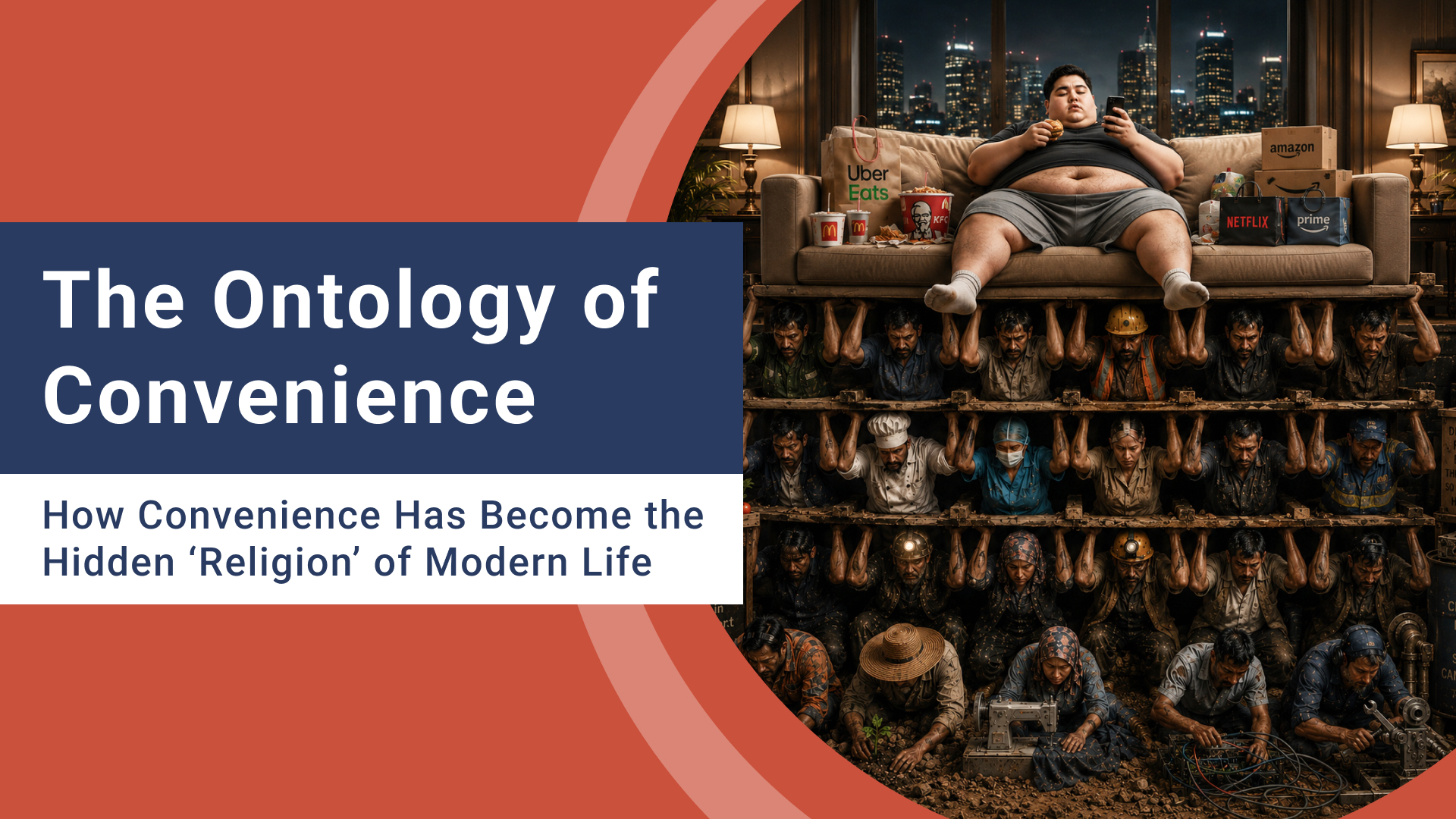

The Great Misunderstanding
We live in an age that proudly celebrates progress. The evidence appears overwhelming. Human beings can communicate across continents in fractions of a second. Diseases that once devastated entire populations can now be prevented, managed or cured. Information that would have required months of travel, years of apprenticeship or access to elite institutions now sits within arm’s reach inside a device that fits comfortably in a pocket. Our homes are warmer, our transportation is faster, our access to entertainment is endless and our ability to purchase goods, acquire knowledge and interact with people has reached a level that previous generations would likely have considered miraculous.
Looking around, it is easy to conclude that humanity is moving forward. Many do. Many point to increasing life expectancy, advances in medicine, technological innovation, scientific discoveries, economic productivity and unprecedented access to information as proof that we are progressing. They are not entirely wrong. There is much worth celebrating. To deny these achievements would require a remarkable degree of blindness. Yet there is another side to this story, a quieter side, a shadow that rarely receives the same level of attention.
While we have become extraordinarily skilled at making life easier, we have become increasingly disconnected from what life actually requires. While we have become remarkably effective at reducing friction, we have often done so without asking whether all friction is bad. While we have become masters at simplifying experiences, we have simultaneously become experts at hiding reality from ourselves. The result is a peculiar paradox. The modern human being has access to more convenience than any generation in history, yet many feel overwhelmed, disconnected, anxious, exhausted, isolated and uncertain about meaning and purpose.
The issue is not technology, science, innovation, comfort or convenience itself. The issue emerges when convenience quietly climbs to the top of our value structure and becomes the invisible ruler of our decisions. This article is not an argument against progress. Nor is it a nostalgic call to return to some romanticised past where life was supposedly simpler, more authentic or somehow better. History offers little support for such fantasies. Earlier generations endured extraordinary levels of suffering, disease, poverty, violence and hardship that few people would willingly choose today.
This article is also not an endorsement of hustle culture. It is not an invitation to glorify exhaustion, celebrate burnout or worship struggle for its own sake. There is nothing noble about unnecessary suffering and there is nothing wise about making things harder than they need to be. Difficulty alone is not a virtue. Rather, this article seeks to explore something deeper. It seeks to examine convenience itself, not merely as a consumer preference, not merely as a feature of modern products and not merely as an economic offering, but as a phenomenon with an underlying structure, assumptions, consequences and implications.
Beneath many contemporary challenges sits a subtle orientation that often escapes scrutiny. It appears in our purchasing decisions, our educational systems, our politics, our organisational life, our relationships, our leadership, our consumption of information and the way we build businesses, raise children and understand ourselves. It is an orientation that asks how things can be made easier, faster and less demanding. These questions are not inherently wrong. Indeed, they have often led to remarkable innovations. The challenge emerges when they become the primary questions.
There are other questions that matter just as much. What is required for this to work? What sustains this over time? What realities are hidden beneath this experience? What participation is required to create and maintain it? What is the cost of making this easier? And perhaps most importantly, what happens when a civilisation becomes so successful at outsourcing inconvenience that it begins outsourcing its understanding of reality itself?
These questions lead us towards a deeper investigation into convenience, progress, participation, systemic integrity and the relationship between ease, flow, sustainability and what it truly means to participate in the ongoing creation of the worlds we inhabit.
Everything Is in Transition
One of the most pervasive illusions in human life is the belief that things remain as they are. We speak about maintaining relationships, preserving organisations, sustaining economies, protecting cultures and defending institutions as though stability were a permanent condition that could simply be achieved and then preserved indefinitely. Yet reality appears to operate differently. Beneath the surface of everyday experience, everything is moving.
A marriage is moving. A family is moving. A business is moving. A friendship is moving. A community is moving. A nation is moving. Even our own bodies, minds and identities are moving. The movement is not always dramatic and it is not always visible, but it is happening nonetheless. The appearance of stability often masks countless transitions occurring beneath the surface.
Consider a family facing financial pressure. Rarely does a healthy financial situation collapse overnight. More often, small decisions accumulate over time. Spending habits become slightly more careless. Savings are deferred. Difficult conversations are postponed. Financial responsibilities become less clear. Stress quietly increases. Resentment begins to form. The family may still appear stable from the outside, yet beneath the surface the system has already begun transitioning towards a greater degree of disintegration.
The same pattern can be observed in intimate relationships. Relationships seldom collapse because of a single argument. The argument is usually the visible expression of something that has been unfolding for months or years. Small disappointments remain unspoken. Acts of care become less frequent. Curiosity is replaced by assumption. Conversations become transactional rather than meaningful. Resentments quietly accumulate until eventually a heated exchange erupts and people point to that moment as the cause of the breakdown. Yet the relationship had already begun moving long before the argument occurred.
The same can be said of health. Many people describe illness as though it arrived unexpectedly. One day they feel healthy and the next they receive a diagnosis. Yet in many cases the body has been communicating for years. Sleep has been deteriorating. Stress has become chronic. Recovery has been neglected. Movement has decreased. Nutritional choices have gradually worsened. The body has been transitioning all along. What appears sudden is often merely the moment at which the consequences become visible.
Businesses provide another example. Organisations rarely fail because of a single bad quarter. Long before declining revenue becomes visible on financial statements, other signs have usually emerged. Innovation slows. Team members disengage. Trust erodes. Customers become less enthusiastic. Processes become bloated. Leadership becomes reactive rather than intentional. The eventual financial consequences are often the final chapter of a story that began much earlier.
Even nations follow a similar pattern. Polarisation does not suddenly appear. Institutional distrust does not emerge overnight. Rising debt, declining social cohesion, weakened civic participation, increasing fragmentation and growing suspicion between groups often develop gradually. The visible crises that eventually capture public attention are frequently symptoms of transitions that have been occurring for years or even decades.
This pattern extends far beyond finance, health, business and politics. It can be observed in friendships, educational systems, religious institutions, ecosystems and entire civilisations. The underlying principle remains remarkably consistent. Systems are rarely static. They are continuously transitioning towards a greater degree of integrity or a greater degree of disintegration.
Integrity, in this context, should not be understood merely as morality or ethical conduct. It refers to the degree to which the constituent parts of a system are functioning coherently together. A healthy body exhibits integrity because its various systems are working together in a coordinated manner. A thriving organisation exhibits integrity because its people, processes, culture and purpose remain aligned. A healthy relationship exhibits integrity because trust, communication, care and mutual participation reinforce one another.
Disintegration represents the opposite movement. It occurs when the relationships between constituent parts begin to weaken. Coordination deteriorates. Alignment decreases. Trust erodes. Contradictions increase. Fragmentation spreads. Systems become less capable of performing their intended function and more vulnerable to breakdown.
The crucial insight is that neither integrity nor disintegration happens by accident. Systems do not magically heal themselves, nor do they mysteriously collapse without cause. The direction of transition is profoundly influenced by participation. Human beings are not merely spectators observing these movements from a distance. We are participants within them. Through our actions, omissions, decisions, habits, assumptions and ways of being, we continuously contribute to the direction in which the systems around us evolve.
This observation becomes particularly important when discussing convenience. For convenience often tempts us to believe that systems simply exist to serve us. It encourages us to focus on outcomes while paying little attention to the conditions required to sustain those outcomes. It invites consumption while obscuring participation. Yet before we can properly understand convenience, we must first recognise a more fundamental truth. Every system that supports our lives is already moving, already changing and already transitioning. The question is not whether change is occurring. The question is whether that transition is leading towards greater integrity or greater disintegration, and what role our participation plays in determining the answer.
The Myth of Separation: We Are the System
Once we recognise that all systems are continually transitioning towards greater integrity or greater disintegration, another misconception begins to reveal itself. It is a misconception so common that most of us rarely notice it. We speak about systems as though they are separate from us. We speak about governments, corporations, economies, institutions, cultures, communities and even societies as though they possess an independent existence, operating somewhere outside the sphere of ordinary human participation.
Listen carefully to how people often speak. They say the government should fix this. They say corporations are responsible for that. They complain about the education system, the healthcare system, the legal system, the economic system or the political system as though these systems were autonomous creatures that somehow emerged from nowhere and now operate according to their own mysterious logic. In doing so, we subtly position ourselves as observers standing outside the system rather than participants within it.
Yet this separation is largely an illusion.
Systems do not possess life independently. They borrow their life from human beings. Every institution, every policy, every organisation, every process, every law, every procedure and every social norm exists because human beings continuously bring them into existence, maintain them, refine them, defend them, challenge them or dismantle them. The system is not some distant object standing apart from humanity. The system is humanity organised in particular ways.
The economy is not an abstract machine floating above society. It is the accumulated result of billions of decisions made by human beings. Markets do not buy, sell, negotiate, invest or consume. People do. Organisations do not innovate. People innovate. Institutions do not build trust. People build trust. Governments do not become corrupt, courageous, incompetent or effective on their own. Human beings embody those qualities and bring them into the systems they participate in.
This does not mean that systems are simple. Nor does it mean that individuals can instantly reshape complex institutions through sheer willpower. Systems possess momentum. They develop structures, incentives, cultures and patterns that can persist across generations. Yet even these patterns are sustained through participation. Remove the people and the system ceases to exist. Remove the participation and the institution becomes an empty shell.
This reality is both confronting and empowering.
It is confronting because it removes one of our favourite excuses. It becomes much harder to point at the system as though it were an external force entirely responsible for our circumstances. It becomes more difficult to criticise organisations, communities or societies without eventually confronting our own role within them. The moment we recognise that systems are animated by human participation, we can no longer comfortably stand outside the picture.
At the same time, it is empowering because it reminds us that systems are not fixed objects handed down from the heavens. Human beings design them. Human beings implement them. Human beings maintain them. Human beings challenge them. Human beings reform them. Human beings improve them. Human beings can also neglect them, distort them, exploit them or dismantle them entirely.
History offers countless examples. Every major institution that exists today was once merely an idea. Every legal system began as a collection of agreements. Every corporation began as a conversation. Every technological revolution began as a possibility residing in the imagination of someone willing to pursue it. Every social movement began with participation. The world we inherit is, in large part, the accumulated consequence of human beings acting upon ideas and transforming those ideas into shared layers of reality.
Consider something as simple as the smartphone resting in your pocket. It is easy to view it merely as an object. Yet behind that object lies a remarkable story of participation. Ideas became designs. Designs became prototypes. Prototypes became products. Products required engineers, miners, manufacturers, logisticians, software developers, researchers, investors, marketers, regulators and countless others. What began as possibility eventually altered how billions of people communicate, work, learn and relate to one another. An idea moved through layers of participation until it reshaped reality itself.
The same principle applies to medicine. There was a time when relatively minor infections could lead to severe illness or death. Through generations of inquiry, experimentation, discovery, refinement and implementation, humanity transformed that reality. What was once common became increasingly rare. What was once fatal became treatable. Again, participation altered the structure of lived experience.
This capacity to move from possibility to reality is one of the defining characteristics of human beings. We imagine, create, organise, refine and implement. We transform ideas into systems and systems into experiences. Yet because modern life has become increasingly sophisticated, we often forget how much participation is required to sustain the realities we take for granted.
This forgetfulness becomes particularly dangerous when convenience enters the picture. The more seamless an experience becomes, the easier it is to overlook the participation required to create it. The more encapsulated a system becomes, the easier it is to imagine that outcomes simply appear on their own. Convenience can therefore create a subtle form of amnesia. It encourages us to focus on what is delivered while paying little attention to what is required.
This matters because every system that contributes to our lives requires participation. Families require participation. Friendships require participation. Organisations require participation. Communities require participation. Democracies require participation. Economies require participation. Even freedom itself requires participation. When participation declines, systems do not remain unchanged. They begin transitioning towards greater disintegration.
Ironically, many of the systems we criticise are often reflections of collective participation rather than external impositions. The quality of a culture reflects how people participate within it. The quality of leadership reflects what people reward, tolerate or demand. The quality of institutions reflects the behaviours, assumptions and values continuously embodied by those who sustain them.
This is why meaningful transformation rarely begins with blaming the system. It begins with understanding our relationship to it. It begins with recognising that we are not merely consumers of systems. We are contributors to them. We are not merely affected by reality. We participate in its creation. We are not simply passengers riding inside the machinery of civilisation. We are among those continuously building, maintaining, repairing and, at times, dismantling it.
This insight becomes particularly important because not all dismantling is inherently negative. There are times when systems become so dysfunctional, so fragmented and so disconnected from their intended purpose that collapse creates the very space required for renewal. Throughout history, outdated institutions, obsolete practices and failing structures have often needed to disintegrate before healthier alternatives could emerge. Regeneration frequently requires the courage to let certain things end.
Yet whether we are preserving, reforming, dismantling or rebuilding, the underlying principle remains the same. Human participation sits at the centre of the equation. The future of any system ultimately depends upon how people participate within it, how effectively they perform, how sustainably they contribute and how consciously they engage with the realities they help create.
Understanding this relationship between systems and participation prepares us for the next question. If human beings are the source of life within systems, and if systems are continuously transitioning towards integrity or disintegration, then how did convenience become such a dominant force in shaping the way we participate in reality?
Progress and Its Shadow
Few ideas have shaped the modern imagination as profoundly as the idea of progress. It is one of the great stories through which contemporary civilisation understands itself. Whether expressed through science, economics, politics, education or technology, the assumption that humanity is moving forward has become deeply embedded within our collective consciousness. We celebrate innovation, reward disruption, admire growth and frequently assume that what is newer is somehow better than what came before it. In many respects, this orientation has served humanity extraordinarily well.
It would be difficult to deny the remarkable achievements that have emerged from centuries of inquiry, experimentation and discovery. Human beings have extended life expectancy, reduced infant mortality, developed treatments for diseases that once devastated entire populations and created technologies that allow people separated by oceans to communicate almost instantaneously. Information that would have required years of travel, apprenticeship or privileged access can now be obtained within moments. Transportation systems, engineering capabilities, agricultural advancements and medical breakthroughs have transformed daily life to such an extent that many aspects of modern existence would have appeared miraculous to previous generations.
To acknowledge these achievements is not merely an act of fairness. It is an act of intellectual honesty. There is a tendency among some critics of modernity to romanticise the past, as though earlier eras were somehow more authentic, meaningful or virtuous. Yet such nostalgia often forgets the immense suffering that characterised much of human history. Disease, famine, poverty, violence, limited mobility and short life expectancy were not abstract possibilities. They were ordinary realities. Any serious examination of progress must therefore begin by recognising that modern civilisation has produced outcomes that have genuinely improved countless aspects of human life.
Yet every civilisation carries within it the seeds of its own blind spots. Success has a peculiar tendency to narrow awareness. When a particular way of seeing the world repeatedly generates impressive outcomes, people naturally become more confident in that perspective. Over time, confidence can harden into certainty and certainty can gradually transform into unquestioned assumptions. What begins as a useful framework for understanding reality eventually becomes the lens through which all reality is interpreted.
This is particularly relevant when discussing progress itself. The modern world frequently speaks about progress as though its meaning were self-evident, as though everyone already knows what it means to move forward. Yet the moment we examine the idea more carefully, important questions begin to emerge. Forward towards what? Progress according to which values? Advancement measured by whose standards? The answers are rarely as obvious as they first appear.
At a deeper level, individuals, organisations and societies tend to orient themselves in one of three broad directions. They may seek preservation, attempting to maintain existing structures and protect what has already been achieved. They may move towards regression, allowing deterioration, fragmentation and decline to unfold. Or they may pursue progression, which might be more accurately described as thriving, a movement towards greater vitality, capability, possibility and effectiveness. Most people naturally prefer progression to regression, yet the modern interpretation of progress often introduces a subtle distortion. It begins to assume that advancement itself is inherently desirable regardless of the broader context within which that advancement occurs.
As a consequence, progress frequently becomes associated with whatever can be most easily measured, quantified and demonstrated. Economic growth becomes evidence of success. Increased production becomes evidence of advancement. Greater consumption becomes evidence of prosperity. New technologies become evidence of improvement. More data, more efficiency, more speed and more output become indicators that society is moving in the right direction. These measures are not meaningless, nor should they be dismissed. The problem is that they represent only a portion of reality.
Many of the most important dimensions of human existence resist easy measurement. Wisdom does not fit neatly into a spreadsheet. Meaning cannot be captured by quarterly reports. Trust cannot be fully quantified. The health of a marriage, the depth of a friendship, the strength of a community, the integrity of a culture and the quality of a person's inner life all influence the flourishing of individuals and societies, yet they often remain invisible to the instruments through which modernity evaluates success.
Consequently, a civilisation can appear successful according to many of its preferred metrics while simultaneously experiencing profound forms of deterioration elsewhere. A society may become wealthier while becoming lonelier. Communication technologies may connect billions of people while weakening the quality of human connection. Economic systems may generate unprecedented prosperity while encouraging the commoditisation of human beings and reducing people to units of production, consumption or demographic categories. Advances in efficiency may simplify daily life while gradually weakening people's relationship with participation, responsibility and mastery.
The issue is not that progress is an illusion. The issue is that progress is rarely as simple as it appears. Every advancement creates new possibilities while simultaneously introducing new challenges. Every solution generates consequences beyond those originally intended. Every innovation reshapes reality in ways that are both beneficial and problematic. Genuine maturity requires the capacity to recognise both dimensions at once without collapsing into either blind celebration or cynical rejection.
It is here that one of the most significant shadows of modern progress begins to emerge. While much attention is given to concerns such as consumerism, financialisation, social fragmentation, technological dependency and superficiality, these phenomena often share a deeper root. Beneath many of them sits an increasingly dominant orientation towards reality itself, one that has become so normalised that it often escapes examination.
That orientation is the pursuit of convenience.
Convenience, in this context, should not be confused with comfort. Nor should it be confused with legitimate improvements in efficiency or quality of life. Rather, it represents a growing tendency to organise our lives around the reduction of friction, the minimisation of effort and the elimination of inconvenience wherever possible. It appears in countless aspects of contemporary life. We increasingly seek faster outcomes, shorter pathways, simplified processes and immediate access. We want complexity hidden from view, difficulties removed from experience and outcomes delivered with minimal participation on our part.
There is nothing inherently wrong with this tendency. Indeed, many innovations have emerged precisely because people sought more effective ways of doing things. The challenge arises when convenience ceases to function as a tool and gradually becomes a value. Once convenience occupies a sufficiently elevated position within our value structure, it begins influencing how we evaluate everything else. Patience becomes harder to tolerate. Complexity becomes frustrating. Delayed gratification feels unreasonable. Participation starts to appear burdensome. Processes are judged primarily by how quickly they deliver outcomes rather than by what they cultivate along the way.
The irony is difficult to ignore. A civilisation that has accumulated unprecedented knowledge, capability and technological power increasingly finds itself uncomfortable with many of the very realities that meaningful achievement requires. We celebrate outcomes while becoming detached from the processes that produce them. We admire results while paying less attention to the conditions that sustain them. We enjoy the fruits while gradually forgetting the roots.
It is precisely this relationship between convenience, participation and reality that demands closer examination. For before we can understand why convenience has become such a powerful force within modern life, we must first understand what convenience actually is, what it removes, what it conceals and what it quietly asks us to trade in exchange for the ease it provides.
The Addiction to Convenience
Having acknowledged the achievements of modern progress and some of the shadows accompanying it, we can now examine more carefully one of the most influential yet least scrutinised forces shaping contemporary life. It is a force so familiar that it often disappears from view. It influences how we make decisions, how we consume information, how we learn, how we build relationships, how we engage with technology and, perhaps most significantly, how we participate in reality itself. That force is convenience.
Before proceeding further, an important distinction must be made. Convenience is not the same as comfort. Comfort refers to a state of ease, relief or reduced discomfort. There is nothing inherently problematic about comfort. Human beings naturally seek shelter from the cold, rest after exertion and safety in the face of danger. Likewise, convenience is not synonymous with laziness. Nor is this discussion an endorsement of hustle culture, perpetual busyness or the glorification of suffering. There is little wisdom in creating unnecessary hardship simply to prove one's resilience. A person who insists on making every task difficult is no more enlightened than a person who avoids all difficulty altogether.
The issue lies elsewhere. The issue emerges when convenience becomes elevated from a useful tool into a governing value. It emerges when reducing friction becomes more important than understanding reality. It emerges when ease becomes the objective rather than the consequence of something deeper. Most importantly, it emerges when convenience gradually displaces participation.
At first glance, this may seem like an exaggeration. After all, what could possibly be wrong with making life easier? The answer becomes clearer when we observe how convenience increasingly shapes our relationship with learning, culture, craftsmanship and mastery.
Imagine, for example, that you develop an appreciation for Japanese cuisine. Not merely the taste of the food, but the culture surrounding it, the traditions behind it, the philosophy of preparation, the regional differences, the ingredients, the techniques and the centuries of refinement that contributed to its development. Historically, engaging with such a world would require participation. One might study the culture, learn the recipes, seek authentic ingredients, speak with people who inherited the tradition or perhaps even travel to experience it more directly. The process itself would become part of the experience.
Today, however, another option exists. One can simply reach for a smartphone, open an application and order a meal. In less than an hour, food arrives at the door. The transaction is efficient. It is convenient. Yet something interesting has happened. The outcome has been obtained while much of the participation has been removed. The culture, the tradition, the learning, the craftsmanship and the relationship with the process have been compressed into a consumer experience.
Again, the point is not that ordering food is wrong. The point is that the reduction of participation often occurs so subtly that it goes unnoticed. The same pattern appears elsewhere. Books can be summarised. Courses can be condensed. Skills can be simplified. Experiences can be packaged. Complex realities can be transformed into easily consumable products. In each case, convenience offers a genuine benefit. It saves time. It reduces effort. It increases accessibility. Yet at the same time, it may reduce the depth of engagement through which understanding is developed.
The modern relationship with knowledge provides a particularly revealing example. Previous generations often spent years studying a subject before claiming competence. They wrestled with uncertainty, conflicting perspectives, incomplete information and the slow accumulation of insight. Today, information is abundant and readily accessible. This is undoubtedly an achievement. Yet the availability of information sometimes creates the illusion that information itself is equivalent to understanding. A person may consume hundreds of summaries without ever developing mastery. They may acquire answers without undertaking the journey through which those answers become meaningful.
The same dynamic increasingly appears in our relationship with artificial intelligence. Consider what happens when a person enters a prompt into an AI system. From the user's perspective, the experience appears remarkably simple. A question is typed. A response appears. The entire interaction may take only a few seconds. It feels almost magical, as though knowledge materialises from nowhere.
Yet this apparent simplicity conceals an extraordinary level of complexity. The prompt travels through wireless signals, networking infrastructure, internet service providers and vast communication systems. Data moves through fibre-optic networks spanning cities, countries and oceans. Requests reach enormous data centres containing thousands upon thousands of processors operating in carefully controlled environments. Engineers maintain the hardware. Technicians monitor performance. Specialists manage security. Construction workers build facilities. Energy systems supply power. Cooling systems prevent overheating. Researchers develop models. Software engineers refine architectures. Supply chains transport components from across the globe. Entire industries cooperate to make that seemingly effortless interaction possible.
All of this unfolds in moments. The response arrives and a small message informs the user that the task was completed in a few seconds. The complexity disappears behind a beautifully designed interface. What remains visible is convenience. What becomes invisible is participation.
The same phenomenon extends far beyond technology. Consider a conference dedicated to empowering women in technology, leadership or entrepreneurship. Attendees arrive at a well-organised venue. A charismatic host welcomes the audience. Distinguished panellists share insights. The environment appears seamless and professional. Yet beneath that experience sits another reality. Architects designed the building. Tradespeople constructed it. Electricians installed systems. Cleaners prepared the venue. Technicians managed sound and lighting. Caterers organised refreshments. Security personnel ensured safety. Countless people participated in ways that remain largely invisible to those enjoying the event.
Or consider a fine dining experience. A beautifully presented steak arrives at the table. The atmosphere is elegant. The service is exceptional. The presentation is artistic. Yet hidden beneath this refined experience lies a chain of realities extending far beyond the restaurant itself. Farmers raised the animal. Land was managed. Infrastructure was built. Transport systems operated. Workers processed, stored and delivered products. The meal appears on a plate looking almost disconnected from the realities that made it possible. The violence, labour, uncertainty, risk and effort embedded within the process become largely invisible.
This observation is not intended to produce guilt. Nor is it an argument for or against consuming meat. The point is something more fundamental. Modern life has become extraordinarily effective at encapsulating complexity. It packages reality into forms that are easy to consume while concealing much of the participation required to produce them.
The same principle can even be observed within moral debates. A person may take pride in consuming a plant-based diet and may sincerely believe they have removed themselves from participation in harm. Yet agricultural systems themselves involve countless interventions. Fields must be protected from insects, rodents, rabbits, hares, feral animals, birds and numerous other threats. Ecosystems are managed. Habitats are altered. Pesticides are used. Species are displaced. Life and death remain present throughout the process even if they are less visible to the consumer. This observation is not offered as a criticism of veganism or vegetarianism. Rather, it highlights how easily encapsulation can create the illusion that complexity has disappeared simply because it is no longer visible.
This tendency towards encapsulation is one of the defining characteristics of modern civilisation. Businesses, governments, entrepreneurs and institutions increasingly specialise in absorbing complexity on behalf of others. In many respects, this is precisely what customers pay for. We outsource inconvenience. We outsource complexity. We outsource effort. We outsource uncertainty. We outsource understanding. Entire industries have been built around making difficult realities appear simple.
There is undeniable value in this. Modern society could not function without specialisation. No individual could master every domain required to sustain contemporary life. Yet specialisation becomes problematic when it gradually disconnects people from an appreciation of what reality actually requires. The more successful systems become at hiding complexity, the easier it becomes to forget that complexity exists at all.
This is where convenience begins to transform from a practical tool into a cultural addiction. Addiction is perhaps a confronting word, yet it is difficult to ignore how frequently contemporary life prioritises immediate ease over meaningful participation. We increasingly expect rapid results, immediate access and minimal friction. We become impatient with processes that require time. We become frustrated by activities that demand effort. We seek outcomes while becoming progressively less interested in the realities that produce those outcomes.
The irony is that many of the most valuable aspects of life continue to resist this logic. Families cannot be meaningfully outsourced. Children cannot be raised through shortcuts. Deep relationships cannot be downloaded. Trust cannot be automated. Character cannot be delivered on demand. Wisdom cannot be generated instantly. Mastery cannot be purchased. Leadership cannot be acquired through convenience.
These realities remind us that participation remains essential. They remind us that some forms of friction are not obstacles to life but part of life itself. They remind us that convenience, while valuable, becomes dangerous when it occupies the highest position within our value structure. For once convenience becomes the objective, we begin evaluating reality primarily through the question of how easily it can be consumed rather than how meaningfully it can be understood, sustained and participated in.
This distinction ultimately leads us towards a deeper question. If convenience has become one of the dominant forces shaping modern life, what exactly is it hiding from us, and what are the consequences when entire societies begin outsourcing not only effort but their relationship with reality itself?
Encapsulated Reality: The Great Outsourcing of Complexity
The modern world has become extraordinarily effective at something previous generations could scarcely imagine. It has become exceptionally good at concealing complexity without eliminating it.
This distinction matters.
Complexity has not disappeared. The realities that sustain our lives have not become fundamentally simpler. Human beings still require food, energy, shelter, transportation, healthcare, education, governance, infrastructure and social coordination. Resources must still be extracted. Materials must still be processed. Systems must still be maintained. Roads must still be repaired. Power stations must still function. Water must still be purified. Technology must still be designed, manufactured and supported. Reality has not become simpler. Rather, it has become increasingly encapsulated.
Encapsulation occurs when complexity is packaged into a form that can be easily consumed without requiring direct engagement with the underlying realities that make it possible. The more successful the encapsulation, the less visible the complexity becomes. What remains visible is the experience. What disappears from view is the participation required to produce that experience.
This is not inherently problematic. In many respects, encapsulation is one of the great achievements of civilisation. Imagine attempting to personally produce everything required for modern life. Growing food, generating electricity, manufacturing tools, building shelter, producing medicine, creating communication networks and maintaining transportation systems would quickly consume every waking moment. Specialisation allows human beings to cooperate, exchange value and achieve outcomes that no individual could accomplish alone.
The challenge emerges when encapsulation becomes so successful that it produces the illusion that complexity no longer exists.
A person opens a tap and clean water appears. They flip a switch and electricity flows. They purchase groceries from a supermarket. They order products online. They access entertainment instantly. They receive medical treatment. They navigate cities using digital maps. They use artificial intelligence to answer questions. From the perspective of daily experience, these realities appear remarkably straightforward.
Yet beneath each of these experiences lies an astonishing network of participation.
The water arriving through a tap may have travelled through reservoirs, treatment facilities, pumping stations, pipes, monitoring systems and regulatory frameworks maintained by thousands of people. The electricity powering a home may depend upon power generation facilities, transmission networks, substations, engineers, technicians, planners and countless workers operating within interconnected systems. The groceries displayed neatly on shelves represent the coordinated efforts of farmers, transport operators, manufacturers, distributors, warehouse workers, retailers and regulators. Even the simplest product often embodies the participation of hundreds or thousands of individuals spread across multiple countries.
The reality becomes even more striking when viewed through the lens of technology. The smartphone resting comfortably in someone's hand appears almost effortless to use. A message is sent. A video is watched. A purchase is completed. A question is answered. Yet behind this apparent simplicity lies one of the most sophisticated achievements in human history. Rare earth minerals have been extracted from the earth. Components have been manufactured and assembled. Software has been written and refined. Communication networks have been constructed. Satellites have been launched. Data centres have been built and maintained. Supply chains have been coordinated across continents. Entire industries cooperate continuously so that a person can tap a screen and receive an outcome within seconds.
What is remarkable is not merely the complexity itself. What is remarkable is how effectively that complexity has been hidden.
A child can use a smartphone long before understanding even a fraction of what makes it possible. Many adults are little different. They use technologies, services and systems daily without possessing the slightest awareness of the realities underpinning them. Again, this is not necessarily a criticism. No individual can understand everything. The issue arises when lack of awareness gradually transforms into detachment.
Detachment is one of the hidden consequences of excessive encapsulation. When realities become sufficiently hidden, people begin relating primarily to outcomes rather than processes. They enjoy the benefits while becoming increasingly unaware of the conditions required to sustain those benefits. They consume products while remaining disconnected from production. They enjoy stability while remaining disconnected from maintenance. They expect functionality while remaining disconnected from participation.
This detachment has profound implications for how individuals relate to society, institutions and even one another.
Consider how often people speak about governments, corporations, educational systems, healthcare systems or economic systems as though they exist independently of human participation. Systems are criticised when they fail and praised when they succeed, yet relatively little attention is given to the countless people whose ongoing participation allows those systems to function in the first place. Encapsulation has made the outputs visible while rendering much of the human effort invisible.
The irony is that the more successful a system becomes, the more vulnerable it can become to being taken for granted. When electricity works consistently, people stop thinking about the grid. When supply chains function smoothly, people stop thinking about logistics. When food remains abundant, people stop thinking about agriculture. When technology operates reliably, people stop thinking about infrastructure. Success often creates invisibility.
The problem is not merely intellectual. It is existential.
As awareness decreases, appreciation often decreases alongside it. As appreciation decreases, participation may also decline. When participation declines, fewer people feel responsible for maintaining the very systems upon which everyone depends. Responsibility becomes concentrated among smaller and smaller groups while larger populations become increasingly positioned as consumers rather than contributors.
This pattern can be observed across numerous domains. Within organisations, a small minority often carries a disproportionate share of responsibility while others simply interact with the outputs. Within communities, a relatively small number of people volunteer, organise, maintain and contribute while many others passively benefit. Within families, responsibilities are sometimes unevenly distributed, creating strains that eventually manifest as conflict or resentment. At the societal level, similar dynamics frequently emerge as fewer people actively participate in maintaining the conditions required for collective flourishing.
The issue is not that everyone must become an expert in everything. Such an expectation would be absurd. The issue is that healthy systems require sufficient participation to sustain themselves. They require people who understand not merely how to consume outcomes but how those outcomes come into existence. They require people capable of appreciating the relationship between benefits and responsibilities, between privileges and participation, between rights and obligations.
This is where convenience and encapsulation begin to intersect in a particularly significant way. The more effectively inconvenience is removed from experience, the easier it becomes to forget what inconvenience was teaching us. The more completely complexity is hidden, the easier it becomes to lose sight of the realities supporting our lives. The more seamlessly systems function, the easier it becomes to assume that they will continue functioning indefinitely.
History repeatedly demonstrates otherwise.
Civilisations, institutions, organisations and relationships rarely collapse because complexity disappears. They collapse because complexity is neglected. They deteriorate when participation declines, when responsibility becomes concentrated, when maintenance is ignored and when people become increasingly detached from the realities sustaining their existence. The visible crisis often arrives long after the underlying disintegration has begun.
This brings us to a critical insight. The greatest threat posed by convenience is not that it makes life easier. The greatest threat is that it can obscure the relationship between outcomes and participation. It can encourage the illusion that valuable realities simply exist rather than recognising that they are continuously created, maintained and renewed through human engagement.
Once this illusion takes hold, societies become vulnerable to a subtle but dangerous form of fragility. They begin expecting the fruits of participation while becoming less willing to participate. They demand outcomes while distancing themselves from the processes that generate them. They celebrate the visible benefits of systems while overlooking the invisible responsibilities that sustain them.
Understanding this dynamic allows us to see why convenience, despite its many advantages, cannot serve as a sufficient organising principle for individuals, organisations or societies. Something deeper is required. Something capable of sustaining participation, preserving functionality and enabling renewal even in the face of increasing complexity.
To discover that alternative, we must return to the question of how systems actually become healthy, functional and sustainable in the first place. We must examine the relationship between participation, performance, integrity and the conditions through which genuine ease and flow emerge.
Participation, Performance and the Path to Systemic Integrity
At this point, a misunderstanding must be avoided.
The argument presented throughout this article is not that complexity should always remain visible. Nor is it that convenience should be eliminated. It is not an argument for making life unnecessarily difficult. It is not a rejection of technology, specialisation, innovation or efficiency. Such conclusions would miss the point entirely.
The deeper issue concerns our relationship with reality itself. More specifically, it concerns how we participate in reality and how our participation influences the systems that shape our lives.
Modern discussions often frame human beings primarily as consumers. We consume products, services, experiences, entertainment, information and opportunities. While there is truth in this observation, it remains incomplete. Human beings are not merely consumers of reality. We are participants within it. We are contributors to it. We are co-creators of the systems we inhabit. Whether we recognise it or not, our actions, decisions, omissions, assumptions and behaviours continuously shape the environments in which we live.
This becomes particularly important when considering how systems move towards greater integrity or greater disintegration. Systems do not become healthy merely because people desire health. Organisations do not become effective because leaders wish them to be effective. Families do not become harmonious because harmony sounds appealing. Nations do not become prosperous because prosperity is desirable. Every meaningful outcome emerges through participation.
Participation, however, is not simply a matter of showing up. One may be physically present within a family and yet contribute very little to its health. One may occupy a leadership position and yet weaken the organisation through poor judgement. One may belong to a community while remaining indifferent to its wellbeing. Participation alone is therefore insufficient.
What matters is the quality of participation.
This is where performance enters the conversation.
Unfortunately, the word performance has acquired several unfortunate associations. Many people hear the term and immediately think of theatrical performance, public image, personal branding or the performative behaviours that have become increasingly common in contemporary culture. That is not what is meant here.
Performance refers to how something functions, operates and participates in relation to its intended purpose. A bridge performs. An ecosystem performs. A heart performs. A family performs. A business performs. A nation performs. Human beings themselves perform in the sense that they continuously engage with reality and produce consequences through their actions.
When viewed through this lens, performance becomes inseparable from participation. Participation determines whether we are involved. Performance determines how effectively we contribute.
The significance of this distinction becomes evident when examining the achievements that modern societies often celebrate. Consider again the smartphone. It did not emerge merely because someone had a clever idea. The world is full of ideas. Most remain unrealised. What transformed the smartphone from possibility into reality was an immense chain of participation and performance. Researchers investigated possibilities. Engineers developed solutions. Designers refined interfaces. Manufacturers built components. Logistics networks distributed products. Infrastructure enabled communication. Millions of people participated and performed in ways that transformed an abstract concept into a technology that reshaped human civilisation.
The same principle applies to medicine. The difference between a world in which a simple infection can lead to death and a world in which that infection can be treated is not merely a difference in knowledge. It is a difference in participation and performance. Scientists, researchers, educators, healthcare professionals, manufacturers and countless others collectively transformed possibility into reality. Human beings did not merely imagine a better world. They participated in creating one.
The same can be said of transportation systems, agricultural advancements, communication technologies, architecture, education and virtually every achievement associated with modern civilisation. Beneath every outcome that we admire lies a story of participation translated into performance and performance translated into reality.
This observation brings us to a crucial insight. The question is not whether participation is required. The question is whether participation is contributing to integrity or disintegration.
When participation is guided by short-term thinking, neglect, indifference, incompetence, fragmentation or bad faith, systems tend towards disintegration. Trust declines. Coordination weakens. Contradictions increase. Misalignment spreads. Capabilities erode. Functionality deteriorates. Eventually the visible symptoms emerge in the form of conflict, inefficiency, breakdown or collapse.
When participation is guided by awareness, responsibility, competence, care, adaptability and integrity, the opposite movement begins to occur. Trust increases. Coordination improves. Relationships strengthen. Capabilities expand. Functionality improves. Systems become more resilient, more workable and more capable of fulfilling their intended purpose.
This movement towards integrity sits at the heart of Authentic Sustainability. Sustainability, in this sense, is not merely about environmental concerns, although those concerns certainly matter. It is not merely about maintaining what already exists. Rather, sustainability concerns the ongoing capacity of systems to remain functional, adaptable, coherent and effective over time.
The implications are profound because they challenge one of the dominant assumptions underlying the pursuit of convenience. Much of modern life is organised around the question of how to make things easier. While understandable, this question is often asked prematurely. It focuses attention on outcomes rather than foundations. It assumes that ease itself is the objective.
Yet the most resilient systems rarely emerge because ease was directly pursued.
A healthy marriage does not emerge because two people sought convenience. It emerges because they developed trust, communication, understanding, adaptability and mutual responsibility. A thriving business does not emerge because it pursued comfort. It emerges because it developed capability, alignment, competence and effective execution. A healthy community does not emerge because people avoided effort. It emerges because enough people participated meaningfully in sustaining it.
What eventually appears as ease is often the consequence of something deeper.
Consider two organisations. One constantly fights internal conflict, confusion, duplication of effort and poor communication. The other possesses clear priorities, strong trust, healthy relationships and effective coordination. The second organisation often appears to operate with greater ease. Yet that ease did not emerge because ease itself was pursued. It emerged because integrity was cultivated.
The same pattern appears in families, friendships, communities and societies. When constituent parts function coherently together, friction is reduced naturally. Energy is no longer wasted compensating for dysfunction. Resources are no longer consumed by unnecessary conflict. Effort becomes more effective because it is aligned.
This distinction is essential because it reveals one of the most important principles within this discussion. Ease and flow are not objectives. They are by-products.
Modern convenience culture often treats ease as the goal. Authentic Sustainability treats integrity as the goal. The difference is subtle yet profound. When convenience becomes the objective, people frequently seek shortcuts that reduce immediate friction while creating deeper problems later. When integrity becomes the objective, systems gradually become more workable, more coherent and more effective. As a consequence, a degree of ease and flow naturally emerges.
Flow, in this context, should not be understood as passivity or the absence of effort. Rather, it refers to the reduction of unnecessary friction resulting from greater alignment and functionality. A skilled musician experiences flow not because mastery required no effort but because years of participation and disciplined practice have produced a relationship with their craft that feels natural. A healthy team experiences flow not because challenges disappear but because trust and coordination reduce unnecessary obstacles. A thriving family experiences flow not because life becomes effortless but because relationships possess sufficient integrity to navigate difficulties effectively.
This understanding fundamentally alters how we approach the pursuit of better outcomes. Instead of obsessing over convenience, we begin focusing on the qualities that generate systemic integrity. Instead of asking how to eliminate every inconvenience, we ask how to increase functionality, coherence, responsibility, trust, capability and participation. Instead of chasing ease directly, we cultivate the conditions from which ease can emerge naturally.
The irony is that this path often produces a more sustainable form of ease than convenience itself. Unlike convenience, which frequently depends upon external systems continuing to function on our behalf, ease emerging from integrity reflects an increase in capability. It represents not merely consuming better outcomes but participating more effectively in their creation.
Yet to consistently cultivate such integrity requires something more fundamental still. It requires an awareness of how we perceive reality, how we interpret it and how we come to know what we know. Without that awareness, even our best intentions can become distorted. Without it, convenience can easily masquerade as wisdom and consumption can easily masquerade as participation.
To fully understand this challenge, we must turn our attention to the role of meta-awareness and the deeper structures through which human beings make sense of reality itself.
Meta-awareness, Convenience and the Recovery of Reality
If convenience has become one of the defining forces shaping modern life, and if systemic integrity rather than convenience itself is the more sustainable path towards ease and flow, then an important question remains. Why is it so difficult for individuals, organisations and societies to recognise the difference?
Part of the answer lies in a capacity that is often overlooked despite being fundamental to every aspect of human existence. It is the capacity not merely to think, but to become aware of how we think. Not merely to know, but to become aware of how we come to know. Not merely to hold beliefs, but to examine the assumptions, interpretations and frameworks through which those beliefs are formed.
This capacity may be described as meta-awareness.
Meta-awareness occupies a unique position within human experience because it allows us to step back from the immediate content of our lives and examine the structures through which we make sense of that content. Most people spend much of their lives focused on the objects of awareness. They focus on events, problems, opportunities, relationships, technologies, political issues, social debates and personal ambitions. Far less attention is given to the lenses through which those realities are interpreted.
Yet the quality of our participation depends profoundly upon those lenses.
Two individuals may observe the same event and arrive at entirely different conclusions. Two leaders may inherit identical organisational challenges yet respond in radically different ways. Two societies may encounter the same technological innovation and experience very different consequences. The difference rarely resides solely within the event itself. More often, it resides within the frameworks through which the event is understood.
This is where the conversation reconnects with convenience.
One of the most subtle consequences of convenience is that it does not merely reduce friction within the external world. It can also reduce friction within the process of sense-making itself. Increasingly, modern systems offer pre-packaged interpretations, simplified narratives, curated experiences and ready-made conclusions. Information arrives already filtered, already organised and often already interpreted. The individual is invited to consume understanding rather than participate in its development.
This tendency is particularly visible within contemporary media environments. Complex issues are compressed into headlines. Multifaceted debates are reduced to slogans. Historical realities are transformed into sound bites. Political positions become identities. Nuance is sacrificed in favour of speed. Certainty becomes more valuable than inquiry. The result is not merely an abundance of information but an abundance of conclusions.
The same pattern can emerge in education, professional development, organisational life and even personal growth. There is a growing temptation to seek answers without engaging deeply with the questions from which those answers emerge. Summaries replace study. Opinions replace investigation. Certainty replaces curiosity. Consumption replaces participation.
Once again, the issue is not the tools themselves. Summaries can be useful. Artificial intelligence can be extraordinarily valuable. Educational resources can increase accessibility. Technology can support learning in remarkable ways. The challenge arises when the convenience provided by these tools gradually weakens our relationship with the underlying processes through which understanding develops.
Understanding is rarely produced through immediate answers alone. It emerges through engagement, reflection, experimentation, failure, revision and the gradual refinement of perspective. It emerges through a relationship with reality rather than merely through exposure to information about reality. The journey matters because it shapes the observer. It develops judgement. It cultivates discernment. It refines the capacity to distinguish appearance from substance.
This distinction becomes increasingly important within a world characterised by encapsulation. As systems become more sophisticated and complexity becomes more effectively hidden, individuals require stronger capacities for seeing beyond surfaces. They require the ability to recognise that every visible outcome rests upon invisible conditions. They require the ability to notice what has been omitted, what has been simplified and what has been concealed. They require the ability to ask not only what they are seeing, but also what they are not seeing.
In many respects, this is one of the central concerns of the Metacontent Discourse. The challenge is not simply that people encounter content. The challenge is that they often encounter content without sufficient awareness of the deeper layers through which that content becomes meaningful. Events, ideas, institutions, technologies, social movements and personal experiences do not interpret themselves. Human beings make sense of them through stories, mental models, perspectives, domains and paradigms. Whether we are conscious of these layers or not, they shape our perception of reality.
Convenience can therefore become particularly dangerous when it extends beyond products and services into the realm of sense-making itself. A person may outsource transportation, food preparation or administrative tasks with relatively little consequence. Yet when they begin outsourcing discernment, interpretation and understanding, something more significant is at stake. They risk losing contact with their own capacity for meaningful participation in reality.
This does not imply that every individual must become an expert in every domain. Such an expectation would be impossible. Rather, it suggests that people must remain sufficiently aware of the limitations of their own understanding. They must remain curious. They must remain open to complexity. They must resist the temptation to confuse accessibility with mastery or information with wisdom.
The irony is that genuine meta-awareness often introduces a certain kind of inconvenience. It requires slowing down when speed would be easier. It requires questioning assumptions when certainty would feel more comfortable. It requires exploring complexity when simplicity would be more appealing. It requires intellectual humility when confidence would be more socially rewarding.
Yet this inconvenience serves a valuable purpose. It reconnects us with reality. It reminds us that understanding is not something we merely receive. It is something we cultivate. It reminds us that participation does not begin with action alone. It begins with awareness. It begins with the willingness to examine how we are making sense of the worlds we inhabit.
Without meta-awareness, convenience can easily become a sedative. It can lull individuals and societies into increasingly passive relationships with reality. With meta-awareness, however, convenience becomes what it was always meant to be: a tool. Useful, valuable and often beneficial, but never a substitute for understanding, participation or responsibility.
This brings us to the final insight of the article. The challenge facing modern civilisation is not whether we should embrace convenience or reject it. The challenge is whether we can enjoy its benefits without becoming captive to its logic. The challenge is whether we can preserve our relationship with participation while benefiting from the efficiencies of modern life. The challenge is whether we can pursue systemic integrity rather than merely chasing comfort, convenience and immediate gratification.
For it is ultimately through integrity, participation and awareness that sustainable ease and flow emerge, and it is there that the ontology of convenience finally reveals both its promise and its limits.
Beyond Convenience
The modern world has achieved something extraordinary. It has enabled human beings to accomplish in moments what once required days, months or even years. Distances have collapsed. Information has become abundant. Communication has become instantaneous. Entire industries have emerged around reducing friction, simplifying complexity and making life more accessible. There is much within this story that deserves appreciation. The purpose of this article has never been to deny these achievements nor to advocate for a return to unnecessary hardship.
Yet throughout this exploration, a deeper pattern has gradually revealed itself. The issue has never been convenience itself. The issue has been our relationship with it.
Convenience becomes problematic when it ceases to function as a tool and begins functioning as a value. It becomes problematic when reducing friction becomes more important than understanding reality. It becomes problematic when ease becomes the objective rather than the consequence. Most significantly, it becomes problematic when it quietly displaces participation and encourages us to relate to the world primarily as consumers rather than contributors.
The challenge facing modern societies is not that systems have become too complex. The challenge is that complexity has become increasingly invisible. Through remarkable achievements in organisation, technology, infrastructure and specialisation, countless realities have been encapsulated and packaged into forms that are easy to consume. We open applications, receive services, purchase products, access information and interact with sophisticated systems while rarely encountering the extraordinary levels of participation required to sustain them.
This invisibility creates a peculiar danger. The more successful systems become, the easier it becomes to take them for granted. The more effectively complexity is hidden, the easier it becomes to forget that complexity exists. The more friction is removed from experience, the easier it becomes to overlook the realities that friction was once teaching us. Over time, individuals, organisations and societies can begin expecting outcomes while becoming increasingly detached from the conditions required to produce those outcomes.
Yet reality remains remarkably indifferent to such assumptions.
Families still require care. Relationships still require participation. Children still require guidance. Communities still require contribution. Organisations still require leadership. Trust still requires cultivation. Capability still requires development. Wisdom still requires engagement. No amount of technology, efficiency or convenience has eliminated these realities. They remain woven into the fabric of human existence because they are not technical problems waiting to be solved. They are existential conditions that must be lived.
This is why the conversation ultimately returns to participation.
Every meaningful achievement in human history emerged because people participated. Ideas became inventions because people participated. Medical breakthroughs emerged because people participated. Institutions were built because people participated. Cultures evolved because people participated. Entire civilisations rose because countless individuals contributed, performed, adapted, learned, sacrificed, created and collaborated. The world we inhabit today is not the product of convenience. It is the product of participation.
At the same time, participation alone is not enough. Participation may contribute to integrity or to disintegration. It may strengthen systems or weaken them. It may increase functionality or accelerate decline. The determining factor lies in the quality of participation and the degree to which it contributes to coherence, trust, capability, responsibility and sustained effectiveness.
This is where the significance of systemic integrity becomes unmistakable. Throughout modern life, people often pursue convenience directly. They seek easier pathways, faster solutions and reduced friction. Yet the most resilient forms of ease rarely emerge through the direct pursuit of convenience. They emerge when systems function well. They emerge when relationships are healthy. They emerge when organisations are aligned. They emerge when communities possess trust. They emerge when people participate responsibly and effectively within the realities they inhabit.
Ease, in this sense, is not the objective.
Flow is not the objective.
Convenience is not the objective.
They are consequences.
They are often the natural by-products of systems possessing a high degree of integrity.
A healthy marriage often feels easier than a dysfunctional one, not because marriage itself became effortless, but because trust, communication and mutual understanding reduced unnecessary friction. A thriving organisation often appears more fluid than a struggling one, not because challenges disappeared, but because alignment and competence increased functionality. A healthy society often feels more stable than a fragmented one, not because complexity vanished, but because sufficient participation exists to sustain coherence.
The pursuit of convenience therefore points us towards an unexpected conclusion. If we truly desire greater ease, greater flow and greater effectiveness, we must look beyond convenience itself. We must concern ourselves with the deeper conditions from which those experiences emerge. We must pay attention to participation. We must pay attention to performance. We must pay attention to trust, responsibility, capability and integrity. Most importantly, we must pay attention to the ways in which systems continually transition towards greater coherence or greater fragmentation.
This requires something that modern life often discourages: meta-awareness. It requires the willingness to examine not only what we believe, but how we come to believe it. Not only what we consume, but how we make sense of what we consume. Not only what appears before us, but the hidden realities, assumptions and structures that make those appearances possible. Without such awareness, convenience can easily become a substitute for understanding. With it, convenience can be appreciated without becoming a master.
Perhaps this is the deeper invitation hidden within the ontology of convenience.
It is an invitation to recover our relationship with reality.
It is an invitation to move beyond passive consumption and towards meaningful participation.
It is an invitation to recognise that the systems supporting our lives are not separate from us but expressions of countless acts of human contribution accumulated across time.
It is an invitation to understand that collapse and disintegration are not always failures, but can sometimes create the conditions necessary for renewal and regeneration.
It is an invitation to recognise that sustainability is not achieved through comfort alone, nor through convenience alone, but through the continual cultivation of systemic integrity.
Above all, it is an invitation to remember that the most valuable realities in life rarely arrive fully formed, instantly delivered or conveniently packaged. They are built. They are cultivated. They are maintained. They are renewed. They emerge through participation.
In an age increasingly organised around the elimination of inconvenience, this may be one of the most important lessons we can recover. The goal is not to make life harder. The goal is not to glorify struggle. The goal is not to reject the achievements of modern civilisation. The goal is to remember what those achievements depend upon. It is to remember the relationship between outcomes and participation, between benefits and responsibility, between ease and integrity.
For when systemic integrity becomes the focus, functionality increases. When functionality increases, workability improves. When workability improves, a natural sense of ease and flow begins to emerge. In that moment, convenience finds its proper place. No longer a governing philosophy. No longer a hidden religion. No longer the highest value in the hierarchy.
Merely a useful consequence of something far deeper.
A life, a family, an organisation and a civilisation that has learned how to participate well in reality.
The Ontology of Convenience
Having now examined the wider relationship between progress, participation, encapsulation, systemic integrity and meta-awareness, we can return more directly to the central phenomenon itself. Convenience is not merely a preference for ease. It is not simply the desire to save time or reduce effort. At an ontological level, convenience is a mode of relating to reality in which friction is reduced, complexity is compressed, participation is minimised and outcomes are made more immediately accessible to the user or consumer.
This does not make convenience inherently wrong. In fact, much of civilisation depends upon forms of convenience. Roads make movement more convenient. Written language makes memory more convenient. Tools make labour more convenient. Institutions make coordination more convenient. Medicine makes healing more convenient. Technology makes communication more convenient. The question is not whether convenience should exist, because that would be absurd. The question is what happens when convenience becomes detached from awareness, participation and responsibility.
To understand this more clearly, we can examine convenience through three dimensions: its anatomy, its mechanics and its topology. By anatomy, we mean the constituent parts that make convenience possible. By mechanics, we mean how convenience operates. By topology, we mean how these constituent parts relate to one another within a broader system. Put more simply, we are asking what convenience is made of, how it works and how its parts interact within the realities of life.
The anatomy of convenience usually includes several elements. There is time compression, where an outcome that once required extended effort can now be achieved quickly. There is effort reduction, where physical, emotional, cognitive or logistical labour is minimised. There is cognitive offloading, where thinking, remembering, comparing, calculating or deciding is transferred to a system, platform, expert or device. There is delegation, where someone or something else performs the task on our behalf. There is accessibility, where something previously distant, difficult or exclusive becomes available more readily. There is predictability, where uncertainty is reduced and the experience becomes smoother. There is encapsulation, where the complexity behind the experience is hidden, wrapped or packaged so that the user interacts only with the simplified surface.
These elements often work together. When someone orders food through an app, time is compressed, effort is reduced, decision-making is simplified, logistics are delegated, access is increased and complexity is encapsulated. The person does not need to know who prepared the food, how the ingredients were sourced, how the restaurant operates, how the delivery system functions, what labour conditions sit behind the process or what infrastructure makes the transaction possible. The interface holds all of that complexity at a distance.
The mechanics of convenience are therefore quite powerful. Convenience functions by reducing friction between desire and fulfilment. A person wants something and the system shortens the distance between wanting and receiving. In many cases, this is genuinely valuable. A medicine that quickly treats an infection is preferable to unnecessary suffering. A banking system that allows a person to transfer money safely in seconds is preferable to carrying large amounts of cash across town. A search engine that helps someone find important information quickly can be genuinely useful. The problem is not that friction is reduced. The problem is that we rarely ask what kind of friction has been reduced.
Some friction is wasteful. Some friction is merely inefficient, outdated or unnecessary. Removing such friction can improve life. Yet some friction is instructive. Some friction develops skill. Some friction cultivates patience. Some friction strengthens judgement. Some friction deepens appreciation. Some friction connects us to the reality of what we are doing. When convenience removes this kind of friction, it may deliver the outcome while weakening the person’s relationship with the process that makes the outcome meaningful.
This is why the topology of convenience matters. Convenience never exists in isolation. Every convenient experience sits within a network of relations. Someone saves time because someone or something else absorbs time. Someone avoids effort because effort is transferred elsewhere. Someone receives a simplified experience because complexity has been organised, hidden or carried by another layer of the system. Someone enjoys immediate access because infrastructure, labour, expertise and coordination have already been put in place.
In other words, convenience is relational. It always belongs to a wider ecology of participation. The question is never merely whether something is convenient for one person. The deeper question is what has been transferred, hidden, delegated or absorbed elsewhere in order to make it convenient. A clean hotel room is convenient for the guest because someone else cleaned it. A same-day delivery is convenient for the customer because logistics workers, warehouse staff, drivers, software systems and infrastructure absorbed the complexity. A beautifully packaged product is convenient for the buyer because design, manufacturing, marketing, transport, retail and waste management have already been organised around that experience.
This does not make these conveniences immoral. It makes them ontologically loaded. They carry hidden structures. They contain invisible relationships. They imply forms of participation that are not always acknowledged. The danger begins when the visible user experience becomes mistaken for the whole reality. At that point, the consumer may believe they are simply enjoying a service, while remaining unaware of the human, material, ecological and systemic realities that make the service possible.
This is where convenience can become philosophically dangerous. It can produce a narrowed field of awareness. It can reduce reality to the immediate relationship between desire and fulfilment. It can encourage the belief that what matters most is whether something is easy, fast and accessible. Over time, this can reshape our value structure. The inconvenient may begin to appear unreasonable. The demanding may begin to appear oppressive. The slow may begin to appear defective. The complex may begin to appear unnecessary. The participatory may begin to appear burdensome.
When that happens, convenience has moved from being a practical feature to becoming an axiological force. It has entered the hierarchy of value. It begins to influence not only how we consume but how we judge life itself. A relationship becomes frustrating because it is not convenient. A child becomes burdensome because parenting is not convenient. A business becomes intolerable because building anything real is not convenient. A body becomes annoying because health requires participation. A community becomes unattractive because belonging requires responsibility. A nation becomes irritating because citizenship requires more than complaint.
This is the deeper concern. If convenience is positioned too high within the value structure, many of the realities that actually sustain life begin to appear as problems. Yet they are not problems. They are conditions. Children require time. Relationships require care. Organisations require leadership. Communities require contribution. Bodies require discipline and recovery. Cultures require transmission. Institutions require maintenance. Civilisations require participation. None of these are design flaws. They are the nature of things.
A mature relationship with convenience therefore requires discernment. It requires the ability to distinguish between unnecessary friction and meaningful friction, between useful simplification and dangerous concealment, between wise delegation and irresponsible outsourcing, between healthy ease and addictive avoidance. Convenience is beneficial when it supports meaningful participation. It becomes corrosive when it replaces participation.
This distinction brings the whole article into sharper focus. The problem is not that modern life offers convenience. The problem is that convenience has increasingly become the standard by which life is judged. Yet the deepest realities of human existence cannot be reduced to convenience. They require presence, responsibility, attention, courage, patience, skill, care and sustained participation. When we understand this, convenience can return to its proper place. It can serve life without ruling it.
From Convenience to Ease and Flow
Once convenience is understood ontologically, we can begin to see why it so easily seduces individuals, families, organisations and societies. It promises ease without necessarily requiring integrity. It promises access without necessarily requiring participation. It promises outcomes without necessarily requiring the cultivation of the conditions that make those outcomes sustainable. This is why the distinction between convenience and ease must be made carefully. They may appear similar on the surface, yet they are not the same.
Convenience is often externally delivered. It is provided by a platform, service, system, product, institution or another person. It reduces friction for the user by moving effort, complexity or responsibility somewhere else. Ease, however, can emerge internally from the integrity of a system. A family may experience ease because trust has been cultivated. A business may experience ease because its priorities, people and processes are aligned. A person may experience ease because their habits, capacities and responsibilities have become coherent. In such cases, ease is not purchased from the outside. It arises from workability within the system itself.
This distinction becomes even clearer when we consider flow. Flow is not the absence of effort. A musician in flow is still playing. An athlete in flow is still exerting energy. A leader in flow is still making decisions. A parent in flow is still parenting. A writer in flow is still writing. What has changed is not the disappearance of participation but the quality of participation. The activity becomes less fragmented, less internally conflicted and less burdened by unnecessary friction. The person is not avoiding reality. They are more deeply attuned to it.
This is why the Authentic Sustainability lens becomes essential. If a system is continually transitioning towards either greater integrity or greater disintegration, then the pursuit of convenience alone cannot be sufficient. Convenience may make a disintegrating system feel temporarily more tolerable, but it does not necessarily restore integrity. A couple may avoid difficult conversations by keeping everything pleasant and convenient, yet the relationship continues to deteriorate beneath the surface. A company may automate processes while failing to address poor culture, weak leadership or strategic confusion. A nation may distribute benefits, slogans and symbolic gestures while avoiding the deeper structural work required to restore trust, productivity and social cohesion.
In each case, convenience may conceal disintegration rather than resolve it. It may create the appearance of functionality while the underlying system continues to weaken. This is why ease and flow must not be treated as consumer experiences to be obtained instantly. They are better understood as emergent qualities arising from integrity, alignment, capability and sustained participation.
The alternative to convenience addiction is not hardship addiction. It is not the worship of struggle. It is not pretending that burnout is noble or that suffering automatically produces wisdom. The alternative is the pursuit of systemic integrity. This means paying attention to the relationships between the parts of a system, the coherence of its purpose, the quality of participation within it, the trust that holds it together, the capability that enables it to perform and the adaptability that allows it to respond to change without collapsing.
When systemic integrity increases, unnecessary friction often decreases. Communication becomes clearer. Decisions become more coherent. Responsibilities become better distributed. Trust reduces the need for excessive control. Competence reduces the need for constant rescue. Alignment reduces wasted effort. Healthy structures reduce confusion. In such conditions, ease begins to emerge, not because life has become free of challenge, but because the system has become more capable of meeting challenge.
This is one of the most important reversals in the entire discussion. Convenience culture asks how we can make things easier now. Authentic Sustainability asks how we can cultivate the integrity through which ease becomes sustainable. Convenience culture asks how friction can be removed. Authentic Sustainability asks which friction is unnecessary, which friction is meaningful and which friction reveals something important about the condition of the system. Convenience culture seeks immediate relief. Systemic integrity seeks deeper workability.
This distinction has practical consequences. In a family, chasing convenience may mean avoiding difficult conversations, outsourcing responsibility to screens, purchasing comfort and trying to keep everyone pleased. Cultivating integrity may mean clarifying responsibilities, restoring trust, setting boundaries, developing routines and having conversations that are uncomfortable in the short term but stabilising in the long term. The first may feel easier immediately. The second creates the possibility of real ease over time.
In a business, chasing convenience may mean adopting fashionable tools, automating prematurely, hiring consultants to decorate confusion with strategy language or using technology to avoid leadership. Cultivating integrity may mean clarifying purpose, understanding customers properly, developing people, improving execution, confronting dysfunction and aligning the organisation around what actually matters. Again, the first may create the feeling of progress. The second creates the conditions for sustained effectiveness.
In a society, chasing convenience may mean demanding services without participation, rights without responsibility, benefits without contribution and reforms without the deeper cultivation of civic capacity. Cultivating integrity may mean restoring trust, strengthening institutions, encouraging responsibility, renewing education, supporting families, rebuilding local communities and recovering the relationship between freedom and participation. The first flatters the consumer. The second matures the citizen.
This is why ease and flow must be rescued from the shallow language of comfort. They are not merely soft, pleasant experiences. They can be signs that a system is functioning with greater coherence. Of course, ease can be artificial and flow can be simulated. A person can feel temporarily at ease because complexity has been hidden or responsibility has been postponed. Yet genuine ease, the kind that can be sustained, usually emerges from deeper alignment with reality.
The same applies to flow. A system in flow is not a system without difficulty. It is a system whose constituent parts are participating with sufficient coherence that energy is not constantly lost to avoidable breakdowns. A body in flow moves well because training, recovery, coordination and capacity have been developed. A team in flow performs well because trust, competence and clarity have been cultivated. A civilisation in flow, if such a thing can be said, is one in which its institutions, cultures, families, economies and citizens participate in ways that maintain enough integrity for renewal to remain possible.
The point, then, is not to reject convenience but to subordinate it to something deeper. Convenience should serve systemic integrity, not replace it. Comfort should support recovery, not become the highest aim. Ease should be welcomed when it emerges from workability, not worshipped when it merely hides disintegration. Flow should be cultivated through participation, not imitated through avoidance.
Once this distinction is understood, the addiction to convenience begins to lose some of its power. We no longer need to treat every inconvenience as an enemy. Some inconvenience reveals the work that has been neglected. Some inconvenience invites participation. Some inconvenience exposes fragility. Some inconvenience calls for leadership. Some inconvenience reminds us that reality has not been abolished by the interface, the application, the service provider or the polished language of modern progress.
A mature civilisation is not one that eliminates all inconvenience. It is one that knows which inconveniences should be removed, which should be understood and which must be engaged with because they are inseparable from the building, sustaining and renewal of anything valuable. This is where convenience finds its rightful place. It becomes a servant of life rather than its organising principle. It assists participation rather than replacing it. It contributes to ease and flow only when it remains grounded in systemic integrity.
The Cost of Forgetting Reality
Perhaps the greatest danger associated with convenience is not that it makes life easier. The greatest danger is that it can gradually alter our relationship with reality itself.
Human beings possess a remarkable capacity for adaptation. We quickly become accustomed to conditions that previous generations would have considered extraordinary. What initially appears miraculous eventually becomes normal. What once inspired gratitude becomes expected. What once felt like a privilege becomes treated as an entitlement. This tendency is neither entirely good nor entirely bad. It is simply part of human nature. Yet when combined with increasing levels of convenience and encapsulation, it can produce consequences that are far more significant than they first appear.
As realities become increasingly hidden behind interfaces, services, institutions and technologies, people can gradually lose sight of what it actually takes to sustain the worlds they inhabit. The more seamless the experience becomes, the easier it becomes to mistake the experience for the whole reality. We begin interacting with surfaces while forgetting the structures beneath them. We become familiar with outcomes while growing unfamiliar with the conditions that make those outcomes possible.
This phenomenon can be observed across virtually every domain of modern life. A person living in a modern city may go years without thinking seriously about water systems, food production, electricity generation, logistics networks or waste management. Yet the quality of their daily life depends upon these systems functioning continuously. The systems become visible only when they fail. The power outage, the supply chain disruption, the infrastructure breakdown or the sudden scarcity reminds people that what appeared permanent was in fact being actively maintained all along.
The same dynamic can be observed within organisations. Employees often experience the visible outcomes of leadership without appreciating the invisible work required to sustain those outcomes. Customers enjoy products without understanding the complexities of design, production, compliance, logistics and support. Investors focus on results while remaining largely detached from the countless decisions, sacrifices and responsibilities required to produce those results. Success conceals effort. Functionality conceals maintenance. Stability conceals participation.
At the societal level, the consequences become even more profound. When enough people become detached from the realities sustaining their civilisation, a subtle shift begins to occur. Citizens increasingly relate to society as consumers. Governments become service providers. Communities become amenities. Rights become emphasised while responsibilities fade into the background. Participation gradually declines because the connection between participation and outcomes becomes less visible.
This is not a criticism directed towards any particular political ideology. It is a pattern that can emerge under many different systems. Regardless of whether one leans left or right, progressive or conservative, capitalist or socialist, the temptation remains remarkably similar. People begin expecting the fruits of a functioning system while paying diminishing attention to the participation required to sustain it. They become increasingly concerned with what they receive and increasingly disconnected from what they contribute.
The irony is that this very pattern often accelerates the disintegration people are attempting to avoid. The less people participate, the more responsibility becomes concentrated among smaller groups. The more responsibility becomes concentrated, the more strain those groups experience. The more strain accumulates, the greater the risk of dysfunction, burnout, resentment and systemic fragility. Eventually the symptoms become visible, often prompting calls for reform, intervention or rescue, while the underlying issue remains insufficiently understood.
This pattern can also be observed in more personal domains. Consider the family. It is easy to admire the visible outcomes of a healthy family. One sees stability, warmth, support and connection. Yet those outcomes emerge from countless acts of participation that are rarely visible. Someone makes sacrifices. Someone has difficult conversations. Someone carries responsibilities. Someone shows patience when patience is difficult. Someone chooses commitment over convenience repeatedly. Remove enough of those acts and the visible outcomes eventually begin to disappear.
The same applies to friendships, marriages, communities and organisations. Healthy systems often appear effortless from the outside precisely because much of the effort has been internalised and integrated into the way people participate. The observer sees the ease but not the discipline. They see the outcome but not the process. They see the flow but not the integrity that made the flow possible.
This misunderstanding becomes particularly dangerous when it influences how people think about progress itself. Modern civilisation often celebrates outcomes while paying less attention to the underlying realities that generated them. We celebrate prosperity while overlooking productivity. We celebrate rights while overlooking responsibilities. We celebrate innovation while overlooking discipline. We celebrate freedom while overlooking the structures required to preserve it. We celebrate convenience while overlooking participation.
Over time, this can produce a peculiar inversion. Instead of viewing participation as the source of valuable outcomes, people begin treating outcomes as something that should simply exist. They come to regard functionality as normal, stability as automatic and prosperity as inevitable. Yet history offers little support for such assumptions. The systems that support human flourishing are neither self-generating nor self-sustaining. They require continuous renewal. They require adaptation. They require maintenance. Above all, they require participation.
This is one of the reasons why collapse should not always be viewed purely through the lens of failure. There are moments in history when systems become so detached from reality, so burdened by contradictions and so disconnected from their original purpose that disintegration becomes unavoidable. While often painful, such periods can also create the conditions for regeneration. Old assumptions are challenged. Ineffective structures are dismantled. New possibilities emerge. Renewal becomes possible precisely because the illusion of permanence has been shattered.
The point is not to celebrate collapse. Nor is it to romanticise crisis. Rather, it is to recognise that reality ultimately reasserts itself. No amount of convenience, technology, bureaucracy, ideology or wishful thinking can permanently override the conditions required for sustainable functionality. Eventually systems encounter the consequences of how they have been designed, maintained and participated in.
This is why the ontology of convenience ultimately leads us back to reality. Beneath every convenience lies participation. Beneath every outcome lies performance. Beneath every functioning system lies integrity. Beneath every period of sustained flourishing lies countless acts of contribution, adaptation, responsibility and renewal. These realities may be hidden, encapsulated or temporarily forgotten, but they do not disappear.
The question therefore becomes whether we can remember them before reality is forced to remind us. Whether as individuals, families, organisations or societies, the challenge is not merely to enjoy the benefits produced by functioning systems. The challenge is to remain sufficiently connected to reality that we continue participating in the conditions that make those benefits possible. For when that connection is lost, convenience can become a veil. When it is maintained, convenience becomes what it was always meant to be: a useful servant operating within a much larger and more meaningful relationship with reality itself.
Towards a Culture of Participation
If the modern age has elevated convenience to an unusually high position within the hierarchy of values, then the question naturally becomes what should take its place. If convenience is not a sufficient organising principle for individuals, families, organisations and societies, then what is?
The answer proposed throughout this article is not a new ideology, a political program or a nostalgic return to the past. It is something both simpler and more demanding. It is the recovery of participation as a central orientation towards life.
Participation is a deceptively simple word. Most people assume they already understand it. Yet participation extends far beyond attendance, involvement or activity. A person may attend meetings without participating meaningfully. They may belong to a family without contributing to its health. They may live within a community without strengthening it. They may occupy a leadership position without genuinely leading. Participation is not merely presence. It is the quality of engagement through which human beings influence the realities they inhabit.
This distinction becomes increasingly important in a world where more and more aspects of life are being designed around consumption. Consumption has its place. We consume food, knowledge, services, entertainment and countless other things. Yet when consumption becomes the dominant mode through which people relate to reality, something essential begins to erode. Individuals gradually stop seeing themselves as contributors to systems and begin seeing themselves primarily as recipients of outcomes. Their relationship with society becomes transactional. Their relationship with institutions becomes transactional. Even their relationship with one another can become transactional.
The consequences are not always immediately visible. In fact, they are often concealed by the very conveniences that help create them. A society may continue functioning for quite some time while participation declines. Institutions may continue operating. Economies may continue producing. Infrastructure may continue functioning. Yet beneath the surface, a subtle imbalance begins to emerge. Fewer people take responsibility for maintaining the conditions upon which everyone depends. Fewer people understand how systems work. Fewer people develop the capacities required to repair, renew or improve them. The visible outputs remain while the underlying culture of participation gradually weakens.
This is why the challenge facing modern societies is not merely technological, economic or political. At its core, it is participatory. The question is whether enough people remain willing to engage meaningfully with reality rather than simply consuming the outcomes produced by others. The question is whether individuals still see themselves as custodians of the systems they inhabit rather than merely customers of those systems.
Custodianship offers a useful contrast to convenience culture because it shifts attention from immediate experience to ongoing responsibility. A custodian does not merely ask what can be gained from a system. A custodian asks what is required to sustain it. A custodian recognises that valuable realities do not simply exist. They must be maintained, protected, adapted and renewed. Whether the system in question is a family, an organisation, a profession, a community, a culture or a nation, the underlying principle remains remarkably similar.
The challenge, of course, is that participation often lacks the immediate rewards offered by convenience. Convenience delivers rapid gratification. Participation frequently demands patience. Convenience reduces effort. Participation often requires effort. Convenience shortens the distance between desire and fulfilment. Participation sometimes requires travelling that distance consciously. It is therefore unsurprising that convenience exerts such a powerful attraction.
Yet many of the most meaningful aspects of life continue to reveal a different logic. Trust cannot be consumed. It must be cultivated. Wisdom cannot be downloaded. It must be developed. Character cannot be purchased. It must be formed. A thriving marriage cannot be ordered through an application. A healthy family cannot be delivered to the front door. A meaningful community cannot be generated through convenience alone. These realities emerge through repeated acts of participation accumulated across time.
The same principle applies to organisations and societies. A high-performing organisation is not simply the result of clever strategy or efficient processes. It emerges from countless individuals participating responsibly, effectively and coherently. A healthy society is not merely the result of legislation, infrastructure or economic output. It depends upon citizens, families, communities and institutions participating in ways that contribute to the integrity of the whole. Remove enough participation and even the most sophisticated systems eventually begin to weaken.
This observation brings us back to one of the central themes of the article. The pursuit of convenience often focuses attention on how to make things easier. Participation asks a different question. It asks what is required for this system to function well. It asks what contribution is necessary. It asks what responsibilities accompany the benefits being enjoyed. It asks what role the individual plays in sustaining the realities upon which they depend.
These questions become increasingly important as the complexity of civilisation continues to grow. The more interconnected systems become, the easier it is for people to lose sight of their relationship to them. The greater the degree of encapsulation, the greater the need for awareness. The greater the level of convenience, the greater the need for participation. Without such participation, complexity can become fragility. With it, complexity can become capability.
This is why participation should not be viewed as a burden imposed upon individuals. Properly understood, participation is one of the primary ways through which human beings express agency, responsibility and meaning. It connects people to realities larger than themselves. It transforms them from passive recipients into active contributors. It reminds them that they are not merely living within systems but helping shape them continuously through their actions and omissions.
A culture of participation therefore represents far more than a practical solution to the challenges discussed throughout this article. It represents a different way of understanding what it means to be human. It challenges the assumption that the highest aspiration of life is comfort, convenience or the avoidance of difficulty. Instead, it suggests that fulfilment often emerges through meaningful engagement with reality. Not through endless consumption of outcomes, but through conscious participation in their creation.
This does not mean rejecting convenience. It means restoring proportion. Convenience remains valuable when it supports participation, enhances capability and contributes to systemic integrity. It becomes dangerous only when it replaces these things. The goal is not to make life harder than necessary. The goal is to ensure that ease never comes at the expense of understanding, responsibility or engagement with reality.
In many respects, the future health of our families, organisations, communities and societies may depend less upon our capacity to create new conveniences and more upon our willingness to cultivate participation. For while convenience can make life easier, participation is what ultimately makes life workable. Convenience can improve experiences, but participation sustains realities. Convenience can deliver outcomes, but participation is what continually renews the conditions from which meaningful outcomes emerge.
Perhaps this is the deeper invitation hidden beneath the entire discussion. Not an invitation to reject modernity, but an invitation to mature within it. Not an invitation to abandon progress, but an invitation to deepen our understanding of what genuine progress requires. Not an invitation to eliminate convenience, but an invitation to place it within a larger framework of participation, responsibility, integrity and sustained effectiveness.
For in the end, the question is not whether life can be made more convenient. The question is whether we remain willing to participate in the realities that make life possible.
Thrive, Progress and the Courage to Move Beyond Convenience
At this stage of the discussion, another distinction becomes necessary. Throughout the article, convenience has been examined as a phenomenon that can distort our relationship with reality when elevated too highly within our value structure. Yet convenience is not the only idea that deserves closer scrutiny. Closely related to it is another concept that modern societies frequently celebrate but rarely examine with sufficient depth: progress.
As discussed earlier, most individuals, organisations and societies orient themselves in one of three broad directions. They seek preservation, attempting to maintain what currently exists. They move towards regression, allowing fragmentation, deterioration and decline to unfold. Or they move towards progression, which may be more accurately described as thriving, a movement towards greater vitality, capability, effectiveness and possibility.
At first glance, progression appears self-evidently preferable. Few people consciously advocate for regression. Most wish to improve their lives, strengthen their families, build healthier organisations and contribute to better societies. Yet the difficulty arises when progression becomes confused with a narrow interpretation of progress.
Modern civilisation often measures progress through highly visible indicators. Economic output increases. New technologies emerge. Infrastructure expands. Scientific discoveries accumulate. Consumption grows. Productivity improves. These developments can undoubtedly contribute to human flourishing. Yet they do not necessarily guarantee it. A society can become more technologically advanced while becoming more socially fragmented. It can become wealthier while becoming more anxious. It can become more connected while becoming more isolated. It can become more efficient while becoming less meaningful.
This observation is not intended to diminish the value of scientific, technological or economic advancement. Rather, it invites a more complete understanding of what progression actually means. Genuine progression cannot be reduced solely to what is measurable. It must also include what is meaningful. It must account not only for what we are producing but also for what we are becoming. It must consider not only the capabilities we are developing but also the wisdom with which those capabilities are used.
This is where the distinction between progress and thriving becomes particularly important. Progress, as commonly understood, often focuses on movement. Thriving focuses on direction. Progress asks whether we are advancing. Thriving asks whether we are advancing towards something worth becoming. Progress often evaluates outcomes. Thriving evaluates both outcomes and the conditions that sustain them. Progress frequently celebrates achievement. Thriving examines achievement alongside integrity, meaning, participation and long-term viability.
Convenience culture tends to amplify the narrower interpretation of progress because convenience itself favours what is immediate, visible and measurable. Faster is easier to measure than wiser. More is easier to measure than better. Growth is easier to measure than meaning. Efficiency is easier to measure than integrity. As a consequence, societies can become extraordinarily skilled at increasing certain forms of progress while remaining uncertain about whether those advancements are actually contributing to flourishing.
This challenge becomes increasingly significant as human capabilities continue to expand. We now possess technologies capable of transforming communication, medicine, transportation, education and countless other domains. Artificial intelligence, automation, biotechnology and advanced computing promise possibilities that previous generations could scarcely imagine. Yet the question remains fundamentally unchanged. Towards what end are these capabilities being directed?
Without sufficient meta-awareness, participation and systemic integrity, even remarkable advancements can produce unintended consequences. Greater capability does not automatically produce greater wisdom. More power does not automatically produce better judgement. Increased convenience does not automatically produce deeper fulfilment. The history of humanity repeatedly demonstrates that technological advancement and human flourishing do not always move in perfect alignment.
This is one of the reasons why thriving offers a more useful orientation than progress alone. Thriving acknowledges the importance of advancement while simultaneously asking whether that advancement contributes to the long-term health of the system. It recognises that capability matters, but it also recognises that capability must be integrated with responsibility. It values innovation while remaining attentive to consequences. It embraces possibility while remaining grounded in reality.
The same principle applies at every scale of existence. An individual can pursue career success while neglecting health, relationships and meaning. Such a person may appear successful according to certain measures while quietly moving towards disintegration in other areas of life. An organisation can increase revenue while weakening culture and trust. A nation can expand economically while eroding social cohesion. In each case, progress may be occurring in one dimension while regression unfolds in another.
Thriving requires a more integrated perspective. It requires seeing systems as wholes rather than collections of isolated metrics. It requires understanding that sustainable advancement depends upon maintaining sufficient integrity across multiple dimensions simultaneously. It requires recognising that the future is not secured merely through growth but through the continual renewal of the conditions that make growth meaningful and sustainable.
This perspective also helps clarify the role of convenience. Convenience is not inherently opposed to thriving. In fact, convenience can support thriving when it contributes to greater functionality, capability and participation. The danger arises only when convenience becomes detached from these deeper aims and begins operating as an end in itself. When convenience becomes the objective, systems often sacrifice resilience for comfort, understanding for speed and participation for consumption. When thriving becomes the objective, convenience is placed in service of something larger.
Seen in this light, one of the defining challenges of modern civilisation may not be whether we can continue advancing technologically, economically or scientifically. It may be whether we can cultivate the wisdom required to ensure that advancement contributes to genuine flourishing. It may be whether we can maintain our relationship with reality while benefiting from increasingly sophisticated forms of convenience. It may be whether we can continue developing capability without losing sight of responsibility.
Ultimately, thriving asks a question that convenience alone cannot answer. It asks not simply whether life is becoming easier, faster or more efficient. It asks whether individuals, families, organisations and societies are becoming more capable of participating meaningfully in reality. It asks whether they are moving towards greater integrity or greater disintegration. It asks whether they are merely progressing or genuinely flourishing.
This distinction may appear subtle, yet it has profound implications. Entire cultures can organise themselves around convenience and still become fragile. Entire economies can expand while becoming unsustainable. Entire societies can celebrate progress while quietly losing touch with the conditions that make meaningful human flourishing possible. Thriving challenges us to look beyond appearances and ask deeper questions about the direction of our development.
In doing so, it reconnects us with one of the central insights running throughout this article. The highest aspiration of human life cannot be convenience. Nor can it be comfort. Nor can it be progress understood merely as accumulation, expansion or acceleration. The deeper invitation is to cultivate the forms of participation, awareness, capability and integrity through which individuals and societies become capable of thriving. When that occurs, progress finds its proper place, convenience finds its proper place and ease emerges not as an illusion purchased through avoidance but as a consequence of a more mature relationship with reality.
The System Is Us
Perhaps the most profound illusion sustaining the modern addiction to convenience is the illusion of separation. Throughout contemporary life, people often speak about systems as though they exist independently of human beings. Governments are discussed as though they are external entities acting upon society. Corporations are treated as though they possess a life of their own. Economies are spoken about as though they operate independently of human participation. Institutions are blamed, praised, criticised or celebrated as though they exist somewhere outside the realm of ordinary human action.
There is, of course, a degree of truth within this perception. Systems can become extraordinarily complex. Institutions can develop momentum. Bureaucracies can become detached from the realities they were originally created to serve. Organisational cultures can persist long after the individuals who created them have departed. Economic incentives can shape behaviour in powerful ways. Political structures can produce outcomes that no individual intended. To acknowledge these realities is important. Yet there is another truth that is equally important and far easier to forget.
Every system ultimately borrows its life from human beings.
The economy does not buy, sell, negotiate, produce, consume, invest or innovate. People do. Governments do not educate children, care for families, build trust or create communities. People do. Organisations do not possess integrity, courage, wisdom, fear, greed, responsibility or bad faith. These qualities are embodied by human beings and then expressed through the systems within which they participate.
The distinction may seem obvious at first glance, yet much of modern discourse proceeds as though it were not true. We frequently criticise systems while mentally positioning ourselves outside them. We speak about social fragmentation, declining trust, institutional dysfunction, political polarisation, corporate misconduct or cultural deterioration as though these realities emerged independently of the countless acts of participation that continuously bring them into existence.
The irony is that this way of thinking mirrors the very pattern that convenience encourages. Convenience often distances us from the realities that sustain our lives. It allows us to enjoy outcomes while remaining detached from the participation required to create them. In a similar way, the illusion of separation allows us to critique systems while remaining detached from our relationship with them. It allows us to imagine that responsibility belongs somewhere else. Someone else should fix the organisation. Someone else should improve the culture. Someone else should strengthen the community. Someone else should restore trust. Someone else should address the problems.
Yet every meaningful system ultimately depends upon participation.
A family becomes healthy because people participate in ways that cultivate trust, care and responsibility. A business becomes effective because people participate in ways that create alignment, capability and value. A community becomes resilient because people participate in ways that strengthen relationships and mutual support. A nation becomes stable because enough people participate in sustaining the institutions, norms and responsibilities upon which collective life depends.
The reverse is equally true. Families do not collapse in abstraction. They collapse through patterns of participation that gradually weaken trust, communication and commitment. Organisations do not become dysfunctional by accident. They become dysfunctional through countless decisions, omissions, compromises and behaviours accumulated over time. Communities do not become fragmented because fragmentation mysteriously appears. Fragmentation emerges when the forms of participation that once held people together begin to weaken.
This is one of the reasons why the language of systems can sometimes become misleading. While systems certainly exist, they should never be understood as separate from the people who animate them. Every institution, every organisation, every culture and every society is ultimately a living expression of human participation. Systems are not merely structures. They are patterns of behaviour embodied and sustained by people.
Understanding this changes how we think about both decline and renewal.
When a system begins moving towards disintegration, it is tempting to focus exclusively on visible symptoms. We see declining trust, increasing conflict, poor performance, fragmentation, corruption or dysfunction. These symptoms are important, but they are not the deepest level of the problem. Beneath them sits the quality of participation that produced them. Likewise, when systems move towards greater integrity, the visible outcomes such as resilience, effectiveness, trust and prosperity are not the deepest explanation. Beneath them sits a different quality of participation.
This insight becomes particularly important when discussing responsibility. Responsibility is often misunderstood as blame. Yet responsibility, in its deeper sense, concerns one's relationship to reality. It concerns the willingness to recognise that our actions, omissions and ways of being influence the systems within which we participate. Responsibility does not require us to accept ownership for everything. It requires us to acknowledge ownership for something.
The challenge facing many modern societies is that convenience can subtly weaken this relationship. The more effectively systems deliver outcomes, the easier it becomes for people to relate to themselves primarily as consumers rather than contributors. Citizens become customers of government. Employees become consumers of organisations. Community members become consumers of community. Students become consumers of education. In each case, attention shifts towards what is being received rather than what is being contributed.
The consequences are rarely immediate. In fact, this orientation can persist for considerable periods while systems continue functioning. The danger emerges over time. As participation declines, responsibility becomes concentrated within smaller groups. As responsibility becomes concentrated, strain increases. As strain increases, the capacity of systems to renew themselves begins to weaken. Eventually the symptoms become visible in the form of burnout, distrust, declining performance, fragmentation and institutional fragility.
This is why meaningful renewal cannot be achieved solely through policy changes, technological innovations or structural reforms. Such interventions may be necessary, but they remain insufficient on their own. Sustainable renewal ultimately depends upon participation. It depends upon whether individuals see themselves as active contributors to the realities they inhabit or merely passive recipients of outcomes created by others.
Seen through this lens, one of the most hopeful aspects of the human condition begins to reveal itself. If systems are animated by participation, then they can also be renewed through participation. If cultures are created through human behaviour, they can be reshaped through human behaviour. If trust can be eroded through countless small acts accumulated over time, trust can also be rebuilt through countless small acts accumulated over time. If decline emerges through participation, regeneration can emerge through participation as well.
This perspective shifts the conversation away from helplessness and towards agency. It reminds us that the future is not something that simply happens to us. It is something that emerges through the quality of our engagement with reality. Every act of responsibility, every act of competence, every act of trust-building, every act of leadership and every act of meaningful contribution influences the direction in which systems evolve. Likewise, every act of neglect, indifference, bad faith or disengagement contributes to a different trajectory.
The deeper lesson is therefore not merely that systems matter. The deeper lesson is that systems are inseparable from the people who sustain them. Families, organisations, communities, economies and nations are not external realities standing apart from humanity. They are living expressions of human participation unfolding across time.
This brings us back to the central theme of the article. The addiction to convenience often encourages us to ask how little participation is necessary to obtain a desired outcome. Reality asks a different question entirely. Reality asks whether sufficient participation exists to sustain the outcome in the first place. It asks whether enough people remain willing to cultivate trust, carry responsibility, develop capability, strengthen relationships and contribute to the integrity of the systems upon which everyone depends.
Ultimately, the future of any system is inseparable from the quality of participation within it. The health of a family, the effectiveness of an organisation, the resilience of a community and the flourishing of a civilisation all emerge from the same underlying reality. Systems do not possess life independently. They borrow their life from us. The question is whether our participation is contributing to greater integrity or greater disintegration.
For in the end, the system is not something separate from us. The system is us, and the direction in which it moves will always reflect how we choose to participate within it.
Reality, Metacontent and the Future of Human Participation
At the deepest level, the discussion presented throughout this article is not really about convenience.
Convenience has merely been the doorway.
Beneath convenience sits participation. Beneath participation sits responsibility. Beneath responsibility sits awareness. Beneath awareness sits something even more fundamental: the way human beings make sense of reality itself.
The reason convenience becomes so influential is not simply because it saves time, reduces effort or delivers desirable outcomes. It becomes influential because it shapes how we perceive the world. It influences what we notice and what we overlook. It influences which aspects of reality remain visible and which disappear into the background. It influences whether we see systems as living networks of participation or as machines that simply produce outcomes for our consumption.
This is why the discussion ultimately leads towards meta-awareness and the role of Metacontent.
Human beings never encounter reality directly in a pure and unfiltered form. We encounter reality through interpretations, assumptions, mental models, stories, perspectives and frameworks. Whether we are conscious of them or not, these structures influence how we understand ourselves, our relationships, our organisations, our societies and the wider world. They influence what we value, what we pursue, what we tolerate and what we ignore.
The individual who sees life primarily through the lens of convenience will make different decisions from the individual who sees life through the lens of participation. The leader who understands organisations primarily as mechanisms for producing quarterly results will lead differently from the leader who understands organisations as living systems requiring trust, capability, adaptation and integrity. The citizen who views society primarily as a provider of services will relate differently to civic life than the citizen who views society as a shared reality requiring contribution and stewardship.
The visible behaviours may differ, but beneath those behaviours sits a deeper layer of sense-making. Different actions emerge because different realities are being perceived.
This is one of the reasons why so many attempts at reform fail. Organisations introduce new policies while leaving underlying assumptions untouched. Governments implement new programs while leaving dominant narratives unchanged. Individuals attempt behavioural change while remaining trapped within the same worldview that generated the behaviour in the first place. The visible symptoms are addressed while the deeper structures through which reality is interpreted remain largely unexamined.
Convenience often thrives in such environments because it offers immediate relief without requiring deeper examination. It addresses symptoms while leaving assumptions intact. It provides outcomes while bypassing understanding. It reduces friction while leaving the underlying relationship with reality unchanged.
The challenge, therefore, is not merely behavioural. It is epistemological and ontological. It concerns how we know and how we relate to what exists. It concerns whether we are willing to examine the lenses through which we perceive reality. It concerns whether we can recognise that many of the problems confronting individuals, organisations and societies are not simply technical problems requiring technical solutions. They are often problems of perception, interpretation and participation.
This is where meta-awareness becomes indispensable. Meta-awareness allows us to step back from immediate experience and examine the frameworks through which we are making sense of that experience. It allows us to ask not only whether something is convenient, but whether convenience is the right measure by which to evaluate it. It allows us to question assumptions that have become so normalised that they are rarely noticed. It allows us to see the hidden structures, invisible dependencies and encapsulated complexities that modern life often conceals.
Without such awareness, convenience can quietly become a substitute for wisdom. Speed can become a substitute for understanding. Access can become a substitute for mastery. Information can become a substitute for knowledge. Consumption can become a substitute for participation.
Yet when meta-awareness is present, something remarkable becomes possible. Convenience can be appreciated without being worshipped. Technology can be embraced without becoming an idol. Progress can be pursued without becoming reductionistic. Efficiency can be valued without sacrificing meaning. Individuals can enjoy the benefits of modernity while remaining connected to the realities that sustain those benefits.
This is ultimately why the question of convenience cannot be separated from the question of human flourishing. Flourishing depends upon our capacity to participate effectively in reality. Participation depends upon our capacity to understand reality. Understanding depends upon the quality of the sense-making structures through which reality is interpreted. In this way, convenience, participation, integrity, sustainability and meaning become inseparably linked.
The future of human flourishing may therefore depend less on whether we can create increasingly sophisticated technologies and more on whether we can cultivate increasingly sophisticated forms of awareness. The challenge is not simply building smarter systems. The challenge is becoming wiser participants within those systems. The challenge is not merely generating more convenience. The challenge is ensuring that convenience remains subordinate to the deeper realities that make human flourishing possible.
This observation returns us to the central argument running throughout the article. Systems are always transitioning. They move towards greater integrity or greater disintegration. Human participation influences that direction. Participation itself is shaped by how people make sense of reality. If our dominant ways of making sense of reality become increasingly organised around convenience, consumption and the avoidance of friction, then the systems we create will inevitably reflect those priorities. If, however, our ways of making sense of reality become organised around participation, responsibility, stewardship, integrity and sustained effectiveness, then different systems, different cultures and different futures become possible.
The question facing modern civilisation is therefore not whether convenience is good or bad. That question is far too simplistic. The deeper question is whether convenience serves our participation in reality or weakens it. Whether it supports integrity or conceals disintegration. Whether it contributes to flourishing or merely provides temporary relief from the consequences of dysfunction.
How we answer that question will shape far more than our relationship with technology, products or services. It will shape the quality of our families, organisations, communities, institutions and societies. It will shape the way we understand progress. It will shape the way we understand responsibility. Ultimately, it will shape the kind of civilisation we become.
For the future is not determined merely by what we build. It is determined by how we participate in what we build, how we make sense of what we build and whether we remain sufficiently connected to reality to renew, sustain and steward it over time.
Beyond Convenience
Every civilisation is shaped by the values it elevates and the assumptions it leaves unexamined. Some societies organise themselves around power. Others around wealth. Others around ideology, tradition, security or identity. Our age, despite all its complexity, often appears increasingly organised around a quieter aspiration. It is an aspiration so familiar that it rarely attracts scrutiny. It is the aspiration to make life easier, faster, smoother and more convenient.
There is nothing inherently wrong with this aspiration. Few people would willingly choose unnecessary suffering. Few would reject a medicine that heals, a technology that genuinely improves communication or a tool that removes needless inefficiency. The story of civilisation is, in many respects, the story of human beings solving problems, reducing unnecessary hardship and expanding what is possible. To deny this would be to deny one of humanity's most remarkable achievements.
Yet every strength carries within it the possibility of distortion. What begins as a useful tool can become a governing philosophy. What begins as a means can become an end. What begins as a servant can quietly become a master. The concern raised throughout this article is not that convenience exists. The concern is that convenience has increasingly become one of the primary lenses through which reality itself is evaluated.
When convenience occupies too high a position within a value structure, reality begins to appear problematic. Relationships become frustrating because they require effort. Children become burdensome because they require patience. Communities become inconvenient because they require participation. Organisations become disappointing because they require responsibility. Citizenship becomes annoying because it requires contribution. Even our own growth becomes irritating because it requires discipline, discomfort and sustained engagement with realities that refuse to conform to our preferences.
The irony is that many of the realities we find most meaningful are precisely those that resist convenience. Love cannot be automated. Trust cannot be mass-produced. Wisdom cannot be downloaded. Character cannot be outsourced. Belonging cannot be delivered. Leadership cannot be purchased. These realities emerge through participation. They emerge through engagement with life rather than avoidance of it. They emerge because human beings invest themselves in something larger than immediate comfort or immediate gratification.
This is why the ontology of convenience ultimately reveals something much larger than convenience itself. It reveals the nature of human flourishing. It reveals the relationship between participation and reality. It reveals the importance of understanding that systems are not external objects operating independently of us but living expressions of human behaviour accumulated across time. Most importantly, it reveals that the health of any system depends not merely upon what it produces but upon the quality of participation sustaining it.
Throughout this article, we have explored how systems continually transition towards greater integrity or greater disintegration. We have examined how complexity becomes encapsulated, how participation becomes obscured and how convenience can gradually distance people from the realities sustaining their lives. We have seen that many of the most significant challenges facing modern societies are not simply technological, political or economic. They are participatory. They concern whether human beings remain sufficiently engaged with reality to maintain, renew and strengthen the systems upon which they depend.
We have also explored an alternative orientation. Rather than organising life around the pursuit of convenience, we can organise it around the cultivation of systemic integrity. Rather than asking only how things can be made easier, we can ask how they can become more functional, more coherent, more resilient and more sustainable. Rather than chasing ease directly, we can cultivate the conditions from which ease naturally emerges.
This distinction is perhaps the most important insight within the entire discussion. Ease and flow are not the highest goals. They are often the by-products of systems possessing integrity. Healthy relationships frequently feel easier than dysfunctional ones because trust reduces unnecessary friction. Effective organisations often operate more smoothly than chaotic ones because alignment reduces wasted effort. Thriving communities often experience greater stability because participation strengthens the bonds that hold them together. In each case, ease emerges not because it was pursued directly but because integrity was cultivated.
The same principle applies to individuals. A person who develops capability, discipline, self-awareness and responsibility often experiences a degree of ease unavailable to someone who continually seeks shortcuts. Not because life becomes free of challenge, but because they become more capable of engaging with challenge effectively. Their relationship with reality changes. They stop seeing every inconvenience as an enemy and begin recognising that some forms of friction are inseparable from growth, mastery and meaningful participation.
At the heart of this transformation sits meta-awareness. Without meta-awareness, convenience can easily become a substitute for understanding. With meta-awareness, convenience returns to its proper place. It becomes a useful tool operating within a broader appreciation of reality. It becomes something to be employed wisely rather than something to be pursued unquestioningly. Meta-awareness reminds us that every outcome rests upon hidden structures, invisible participation and deeper layers of meaning. It reminds us that what appears simple is often supported by extraordinary complexity. It reminds us that understanding reality requires more than consuming its outputs.
This is ultimately why the conversation reconnects with Metacontent, Authentic Sustainability and the broader question of what it means to thrive. Human flourishing depends not merely on what we have but on how we participate. It depends not merely on the systems we inherit but on the systems we help create. It depends not merely on progress understood as accumulation, acceleration or expansion, but on progress understood as the cultivation of integrity, capability, wisdom and sustained effectiveness.
The future therefore presents us with a choice. We can continue organising ourselves around increasingly sophisticated forms of convenience while paying diminishing attention to the realities that make those conveniences possible. Or we can embrace a more mature relationship with modernity, one that appreciates its achievements while remaining grounded in participation, responsibility and awareness. One path gradually encourages passive consumption. The other cultivates active stewardship. One treats human beings primarily as recipients of outcomes. The other recognises them as participants in the ongoing creation of reality.
The invitation offered by this article is not a rejection of convenience. It is an invitation to place convenience in its rightful context. It is an invitation to remember that every valuable reality is sustained through participation. It is an invitation to recognise that systems are not separate from us. It is an invitation to understand that flourishing depends upon integrity and that integrity depends upon the quality of our engagement with life.
In the end, the question is not whether life can be made more convenient. Human ingenuity will undoubtedly continue expanding the possibilities available to us. The deeper question is whether we will remain connected to the realities that those possibilities depend upon. Whether we will remain willing to participate in the families, organisations, communities and societies that sustain us. Whether we will cultivate the awareness required to see beyond encapsulated surfaces and engage with the deeper structures beneath them.
For when convenience ceases to be a hidden religion and returns to being a useful servant, something remarkable becomes possible. We begin moving beyond the pursuit of ease and towards the cultivation of integrity. We begin moving beyond passive consumption and towards meaningful participation. We begin moving beyond the illusion of separation and towards a more authentic relationship with reality itself.
And it is there, not in convenience but in conscious participation, that the possibility of genuine thriving ultimately resides.
A Question Worth Carrying
Perhaps the most important contribution of this discussion is not the conclusion that convenience is either good or bad. Such a conclusion would be far too simplistic for a phenomenon that has become so deeply woven into the fabric of modern life. Convenience has contributed to extraordinary achievements. It has reduced unnecessary hardship, increased accessibility, accelerated communication and enabled forms of cooperation that previous generations could scarcely imagine. To condemn convenience outright would be as misguided as celebrating it uncritically. The more meaningful question concerns the relationship we develop with it and the influence that relationship exerts upon the way we participate in reality.
Throughout this article, a recurring theme has emerged. Convenience is not merely a feature of products, services or technologies. It is increasingly becoming a lens through which individuals, organisations and societies evaluate the world around them. The danger does not arise because convenience exists. The danger emerges when convenience becomes one of the primary measures through which decisions are judged, priorities are established and realities are interpreted. Once this occurs, there is a subtle tendency to evaluate experiences according to how quickly they deliver outcomes, how effectively they reduce friction and how successfully they remove difficulty. While these considerations have their place, they can gradually obscure deeper questions concerning participation, responsibility, stewardship and the conditions required for long-term flourishing.
This becomes particularly evident when we begin examining the different domains of life through the lens developed in this article. Within relationships, for example, convenience may sometimes serve connection by removing unnecessary burdens and creating more space for care. Yet it may also become a mechanism through which people avoid the responsibilities, vulnerabilities and commitments that meaningful intimacy requires. Within learning, convenience may increase access to information and accelerate discovery, yet it may also encourage the illusion that information and understanding are the same thing. Within organisations, convenience may improve efficiency and streamline processes, yet it may also tempt leaders to substitute technological solutions for the more demanding work of cultivating trust, capability and culture. At the societal level, convenience may improve the delivery of services and enhance quality of life, yet it may also contribute to a gradual shift in which citizens increasingly relate to society as consumers rather than participants.
These observations do not lead to a universal rule because the same convenience can strengthen participation in one context while weakening it in another. What matters is not the convenience itself but the awareness with which it is approached. A person may benefit from extraordinary technologies, sophisticated infrastructure and highly efficient systems while remaining deeply connected to the realities that sustain them. Such a person understands that every convenience rests upon layers of participation. They recognise the hidden labour, expertise, sacrifice, maintenance and responsibility embedded within the systems supporting their lives. They enjoy the benefits without becoming detached from the conditions that make those benefits possible.
Another individual may possess precisely the same conveniences and yet develop an entirely different relationship with reality. They may become increasingly disconnected from the processes sustaining the outcomes they enjoy. They may begin treating functionality as automatic, prosperity as inevitable and participation as optional. In such circumstances, convenience gradually ceases to be a tool and begins functioning as a veil. It obscures rather than reveals. It distances rather than connects. It encourages consumption while weakening appreciation for the realities that make consumption possible.
The significance of this distinction extends far beyond individual lifestyles. Entire organisations can become detached from the realities sustaining their performance. Entire communities can lose sight of the participation required to maintain cohesion. Entire societies can forget the responsibilities accompanying freedom, prosperity and stability. Entire civilisations can become disconnected from the conditions that made their achievements possible in the first place. When this occurs, decline rarely arrives dramatically or all at once. More often, it begins as a form of collective forgetfulness. People continue enjoying the fruits of functioning systems while gradually losing sight of the roots from which those systems derive their strength.
Yet if decline can emerge through forgetfulness, renewal can emerge through remembrance. Renewal begins when individuals recover their relationship with reality. It begins when they recognise that valuable outcomes do not simply appear but are continually produced and sustained through participation. It begins when they move beyond the posture of passive consumption and rediscover their role as contributors, custodians and stewards. Most importantly, it begins when they understand that flourishing is not something delivered to them by systems but something co-created through the quality of their engagement with those systems.
This may ultimately be the deeper invitation hidden beneath the ontology of convenience. It is not an invitation to reject modernity, technology, progress or comfort. Nor is it an invitation to romanticise hardship or glorify struggle. Rather, it is an invitation to remember. It is an invitation to remember that every valuable reality depends upon participation. It is an invitation to remember that ease often emerges as a consequence of integrity. It is an invitation to remember that systems borrow their life from people and that the health of those systems depends upon the quality of the participation sustaining them. Above all, it is an invitation to remember that convenience serves human flourishing most effectively when it remains grounded in awareness, responsibility and an authentic relationship with reality.
The future will almost certainly bring forms of convenience that are difficult for us to imagine today. Technologies will become more sophisticated. Systems will become more efficient. Processes will become increasingly automated. The central question, however, will remain unchanged. As convenience expands, will our capacity for participation, stewardship, responsibility and awareness expand alongside it? Will we remain connected to the realities sustaining our lives, or will we become increasingly detached from them? The answer to that question may ultimately shape not only the future of our technologies and institutions, but the future of our families, our communities, our organisations and our civilisation itself.
An Invitation to Reconsider What We Call Success
There is one final observation worth making before leaving this discussion.
Many of the tensions explored throughout this article ultimately converge around a single question: what does success actually mean?
Modern societies often provide relatively clear answers. Success is associated with growth, efficiency, convenience, productivity, wealth, visibility, influence and measurable achievement. These indicators are not meaningless. In many contexts they matter greatly. A business that cannot generate revenue will struggle to survive. A society that cannot produce value will eventually encounter serious difficulties. An individual who cannot develop capability will often find it difficult to contribute meaningfully. The issue is not that these measures are wrong. The issue is that they are incomplete.
The ontology of convenience invites us to reconsider whether success should be evaluated solely through outcomes or whether it should also be evaluated through the quality of participation that produced those outcomes. Two organisations may generate similar results, yet one may do so through a culture of trust, responsibility, capability and stewardship while the other relies upon burnout, fear, fragmentation and short-term extraction. Two families may appear equally successful from the outside, yet one may be sustained by genuine connection while the other is quietly deteriorating beneath the surface. Two societies may produce similar levels of prosperity, yet one may be strengthening the capacities required for long-term flourishing while the other consumes the very foundations upon which its success depends.
This distinction matters because reality eventually exposes the difference. Systems can often conceal disintegration for extended periods, particularly when resources remain abundant and consequences are delayed. Yet disintegration has a habit of revealing itself eventually. Trust that has been neglected eventually weakens. Responsibilities that have been avoided eventually accumulate. Relationships that have been taken for granted eventually become strained. Institutions that have been poorly stewarded eventually lose effectiveness. Civilisations that consume more integrity than they generate eventually encounter limits.
The opposite is equally true. Integrity often compounds quietly. Trust built consistently over many years may appear unremarkable in any given moment, yet it becomes an extraordinary asset when difficulties arise. Capabilities developed patiently may seem slow compared with shortcuts, yet they create resilience that shortcuts cannot provide. Communities strengthened through participation may not attract headlines, yet they often prove remarkably durable. Families that invest in responsibility, communication and care may not appear exceptional from the outside, yet they generate forms of stability and flourishing that cannot be purchased through convenience.
Seen from this perspective, success begins to look different. Success is not merely obtaining desired outcomes. Success is the cultivation of the conditions that allow valuable outcomes to emerge repeatedly and sustainably over time. It is not merely reaching a destination. It is developing the integrity required to continue the journey. It is not merely achieving prosperity, influence or recognition. It is becoming capable of sustaining and stewarding whatever has been achieved.
This understanding aligns closely with the distinction made earlier between convenience and ease. Convenience often focuses attention on immediate outcomes. Integrity focuses attention on the quality of the system producing those outcomes. Convenience asks how quickly a result can be obtained. Integrity asks whether the result can be sustained. Convenience seeks relief from friction. Integrity seeks functionality. Convenience often concerns the experience of the consumer. Integrity concerns the health of the whole.
The deeper invitation of this article is therefore not simply to think differently about convenience. It is to think differently about success itself. It is to ask whether our definitions of success are helping us move towards thriving or merely towards increasingly sophisticated forms of consumption. It is to examine whether our aspirations are strengthening our capacity for participation or weakening it. It is to consider whether the futures we are building are generating more integrity than they consume.
For if convenience is allowed to occupy the highest place within our value structure, success will increasingly be measured by how little participation is required. Yet if integrity, stewardship and flourishing occupy that place instead, success begins to be measured by something deeper: the extent to which our participation contributes to realities that remain workable, meaningful and life-giving not only for ourselves, but for those who will inherit the consequences of what we create.
In that sense, the ontology of convenience is ultimately inseparable from the ontology of success. How we understand one will inevitably shape how we understand the other, and together they will influence the kind of individuals, organisations, communities and civilisations we become.
The Value Structure of Convenience
One of the central arguments of this article is that convenience is far more than a practical feature of modern life. It is far more than an economic offering, a technological capability or a consumer preference. Convenience has increasingly become an axiological force. In other words, it has become a value, and perhaps more significantly, it has become one of the dominant values through which individuals, organisations and societies increasingly evaluate reality.
This distinction matters because values do not merely influence what we choose. Values influence how reality appears to us in the first place. They shape what seems desirable, worthwhile, reasonable and meaningful. They influence what we pursue, what we avoid, what we celebrate and what we tolerate. Long before a decision is made, a value structure is already shaping how the available options are interpreted. A person who places security above all else will often perceive the world differently from someone who places freedom above all else. A person who values achievement highly will interpret opportunities differently from someone who values belonging, harmony or stability. Neither necessarily sees reality incorrectly, yet each experiences reality through a different hierarchy of priorities.
The same principle applies to convenience. What makes convenience particularly significant is that it rarely presents itself openly as a value. Few people consciously identify convenience as one of their highest priorities. Few organisations explicitly describe convenience as a foundational virtue. Few societies openly celebrate convenience as a defining cultural ideal. Yet when we examine how decisions are made, how systems are designed and how success is evaluated, convenience repeatedly appears near the top of the hierarchy. Educational systems increasingly seek to make learning more accessible, digestible and frictionless. Organisations compete to simplify processes, remove obstacles and streamline engagement. Businesses continually seek to reduce waiting times, minimise effort and shorten the distance between desire and fulfilment. Political discourse frequently revolves around reducing burdens, simplifying experiences and making life easier for citizens. Across a vast range of domains, convenience functions as a largely unquestioned criterion through which improvement is judged.
There is nothing inherently wrong with this tendency. Indeed, many genuine advances have emerged because people sought better ways of doing things. The deeper question concerns the position convenience occupies within the hierarchy of values. The moment convenience becomes one of the primary lenses through which reality is evaluated, it begins influencing far more than consumer behaviour. It begins shaping expectations. People increasingly expect relationships to be easier, careers to be easier, learning to be easier, parenting to be easier and even personal growth to be easier. Activities that previous generations may have regarded as ordinary aspects of life increasingly come to be viewed as unnecessary burdens, inefficiencies or obstacles to satisfaction.
The difficulty is that many of the most important realities in human existence do not conform to these expectations. A meaningful relationship requires vulnerability, patience, commitment and the willingness to navigate difficulty. Parenting requires responsibility, sacrifice and sustained participation. Leadership requires carrying forms of complexity that others may never fully appreciate. Building an organisation requires perseverance, uncertainty and adaptation. Developing mastery requires repetition, discipline and the capacity to remain engaged with difficulty long enough for capability to emerge. These realities are not design flaws. They are intrinsic aspects of the activities themselves.
When convenience occupies too elevated a position within a value structure, these realities can begin to appear unreasonable. Responsibilities feel oppressive. Commitments feel restrictive. Difficult conversations feel avoidable. Long-term cultivation feels inefficient. Activities that were once understood as normal features of meaningful participation increasingly appear as problems requiring solutions. Instead of asking what contribution is required, people begin asking how contribution can be minimised. Instead of asking what responsibility accompanies a desired outcome, they ask how the outcome can be obtained with the least amount of inconvenience. Instead of asking what capacities need to be developed, they ask which systems can compensate for the absence of those capacities.
Over time, convenience ceases to function merely as a preference and begins operating as a lens through which reality itself is interpreted. This can be observed across numerous domains. In health, individuals often seek interventions that remove symptoms while remaining reluctant to examine the behaviours contributing to those symptoms. In education, there is frequently a desire for credentials without a corresponding commitment to mastery. Within organisations, leaders may seek innovation, growth and performance while neglecting the cultural, relational and developmental conditions upon which those outcomes depend. At the societal level, citizens may increasingly demand sophisticated services while becoming progressively less interested in the responsibilities required to sustain them.
The issue is not that people seek easier pathways. Human beings have always sought ways of reducing unnecessary hardship. The issue emerges when convenience becomes detached from reality. It emerges when convenience begins replacing participation rather than supporting it. It emerges when convenience becomes a higher value than responsibility, stewardship, capability, integrity or meaning. Once this occurs, convenience begins subtly reshaping how success, progress and flourishing are understood.
This is where the ontology of convenience intersects directly with the question of human flourishing. Every value structure encourages certain forms of behaviour while discouraging others. A society that places convenience above almost everything else will inevitably produce different outcomes from a society that places participation, stewardship, responsibility and integrity closer to the centre of its cultural imagination. The irony is that many of the outcomes people seek through convenience are often more effectively achieved through these deeper values. Trust emerges through responsibility. Capability emerges through participation. Resilience emerges through adaptation. Meaning emerges through contribution. Sustainable ease emerges through integrity. Yet because these realities require time, effort and engagement, they often struggle to compete with the immediate appeal of convenience.
This may be one of the defining tensions of the modern age. Humanity possesses unprecedented power to make life easier, yet increasingly risks organising itself around ease rather than around the conditions that make genuine flourishing possible. We optimise for convenience while sometimes neglecting resilience. We reduce friction while occasionally weakening capacity. We simplify participation while unintentionally undermining the very forms of participation upon which healthy systems depend. In doing so, we may gradually lose sight of a simple but profound truth: convenience is most valuable when it serves flourishing, but flourishing becomes fragile when convenience is elevated above the deeper values that sustain it.
Understanding convenience as a value rather than merely a feature therefore transforms the entire discussion. It shifts attention away from products, services and technologies and towards the deeper question of what kind of individuals, organisations and societies we are becoming. It invites us to examine not only the conveniences we consume but also the values those conveniences reinforce. Most importantly, it challenges us to ask whether convenience occupies its proper place within our hierarchy of values or whether it has quietly become one of the hidden organising principles of modern civilisation. If it has, then the challenge before us is not to eliminate convenience but to restore it to its rightful place beneath participation, stewardship, responsibility, integrity and meaning. Only then can convenience remain a useful servant rather than becoming an invisible master.
Convenience and the Erosion of Capacity
If convenience has become one of the dominant values of modern civilisation, then one of its most significant consequences may be its influence on human capacity.
Capacity is not merely the ability to do something. It is the ability to participate effectively in reality. It encompasses competence, resilience, adaptability, judgement, responsibility, discernment and the capability to engage meaningfully with complexity. Capacity determines whether an individual, a family, an organisation or a society can respond effectively to the challenges it encounters. It is one of the primary conditions through which flourishing becomes possible.
What makes capacity particularly important is that it rarely develops in the absence of engagement. Human beings do not generally become stronger by avoiding all resistance. They do not develop wisdom by avoiding uncertainty. They do not cultivate resilience by eliminating every challenge. Capacity emerges through interaction with reality. It develops through participation, adaptation, experimentation, failure, learning and renewal. While excessive hardship can certainly be destructive, the complete absence of challenge is rarely developmental.
This observation is important because convenience often changes the relationship between people and the very experiences through which capacity is formed. The more effectively friction is removed, the fewer opportunities there may be to develop the capabilities required to navigate that friction. The more frequently responsibility is outsourced, the fewer opportunities there may be to cultivate responsibility. The more completely systems compensate for weakness, the fewer incentives there may be to develop strength.
Consider something as simple as navigation. Previous generations frequently developed detailed mental maps of their environments. They learned routes, landmarks, distances and directions through repeated engagement with the world around them. Today, many people rely almost entirely upon navigation applications. The technology is undeniably useful and often superior for practical purposes. Yet it also illustrates a broader principle. A capability that was once commonly developed through participation is now frequently delegated to a system. The convenience is real, but so is the transfer of responsibility.
The same pattern can be observed across numerous domains. Memory is increasingly outsourced to devices. Calculations are increasingly outsourced to software. Research is increasingly outsourced to search engines. Decision-making is increasingly influenced by algorithms, recommendations and automated systems. None of these developments are inherently problematic. In many situations they free human beings to focus on higher-order activities. The question is whether the capacities being outsourced are simultaneously being replaced by stronger capacities, or whether they are simply diminishing through disuse.
This distinction becomes even more significant when examining organisations and societies. Healthy systems often provide support precisely because support enables people to become more capable. Dysfunctional systems, however, can sometimes provide support in ways that gradually reduce capability. A family may become so protective that it prevents children from developing independence. An organisation may become so focused on avoiding mistakes that it discourages initiative and learning. A society may become so concerned with eliminating every difficulty that it unintentionally weakens the capacities required to navigate difficulty.
The issue is not support itself. Human beings require support. Families support children. Communities support members. Organisations support employees. Societies support citizens. The deeper question concerns the relationship between support and development. Does the support contribute to greater capability, or does it gradually reduce the need for capability? Does it strengthen participation, or does it encourage dependency? Does it prepare individuals to engage with reality more effectively, or does it increasingly insulate them from reality?
Convenience often obscures this distinction because its benefits are immediate while its costs may emerge gradually. The convenience is visible. The erosion of capacity is often invisible. A person experiences the benefit of the shortcut today, while the capability that would have developed through participation remains unrealised. Because the absence of a capacity is difficult to observe directly, the trade-off often goes unnoticed.
This dynamic can be particularly challenging within affluent and technologically sophisticated societies. As systems become more capable, they can absorb increasing amounts of complexity on behalf of individuals. Tasks become easier. Decisions become simpler. Processes become more streamlined. In many respects this is a remarkable achievement. Yet it also raises an important question. If systems continuously become more capable while individuals participate less directly in the realities those systems manage, what happens to the capacities that were once developed through such participation?
The answer is not always straightforward. Some capacities decline while others emerge. A person may possess skills that previous generations lacked entirely. Technological societies create new forms of expertise, new opportunities and new capabilities. The concern is therefore not that humanity is becoming universally less capable. The concern is that certain foundational capacities may be weakening because the conditions through which they develop are increasingly absent.
Among these capacities are patience, perseverance, delayed gratification, responsibility, tolerance for uncertainty and the ability to engage constructively with complexity. These qualities rarely emerge through immediate gratification. They develop through repeated participation in realities that resist instant resolution. They develop through encountering challenges that cannot be solved with a single click, a quick purchase or an immediate response. They develop because reality sometimes requires us to remain engaged long enough for growth to occur.
This brings us to one of the most important distinctions in the entire discussion. Convenience often reduces the necessity for participation. Capacity develops through participation. Therefore, whenever convenience reduces participation, a question should be asked: what capacity might no longer be developing as a result?
This does not mean convenience should be rejected. Such a conclusion would be simplistic. Rather, it means convenience should be evaluated not only according to the outcomes it delivers but also according to the capacities it influences. A convenience that frees human beings to engage more meaningfully with life may be highly beneficial. A convenience that gradually weakens the capacities required for flourishing may be far more costly than it first appears.
From this perspective, one of the defining challenges of the modern age may not be how to create more convenience, but how to preserve and develop human capacity within increasingly convenient environments. The question is not whether life can be made easier. The question is whether human beings remain capable of engaging effectively with reality when ease becomes abundant. The answer to that question will influence not only the quality of individual lives but also the resilience of families, organisations, communities and civilisations.
For while convenience can deliver outcomes, capacity determines whether those outcomes can be sustained, renewed and meaningfully stewarded over time. In the absence of capacity, even the most sophisticated systems become fragile. In the presence of capacity, convenience becomes what it was always meant to be: a tool that serves human flourishing rather than a substitute for the development through which flourishing becomes possible.
Convenience and Leadership: The Responsibility of Absorbing Complexity
One of the most revealing ways to understand convenience is through the lens of leadership.
Throughout this article, convenience has been examined primarily from the perspective of those receiving its benefits. We have explored how complexity becomes encapsulated, how participation can become obscured and how convenience can sometimes distance people from the realities sustaining their lives. Yet there is another side to this story that deserves equal attention. If someone is experiencing convenience, then somewhere else complexity is being carried. If friction is being removed for one group, then effort is often being absorbed by another. If an experience appears simple, then someone has usually done the work required to manage the complexity behind it.
This observation points towards one of the deepest responsibilities of leadership.
At its best, leadership is not the pursuit of convenience for oneself. Leadership is often the willingness to absorb complexity so that others can participate more effectively. Parents do this for children. Teachers do this for students. Founders do this for teams. Community leaders do this for communities. Statesmen do this for nations. In each case, leadership involves engaging with realities that others may never fully see so that a system can function more effectively as a whole.
Consider the role of a parent. A young child experiences a world that appears relatively stable, safe and predictable. Meals arrive. Shelter exists. Problems are solved. Needs are addressed. From the child's perspective, much of life appears straightforward. Yet this simplicity often exists because parents are carrying forms of complexity on the child's behalf. They manage finances, navigate uncertainty, make difficult decisions, plan for the future, absorb risks and make sacrifices that remain largely invisible. The convenience experienced by the child is made possible because someone else is willingly participating in realities that the child is not yet equipped to manage.
The same pattern can be observed within organisations. Employees often experience the visible outputs of leadership without seeing the complexities that leadership absorbs. Strategic decisions, financial pressures, legal obligations, stakeholder expectations, cultural challenges, operational risks and long-term uncertainties are frequently carried by a relatively small number of people. When leadership is functioning well, much of this complexity remains invisible to those focused on their own roles. The organisation appears coherent because someone is helping hold coherence together.
This dynamic extends well beyond families and organisations. A functioning community depends upon individuals who are willing to carry responsibilities that many others may never notice. The same applies to institutions, professions and societies. In each case, leadership involves a willingness to participate in complexity rather than simply consuming the outcomes produced by others.
This observation reveals an important contrast between leadership and convenience culture. Convenience culture often asks how complexity can be avoided. Leadership asks how complexity can be engaged with responsibly. Convenience culture often seeks to minimise responsibility. Leadership accepts responsibility. Convenience culture frequently evaluates situations according to how much friction can be removed. Leadership asks which forms of friction are necessary, which are unnecessary and how the system can remain functional over time.
This distinction becomes particularly important because many contemporary discussions of leadership unintentionally reduce leadership to visibility, status or influence. Leadership becomes associated with authority, recognition or public prominence. Yet from the perspective developed throughout this article, leadership is more accurately understood as a relationship with complexity. The leader is often the individual willing to engage realities that others are either unable or unwilling to engage. Leadership is therefore less about occupying a position and more about participating in a way that contributes to the integrity of the system.
Seen in this light, one of the defining characteristics of good leadership is the ability to transform complexity into workability without becoming detached from reality. The leader does not merely hide problems. The leader understands them. The leader does not merely simplify appearances. The leader engages deeply enough with complexity to create coherence. The goal is not to create illusions of simplicity but to develop the capacity required to navigate complexity effectively.
This is where convenience can become both a benefit and a danger. Good leadership often creates convenience for others. A well-designed organisation makes it easier for people to contribute. A healthy family creates stability. Effective institutions reduce unnecessary friction. Functional communities support participation. In all these cases, convenience emerges as a consequence of leadership contributing to systemic integrity.
The danger arises when convenience becomes detached from the leadership and participation sustaining it. Individuals begin enjoying the benefits while forgetting the responsibilities that make those benefits possible. They experience the coherence without appreciating the effort required to maintain it. Over time, the very success of the system can make leadership appear unnecessary because much of what leadership does remains invisible when it is functioning well.
This is one of the great paradoxes of leadership. When leadership fails, its absence becomes obvious. When leadership succeeds, many people assume that things simply work on their own. The better the leadership, the less visible much of its work often becomes. As a result, people may underestimate the importance of the participation, responsibility and complexity being carried on behalf of the wider system.
The implications of this insight extend far beyond formal leadership roles. Every individual exercises leadership within certain domains of life. Parents lead families. Professionals lead through expertise. Friends influence friendships. Citizens influence communities. Entrepreneurs influence markets. Teachers influence students. In each case, leadership begins the moment a person accepts responsibility for contributing to the integrity of a system rather than merely consuming its outputs.
This understanding reconnects leadership with many of the themes explored throughout the article. Systems require participation. Participation influences integrity. Integrity influences functionality. Functionality creates the conditions through which ease and flow emerge. Leadership therefore becomes one of the primary mechanisms through which convenience can be transformed from a shallow pursuit into a meaningful by-product of systemic health.
The irony is that the conveniences most people appreciate often originate in the willingness of others to engage realities that are inconvenient. The stable family often exists because someone accepted responsibility when it would have been easier not to. The successful organisation often exists because someone endured uncertainty, complexity and risk. The thriving community often exists because people invested time and effort into relationships that could not be automated or outsourced. The functional society often exists because enough individuals remained willing to contribute to realities larger than themselves.
Perhaps this is why leadership remains so important in an age increasingly organised around convenience. Leadership reminds us that meaningful outcomes do not simply appear. They are created, maintained and renewed through participation. Leadership reminds us that complexity cannot be abolished, only managed. Most importantly, leadership reminds us that the path towards flourishing is not found in the elimination of responsibility but in the willingness to engage reality in ways that contribute to the integrity of the systems upon which human flourishing depends.
From this perspective, one of the clearest signs of mature leadership is not the ability to make life easier for oneself. It is the willingness to carry complexity responsibly so that others can participate, contribute and thrive more effectively. In that sense, leadership stands as one of the most powerful antidotes to the excesses of convenience culture, because it reconnects ease with responsibility, functionality with participation and flourishing with the ongoing work of sustaining reality itself.
Why Meaning Rarely Arrives Conveniently
If convenience influences how we relate to reality and capacity influences how effectively we participate in it, then meaning introduces another dimension to the discussion. In many respects, meaning reveals one of the greatest limitations of convenience as an organising principle for life.
The reason is simple. Many of the things that human beings describe as most meaningful are rarely convenient.
This observation appears so obvious that it can easily be overlooked. Yet it deserves careful consideration because it exposes a tension at the heart of modern culture. If convenience is increasingly elevated as a value, and if meaning is often found in realities that resist convenience, then a society organised primarily around convenience may gradually struggle to understand the sources of meaning itself.
Consider the experiences people most frequently describe as meaningful when reflecting on their lives. Raising children. Building a family. Caring for ageing parents. Creating something that did not previously exist. Building a business. Leading a community. Pursuing mastery within a craft. Remaining committed to a cause. Serving others. Contributing to something larger than oneself. Very few of these realities would be described as convenient by those who have lived them. They require sacrifice, patience, uncertainty, responsibility and sustained participation. They often involve frustration, disappointment, setbacks and periods of exhaustion. Yet despite these challenges, they are frequently remembered as among the most meaningful aspects of life.
This contrast is important because it reveals a fundamental difference between pleasure and meaning. Convenience often excels at delivering forms of comfort, efficiency and immediate satisfaction. Meaning, however, tends to emerge through participation. It arises when human beings become invested in realities larger than themselves. It develops through responsibility, contribution and engagement. Meaning is not simply received. More often, it is cultivated.
This helps explain why some of the most comfortable periods in human history have also produced widespread concerns regarding meaninglessness, loneliness and existential confusion. Material prosperity and technological sophistication can dramatically improve quality of life, yet they do not automatically answer questions concerning purpose, significance or fulfilment. Human beings require more than comfort. They require a sense that their lives matter, that their actions contribute to something worthwhile and that their existence participates in realities possessing value beyond immediate gratification.
The difficulty is that meaning rarely conforms to the logic of convenience. Meaning often asks for things that convenience seeks to minimise. It asks for commitment when convenience prefers flexibility. It asks for responsibility when convenience seeks freedom from obligation. It asks for perseverance when convenience seeks efficiency. It asks for participation when convenience seeks simplification.
Consider the difference between consuming a product and creating one. Consumption is often easier. Creation is often harder. Yet the meaning derived from creating something frequently exceeds the satisfaction derived from merely consuming it. The same principle applies to relationships. It is often easier to avoid vulnerability than to embrace it. Easier to leave than to work through difficulties. Easier to criticise than to contribute. Yet meaningful relationships are built precisely through the forms of participation that convenience often encourages people to avoid.
This dynamic can also be observed in leadership. Leadership is rarely meaningful because it is easy. It becomes meaningful because it involves responsibility. It requires people to carry realities that others may not see. It demands engagement with complexity, uncertainty and consequence. The meaning emerges not despite these realities but often because of them. The same can be said of parenting, teaching, entrepreneurship, craftsmanship and countless other pursuits that shape human life.
What makes this observation particularly important is that it challenges a common assumption within contemporary culture. Many people unconsciously assume that reducing difficulty will naturally increase fulfilment. While reducing unnecessary suffering can certainly improve wellbeing, fulfilment and meaning do not necessarily increase in direct proportion to convenience. Beyond a certain point, the relationship may even begin to reverse. A life organised entirely around comfort, ease and the avoidance of challenge can become surprisingly empty because many of the experiences through which meaning emerges have been minimised or removed.
This does not mean hardship should be pursued for its own sake. Such a conclusion would be just as misguided as the uncritical pursuit of convenience. Meaning does not emerge from suffering alone. Countless forms of suffering are destructive rather than developmental. The issue is not hardship. The issue is participation. Meaning often emerges when individuals willingly engage realities that matter. Those realities frequently involve challenge because anything of significance usually requires investment. The challenge is not the source of the meaning, but it is often inseparable from the process through which meaning develops.
This insight aligns closely with the broader themes of the article. Throughout our exploration of systems, participation, integrity and flourishing, a recurring pattern has appeared. Valuable realities tend to require engagement. Trust requires engagement. Capability requires engagement. Leadership requires engagement. Community requires engagement. Integrity requires engagement. Meaning belongs within the same family of phenomena. It is less a product to be acquired than a consequence of participating in life deeply enough for significance to emerge.
This perspective becomes particularly relevant when considering the future of increasingly convenient societies. As technology continues reducing friction and automating complexity, opportunities for convenience will almost certainly continue expanding. Yet the fundamental conditions through which meaning emerges are unlikely to change. Human beings will still seek purpose. They will still seek belonging. They will still seek significance. They will still seek ways of contributing to realities larger than themselves. No amount of technological sophistication is likely to eliminate these existential dimensions of life.
The question therefore is not whether convenience should be embraced or rejected. The question is whether convenience serves meaningful participation or gradually replaces it. Does it create greater capacity to engage with what matters most, or does it encourage withdrawal from the very realities through which meaning emerges? Does it free people to contribute more effectively, or does it subtly transform them into consumers of experiences that once required participation?
Perhaps one of the clearest indicators that convenience has become disproportionate within a value structure is when people begin seeking meaning while simultaneously avoiding the forms of participation through which meaning is most likely to arise. They desire belonging without commitment, mastery without practice, influence without responsibility, intimacy without vulnerability and fulfilment without contribution. Yet reality rarely operates according to these terms.
Meaning has a stubborn tendency to reside on the other side of participation. It emerges when people invest themselves in relationships, responsibilities, communities, causes and creations that extend beyond immediate gratification. It appears when individuals move beyond the question of what they can receive from life and begin engaging with the question of what they can contribute to it.
For this reason, meaning serves as an important corrective to convenience culture. It reminds us that the highest goods in life are often not the easiest ones. It reminds us that flourishing depends upon more than comfort. Most importantly, it reminds us that some of the most valuable experiences available to human beings cannot be downloaded, delivered, automated or outsourced. They must be lived, cultivated and earned through participation in reality itself.
From Metacontent to Thrive: The Architecture of Sustainable Flourishing
If there is a single thread connecting the various arguments explored throughout this article, it is the recognition that human flourishing cannot be reduced to convenience. Convenience may improve experiences, remove unnecessary friction and expand possibilities, but it does not explain why some individuals, families, organisations and societies thrive while others deteriorate despite possessing similar resources, technologies or opportunities.
To understand that difference, it is necessary to move beneath the surface of outcomes and examine the deeper architecture through which human beings engage with reality.
Every action begins long before the action itself. Before participation, there is interpretation. Before interpretation, there is perception. Before perception, there are the frameworks through which reality is understood. Human beings do not respond to reality directly. They respond to reality as it is made sense of. This is why two individuals can encounter the same circumstance and produce entirely different outcomes. The difference often lies not in the situation itself but in the structures through which that situation is interpreted.
This is where the importance of Metacontent becomes evident. Metacontent concerns the deeper layers through which reality becomes meaningful and actionable. It concerns the stories, assumptions, mental models, perspectives, domains and paradigms that shape how human beings understand the world around them. Whether consciously recognised or not, these layers influence what people notice, what they ignore, what they value and ultimately how they participate.
Participation therefore emerges from sense-making. People act according to how they understand reality. If reality is interpreted primarily through the lens of convenience, participation will tend to orient itself towards minimising effort, reducing friction and optimising immediate outcomes. If reality is interpreted through stewardship, responsibility, contribution or flourishing, participation will take a different form. The actions may appear similar on the surface, yet the underlying orientation can produce profoundly different consequences over time.
Participation then gives rise to performance. Performance, in this context, does not refer to appearance, image management or theatrical behaviour. It refers to the quality of functioning within reality. It concerns how effectively individuals, teams, organisations and societies engage with the circumstances they encounter. Participation determines whether people are engaged. Performance determines how effectively they engage.
The relationship between participation and performance is crucial because systems are not sustained merely through involvement. They are sustained through effective involvement. A family requires more than the presence of its members. It requires meaningful participation. An organisation requires more than employees occupying positions. It requires coordinated performance. A society requires more than citizens existing within its borders. It requires participation that contributes to the health and functionality of the whole.
Over time, patterns of participation and performance accumulate. These accumulated patterns produce what may be described as systemic integrity. Systemic integrity emerges when the constituent parts of a system interact in ways that support functionality, coherence, trust, adaptability and sustained viability. It reflects the degree to which a system remains aligned with its purpose while retaining the capacity to adapt to changing circumstances without losing its essential coherence.
This concept sits at the heart of Authentic Sustainability. Sustainability, in this sense, is not merely environmental stewardship, although environmental stewardship may certainly form part of it. Sustainability concerns the ongoing capacity of systems to remain workable, functional and regenerative over time. A family is sustainable when it can navigate challenges without collapsing. An organisation is sustainable when it can adapt without losing effectiveness. A society is sustainable when it can evolve without destroying the conditions that support flourishing. The central concern is not preservation for its own sake but the cultivation of integrity sufficient to support long-term viability.
One of the most significant misunderstandings of modern culture is the assumption that ease should be pursued directly. This assumption appears in countless forms. People seek easier relationships, easier careers, easier solutions, easier governance, easier leadership and easier lives. Yet ease rarely emerges through its direct pursuit. More often, it emerges as a consequence of systemic integrity.
A healthy relationship often feels easier than a dysfunctional one, not because relationships have become simple but because trust reduces unnecessary friction. A high-performing organisation often feels more fluid than a fragmented one, not because complexity has disappeared but because alignment has improved. A capable individual often appears to navigate life with greater ease, not because challenges have vanished but because capability has increased. In each case, ease emerges as a by-product rather than an objective.
The same principle applies to flow. Flow is frequently misunderstood as the absence of effort. In reality, flow often represents the reduction of unnecessary friction within a system possessing sufficient integrity to function coherently. The musician experiences flow because years of disciplined participation have produced capability. The athlete experiences flow because training has created alignment between intention and execution. The organisation experiences flow because trust, competence and coordination have reduced wasteful friction. Flow is not the elimination of reality. It is the expression of integrity within reality.
When ease and flow emerge repeatedly, a further consequence becomes possible: sustained effectiveness. Sustained effectiveness differs from temporary success because it concerns the ongoing ability to generate valuable outcomes without consuming the foundations upon which those outcomes depend. Many systems achieve short-term success. Far fewer remain effective across extended periods of time. Sustained effectiveness requires capability, adaptability, integrity and renewal operating together.
This distinction becomes increasingly important in a world often obsessed with immediate results. Short-term performance can frequently be achieved through extraction, shortcuts or unsustainable practices. Sustained effectiveness requires something deeper. It requires maintaining the conditions that make future effectiveness possible. It requires stewardship rather than exploitation. It requires regeneration rather than depletion. It requires an ongoing commitment to the integrity of the system itself.
When these elements align, thriving becomes possible.
Thriving is often confused with growth, accumulation or expansion. Yet thriving represents something richer. It describes the condition in which individuals, families, organisations and societies continually develop greater capability while maintaining sufficient integrity to sustain that development over time. Thriving is not merely moving forward. It is moving forward without undermining the foundations that make forward movement possible.
This understanding reveals why convenience, while valuable, cannot occupy the centre of a flourishing life or civilisation. Convenience can support participation. It can support performance. It can support integrity. It can support effectiveness. Yet convenience itself cannot generate these realities. It cannot substitute for them. It cannot replace the deeper developmental processes through which they emerge.
The irony is that many of the experiences people seek through convenience ultimately arise more reliably through this broader architecture. Ease emerges from integrity. Flow emerges from capability. Effectiveness emerges from participation. Flourishing emerges from stewardship. The very outcomes people often pursue directly are more likely to arise when attention is directed towards the deeper realities from which those outcomes naturally emerge.
This is why the ontology of convenience ultimately leads beyond convenience itself. It leads towards questions of sense-making, participation, leadership, responsibility, capacity, stewardship and flourishing. It leads towards a more mature understanding of sustainability, one rooted not merely in preserving what exists but in continually cultivating the integrity required for renewal. Most importantly, it reminds us that human flourishing is not a product delivered by systems. It is an emergent consequence of how human beings understand reality, participate within it and contribute to the integrity of the systems they inhabit.
Seen in this light, the challenge of the modern age is not simply learning how to create more convenience. It is learning how to ensure that convenience remains subordinate to the deeper realities that make flourishing possible. For when convenience occupies its proper place within a broader architecture of participation, integrity and stewardship, it ceases to be a hidden master and becomes what it was always meant to be: a useful servant in the ongoing pursuit of thriving.
The Forgotten Weight of Things
Perhaps one of the greatest achievements of modern civilisation is not merely that it has made life easier, but that it has become extraordinarily effective at hiding the weight of things. The weight of producing food, maintaining infrastructure, raising children, sustaining communities, building organisations, preserving trust, carrying responsibility and participating in reality has not disappeared. Much of it has simply been absorbed into systems so sophisticated that the effort beneath them has become increasingly invisible.
This achievement deserves admiration. It is a remarkable expression of human ingenuity. Yet it also carries a danger. The more effectively the weight of things is hidden, the easier it becomes to forget that the weight still exists. Reality does not disappear because it becomes invisible. Responsibility does not disappear because it is outsourced. Complexity does not disappear because it is encapsulated. Participation does not disappear because it is delegated. The weight remains, whether carried by an individual, a family, an organisation, a community, an institution or an entire civilisation.
This is why the ontology of convenience ultimately becomes an inquiry into reality itself. Convenience is not merely about speed, efficiency or ease. It is about what becomes visible and what becomes hidden. It is about whether human beings remain connected to the realities sustaining their lives or gradually become detached from them. It is about whether flourishing is understood as consumption or participation. It is about whether progress is measured merely by outcomes or also by the integrity of the processes producing those outcomes.
The deeper invitation, then, is not to reject convenience, progress, technology or modernity. Such rejection would be simplistic and ultimately unhelpful. The invitation is to remain awake to the realities concealed beneath the surface of convenience. It is to remember that every meaningful reality rests upon participation, every functioning system rests upon responsibility, every form of sustainable ease rests upon integrity and every flourishing civilisation rests upon people willing to contribute to realities larger than themselves.
If convenience remains connected to awareness, participation and systemic integrity, it can continue serving human flourishing. It can reduce unnecessary hardship, free capacity and support more effective engagement with life. Yet if convenience becomes detached from these deeper realities, it risks becoming one of civilisation’s great distractions, a polished surface that hides the very conditions upon which flourishing depends.
The future will not ultimately be shaped by convenience itself. It will be shaped by the quality of human participation that exists beneath convenience. It will be shaped by whether individuals, families, organisations and societies remain willing to steward the systems they inherit, renew the systems they depend upon and cultivate the integrity required for sustained effectiveness.
The challenge, as always, is remembering the difference.