
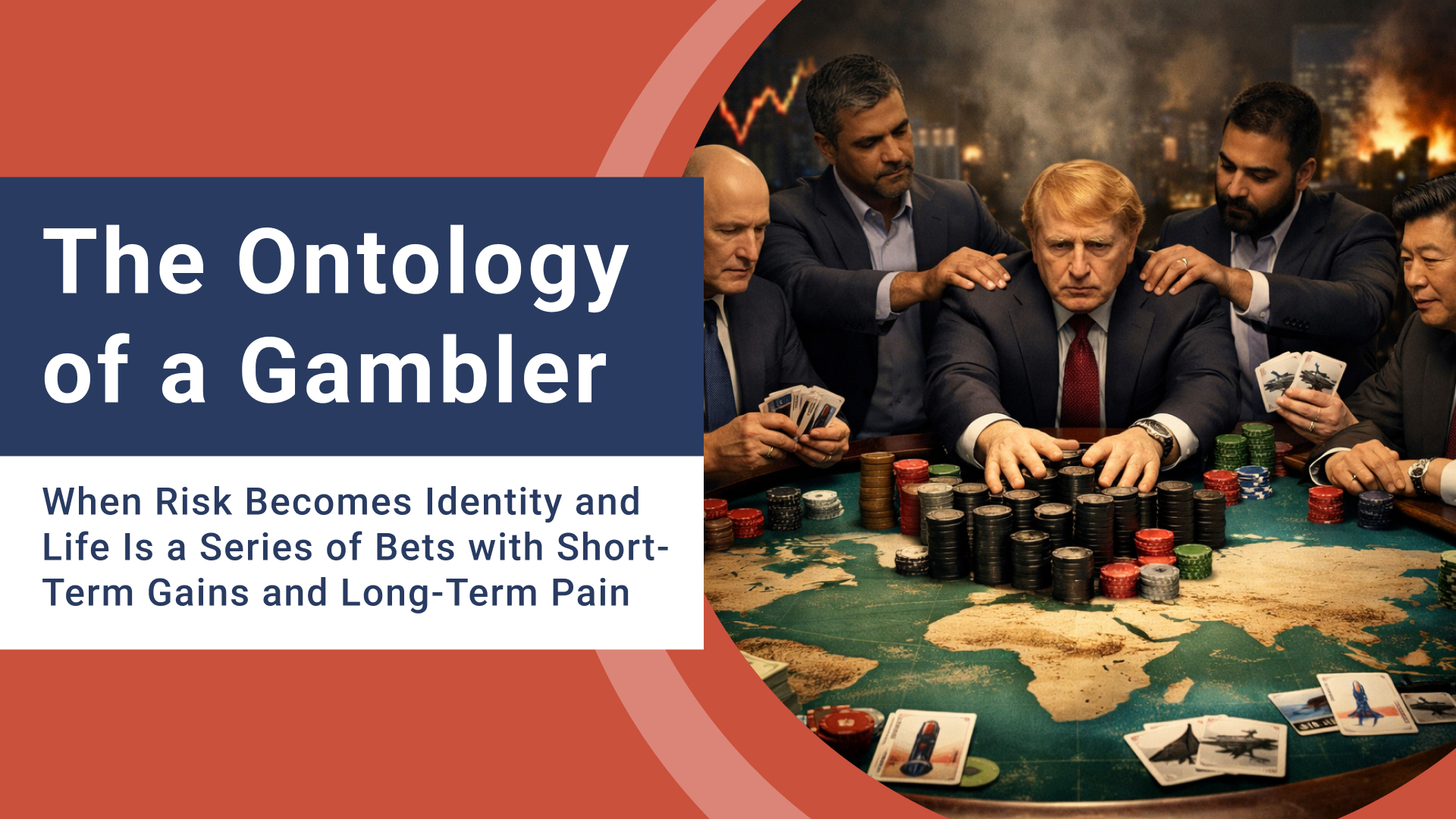

When Life Becomes a Bet
There is a pattern emerging in how many individuals relate to life, one that is often mistaken for boldness, ambition, or even courage. It is rewarded in markets, amplified in media, and at times mistaken for leadership itself. Yet beneath these expressions sits a deeper orientation that rarely comes into view. An orientation where life is no longer engaged as something to be understood, cultivated, or stewarded, but as something to be played.
A distinction is required early. Gambling, as an activity, is not the concern here. People take risks, place bets, and engage uncertainty for entertainment, exploration, or even calculated opportunity. That, in itself, is not the issue. What demands closer attention is the moment gambling ceases to be an activity and becomes an orientation. A way of being through which life itself is approached.
In this orientation, uncertainty is no longer something to be held with care, but something to be pursued. The unknown is not met with curiosity and responsibility, but with intensity and appetite. Outcomes are not built over time through coherence and discipline, but chased through moments of exposure and high stakes. The individual is no longer participating within reality, but positioning themselves as a player within what feels like a game.
Part of what makes this orientation so compelling is that life itself carries uncertainty. Love, for example, is never guaranteed. To care is to expose oneself. To commit is to enter what cannot be fully known. For some, this deepens responsibility. For others, it triggers something else. Instead of developing the capacity to remain with uncertainty, it is converted into movement. Life becomes a sequence of wagers. Relationships become positions. Decisions become moves. Commitment becomes conditional.
At first glance, this can resemble freedom. A refusal to be constrained. A willingness to go where others hesitate. But beneath that surface, something more subtle begins to take shape. A loosening of consequence. A fragmentation of responsibility. A growing distance from reality as it is, replaced by a heightened engagement with possibility as it is imagined.
This article is not a critique of risk. It is an inquiry into a way of being. What it means to become a gambler, not in behaviour, but in orientation. What structures give rise to it, how it operates, and what unfolds when a person, or even a system, begins to live through this lens.
The Whatness: Anatomy of a Gambler
To understand the gambler as a way of being, it is necessary to move beneath behaviour and into structure. What appears externally as bold decisions, high-stakes moves, or dramatic swings in outcome is only the surface. The deeper question is what configuration of Being gives rise to this pattern, what must be present, and what must be distorted, for life to be consistently approached as a gamble.
At the centre of this structure sits a misrelationship with courage. In its grounded form, courage is not about intensity or the scale of risk, but about the capacity to move forward when fear, discomfort, or uncertainty is present. It allows an individual to face reality, make decisions, and act without collapsing or withdrawing. It does not remove fear, but it prevents fear from dictating action.
Courage is the state of Being that gives rise to the ability to make decisions, move forward and take action when you are uncomfortable, frightened, worried or concerned for your safety and/or the safety of others. Courage is not the absence of fear; on the contrary, courage shows up when fear or discomfort is present. Courage enables you to continue to be of service and pursue objectives, even when circumstances appear insurmountable, unpleasant or dangerous.
A healthy relationship with courage indicates that you are likely to look for ways to move forward, make decisions and take action, even when you are afraid, feel threatened or are challenged. Others may consider you brave-hearted, daring and spirited, and someone who stands up for their values and in defence of others when challenged.
An unhealthy relationship with courage indicates you may freeze, shut down or withdraw in the face of difficult circumstances or when you are challenged or frightened. You may be inclined to avoid confrontation and be hesitant to express and assert yourself or deal powerfully with uncomfortable situations while tolerating unwanted circumstances. You may avoid confronting and looking into the reality of matters if they challenge or frighten you. Alternatively, you may be reckless in dealing with dangerous or high-risk situations and be unable to predict the consequences of your bravado. You may also underplay and diminish the impact of how you are being and your actions.
Reference: Tashvir, A. (2021). BEING (p. 305). Engenesis Publications.
When this relationship is intact, action emerges from clarity and responsibility. One moves forward while remaining connected to consequence, to context, and to what is actually unfolding. When it is distorted, however, it tends to polarise. On one end, fear leads to hesitation, avoidance, and withdrawal from reality. On the other, it gives rise to recklessness, where action becomes untethered from grounding, taken rapidly, and often without the capacity to hold what follows. What appears as boldness in this state is not courage, but a bypassing of fear.
The gambler lives within this distortion, but to fully understand it, another layer must be brought into view.
Anxiety.
Within the Being Framework, anxiety is not merely a reaction to specific threats, but a mood that shapes how the future is anticipated. It influences how uncertainty, risk, and preparedness are experienced, often generating a persistent sense of unease about what may unfold.
Anxiety impacts the anticipation, uncertainty, perceived risk or lack of preparedness associated with future situations, circumstances or events. It indicates how worry, nervousness or unease about the future impairs your ability to move forward. Anxiety fuels the constant prediction of potential consequences of the decision you are about to make and/or the action you are about to take. Anxiety, as a Mood, is clearly distinct from Anxiety Disorder. Anxiety can be about ‘nothing in particular’ and is often indeterminate. It can be experienced in the face of something completely unknown to you, something you do not have a perception or conception of, hence you may be unable to articulate it. It indicates how you are with anxiety – your propensity and capacity to be with it.
A healthy relationship with anxiety indicates that although certain situations may cause you to experience anxiety, you are still able to make appropriate decisions and take effective action. It leads you to be attentive and prepared and considerate of any relevant risks associated with the situation, keeping you on your toes. You may leverage your anxiety to achieve the best possible outcome in challenging situations.
An unhealthy relationship with anxiety indicates that in uncertain situations, it is likely to cloud your judgement, constrain you and cause you to freeze. Others may consider you as someone who is passive, lacks discernment, procrastinates and defers making decisions. You may have a propensity to frequently anticipate the worst possible outcomes, be overly sceptical and focus on what may go wrong. Alternatively, you may be considered nonchalant and oblivious to or ignore the consequences of your actions or inaction.
Reference: Tashvir, A. (2021). BEING (p. 224). Engenesis Publications.
In a healthy relationship, anxiety sharpens attention. It invites preparation, discernment, and care. It allows an individual to move forward while remaining aware of consequence, without being paralysed by it. In an unhealthy relationship, it distorts perception and constrains action. It may lead to hesitation, over-analysis, and withdrawal. Yet it can also express itself in a very different form, one that is less often recognised.
It can be overridden.
In the gambler, anxiety is not resolved, but neither is it allowed to fully surface. It sits beneath the surface as pressure, as an unease that cannot be comfortably held. Rather than being processed, it is discharged through action. The gamble becomes a release, a way to convert internal instability into external movement. What looks like decisiveness is often a response to tension, not clarity.
This is where the distortion of courage and the misrelationship with anxiety begin to intertwine. Action is no longer taken because reality has been sufficiently engaged, but because it cannot be tolerated. The move resolves the feeling, even if it complicates the situation.
Alongside this, awareness becomes selective. The gambler is not blind to reality, but perception is filtered. Signals that support the possibility of winning, breakthrough, or dominance are brought into focus, while signals that point to limitation or consequence are softened or delayed. Reality is not rejected outright, but subtly edited in a way that allows the pattern to continue.
Integrity, in this structure, begins to fragment. Alignment between what is seen, what is intended, and what is enacted loosens over time. Commitments become conditional, shifting with circumstance. Narratives adjust to maintain coherence, even when underlying patterns are unstable. What holds in one moment may not hold in the next.
Authenticity, which may appear present on the surface, takes on a different quality. The gambler often presents as direct, unapologetic, and expressive. Yet this expression is driven more by intensity than by grounded truth. It carries force, but not always alignment. What is revealed is shaped by the moment, not necessarily by what is accurate.
Taken together, these elements form a coherent structure. Not a lack of capability, but a distortion in how key aspects of Being relate to one another. It is within this configuration that the gambler emerges, not as a set of isolated actions, but as a consistent way of engaging with life, one that replaces grounded participation with the continual need to act, to move, and to resolve what has not yet been faced.
The Howness: Mechanics of the Gambler
If the anatomy reveals what constitutes the gambler, the next question is how this way of being operates in motion. The gambler is not simply impulsive or erratic. There is a coherence to how situations are interpreted, how decisions are made, and how action unfolds. It may appear instinctive from the outside, even sharp, but beneath it sits a patterned way of engaging with reality.
One of the first shifts occurs in how situations are framed. Complexity begins to collapse. What could be held as layered, nuanced, and evolving is reduced into sharper contrasts, into moments that demand resolution. Win or lose. Breakthrough or failure. Move or miss the opportunity. The richness of reality gives way to a more immediate field of action, where hesitation feels costly and deliberation feels like a risk in itself. This compression creates speed, but it also narrows what can be seen.
Alongside this, the sense of time begins to contract. The future is no longer held as something to be shaped over extended horizons, but as something that must be engaged now. The weight of long-term consequence softens, not because it is irrelevant, but because it no longer holds the same presence in decision-making. What matters is the move, the position, the outcome that can be reached or avoided in the near term. Over time, this erodes the capacity to build anything that requires continuity, patience, or sustained alignment.
Within this compressed field, what is often called intuition begins to take on a different role. It is no longer the quiet emergence of insight grounded in awareness and experience, but something more immediate, more charged. A signal, a sense, a perceived opening quickly gathers certainty. Action follows with little space for deeper examination. It feels like clarity, yet it is often driven by the need to resolve tension rather than to understand what is actually present.
Narrative then begins to organise experience in a way that sustains this movement. Outcomes are rarely neutral. When things go well, they reinforce the sense of instinct, of being able to read the moment, of having acted where others would hesitate. When they do not, they are rarely held as they are. They are reinterpreted, softened, or absorbed into a broader story where the next move will redeem the last. In this way, coherence is maintained, not through alignment with reality, but through the continual adjustment of how reality is described.
Over time, a relationship with volatility begins to form. Stillness becomes difficult to remain with. Environments that are stable or predictable start to feel flat, even restrictive. What brings a sense of engagement is movement, uncertainty, the possibility of significant change. High-stakes situations begin to carry a certain pull, not only for what they may offer externally, but for what they resolve internally.
What emerges is not randomness, but a reinforcing rhythm. A situation is compressed, a move is made, an outcome is interpreted, and the cycle continues. Each iteration strengthens the pattern. From the outside, it can look like decisiveness, boldness, even strategic instinct. From within, it is a way of moving through reality that prioritises intensity over depth, resolution over understanding, and action over the capacity to remain with what has not yet been settled.
At some point, this rhythm becomes familiar enough that it no longer feels like a choice. It feels like the only way to engage.
The Interplay: Topology of the Gambler
What has been described so far does not sit in isolation. These elements do not operate independently, nor do they appear randomly. They organise. They reinforce. They begin to move together in a way that creates a self-sustaining pattern, one that gradually becomes stronger than any single decision within it.
At the centre of this interplay sits anxiety, not as something visible and fully acknowledged, but as an underlying current. It does not remain still. It generates pressure, a subtle but persistent sense that something must be done, that the moment cannot simply be held. This pressure does not point clearly to what is required, but it demands movement.
Courage, in its distorted form, becomes the pathway through which this pressure is released. Action is taken, not because the situation has been sufficiently understood, but because remaining with it is no longer tolerable. The move itself brings relief. It creates a temporary sense of clarity, of decisiveness, of being in control.
That action introduces volatility. Outcomes become uncertain, stakes are heightened, and the environment begins to shift. When the outcome aligns, even briefly, it validates not just the move but the entire way of engaging. It reinforces the sense that this is how life works, that movement is the answer, that risk is the path.
Narrative then steps in to hold this together. Wins are expanded into proof. Losses are softened into steps along the way. Contradictions do not break the pattern; they are absorbed into it. The story adjusts so that the orientation does not have to. In this way, coherence is preserved, even as alignment with reality begins to drift.
Awareness narrows in support of this loop. It does not disappear, but it becomes selective. What confirms the pattern is noticed quickly. What challenges it arrives more slowly, or is held at a distance. This is rarely deliberate. It is structural. The system protects itself by shaping what is seen and what is not.
Over time, this interplay begins to reorganise the individual. What once felt like a series of decisions starts to take on the quality of inevitability. The range of possible responses narrows. The same pattern appears across different areas of life, not because each situation demands it, but because the orientation has become the default way of engaging.
This is where the shift becomes difficult to detect from within. The person still feels active, decisive, and engaged. Yet what is driving the movement is no longer fully visible to them. The pattern carries its own momentum. The individual begins to move with it, rather than direct it.
From the outside, this may still resemble strength. A willingness to act. A capacity to take risks others avoid. From within the topology, however, something else has taken hold. The interplay of anxiety, distorted courage, selective awareness, and reinforcing narrative forms a closed circuit.
The gambler is no longer simply playing.
The pattern is now playing through them.
When the Gambler Scales: From Individual to System
This orientation does not remain confined to individuals. Under certain conditions, it begins to appear in leadership, in institutions, and in the decisions that shape entire systems. What was once a personal pattern becomes amplified, carrying consequences far beyond the individual making the move.
In recent events, decisions made within moments have carried the weight of global consequence. Military actions, escalations, and retaliations are not contained within borders. They move through energy systems, supply chains, financial markets, and the daily lives of millions who are not present at the point of decision. When key transit routes such as the Strait of Hormuz are disrupted, nearly a fifth of global oil and gas flows are affected, sending shockwaves through prices, inflation, and economic stability worldwide.
What becomes visible is not only conflict, but a pattern. Moves made under pressure. Escalations that prioritise immediate positioning over longer-term consequence. Decisions that resolve tension in the moment while expanding instability across the system. Energy infrastructure is damaged, supply chains fracture, and the ripple effects extend into food security, inflation, and global growth.
From a distance, these actions may appear decisive, even necessary. They may be framed as strength, as control, as leadership under pressure. Yet when viewed through a different lens, another possibility emerges. That what is being expressed is not grounded courage, but a scaled form of the same pattern seen in the gambler. An inability to remain with uncertainty translated into action that carries disproportionate consequence.
At this level, the distinction becomes more difficult to ignore. The cost is no longer contained within the individual. Entire economies begin to absorb the impact. Energy prices rise, inflationary pressures increase, and fragile systems are pushed further toward instability. The move that resolves tension for one actor becomes a burden carried by many.
This is where the ontology reveals its significance. The question is no longer about who is right or wrong within a specific conflict. It is about the orientation from which decisions are made. Whether they emerge from the capacity to hold complexity, consequence, and uncertainty, or from the need to act in order to resolve what cannot be held.
Because when the gambler scales, the stakes are no longer personal.
They become systemic.
The Endgame: Why the Gambler Always Loses
The gambler may win. There are moments where the move lands, the risk pays off, and outcomes appear to validate the entire orientation. These moments are visible, amplified, and often mistaken for proof. But they are not the endgame. They are the reinforcement. Each win increases the likelihood of the next move, not the stability of what has been gained. What is won is rarely held. It must be defended, extended, or risked again. The system does not allow for rest.
This is where the irony reveals itself. What appears as strength is dependency. What appears as control is compulsion. What appears as winning is often the early stage of a longer arc already set in motion. Short-term gain for long-term pain.
The cost accumulates. It appears in what cannot be sustained, in what must be constantly re-created, and in what eventually fractures under its own instability. Relationships become conditional, systems absorb the shock of repeated volatility, and decisions that once seemed decisive begin to expose their consequences across time. The gambler does not only suffer from this. They extend it. What begins as a way of resolving internal tension becomes a source of external instability, drawing others into outcomes they did not choose.
In this sense, the gambler loses even when they appear to win. They lose the ability to hold what they gain, the capacity to engage with reality without escalation, and the stability required to build anything that endures. Over time, something more fundamental erodes. The ability to stop. Because when life is lived as a series of bets, stopping feels like losing, even when continuing guarantees it.
The endgame, then, is not uncertain. It is structural. The gambler does not lose because of a single bad move, but because the way of being cannot sustain what it seeks to gain.
The Way Out: From Gambler to Leader
If the gambler is not defined by behaviour alone but by an underlying orientation, then the way out cannot be reduced to changing actions on the surface. Taking fewer risks, slowing down decisions, or adopting more cautious strategies may create temporary stability, but they do not address the structure that produces the pattern. The shift required is deeper. It is a reorganisation of Being.
At the centre of this transition sits a redefinition of courage. Courage must move away from being an override of uncertainty and return to its grounded form, the capacity to remain with discomfort, fear, and ambiguity without collapsing or reacting prematurely. It is no longer expressed through the intensity of action, but through the steadiness with which reality can be faced. Action still occurs, but it emerges from clarity rather than from the need to escape tension. What was previously experienced as urgency begins to give way to presence.
This immediately alters the relationship with anxiety. Instead of being discharged through movement, anxiety becomes something that can be held, examined, and integrated. This is not passive, nor is it comfortable. It requires capacity, the capacity to remain with what is not yet resolved without forcing resolution. As this develops, the compulsion to convert uncertainty into action begins to loosen. Decisions are no longer driven by the need to relieve pressure, but by a more coherent engagement with what is actually unfolding.
Awareness expands in parallel. It becomes less selective and less tied to preferred outcomes. Signals that were previously minimised or delayed begin to enter the field more fully. Contradictions are no longer immediately reframed or bypassed, but explored. This does not slow the individual in a limiting way. It grounds movement in a broader and more accurate perception of reality, allowing action to be both responsive and responsible.
Integrity, which had fragmented within the gambler orientation, begins to stabilise through alignment. What is seen, what is intended, and what is enacted start to converge. Commitments are no longer contingent on immediate outcomes. They are held across changing conditions. This introduces a different form of stability, one that is not dependent on constant success, but on coherence over time.
With this, the experience of time itself begins to shift. The future is no longer compressed into the next move. It is held across longer arcs. Decisions are no longer isolated acts, but part of a continuum. This makes it possible to build, to cultivate, and to sustain. Outcomes are no longer chased through intensity, but developed through consistency.
In this reorganisation, a different orientation becomes available. Not the gambler, but the leader. The leader does not eliminate risk, nor withdraw from uncertainty. Risk remains inherent to life. What changes is the relationship to it. Risk is no longer pursued as a means of resolving internal tension, nor avoided out of fear, but engaged with discernment and held within a broader context that allows for sustainability.
The movement, then, is not from risk to safety, but from compulsion to coherence, from intensity to depth, from reacting to uncertainty to having the capacity to remain with it and act from within it. In that shift, life is no longer experienced as a series of bets, but as something that can be built, held, and led.
Closing Reflection: The Cost of Living as a Bet
The gambler does not begin with collapse. In many cases, the early stages are marked by momentum, visibility, and moments of success that appear to validate the orientation. Decisions land, risks pay off, and the individual seems to move ahead of others who hesitate. This is part of what makes the pattern so compelling. It works, at least for a time, and in working, it conceals what it is gradually shaping.
The cost does not arrive immediately. It accumulates in what cannot be sustained. It appears in outcomes that must be continually re-won, in positions that must be constantly defended, and in decisions that cannot hold beyond the moment that produced them. What is gained through intensity is often lost in continuity. Relationships begin to carry conditions. Commitments lose their weight. The ability to build something that endures begins to erode, even as activity increases.
Over time, dependence on the next move begins to form. Not because it is always strategically necessary, but because it becomes psychologically required. Each action must justify the last. Each outcome must restore a sense of coherence. Stillness becomes difficult to remain with, not because nothing is happening, but because stillness removes the mechanism through which tension has been managed. Without movement, what has been avoided begins to surface.
This is where the deeper cost reveals itself. Life does not necessarily shrink in terms of opportunity, but it narrows in how it can be engaged. Fewer situations feel meaningful unless they carry a certain level of risk or volatility. Stability begins to feel flat, even suffocating. Depth is gradually replaced by escalation. The range of what can be held, built, and sustained diminishes, even as the appearance of decisiveness and action remains.
From the outside, this may still resemble strength. It may be interpreted as boldness, conviction, or even leadership. This is why the distinction is not always immediately visible. It does not reveal itself in isolated moments, but across time, in what endures, in what can be built, and in what remains when volatility subsides.
The gambler requires the next outcome to make sense of the present. The leader does not. The gambler exists in a constant proximity to validation or collapse, where each move carries the weight of proving or redeeming. The leader is not organised around either. Their orientation does not depend on the next result to sustain coherence.
The more confronting question, then, is not whether one takes risks, but from where those risks are taken. Because when life is lived as a series of bets, it is not only outcomes that are at stake. It is the very capacity to engage with reality in a way that allows something meaningful to be built and sustained.