
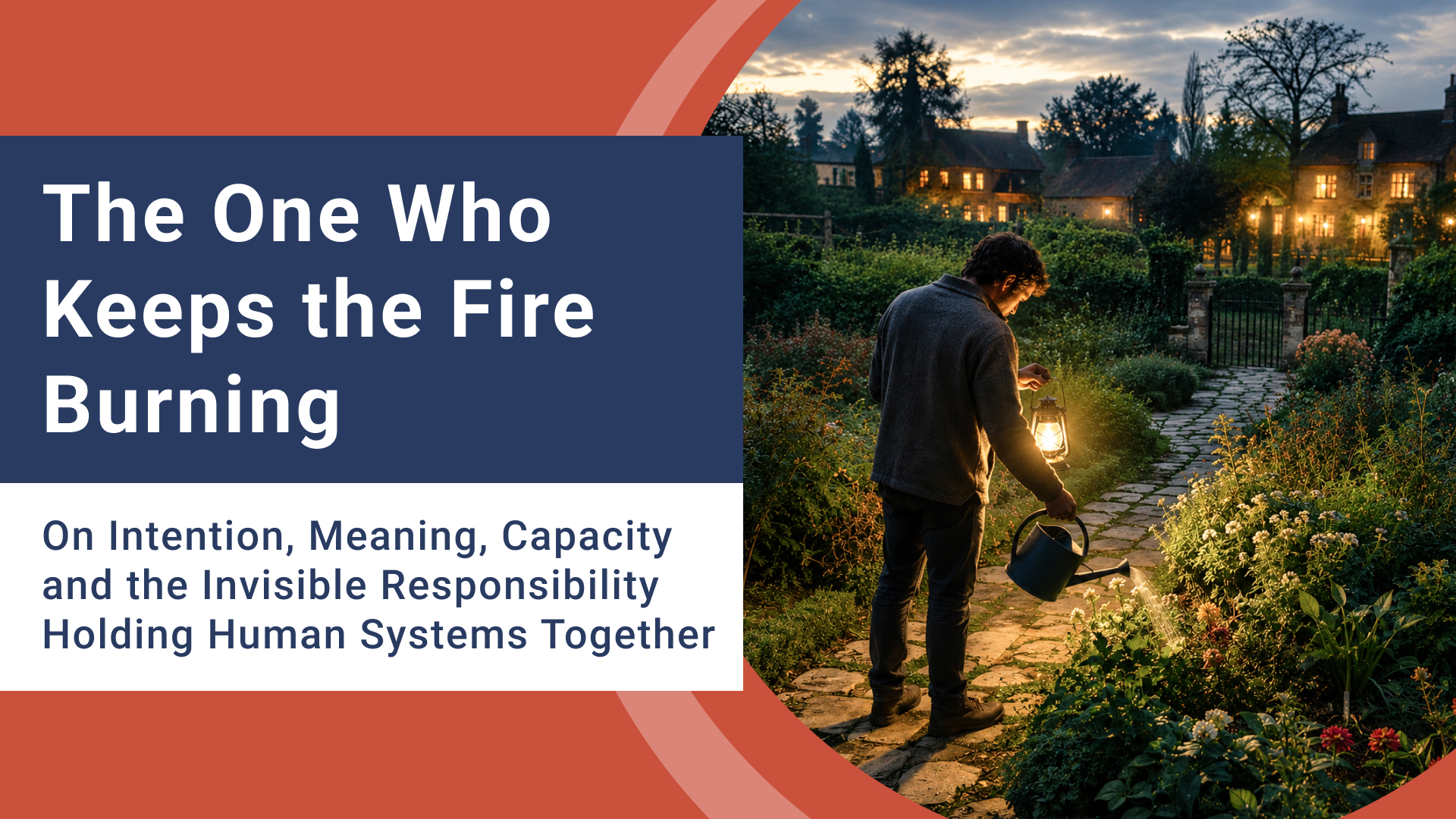

The Silent Reality Behind Every Living System
There is a quiet truth hiding beneath almost everything human beings build, love, preserve, and depend upon. It is so ordinary that most people rarely stop to notice it until something begins falling apart. Gardens do not remain beautiful on their own. Families do not remain emotionally warm on their own. Teams do not remain cohesive on their own. Relationships do not continue carrying intimacy, affection, trust, and emotional safety on their own. Institutions do not maintain integrity on their own. Even cultures, communities, and civilisations themselves slowly decay when nobody actively tends to them.
Entropy is not dramatic at first. It rarely announces itself with explosions. More often, it enters quietly through neglect. The weeds appear slowly. The conversations become slightly colder. The standards loosen subtly. The resentment accumulates silently. The vision becomes blurred around the edges long before anybody admits it has disappeared. Most forms of deterioration begin not through direct destruction, but through the gradual absence of deliberate care.
And yet, behind most functioning systems, there is usually someone. Sometimes visible, sometimes almost completely invisible. Someone who keeps checking the details when everybody else is tired. Someone who keeps initiating difficult conversations. Someone who keeps carrying the emotional atmosphere of the family. Someone who keeps protecting the standards of the organisation when compromise would be easier. Someone who keeps showing up for the relationship after disappointment, misunderstanding, exhaustion, or uncertainty. Someone who keeps watering the garden, paying attention to the culture, preserving the vision, stabilising the structure, or protecting what others have unconsciously begun taking for granted.
The fascinating part is that this role is often not formally assigned. Many of the people who carry systems are not necessarily the ones with the highest title, the greatest authority, or the loudest voice. Sometimes they are parents quietly absorbing emotional burdens so their children can feel safe. Sometimes they are founders holding together a struggling company while everyone else waits to see whether the vision survives. Sometimes they are the one friend in a social circle who continues initiating connection while everyone else becomes consumed by convenience. Sometimes they are leaders who continue carrying responsibility long after the glamour of leadership has disappeared and only the weight remains.
At the heart of all this sits a deeper existential reality. Every living system eventually reaches moments where at least one person must care enough to prioritise its survival, coherence, stability, or future above competing comforts, distractions, impulses, or conveniences. Not forever, not in every moment, and not in some mystical or ideological sense where self-sacrifice becomes automatically virtuous, but at least at certain critical points in time. Without that phenomenon, deterioration eventually wins.
A neglected garden does not negotiate with the weeds. A neglected relationship does not negotiate with emotional distance. A neglected culture does not negotiate with fragmentation. The absence of intentional care slowly becomes visible through disintegration itself.
This is why some systems survive extraordinary hardship while others collapse under relatively minor pressure. Often the difference is not merely resources, intelligence, technology, strategy, or talent. Often the difference is that somewhere within the system, at least one person decided: “This matters too much for me to abandon.”
That decision is far more profound than motivation. Motivation fluctuates with mood, energy, convenience, recognition, and reward. What we are speaking about here is something deeper. It is a developed orientation toward meaning and intention, where a person gradually reorganises themselves around something they experience as significant enough to protect, preserve, pursue, or sustain despite the cost involved.
The cost matters because this phenomenon is not romantic in any simplistic sense. The person who becomes “the one who carries” often absorbs immense pressure. They may sacrifice rest, comfort, emotional ease, financial security, recognition, simplicity, or even parts of themselves. Sometimes they do so consciously. Sometimes they slide into the role slowly, almost accidentally, until one day they realise the system leans on them far more than they ever intended.
This is where the phenomenon becomes both beautiful and dangerous. Because the same force that preserves families, organisations, movements, and societies can also create exhaustion, dependency, entitlement, resentment, imbalance, and collapse when left unexamined. The same willingness to care that allows life to flourish can eventually become a shadow when the burden ceases to be shared, modulated, or consciously navigated.
To understand this tension properly, we must first understand the deeper relationship between Intention, Meaning, responsibility, and the human capacity to carry what others cannot, will not, or no longer choose to carry themselves.
Intention Is Not Declaration
One of the great confusions of modern life is the assumption that intention is something people merely announce. We live in a world overflowing with declarations. People declare values, declare commitments, declare visions, declare identities, declare purposes, and declare aspirations with extraordinary confidence. Yet systems are rarely sustained by what people say they care about. Systems are sustained by what people repeatedly reorganise themselves around when sacrifice, inconvenience, uncertainty, or discomfort enters the equation.
There is a profound difference between expressing an intention and developing one. A declared intention exists primarily in language. A developed intention begins reshaping behaviour, perception, priorities, attention, emotional investment, and ultimately identity itself. It gradually moves from abstraction into embodiment. The person no longer merely speaks about what matters. Their decisions begin revealing it. Their calendar reveals it. Their sacrifices reveal it. Their consistency reveals it. Their willingness to endure difficulty reveals it.
This is why truly meaningful intentions often become visible long before they are verbally explained. One person continues caring for an ageing parent while others slowly distance themselves emotionally. One leader continues protecting the integrity of the organisation when compromise would produce easier short term gains. One partner keeps trying to restore warmth and repair after conflict rather than allowing resentment to quietly calcify into emotional withdrawal. One founder continues carrying the vision through years of uncertainty because something within them refuses to let the possibility die.
None of this means the path is emotionally pleasant. In many cases, the pursuit of meaningful intentions becomes profoundly difficult. The person may experience exhaustion, loneliness, fear, doubt, financial instability, criticism, misunderstanding, or repeated disappointment. Yet they continue. Not necessarily because they enjoy suffering, nor because they possess infinite strength, but because abandoning what they are carrying feels existentially heavier than the burden required to continue carrying it.
This distinction matters deeply. Human beings can tolerate extraordinary hardship when the hardship is connected to meaning. The mother who wakes repeatedly through the night for her child, the artist who spends years creating without recognition, the reformer confronting institutional resistance, the entrepreneur risking stability to bring something valuable into existence, or the person who chooses to preserve a marriage through painful seasons are often not driven merely by discipline alone. Beneath the discipline sits a deeper structure of meaning that reorganises priorities around something experienced as profoundly significant.
Meaning, in this sense, is not simply emotional excitement or motivational intensity. It is not the temporary stimulation people often mistake for purpose. Meaning operates more like existential gravity. It changes what becomes tolerable, what becomes worthwhile, and what becomes unbearable to abandon. A person anchored in deep meaning may willingly endure sacrifices that would appear irrational to those observing from outside the experience because the absence of what they are protecting feels darker than the hardship involved in preserving it.
This is why intention cannot be understood merely as goal setting. Goals can exist without existential commitment. Many goals disappear the moment comfort becomes threatened. Developed intention is different because it becomes intertwined with the person’s orientation toward reality itself. It begins influencing how they interpret responsibility, relationships, time, sacrifice, loyalty, care, and even suffering. Their life gradually starts organising around preserving or bringing forth something they believe genuinely matters.
At the same time, this process should not be romanticised carelessly. Not every sacrifice is wise. Not every attachment is healthy. Not every form of persistence reflects integrity or authentic meaning. Human beings are also capable of attaching themselves to illusions, compulsions, unhealthy dependencies, ideological obsessions, or trauma driven forms of self-erasure while convincing themselves they are pursuing noble intentions. This is why intention must eventually be examined not only through emotional intensity, but also through awareness, discernment, coherence, and sustainability.
Still, despite all the distortions that can emerge, there remains a simple reality that cannot be ignored. Almost everything meaningful that survives across time does so because somewhere, at some point, someone developed an intention strong enough to continue carrying responsibility after convenience disappeared. The family survived because somebody continued caring. The institution survived because somebody protected its integrity. The culture survived because somebody refused to abandon its values. The relationship survived because somebody kept choosing repair over pride. The vision survived because somebody remained devoted to a possibility others could no longer see clearly.
And perhaps this is one of the deepest tests of intention. Not whether we can speak passionately about what matters during moments of inspiration, but whether we can remain meaningfully oriented toward it when reality begins demanding something from us in return.
Every System Eventually Depends on “The One”
There is an uncomfortable truth that many systems prefer not to acknowledge openly because it disrupts the comforting illusion that things simply sustain themselves automatically. Beneath the language of teamwork, collaboration, structure, policies, culture, and process, there is very often at least one person carrying a disproportionate amount of responsibility for the system’s actual continuity, coherence, emotional stability, or survival.
In families, it may be the person who continually absorbs tension before conflict destroys the atmosphere of the home. In organisations, it may be the individual who keeps protecting standards while others slowly drift toward convenience, complacency, or fragmentation. In friendships, it may be the one who keeps initiating connection long after everyone else has become distracted by their own lives. In relationships, it may be the person who continues choosing tenderness, repair, patience, and emotional presence during seasons where affection no longer flows effortlessly. In communities and societies, it is often the people who continue preserving institutions, values, traditions, ethics, or social cohesion while others consume the benefits without fully noticing the labour required to maintain them.
The interesting part is that these people are frequently invisible while the system is functioning. Human beings tend to notice collapse more easily than maintenance. They notice the garden when it becomes overgrown, but rarely pause to appreciate the countless ordinary moments somebody spent tending it quietly before deterioration became visible. They notice the family once relationships become fractured, but often fail to recognise the emotional labour that had been preventing that fracture for years. They notice organisational dysfunction after culture collapses, trust deteriorates, or morale disappears, while overlooking the individuals who had long been stabilising those dynamics behind the scenes.
This hidden asymmetry exists almost everywhere because living systems naturally drift toward disorder unless intentional energy continuously counterbalances that drift. Authentic sustainability never meant passive preservation or static equilibrium. Within the Authentic Sustainability discourse, sustainability is not the absence of tension, sacrifice, effort, or modulation. It is the ongoing capacity of a system to remain coherently alive, adaptive, regenerative, and meaningfully functional across time. That process often requires custodianship. It requires people willing, at least temporarily, to carry more responsibility than others in order to preserve the integrity of the whole during periods of instability, transition, vulnerability, or strain.
This is important because discussions around sustainability can sometimes become overly abstract, procedural, or institutional while quietly forgetting the existential and human dimensions underneath them. No framework, policy, structure, or system sustains itself without embodied human beings choosing to care enough to enact and preserve it. Sustainability is not merely structural. It is relational, intentional, phenomenological, and deeply connected to human Being. Systems survive because somebody remains oriented toward preserving coherence when incoherence would be easier.
At the same time, this phenomenon should not be misunderstood as a celebration of endless self sacrifice or heroic martyrdom. The presence of “the one who carries” is often necessary, but necessity alone does not automatically make a pattern sustainable. In many cases, the temporary concentration of responsibility is precisely what allows a system to stabilise long enough to eventually distribute responsibility more coherently later. A parent may temporarily carry more while children are young. A founder may carry extraordinary pressure during the vulnerable early years of a company. A leader may absorb immense instability during a crisis. A partner may temporarily hold more emotional weight while the other moves through grief, illness, or collapse.
These asymmetries are not inherently unhealthy. In fact, many forms of life would not survive without them. Problems begin emerging when temporary necessity hardens into permanent dependency, when one person’s capacity becomes endlessly extracted without regeneration, or when systems quietly organise themselves around the assumption that somebody else will always absorb the burden.
Still, before exploring those shadows, it is important to fully appreciate the value of this phenomenon itself because modern discourse often oscillates between two extremes. On one side sits hyper individualism, where responsibility becomes increasingly fragmented and everybody prioritises personal convenience over shared custodianship. On the other side sits unhealthy self erasure, where individuals become consumed by endless obligation without modulation, reciprocity, or sustainability. Neither extreme produces healthy systems.
Healthy systems are rarely built through the total absence of burden. More often, they survive because certain individuals consciously choose, at critical moments, to carry what must be carried so that something meaningful does not collapse prematurely. Sometimes that burden is practical. Sometimes emotional. Sometimes existential. Sometimes moral. Sometimes relational. Sometimes visionary. Yet beneath all of them sits the same quiet orientation toward reality: “This matters enough that I am willing, for now, to prioritise its preservation over my immediate comfort.”
Without people capable of making that choice, most systems eventually decay into fragmentation, passivity, resentment, and disintegration. Because despite how sophisticated societies become, one truth remains remarkably constant across human existence: meaningful things survive only when somebody continues caring after caring becomes difficult.
The Capacity to Carry
Not everybody can carry the same weight, and not everybody breaks under the same pressure. Two people may enter the exact same situation and respond in radically different ways. One becomes overwhelmed almost immediately, emotionally fragmented by uncertainty, responsibility, complexity, or sustained tension. Another remains steady enough to continue functioning, adapting, deciding, caring, and preserving coherence even while under immense strain. This difference cannot be explained merely through intelligence, knowledge, motivation, or personality alone. It points toward something deeper that the Capacity discourse attempts to illuminate.
Capacity is not simply how much a person can do. Nor is it merely resilience in the motivational sense commonly celebrated in modern performance culture. Capacity concerns how much reality a person can consciously hold, metabolise, navigate, and remain coherent within without collapsing into distortion, avoidance, denial, fragmentation, impulsivity, emotional reactivity, or self destruction. It involves cognitive capacity, emotional capacity, relational capacity, existential capacity, ethical capacity, and systemic capacity simultaneously.
This matters profoundly when discussing the phenomenon of “the one who carries” because not all forms of carrying emerge from the same place. Some people carry from authentic devotion and grounded responsibility. Others carry from fear, trauma, control, guilt, insecurity, emotional dependency, identity attachment, or the inability to tolerate disappointment. From the outside, these patterns can appear similar because both individuals may seem highly responsible, highly sacrificial, or deeply committed. Yet internally, the structures generating those behaviours may be entirely different.
A parent may genuinely carry more because love and responsibility call for it during a vulnerable season in the child’s life. Another parent may overfunction compulsively because their identity has fused with being needed. A leader may absorb extraordinary pressure temporarily because the organisation requires stabilisation during crisis. Another leader may refuse to delegate because control itself has become psychologically addictive. A partner may hold emotional space for someone they love through a difficult season with wisdom and care. Another may remain trapped in endless emotional exhaustion because they cannot distinguish compassion from self abandonment.
This distinction becomes critically important because authentic capacity is not measured merely by how much suffering a person can endure. Human beings can endure tremendous suffering while becoming increasingly distorted internally. Some forms of endurance actually conceal fragmentation rather than transcend it. Authentic capacity involves the ability to remain coherent while engaging complexity. It includes discernment, modulation, adaptability, boundaries, recovery, perspective, emotional regulation, and the ability to distinguish temporary necessity from unsustainable patterns.
In this sense, mature carrying is not blind sacrifice. It is conscious custodianship. The person recognises both the value of what they are preserving and the limits of their own humanity. They understand that meaningful systems sometimes require disproportionate effort during critical periods, but they also recognise that sustainability cannot emerge through endless depletion. Without modulation, even noble responsibility eventually becomes unstable.
This is precisely where the Capacity discourse intersects deeply with Authentic Sustainability. Sustainable systems are not sustained merely by effort alone. They are sustained through the ongoing relationship between responsibility, regeneration, coherence, adaptation, and developmental expansion. A person may successfully carry a burden temporarily through sheer force of will, but if the system continually extracts more than can be restored, deterioration eventually enters both the individual and the system itself.
This is why some people who once carried organisations, families, movements, or relationships with extraordinary devotion eventually become exhausted, cynical, emotionally numb, resentful, controlling, or psychologically fractured. The issue was not necessarily that they cared too much. Often the deeper issue is that the system never evolved beyond depending disproportionately on their carrying capacity alone. The burden remained concentrated instead of becoming distributed, developmental, and regenerative.
Healthy carrying therefore requires more than strength. It requires awareness. The person must continually discern questions such as: What is truly mine to carry? What is temporarily necessary? What is becoming unsustainable? What responsibilities help life flourish? What responsibilities are feeding dependency? What sacrifices emerge from authentic meaning? Which ones emerge from unconscious fear or identity attachment? At what point does preserving the system begin destroying the person?
These are not simple questions because reality itself is not simple. There are seasons where extraordinary carrying becomes necessary. A collapsing company, a traumatised child, a dying parent, a social crisis, a struggling community, or a fractured relationship may genuinely require someone to temporarily absorb far more than feels comfortable or balanced. The Capacity discourse does not deny this reality in pursuit of simplistic equilibrium. Instead, it asks whether the individual and the system can navigate these asymmetries consciously enough that temporary necessity does not quietly solidify into chronic dysfunction.
Perhaps this is one of the deepest misunderstandings surrounding responsibility itself. People often assume the opposite of irresponsibility is endless self sacrifice. Yet sustainable responsibility is something more sophisticated. It is the capacity to remain devoted without becoming consumed, to remain caring without dissolving boundaries, to remain committed without becoming psychologically imprisoned by the role of carrying everything for everyone indefinitely.
Because ultimately, the healthiest systems are not the ones where one extraordinary individual endlessly compensates for everybody else’s underdevelopment. The healthiest systems are the ones where carrying becomes gradually shared, where more people develop the capacity to care, where stewardship multiplies across the system itself, and where responsibility becomes regenerative rather than extractive.
When the Necessary Becomes Pathological
One of the great paradoxes of human systems is that the very behaviour which initially preserves a relationship, organisation, family, institution, or community can eventually become the source of its hidden dysfunction. What begins as necessary responsibility can slowly evolve into unhealthy dependency. What begins as noble care can gradually produce passivity in others. What begins as leadership can eventually harden into overfunctioning, resentment, exhaustion, or control.
This transition rarely happens suddenly. Most pathological systems do not begin through malice. They emerge slowly through repetition. One person continually steps forward because somebody has to. One person keeps repairing conflict because nobody else will initiate repair. One person keeps carrying standards because others have become complacent. One person continues absorbing emotional pressure because the system depends on their stability. One person keeps sacrificing sleep, energy, time, or peace because the alternative appears worse.
At first, this may even be genuinely necessary. In moments of crisis, vulnerability, instability, or developmental immaturity, asymmetrical responsibility is often unavoidable. The problem is not asymmetry itself. The problem begins when the system unconsciously adapts around the asymmetry and starts normalising it as the permanent structure of reality.
Over time, people begin relying on the carrier rather than developing their own capacity. Emotional labour becomes silently outsourced. Responsibility becomes assumed rather than appreciated. The one who keeps initiating repair becomes expected to continue initiating it forever. The one who always solves problems becomes the permanent clean up crew. The one who remains emotionally mature during conflict becomes responsible for regulating everyone else’s emotional instability. The one who keeps preserving standards becomes burdened with protecting the culture while others merely participate in its benefits.
Eventually, something dangerous begins happening beneath the surface. The system no longer merely appreciates the carrier. It starts consuming them.
This is where entitlement quietly emerges. Entitlement is not always loud, aggressive, or openly narcissistic. Often it appears through subtle psychological assumptions. The assumption that somebody else will handle the difficult conversation. The assumption that somebody else will absorb the stress. The assumption that somebody else will preserve the relationship, maintain the culture, stabilise the team, carry the emotional atmosphere, solve the crisis, or sacrifice their own wellbeing for the continuity of the whole.
In these moments, the carrier slowly stops being experienced as a human being with limits, needs, vulnerabilities, and finite capacity. They become experienced more as a function within the system itself. The reliable partner becomes an emotional stabilisation mechanism. The responsible sibling becomes the family’s permanent shock absorber. The conscientious employee becomes the one expected to compensate for everyone else’s lack of discipline. The founder becomes an endless reservoir of vision, energy, and sacrifice. The leader becomes the one expected to prioritise everybody else’s comfort while silently carrying the burden of uncertainty, risk, and consequence.
This is precisely where healthy responsibility begins drifting into pathology. Not because responsibility itself is unhealthy, but because the relationship between responsibility and reciprocity has broken down. The system becomes structurally dependent on asymmetrical carrying while simultaneously failing to regenerate, support, distribute, or develop that capacity elsewhere.
The tragedy is that many carriers do not notice this transition immediately because meaning itself can obscure the deterioration. When a person deeply loves what they are protecting, they can continue tolerating unsustainable patterns for extraordinarily long periods of time. Meaning increases endurance. It expands what people can withstand. Yet endurance alone does not guarantee sustainability. Sometimes people continue carrying long after the system has stopped evolving responsibly around them.
This is where shadows begin forming on both sides simultaneously. The dependents may become passive, entitled, avoidant, emotionally underdeveloped, or increasingly disconnected from responsibility. The carrier, meanwhile, may slowly become resentful, controlling, emotionally exhausted, hyper vigilant, cynical, or psychologically fused with the role of indispensability.
That last point is important because pathology does not belong only to the dependents. The one who carries can also become attached to carrying. They may unconsciously derive identity, significance, moral superiority, control, emotional security, or existential purpose from remaining indispensable. In these cases, the system becomes mutually reinforcing in its dysfunction. Others stop growing because one person keeps compensating. One person keeps compensating because others continue needing them.
This creates a dangerous illusion of necessity. Everybody starts believing the system cannot function differently anymore.
Within the Authentic Sustainability discourse, this represents a breakdown in systemic integrity. The issue is no longer simply effort or sacrifice. The issue becomes structural incoherence. The system may continue functioning externally while internally becoming increasingly fragile, extractive, and developmentally stagnant. It survives through imbalance rather than through regenerative coherence.
This is why sustainability cannot simply mean preservation at all costs. A family that survives by emotionally destroying one member is not authentically sustainable. An organisation that grows while chronically burning out its leaders is not authentically sustainable. A relationship where one person permanently carries emotional maturity for both individuals is not authentically sustainable. A society that endlessly extracts responsibility from productive minorities while rewarding passivity eventually destabilises itself.
Something deeper is required beyond mere survival. Healthy systems must eventually develop the capacity to distribute responsibility more consciously, cultivate stewardship more widely, and prevent care itself from becoming structurally exploitative.
Otherwise, the very people who once held the system together eventually become the exhausted fault lines through which the system itself begins cracking apart.
The Shadow of Identity
One of the more difficult truths to confront is that people do not only become exhausted by carrying systems. Sometimes they become psychologically attached to being the one who carries them. Over time, responsibility can slowly stop being merely something a person does and start becoming who they believe they are.
This transition is subtle because responsibility is often socially admired. The dependable person is praised. The self sacrificing parent is admired. The tireless founder is respected. The leader who absorbs pressure without complaint is celebrated. The partner who endlessly gives is seen as loving. Yet beneath these admirable qualities, another process can quietly begin unfolding. The individual’s identity starts fusing with indispensability itself.
At first, the attachment may appear harmless. The person genuinely cares. Their contribution may even be necessary. But as years pass, they may gradually lose the ability to separate their worth from their function within the system. Being needed becomes psychologically stabilising. Carrying becomes emotionally familiar. Sacrifice becomes intertwined with significance. The individual no longer merely protects the system. The system becomes the place through which they derive identity, control, certainty, validation, or existential meaning.
This creates a profound internal contradiction. On the surface, the person may complain about the burden, exhaustion, lack of support, or emotional weight they carry. Yet unconsciously, they may also resist the very changes that would distribute responsibility more evenly. Delegation becomes difficult. Trust becomes difficult. Letting others fail, learn, grow, or contribute imperfectly becomes intolerable. The person may begin micromanaging, overcorrecting, controlling, or emotionally inserting themselves into every instability because their nervous system no longer knows how to exist without carrying.
This is where responsibility begins mutating into identity attachment.
The tragedy is that many people trapped in this pattern are not malicious. Often they developed this orientation through years of necessity. Perhaps they truly did grow up in environments where nobody else was reliable. Perhaps they genuinely had to become emotionally mature too early. Perhaps they survived chaos by becoming hyper responsible. Perhaps they entered systems already collapsing and learned that if they did not carry more than others, everything would disintegrate.
Over time, however, survival strategies can become existential identities. What once protected life can quietly start limiting it.
This pattern appears everywhere. Leaders who cannot stop leading even when leadership is destroying their health. Parents who continue treating adult children as incapable because being needed has become emotionally central to their identity. Founders who cannot relinquish control because the company has become fused with their sense of self. Partners who continually rescue others while unconsciously selecting relationships that guarantee they remain indispensable. Coaches, therapists, mentors, or caretakers who lose touch with their own humanity because they have become psychologically trapped inside the role of helper.
The danger here is not merely burnout. The deeper danger is developmental stagnation for everybody involved.
When one person unconsciously needs to remain indispensable, others often remain underdeveloped. The carrier may unknowingly prevent the very growth they consciously claim to desire. By continually intervening, compensating, fixing, rescuing, or over functioning, they deny others the friction required for capacity development. The system remains trapped in asymmetry because asymmetry itself has become emotionally stabilising to the person carrying it.
This is why authentic care sometimes requires restraint rather than endless intervention. Mature responsibility does not merely ask, “How do I keep this system functioning?” It also asks, “How do I help this system become less dependent on my constant overextension?” These are very different orientations.
Within the Capacity discourse, this reflects an important distinction between carrying from grounded intentionality versus carrying from unresolved identity structures. A person with authentic capacity can engage deeply without psychologically dissolving into the role itself. They can care profoundly while still recognising limits, boundaries, seasons, and the developmental importance of shared responsibility. They can step forward when necessary without unconsciously needing permanent asymmetry to maintain their sense of self.
This connects deeply to Authentic Sustainability because sustainable systems cannot be built around psychological dependency disguised as virtue. Even noble identities can become structurally destabilising when they prevent regeneration, distribution of responsibility, or developmental maturation within the wider system. A system that relies permanently on one person’s exhaustion, hyper vigilance, or self abandonment is not stable. It is fragile, even if it appears functional from the outside.
Perhaps this is one of the most difficult lessons for highly responsible people to learn. Sometimes the healthiest thing is not carrying more. Sometimes the healthiest thing is allowing discomfort, allowing consequence, allowing others to confront reality, allowing imperfection, allowing temporary instability, and allowing space for other people’s capacity to develop.
Because there is a profound difference between being genuinely needed for a season and becoming psychologically unable to stop being needed altogether. One emerges from conscious responsibility. The other slowly transforms responsibility into a prison wearing the costume of virtue.
The Line Between Love and Self Erasure
There are moments in life where carrying more is not only understandable, but deeply necessary. A parent staying awake night after night beside a sick child is not engaging in unhealthy overfunctioning. A partner temporarily carrying more emotional weight while the other moves through grief, depression, illness, or collapse is not automatically trapped in dysfunction. A founder enduring extraordinary pressure to prevent a meaningful vision from dying prematurely may genuinely be responding to the demands of reality rather than some pathological attachment to suffering. Human life contains seasons where asymmetry is both inevitable and appropriate.
This is important because modern discourse often struggles to hold nuance around responsibility. Some perspectives romanticise endless sacrifice as though exhaustion itself proves virtue. Others react so strongly against exploitation that any sustained burden immediately becomes framed as unhealthy. Reality is rarely that simple. Meaningful systems frequently require periods where somebody consciously chooses to carry more than feels balanced because the alternative would allow something valuable to deteriorate, collapse, or disappear.
The deeper question is not whether asymmetry exists. The deeper question is what the asymmetry is serving, how consciously it is being navigated, whether it remains connected to reality, and whether it is ultimately helping life become more coherent, regenerative, and developmentally capable over time.
This distinction matters because there is a profound difference between temporary sacrificial responsibility and chronic self erasure. One preserves life during vulnerable periods. The other slowly destroys the person while enabling dysfunction around them.
Self erasure rarely begins dramatically. Most people do not consciously decide to disappear into exhaustion. More often, it happens gradually through repeated small compromises against one’s own limits, wellbeing, emotional truth, or humanity. The person keeps postponing rest. Keeps suppressing resentment. Keeps absorbing pressure. Keeps accommodating behaviour that should have been confronted. Keeps rescuing others from consequences they need to experience. Keeps giving from reserves that are no longer replenishing.
At first, this may even appear noble from the outside. The person looks strong, devoted, endlessly reliable, selfless, resilient. Yet internally, something else may be unfolding. Emotional vitality begins thinning. Joy becomes conditional upon usefulness. The nervous system becomes chronically overloaded. Exhaustion hardens into identity. The person slowly loses contact with spontaneity, reciprocity, playfulness, intimacy, or even their own emotional needs.
This is where love itself can become distorted.
Authentic love does involve sacrifice. It does involve responsibility. It does involve periods where another person’s needs must temporarily matter more than comfort or convenience. But authentic love is not the same as permanent self abandonment. Love that continually destroys the humanity of the one giving it eventually becomes unsustainable, even when the original intention was sincere.
The same principle applies across systems. An organisation that survives only because a handful of people are chronically exhausted is not healthy. A family where one person permanently absorbs everyone else’s emotional instability is not healthy. A relationship where only one individual keeps repairing, initiating, regulating, forgiving, adapting, and carrying emotional maturity is not healthy. A society that quietly depends on the endless extraction of responsibility from a shrinking minority eventually creates instability within itself.
Within Authentic Sustainability, this is precisely why modulation matters so deeply. Sustainability does not mean rigid preservation through force of will alone. It involves the continuous navigation of thresholds, pressures, tensions, capacities, trade offs, and adaptations in a way that preserves the integrity and regenerative possibility of the system over time. When carrying ceases to be modulated, it gradually transforms from meaningful responsibility into structural depletion.
This is why discernment becomes essential. The individual must continually ask difficult questions that cannot be answered through ideology alone. Am I carrying this because it is genuinely necessary right now, or because I fear what will happen if I stop? Am I helping development occur, or am I preventing others from confronting reality? Is this season temporary, or has dysfunction become normalised? Am I preserving life, or merely delaying collapse while destroying myself in the process?
These questions rarely have perfectly clean answers because human systems are dynamic and contextual. There are moments where extraordinary endurance may genuinely be required. A mother caring for a disabled child, a leader stabilising an institution during crisis, or a partner supporting someone through profound suffering may need to carry more for extended periods without immediate reciprocity. Yet even in these situations, awareness still matters because the absence of modulation eventually produces consequences for both the individual and the wider system.
Perhaps this is one of the deepest tensions within responsibility itself. To love meaningfully often requires sacrifice. Yet to sustain love across time requires that sacrifice not completely annihilate the person offering it. Healthy carrying therefore involves more than devotion alone. It requires wisdom regarding thresholds, boundaries, seasons, reciprocity, recovery, and the developmental trajectory of the entire system.
Because the goal is not merely survival at any cost. The goal is the preservation and cultivation of life in a way that allows both the system and the people within it to remain genuinely alive.
Healthy Systems Eventually Multiply Carriers
One of the clearest signs that a system is maturing is that responsibility slowly stops concentrating around one exhausted individual and begins spreading more consciously across the wider structure. Healthy systems do not merely survive because one extraordinary person continues compensating indefinitely for everybody else’s disengagement, avoidance, or underdevelopment. Healthy systems gradually cultivate more people who care, more people who notice, more people who initiate, and more people willing to carry meaningful responsibility voluntarily.
This principle applies everywhere. A healthy family is not one where a single parent permanently absorbs all emotional labour while everybody else passively consumes stability. A healthy organisation is not one where culture survives only because one founder or leader refuses to collapse. A healthy relationship is not one where one partner continually preserves intimacy while the other remains emotionally absent. A healthy society is not one where responsibility becomes increasingly concentrated among fewer and fewer people while the wider population drifts into passive entitlement.
In authentically sustainable systems, stewardship expands. Capacity develops across the system itself.
This does not mean every person carries equally at all times. Human life is not mechanically symmetrical. There will always be seasons where different individuals temporarily carry more based on competence, maturity, experience, circumstance, vulnerability, or necessity. The issue is not whether asymmetry exists. The issue is whether the system remains developmentally alive enough to gradually produce more carriers rather than endlessly extracting from the same ones.
This is where authentic leadership becomes deeply misunderstood. Many people think leadership means becoming the strongest carrier in the room. Sometimes it does require that temporarily. Yet mature leadership ultimately involves something more difficult and far more sustainable. It involves developing the conditions through which other people’s capacity can expand. It means creating cultures where responsibility becomes shared rather than outsourced upward toward one perpetually burdened individual.
A parent eventually teaches children how to contribute to the emotional and practical life of the family. A wise founder gradually develops leaders instead of remaining psychologically fused with being the sole visionary. A healthy coach does not create endless dependency around their guidance, but helps people develop greater awareness, discernment, responsibility, and self authorship. A mature institution builds structures, values, culture, and developmental pathways that allow stewardship to become distributed across the organisation itself.
This process is not always comfortable because multiplying carriers often requires allowing others to struggle, fail, experience consequences, and confront reality directly. One of the reasons over functioning becomes so tempting is that carrying everything personally can sometimes feel easier than tolerating the discomfort of watching others learn imperfectly. Yet systems cannot mature when friction is endlessly removed from everyone except the primary carrier.
This is where the Capacity discourse becomes essential again. Capacity does not develop merely through protection or comfort. It develops through meaningful engagement with reality, responsibility, consequence, complexity, and adaptation. People become capable partly because life eventually asks something difficult from them and they consciously rise to meet it. If one person continually absorbs all pressure on behalf of the wider system, others may never encounter the developmental friction required for their own growth.
Within the Authentic Sustainability discourse, this movement from concentrated carrying toward distributed stewardship reflects the transition from fragile sustainability toward regenerative sustainability. Fragile systems survive through extraction. Regenerative systems cultivate replenishment, adaptation, participation, and developmental expansion within the wider whole. They do not merely preserve functionality. They increase the system’s overall capacity to sustain coherence across time.
This distinction becomes incredibly important in leadership, culture, and civilisation itself. Many modern systems are quietly becoming structurally fragile because fewer and fewer people feel genuine custodial responsibility toward the whole. Consumption expands while stewardship contracts. People increasingly expect systems to provide stability, meaning, safety, opportunity, cohesion, and functionality while simultaneously becoming less willing to carry the burdens required to preserve those conditions collectively.
Yet every meaningful civilisation, institution, movement, or community in history survived because enough people developed an orientation beyond mere consumption. Enough people chose responsibility over convenience. Enough people cared not only about what they could extract from the system, but about what they were willing to preserve, contribute, protect, and carry for the sake of something larger than immediate self interest.
Still, healthy stewardship must remain conscious. The answer is not creating cultures of endless guilt, hyper obligation, or performative sacrifice. Nor is it demanding that everybody become equally responsible for everything all the time. Human systems require differentiation, seasons, flexibility, and contextual wisdom. The deeper principle is simpler and more human than that. A system becomes healthier when more people voluntarily develop the capacity to care beyond themselves and participate meaningfully in the preservation and cultivation of the whole.
Perhaps this is one of the deepest responsibilities of leadership, parenting, education, coaching, and culture itself. Not merely keeping systems alive through personal exhaustion, but helping produce more human beings capable of carrying life forward consciously, responsibly, and sustainably together.
Because no system remains healthy for long when everybody waits for somebody else to become “the one who carries.”
Closing Reflection: The Ones Who Keep Life Alive
Perhaps one of the quietest tragedies in human life is how often people notice the value of care only after its absence begins revealing itself through deterioration. We notice the warmth of a relationship once emotional distance settles in. We notice the integrity of an organisation after culture collapses into politics, fragmentation, or distrust. We notice the stability of families after the person who was quietly holding everyone together becomes exhausted. We notice the importance of custodianship only when the weeds have already overtaken the garden.
Yet beneath these moments sits a truth that has followed human beings across generations, cultures, institutions, and civilisations. Almost everything meaningful that survives across time does so because somewhere, at some point, somebody chose to care beyond convenience.
Somebody stayed attentive after others became distracted. Somebody remained responsible after responsibility became heavy. Somebody preserved standards after compromise became tempting. Somebody kept loving after affection no longer flowed easily. Somebody continued believing in the possibility of something meaningful while others became cynical, passive, fatigued, or indifferent.
This phenomenon is neither simplistic heroism nor endless martyrdom. Human systems genuinely require people willing to step forward and carry more during critical seasons. Without such people, many forms of life would collapse prematurely. Yet the deeper wisdom lies in understanding that carrying itself must remain conscious, modulated, and connected to authentic sustainability. Otherwise, the very force that preserves life can slowly begin consuming it.
This is why the question is not merely whether we should care deeply. The deeper question is how we care, why we care, what we are serving through that care, and whether the way we carry responsibility ultimately cultivates greater coherence, capacity, stewardship, and life within the wider system itself.
Healthy responsibility does not deny sacrifice. It simply refuses to romanticise self destruction as though depletion itself proves virtue. Authentic care involves discernment. It recognises seasons where extraordinary carrying becomes necessary while also recognising that no sustainable system can permanently depend upon the exhaustion of one individual alone. Eventually, responsibility must become developmental. Stewardship must spread. Capacity must multiply. More people must learn how to care consciously for the systems they participate in.
And perhaps this is one of the most important questions any person can ask themselves in relation to relationships, organisations, families, communities, institutions, or even civilisation itself:
What am I willing to help preserve when preservation becomes inconvenient?
Not performatively. Not ideologically. Not through guilt or self erasure. But because something within me recognises that certain things are too meaningful to abandon carelessly.
For some, that may be a child. For others, a vision, a marriage, a culture, a community, a body of work, a team, a moral principle, a craft, or a way of being in the world. The form changes. The underlying reality remains remarkably similar. Human life continues because enough people, across time, decide that certain things matter enough to carry through difficulty rather than discard at the first encounter with burden.
At the same time, wisdom asks us to remember another truth with equal seriousness. We are not meant to become machines of endless extraction. We are not meant to disappear entirely beneath the systems we sustain. The healthiest forms of love, leadership, responsibility, and stewardship ultimately create more life around them, not merely more dependency upon them.
Perhaps this is the real art of carrying well. To step forward when reality genuinely requires it, to remain devoted when meaning calls for perseverance, to preserve what deserves preservation, but also to help cultivate conditions where others gradually become capable of carrying alongside us.
Because meaningful systems survive not merely when one person keeps sacrificing forever, but when care itself becomes contagious enough that stewardship no longer belongs to one exhausted soul alone.
And still, despite all the dangers, distortions, and shadows that can emerge around this phenomenon, one truth remains difficult to deny.
Almost everything beautiful in human life exists today because somewhere, quietly and often without recognition, at least one person cared enough not to let it disappear.