

The sweater holds the fate of your future
I recently found myself staring at two subscriptions I wasn't sure I wanted anymore. One was Netflix. The other was my coaching credential.
At first glance they appear to have very little in common. One gives me access to an endless catalogue of movies and television shows. The other represents years of training, professional development, coaching practice, supervision and membership in a global professional community. Yet as I sat looking at the renewal notices for both, I realised they were provoking exactly the same question. Why was I still paying for them?
The Netflix question should have been easy. Most evenings I spend more time scrolling than watching. The algorithms faithfully serve up endless variations of the same stories dressed in different costumes. A detective with personal problems. A lawyer with personal problems. Occasionally everyone has personal problems simultaneously and it becomes a limited series. In contrast, while at the French Film Festival, I was reminded there are entire worlds beyond the Netflix menu. Films that move differently. Stories that trust silence. Humour that does not require a laugh track to remind me when something is funny. For ninety minutes I found myself laughing entirely of my own free will, which felt oddly refreshing. And yet every month the subscription quietly renews.
The coaching credential was proving more complicated. I have accumulated more than five hundred coaching hours over the years. My credential expires in October. I could simply renew at the same level. I could pursue a higher credential. Technically, I have enough experience to continue down that pathway if I choose. The strange thing is that coaching itself is not really the question. I still work with leaders. I still facilitate learning, reflection and change. Much of my work today sits closer to strategy, systems thinking, and advisory practice than traditional coaching. The modality that has influenced me most profoundly is ontological work, which is not accredited in the same way, yet has transformed both my own life and the lives of many people I have worked with. So why was I hesitating? The answer, I eventually realised, had very little to do with Netflix or coaching. It had everything to do with the futures attached to them.
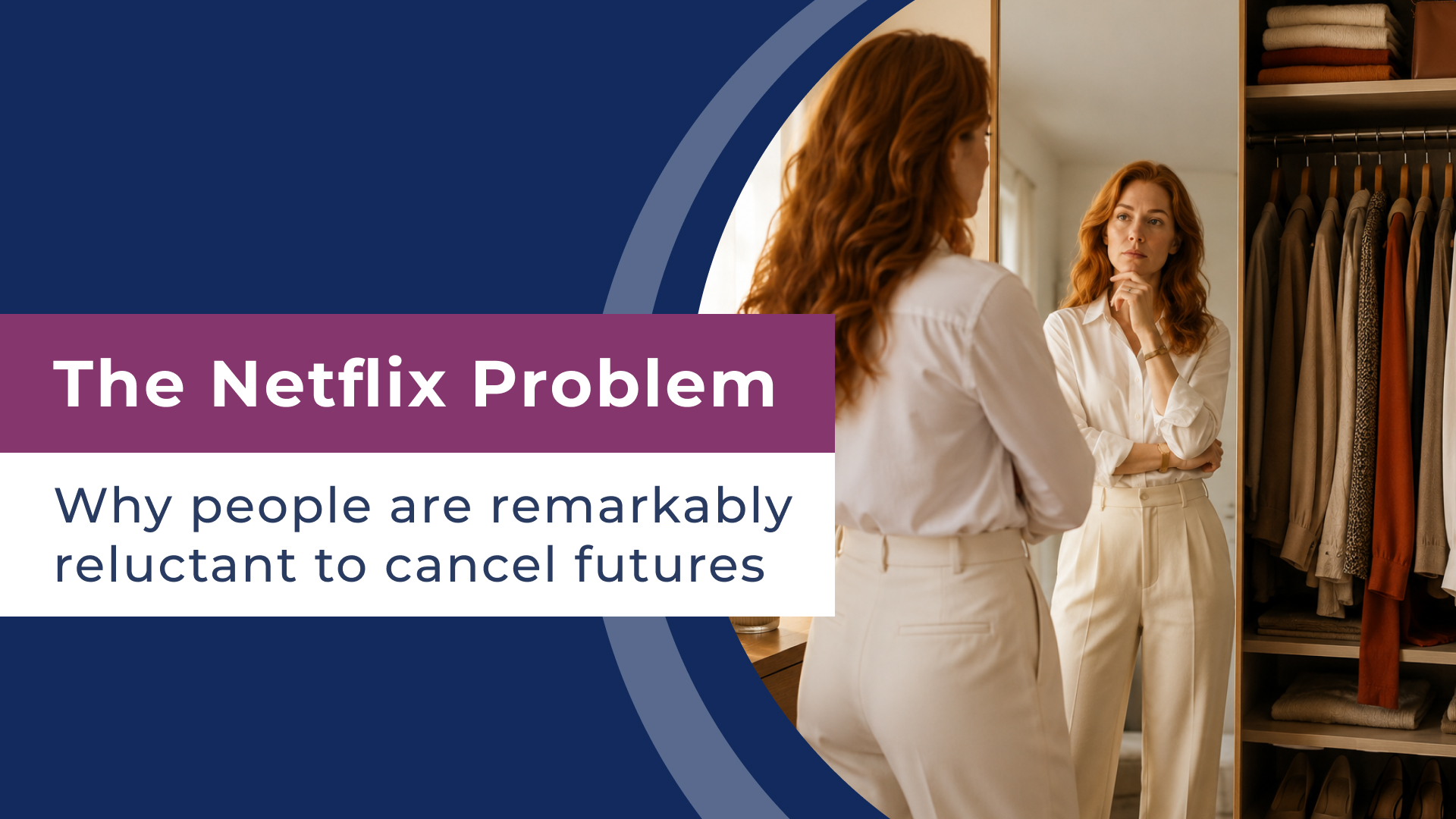
A few years ago I came across a piece of wardrobe advice that has lingered with me ever since. If you saw it in a shop today, would you buy it again? Most of us have a sweater hanging somewhere that fails this test spectacularly. You remember buying it. It was on sale. There was only one left. Someone else seemed interested. It felt like a bargain. You imagined yourself wearing it. You may even remember the version of yourself who would wear it. Confident. Relaxed. Stylish. Outdoorsy. Sophisticated. Whatever fantasy the sweater happened to be selling that day. Years later it still hangs in the wardrobe. The tags remain attached. You have never worn it. There is nothing wrong with the sweater. You simply never became the person who wore it. The real problem is not the sweater. It is the future attached to it.
The lives we keep paying for
Once I noticed this pattern, I started seeing it everywhere. Most of us are paying for several versions of ourselves at any given time. There is the gym membership we fully intend to use properly next month. The language app patiently waiting for our future fluent self to arrive. The online course we are definitely going to finish one day. The streaming service we barely open. The professional association we have not engaged with in years.
People are remarkably reluctant to cancel futures. We tell ourselves we are preserving options. Keeping doors open. Remaining flexible. Sometimes that is true. Often, however, we are maintaining possibilities that quietly stopped participating in our lives years ago. Netflix suddenly became much more interesting through this lens. What future am I actually losing if I cancel it?
The future where I finally watch that documentary everyone recommended. The future where I discover a brilliant series hidden somewhere deep in the catalogue. The future where I eventually justify all those monthly payments. The future where I might need it. The subscription is no longer really about television. It has become a future preservation system.
Professional memberships often work in exactly the same way. We keep them not because of what they provide today, but because of what they might provide tomorrow. Access. Possibility. Legitimacy. Community. Opportunity. We maintain the relationship because we are not entirely ready to let go of the future attached to it. The interesting question is whether we are preserving genuine possibility or simply postponing a decision.
Participation and the identity museum
This tendency may start earlier than we realise. Growing up in Canada, I was an enthusiastic collector of badges. Brownies, Girl Guides, Pathfinders. There was always another achievement to unlock, another patch to earn, another milestone to work towards. At the time it felt perfectly sensible. Looking back, I can see the appeal of visible progress. Badges made effort tangible. They offered reassurance that I was moving forward. Friends would joke that I collected qualifications like frequent flyer points. They weren't entirely wrong.
Professional life rewards much the same instinct. We collect qualifications, memberships, certifications and post-nominals as evidence of competence and commitment. Sometimes they genuinely matter. Sometimes they open doors that would otherwise remain closed. But they also become attached to something larger than the credential itself.
Most professional identities are rooted in place more than we realise. Not only physical places, but communities, institutions, cultures and ways of seeing the world. The credential may sit after our name, but the meaning comes from the people who shaped us, the places we learned, the tribes we joined and the stories we inherited about who we might become. Sometimes what we are really maintaining is not the credential itself, but a relationship to a place in our life where that identity once made sense.
Institutions understandably rely on credentials because they simplify complexity. Procurement panels do it. Professional bodies do it. Recruitment systems do it. On paper, credentials provide reassurance. They signal competence, consistency and minimum standards. Sometimes they are essential. But credentials are still proxies. I have a driver's licence. Anyone who has travelled with me through a roundabout may feel that further evidence should occasionally be required.
The point is not that credentials lack value. The point is that they are evidence of participation, not participation itself. Road-testing still matters. This is where identity enters the conversation. Most people think identity is something they possess. I am a coach. I am a consultant. I am a board member. I am a runner. I am an academic. We speak about identity as though it were an object stored somewhere inside us. Yet identities are not possessions. They are forms of participation.
A runner becomes a runner by running. A musician by making music. A volunteer by volunteering. A coach by coaching. Participation creates identity long before identity creates participation. The challenge emerges when participation quietly ends while identity remains. The membership continues. The renewal notice arrives. The LinkedIn profile remains unchanged. The letters stay after the name. Meanwhile, the life that originally gave those things meaning has gradually moved elsewhere. Without realising it, we begin curating museums of former selves.
LinkedIn sometimes feels a little like this. Scroll through enough profiles and you encounter a carefully preserved collection of credentials, affiliations, courses, memberships and titles. Evidence of who we have been. Proof of what we have achieved. A catalogue of identities accumulated over time. There is nothing inherently wrong with this. History matters. Experience matters. But museums serve a particular purpose. They help us remember where we have been. They are not designed for participation.
Identity maintenance costs
Modern professional culture is remarkably good at rewarding accumulation. More qualifications. More certifications. More memberships. More affiliations. More badges. More proof. Entire industries exist to help us become more of something. What we talk about far less often are maintenance costs.
Most people understand maintenance costs when it comes to money. Boats require storage, insurance and servicing. Houses require repairs and upkeep. Cars require registration and fuel. Identities have maintenance costs too. Membership fees. Professional development. Conferences. Continuing education. Networking. Remaining current. Remaining visible. Remaining connected to communities that once mattered deeply. The financial cost is often the least interesting part. The deeper costs are psychological.
Every maintained identity asks us to continue investing energy in remaining that kind of person. Not because anyone is forcing us to, but because identities have gravity. They exert a subtle pull toward continuity. The coaching community makes this particularly difficult.
Imagine belonging to a professional tribe largely populated by people who care deeply about personal development, self-awareness, communication, reflection and growth. A group of people who spend an unusual amount of time talking about emotions, purpose, identity and what it means to live well. There are far worse tribes to belong to.
When identities become communities, letting go is rarely about the credential itself. It is about belonging. It is about friendships. Shared language. Familiar conversations. A place where parts of ourselves have felt seen and understood. Leaving a tribe is emotionally different from cancelling a subscription. At some point the question changes from “What is this worth?” to “What is this costing me?” The identity is not bad. It is simply that every commitment excludes something else.
Transformation requires deselection
Modern culture talks endlessly about becoming. Become a leader. Become healthier. Become more successful. Become your best self. Entire industries exist to support our next evolution. Far less attention is paid to the other side of transformation. Unbecoming. Every meaningful transformation requires deselection.
The woman who buys the sweater. The person who joins the association. The coach who earns the credential. The executive who becomes a leader. All of them are becoming something. The harder question is who they are willing to stop being.
This is why letting go often feels surprisingly emotional. We are rarely grieving the identity itself. We are grieving the future attached to it. The credential may have opened important doors. The membership may have provided belonging. The role may have offered confidence, legitimacy or community during a chapter when those things were deeply needed. The hardest futures to release are often the ones that once gave us a place to belong. Not because they are wrong now. Because they were profoundly right then.
One of the quieter challenges of adulthood is learning how to honour what shaped us without feeling obligated to carry it forever. Learning how to distinguish between gratitude and permanence. Something can have changed your life without needing to remain part of it indefinitely.
Would you choose it again?
Eventually the wardrobe question returns. If I saw this on the rack today, would I still choose it?
The same question applies to memberships. Subscriptions. Roles. Communities. Credentials. Identities. Not everything should be discarded. Some sweaters still fit. Some memberships still create genuine participation. Some identities remain deeply alive and meaningful.
The invitation is not decluttering. It is discernment. It is the willingness to ask whether we are actively choosing a life or simply maintaining one. Not every future needs to remain preserved. Some futures need to be released so another one can begin.
Dr Jordan Marijana Alexander works at the intersection of identity, leadership, and organisational systems. She is the co-founder of RelateAble.Global. If this article has surfaced questions for you as a leader, or raised challenges you are navigating within your organisation or your own life, she welcomes thoughtful conversation or inquiry. You can follow DrJMA on LinkedIn and Engenesis.