

The Missing Structure in How We Make Sense of the World
We live in a time where access to information is no longer the problem. We can read, watch, listen, and learn about almost anything at any moment. News travels instantly, opinions are everywhere, and explanations are always available. On the surface, it appears that we are more informed than ever before.
Yet something does not add up. Despite this abundance of information, confusion is not decreasing. People look at the same situation and arrive at completely different conclusions. Conversations turn into arguments not because people lack data, but because they seem to be operating from entirely different realities. In organisations, strategies that look sound on paper fail in practice. In relationships, intentions are misunderstood. In society, issues become polarised even when everyone claims to be acting rationally.
If information is available, and if people are capable of thinking, then why does this keep happening?
The common explanations are familiar. We say it is a lack of education, or a lack of intelligence, or misinformation, or bias. While all of these may play a role, they do not fully explain the depth of the problem. Two highly educated people can look at the same situation and fundamentally disagree. Entire groups with access to the same facts can interpret them in ways that are not just different, but incompatible.
What is missing is not more content.
What is missing is a structured way to understand how we make sense of content in the first place. Every time we encounter something, whether it is a conversation, a piece of news, a business decision, or a personal experience, we do not simply absorb it as it is. We interpret it. We relate it to what we already know. We form a view about what it means and what should be done about it.
This process is constant, automatic, and largely invisible.
We assume that we are simply seeing reality as it is, when in fact we are always making sense of it through an underlying structure. That structure determines what we notice, what we ignore, what feels true to us, and what conclusions we draw. The issue is that this structure has not been clearly defined, articulated, or worked with in a systematic way.
Because of that, we continue to focus on content itself. We argue about facts, positions, and opinions, while overlooking the deeper structure that shapes how those facts, positions, and opinions are formed and understood.
This is the gap.
Not a gap in information, but a gap in the structure of sense-making itself.
To address this gap, that structure needs to be brought into view, not as an abstract idea, but as something that can be examined, understood, and developed. This is where the necessity for what will be introduced as the Metacontent Discourse begins.
Why This Gap Matters More Than We Think
When the structure of sense-making remains undefined, something subtle but significant happens. We begin to assume that disagreement is about content. We think people disagree because they do not have the right information, or they are not educated enough, or they are biased, emotional, or simply wrong. While these factors can play a role, they do not adequately explain what we repeatedly observe in real situations.
Two people can look at the same set of facts and arrive at entirely different conclusions, not because one is intelligent and the other is not, but because they are making sense of those facts through fundamentally different structures. What one person sees as strong evidence, another may dismiss entirely. What appears rational to one may seem deeply flawed to another. What feels obvious to one may not even register for someone else. At that point, the issue is no longer about the content itself, but about how that content is being interpreted, organised, and understood.
This has very real consequences across different areas of life. In conversations, it leads to people talking past each other. Each side believes they are being clear, yet neither feels understood. In organisations, it creates misalignment. Teams may agree on goals at the level of language, but act in ways that are inconsistent because they are not operating from the same understanding of what those goals actually mean. In relationships, it leads to repeated misunderstandings, where actions are interpreted through different frames, often escalating into unnecessary conflict. At a broader level, it contributes to polarisation, where groups form around shared interpretations rather than shared reality, and the distance between those interpretations continues to grow.
What makes this even more challenging is that these differences are not always visible. People often use the same words, refer to the same events, and believe they are discussing the same thing. Yet beneath that surface, the meaning of those words, the way those events are interpreted, and the assumptions being made can be entirely different. This creates a situation where communication appears to be happening, but understanding is not.
This is why many discussions become unproductive, not because people are unwilling to engage, but because they are not engaging from the same underlying structure of sense-making. Without a way to understand and work with that structure, we remain confined to debating conclusions while overlooking the process that produces those conclusions.
At this point, the need for something more structured becomes unavoidable. Not another opinion, and not simply another perspective, but a way to understand how perspectives themselves are formed, how interpretations take shape, and how meaning is constructed in the first place. This is where the Metacontent Discourse becomes necessary, not as a replacement for content, but as a way to make sense of how content is made sense of.
Introducing Metacontent Discourse
To understand why disagreements persist, why alignment is difficult, and why clarity often breaks down even when information is available, we need to shift our attention away from content alone and examine how that content is being made sense of. This is where the Metacontent Discourse begins.
Metacontent does not refer to the content itself. It refers to the underlying structure through which content is interpreted, organised, and understood. Every time we encounter something, whether it is a conversation, a decision, a problem, or a piece of information, we are not engaging with it in a neutral or empty way. We are engaging with it through a set of existing understandings, associations, assumptions, and ways of relating to what we are seeing.
These are not always visible to us. They operate in the background, shaping how we perceive what something is, what it means, how it connects to other things, and what should be done about it. They influence how we interpret events, how we respond to situations, and how we make decisions, often without us being consciously aware of them.
The Metacontent Discourse brings this into focus. It provides a way to look at the structure of sense-making itself rather than only the outcomes of that process. It allows us to ask not only what someone is saying, but how they are making sense of what they are saying. It shifts the attention from conclusions to the process that generates those conclusions.
Without this, we remain limited to engaging at the level of content. We argue over facts, defend positions, and attempt to persuade others, often without realising that the differences we are encountering are not simply about opinions, but about the underlying structure through which those opinions are formed.
This is why many attempts at resolving disagreement fall short. More information does not necessarily lead to more clarity. More debate does not necessarily lead to better understanding. In some cases, it intensifies confusion, because it adds more content into a structure that is already misaligned or insufficient.
The Metacontent Discourse does not attempt to replace content or dismiss its importance. Rather, it recognises that without understanding the structure of sense-making, content alone cannot lead to reliable understanding or effective action. It provides a way to examine, articulate, and work with that structure in a more deliberate and systematic way.
At the same time, there is an important limitation that needs to be acknowledged. Even with this recognition, the idea of metacontent can remain abstract. It can be understood conceptually, yet still be difficult to apply in practice. This is where the need for further development emerged, leading to the articulation of a more structured model of how sense-making actually unfolds.
Why Metacontent Discourse Alone Was Not Enough
Bringing attention to metacontent is a necessary step, but on its own it is not sufficient. It helps us recognise that there is an underlying structure shaping how we make sense of things, but it does not yet show us how that structure actually operates. Without that, the idea can remain conceptual. It can make sense intellectually, yet still be difficult to apply when we are in the middle of a conversation, a disagreement, a decision, or a complex situation.
This creates a risk. Metacontent can become something we agree with in principle, but do not know how to work with in practice. We may recognise that people are making sense of things differently, but still not be able to pinpoint where those differences are coming from, or how they are being formed.
To move beyond this, a more detailed articulation was needed. Not another abstract explanation, but a way to map how sense-making actually unfolds in real situations. A way to see where it can go right, and more importantly, where it can break down.
This is what led to the development of the Nested Theory of Sense-Making.
The theory does not introduce something separate from metacontent. It makes it workable. It breaks down the structure of sense-making into distinguishable parts, showing how understanding is formed step by step, and how distortions can occur along the way.
Instead of treating sense-making as a single act, it shows that it is a process that unfolds across multiple components, each influencing the next. When one part is weak, incomplete, or distorted, it affects everything that follows. When several parts are misaligned, the overall outcome can look coherent on the surface while being fundamentally flawed.
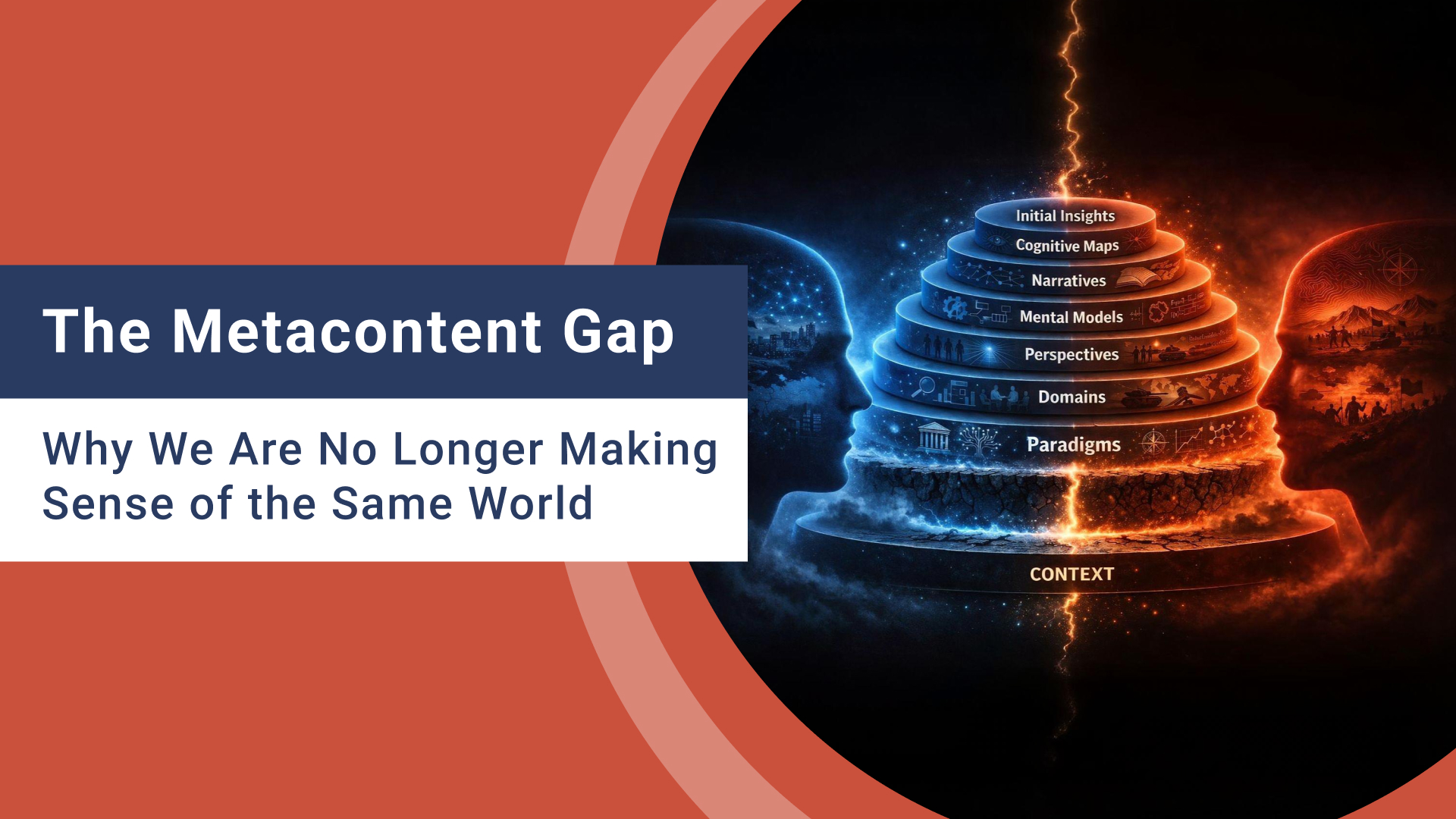
To make this visible, the Nested Theory presents a structured view of sense-making, which can be illustrated as follows:
This structure allows us to move from a general idea to something we can actually observe, examine, and work with. It enables us to ask more precise questions about how understanding is being formed, rather than simply reacting to the conclusions that emerge.
Before we explore each part in detail, it is important to recognise that this is not a rigid model imposed on reality. It is a way of making visible something that is already happening every time we try to understand anything.
The Structure of Sense-Making
The Nested Theory of Sense-Making shows that understanding does not happen in a single step. It unfolds across multiple components, each shaping how we interpret what we are exposed to. When these components are clear and aligned, our sense-making becomes more grounded. When they are weak, incomplete, or distorted, our understanding begins to drift.
To see this clearly, it is helpful to refer to the structure as a whole before breaking it down.

What this structure shows is that sense-making develops across several interconnected components, not in isolation. Each one builds on the previous, and each one can introduce its own form of distortion. We will go through them one by one.
1. Initial Insights
This is the knowing we have based on a glance. It is the quick snapshot we take of reality, often within seconds. It happens before we have had the chance to think deeply, analyse, or reflect.
At this stage, we feel like we already know what we are looking at. We recognise something, label it, and form an immediate sense of what it is. This is necessary for functioning in everyday life, but it is also where many distortions begin.
When we stop at initial insights, we assume we understand something simply because it feels familiar. We rely on quick recognition rather than deeper examination. This is one of the most common ways in which sense-making becomes shallow.
2. Cognitive Maps
Beyond the initial snapshot, we begin to organise what we know into a network. This is what can be referred to as our cognitive map. It is the web of what things are for me.
Each point in this web represents something we recognise. It can be physical, such as a cat, an apple, or a computer. It can also be abstract, such as the idea of standing in a queue, the notion of money, or systems like socialism.
At this level, we often operate with perceptions rather than conceptions.
Perceptions are what we collect. They come either from our direct sensory experience or from what we have adopted from others, often in a pre-packaged form through media, education, or social environments. They give us a sense of what something is, but that sense can remain relatively unexamined.
Conceptions go further. They involve actively engaging our mental capabilities, including comparison, analysis, reflection, dialogue, debate, consultation, and reason. Through conception, we do not just recognise something, we begin to understand it more deeply and place it in relation to other things in a more deliberate way.
If our cognitive map is built mostly on perceptions and not conceptions, it can appear rich while remaining shallow. It can contain many elements, but the relationships between those elements may be weak, inconsistent, or influenced by what has been passively adopted rather than actively understood.
3. Narratives
Once we have a cognitive map, we begin to interpret events through it. This is where narratives come in.
Narratives are the stories we form about what is happening, why it is happening, and what it means. They connect elements within our cognitive map into a sequence that feels coherent.
These stories can be powerful because they provide a sense of order and direction. They help us make decisions and justify our actions. At the same time, they are also one of the primary points where distortion can occur.
If the underlying map is incomplete or inaccurate, the narratives built on top of it will reflect that. Even when the narrative feels convincing, it may be based on assumptions that have not been examined.
4. Mental Models
At this stage, we move from interpretation to operation. Mental models are about how things work for me, the know-hows.
They include the processes and procedures we rely on in different situations. How we express concerns, how we give constructive criticism, how we receive harsh feedback without collapsing, how we drive a car, how we brush our teeth, or how we hire a new member into a team. All of these are expressions of mental models.
These models determine how we act.
When there are distortions at this level, we may still feel confident in what we are doing, but the way we do things does not function effectively. Systems we build begin to break down. Miscommunication increases. Efforts do not produce the intended outcomes.
How we do things depends heavily on how we understand things and the narratives we hold. If those are misaligned, the way we operate will reflect that misalignment.
5. Perspectives
Perspectives refer to the angle from which we look at something. They shape what we emphasise, what we overlook, and how we position ourselves in relation to a situation.
This includes our willingness and ability to shift perspective. Can we put ourselves in the position of another person? Can we step back in the middle of a heated discussion and see the broader picture? Can we hold multiple viewpoints at the same time and consider them without immediately rejecting one of them?
When perspective is limited, sense-making becomes narrow. We begin to mistake a partial view for a complete one. The ability to expand or shift perspective is essential for engaging with complexity.
6. Domains
Identifying the domain we are operating in is critical, yet it is often overlooked.
Different domains have different rules, structures, and ways of functioning. When we misidentify a domain or collapse multiple domains into one, our sense-making begins to distort.
For example, applying political logic to deeply personal relationships can create unnecessary conflict. Bringing market-based thinking into areas that require care and trust can undermine those relationships. Confusing branding with marketing or marketing with sales can lead to ineffective business decisions. Interpreting a biological issue as purely philosophical, or a philosophical issue as purely biological, can lead to incomplete or misguided responses.
Recognising the correct domain is not a minor detail. It shapes how we approach a situation and what we consider relevant.
7. Paradigm Within the Domain
Even when the domain is correctly identified, there is another level to consider.
Within each domain, there are different paradigms. These are the underlying approaches or schools of thought that guide how we understand and operate within that domain.
For example, within science, different paradigms such as positivism, post-positivism, interpretivism, and constructivism lead to different ways of asking questions, gathering information, and interpreting results.
Simply saying that something belongs to the domain of science is not enough. The approach taken within that domain matters just as much. Different paradigms can lead to different conclusions, even when they are applied to the same subject.
At this point, we can begin to see that sense-making is not a single act. It is a structured process that develops across these components. Each one plays a role, and each one can introduce its own form of distortion.
Context as the Substrate Beneath Sense-Making
Up to this point, we have looked at the components through which sense-making unfolds. However, there is something even more fundamental that influences all of them.
Context.
Context is not another component in the sequence, and it is not something that comes before or after the others. It sits beneath all of them as a substrate. It shapes how each part forms, interacts, and evolves.
To understand this more precisely, it is helpful to think in terms of contextual variables rather than context as a single, fixed condition.
These variables are constantly at play, and they influence how we perceive, interpret, and respond to what we encounter.
They include factors such as emotional states, ideological positions, personal interests and incentives, cultural nuances, environment and location, power dynamics, and timing and situational pressure.
None of these operate in isolation. They interact and shift continuously.
When these contextual variables are relatively aligned and stable, sense-making tends to be more coherent. We are more likely to interpret things in ways that are consistent and grounded.
When they diverge or break down, distortions begin to appear across all the components we explored earlier.
This is why two people can go through the same situation and come away with entirely different interpretations. The content may be identical, but the contextual variables shaping their sense-making are not.
Context, in this sense, is not simply the background. It is an active force that continuously shapes how sense-making unfolds.
From Distortion in Sense-Making to the Metacontent Gap
Once we see how sense-making is structured, and how it is influenced by contextual variables, a deeper pattern begins to emerge.
In dialogue, discussion, debate, negotiation, and even in situations of conflict and war, when there are particles in communication, the issue is often not what it appears to be on the surface.
It is not simply a matter of education, intelligence, or access to information.
More fundamentally, and more comprehensively, what we are encountering is a Metacontent Gap.
This gap arises when the entire structure through which one party makes sense of the world is different from that of another.
At that point, the issue is no longer about the content being exchanged. It is about the metacontent.
People may be using the same words, but those words carry different meanings. What exists in their cognitive maps is different. How those elements are connected is different. The narratives they form are different. Their mental models, their ways of doing things, including how they engage in discussion, debate, dialogue, or even conflict, are different.
From the outside, it may look like disagreement over a topic. In reality, it is a divergence in the structure of sense-making itself.
This is why attempts to resolve conflict at the level of content often fail. More explanation does not necessarily lead to more understanding. More argument does not necessarily lead to alignment.
Because the difference is not only in what is being said. It is in how what is being said is being made sense of.
The Metacontent Gap as an Ontological Distinction
At this point, it becomes necessary to be precise about what is being referred to as the Metacontent Gap. This is not simply a difference in opinion, nor is it adequately explained by differences in education, intelligence, or access to information. The Metacontent Gap refers to a divergence at the level of the structure through which sense-making occurs, and this divergence can span multiple components simultaneously. It can exist in how something is initially recognised, how it is organised within a cognitive map, how it is interpreted through narratives, how it is acted upon through mental models, how it is viewed through different perspectives, how the domain is identified, and which paradigm is being applied within that domain.
When these components differ significantly between individuals or groups, the gap is not superficial. It is structural. Two people may believe they are discussing the same topic, yet they are not operating from the same understanding of what that topic is. They may use the same words, but those words are anchored in different cognitive maps. They may follow the same line of discussion, yet interpret it through entirely different narratives. They may attempt to resolve an issue, yet rely on fundamentally different mental models of how things should be done. In such situations, communication may be taking place at the level of syntax, but it is not taking place at the level of meaning.
This is why the Metacontent Gap cannot be reduced to a qualification gap or an intelligence gap. It is broader and more fundamental. It encompasses the entire structure through which meaning is formed and understanding is constructed. Without recognising this, we continue to treat misalignment as something that can be resolved by adding more content, more explanation, or more argument. In reality, the gap persists because the structures through which that content is being processed remain different.
Addressing the Metacontent Gap
If there is a genuine willingness to communicate, the Metacontent Gap can be addressed, but not at the level where it is usually approached. It cannot be resolved by arguing over content alone, because the disagreement is not only about what is being said, but about how what is being said is being made sense of. To work with this gap, attention needs to shift toward the structure of sense-making itself, and this is where the Nested Theory becomes practically useful.
A structured approach begins by making the components of sense-making visible and discussable. Instead of debating conclusions, the conversation moves toward examining how those conclusions are formed. This can begin at the level of initial insights by clarifying what each person immediately sees or assumes based on their first impression, as many differences originate in these quick snapshots that are taken as complete understanding. It then moves into cognitive maps, where the focus shifts to what exists for each person, what they recognise as relevant, and whether they are operating from perceptions that have been adopted or from conceptions that have been examined and developed through analysis, reflection, and reasoning.
From there, attention turns to narratives, where each party’s interpretation of what is happening and why it is happening is explored, followed by mental models, where the question becomes how each person approaches action. This includes how they engage in the conversation itself, how they express concerns, how they respond to disagreement, and how they attempt to resolve the issue. The process continues by examining perspectives, where the capacity and willingness to shift angles is brought into view, including the ability to step out of one’s own position and consider others, and to hold a broader, more complete view of the situation.
At the level of domains, it becomes necessary to clarify whether both parties are operating within the same domain, as misidentification or collapse of domains is a common source of distortion. One party may be approaching the issue as a technical problem, while another may be engaging with it as a relational or ethical matter. Even when the domain is aligned, the paradigm within that domain must be identified, as different paradigms lead to different methods, interpretations, and conclusions. Finally, across all of these components, contextual variables need to be surfaced, including emotional states, incentives, cultural factors, environmental conditions, and situational pressures, all of which actively shape how sense-making unfolds.
By making these components visible, the conversation shifts from defending positions to examining how those positions are formed. This creates the possibility of alignment at a deeper level, not by forcing agreement, but by enabling a shared understanding of how each party is making sense of the situation.
The Preconditions for Bridging the Gap
Even with a structured approach, the Metacontent Gap cannot be addressed unless certain conditions are present. There needs to be openness, not only to express a view, but to examine how that view has been formed. There needs to be willingness, not only to participate in the conversation, but to question the structure through which one is making sense of what is being discussed. Good faith is essential, because without it the process becomes performative, and the intention shifts from understanding to winning or defending a position.
The absence of ill intention is equally important, as attempts to dominate, manipulate, or control the outcome undermine any possibility of alignment. Vulnerability also plays a critical role, because examining one’s own sense-making requires the willingness to recognise that it may be incomplete, limited, or distorted in ways that are not immediately comfortable to acknowledge. Without these conditions, the Metacontent Gap does not close. It widens, even if communication continues at the surface level.
Closing
The challenge we face is not simply that we disagree. It is that we often do not realise that we are not making sense from the same structure, and because of that, we continue to operate as if disagreement can be resolved by adding more content, more explanation, or more argument. This assumption keeps us engaged at the surface, where positions are defended, conclusions are reinforced, and conversations circulate without resolution.
What remains largely unseen is that beneath these exchanges, the structures through which meaning is being formed are already diverging. The same words are being used, yet they are anchored in different cognitive maps. The same events are being discussed, yet they are interpreted through different narratives. The same intentions may even be present, yet the ways of acting, deciding, and responding are shaped by different mental models, different perspectives, different domains, and different paradigms. When this is the case, communication continues, but understanding does not.
The Metacontent Gap brings this into focus by making visible what is otherwise assumed. It shows that the problem is not only in what is being said, but in how what is being said is being made sense of. It shifts attention from outcomes to the process that produces those outcomes, and in doing so, it opens a different path for engagement.
This does not mean that agreement becomes easy, nor does it mean that all differences can or should be resolved. What it does mean is that the nature of disagreement can be understood more accurately. Instead of attempting to correct each other at the level of content, there is the possibility of examining the structures through which each person is arriving at their conclusions. This creates space for a different kind of conversation, one that is not limited to defending positions, but is capable of exploring how those positions have been formed.
Without this shift, the pattern remains the same. More information leads to more noise, more discussion leads to more fragmentation, and more effort leads to diminishing returns. With it, there is at least the possibility of moving toward alignment, not by forcing agreement, but by developing a shared awareness of how sense-making itself is unfolding.
Ultimately, the Metacontent Gap is not an abstract idea. It is a practical reality that shows up wherever people attempt to understand, decide, and act together. Recognising it does not solve everything, but it changes where we look, what we question, and how we engage. That shift, in itself, is what makes a different kind of understanding possible.