

The requirement of law
One is expected to conform one’s behaviour to the requirements of the law. This expectation is one of the load-bearing assumptions of civil society. Law is not ordinarily presented as a suggestion that each person may accept or reject according to mood, convenience or private conviction. It establishes publicly recognisable boundaries within which people, organisations and institutions are expected to act.
There are good reasons for this expectation. The rule of law makes conduct more predictable, restrains at least some exercises of arbitrary power and provides shared procedures through which disputes may be addressed. It allows people who do not know one another, trust one another or agree with one another to participate in a common order. Without it, power does not disappear. It merely becomes less visible, less constrained and more dependent on whoever can exercise it most forcefully.
Nothing in the argument that follows is an invitation to trivialise law or to romanticise lawlessness. A society in which every person treats private preference as superior to public law soon ceases to have a public world at all. Yet the importance of law does not settle a more difficult question: what exactly gives a law the quality that makes conformity to it warranted?
The question matters because law is not simply found waiting in nature. Human laws are drafted, negotiated, enacted, interpreted, enforced, amended and repealed. They bear the marks of the knowledge, interests, fears, moral horizons, technologies, institutions and distributions of power from which they emerge. They are manufactured laws. To call them manufactured is not to call them false or unimportant. It is to acknowledge that human beings made them and that human beings can make them differently.
The law that changes
Was the law fair and just one thousand years ago? There can be no single answer because there was no single legal order, just as there is none today. Some laws protected life, property and forms of social cooperation. Others preserved hereditary domination, religious persecution, conquest and profound inequalities of status. Legality and justice sometimes coincided and sometimes stood in direct opposition.
Was the law fair and just one hundred years ago? Again, the answer depends on the jurisdiction, the people whose experience is taken seriously and the matter under consideration. Practices involving racial segregation, colonial domination, the legal subordination of women, the criminalisation of forms of intimacy and the exclusion of whole groups from political participation were not merely private prejudices. In many places they were carried, authorised or protected by law. People could conform meticulously to the law while participating in an unjust order.
The comparison becomes more confronting when it is made across societies in the present. Conduct treated as lawful and ordinary in one jurisdiction may be criminal in another. A right regarded as foundational in one society may be restricted elsewhere, while an obligation treated as obvious in one legal culture may be barely recognised in another. The existence of these differences does not prove that all legal judgements are relative or equally defensible. It proves that legal enactment alone cannot be the final test of truth or justice.
Nor can present confidence guarantee future vindication. What can guarantee that people living one hundred years from now will not regard some of today's accepted laws as unjust, incoherent or needlessly cruel? Nothing can. Our descendants may see some of our arrangements as achievements worth preserving and others as elaborate ways of normalising harm. We are not exempt from history merely because we happen to occupy its present edge.
The distinction here is not between having law and having no law. It is between the rule of law and the rule of just law. A legal system may be procedurally orderly, internally consistent and efficiently administered while remaining profoundly mistaken about the human beings and realities it governs. Procedural fidelity can preserve injustice with remarkable discipline. Legality is therefore a necessary achievement of civic order, but it is not a sufficient measure of reality, morality or justice.
This is also why criticism of law need not weaken the rule of law. The capacity to examine, contest and reconstruct law may be one of the conditions that keeps the rule of law from degenerating into the rule of authorised power. A legal order that cannot receive difficult information about its own effects may remain stable for a time, but its stability is purchased through distortion. What it refuses to recognise does not thereby cease to exist.
The turn
The argument now turns in a different direction. If one is expected to conform her behaviour to the requirements of mutable, human-made and manufactured laws, what may reasonably be expected in relation to the axiomatic laws governing the reality within which every human law is made? Before a legislature convenes, before a court interprets and before a government enforces, there are already conditions that none of them created and none of them can repeal.
The word law is being used here in three related but distinct senses. An enacted law prescribes what people are permitted, required or forbidden to do within a jurisdiction. A physical law describes stable regularities, relations and constraints in the material world. An ontological or metaphysical law identifies a constitutive condition of reality and of human participation in it, something that must already be the case for action, meaning, truth, responsibility or commitment to be intelligible at all. Collapsing these senses would create a category error, but separating them reveals their order.
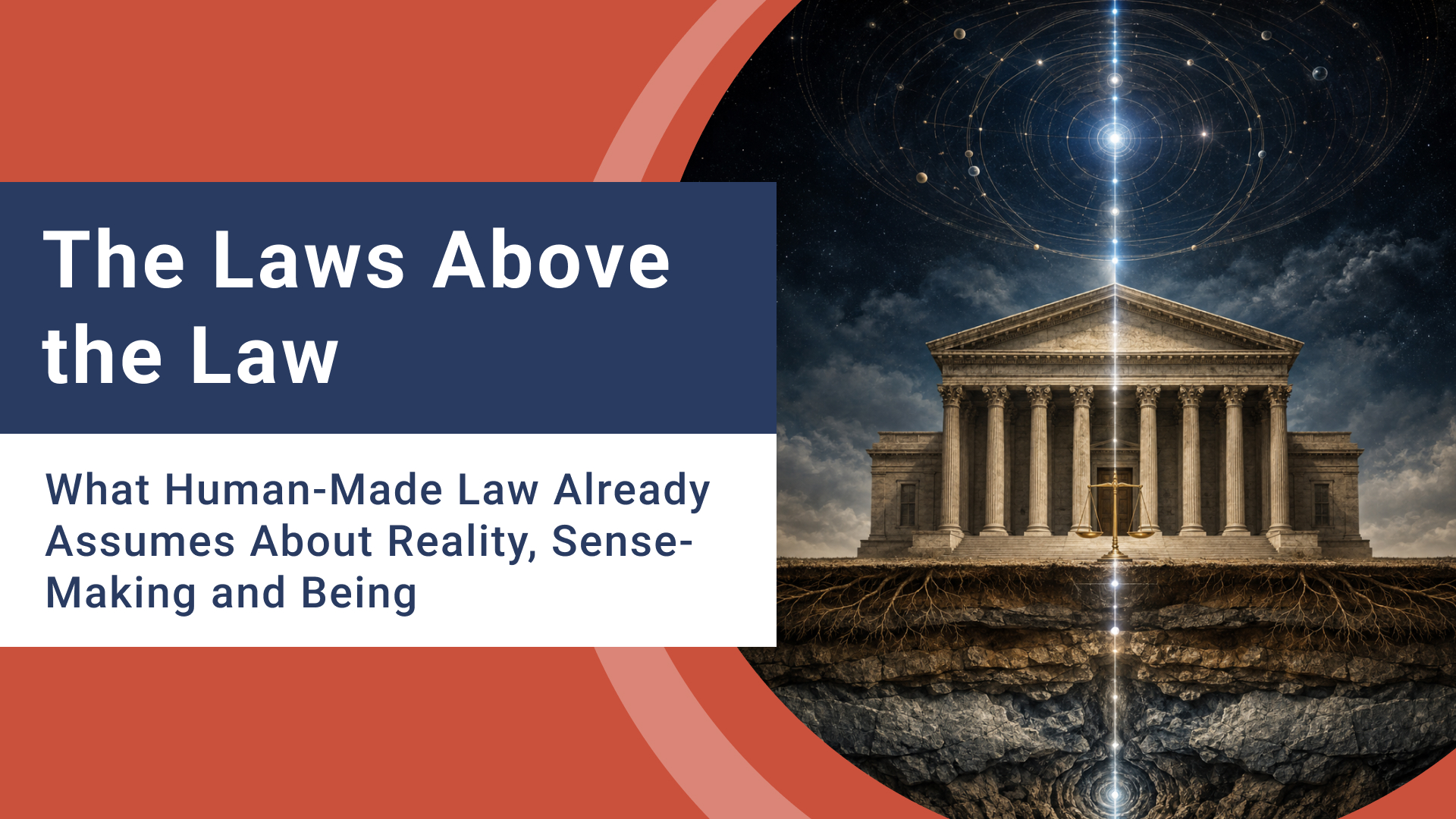
The laws above the law are not above it as another code issued by a more powerful legislator. They are prior to it and, in another sense, beneath it. They are the ground on which enacted law operates. Human law may organise how people respond to them, distribute the burdens that follow from them or misunderstand them entirely, but it cannot make them disappear.
The three layers of reality
A further difficulty arises because first-layer, second-layer and third-layer realities are frequently collapsed into one another. The distinction is not between what is real and what is unreal. All three layers are real, but they are real in different ways, arise through different conditions and possess different kinds of authority.
First-layer reality consists of what does not depend for its existence on the belief, agreement or recognition of a particular person or society. It includes physical realities such as gravity, temperature, biological limitation and material consequence. It also includes ontological conditions such as finitude, human vulnerability and the fact that action enters a world of consequences. Our accounts of these matters may change, but the matters themselves are not brought into existence merely by our accounts.
Second-layer reality is intersubjective or shared reality. It arises and operates through collective recognition, coordinated participation, language, institutions and social practices. Money, citizenship, corporations, professional titles, property rights and enacted laws belong primarily to this layer. These are human constructions, but that does not make them imaginary or inconsequential. Money can be constructed and still determine whether someone can obtain food. A border can be instituted and still constrain movement. An enacted law can be changed and still place a person in prison while it remains in force.
Third-layer reality is subjective reality: the reality of a person’s experience, perception, interpretation, memory, emotion and conception. Fear is real as an experience even when the danger perceived is not present. A person may experience an enacted law as protective, oppressive or irrelevant. That experience does not by itself establish what the law is, whether it is just or what consequences it produces, but it remains part of the reality of how that person encounters and responds to it.
Collapse occurs when the mode of reality belonging to one layer is attributed to another. We collapse the second layer into the first when we treat a social arrangement as natural, inevitable or beyond reconstruction. We collapse the third into the first when we assume that because something feels true, it must be true independently of our experience. We collapse the first into the second or third when we claim that everything is only a social construction or personal interpretation. Each collapse conceals something important about what is actually happening.
Reconstructive discernment begins by asking three questions. What brings this matter into existence? What sustains its operation? How is it encountered and interpreted by the person involved? If it would continue to exist without personal belief or collective agreement, it belongs principally to first-layer reality. If it depends on shared recognition and coordinated participation, it belongs principally to second-layer reality. If it exists as a person’s lived experience or interpretation, it belongs principally to third-layer reality.
Complex matters, however, often operate across all three layers. An enacted law originates primarily in second-layer reality because its legal authority depends on institutions and shared recognition. It nevertheless operates within first-layer constraints that legislation cannot abolish, and it is encountered through the third-layer experiences and conceptions of particular people. Responsibility offers the reverse movement: the ontological fact that human action generates consequences belongs to the first layer, the legal distribution of accountability belongs to the second and a person’s experience of guilt, ownership or denial belongs to the third.
The reconstructive task is therefore not always to place a matter exclusively within one layer. It is to identify its primary layer, trace how it enters the others and refuse to grant one layer the authority of another. The laws above the law belong to first-layer reality, but our formulations of them are developed within shared language and our access to them is mediated through subjective experience. Recognising this protects us from both dogmatism and relativism. We may never possess an entirely unmediated view of reality, but neither are we entitled to conclude that reality is whatever individuals or societies declare it to be.
At the physical level, this is readily accepted. One cannot repeal gravity, negotiate with the temperature at which human tissue is damaged or declare a toxic plant edible by legislative vote. One may learn to work with electricity, insulate its conductors and regulate its safe use, but one cannot suspend its nature through confidence or consensus. A hot surface does not ask whether the person touching it understands thermodynamics. Reality does not withhold consequences until one's conception becomes accurate.
This does not mean that every physical encounter has a simple or identical outcome. Temperature, duration, pressure, physiology and context all matter. The point is not that reality is crude, but that it is not answerable to preference. Better knowledge makes more skilful participation possible because conception becomes more congruent with the matter itself.
What metaphysical means here
The claim becomes less familiar when it moves from physical to metaphysical law, partly because metaphysical is often used carelessly. Metaphysics here does not refer to fantasy, mythology, mysticism or a realm in which any untestable belief may be declared true. It refers to inquiry into the most basic conditions and structures of reality, including what must be presupposed when we speak of identity, truth, agency, meaning, causation, time, possibility, responsibility and consequence.
Physics may investigate how material phenomena behave and interact. Metaphysical inquiry asks what makes it intelligible to say that there is a matter at all, that a person encountered it, that the person's conception may be accurate or inaccurate, that an action was theirs or that a consequence followed. These are not substitutes for empirical inquiry. They are conditions already assumed whenever evidence is gathered, a claim is tested or an explanation is offered.
The term axiomatic also requires care. It does not mean that every proposition labelled metaphysical is obvious, infallible or beyond criticism. It means that some relations are so basic to intelligible human participation that our practices presuppose them even when our theories deny them. A person who argues that there is no truth still presents a claim to be understood as true. A legal system that denies agency in theory must still distinguish an event from an act when it assigns liability. A society may obscure consequences, transfer them to others or postpone their arrival, but it cannot abolish consequence itself.
The metaphysical laws at issue are not mechanical copies of physical laws. Human beings possess different degrees of capacity, freedom, knowledge and constraint. Much of human conduct is habitual, reactive, socially conditioned or undertaken under pressure. To recognise agency is not to imagine an isolated, perfectly sovereign chooser who authored every condition of their life. It is to recognise that human participation includes response, selection, interpretation and action within conditions that were only partly chosen.
Nor does this account promise cosmic justice. It does not claim that every good action will be rewarded, that every harmful action will be punished or that the universe operates as a moral court. People sometimes evade legal and social accountability. Institutions sometimes protect those who caused harm and impose its consequences on those who did not. The deeper claim is more sober: consequences remain, response is still required somewhere and a burden that has been displaced has not been erased.
How can we recognise a law above the law?
The difficulty, of course, is that human beings do not have unmediated access to first-layer reality. We do not encounter reality from nowhere. What reaches us is perceived through a body and nervous system, organised through concepts, expressed through language and interpreted through histories, cultures, moods and interests. Even scientific instruments do not remove mediation. They extend our capacities of observation while still requiring interpretation. This is a limitation of human knowing, but it does not follow that reality itself is produced by the limitations through which we know it.
This distinction is essential. All human knowledge may be constructed in the modest sense that knowing involves selection, organisation and conception. It does not follow that everything known is constructed into existence. A map is made, but the terrain is not necessarily made by the map. Our conception of gravity has changed repeatedly, but whatever our theories were attempting to describe continued to operate. The fact that our access to reality is mediated does not mean that reality is reducible to the mediation.
We therefore cannot identify a law above the law merely because an idea feels self-evident, has been accepted for a long time or appears in several cultures. History contains many beliefs that once passed for common sense. Nor does calling something metaphysical make it fundamental. A proposed metaphysical law must withstand disciplined examination just as a claim about the physical world must withstand observation, evidence and possible counterexamples, even though the forms of examination are not identical.
The first test is independence from declaration. An enacted law comes into force because an authorised human institution declares, recognises and enforces it. A law above the law does not begin operating when it is announced. Gravity did not await its formulation. Finitude does not depend on cultural agreement. Human vulnerability is not suspended because a government refuses to recognise it. The ways these realities are understood and managed may differ, but their operation is not created by legislation.
The second test is resistance. First-layer reality places limits on what our concepts, wishes and declarations can accomplish. When events repeatedly refuse to conform to a conception, and consequences continue despite disbelief or institutional denial, that resistance is evidence that something more than the conception is involved.
The third test is inescapability. Some conditions must already be operating even when a person attempts to deny them. Anyone who argues that truth is irrelevant still expects their argument to be understood as a truthful account of the matter. Anyone who gives reasons against human agency is still participating in an intentional act of giving reasons, although this alone does not settle every philosophical question concerning freedom. Similarly, a person may deny responsibility, but actions still enter the world, affect others and generate matters to which someone must respond. Denial may alter how the condition is interpreted, but it does not necessarily remove the condition itself.
The fourth test is recurrence across contexts without requiring identical expression. Human societies differ enormously in their customs, institutions and moral vocabularies. This means that universality should never be inferred simply from familiarity. Yet beneath those differences, certain conditions recur. Human beings act without complete knowledge, depend on others, make meaning, confront consequences and attempt to distinguish what is from what merely appears to be. The cultural expressions vary, but the underlying conditions continue to present themselves.
The fifth test is consequence prior to sanction. Enacted law attaches an institutional consequence to an action, such as a fine, imprisonment or the invalidation of an agreement. A law above the law does not need a court to activate its consequences. Betrayal may damage trust even when no written law has been broken. A false conception may produce ineffective action even when everyone involved sincerely believes it. A commitment may reorganise expectations and possibilities before any contract is drafted. Human law can recognise, distribute or ignore these consequences, but it does not create all of them.
Physical and metaphysical laws are therefore discerned differently. Physical laws are investigated through observation, measurement, experimentation and the comparison of predictions with events. Metaphysical or ontological laws require examination of the conditions that make experience, action and intelligibility possible. We ask what must already be the case for a person to act, promise, testify, interpret, choose, refuse or answer for something. We examine lived experience, conceptual coherence, practical consequences and whether denying a proposed condition secretly depends on that same condition.
None of these tests grants infallibility. What appears to be an ontological necessity may turn out to be a cultural inheritance, a linguistic habit or an unexamined moral preference. Claims about laws above the law must therefore remain open to challenge, reconstruction and refinement. Their authority does not come from the confidence with which they are asserted. It comes from the degree to which they illuminate persistent conditions of reality, survive attempted denial and account for consequences across differing situations.
The decisive question is not simply, “Do I believe this to be universal?” It is: “What must already be the case for this human activity to be possible, what continues to operate when it is denied and what consequences arise independently of formal recognition?” Where a condition survives those questions, resists our preferred constructions and remains presupposed by our attempts to escape it, we have reason to regard it as belonging to first-layer reality and, provisionally, as one of the laws above the law.
Reality, Metacontent and the possibility of authenticity
The Metacontent discourse begins from a crucial distinction. First-layer reality is to be discovered, not invented. It exists independently of a person's preferences and does not become true merely because a person, group or institution has produced a compelling account of it. Yet human beings do not participate in reality without mediation. What is encountered through the experiential substrate takes form in the intellectual substrate through reception, perception and conception.
Content, therefore, never operates alone. Metacontent is the nested architecture through which content becomes intelligible and meaningful. It includes the distinctions, assumptions, categories, narratives, mental models, perspectives and paradigms through which a matter is received and lived. Two people may encounter closely related content yet make very different sense of it because the architecture through which it is organised differs.
This does not imply that each person's interpretation creates an equally valid reality. It explains how a person may remain convinced while being mistaken, how a group may institutionalise a distortion and how a society may turn a partial conception into law. Reality and conception are not identical. Because they are not identical, incongruence, correction and learning are possible.
This is precisely what makes authenticity a metaphysical possibility. Authenticity concerns the degree to which one's conception is congruent with the reality of the matter. If reality were nothing more than whatever a person conceived, authenticity would collapse into self-confirmation because there would be no independent matter with which conception could agree or disagree. If reality could never be encountered at all, authenticity would be equally empty because no correction would be possible. Authenticity becomes intelligible because reality is independent, access to it is mediated and greater or lesser congruence remains possible.
The hot surface offers the simplest example. A child may initially have no developed conception of heat, danger or tissue damage. The encounter is experiential before it is adequately intellectual. Through contact, warning, observation and learning, a conception takes form: objects within certain temperature ranges cannot be touched in certain ways without likely consequences. The quality of participation changes as the conception becomes more congruent with reality and conduct becomes more congruent with that conception.
The same architecture applies when the matter is human-made. Fiat money is invented, but it is not therefore unreal. Currency depends on shared meanings, legal arrangements, institutional confidence, accounting systems and coordinated practices rather than on a naturally occurring monetary essence. Once established, however, it participates in the organisation of access, debt, exchange, labour, security and possibility. A person who dismisses money as merely imaginary may encounter consequences as real as the person who mistakes it for a natural and immutable feature of the universe.
Authenticity in relation to money requires a conception congruent with its layered reality. One must understand both that it is socially constituted and that its constitution has operative consequences. The same is true of corporations, contracts, borders, offices and many legal statuses. Human beings can manufacture realities that are not physically intrinsic yet become consequential through sustained participation. Metacontent is therefore not only an intellectual endeavour concerned with ideas inside the mind. The architectures through which meaning is organised direct conduct, allocate resources, establish institutions and shape material lives.
What the courtroom already assumes
The courtroom provides an illuminating example because civil and criminal law already rely on many of these metaphysical conditions. A court asks what happened, what a person knew, what they intended, what capacity and freedom they possessed, what duty or commitment existed, what consequences followed and to whom conduct may reasonably be attributed. Different legal systems answer these questions differently, but the questions themselves reveal an underlying architecture.
When a person is called as a witness, the court ordinarily expects them to testify truthfully according to what they know and remember. This practice presupposes that an event is not identical to every account given of it. It also presupposes that a witness has a conception of the event, that the conception may be more or less accurate and that the witness can report it with greater or lesser honesty. The law may regulate testimony, but it did not invent the distinction between what occurred, what was understood and what was said.
Truth, honesty and authenticity must not be collapsed. A person may honestly report what they remember and still be factually mistaken. Another may utter an accurate statement while intending to mislead. Authenticity concerns the congruence of conception with the reality of the matter, while honesty concerns, among other things, whether expression faithfully represents what one understands or believes to be the case. Accuracy, sincerity and disclosure overlap, but they are not interchangeable.
Responsibility requires a similar distinction. It is not merely a synonym for blame and it does not imply that one caused every matter that life brings. A person may not have caused an illness, an accident, an inherited institutional failure or another person's conduct, yet the matter may still call for a response from them. Responsibility concerns the fact that we are to respond to the matters life brings to us or that we cause, regardless of the source. What varies is the response that is possible, fitting and proportionate to one's role and capacity.
This is an axiomatic condition in a restrained but important sense. A matter requiring response can be addressed, neglected, denied or transferred, but it cannot be made not to require a response merely through refusal. Even non-response alters the field of possibility and leaves consequences for oneself or others. Responsibility can be owned or displaced. It cannot be eliminated by changing its name.
Accountability is related but not identical. It concerns answerability for conduct, participation and consequence. Courts assume some form of accountable agency when they ask who did what, under what conditions and with what degree of understanding or control. Their recognition of childhood, incapacity, coercion, diminished responsibility and other limiting conditions does not make agency meaningless. It demonstrates that accountability must be calibrated to actual capacity rather than imposed as a fiction of total autonomy.
Contracts similarly presuppose commitment. Negligence law presupposes that foreseeable effects, relationships and standards of care matter. Rules of evidence presuppose that some methods of establishing a matter are more reliable than others. Legal procedure itself presupposes that power should be answerable through reasons, records and review. The court does not prove the Being Framework, but it shows that ordinary legal practice already depends on realities corresponding to authenticity, responsibility, accountability, commitment, integrity and care.
The ontological ground of the Being Framework
The Being Framework Ontological Model is not a list of admirable personality traits added to an otherwise complete account of human conduct. Its 31 Aspects of Being are organised across Meta Factors, Moods, Primary Ways of Being and Secondary Ways of Being because different dimensions of Being operate differently while remaining dynamically related. The model asks how human beings encounter reality, make sense of matters, participate, choose, respond, act and live with consequences.
Moods are especially important because participation never begins from a neutral intellectual position. Fear, anxiety and vulnerability can shape what appears salient, threatening, possible or unavailable before a person produces an explicit explanation. These moods are not statutes imposed by society and they are not moral failures to be prohibited. They are phenomenologically encountered conditions that influence how the world is disclosed and how a person becomes disposed to act within it.
Primary Ways of Being such as authenticity, responsibility and commitment are likewise not inventions whose reality depends on whether a culture happens to admire the words. Societies may define, reward and distribute them differently, while individuals may embody them with very different degrees of capacity. Yet the underlying relations remain. Conception can be more or less congruent with reality, matters call for response and participation across time requires some relation to commitment.
These are ontologically grounded and phenomenologically experienced on a spectrum, in varying degrees of health, by different people. Health here is how congruent the conception and conduct of that person are around the quality in question, such as commitment. The point is not simply whether a person uses the word positively or performs behaviour that their group rewards. It is whether their conception answers to the reality of the quality and whether their conduct is congruent with that sound conception.
Consider commitment. One person may conceive commitment as a feeling that lasts only while enthusiasm remains. Their conduct may appear energetic at the beginning and vanish when mood changes. Another may conceive commitment as an absolute prohibition against revision, remaining rigid even when circumstances, evidence or legitimate responsibilities change. In both cases, conduct may be consistent with the person's conception while the conception itself remains distorted.
A healthy relationship with commitment requires more than persistence at any cost. It involves the capacity to constitute and sustain a future through action, to remain answerable for what others have reasonably organised around and to confront changed reality without secretly converting abandonment into reinterpretation. A commitment may sometimes need to be revised or relinquished, but authenticity requires naming what has changed and accountability requires addressing the consequences. This is how commitment remains grounded in reality rather than becoming either passing preference or romanticised rigidity.
The same pattern applies across other Aspects of Being. Integrity concerns coherence that can be strengthened or fractured. Courage concerns participation in the presence of fear and uncertainty, not the elimination of fear. Responsibility concerns the capacity to respond without reducing every response to culpability. Accountability concerns answerability without pretending that power, knowledge and freedom are equal in every person or circumstance. These are lived structures before they become moral slogans.
To say that the Aspects are ontologically grounded does not make the framework itself infallible. The realities being investigated must be distinguished from the human conception used to map them. The names, definitions, relationships and measurements within any model remain answerable to experience, coherence, evidence, consequence and correction. A discourse concerned with authenticity would contradict itself if it insulated its own conceptions from reality.
From what is to what ought to be
Ontological grounding does not remove the normative layer. It makes that layer more rigorous by preventing us from confusing what is the case with what ought to be done about it. That a person can disclose a truth does not by itself establish that every truth should be disclosed to everyone at every time. That accountability is an intelligible feature of human participation does not determine the exact penalty a court should impose. That commitment is real does not make every promise legitimate or every continuation wise.
These distinctions are often hidden beneath the expression common sense. Common sense may preserve accumulated practical wisdom, but it may also preserve accumulated prejudice, unexamined convention and the interests of those whose experience has defined what counts as normal. The fact that something feels obvious within a society does not make it axiomatic. It may simply reveal how thoroughly a particular metacontent has been shared.
The question what is true? concerns the reality of a matter and the adequacy of our conception of it. The question should one be honest all the time? belongs to a normative field that includes what honesty requires in context, whether silence is deceptive, whether disclosure violates a legitimate confidence and whether another responsibility such as protection from imminent harm is also present. The existence of truth constrains the judgement, but it does not make judgement unnecessary.
Normative judgement must therefore consider the realities involved, the capacities of the participants, competing responsibilities, foreseeable consequences, asymmetries of power, the distribution of burdens and viability across time. It must also remain open to correction because no participant or institution possesses reality without mediation. This is neither a universal algorithm that produces one answer in every context nor a surrender to pure subjectivism. It is reconstructive judgement undertaken under conditions of reality, plurality and fallibility.
The distinction also protects the laws above the law from ideological capture. No person may simply elevate a preference, religious conviction, political programme or private intuition by calling it metaphysical. A serious ontological claim must withstand conceptual scrutiny, phenomenological examination, engagement with evidence, application across contexts and exposure to consequences. It must remain corrigible in its formulation even where the reality it seeks to describe is not created by agreement.
When law must conform
The opening sentence can now be read in both directions. One is expected to conform her behaviour to the requirements of the law, but human-made law must also be expected to become more congruent with the reality of the beings, relationships and systems it governs. The first expectation without the second produces obedience without correction. The second without the first risks turning every private conviction into an exemption from common order.
A law has its own metacontent. It carries a conception of the human being, whether explicit or hidden. It assumes something about agency, motivation, capacity, consequence, responsibility, authority, risk and the kind of social order worth preserving. Those assumptions operate even when legislators never articulate them. Poor law is often not merely a badly written rule. It is a rule generated from an inadequate conception of the matter.
Law can create genuine institutional realities. It can constitute a corporation, recognise a marriage, issue a currency, establish an office or allocate a legal right. Its constitutive power should not be underestimated. Yet law cannot guarantee trust merely by requiring it, produce capacity merely by assigning responsibility or abolish material and relational consequences by excluding them from its definitions. It may redistribute a cost, conceal a burden or postpone a breakdown, but these are interventions in reality rather than escapes from it.
An authentic legal order would seek increasing congruence between its conception of a matter and the reality of that matter. A responsible legal order would remain available to respond to effects it did not intend as well as those it did. An accountable legal order would make its decisions, assumptions and consequences open to examination. A committed legal order would provide sufficient continuity for people to organise their lives while retaining the capacity to revise what reality has shown to be untenable. An order with integrity would preserve coherence between its declared purposes, actual mechanisms and lived effects.
These formulations do not anthropomorphise law so much as expose the Being of the people and institutions through which law operates. Legislatures, courts, agencies and governments do not act apart from human beings. Their procedures can strengthen certain modes of participation, conceal others and distribute the consequences of collective incapacity. Institutions magnify metacontent because their conceptions are translated into permissions, prohibitions, incentives and material arrangements.
This is where the Metacontent and Being discourses move decisively beyond intellectual endeavour. Metacontent explains how reality becomes meaningful through nested architectures and how those architectures become socially operative. The Being Framework examines the modes and capacities through which people participate in the reality thus encountered. Together they make it possible to ask not only whether a law was validly enacted, but what conception produced it, what modes of Being it embodies, what capacities it presumes, what consequences it generates and how open it remains to reality's correction.
The laws above the law
The laws above the law are not a secret moral code waiting to be announced by a philosopher. They are not mystical punishments, ideological absolutes or permissions for self-appointed sovereignty. They are the physical constraints, ontological conditions and constitutive relations within which every human order must operate. We do not manufacture the independence of reality from preference, the difference between an event and its conception, the consequential nature of participation or the need for response. We encounter them and then form better or worse conceptions of them.
Human-made laws remain necessary because axiomatic conditions do not administer societies. Gravity does not write building codes. The reality of accountability does not determine a sentencing framework and the possibility of authenticity does not draft rules of evidence. Human beings must still make normative judgements, establish procedures, negotiate competing responsibilities and exercise power. The question is whether they do so with conceptions sufficiently congruent with the realities involved.
This also explains why no generation can guarantee that its laws will survive the judgement of the next. A statute records a society's present conception, not reality's final word. Its best protection against future condemnation is not certainty, but the institutional capacity to receive what it has excluded, examine the consequences it has displaced and reconstruct itself without waiting for breakdown to make correction unavoidable.
One is expected to conform her behaviour to the requirements of the law because common life requires an order that is more durable than private preference. Yet conformity cannot be the final civic or philosophical virtue. The deeper demand is reciprocal: people must participate responsibly within lawful order, while lawful order must remain answerable to the realities it did not create.
The written law is therefore not the highest law simply because it can be enforced. Above it, beneath it and already presupposed by it are the conditions of reality and Being. A mature society does not weaken law by recognising those conditions. It gives law something more demanding than authority to answer to.