

Background: When Decay Becomes Visible
Every civilisation eventually reaches a moment when something long concealed becomes visible. A scandal surfaces. A network is exposed. A structure collapses. A name once associated with influence suddenly becomes associated with suspicion. The public reaction follows a predictable rhythm: shock, outrage, moral condemnation, political weaponisation and then fatigue.
Yet beneath this emotional cycle lies a deeper structural question. When decay becomes visible at the highest levels of influence, where did it begin? Did corruption originate at the top and trickle downward, or did it grow quietly within the broader culture long before it concentrated itself in elite circles?
We tend to focus on individuals because individuals are easier to blame. They have faces, titles and biographies. But structural rot rarely begins with a single person acting in isolation. It develops within environments that permit, reward or ignore certain behaviours. Over time those behaviours become normalised inside insulated spaces that operate with reduced scrutiny and expanded privilege.
History shows a recurring pattern. Closed circles form. Access becomes selective. Status shields conduct. Accountability weakens. What would be unacceptable in ordinary life becomes tolerable inside protected domains. These spaces are rarely official yet they are functionally protected by power, wealth, influence or silence.
When exposure eventually occurs, we often describe it as rot from the top. It is a comforting explanation. It suggests that the problem belongs to a few corrupt individuals rather than to a wider civilisational and cultural architecture.
The more uncomfortable possibility is that such islands do not emerge without a mainland that makes them possible. The deeper question is not who stood on the island. The deeper question is why the island could exist at all.
Introduction: The Island and the Mainland
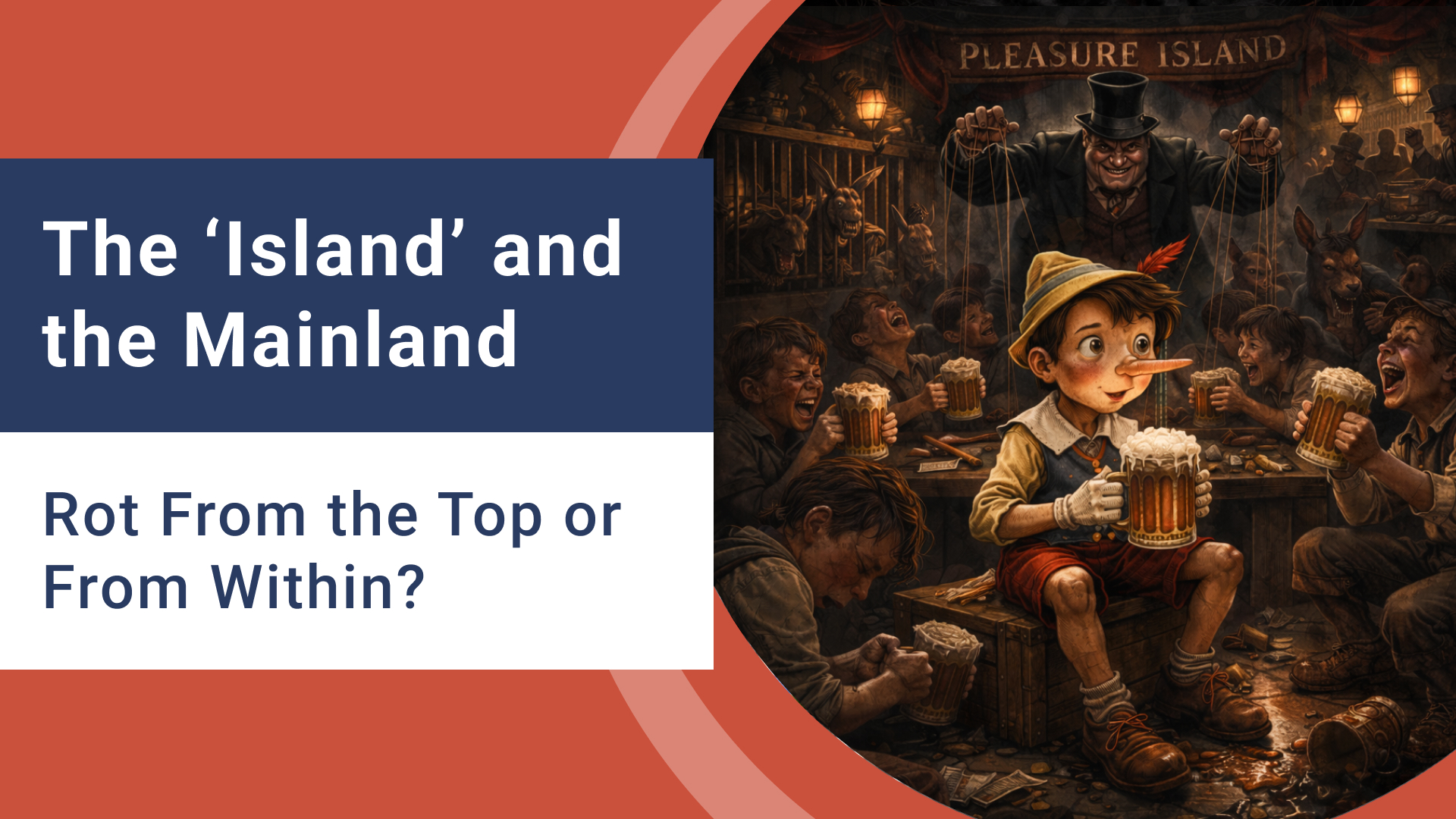
There is an old story about an island where rules dissolve and consequence disappears. It is presented as a place of freedom, a refuge from discipline, a celebration of appetite without restraint. Those who arrive feel liberated. They are told they can do as they wish. No authority watches. No limits apply. What begins as amusement slowly becomes excess and what begins as excess gradually becomes transformation.
In the story, the boys who arrive do not recognise the moment they begin to change. They do not feel corrupted. They feel empowered. Their laughter grows louder as their awareness grows thinner. They mistake the absence of restraint for the presence of freedom. Only later do they realise that something essential has been lost. Their speech falters. Their posture shifts. Their agency diminishes. By the time they understand what has happened, the transformation is complete.
The island is not merely a setting in a children’s tale. It is an archetype. It represents the structural condition in which appetite detaches from responsibility and indulgence detaches from integration. It is the psychological and civilisational space where privilege suspends consequence and permission replaces discipline.
The mainland, by contrast, represents ordinary life. It is where norms still function, where accountability still exists and where behaviour is moderated by shared expectations. The mainland assumes that its moral architecture is intact. It assumes that what happens in isolated domains does not concern it. It treats the island as an exception rather than as a reflection.
The central question is not whether islands exist. They always do. The question is whether the island is separate from the mainland or whether it is merely the mainland intensified. When we witness exposure at the highest levels of influence, we must ask whether we are observing rot from the top or whether we are confronting a mirror held up to the culture itself.
The Mechanism of Transformation
The island does not corrupt through force. It corrupts through gradual permission. Those who arrive are not coerced. They are invited. They are reassured that what they are doing is harmless, deserved or private. The absence of immediate consequence is interpreted as safety. Over time the nervous system adapts, the intellect rationalises and identity reorganises itself around new norms.
Degeneration rarely announces itself as degeneration. It presents as liberation. The first boundary crossed feels minor. The second feels justified. The third feels normal. What would once have provoked hesitation begins to feel routine. The internal voice that once questioned behaviour becomes quieter. Not because it has been disproven, but because it has been ignored.
In the story, the transformation into donkeys is not instantaneous. It is progressive. Speech weakens before posture changes. Awareness thins before agency disappears. The loss of humanity is not dramatic at first. It is incremental. By the time the transformation is visible, it has already been underway for some time.
This is how structural decay operates in real systems. Appetite detaches from responsibility. Privilege detaches from accountability. Power detaches from scrutiny. Each detachment is small enough to justify in isolation. Together they form an environment in which moral and existential gravity weakens.
When gravity weakens, behaviour drifts. When behaviour drifts, standards shift. When standards shift, what once appeared unthinkable becomes possible. The island does not begin as a monstrous place. It begins as a tolerated exception. Over time the exception becomes insulated and the insulation becomes normalised.
The critical insight is this: transformation is not caused by desire alone. It is caused by desire operating without integrative constraint. The problem is not appetite. The problem is appetite ungoverned by structure. Once that governance dissolves, the transformation follows a predictable arc.
Rot From the Top or Rot From Within
When exposure finally occurs and the island is revealed, the immediate instinct is to say that decay began at the summit. Power, after all, magnifies appetite. Insulation protects misconduct. Influence suppresses scrutiny. From this perspective rot appears to flow downward. The powerful corrupt the structure and the consequences cascade through society.
There is truth in this view. Concentrated power without accountability accelerates degeneration. When consequence is suspended at the highest levels, the signal transmitted to the wider culture is unmistakable. Standards weaken. Intentions get distorted. Cynicism rises. Trust erodes. The distance between public virtue and private behaviour becomes more visible.
Yet this explanation remains incomplete. Islands do not materialise out of nothing. They require conditions. They require a culture that tolerates status worship, that confuses wealth with virtue, that equates exclusivity with legitimacy. They require silence, indifference or fascination from the mainland. Without these cultural permissions the island cannot stabilise.
If the mainland rewards excess, glorifies power and consumes scandal as entertainment, it participates in the architecture that makes the island viable. The island then becomes an intensified expression of broader tendencies rather than an isolated anomaly. What appears as rot from the top may in fact be rot that has accumulated quietly within and simply concentrated where power amplifies it.
The uncomfortable possibility is that the island and the mainland are not opposites. They are different densities of the same moral atmosphere. The island reveals what happens when certain impulses are freed from constraint. The mainland reveals how those impulses are quietly tolerated in diluted form.
So the question remains unresolved in a simple way. Does decay begin at the top or within? Perhaps it begins wherever appetite first detaches from responsibility and is allowed to remain unexamined. When that detachment is scaled through power, it becomes visible. But its roots may have been growing long before visibility arrived.
The Supply Line: No Island Exists Alone
As mentioned, an island cannot sustain itself without supply.
It requires access.
It requires protection.
It requires silence.
It requires participation at some level.
Even the most insulated domain depends on a surrounding system that feeds it. Resources flow in. Legitimacy flows in. Talent flows in. Protection flows in. Most importantly, indifference flows in.
We often reduce corruption to a handful of guilty individuals. We search for names, for prosecutions, for visible justice. While accountability is necessary, scapegoating alone offers psychological relief without structural understanding.
If the problem is only a few corrupt actors, then once they are removed the system is clean. That narrative is comforting. It allows the mainland to declare itself innocent.
But islands are rarely sustained by a few alone. They are sustained by networks of convenience, by people who looked away, by institutions that prioritised status over scrutiny, and optics over sincerity and commitment, by cultures that admired proximity to power more than integrity.
The deeper insight is uncomfortable. Exposure is not only about what they did. It is about what we tolerated, celebrated or refused to question.
Where did we participate indirectly?
Where did we dismiss warning signs?
Where did fascination override discernment?
Where did silence feel easier than confrontation?
The island feeds on more than appetite. It feeds on collective disengagement.
To reduce everything to villains and victims is to miss the structural lesson. Justice must address individuals. Wisdom must address architecture. The island reflects something about us, not just about them.
If we fail to ask what part of the mainland supplied the island, we guarantee repetition. New names will emerge. New circles will form. The pattern will persist.
The hard question is not simply who is guilty. The hard question is what conditions we helped create, maintain or ignore.
Civilisations do not rot because a few individuals lose their way. They rot when too many choose not to see.
The Architecture of Temptation: The Island’s Characters
The island does not operate alone. It is part of a larger ecosystem of forces that act upon a not-yet-integrated being.
In the story of Pinocchio, the boy is not fully formed. He is animated but not yet integrated. He has agency but not maturity. He can choose but cannot yet discern deeply. This matters. The island does not target the fully integrated. It targets the unfinished.
Around him stand multiple archetypal forces.
There is the benevolent father, Geppetto. He represents grounding, patience, discipline and unconditional commitment to the maturation of the boy. He does not manipulate. He guides. He does not seduce. He is constructive and benevolent. He sacrifices.
There is the Fairy, a figure of higher order alignment. She represents moral gravity and restorative possibility. She does not remove consequence. She reorients. She offers redemption but never suspends responsibility.
Then there is the theatre master. The impresario of spectacle. He is not yet the architect of degeneration but he is the first to commodify the unfinished. He sees potential not as something to cultivate but as something to display. He places the boy on stage before he is ready. He monetises animation without integration. He rewards performance without formation. Under the lights of applause the boy learns that visibility can substitute for maturity.
This is a critical step.
Before indulgence is industrialised it is glamorised. Before appetite is exploited it is showcased. The theatre master does not destroy the boy. He accelerates him prematurely. He extracts value from incompleteness.
Then there are the intermediaries. The Fox and the Cat. They are not sovereign villains. They are agents of distortion. They flatter. They exaggerate opportunity. They frame indulgence as advantage. They do not force Pinocchio. They redirect him.
And then there is the figure who operates Pleasure Island. The impresario of chaos. He is calm, charming and calculating. He does not appear monstrous. He appears organised. His role is not to tempt emotionally but to industrialise temptation. He creates an environment where consequence is delayed long enough for transformation to occur.
This is important. Corruption at scale is rarely chaotic. It is structured. It is managed. It is facilitated.
Pinocchio stands between these forces. On one side, formation. On the other, exploitation. On one side, integration. On the other, indulgence. His tragedy is not that he is evil. It is that he is unformed.
The island requires three things to function.
An unfinished being.
Agents who distort perception.
A system that converts indulgence into utility.
Without the agents, temptation does not scale. Without the impresario, indulgence does not industrialise. Without the unfinished boy, transformation does not occur.
This is why the story endures. It is not about children misbehaving. It is about the vulnerability of semi-autonomous beings within systems that are more organised and robust than they are.
The deeper question for any civilisation is this.
Who today is still unfinished yet being courted by islands?
Who plays the role of flattering intermediary?
Who has built environments where appetite is converted into dependency?
And where are the father figures and higher forces that insist on maturation rather than indulgence?
The battle is not between good and evil caricatures. It is between forces that accelerate fragmentation and forces that cultivate integration.
The boy can become real.
But only if he resists becoming a beast of burden.
Bad Faith and the Deliberate Abuse of Power
Systemic disintegration explains how decay spreads. Shadow explains how unintegrated impulses distort behaviour. But neither fully accounts for a darker layer in the architecture of the island.
There is something else at work.
Bad faith.
Bad faith is not mere weakness. It is not impulsive loss of control. It is not ignorance. It is the conscious manipulation of perception while maintaining awareness of what one is doing. It is the deliberate construction of environments that conceal consequence while extracting advantage.
In the story, the impresario of the island is not confused. He is not immature. He is organised. He understands the mechanism of transformation. He knows that the boys will change. He plans for it. The transformation is not an accident. It is the product.
This is the difference between flaw and exploitation.
Flaw is human. Exploitation is strategic.
When semi-autonomous beings are targeted precisely because they are unfinished, we move beyond weakness into deliberate asymmetry. The naive are selected because they are malleable. The unformed are courted because they are easier to redirect. The harmless are preferred because they do not yet possess the internal structure to resist.
This is not simply indulgence. It is instrumentalisation.
Evil, when stripped of moral rhetoric, can be understood existentially as the intentional use of another’s incompleteness for one’s own gain. It is the reduction of a becoming subject into an object of utility.
The island functions because someone designed it to function.
Bad faith appears when power recognises vulnerability and chooses not to protect it but to exploit it. It appears when influence constructs plausible deniability while benefiting from outcomes it privately understands. It appears when language is used to mask intention and when charm is used to suspend suspicion.
This is more than systemic drift. It is conscious distortion.
The unsettling question is not only why unfinished beings are tempted. It is why finished beings design systems that depend on their corruption.
The father figure in the story seeks maturation. The fairy restores alignment. They operate in good faith. They respect the becoming of the boy.
The impresario operates differently. He does not care whether the boy becomes real. He cares whether the boy becomes useful.
Here the discussion shifts from moral condemnation to ontological clarity. When power divorces itself from responsibility and aligns itself with extraction, bad faith becomes structural. It is no longer an individual flaw. It becomes an operating principle.
And once bad faith stabilises at the top, the island ceases to be accidental. It becomes intentional.
This is the point where civilisations face their deepest test. Not whether humans are flawed. That is inevitable. But whether deliberate exploitation of the unfinished will be tolerated, ignored or structurally confronted.
Rot from within may explain vulnerability. Bad faith explains predation.
Both must be understood if the island is to be dismantled.
Civilisational Implications: The Island Is a Mirror
If the island were merely a story about corrupt elites it would be simple to condemn and move on. But its enduring power lies in what it reveals about structure rather than individuals. The island is not simply a place where a few lose their way. It is a concentrated expression of tendencies that exist, in lesser form, across the mainland.
When freedom is defined as the absence of restraint rather than the presence of discipline, degeneration begins quietly. When power is admired without reference to integrity, insulation becomes desirable. When accountability is treated as hostility rather than necessity, scrutiny weakens. None of these shifts appear catastrophic in isolation. Together they create a moral climate in which islands can form and persist.
Civilisations rarely collapse because of a single scandal. They erode when the internal architecture that once governed appetite weakens across multiple layers. Exposure then becomes a symptom rather than a cause. The island is revealed not because it suddenly appeared but because the conditions that protected it have shifted.
The deeper warning of the story is not about indulgence alone. It is about the loss of integrative capacity. Speech disappears before posture does. Agency weakens before collapse is visible. In structural terms, awareness detaches from responsibility and identity detaches from consequence. What remains is impulse operating at scale.
If we treat each exposure as an anomaly, we learn little. If we treat it as a mirror, we confront something more demanding. The question is not simply who occupied the island but what cultural forces allowed it to exist without interruption. The mainland must examine its own appetites, its own silences and its own complicities.
Rot from the top and rot from within are not mutually exclusive. They reinforce each other. Power amplifies what culture tolerates. Culture absorbs what power normalises. Between the two a feedback loop forms.
The island, therefore, is not an exception to the mainland. It is the mainland intensified. Until the underlying architecture of appetite and responsibility is recalibrated, new islands will continue to form even if old ones disappear.
Ontological Roots: When Sense-Making Fails
If the island is the mainland intensified, then the root of decay is not first behavioural. It is interpretive.
Before appetite detaches from responsibility, freedom has already been misdefined. Before power detaches from accountability, legitimacy has already been distorted. Before exploitation industrialises, value has already been recalibrated around utility rather than dignity.
Islands form when a culture’s sense-making architecture weakens.
When spectacle is mistaken for substance.
When visibility substitutes for maturity.
When status is confused with virtue.
When indulgence is reframed as liberation.
These are not accidental shifts. They are shifts in metacontent. They are changes in how reality is interpreted, framed and justified.
The unfinished being in the story is vulnerable not only because he is immature, but because the environment misreads what maturation requires. He is rewarded for performance before formation. He is exposed before integrated. He is accelerated before stabilised.
This is a failure of cultural discernment.
At a deeper level, this is a failure of intention. When influence is pursued without clarity of purpose, extraction replaces cultivation. When power is pursued without inner alignment, protection turns into manipulation. Appetite becomes directional only when intention is disordered.
Rot therefore is not simply moral weakness. It is ontological misalignment.
Being fragments before systems collapse.
Intention distorts before institutions decay.
Interpretation falters before behaviour degenerates.
Sustainability, in this light, cannot be reduced to environmental or economic continuity. It is the capacity of a civilisation to maintain alignment between its sense-making, its intentions and its structures of power. Where that alignment holds, islands struggle to stabilise. Where that alignment fractures, insulation becomes attractive and indulgence becomes systematised.
The island is not sustained merely by secrecy. It is sustained by distorted meaning.
If freedom means absence of restraint, fragmentation follows.
If success means visibility, commodification follows.
If power means insulation, bad faith follows.
Recalibrating the mainland therefore demands more than punishment. It demands restoration of interpretive integrity. It requires cultures to ask how they define maturity, how they frame success, how they legitimise power and how they understand responsibility.
Without disciplined sense-making, new islands will form even if old ones are dismantled. Without intentional clarity, power will drift. Without integrative Being, structures will hollow.
The problem is not simply that some stood on the island.
The problem is that the mainland lost clarity about what it stands for.
Recalibrating the Mainland
If the island is the mainland intensified then the solution cannot be limited to exposure or punishment alone. Removing individuals without recalibrating structure merely changes occupants while preserving conditions. The deeper task is restoring alignment between appetite and responsibility, power and accountability, freedom and discipline.
Civilisational health depends less on the absence of scandal and more on the strength of internal architecture. When integrity is cultivated at multiple layers, islands struggle to stabilise. When scrutiny is normal rather than selective, insulation weakens. When cultural admiration shifts from status to substance, privilege loses its shield.
The uncomfortable work, therefore, belongs not only to leaders but to citizens, institutions and communities. It belongs to how we educate, what we celebrate, what we ignore and what we excuse. The mainland determines the climate in which islands either dissolve or thrive.
The final question is not whether islands will attempt to form. They always will. The question is whether the mainland possesses enough structural coherence to prevent indulgence from detaching itself from consequence.
Rot from the top may draw headlines. Rot from within determines longevity. The island reveals what happens when integration fails. The mainland decides whether that failure remains contained or becomes cultural.
If the island is a mirror, then the work begins not by staring at it but by strengthening what it reflects.