
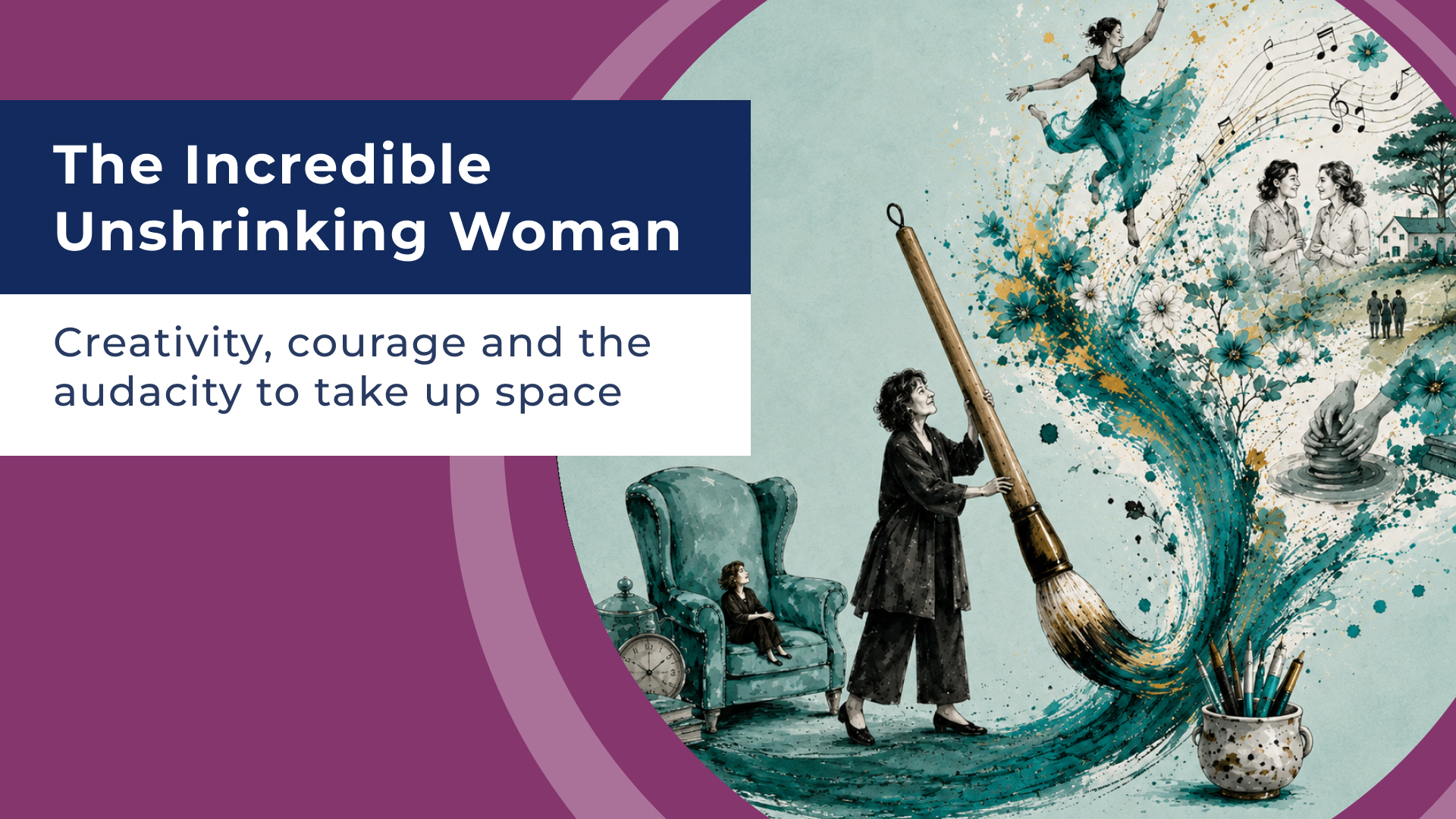

What might you make if being good at it were entirely beside the point?
Those of us of a certain age have had the rather wonderful experience of growing older alongside Lily Tomlin. I have been a fan for as long as I can remember. She has been funny, strange, subversive, occasionally outrageous and gloriously difficult to categorise for more than half a century. I remember her from television and films long before Grace and Frankie introduced her to another generation, but recently I found myself thinking about one particular role from much earlier in her career.
In 1981, Tomlin starred in The Incredible Shrinking Woman. The premise was wonderfully absurd. An ordinary suburban woman, exposed to a peculiar combination of household chemicals, begins to shrink. The domestic world around her stays exactly the same while she becomes progressively smaller within it. Kitchen counters become inaccessible. Furniture becomes enormous. The ordinary objects of everyday life begin to dwarf her.
More than forty years later, there is something almost too perfect about the metaphor. Lily Tomlin herself appears to have done precisely the opposite. She has aged, certainly. She has also continued creating, performing, collaborating, speaking, making people laugh and occupying cultural space. Alongside Jane Fonda in Grace and Frankie, she spent seven seasons playing an older woman who was not politely disappearing from life but continuing to discover how much more of it there might be.
Most women do not wake one morning to discover that the kitchen bench has become impossibly high. Our shrinking is usually less cinematic. We shrink from things we once enjoyed because we no longer think we are good enough at them. We become more reluctant to look ridiculous. We stop singing because somebody once told us we couldn’t sing, stop drawing because we aren’t artists, stop dancing because our bodies have changed, stop writing because we don’t know whether anyone would want to read it. Curiosity begins requiring a business case. Hobbies acquire objectives. Time becomes something we are expected to use productively.
We can become extraordinarily competent at living and strangely reluctant to be beginners at it. Creativity requires almost the opposite. It asks us to make things nobody requested, waste materials, spend time with no measurable return on investment and tolerate uncertainty, experimentation, mess and the possibility that after several hours of earnest effort we may have produced an absolutely hideous ceramic bowl. I know something about this.
Be shit at something
Some years ago, I took a pottery class. I would like to tell you that I discovered an intuitive relationship with clay, but the clay and I appear to have had different expectations of the relationship. There is a thing potters do called centring. It turns out to be rather important. The teacher explained how to do it. I apparently decided that listening carefully was optional, and before long there was clay where clay had not been intended to go. My ambitions became progressively more modest. I began, I think, intending to make a mug. As I attempted to correct one problem after another, the clay mug became smaller and smaller until eventually I had produced something closer to a sake cup, albeit one unlikely to trouble the Japanese ceramics industry.
At the end of the class we gathered for morning tea and used some of the things we had created. I poured a hot drink into my little mug and, shortly afterwards, there was water on the table. Our teacher, in the wonderfully encouraging manner of teachers everywhere, suggested that I was being too hard on myself. It was probably condensation. I wiped the table. More water appeared. I wiped it again. Eventually, after approximately the fifth wiping, teacher, classmates and aspiring potter were forced into a rare moment of unanimous artistic criticism. The mug was shit. I still have it. It sits beside my desk holding pens and highlighters, having inadvertently discovered a second career for which watertightness is considerably less important. I don’t keep it because I have retrospectively decided it is beautiful. I keep it because it reminds me that something does not have to be good to have been worth making.
It is a surprisingly difficult proposition for competent adults. Children seem to understand it instinctively. They draw before deciding whether they are artists, dance before wondering whether they have rhythm, and invent songs nobody requested and stories with significant structural problems. A cardboard box can become a castle without first undergoing feasibility analysis. Creation and evaluation have not yet become inseparable. Many of us learn to ask a different set of questions. Am I any good? What’s this for? Will anybody want it? Is this a sensible use of my time? The difficulty isn’t that we’ve lost our creativity. We’ve just become good at evaluating it before it has had a chance to exist.
Dance while somebody is watching
Not long after Covid, I took up belly dancing. This was not the culmination of a lifelong ambition. By that stage I had spent enough time inside an apartment that I was willing to consider almost any activity involving other human beings and an external door. Even so, walking into that first class took considerably more courage than I expected.
I have always loved dancing, but loving to dance and being willing to belly dance in a room full of other women turned out to be different propositions. There is nowhere particularly convincing to hide your body in belly dancing. The whole point is to move it. Hips, stomach, shoulders, arms; including muscles I was apparently meeting for the first time. Then there were scarves, music and those wonderful belts covered in coins that announced every movement whether I had intended to make it or not. It was fabulous. I didn’t suddenly find my calling as a belly dancer, but if I was willing to feel awkward long enough, I discovered how alive it made me feel.
There is a familiar piece of advice about living freely: dance like nobody’s watching. I’ve always liked the sentiment. Stop worrying about judgement. Let yourself go. Sing. Dance. Love. Live. But belly dancing made me wonder: why does nobody have to be watching? Why is our cultural fantasy of uninhibited expression so often dependent upon the removal of the audience?
Creative freedom cannot only be what becomes possible when judgement disappears. There may be another kind of freedom in knowing perfectly well that somebody might be watching and moving anyway: taking the class when everyone else appears to know what they’re doing, singing when somebody can hear you, writing the poem, making the dreadful pot. Aliveness does not always wait until we feel confident enough to receive it. Sometimes it arrives first. It is where creative courage begins.
Creative pursuits so often bring us into relationship with other people. We join classes, choirs, writing groups, theatre companies, dance schools, community gardens and workshops. Ostensibly, we are there to learn something, but often something else happens as well. We become slightly different people in one another’s company. It may be part of what made Grace and Frankie so delightful. Decades after playing the incredible shrinking woman, Lily Tomlin appeared alongside Jane Fonda as one half of one of television’s more improbable later-life friendships. Frankie is expressive, eccentric, instinctive and spiritually inclined; Grace controlled, polished, pragmatic and considerably less interested in communing with the universe. They irritate, misunderstand and judge each other, but they also rescue, challenge and enlarge one another. Neither expands because she becomes more like the other. In many ways, each woman’s world becomes larger because the other is in it.
Belonging is not always about finding people who confirm who we already are. Sometimes another person expands the range of who we are able to become. They introduce us to music we would never have chosen, food we would never order, places we would never visit, ideas we initially dislike and activities we would never attempt alone. A pottery class or dance class can do something similar. The identities that organise the rest of our lives temporarily matter less. Nobody particularly cares about your job title when everyone is trying to make one hip go up while the other apparently has plans of its own. Expertise elsewhere offers remarkably little assistance when a lump of clay has attached itself to your sleeve. Maybe this is another form of creative aliveness: not simply expressing who we already are, but allowing participation to introduce us to who else we might be.
Creative courage
Creative courage is not only about risking being bad at something or being seen while we are learning. Sometimes it is having the courage to do something for no particularly defensible reason at all. Adults can be strangely suspicious of activities without a purpose. Children will spend an afternoon constructing something elaborate from sticks and string without explaining the strategic objective. Adults are more inclined to ask what something is for. Will I become fitter? Could I sell these? Is there a qualification? Will this help my career? Could it become a side hustle? Even leisure can acquire performance indicators: we track the kilometres, count the books, photograph the meal, improve the technique and enter the event. A hobby becomes another opportunity for achievement.
There is nothing wrong with becoming good at something. Mastery can be deeply satisfying. The problem comes when usefulness becomes the admission price for curiosity. What if I want to learn a language because I like the sound of it, plant ridiculous flowers, draw faces badly, make an enormous cake nobody needs or take a dance class because moving my body to music makes something in me light up? What is it for? Because I wanted to may be one of the most underrated answers available to an adult.
There is something almost radical in spending time, attention or money on an activity whose primary output is aliveness. We know something of the feeling when it happens. Time changes. Attention gathers. The incessant commentary about ourselves can become quieter because we are absorbed in something beyond it. Our hands are busy, our bodies are moving, and we become curious about what happens next. Psychologists have described one version of this as flow, but I am interested in something broader than optimal performance or wellbeing. I am interested in the experience of being vividly here. Creativity may be one of the ways we practise that. Not creativity as artistic talent, but creativity as participation: making, moving, arranging, experimenting, combining, imagining and expressing. Bringing something into the world that was not there before simply because we participated in making it.
Making something for ourselves is one thing. Allowing somebody else to see it is quite another. Eventually, the audience comes back. Looking back, I can see that my experiments with creativity have asked progressively more uncomfortable things of me. Pottery required me to tolerate the possibility that I might be bad at this. Belly dancing added another layer: you might see me being bad at this. But some things we create carry more of us in them. A story, painting, song or piece of writing asks something more vulnerable again: you might see something of me in this, and not like it.
This is what creative courage actually asks us to practise. Not confidence, and certainly not the absence of self-consciousness, but a willingness to remain present as the possibility of judgement increases. How much aliveness remains unavailable to us because accessing it requires us first to risk awkwardness? How many things never get attempted because we mistake the discomfort of being a beginner for evidence that we shouldn’t begin?
For more than a decade, I sat on a manuscript of poetry. I had written it; that wasn’t the problem. The work existed. But there is an enormous difference between creating something in private and releasing it into a world where other people are free to make of it what they will. Perhaps one of the saddest forms of shrinking isn’t that we stop creating. It’s that we create and then hide the evidence. Not everything needs to be shared, of course. Privacy can be part of creativity’s beauty. A journal does not fail because nobody publishes it, and a painting made for one wall does not require an exhibition. But sometimes this is mine and I’m not ready quietly become not yet. And not yet possesses a remarkable capacity to become ten years.
Eventually releasing those poems required something different from the courage to write them. I had to relinquish control over what happened after they left me. Somebody might be moved by them, recognise themselves in them, or misunderstand them. And, inconveniently given the argument I made in I Don’t Like This, they are allowed to think they are dreadful. If I don’t like this is an experience I am allowed to have, I can hardly deny it to everybody else. Creative expression does not entitle us to approval. Allowing our work to enter the world means allowing other people to have an experience of it that we cannot manage.
This is why creative work can feel so vulnerable. We know intellectually that the thing I made is not identical to me, but expression carries traces of its maker. Criticism can therefore land alarmingly close to identity, and we begin protecting ourselves by protecting the work from exposure. The work stays in the drawer, and sometimes a little of us stays there with it.
Shrinking.
Taking up space is often imagined as becoming louder, larger or more conspicuous. I am beginning to wonder whether it can be much quieter than that. It can mean allowing our curiosity to occupy an afternoon without requiring it to become productive, allowing our bodies onto the dance floor before they have mastered the steps, or allowing something we have made to exist without demanding that it be excellent. Perhaps taking up space means no longer requiring our participation to be justified by our proficiency.
Nor does taking up space require somebody else to occupy less. This may be another thing Grace and Frankie have been showing us. They take up space very differently, but together they also create it. We tend to think of creativity as making things: a painting, a poem, a pot, a piece of music. But these are not the only things human beings create. We create friendships, conversations, communities, rituals, homes and possibilities that did not exist before we participated in them. Grace and Frankie do not simply occupy space differently; together they create a space that neither could have made alone.
And here lies the more interesting possibility of unshrinking. Once we stop editing ourselves out, we do not merely take more for ourselves. We have more of ourselves available to contribute. We might make a pot or write a poem, but we might equally make a friendship, an invitation, a garden, a gathering or a possibility. A shit mug isn’t the only thing we create when we stop shrinking.
You haven’t missed the enrolment date
There is another peculiar story we tell about creativity: that it belongs disproportionately to the young. Youth gets discovery, experimentation, reinvention, questionable haircuts and starting again. Later life gets expertise, responsibility and the expectation that by now we should have worked out what we’re doing. What an extraordinary waste of material. By fifty or sixty, a woman may have accumulated decades of friendships, work, desire, mistakes, bodies, children or decisions not to have them, parents, deaths, marriages, divorces, migrations, disappointments, triumphs, places, secrets, expertise and contradictions. She has an absolute warehouse of material, and now she’s worried she’s too old to start painting? You’ve spent fifty years accumulating material and now you’re worried you missed the enrolment date?
Later-life creativity may have possibilities that earlier creativity simply cannot. Not because older automatically means wiser, but because there is more to work with: more lived texture, more references, more things that have fallen apart and been reconstructed, more experiences whose meaning has changed with time and, with luck, a gradually declining willingness to organise one’s entire existence around whether everybody approves. Ageing’s creative invitation may not be to remain young or prove that we are still relevant. It may be to use what life has given us.
Which brings me back to Lily Tomlin. The woman who once played a character literally disappearing inside her own domestic world did not herself disappear. She kept creating, collaborating and performing. She did not grow backwards into the woman she had been; she continued becoming a woman she had not yet been. It is what I like about the idea of the incredible unshrinking woman. Unshrinking isn’t returning to some supposedly freer, more creative younger self. It is continuing to participate in our own becoming: trying, making, moving, having preferences, producing things nobody requested, becoming beginners and allowing what we create to leave our hands. Creative courage may be something subtler than fearlessness. We make ourselves available to life despite the possibility of being awkward, imperfect or disliked.
As I write this, beside me sits a tiny ceramic object that failed rather decisively at being a mug. It holds my pens and highlighters now. I rather love that it inadvertently found another purpose, but that isn’t why it matters. It matters because I made it. It is imperfect, slightly ridiculous, indisputable evidence that for a few hours I stopped needing to know whether I was good at something and put my hands in the clay.
The evidence of our creativity is not always an object. It may be the poems we finally release, the friendships that changed us, the spaces we helped create, the gardens we planted, the rooms in which somebody became more fully themselves because we were there. Once we stop shrinking, we have more of ourselves available to life, and more of ourselves available to one another.
Creativity may be one of the ways we leave evidence that we were here. Not merely alive, but participating. And after all this talk of audiences, a little audience participation is in order.
Go make something. 😉
Dr Jordan Marijana Alexander is a writer, executive advisor and human systems strategist exploring how identity, place, culture and living systems shape participation in the modern world. She works alongside leaders, boards and organisations navigating complex questions of leadership, change and participation, and is the co-founder of RelateAble.Global. If this article has raised questions, sparked reflection or highlighted a decision you’re carrying, you’re invited to book a confidential conversation. You can follow DrJMA on LinkedIn and Engenesis for ongoing essays, reflections and research exploring leadership, identity, belonging and participation.