

The Beast That Regenerated
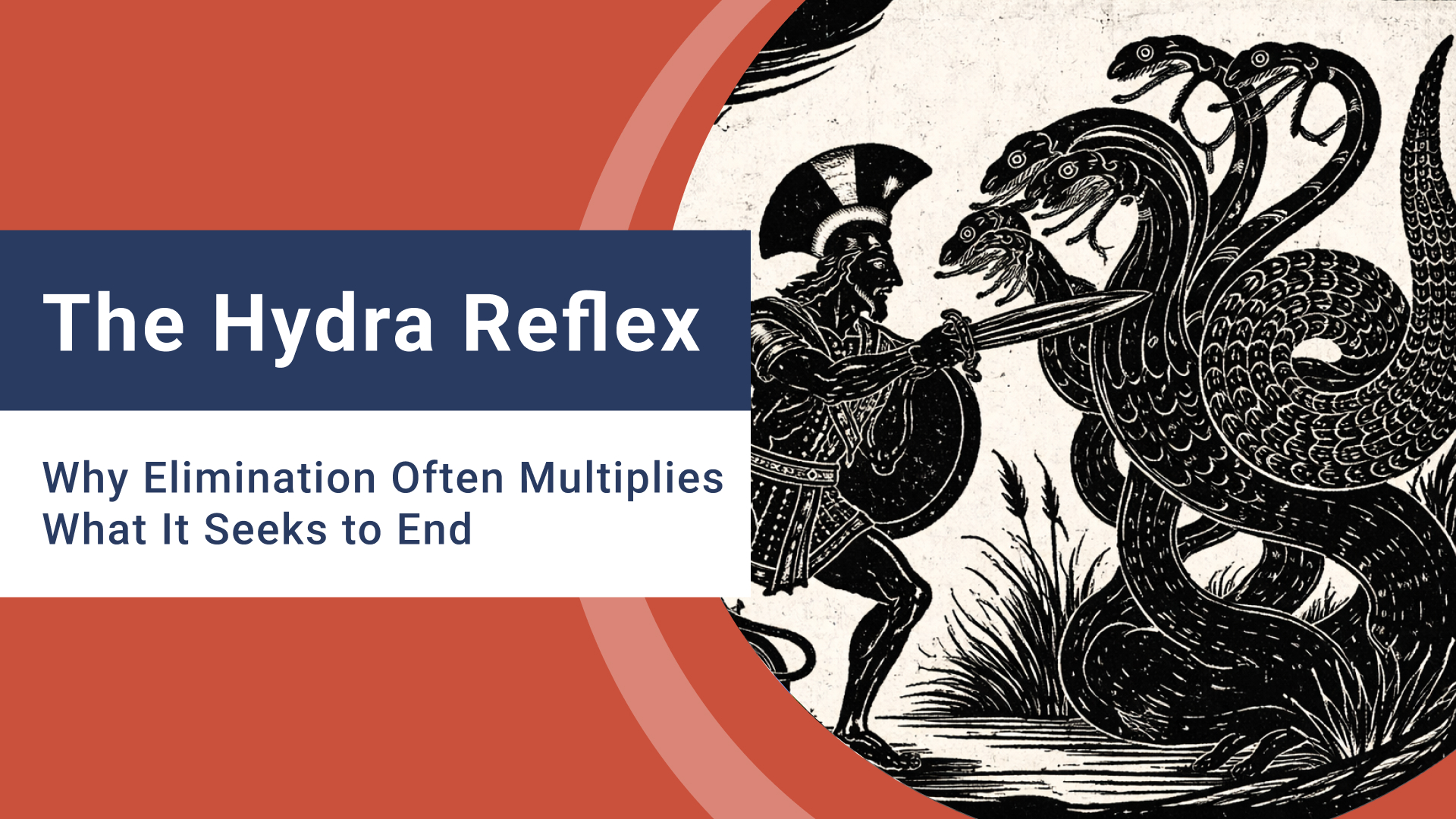
In the marshes of Lerna there lived a creature that could not be defeated in the ordinary way. The Lernaean Hydra was a serpent with many heads. When one head was cut off, two or three would grow back in its place. The more fiercely it was attacked, the more formidable it became. Strength produced multiplication. Precision-produced escalation.
When Heracles confronted the Hydra, he did what heroes are expected to do. He struck decisively. He severed a head. The result was not victory but proliferation. Each swing of the sword intensified the threat. The battlefield did not shrink. It expanded.
There was another detail in the myth that is often overlooked. One of the Hydra’s heads was immortal. It could not be destroyed by force. Even if separated from the body, it retained its potency. And the creature did not live on bare rock but in a swamp. It was sustained by its ecology. The environment nourished its regeneration.
Heracles only prevailed when he changed his method. After each head was severed, the wound was cauterised with fire so that it could not regenerate. The battle shifted from cutting to sealing. From reaction to transformation. The problem was not only the visible heads. It was the regenerative capacity beneath them.
The myth is not merely a tale of a monster. It is a study in how some threats behave. They do not diminish under pressure. They multiply.
The Pattern of Regenerative Conflict
The Hydra is not unique to mythology. It represents a recurring structural pattern. Some problems do not dissolve when confronted directly. They disperse. They fragment. They reorganise. What appears as removal becomes redistribution.
When a visible figure is eliminated, the assumption is that the force behind it will weaken. Yet often the opposite occurs. The removal creates a vacuum that draws energy toward it. Followers consolidate. Narratives sharpen. Identity hardens. What was once attached to a person becomes attached to a cause. The head is gone, but the body reorganises around memory, grievance and loyalty.
Elimination can convert influence into symbolism. A leader becomes a martyr. A movement becomes sacred. A local grievance becomes generational inheritance. Instead of dissolving, it deepens its roots. Instead of centralised power, there emerges distributed conviction. What was once concentrated becomes cellular.
This pattern is not limited to politics. Organisations remove a disruptive individual only to find similar behaviours emerging elsewhere. Families silence a conflict only to see it resurface through another member. Institutions ban an idea only to watch it migrate underground where it gains intensity rather than moderation. Suppression compresses energy. Compressed energy seeks release.
The Hydra effect operates through reaction. When force meets identity, identity fuses with resistance. When resistance fuses with identity, it becomes self reinforcing. The strike that was meant to end the threat becomes the proof that the threat was justified. The blade validates the narrative.
What regenerates is rarely identical to what was cut. It evolves. It adapts. It multiplies in new forms. The visible head was only the surface expression of something structural. Remove the expression and the structure remains intact, ready to produce another.
The lesson embedded in the myth is subtle. It is not that action is futile. It is that action directed at the surface of a regenerative system strengthens it. The problem is not always the head. It is the ecosystem that makes regeneration possible.
The Human Reflex Toward Decapitation
Why do we keep striking at the heads? Because the human mind prefers clarity over complexity. A visible figure is easier to confront than an invisible structure. A person can be blamed, removed, condemned. A system requires examination. Examination requires humility.
We are drawn to solutions that feel decisive. Cutting is faster than integrating. Removing is cleaner than transforming. Declaring victory is more satisfying than expanding capacity. The psyche seeks resolution, not tension. When faced with contradiction, we experience discomfort. When discomfort rises, we look for an object to eliminate.
There is also something reassuring about locating the problem in a single figure. It restores moral simplicity. If this person is gone, order returns. If this voice is silenced, harmony resumes. If this leader is removed, peace will follow. The narrative becomes linear. Cause and effect appear manageable.
But many realities are not linear. They are polar. They are tensions between forces that coexist within the same ecosystem. When we interpret polarity as pathology, we attempt to delete one side. When we delete one side, the tension does not vanish. It intensifies. What was marginal becomes central. What was reactive becomes ideological.
At a psychological level, this is also how we treat our own internal contradictions. We try to suppress impulses we dislike. We exile parts of ourselves that do not fit our self image. We attempt to amputate aspects of identity rather than integrate them. Yet repression does not dissolve energy. It stores it. Stored energy reappears under pressure.
The reflex to decapitate is therefore not merely strategic. It is existential. It reflects our limited capacity to host ambiguity. We equate strength with control and control with removal. We struggle to conceive that maturity might mean holding tension without immediate closure.
The Hydra endures because we prefer the sword to the fire. Cutting satisfies urgency. Cauterising demands patience. And patience requires the expansion of capacity rather than the assertion of force.
When Systems Attack What They Cannot Integrate
The pattern scales from the individual to the collective. When systems encounter forces they cannot absorb, they often attempt removal rather than transformation. The visible head becomes the target. The deeper ecology remains untouched.
In political arenas, eliminating a figure is frequently mistaken for resolving a movement. Yet movements are rarely born from a single personality. They emerge from accumulated grievances, perceived humiliations, unresolved contradictions and identity bonds. Remove the figure and those currents do not disappear. They reorganise around memory and narrative. The story becomes sharper. The lineage becomes clearer. The next generation inherits not only belief but grievance fused with legacy.
In organisations, leaders sometimes dismiss a disruptive employee, believing that culture will stabilise. Yet if the culture itself produces competition without trust or pressure without coherence, the behaviour reappears in another form. The issue was never confined to one individual. It was structural. The swamp regenerates new heads.
Families mirror the same logic. Silence one member who names an uncomfortable truth and harmony may briefly return. Over time the unresolved tension surfaces through another sibling, another conflict, another fracture. Suppression produces symptoms elsewhere in the system.
Across societies, ideas that are banned rarely dissolve. They migrate. In migration, they can harden. In hardening, they can radicalise. The effort to eliminate difference can transform difference into defiance. What might have been moderated through dialogue becomes intensified through exclusion.
The multiplication effect is not mystical. It is systemic. When pressure is applied without integration, energy redistributes. When identity is attacked without addressing underlying causes, identity fuses with resistance. What was once flexible becomes rigid. What was once local becomes generational.
Systems that lack the capacity to host contradiction attempt to restore coherence through subtraction. Yet subtraction in regenerative ecosystems often produces proliferation. The head falls. The structure produces successors. And each successor carries not only the original impulse but the memory of attempted elimination.
The Era of Accelerated Elimination
In earlier times, decapitation was literal. Today it is often symbolic. The blade has been replaced by narrative, sanction, isolation, deplatforming, reputational destruction and administrative exclusion. The method has changed. The reflex has not.
We live in an age that moves quickly and tolerates ambiguity poorly. Digital ecosystems amplify outrage and compress response time. When something appears threatening or offensive, the demand for immediate removal escalates. The slower work of understanding structure feels inadequate compared to the speed of elimination.
In this environment, identity fuses rapidly with narrative. A figure becomes a symbol within hours. A symbol becomes a cause. A cause becomes a banner under which others gather. When removal occurs, it is broadcast, archived and replayed. What might once have faded into obscurity now becomes immortalised in digital memory. The head that falls does not disappear. It circulates.
Elimination in this era does not only affect individuals. It shapes entire communities. Families of the removed, associates, sympathisers and even distant observers can inherit a sense of injustice. Generational transmission becomes easier in a networked world. Stories travel. Grievances synchronise. What began as a contained conflict can expand beyond geography.
At the same time, institutions face internal contradictions that they struggle to integrate. Cultural shifts, demographic changes, economic disparities and ideological polarities generate tension. When that tension is channelled toward a visible antagonist, the complexity of the system is simplified. The removal appears decisive. Yet the conditions that produced the figure remain intact.
The Hydra reflex accelerates in such an era because speed replaces reflection. The desire to restore order overrides the patience required to transform ecology. Elimination feels like action. Capacity building feels slow. In a culture addicted to immediacy, the sword is always closer to hand than the fire.
The Swamp Beneath the Heads
The myth makes one detail unmistakable. The Hydra did not float in abstraction. It lived in a swamp. The swamp sustained it. The regenerative power was ecological before it was anatomical.
This is the deeper twist. The visible head is rarely the origin of the force it represents. It is an expression of underlying conditions. Humiliation, exclusion, unresolved identity conflicts, structural imbalances, perceived injustice, unintegrated modernisation, cultural displacement, rapid change without shared meaning. These are swamps. They nourish regeneration.
When a head is removed but the swamp remains, the system has not changed. The conditions that produced one figure are capable of producing another. Sometimes the successor is more disciplined. Sometimes more radical. Sometimes more fragmented and therefore harder to contain. The ecology continues its work.
Even more subtly, the act of striking can enrich the swamp. Force applied from outside can validate internal narratives. External pressure can confirm internal stories of persecution. What was once debate becomes destiny. What was once disagreement becomes identity. Regeneration accelerates because the environment has been fertilised.
The immortal head in the myth symbolises something similar. Certain forces cannot be destroyed because they are not merely personal. They are archetypal. They represent polarities embedded in human existence, such as autonomy and control, tradition and change, belonging and sovereignty, faith and rationality. Attempting to eliminate one side of a polarity does not erase it. It intensifies its expression elsewhere.
The real question, therefore, shifts. Not how many heads can be cut, but what kind of swamp are we cultivating. If the ecology remains reactive, fragmented and unable to host tension, regeneration is inevitable. If the ecology transforms, the need for new heads diminishes.
The Hydra was never only a monster. It was a mirror held up to systems that confuse surface removal with structural change.
Capacity Instead of Elimination
The alternative to the Hydra reflex is not passivity. It is maturation. It requires a shift from attacking expressions to transforming conditions. From forcing resolution to expanding the capacity to host tension.
High-capacity systems do not rush to delete what disturbs them. They examine what the disturbance reveals. They distinguish between a destructive act and the underlying polarity that produced it. They recognise that contradiction is not always corruption. It can be a signal of structural imbalance that requires integration rather than eradication.
Hosting polarity does not mean moral equivalence. It does not mean tolerating harm. It means recognising that sustainable stability cannot be built on subtraction alone. If grievances, identity fractures and structural contradictions are left unexamined, removing a figure only postpones the next eruption.
Capacity operates at several levels. Psychologically, it is the ability to endure ambiguity without immediate closure. Organisationally, it is the willingness to reform culture rather than replace personnel. Civilisationally, it is the courage to confront underlying tensions rather than externalise them into enemies. Capacity is slower than reaction but more durable than suppression.
The fire in the myth symbolises transformation. It seals the wound so that regeneration ceases. In human systems, the equivalent is structural change, dialogue that metabolises grievance, reforms that address imbalance and a willingness to confront uncomfortable realities without simplifying them into single villains.
Some threats are indeed dangerous. Some actions require firm response. Yet when elimination becomes the primary instinct, regeneration becomes the predictable outcome. Heads multiply because the ecosystem remains unchanged. Figures fall because systems cannot host contradiction.
In every era, societies face forces they do not like. The reflex is to remove them. The harder path is to ask what conditions produced them and whether those conditions are being transformed or merely provoked. The difference between repetition and renewal lies there.
Some dragons multiply when attacked. Not because they are invincible, but because we have mistaken decapitation for resolution and urgency for capacity.
Proactivity or the Hydra Reflex
At the heart of the Hydra reflex lies not only strategy, but a way of being. When systems repeatedly react to visible heads instead of transforming the swamp, what is revealed is not merely geopolitical miscalculation. It is an unhealthy relationship with Proactivity.
Let us examine the ontological distinction of Proactivity within the Being Framework:
Proactivity is the quality of actively influencing, creating and contributing to a situation rather than reacting to it after it has happened. Being proactive moves you to think, plan and act in advance of an impending situation, making decisions and taking appropriate actions beforehand rather than procrastinating or waiting for the outcome. When you are being proactive, you make things happen and take the initiative to bring about a different future for yourself, your team or the organisation as a whole. Proactive individuals are willing to challenge, make suggestions and try new ways of doing things to bring about relevant change.
A healthy relationship with proactivity indicates that you tend to take the initiative to move things forward and bring about change. You are solution-oriented and actively seek opportunities to advance in any situation. Others may experience you as someone who is considered, frequently contributes, asks questions, takes action and will step up without hesitation. You may often anticipate what is needed in advance, respond rather than react to matters, and are prepared and willing to do what is required.
An unhealthy relationship with proactivity indicates that you may be unreasonably inactive or reactive. You may rely on waiting to be told what to do and procrastinate until you have everything at hand. You may only take prescribed actions and rarely plan effectively. You may often be indecisive and inactive, ignoring what you know needs to be done, leaving yourself exposed to potential breakdowns. Alternatively, you may only address matters when there is a breakdown and then react to the subsequent undesirable outcome. You may frequently be on the back foot, avoid change and defer making decisions. Others may express frustration at your apparent disinterest, lack of engagement, inaction, reactivity or your need to be fully convinced before you move forward.
Reference: Tashvir, A. (2021). BEING (p. 488). Engenesis Publications.
Both inactivity and reactivity feed the Hydra. Inactivity allows the swamp to deepen. Reactivity strikes at the heads once they emerge. Neither transforms the ecology.
Proactivity, properly understood, is not premature aggression. It is disciplined foresight. It is the willingness to expand capacity before conflict becomes generational. It is the courage to host polarity early so that elimination does not become the default instinct later.
Where proactivity is absent, elimination feels decisive. Where proactivity is present, transformation becomes possible.
The Hydra reflex is reactive. Capacity is proactive.
When the Head Falls and the Crowd Celebrates
There are moments in history when a single figure becomes the embodiment of collective frustration. Years of anger, humiliation and moral outrage concentrate around one person. The image hardens. The narrative simplifies. Remove this head and everything will change.
When such a figure falls, celebrations erupt. Fireworks. Slogans. A sense of historical release. It feels like the end of an era. It feels like justice. It feels like oxygen after suffocation.
But ecosystems do not reorganise according to emotion.
When a highly centralised authority collapses abruptly, two forces are set in motion. The first is fragmentation. Power does not disappear. It disperses. Rival actors move quickly. Some are domestic. Some are foreign. Some carry ideological fervour without institutional restraint. Some carry ambition without legitimacy. The vacuum invites competition.
The second force is external recalibration. Outside powers that once defined the fallen figure as the primary threat must now confront a more complex terrain. The singular antagonist has dissolved into multiple actors. Some are less predictable. Some are less constrained. Some have fewer incentives to negotiate. What was once a single head becomes a field of moving targets.
There is also a strategic misreading that sometimes occurs beyond the borders of the fallen regime. External powers may believe that removing a central adversary weakens the entire field. They calculate in terms of hierarchy and command. Yet when a system is tightly centralised, the removal of its apex can dissolve chains of control and unleash actors who were previously contained. What once operated under a predictable command structure fragments into semi-autonomous networks. Militias, hardline factions, regional proxies and opportunistic groups move independently. For outside players who anticipated simplification, the terrain becomes more volatile, less negotiable and harder to influence. The adversary they prepared for disappears, and in its place emerges a landscape of actors with fewer constraints and fewer incentives for restraint.
There is another irony. Figures who are publicly branded as the ultimate source of instability can, within their own systems, function as regulators of more extreme currents. Authority that appears oppressive from one vantage point can simultaneously restrain forces that would produce even greater volatility if unleashed. Remove the restraining structure and suppressed factions emerge with intensity.
Those who celebrated may discover that the creature was not a single head but a balancing point within a tense ecosystem. The removal does not erase the swamp. It stirs it.
History contains many examples of regimes that fell only to be followed by civil war, foreign intervention, sectarian fragmentation or militant escalation. The expectation of immediate liberation collided with the reality of structural vacuum. The Hydra does not always return in identical form. Sometimes it returns as many smaller serpents moving in different directions.
This is not a defence of tyranny. It is a warning about naivety. When relief is driven by emotion rather than structural analysis, the celebration can precede a more complex instability.
The question is not whether a figure was flawed or harmful. The question is whether the conditions beneath that figure have been transformed or merely exposed. If the swamp remains reactive, polarised and externally entangled, the fall of one head can signal the beginning of multiplication rather than resolution.
Some crowds celebrate the strike. Some distant capitals applaud the removal. But ecosystems do not respond to applause. They respond to structure.
Conclusion – What We Do With What We Do Not Like
Every era confronts figures, movements or ideas that disturb its sense of order. The instinct is familiar. Remove them. Silence them. Isolate them. Strike decisively and restore coherence. It feels strong. It feels clean. It feels final.
Yet the Hydra warns that some disturbances are not anomalies. They are symptoms. When we confront only the symptom, we energise the source. When we eliminate without transforming, we fertilise the swamp. When we suppress polarity rather than integrate it, we radicalise it.
The deeper challenge of our time is not merely external conflict. It is our limited tolerance for contradiction. We prefer convergence over complexity. We prefer uniformity over tension. We prefer decisive gestures over structural reform. But ecosystems do not respond to preference. They respond to conditions.
If we want fewer heads, we must cultivate different swamps. If we want stability that endures, we must build capacity that can host what is uncomfortable without immediately externalising it. This requires psychological maturity, institutional integrity and civilisational patience. It requires the courage to expand rather than amputate.
The Hydra is not a relic of myth. It is a pattern that appears wherever force is used as a substitute for transformation. The question is not whether we can cut effectively. It is whether we can cauterise wisely.
What we do with what we do not like will determine whether we multiply conflict or metabolise it. Some dragons fall by the sword. Others grow stronger because of it. The difference lies not in the sharpness of the blade, but in the depth of our capacity.