
The Age of Entitlement and Overwhelm
We live in a strange age. Almost everyone seems overwhelmed. People are overwhelmed by work, money, parenting, relationships, information, uncertainty, expectations, the speed of change, the pressure to perform, and even the pressure not to be pressured. Overwhelm has become one of the dominant moods of modern life. It has become so common that it almost functions like a social password. Say “I am overwhelmed” and most people immediately understand. They may not know what you are facing, but they recognise the condition.
And to be fair, much of this overwhelm is real. Modern life is not simple. It is not gentle on the human nervous system. We are exposed to more information than we can digest, more choices than we can properly evaluate, more opinions than we can metabolise, and more complexity than most people have been prepared to carry. Many people are tired, anxious, overstimulated, fragmented, and increasingly fragile in the face of ordinary pressure. It would be lazy and unkind to dismiss all of this as weakness.
But there is another side to this story, and it is less fashionable to discuss.
At the same time that people are more overwhelmed, many are also becoming more entitled. They are increasingly fluent in the language of rights, fairness, safety, inclusion, flexibility, care, boundaries, leave, support, wellbeing, and protection. Yet many have not developed the corresponding language of responsibility, burden, reciprocity, sacrifice, consequence, contribution, endurance, custodianship, and care for the systems that make those rights possible.
This is where the contradiction begins to bite.
A person may be entitled to support, but someone must provide that support. A person may be entitled to wages, but someone must carry the commercial risk that makes wages possible. A person may be entitled to leave, but someone must absorb the operational consequence of their absence. A person may be entitled to flexibility, but someone must hold the structure that prevents flexibility from becoming chaos. A person may be entitled to be cared for, but someone must develop the emotional, financial, physical, and existential capacity to care.
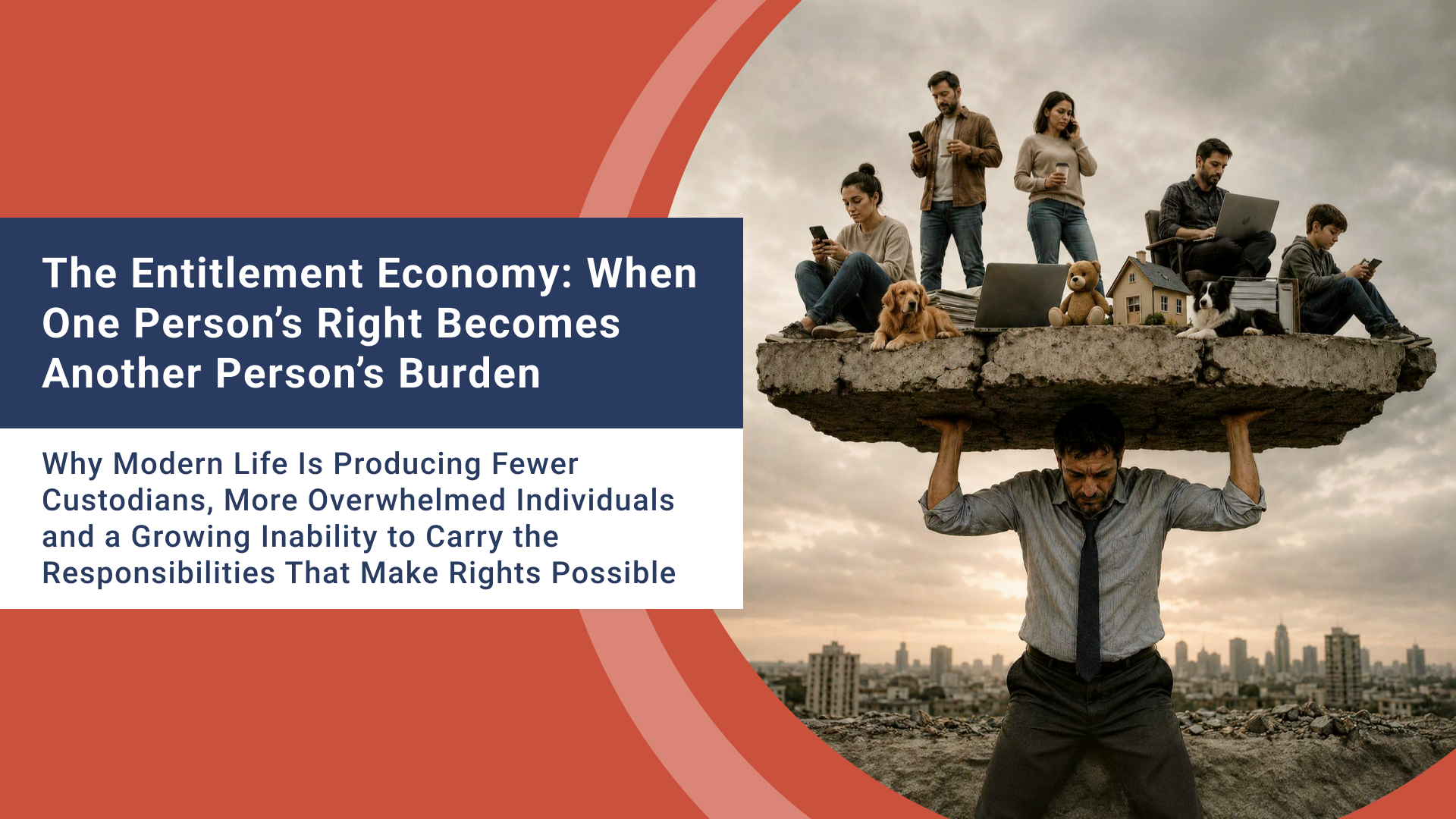
Rights do not float in the air. They land somewhere.
They land on a founder who has not slept properly. They land on a parent who has already exceeded their own limit. They land on the reliable employee who quietly cleans up what others neglect. They land on the emotionally regulated spouse who is expected to absorb everyone else’s volatility. They land on the taxpayer, the manager, the carer, the responsible sibling, the serious friend, the person in the team who notices what no one else notices, and the minority of people who somehow become the load-bearing walls of families, businesses, communities, and societies.
The problem is not that people have rights. A civilised society must protect people from exploitation, abandonment, abuse, unnecessary suffering, and the crude arrogance of unchecked power. The problem begins when rights are experienced as weightless, as if they have no cost, no carrier, no consequence, and no relationship to the living system that must sustain them.
That is where entitlement enters.
Entitlement is not simply wanting what one is owed. That would be too shallow. A worker wanting to be paid properly is not entitlement. A mother needing support is not entitlement. A sick person needing care is not entitlement. A vulnerable person needing protection is not entitlement. These are legitimate human concerns, and any serious society must know how to respond to them with dignity.
Entitlement begins when a person remembers their claim but forgets the burden of that claim. It begins when someone says, “I am entitled to this,” while refusing, ignoring, or being unable to see the person, family, organisation, economy, community, or system that must carry it.
And this is why entitlement is not merely a social attitude. It is not only bad manners dressed in moral language. It is a deeper breakdown in awareness. It is a failure to see relationship, a failure to see consequence, and a failure to see the human being on the other side of one’s expectation.
In this sense, entitlement is one of the great symptoms of our time. It sits quietly beneath marriages, workplaces, families, governments, welfare systems, corporations, teams, and economies. It appears wherever people become more fluent in claim than contribution, more alert to inconvenience than responsibility, and more sensitive to pressure than to the burden they place on others.
The tragic irony is that the more overwhelmed people become, the more likely they are to demand that someone else carry what they cannot carry. And the more this happens, the more pressure is placed on the minority who are still willing, or still able, to carry responsibility without immediately collapsing, outsourcing, accusing, or disappearing.
Eventually, the responsible become exhausted, the fragile become more protected, the systems become more expensive to maintain, and everyone wonders why things are breaking down.
But perhaps things are not breaking down because people do not have enough rights. Perhaps they are breaking down because we have forgotten that every right requires a corresponding capacity somewhere in the system.
The Original Intention Was Not Wrong
It is important to begin fairly. The problem is not that we created rights, protections, welfare systems, employment standards, leave entitlements, maternity support, workplace safeguards, or legal mechanisms to protect people from exploitation. Much of this was necessary. Civilisation did not develop these structures because human beings were naturally fair, power was naturally gentle, or the strong were always careful with the weak.
Power can oppress. Employers can exploit. Families can suffocate. Governments can neglect. Corporations can consume people as disposable instruments. Communities can shame those who fall behind. Markets can reward ruthlessness and call it efficiency. Without laws, policies, norms, and protections, many people would be left exposed to the cold machinery of appetite, advantage, and indifference.
So this article is not an argument against rights. It is not a nostalgic fantasy about a harsher world where everyone was supposedly tougher, more grateful, and more responsible. Many people in the past were not more virtuous. They were simply more trapped. Some endured silently because they had no language, power, protection, or pathway to object.
The development of rights and protections was, in many ways, a moral achievement. It recognised that human beings should not be reduced to labour units, reproductive bodies, obedient children, replaceable employees, silent spouses, or disposable citizens. It recognised that fairness cannot be left entirely to the goodwill of those who hold power.
But every moral achievement can decay when it loses its relationship to reality.
A protection can become an entitlement. A safety net can become an expectation that someone else must endlessly absorb the consequences of one’s life. A fair contract can become a one-sided claim. A compassionate system can become an extraction machine. A right created to prevent oppression can slowly become a way of transferring burden without awareness, gratitude, or responsibility.
This is the distinction we must hold carefully. Rights are necessary, but they are not weightless. Protections are civilised, but they are not free from consequence. Fairness matters, but fairness cannot mean that one group is permanently shielded from pressure while another group is silently required to carry it.
The original intention was not wrong. The distortion begins when the person protected by a system loses sight of the human beings, institutions, sacrifices, and capacities required to keep that system alive.
Rights Are Not Weightless
Rights often appear to us as moral statements, legal clauses, workplace policies, social expectations, or personal claims. They are written into contracts, defended in courts, discussed in boardrooms, demanded in relationships, and repeated in the language of fairness. Because of this, we can easily begin to experience them as if they are self-existing realities, almost like gravity or the weather. But rights are not natural forces. They are human constructs, and like all human constructs, they must be upheld by living systems.
This does not make rights false or unimportant. Money is also a construct, yet few people treat their bank account as imaginary when rent is due. Marriage, citizenship, employment, taxation, property, and contracts are all constructed realities, but they organise our lives in powerful ways. The point is not that constructed realities are unreal. The point is that they are dependent realities. They require interpretation, agreement, enforcement, funding, administration, trust, and continual maintenance.
A right, therefore, is never merely a sentence on paper. It is a claim placed upon a system. If someone has a right to wages, a business must generate enough value to pay them. If someone has a right to leave, a team must absorb the absence. If someone has a right to welfare, taxpayers and institutions must fund and administer it. If someone has a right to safety, others must modify their behaviour, carry compliance duties, and maintain the environment in which that safety becomes possible. None of this means the right is illegitimate. It simply means the right has weight.
Entitlement begins when this weight disappears from awareness. The person still sees the claim, but no longer sees the carrier of the claim. They see the policy, but not the person who must reorganise the week. They see the wage, but not the commercial risk that must be carried before the wage can exist. They see the support, but not the emotional, financial, or operational burden behind it. They see the fairness language, but not the structure that must be kept intact for fairness to remain more than a slogan.
This is why a mature society must speak not only about rights, but also about the responsibilities that make rights sustainable. Without that second conversation, we do not create justice. We create a theatre of justice in which one side becomes more articulate in claim while another side becomes more exhausted in carrying consequence. The right remains visible, respectable, and morally celebrated, while the burden becomes hidden, normalised, and often silently resented.
When Rights Lose Sight of Responsibility
The distortion begins when rights are separated from the responsibilities that sustain them. At that point, the person no longer experiences a right as part of a living relationship. They experience it as an isolated entitlement, something owed to them without any serious awareness of what it asks of others. The claim becomes loud, but the carrier becomes invisible.
This is where legitimate need and entitlement must be distinguished. A person with legitimate need may require support, care, protection, leave, money, accommodation, patience, or understanding. There is nothing inherently entitled about that. Life can wound people, bodies can fail, families can break, economies can turn, nervous systems can become overloaded, and people can genuinely need help to remain standing. A civilised society should not shame need simply because need is inconvenient.
Entitlement has a different quality. It does not merely ask for support. It assumes support while remaining indifferent to its cost. It does not merely say, “I need help.” It says, often without words, “My need must become your burden, and I should not have to think too deeply about what that does to you.” In this condition, the other person becomes less visible as a human being and more visible as a function. The employer becomes a payment machine. The spouse becomes an emotional shock absorber. The parent becomes an endless provider. The founder becomes a risk-bearing instrument. The leader becomes the one expected to absorb the heaviest burden so others can prioritise convenience. The taxpayer becomes an abstraction. The reliable colleague becomes the clean-up crew.
This is why entitlement can so easily hide behind moral language. It can speak the language of fairness while practising extraction. It can speak the language of boundaries while avoiding responsibility. It can speak the language of wellbeing while transferring pressure to others. It can speak the language of justice while refusing reciprocity. The words may sound civilised, but the underlying relationship may still be one of unconscious consumption.
A healthy right does not erase responsibility. It invites a more mature relationship with it. It says, “This protection matters, and because it matters, we must understand what makes it possible.” Entitlement, by contrast, treats the system as if it exists to satisfy the claimant without requiring the claimant to develop awareness of the system. That is not maturity. That is dependency dressed as moral certainty.
The Invisible Load-Bearers
Every family, team, organisation, community, and economy has its visible participants and its invisible load-bearers. The visible participants are easy to identify because they occupy roles, receive benefits, express needs, make claims, and move through the system as recognised members. The load-bearers are harder to see because their work often appears only as the absence of breakdown. The bills are paid, the meeting happens, the client is handled, the child is cared for, the conflict is absorbed, the payroll is met, the deadline is rescued, the emotional explosion is contained, and because nothing collapses, everyone assumes things are normal.
But normal is often not natural. Normal is often maintained.
In many systems, a minority of people carry a disproportionate share of responsibility. They are not always the most senior, the most celebrated, or the most formally powerful. Sometimes they are simply the ones with the most care, the most capacity, the strongest conscience, the clearest sense of consequence, or the least ability to pretend that things will somehow fix themselves. They notice what others ignore. They follow through when others forget. They absorb complexity when others simplify. They hold tension when others escape into complaint, accusation, or helplessness.
This is not only true in business. It is true in marriages, where one spouse may quietly hold the emotional and practical architecture of the household together. It is true in parenting, where one parent often becomes the default nervous system of the family. It is true in teams, where one or two people prevent the consequences of everyone else’s carelessness from becoming visible. It is true in communities, where a few responsible individuals volunteer, organise, repair, fund, mediate, and remember. It is true in economies, where a minority create businesses, take risks, employ others, pay taxes, innovate, and carry pressure that many beneficiaries never have to see.
The tragedy is that the more reliable these people become, the more invisible their burden often becomes. Their responsibility is mistaken for ease. Their endurance is mistaken for consent. Their self-regulation is mistaken for unlimited capacity. Because they do not collapse loudly, others assume they are fine. Because they keep carrying, others keep placing more upon them. Eventually, the load-bearer is not related to as a human being with limits, needs, fatigue, family, grief, uncertainty, and health, but as part of the infrastructure.
This is one of entitlement’s most subtle cruelties. It does not always attack the responsible person directly. It simply takes them for granted until their humanity disappears behind their usefulness.
Entrepreneurship and the Dehumanised Founder
Nowhere is this more visible than in entrepreneurship, especially in small and growing businesses where the founder is not sitting on some golden throne smoking cigars over a spreadsheet of passive income. The founder is often the person carrying risk before anyone else sees opportunity. They carry uncertainty before anyone else receives stability. They carry the consequences of delayed payments, difficult clients, cash flow pressure, tax obligations, payroll, compliance, market changes, family tension, sleepless nights, and the quiet terror of knowing that one wrong sequence of events can undo years of work.
Yet the founder is often treated as if they are not quite human. Employees are entitled to wages, leave, safety, flexibility, boundaries, mental health days, sick leave, and stability, and most of these protections exist for good reasons. But the founder is expected to absorb the pressure behind them with almost supernatural composure. If the business is doing well, everyone has a claim. If the business is struggling, the founder is expected to keep smiling, keep paying, keep leading, keep solving, keep reassuring, and ideally not make anyone uncomfortable with the inconvenient smell of reality.
Then, when the founder reaches their limit, the response is often brutally simple: “Well, they chose this.” Yes, they did. But that sentence can become a very cheap moral escape. A woman may choose to become a mother, but that does not mean society should abandon her during pregnancy. A person may choose to become a teacher, nurse, soldier, carer, builder, or leader, but that does not mean we should become indifferent to the burden that comes with their role. Choice does not erase humanity. Choice does not remove the need for care.
This matters because entrepreneurship is not merely a private lifestyle preference. It is one of the ways societies create work, solve problems, develop services, circulate value, generate opportunity, and renew economic life. Of course, not all entrepreneurs are noble. Some are exploitative, careless, arrogant, or delusional. But the answer to bad entrepreneurship cannot be the cultural dehumanisation of those who build responsibly. If we want jobs, innovation, options, services, and productive economic life, then we should not treat the people who carry the early risk as if their exhaustion is simply the entrance fee for daring to create something.
The irony is that many people want the benefits of entrepreneurship without wanting to care for the human being who makes those benefits possible. They want stable wages without market volatility, opportunity without risk, flexibility without operational strain, leadership without pressure, and business growth without the founder’s nervous system being allowed to register the cost. But businesses are not maintained by motivational slogans, policy documents, or nice values written on office walls. They are maintained by people who must repeatedly face reality, make decisions under uncertainty, and carry consequences that others are legally, emotionally, or practically shielded from.
The fact that someone chose responsibility does not give others permission to dehumanise them. In fact, the opposite should be true. Those who choose responsibility, not merely for private gain but because they are willing to build, serve, risk, employ, solve, and sustain, should be related to with greater seriousness, not less. A society that mocks or exploits its builders should not be surprised when fewer people choose to build.
Some Burdens Are Personally Carried but Socially Significant
There are certain burdens that are carried by one person, but their consequences do not belong only to that person. Pregnancy is one of the clearest examples. A woman physically carries the child. Her body bears the direct physiological cost, the discomfort, the risk, the hormonal upheaval, the interruption, the recovery, and the invisible changes that others may never fully understand. In one sense, it is her pregnancy, her body, her experience, and her responsibility.
But a civilised society does not stop there and say, “That is your baby, your problem.” We understand, at least when we are thinking clearly, that birth is not merely a private event. Children become families, communities, citizens, workers, creators, carers, leaders, and future generations. A healthy birth rate, stable families, supported mothers, and well-raised children are not sentimental side issues. They are civilisational concerns. The burden is personally carried, but the significance is collective.
This pattern appears in many forms. A parent carries the daily responsibility of raising a child, but society eventually lives with the result of that parenting. A teacher carries the burden of educating students, but the community inherits the consequences of what was formed or neglected. A carer carries the needs of another human being, but their labour protects families, hospitals, institutions, and communities from greater collapse. A founder carries the early risk of a business, but the jobs, services, taxes, innovation, and opportunities created from that risk move far beyond the founder’s private life.
This is why the phrase “they chose it” is often too shallow. Yes, people choose many of their burdens. They choose to have children, start businesses, care for relatives, lead teams, build institutions, serve communities, or take on responsibility when others step back. But the fact that a burden was chosen does not make it socially irrelevant. Nor does it mean everyone else is free to benefit from that choice while remaining indifferent to the cost.
A mature society knows how to distinguish between private ownership and public significance. It does not collapse everything into individual choice, nor does it pretend every personal burden should be absorbed by the collective. It asks a more serious question: when someone carries a responsibility that helps sustain the wider system, how do we relate to them without romanticising their sacrifice, exploiting their endurance, or abandoning them under the excuse that they chose it?
This is where entitlement becomes especially dangerous. It trains people to receive the benefit of another person’s burden while losing sight of the burden itself. It allows society to enjoy children while neglecting mothers, enjoy education while exhausting teachers, enjoy care while underpaying carers, enjoy jobs while dehumanising founders, enjoy stability while ignoring those who quietly absorb instability on everyone else’s behalf. It turns gratitude into expectation and responsibility into infrastructure.
Some burdens are personally carried but socially significant. When we forget this, we create a culture that consumes its custodians and then acts confused when fewer people are willing to become one.
The Small Acts of Carelessness That Break Systems
Systems rarely collapse only because of one dramatic betrayal. More often, they decay through small acts of carelessness that appear too ordinary to be called serious and too subtle to be recognised as destructive. A task is not completed properly. A message is not followed up. A promise is treated casually. A deadline is missed with a shrug. A small responsibility is handled as if it were optional. A person assumes that because their part seems minor, the consequence of neglecting it must also be minor.
But systems are made of sequences. One person’s carelessness becomes another person’s urgency. One forgotten detail becomes someone else’s evening. One casual mistake becomes a client issue, a family argument, a financial loss, a compliance problem, a damaged relationship, or a broken trust. The person who created the problem may only see their isolated action, but the load-bearer sees the chain. They see how small failures accumulate, multiply, and eventually become the hidden tax paid by the responsible.
This is especially visible in teams and organisations. The least senior person in a company may think their task is small, but small tasks often sit inside larger structures of consequence. A poorly handled email, an inaccurate note, a neglected customer, a careless handover, or a missed update can force others to repair what should never have broken. The tragedy is not merely the mistake itself. Mistakes happen. The deeper issue is the lack of seriousness with which people relate to their own place in the system.
This is where entitlement and carelessness meet. Entitlement says, “My comfort, confusion, mood, pressure, or lack of attention should be accommodated.” Responsibility says, “Even if my role is small, the consequence of my role may not be.” A mature person understands that they are not floating outside the system. Their actions enter reality. They affect people, time, money, trust, energy, and the nervous systems of others.
Many businesses, marriages, families, and communities are not ruined by grand villains. They are ruined by accumulated neglect. They are ruined by people who repeatedly do a little less than what reality requires, while someone else repeatedly does a little more to keep everything from falling apart. At first, this looks manageable. Later, it becomes resentment. Eventually, the responsible either burn out, withdraw, harden, or stop rescuing the system that trained everyone else to be careless.
This is why small responsibilities matter. Not because every error is a moral failure, but because every system depends on enough people treating their part as real. When too many people relate to their responsibilities lightly, the burden does not disappear. It simply travels. It moves toward the few who still care enough to notice what is breaking.
Entitlement Everywhere, Not Just in One Group
It would be too easy to turn this into an attack on one group. The young are entitled. Employees are entitled. Welfare recipients are entitled. Modern people are entitled. These claims may occasionally point to something real, but they are too crude to carry the deeper issue. Entitlement is not owned by one generation, class, gender, profession, or political tribe. It is a way of relating to reality, and it can appear anywhere a person or group becomes more conscious of what they can claim than what they must carry.
Employees can become entitled when they relate to wages, flexibility, leave, safety, and support without any serious awareness of the business reality that makes those things possible. But employers can also become entitled when they expect loyalty, sacrifice, initiative, availability, and emotional investment from people they treat as replaceable. Founders can become entitled when they assume their risk gives them moral superiority over everyone else. Investors can become entitled when they want high returns without patience, uncertainty, or genuine participation in the burden of building.
Corporations can become entitled too. A corporation may expect consumers to keep buying, workers to keep producing, governments to keep providing infrastructure, communities to keep tolerating their presence, and societies to keep supplying purchasing power, while giving little back beyond polished public relations and occasional charity dressed up as virtue. Governments can become entitled when they keep expanding their claims on citizens’ income, behaviour, compliance, and attention, while becoming less accountable for waste, dysfunction, or the burden their decisions place on families and businesses.
Entitlement appears in families when one spouse assumes the other should carry the emotional labour, financial pressure, domestic responsibility, forgiveness, repair, or stability of the relationship. It appears in parenting when children receive sacrifice without developing gratitude, or when parents expect children to fulfil unresolved emotional needs. It appears in friendships when one person always takes support but rarely becomes available when support is needed in return. It appears in communities when people enjoy the order, cleanliness, safety, events, and cohesion maintained by others, while contributing little beyond opinion.
This is why entitlement must be understood ontologically, not merely politically or economically. It is not simply a policy problem, a workplace problem, or a generational problem. It is a breakdown in Being. It is the collapse of reciprocity, gratitude, awareness, responsibility, and systemic sight. It occurs wherever a person or institution becomes blind to the living relationships that sustain what they receive.
Once we see this, the article becomes harder to weaponise. The point is not that employees are bad and founders are good, or citizens are lazy and governments are noble, or vulnerable people are manipulative and powerful people are innocent. The point is that entitlement can infect anyone who loses contact with the cost of their claims. It can live in the palace and the protest. It can live in the boardroom and the lunchroom. It can live in the parent and the child, the leader and the follower, the wealthy and the poor.
The real question, then, is not “Which group is entitled?” The real question is: where have we lost awareness of the burden our expectations place on others? Wherever that awareness disappears, entitlement begins to grow.
Overwhelm: The Mood Beneath Entitlement
Beneath much of modern entitlement sits a quieter and more uncomfortable condition: overwhelm. Many people are not consciously trying to become extractive, careless, demanding, or blind to the burden they place on others. They are simply encountering more reality than they know how to carry. Work feels too much. Family feels too much. Money feels too much. Responsibility feels too much. Uncertainty feels too much. Even ordinary disagreement, feedback, pressure, waiting, disappointment, or inconvenience can feel like an attack on the nervous system.
This does not excuse entitlement, but it helps explain why it spreads so easily. When people feel overwhelmed, they do not usually become more nuanced, more generous, more responsible, and more capable of seeing the whole system. More often, their field of awareness narrows. They become occupied by their own discomfort. They look for relief before truth. They seek protection before participation. They interpret pressure as unfairness, responsibility as burden, expectation as oppression, and consequence as someone else’s failure to support them properly.
This is why overwhelm has become such a powerful moral language. To say “I am overwhelmed” is often true, but it can also become a shield against responsibility. It can signal genuine distress, but it can also become a way of making one’s inner state the organising principle for everyone else. Once overwhelm becomes unquestionable, the person who asks for responsibility may be made to look cruel, insensitive, oppressive, or lacking compassion. In this way, the overwhelmed person can unconsciously become powerful through fragility.
The deeper problem is that many people have been trained to treat comfort as the measure of health. If something creates pressure, it must be harmful. If something creates anxiety, it must be wrong. If something stretches them, it must be too much. If someone expects more of them, that person must be unreasonable. But not every pressure is oppression, not every discomfort is trauma, not every expectation is exploitation, and not every burden is unjust. Some burdens are simply the weight of becoming a serious human being.
A culture that cannot distinguish between harmful overload and developmental pressure will eventually produce people who are highly defended but poorly formed. They may have language for boundaries, but little capacity for sacrifice. They may speak of wellbeing, but lack endurance. They may recognise abuse, but mislabel ordinary responsibility as harm. They may ask for care, but have little awareness of the care they owe others.
This is where entitlement becomes more than a moral flaw. It becomes a symptom of insufficient capacity. The person is not merely saying, “I deserve more.” They are often saying, beneath the surface, “I cannot carry this, so someone else must carry it for me.” The tragedy is that they may not even know they are saying it.
When Capacity Is Exceeded
When a person exceeds their capacity, they rarely become more truthful, more responsible, and more able to hold the whole of reality. In theory, pressure could deepen them. It could make them more reflective, more humble, more discerning, and more capable of seeing their part in the system. But in practice, when pressure rises beyond what a person can metabolise, something else often happens. They begin to compensate.
Compensatory mechanisms are the mind, body, and personality’s way of reducing contact with what feels unbearable. A person may deny what is happening because reality is too confronting. They may oversimplify the situation because complexity is too demanding. They may project responsibility onto others because carrying their own part feels too exposing. They may manipulate the environment to reduce pressure without honestly naming what they are doing. They may moralise their avoidance so that what is actually incapacity begins to look like virtue.
This is where entitlement becomes psychologically and ontologically interesting. It is not always raw selfishness. Sometimes it is a compensation for exceeded capacity. A person cannot carry the pressure of responsibility, so they unconsciously convert that pressure into a claim against someone else. The founder becomes greedy. The manager becomes oppressive. The spouse becomes uncaring. The parent becomes unfair. The market becomes cruel. The system becomes entirely responsible. Sometimes these accusations may contain truth, and we should not dismiss them automatically. But when accusation replaces self-examination, entitlement has entered the room.
A low-capacity person does not necessarily choose low capacity consciously. Often, they choose convenience repeatedly, avoid exposure repeatedly, outsource consequence repeatedly, and protect themselves from developmental pressure repeatedly. Over time, these choices form a life. The person may not say, “I choose fragility,” but their pattern says it for them. They avoid the very experiences that would have expanded their ability to carry reality, then later experience normal responsibility as overwhelming.
This is why the matter cannot be solved merely through advice, motivation, or moral instruction. Telling someone to “take responsibility” may be accurate, but it may not reach the deeper issue. The person may not yet have the capacity to hold responsibility without collapse, resentment, projection, or avoidance. They may understand the words, agree with the principle, and still be unable to embody it when pressure arrives.
Capacity is the hidden variable beneath much of this discussion. It determines how much truth a person can face without denial, how much complexity they can hold without oversimplification, how much uncertainty they can endure without control, how much pressure they can carry without projection, and how much responsibility they can accept without turning it into someone else’s fault. When capacity is exceeded, entitlement is often not far behind.
Why Skills, Techniques, and Mindset Are Not Enough
This is why entitlement cannot be addressed only through skills, techniques, behavioural training, or mindset shifts. These things may help, but they do not reach the deepest layer of the problem. A person can learn communication techniques and still avoid responsibility. They can use better language and still remain extractive. They can attend leadership training and still collapse under pressure. They can speak fluently about boundaries, wellbeing, psychological safety, and fairness while still lacking the capacity to see what their expectations cost others.
The modern development world often assumes that if people are given better tools, they will behave better. Sometimes they do. But tools only work to the extent that the person has the capacity to use them under pressure. A person may know how to have a difficult conversation in theory, but when anxiety rises, they may still deny, blame, withdraw, manipulate, or become offended. They may understand reciprocity intellectually, yet still become resentful the moment responsibility asks something inconvenient of them.
This is why capacity sits beneath technique. Capacity is not merely what a person knows. It is what they can hold. It is their ability to remain in contact with reality without distorting it too quickly. It is their ability to face consequence without immediately outsourcing it, to carry pressure without turning it into accusation, to receive care without becoming entitled to endless care, and to ask for support without losing sight of the person providing it.
Mindset language is also too shallow when it becomes detached from capacity. A person may adopt a positive mindset, growth mindset, abundance mindset, or responsibility mindset, yet still lack the embodied ability to carry ambiguity, risk, discomfort, sacrifice, and sustained consequence. They may think differently for a while, but when reality becomes heavier than their system can bear, the old compensations return. Denial returns. Projection returns. Simplification returns. Entitlement returns.
The real question, then, is not only, “What should people think?” or “What should people do?” It is also, “What must people become capable of carrying?” Until that question is taken seriously, we will keep trying to solve deep capacity problems with surface-level instructions. We will teach responsibility to people who cannot yet hold consequence, teach empathy to people who cannot yet see beyond their own overwhelm, and teach leadership to people whose nervous system still negotiates with reality like a frightened lawyer looking for a loophole.
This is the deeper invitation: not merely to become less entitled, but to become more capable of participating in reality without constantly demanding that reality be softened, simplified, or transferred onto someone else
The Decline of Service and Adventure
One of the deeper consequences of this capacity crisis is that fewer people seem willing to choose a life of service and adventure. Service, in this context, does not mean polite obedience, martyrdom, or becoming useful until there is nothing left of you. Adventure does not mean recklessness, fantasy, or chasing excitement while avoiding duty. Service and adventure mean choosing a life in which one is willing to enter reality, carry meaningful burdens, face uncertainty, contribute to something beyond convenience, and become enlarged by responsibility rather than permanently protected from it.
This kind of life has always required capacity. To build a business, raise children, lead a team, care for a family, serve a community, create meaningful work, protect what is fragile, or take responsibility for something that may fail is to enter a field of exposure. There is no serious service without inconvenience. There is no real adventure without risk. There is no meaningful contribution without some form of pressure, sacrifice, disappointment, and consequence. A person who wants a life without these things may still want comfort, recognition, money, identity, and rights, but they should not confuse that with a life of responsibility.
The problem is that modern culture often trains people in the opposite direction. It teaches them to optimise for convenience, reduce friction, avoid discomfort, outsource difficulty, and treat pressure as a sign that something has gone wrong. At times this is explicit. People openly choose ease, flexibility, low exposure, low commitment, and low consequence. At other times it is more implicit. They may speak beautifully about purpose, impact, justice, leadership, creativity, or contribution, while repeatedly arranging their lives to avoid the very pressures through which such words become real.
This is how people choose low capacity without consciously knowing they are choosing it. They do not necessarily reject responsibility in one dramatic act. They decline it through thousands of small negotiations with comfort. They avoid the difficult conversation, delay the decision, escape the consequence, refuse the pressure, resent the expectation, and slowly build a life in which their nervous system becomes less and less accustomed to carrying reality. Then, when reality eventually arrives with its usual lack of manners, they experience it as unfair.
A society can survive some of this. Not everyone needs to be a founder, leader, parent, carer, builder, or custodian in the same way. But a society cannot survive when too many people become claimants and too few remain willing to carry the conditions that make those claims possible. When the number of people who choose service and adventure declines, the remaining custodians are asked to carry more. They become the exhausted minority holding together systems designed for beneficiaries who increasingly cannot see them.
This is why entitlement is not only a personal flaw. It is a civilisational warning. It tells us that we may be producing people who are highly conscious of what they want from life, but less capable of carrying what life requires from them.
From Entitlement to Custodianship
The answer to entitlement is not cruelty. It is not removing every protection, mocking vulnerability, worshipping hardship, or pretending that people should simply toughen up while broken systems continue to break them. That response would only create another distortion. It would replace entitlement with harshness, and harshness is not maturity. A serious society must protect people from exploitation, abuse, abandonment, and unnecessary suffering while still refusing to train them into unconscious dependency.
The deeper answer is custodianship. A custodian does not merely ask, “What am I owed?” They also ask, “What am I part of?” They understand that their rights, needs, freedoms, opportunities, and protections exist within living systems that must be maintained. They can receive care without becoming blind to the cost of care. They can ask for support without turning the supporter into a function. They can name unfairness without using unfairness as an excuse to avoid every burden that belongs to them.
Custodianship requires a different relationship with responsibility. It does not romanticise sacrifice, and it does not demand that the responsible quietly destroy themselves for everyone else’s comfort. In fact, true custodianship must also protect the custodian. It must recognise that founders, parents, carers, leaders, teachers, serious employees, and emotionally reliable people are not infinite resources. They are human beings whose capacity must be respected, renewed, and not endlessly exploited because they happen to be more capable than others.
This is where the article must return to the question of capacity. We do not need a society where a few high-capacity people carry an ever-growing population of low-capacity claimants. That is not compassion. That is delayed collapse. Nor do we need a society where people are shamed for needing help. That is not responsibility. That is moral laziness dressed as toughness. What we need is a culture that helps people expand their capacity to participate, contribute, reciprocate, and carry reality more truthfully.
A custodian is not someone without needs. A custodian is someone who remembers relationship even while having needs. They may require support, rest, care, protection, or mercy, but they do not lose sight of the fact that support is carried by someone, rest is made possible by someone, care requires someone’s presence, and mercy asks something of the one who gives it. This awareness changes the moral atmosphere. It turns entitlement into gratitude, dependency into participation, and rights into a shared architecture of responsibility.
The future will not be held together by those who only know how to claim. It will be held together by those who can carry, repair, build, protect, fund, nurture, lead, and renew without losing their humanity in the process. A society of entitlement produces fragile beneficiaries and exhausted custodians. A mature society produces people who can receive without becoming extractive, serve without becoming resentful, and ask for care without dehumanising those who provide it.
Capacity as the Future of Responsibility
If entitlement is one of the symptoms of our time, then capacity may be one of the most important questions of our future. A society cannot survive by expanding rights alone if it does not also expand the capacity of people to carry the responsibilities those rights create. Otherwise, every new protection, entitlement, benefit, policy, and expectation becomes another claim upon a shrinking minority of people who are still willing or able to bear consequence.
This does not mean we should become less caring. It means care itself must mature. Immature care rescues people from every pressure until they become less able to meet life. Mature care protects people from genuine harm while still helping them grow the capacity to participate in reality. Immature care says, “You should never have to carry this.” Mature care asks, “What support do you need so you can learn to carry what is truly yours?” The difference is enormous.
Capacity is not merely a matter of intelligence, technique, motivation, or positive thinking. It is the deeper ability to remain in contact with reality without collapsing, denying, projecting, manipulating, oversimplifying, or demanding that someone else absorb the consequence of one’s life. It is the ability to hold pressure without becoming cruel, to hold need without becoming entitled, to hold responsibility without becoming resentful, and to hold discomfort without immediately interpreting it as injustice.
This is why the conversation about entitlement must eventually move beyond moral accusation. Yes, some people are selfish. Yes, some people are careless. Yes, some people have become far too comfortable receiving from systems they barely understand and rarely serve. But beneath much of this sits a deeper developmental question: what have we failed to cultivate in people that makes responsibility feel so unbearable, pressure feel so offensive, and reciprocity feel so optional?
The next frontier is not merely better policies, better workplace language, better wellbeing programs, better leadership slogans, or better personal development techniques. These may help, but they are not enough. The deeper work is capacity formation. Can we develop people who can carry more truth, more complexity, more consequence, more uncertainty, more relational awareness, and more responsibility without turning reality into someone else’s fault?
This is where the culture of entitlement begins to lose its grip. Not when people are shamed into silence, but when they become capable of seeing more. They see the founder behind the wage, the taxpayer behind the welfare system, the parent behind the household, the spouse behind the emotional stability, the teacher behind the learning, the carer behind the comfort, the reliable colleague behind the rescued deadline, and the custodian behind the functioning system.
A human being becomes less entitled not merely by being told to be grateful, but by becoming capable of perceiving the web of burden and care that holds life together. Once they can see it, they can no longer innocently consume it. They must either participate more honestly or consciously choose extraction.
That is the real invitation. Not a return to cruelty, not a rejection of rights, not a glorification of suffering, and not a sentimental worship of those who carry everything. The invitation is to become the kind of human being who can receive with awareness, claim with responsibility, need with humility, serve without self-erasure, and carry reality without constantly demanding that someone else carry it instead.
A civilisation that forgets this will keep producing more claimants than custodians. And when that happens, the question will no longer be who is entitled to what. The question will be who is still left with enough capacity to hold the whole thing together.
Closing: Who Is Left to Carry It?
The great danger of entitlement is not that some people become annoying, demanding, fragile, or ungrateful. That is unpleasant, but it is not the deepest issue. The real danger is that entitlement slowly reorganises the moral structure of a society. It trains people to see rights without responsibility, support without burden, care without cost, opportunity without risk, and comfort without custodianship. It teaches people to ask, “What am I owed?” before they ever learn to ask, “What am I part of?”
When enough people live this way, systems do not collapse immediately. For a while, they continue functioning because the load-bearers keep carrying. The founder keeps paying. The parent keeps holding. The spouse keeps absorbing. The reliable employee keeps repairing. The taxpayer keeps funding. The carer keeps showing up. The serious few keep protecting the careless many from the full consequence of their carelessness. From the outside, everything may still look normal. But underneath, the responsible are becoming tired.
And when the responsible become tired, societies should pay attention. Not because the responsible are morally superior or should be worshipped as tragic heroes, but because every functioning system depends on enough people being willing and able to carry more than their immediate comfort. Families depend on this. Businesses depend on this. Communities depend on this. Economies depend on this. Civilisation itself depends on this.
The issue, then, is not whether people should have rights. They should. The issue is whether we can recover the maturity to understand that every right lives inside a field of responsibility. Someone must carry the cost. Someone must preserve the structure. Someone must maintain the conditions. Someone must develop the capacity to hold pressure, uncertainty, reciprocity, consequence, and care without immediately converting them into resentment or accusation.
Entitlement ends where reality is seen more fully. Once we see the burden behind the benefit, the person behind the provision, the sacrifice behind the support, and the custodian behind the system, we can no longer relate to life as mere consumers of what others carry. We are invited into a different kind of adulthood, one in which receiving and contributing are not enemies, rights and responsibilities are not strangers, and care does not become another word for extraction.
The question for our time is not only how many more protections we can create, how many more claims we can legitimise, or how many more comforts we can guarantee. The deeper question is whether we are still forming human beings with enough capacity to participate in the systems they depend on. Because if we keep producing more claimants than custodians, more overwhelm than responsibility, and more entitlement than capacity, eventually the invisible load-bearers will step back, collapse, harden, or disappear.
And then the most uncomfortable question will finally arrive.
Who is left to carry it?