
“What moves me so deeply about this little prince who is sleeping here, is his loyalty to a flower – the image of a rose shining within him like the flame of a lamp, even when he is asleep... And I realised that he was even more fragile than I had thought. Lamps must be protected: a gust of wind can blow them out.” – The Little Prince by Antoine de Saint-Exupéry
Devotion to an Empty Hand
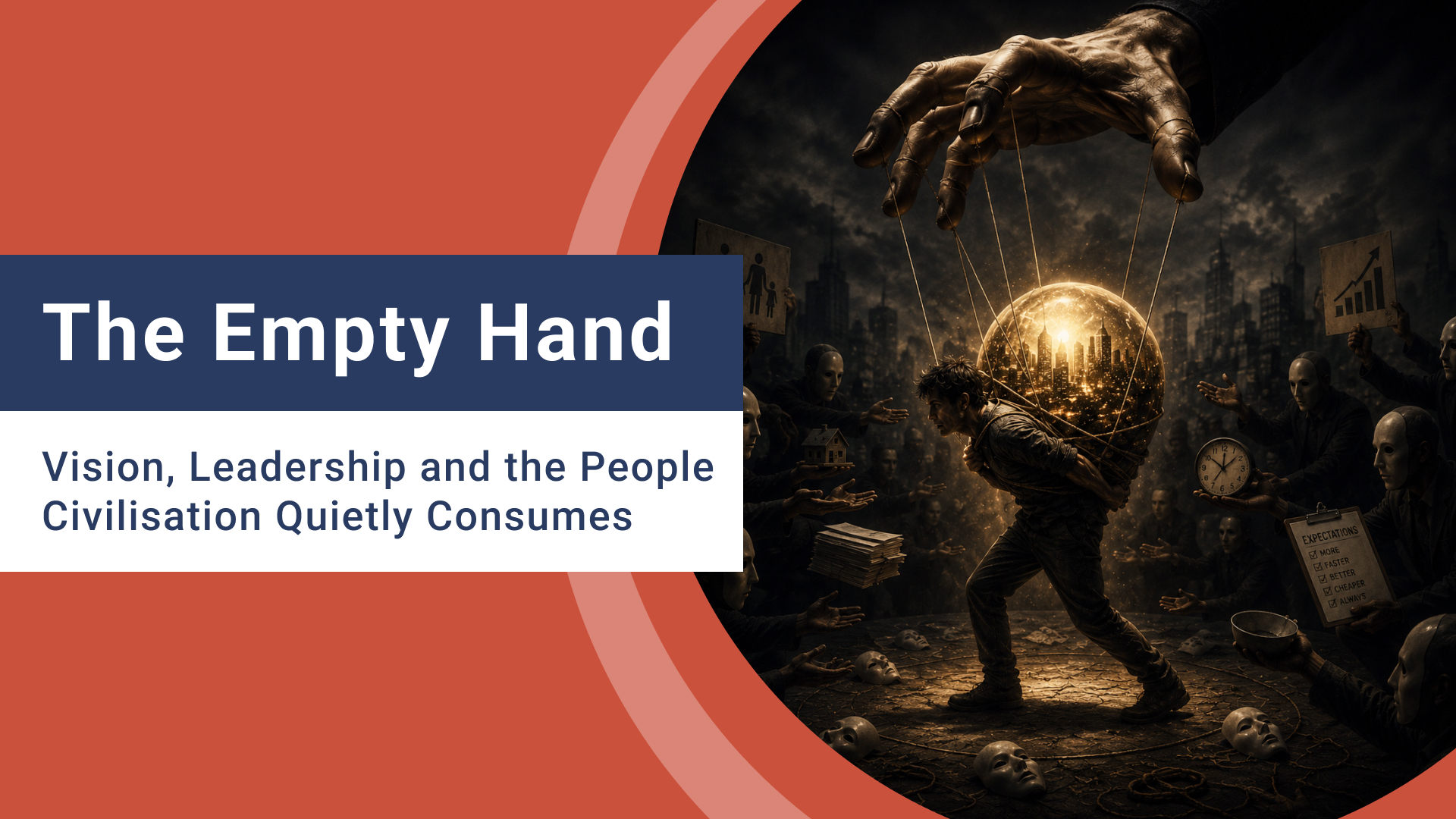
There is something strangely theatrical about elite dog obedience competitions. Not the dogs themselves, of course. The dogs are magnificent, hyper-alert, disciplined, astonishingly precise creatures moving through commands with the kind of devotion most human organisations would place behind bulletproof glass and call “leadership culture.” No, the truly fascinating part is the handler’s hand. Once you notice it, you cannot unsee it. The handler walks with one hand lifted awkwardly near the chest or ribs, fingers curled into a tiny fist as though protecting the last sacred object on earth. The dog walks beside them with religious concentration, head tilted upward, eyes locked onto that hand with absolute emotional commitment. Every movement is tracked. Every twitch matters. The creature is mesmerised.
The funny part, of course, is that the hand is often empty. Completely empty. The treats may have disappeared twenty minutes ago, but the dog continues walking as though the meaning of existence itself remains hidden somewhere inside that tiny closed fist. Hope has already done its work. Conditioning has moved deeper than reality. The possibility of reward has become more powerful than the presence of reward. And honestly, when you first watch this scene, it is difficult not to laugh a little. There is something absurdly adorable about such wholehearted devotion toward an empty hand. The poor creature walks with the emotional intensity of a medieval knight guarding a holy relic, while in reality it is essentially saying, “This time for sure. I can feel the chicken cube coming.” One cannot help but admire the optimism.
Human beings, however, should probably avoid laughing too confidently, because civilisation eventually figured out how to do something remarkably similar to people, particularly to visionaries, founders, reformers, leaders, inventors, and the strange minority of human beings who suffer from the psychological condition of being unable to peacefully coexist with unrealised possibility. These people become captivated by something we shall respectfully and dangerously call “The Vision.” Capital T. Capital V. Naturally. If one is going to build a modern religion, one should at least have the courtesy to capitalise the deity.
“The Vision” is fascinating because it rarely begins as tyranny. It often begins as wonderment. A person sees something others do not yet see. A pattern. A possibility. A future. A different way reality could be arranged. Sometimes the vision is noble. Sometimes destructive. Sometimes brilliant. Sometimes catastrophic. Human history has generously supplied examples across all categories. But regardless of whether “The Vision” intends to save civilisation, reinvent it, optimise it, disrupt it, heal it, digitise it, decentralise it, monetise it, spiritualise it, or apparently “reimagine stakeholder synergies through sustainable innovation ecosystems,” the effect upon the visionary tends to follow a strangely similar pattern.
Reality begins reorganising itself around the vision, slowly at first, then completely. Ordinary pleasures become quieter. Sleep becomes negotiable. Comfort starts feeling suspiciously unimportant. Relationships become peripheral unless they can emotionally coexist with the gravitational pull of “The Vision.” The nervous system itself begins orienting toward something not yet real as though it were already alive and demanding tribute. The visionary no longer merely has a vision. The Vision has them.
When The Vision Starts Eating
At first, this looks inspiring. We admire the fire in such people. We point to their discipline, their commitment, their strange refusal to accept what everyone else has already agreed to tolerate. We write little quotes about them on LinkedIn, usually over a black-and-white photograph of someone looking out of a window, because apparently that is where vision lives. We say they are driven. We say they are passionate. We say they are built differently. All of this sounds complimentary, and often it is, but it also hides something more uncomfortable. A person can be inspired by a vision, but they can also be consumed by it.
This is where The Vision becomes less like a lantern and more like a furnace. It gives light, yes, but it also demands fuel. It asks for evenings, then weekends, then sleep, then patience, then friendships, then health, then a strange little portion of the soul that cannot be claimed back through annual leave. The visionary starts negotiating with ordinary life as though ordinary life were an inefficient department that must be restructured. Rest becomes laziness with better branding. Pleasure becomes distraction. Personal preference becomes self-indulgence. The body becomes a mildly inconvenient delivery vehicle for the mission. Even grief is asked to submit a calendar invitation.
And yet, before we become too smug, we must admit something awkward. Humanity is heavily dependent on these people. Civilisation does not usually move because everyone politely agrees to improve things after lunch. It moves because some inconvenient minority refuses to leave reality alone. Someone stays awake longer. Someone risks being mocked. Someone absorbs uncertainty. Someone becomes obsessed enough to endure the early stages when everyone else calls the idea impractical, unnecessary, unrealistic, or my personal favourite, “interesting.” That word has buried more unborn futures than most wars.
Without these people, very little of value gets created. Innovation requires cost. Reform requires cost. Art requires cost. Institutions that eventually become respectable often begin as the socially irritating insistence of someone who would not stop seeing what others preferred not to see. The visionary may be difficult, intense, strange, inconvenient, and at times unbearable at dinner parties, but without such people, we would still be sitting in caves complaining that fire is too disruptive to existing stakeholder arrangements.
So the article cannot simply mock The Vision, because The Vision is not merely a delusion. Sometimes it is the only reason anything worth building is built. The problem is not that a human being becomes devoted to something larger than comfort. The problem is that devotion can quietly become possession, and possession can be mistaken for virtue when everyone around the possessed person benefits from the light. A candle burning at both ends is still beautiful, especially if you are the one reading by it. The candle may have a different opinion, but candles are famously underrepresented in governance discussions.
The Ones We Burn for Warmth
This is where the story becomes slightly inconvenient for modern narratives about power. We are repeatedly taught to look upward with suspicion, and sometimes rightly so. History contains no shortage of tyrants, narcissists, megalomaniacs, and emotionally constipated emperors who treated human beings like decorative furniture with tax obligations. Certainly, leadership can become exploitative. Certainly, power can become predatory. Certainly, some visions devour entire populations while calling themselves progress.
But there is another archetype that receives remarkably little attention, perhaps because it forces society to confront a mirror it would rather avoid. It is the archetype of the consumed leader, the visionary whose life gradually becomes public infrastructure, the person who carries so much weight for others that eventually their nervous system resembles a collapsing bridge with excellent communication skills.
These are not merely people occupying positions of leadership through optics, titles, branding, or strategic photography involving rolled-up sleeves and thoughtful gazes at construction sites. This article is speaking about a particular archetypal orientation toward responsibility, toward burden, toward seeing, toward carrying. These are the people who often notice danger before others do, who absorb uncertainty before others even realise uncertainty exists, who sacrifice preference for responsibility, comfort for continuity, convenience for contribution. They are the ones who remain awake emotionally while others outsource awareness to them like a subscription service.
And strangely enough, society becomes extraordinarily efficient at locating such people. Families find them, organisations find them, communities find them, institutions find them, and even friendship groups somehow develop supernatural instincts for identifying the one person least likely to let everything collapse.
Then the loading begins. Not violently at first. That would almost be easier to recognise. No, real exploitation usually arrives disguised as admiration. “You’re just so capable.” “You handle things better than most people.” “You’re stronger.” “You understand.” “You care more.” These statements sound loving, respectful, appreciative even, but beneath them often sits an unspoken transaction. What people frequently mean is: you can absorb more than the rest of us without immediately breaking, therefore the burden should gradually migrate toward you.
Human beings are astonishingly adaptive creatures when it comes to redistributing discomfort away from themselves. The responsible become responsible for the irresponsible. The emotionally regulated become containers for the emotionally chaotic. The competent become cleanup crews for the careless. The visionary becomes responsible not only for building the future, but for carrying the psychological fragility of everyone benefiting from that future while simultaneously pretending not to notice the asymmetry.
And this is where dark comedy quietly enters the room holding a glass of wine, because many people genuinely admire these individuals while unconsciously feeding on them at the same time. Society praises resilience precisely because it intends to rely on it. Compassion becomes a resource to mine. Patience becomes an extension mechanism. Tolerance becomes permission. Reliability becomes availability. The more someone demonstrates capacity, the more the world begins treating that capacity like public property, like discovering a horse strong enough to pull ten wagons and concluding the ethical response is obviously to attach an eleventh.
What makes this dynamic especially painful is that high-capacity individuals often participate willingly in their own consumption. Their relationship with meaning becomes intertwined with usefulness. Contribution becomes existential orientation. Carrying becomes identity. Solving becomes purpose. Somewhere deep within them lives the dangerous conviction that if they stop holding things together, something valuable may collapse. And perhaps they are not entirely wrong.
This is the tragedy hidden beneath many great leaders, reformers, creators, founders, parents, teachers, protectors, and visionaries. The world frequently benefits from people it does not know how to love without extracting from. Humanity often treats its strongest bridges as immortal simply because they have not collapsed yet.
The Polite Machinery of Exploitation
The exploitation of capable people rarely announces itself with a villainous soundtrack. It usually arrives through tiny, reasonable, socially acceptable demands that individually appear harmless and collectively become a form of slow theft. Someone asks for one more favour, one more exception, one more act of understanding, one more emotional accommodation, one more rescue mission, one more “quick call,” one more instance of being carried through a situation they helped create and now find spiritually inconvenient. Nothing appears dramatic enough to be called exploitation, which is precisely why it works so well.
The family, the organisation, the institution, or the community often does not say, “We would like to consume your life-force because your stability makes our avoidance possible.” That would be rude, and also poor branding. Instead, it develops a more sophisticated language of dependency. It calls extraction “trust.” It calls entitlement “need.” It calls avoidance “timing.” It calls emotional dumping “being vulnerable.” It calls chronic underdevelopment “a season.” It calls the leader’s exhaustion “intensity.” Then, when the capable person finally names the imbalance, everyone looks surprised, wounded, and morally confused, as though the electricity has suddenly complained about being used by the toaster.
This is where the compensation mechanisms begin. Denial protects people from seeing how much they rely on someone else’s capacity. Projection allows them to accuse the responsible person of being demanding, controlling, unavailable, difficult, or insufficiently warm, especially when that person stops performing unlimited emotional labour with a pleasant facial expression. Oversimplification reduces a complex pattern of extraction into one convenient incident, usually the moment the leader finally became tired, spoke sharply, withdrew, or refused. Manipulation then enters with its polished shoes, often in the form of guilt, selective memory, spiritual language, moral performance, or the deeply popular phrase, “I just don’t feel supported,” spoken by someone who has been emotionally airlifted for years.
There is something almost artistic about the way human beings can benefit from another person’s sacrifice while remaining innocent in their own self-image. We can sit under the tree, eat its fruit, enjoy its shade, carve our initials into its bark, break a few branches for convenience, then complain that it no longer looks as vibrant as it used to. This is not always malicious. Often it is worse than malice, because it is unconscious entitlement wrapped in affection. People may genuinely love the leader, the parent, the founder, the teacher, the reformer, or the friend they are consuming, but love without awareness can still have teeth.
And here is the uncomfortable part. We often punish people precisely for the brilliance we depend on. The one who sees more is accused of overthinking. The one who anticipates consequences is called negative. The one who holds standards is labelled harsh. The one who refuses collective denial is described as intense. The one who carries the heaviest burden is criticised for not carrying it with enough softness, enough elegance, enough emotional availability, enough smiling gratitude for the privilege of being used. Apparently, if you are going to be the human load-bearing wall of a collapsing structure, you should at least remember to be charming about the cracks.
Capacity, Burden, and the Loneliness of Seeing
One of the great misunderstandings about high-capacity individuals is that people imagine capacity simply means the ability to do more. More work. More stress. More responsibility. More hours. More output. But capacity, at least in the deeper existential sense, is not merely productivity with better posture. Capacity is the ability to remain in relationship with reality without immediately collapsing into denial, resentment, avoidance, fragmentation, or self-deception. It is the ability to hold contradiction without demanding premature simplicity. It is the ability to tolerate uncertainty without compulsively manufacturing false certainty for emotional comfort. It is the ability to remain functional while carrying emotional, relational, systemic, ethical, and existential weight that would destabilise many others.
And unfortunately, the moment society detects such a person, it begins loading them like a truck that made the catastrophic mistake of looking structurally sound.
The irony is almost offensive. The very people most capable of carrying become the ones most likely to be burdened further, because human systems instinctively redistribute pressure toward wherever collapse appears least imminent. Families do this. Organisations do this. Communities do this. Nations do this. Even intimate relationships quietly drift toward this gravitational pattern. The stable person becomes stabiliser. The one with emotional regulation becomes emotional regulator for everyone else. The one capable of discernment becomes decision-making infrastructure. The one who can withstand discomfort becomes the designated absorber of discomfort on behalf of the collective.
Then everyone becomes mildly distressed when that person begins showing signs of exhaustion, as though bridges should feel honoured by traffic.
This is where the loneliness begins to deepen for many visionaries and leaders. Not merely because they carry more, but because they often see more. Seeing, despite all the poetic nonsense written about it, is not always pleasant. To see clearly means recognising patterns others are still emotionally negotiating with. It means detecting consequences before they become socially undeniable. It means recognising manipulation while still choosing compassion. It means understanding the difference between genuine vulnerability and performative helplessness. It means noticing how often “need” quietly mutates into dependency, how often “support” becomes extraction, and how frequently “love” becomes conditional upon continued usefulness.
The painful part is that many high-capacity individuals continue giving anyway.
Not because they are weak.
Not because they are naïve.
Not because they cannot see what is happening.
But because somewhere within them lives a relationship with responsibility that runs deeper than transaction. They cannot comfortably watch things collapse when they possess the ability to help stabilise them. Their conscience interferes with self-preservation. Their awareness disrupts emotional detachment. Their capacity itself becomes a kind of burden, because once a human being truly sees, pretending blindness requires its own form of violence against the self.
And yet this creates a devastating paradox. The more such people give, the more others normalise the giving. Extraordinary contribution slowly becomes baseline expectation. Sacrifice becomes personality. Reliability becomes obligation. Availability becomes entitlement. The visionary, the leader, the protector, the builder, the stabiliser gradually stops being experienced as a human being with limits and starts being experienced as infrastructure. Not someone carrying the system, but part of the system itself. Something permanent. Something durable. Something there.
Until suddenly they are not.
The Strange Grief of Never Being Enough
There is a particular kind of grief that high-capacity people rarely speak about openly, partly because they themselves struggle to articulate it without sounding ungrateful, arrogant, dramatic, or emotionally self-indulgent. It is the grief of discovering that no matter how much one gives, stabilises, sacrifices, absorbs, builds, fixes, carries, forgives, tolerates, or contributes, existence itself seems to extend another empty hand. Another expectation appears. Another responsibility emerges. Another crisis arrives with remarkable confidence in your availability. Another person quietly reorganises their emotional economy around your continued capacity to endure.
At some point the visionary begins asking a dangerous internal question. Not publicly, of course. Publicly they are still functioning, still solving, still leading meetings, still reassuring others, still replying with “all good” while their nervous system resembles an overloaded electrical station during a thunderstorm. But privately, somewhere beneath the competence and composure, another voice begins whispering: When exactly does it become enough?
Not enough for applause. Not enough for recognition. Most genuine leaders outgrow fantasies of universal appreciation relatively early, usually around the same time they realise “thank you” is one of humanity’s most inconsistently funded currencies. No, the deeper question is existential. When does the burden stop multiplying? When does contribution stop becoming permission for further extraction? When does being capable stop functioning as an invitation to be consumed?
And perhaps this is why so many visionaries carry a strange mixture of love and exhaustion simultaneously. They often genuinely care about the people, systems, communities, organisations, and futures they serve. Their contribution is not fake. Their devotion is not merely performative. The Vision matters to them deeply. Sometimes tragically deeply. But alongside that devotion sits another quieter reality, the recognition that many people love what these individuals provide more than they love the individuals themselves. That sentence tends to sit in the room like smoke.
Because once seen, it becomes difficult to entirely unsee. Many people adore the light while remaining remarkably disconnected from the cost of combustion. They admire the stability without emotionally processing the pressure required to maintain it. They celebrate resilience while unconsciously participating in the very dynamics requiring resilience in the first place. Humanity has developed an extraordinary ability to romanticise sacrifice while outsourcing it to a minority of psychologically durable people.
And still, despite all of this, despite the asymmetry, despite the exhaustion, despite the hidden loneliness, despite the moments of bitterness that occasionally slip through the cracks like dark water under a locked door, these people often continue. This is what makes the whole thing simultaneously beautiful and heartbreaking.
Because at the centre of many true visionaries there exists something deeper than reward. Deeper than recognition. Deeper even than reciprocity. There is often a profound relationship with meaning itself, a relationship so intimate that abandoning the responsibility they perceive would feel like betraying something sacred within their own being. The leader continues because they see. The visionary continues because they cannot unknow what they know. The builder continues because the unfinished structure haunts them. The protector continues because awareness itself has made withdrawal psychologically expensive.
Which brings us back, strangely enough, to the obedience dog staring upward at the empty hand. Except now the image no longer feels entirely funny.
The visionary walks forward with the same strange devotion, eyes fixed upon “The Vision,” filtering reality through its gravitational pull, continuing despite exhaustion, despite disappointment, despite the growing awareness that the reward may never fully arrive in the form they once imagined. The hand may already be empty. Perhaps it was always empty. Perhaps the meaning was never in the treat at all, but in the movement itself, in the pursuit, in the unbearable tension between possibility and sacrifice.
Or perhaps human civilisation progresses because some people are willing to keep walking beside the empty hand long after others would have sat down and demanded proof.
Beyond the Vision
Perhaps the most dangerous misunderstanding about people like this is assuming they are endlessly strong. Society often mistakes sustained functionality for infinite capacity. If someone continues carrying, people unconsciously conclude they can continue carrying. If someone continues solving, stabilising, absorbing, protecting, building, leading, and enduring, others gradually stop perceiving those actions as costly. The extraordinary slowly becomes normalised. The sacrifice disappears into routine. The burden becomes invisible precisely because it is being handled well. This is one of the quiet cruelties hidden inside competence.
Human beings are generally very sensitive to visible suffering. We respond to collapse, tears, breakdowns, emotional explosions, dramatic exits, and public crises. But stable suffering is much harder for people to recognise. The person who keeps functioning while internally eroding often becomes the least protected person in the room because everyone assumes resilience means safety. We see the one still standing and conclude they must somehow need less care than those already on the floor.
Meanwhile, many visionaries themselves become trapped inside a psychological contradiction. They long to be seen beyond their usefulness, yet their very orientation toward responsibility makes them continue being useful even while exhausted. They want reciprocity, but struggle to stop giving long enough to discover whether reciprocity actually exists around them. They desire understanding, but often explain themselves poorly because exhaustion eventually compresses language into silence. Some even become frightened by stillness itself, because without movement, without contribution, without The Vision pulling them forward, they are suddenly forced into direct confrontation with their own depletion. And this is where the article must become careful.
Because none of this means the answer is bitterness. Nor cynicism. Nor theatrical self-victimisation disguised as depth. The world genuinely needs builders, reformers, visionaries, protectors, and those capable of carrying complexity without immediately collapsing into simplistic ideology or emotional paralysis. Humanity progresses because some people are willing to hold burdens others cannot yet hold. That matters. It matters enormously.
But perhaps what also matters is developing the capacity to see these individuals more truthfully, not merely as functions, utilities, stabilisers, or engines of contribution, but as human beings standing inside the fire they create for others. Perhaps societies, organisations, families, and communities must eventually mature beyond their unconscious addiction to extracting from whoever appears most capable. Perhaps love itself becomes corrupted when contribution is endlessly consumed without reverence, reciprocity, protection, or genuine acknowledgement. Because eventually even the strongest candles disappear.
And then everyone stands around in confusion asking why the room has gone dark.
The Weight of the Empty Hand
There is something almost sacred and tragic about the moment a visionary begins realising that The Vision itself may never fully love them back. The mission may give meaning, momentum, direction, and even transcendence, but it does not necessarily provide rest. The future they are building rarely pauses to ask whether they are tired. The people benefiting from their labour may admire them, rely on them, quote them, celebrate them, even claim to love them, while still unconsciously participating in the machinery consuming them piece by piece.
And perhaps this is why some of the most capable people occasionally develop an almost unbearable loneliness in crowded rooms. Not because nobody is physically present, but because very few people are truly relating to the weight they carry. Many interact primarily with what the visionary provides rather than what the visionary experiences. They relate to the protection, the stability, the solutions, the direction, the leadership, the emotional regulation, the opportunities, the structures, the sacrifices. But the actual inner cost of sustaining all of that often remains strangely invisible.
It is difficult to explain this loneliness without sounding dramatic, which is unfortunate because reality does not become less true simply because it sounds poetic. There are people walking among us whose nervous systems have quietly become battlefields between responsibility and depletion, between meaning and exhaustion, between devotion and erosion. They continue functioning so effectively that others mistake their continued movement for wellness. Meanwhile, parts of them are burning quietly beneath the surface like electrical wiring hidden inside walls, overheating long before flames become visible.
And still they continue. That may be the most bewildering part of all. They continue after disappointment, after betrayal, after being misunderstood, after watching people consume what they provide while remaining emotionally absent from the cost, and after realising that many forms of “support” are merely dependency wearing softer language.
Why?
Because for some people contribution is not merely behaviour. It is ontology. It is orientation toward existence itself. They do not simply perform responsibility. They experience reality through responsibility. To see suffering, fragmentation, unrealised potential, systemic breakdown, preventable chaos, or unnecessary darkness while possessing the capacity to intervene creates an almost existential tension within them. Withdrawal begins feeling less like rest and more like abandonment of conscience.
This is why simplistic conversations about leadership so often fail. We reduce everything to power, privilege, authority, visibility, success, status, or influence, while ignoring the hidden phenomenology of carrying. We discuss leaders as though leadership is primarily about commanding others, when in many cases it is actually about absorbing what others cannot yet absorb without disintegrating. The true burden is not merely decision-making. It is containment: emotional containment, ethical containment, existential containment, systemic containment. It is the ability to remain present to complexity while others desperately seek escape routes into oversimplification.
And perhaps this is why genuine leaders and visionaries often feel strangely alien within the very societies benefiting from them. They live too close to responsibility to fully participate in collective denial. They see the cracks too early, notice consequences too quickly, and feel the weight of unfinished realities before others even perceive a problem. There is a peculiar isolation in seeing tomorrow while being surrounded by people emotionally negotiating yesterday.
Which brings us back one final time to that obedience dog staring upward at the empty hand. At first the image seemed humorous, then sad, then strangely human. But perhaps now the image reveals something deeper still. The dog was never merely following the possibility of reward. It had become organised around the relationship itself, around the orientation, around the movement, around the meaning projected into the hand.
And perhaps many visionaries live the same way, walking forward beside an empty hand called The Vision, exhausted yet devoted, consumed yet luminous, carrying warmth for others while slowly disappearing into the very light they create.
The Ones Who Stay Awake
Civilisation has always had a complicated relationship with the people who stay awake while others sleep comfortably inside inherited structures. We celebrate them ceremonially after the fact, preferably once they are dead, exhausted, safely distant, or no longer disruptive to the emotional economy of the present. Humanity loves visionaries most when they can no longer challenge anyone directly. Once transformed into quotes, documentaries, statues, or neatly curated biographies with inspirational piano music in the background, they become much easier to digest. Living visionaries are considerably less convenient.
Living visionaries interrupt things. They expose cracks in systems people have emotionally adapted to. They ask uncomfortable questions during meetings everyone else hoped would end early. They refuse to entirely participate in collective denial. They carry an irritating tendency to notice the difference between appearance and substance, between performance and integrity, between symbolic gestures and actual transformation. They often become walking disturbances within environments built upon emotional compromise. And this is precisely why societies both need and resist them simultaneously.
Because genuine vision creates movement, but movement destabilises comfort. Real leadership creates direction, but direction inevitably exposes who has been drifting. True responsibility forces confrontation with consequence, and consequence is deeply unpopular among creatures who prefer motivational slogans over existential accountability. Human beings enjoy the benefits of transformation far more than the process of being transformed.
So what often happens to these individuals is something strangely paradoxical. The collective leans upon them while subtly pressuring them to become smaller at the same time. “Lead us,” but not in ways that inconvenience us too much. “Tell the truth,” but not if the truth threatens our preferred self-image. “Carry responsibility,” but please continue appearing emotionally pleasant while doing so. “Be visionary,” but make sure your vision remains compatible with our comfort, insecurities, coping mechanisms, and existing dependency structures. In other words, humanity frequently demands transformation while negotiating aggressively against the psychological cost of transformation.
And still, despite all this contradiction, despite the loneliness, despite the extraction, despite the hidden grief of carrying more than one can easily explain, some people continue choosing responsibility anyway. That choice matters. It matters more than most people realise. Entire families survive because of it. Entire organisations stabilise because of it. Entire communities evolve because someone somewhere tolerated the burden of seeing before others were ready to see.
This does not make such people morally superior. That would oversimplify the matter and betray the complexity of the archetype itself. High-capacity individuals are still human. They can become resentful, obsessive, emotionally unavailable, controlling, self-neglectful, arrogant, sacrificial in unhealthy ways, or psychologically fused with usefulness to the point of self-erasure. Some become consumed by The Vision so completely that they forget how to exist outside contribution. Some lose tenderness. Some lose relationships. Some lose themselves. But even acknowledging all of that, one truth remains difficult to escape. Nothing of value emerges without someone giving themselves to it.
Every meaningful structure, every genuine reform, every advancement, every movement toward greater coherence, beauty, order, protection, sustainability, truthfulness, or possibility exists because somebody somewhere accepted a burden heavier than comfort would permit. Civilisation progresses because a minority of people repeatedly volunteer themselves into forms of exhaustion the majority would never consciously choose.
And perhaps the deepest tragedy is not that these people suffer. Perhaps the deepest tragedy is how often their suffering becomes normalised precisely because they continue functioning through it. The bridge remains standing, so everyone keeps driving across it. The candle continues burning, so everyone assumes there is more wax. The leader continues carrying, so everyone assumes the weight must not be that heavy after all.
Until one day the room grows dark, the bridge collapses, the voice disappears, the builder finally stops building, and people look around in confusion asking what happened to the person who always seemed capable of holding everything together.
As though endurance itself had quietly convinced everyone they were indestructible.
The Vision and the Void
Perhaps this is the final paradox sitting quietly beneath all great visions, great leaders, great reformers, and great builders. The very people most capable of illuminating the world are often the ones standing closest to inner emptiness. Not because they lack meaning, but because meaning itself demands continual expenditure. To carry responsibility at a high level for long enough is to repeatedly pour parts of oneself into realities that may never fully reciprocate emotionally. The founder pours into the organisation. The parent pours into the family. The reformer pours into society. The visionary pours into the future. The protector pours into stability. And over time, many begin discovering that contribution without replenishment creates a strange spiritual drought hidden beneath outward functionality. This is why so many highly capable people eventually wrestle with an almost unspeakable question: if I stop carrying, who am I beyond the carrying?
It is an extraordinarily dangerous question because many have spent years, sometimes decades, becoming structurally organised around usefulness. Their value became intertwined with contribution so gradually that the distinction between identity and responsibility started dissolving. They became the dependable one. The stable one. The strong one. The wise one. The one who understands. The one who absorbs. The one who remains calm. The one who solves. The one who stays awake while everyone else emotionally clocks out.
And society rewards this arrangement beautifully, at least initially. Reliable people are trusted. Responsible people are needed. Visionaries are admired. Builders are celebrated. Leaders are followed. But eventually the applause fades into expectation. What once appeared extraordinary becomes assumed baseline functionality. The miracle becomes routine. The sacrifice becomes invisible through repetition. People stop asking whether the one carrying the burden still has somewhere safe to place their own. This is where the void quietly begins widening.
Not dramatic collapse, not cinematic breakdown, and not necessarily depression in the obvious sense. Often it is something subtler and more existential than that: a gradual erosion of interiority, a strange emotional homelessness, the feeling of becoming functionally indispensable while personally unseen, and the experience of being surrounded by dependence while starving for genuine containment oneself.
And ironically, this often intensifies the relationship with The Vision rather than weakening it. The more exhausted some visionaries become, the more tightly they cling to the mission because the mission itself has become the primary structure organising their existence. The Vision gives coherence to suffering. It explains the sacrifice. It justifies the loneliness. It transforms exhaustion into purpose. Without it, they risk confronting the terrifying possibility that they may have spent years burning themselves alive in service of something that still keeps extending another empty hand.
But perhaps this is where the article must refuse both cynicism and naïve romanticism. Because despite everything, despite the exploitation, the asymmetry, the emotional cost, and the loneliness of carrying realities others do not yet perceive, there remains something profoundly beautiful about human beings willing to devote themselves to possibilities beyond immediate self-interest. There is something sacred in the person who continues building despite uncertainty, and something deeply human in those who continue carrying because they cannot comfortably abandon what they know matters.
The tragedy is not that such people exist. The tragedy is that humanity so often receives their light without developing equal reverence for the life being consumed to produce it.
The Last Look Toward the Hand
And so, after all the philosophy, the psychology, the leadership discourse, the conversations about capacity, sacrifice, exploitation, responsibility, and The Vision, we somehow end up back where we started, beside an obedience field, watching a dog stare upward at an empty hand with absolute devotion. Only now the image no longer feels simple.
At first it looked amusing. Then symbolic. Then tragic. But perhaps the deepest discomfort comes from recognising how profoundly human the scene really is. Because many of us, in one form or another, organise our lives around invisible hands. Around promises. Around futures. Around identities. Around meanings projected into things that continually demand from us while rarely fully satisfying us in return. But visionaries are different.
Most people eventually stop walking when the hand remains empty for too long. They renegotiate with comfort. They lower the burden. They return to manageable realities. They protect themselves through limitation, distraction, cynicism, entertainment, ideology, or emotional disengagement. There is nothing inherently wrong with this. Human beings are not designed to live permanently exposed to existential intensity. Most people simply want enough stability to survive with dignity and moments of peace. Visionaries, however, often continue.
That is what makes them both dangerous and necessary. They continue after certainty disappears, after recognition fades, after exhaustion arrives, after discovering how asymmetrical contribution can become, after realising that some people love the warmth more than the fire itself, and even after understanding that civilisation frequently feeds upon the very people it depends on.
And perhaps this is why truly visionary people often appear simultaneously luminous and haunted. There is usually a grief living inside them alongside the devotion, a quiet awareness that the road ahead may continue demanding pieces of them indefinitely, and a recognition that responsibility, once deeply internalised, rarely loosens its grip entirely. They carry not only the burden of action, but the burden of seeing. And seeing changes people. Once a human being truly perceives unrealised possibility, avoidable suffering, preventable collapse, hidden potential, systemic fragmentation, or the consequences of collective denial, returning fully to ordinary unconsciousness becomes almost impossible.
So they continue walking beside The Vision, that strange empty hand suspended somewhere between meaning and madness, between purpose and captivity, between illumination and self-erasure. Some will call them obsessive. Some will call them intense. Some will admire them publicly while privately depending on them far more than they will ever admit. Some will consume what they create while remaining emotionally absent from the cost. Some will misunderstand them entirely.
And still they continue, not because they are invincible, not because they do not bleed, and not because they have transcended exhaustion, but because once certain people see light hidden inside darkness, they can no longer peacefully pretend the darkness is acceptable.
Perhaps that is the true cost of vision. Not merely building the future, but becoming the candle civilisation repeatedly burns in order to see it.
After the Light
And perhaps the most unsettling part of all this is recognising how ordinary the entire mechanism becomes. The exploitation of visionaries does not usually look like chains, violence, dictatorships, or theatrical oppression. More often it looks like daily life. A reliable person answering another late-night call. A founder sacrificing health to keep salaries paid. A parent absorbing emotional chaos so the family remains functional. A leader carrying uncertainty privately so others can continue operating without panic. A reformer tolerating ridicule long enough for an idea to survive infancy. A teacher staying awake preparing material no one will ever fully appreciate. A protector quietly becoming psychologically exhausted while ensuring others continue feeling safe enough to complain comfortably about minor inconveniences. Civilisation is filled with people surviving emotionally on the invisible labour of others.
And the uncomfortable truth is that many of these dynamics are not entirely avoidable. Human beings are interdependent creatures. We rely on each other, lean on each other, and borrow strength from each other. Every child survives because somebody carried more than was fair. Every meaningful institution exists because somebody tolerated pressure others could not tolerate. Every stable society rests upon layers of sacrifice distributed unevenly across generations of human beings, many of whom disappeared without receiving proportional recognition for what they absorbed.
The problem, then, is not dependency itself. The problem is unconscious dependency. It begins when people consume capacity without reverence, normalise sacrifice without gratitude, demand emotional labour without restraint, and treat reliable people as permanent infrastructure rather than mortal human beings with nervous systems, limits, grief, exhaustion, desires, fears, and breaking points.
And perhaps this is where the article finally turns its gaze toward the reader, because almost everyone will find themselves somewhere inside this dynamic. Some will recognise themselves in the visionary, the leader, the stabiliser, the one carrying too much while quietly wondering why it never feels enough. Others will recognise themselves in the collective, in the subtle ways they lean upon capable people while failing to fully see the cost. Most human beings, if honest enough, have probably occupied both sides at different moments of life.
This is not an invitation toward guilt, nor toward resentment, nor toward glorifying self-destruction as virtue. It is an invitation toward awareness: awareness of how easily usefulness becomes exploitation, how quietly contribution can become identity, how often people offering the most support receive the least containment themselves, how much hidden violence lives inside normalised extraction, and how some of the strongest people around us may actually be the most depleted precisely because they appear capable of continuing.
Because once these dynamics become visible, something important changes. Gratitude deepens. Responsibility deepens. Reciprocity deepens. One begins seeing leadership not merely as authority, status, charisma, or influence, but as a form of existential expenditure. One begins recognising that many of the people holding reality together around us are doing so at profound personal cost while smiling just enough to avoid making everyone uncomfortable.
And perhaps civilisation matures the moment it stops merely admiring the light and finally learns how to protect the flame.
The Silence Beneath Capability
There is also another cruelty hidden within high capacity that few people discuss openly. The more capable someone becomes, the less permission they are unconsciously given to struggle visibly. Human beings tolerate fragility far more comfortably in those already identified as fragile. We rush toward the visibly collapsing. We soften toward the obviously wounded. But the strong, the reliable, the composed, the insightful, the emotionally regulated, the ones who have repeatedly demonstrated the ability to carry complexity without immediate breakdown, often become trapped inside the prison of their own demonstrated competence.
Their suffering becomes harder for others to emotionally register because capability itself creates perceptual distortion.
People look at the leader still functioning and conclude they must be fine.
They look at the visionary still producing and conclude they must still have energy.
They look at the stable one still holding others together and conclude they must somehow require less support themselves.
And over time, many capable individuals begin internalising this distortion. They become reluctant to reveal exhaustion because they fear destabilising the very people depending on them. They suppress needs because there is always something “more important” requiring attention. They minimise their own depletion because others appear more visibly distressed. They become experts at continuing while quietly deteriorating. Some even lose the language for asking for help entirely.
Not because they lack emotion, but because years of being the container for others slowly conditions them into emotional asymmetry. They know how to absorb. They know how to stabilise. They know how to protect, guide, regulate, build, and endure. But receiving becomes psychologically unfamiliar. Vulnerability begins feeling dangerous not merely because of pride, but because many have repeatedly discovered that once they stop functioning, disappointment appears almost immediately in the eyes of those benefiting from their functioning. The system prefers the bridge standing.
And this creates one of the loneliest experiences imaginable: being deeply needed while feeling insufficiently held. To be relied upon constantly yet emotionally unseen, to be admired publicly yet privately exhausted, to be surrounded by people while carrying realities no one around you fully comprehends, and to become so associated with strength that others unconsciously stop relating to your humanity altogether.
This is why many visionaries, leaders, builders, and protectors eventually develop a strange emotional duality. Outwardly they continue moving, speaking, solving, carrying, guiding, creating, and contributing. Inwardly they begin oscillating between profound meaning and profound depletion, between devotion and fatigue, between purpose and erosion. Some become cynical. Some become detached. Some become quietly heartbroken beneath extraordinary functionality. Some continue smiling while slowly disappearing from within themselves.
And yet perhaps the saddest part is that many of them would still choose the burden again. Because despite everything, despite the cost, the asymmetry, and the exhaustion of being treated as emotional infrastructure, there remains something within them that cannot comfortably abandon what they perceive as necessary. Their relationship with responsibility has moved beyond transaction. It has become existential orientation. They do not merely carry because they are rewarded. They carry because not carrying feels like betrayal of something fundamental within their own being. Which is both beautiful and terrifying.
Because humanity survives through such people while simultaneously exhausting them, and often does not fully realise what it had until the carrying stops.
The World Built on Invisible Shoulders
If one looks carefully enough, nearly every functioning system reveals the fingerprints of unseen sacrifice. Behind stable families there is often someone carrying emotional tension long before conflict becomes visible. Behind meaningful organisations there is usually someone absorbing uncertainty, protecting others from chaos, making difficult decisions privately so the collective can continue operating coherently. Behind reform movements there are individuals enduring ridicule, isolation, financial instability, reputational attacks, and psychological exhaustion while attempting to move reality itself a few inches away from dysfunction. Humanity loves outcomes. It is less enthusiastic about the cost structure producing them.
We enjoy safety without wanting to study protection.
We enjoy innovation without wanting to witness obsession.
We enjoy stability without wanting to examine sacrifice.
We enjoy leadership without wanting to understand burden.
And perhaps this is why so many societies accidentally produce shallow conversations about power. We fixate on visibility while ignoring expenditure. We discuss authority while overlooking responsibility. We analyse influence while remaining strangely blind to the psychological, emotional, existential, and relational cost of carrying more reality than others can comfortably hold at a given time. Because carrying reality has weight. Real weight.
Not metaphorical motivational-poster weight. Not the kind solved by productivity hacks, gratitude journals, cold plunges, or an executive wellness retreat where emotionally exhausted people pay several thousand dollars to breathe near eucalyptus trees while pretending burnout is a mindset issue. Actual existential weight. The weight of responsibility. The weight of consequence. The weight of seeing systems fracturing while others remain distracted by surface-level noise. The weight of recognising that many forms of suffering are preventable while simultaneously understanding how resistant human beings can be to transformation.
This is where the relationship between leadership and capacity becomes deeply important. Capacity is not simply endurance. Endless endurance without awareness eventually becomes self-destruction with good public relations. Genuine capacity includes the ability to remain in truthful relationship with reality, including one’s own limits, one’s own erosion, one’s own humanity. But many visionaries and leaders struggle precisely because the world continually rewards them for overriding those limits. Their usefulness becomes socially valuable. Their sacrifice becomes productive. Their depletion becomes economically and emotionally convenient for others.
And this creates a devastating distortion where the person most capable of seeing the cost often becomes the least able to step away from paying it.
Not because they are foolish.
Not because they enjoy suffering.
Not because they are incapable of rest.
But because they understand too clearly what may happen if nobody carries the burden at all. This is why so many high-capacity individuals live inside a permanent tension between responsibility and self-preservation. If they withdraw entirely, systems may collapse, families may destabilise, organisations may fracture, visions may die, people may suffer unnecessarily. If they continue endlessly, however, parts of themselves slowly disappear into the machinery they are sustaining.
And perhaps this is the hidden existential bargain beneath many forms of leadership. The leader often becomes the location where unresolved tension accumulates so that the collective can temporarily continue functioning. They absorb uncertainty so others can feel certainty. They metabolise chaos so others can experience order. They carry emotional complexity so others can maintain simpler narratives about reality.
Until eventually the weight becomes visible through cracks.
A sharper tone.
A distant look.
A tired nervous system.
A strange grief that appears without obvious explanation.
Moments where even success feels emotionally insufficient because the soul itself has become exhausted from carrying too much for too long.
And still, despite all of this, civilisation continues depending on such people far more than it comfortably admits.
The Quiet Violence of Convenience
Perhaps one of the most uncomfortable truths hidden inside modern life is how much of human behaviour is organised around convenience, not necessarily malice, not necessarily evil, but convenience. Human beings naturally drift toward whatever reduces immediate discomfort, and this includes emotional discomfort, moral discomfort, existential discomfort, and responsibility itself. If someone else appears capable of carrying the burden, many people unconsciously allow the burden to migrate toward them the way water naturally finds the lowest point in a structure.
This is why capable people often become surrounded by individuals who genuinely believe they are loving, supportive, ethical, and appreciative while simultaneously participating in patterns of extraction. The issue is rarely cartoonish villainy. It is far subtler than that. It is the quiet normalisation of asymmetry. The gradual expectation that the responsible one will continue being responsible. That the emotionally mature one will continue regulating the emotional atmosphere. That the stable one will continue stabilising. That the visionary will continue carrying direction. That the leader will continue absorbing uncertainty privately so everyone else can remain psychologically comfortable publicly.
And once this dynamic becomes established, something deeply ironic begins happening. The people carrying the most weight often become the least permitted to visibly struggle under it. Their exhaustion becomes inconvenient because too many others have organised their own emotional stability around the assumption that the strong one will remain strong. The system develops dependency upon the very people it fails to adequately protect.
Then, if the leader finally reaches a breaking point, the collective frequently responds not with deep reflection about how much burden had accumulated upon that individual, but with disappointment. Confusion. Sometimes even resentment. The bridge was supposed to keep holding. The candle was supposed to keep burning. The stabiliser was supposed to remain stable. The psychologically durable person was supposed to continue metabolising chaos indefinitely without asking the rest of the system to confront its own underdevelopment.
There is something almost tragicomic about this. Humanity often demands extraordinary people while resisting the conditions necessary for extraordinary people to remain psychologically alive. We praise sacrifice while quietly incentivising self-erasure. We admire resilience while constructing environments requiring unsustainable resilience in the first place. We romanticise devotion while remaining strangely disconnected from the biological, emotional, and existential cost of continuous giving.
And perhaps nowhere is this more visible than in the lives of those who become consumed by The Vision. The visionary initially sacrifices voluntarily because the future they perceive feels meaningful enough to justify the cost. But over time, others begin building expectations atop that sacrifice. The extraordinary becomes normalised. Availability becomes assumed. Contribution becomes identity. Eventually the visionary no longer merely serves the mission. They become trapped inside everyone else’s dependency upon their continued service to the mission.
This is why so many highly capable people quietly wrestle with a haunting question they rarely say aloud:
Would people still value me if I stopped carrying them?
Not because they crave applause, but because somewhere deep within them they begin sensing the terrifying possibility that many relationships, systems, organisations, and communities have become attached less to their humanity and more to the utility extracted from their humanity. That realisation changes people.
Sometimes it hardens them.
Sometimes it saddens them.
Sometimes it isolates them.
Sometimes it forces them into painful reevaluation of who actually loves them versus who merely loves access to what they provide.
And yet even after recognising all this, many continue carrying anyway. Because once responsibility reaches a certain existential depth, walking away no longer feels emotionally simple. The burden has already entered the architecture of the self.
The Burden of Those Who See
There is a reason many genuinely visionary people appear older than their years, even when they are still smiling, still functioning, still producing, still moving forward with outward competence. Seeing carries weight. Not merely intellectual seeing, but existential seeing. To perceive patterns others ignore, to recognise consequences before they arrive, to detect fractures forming beneath apparently stable systems, to feel responsibility toward unrealised possibility, all of this exerts continuous pressure upon the human nervous system. Most people are protected by partial blindness. That is not an insult. It is often mercy.
Human beings generally require a degree of selective attention in order to remain psychologically stable. We narrow reality into manageable portions. We focus on immediate concerns. We emotionally filter complexity. We compartmentalise. We distract ourselves. We negotiate with uncomfortable truths slowly enough to continue functioning without drowning in existential overload. Visionaries often struggle to do this.
Their awareness keeps leaking beyond the boundaries of ordinary containment. They see not only what is present, but what is absent. Not only current reality, but unrealised reality. Not only visible systems, but invisible trajectories. And once someone begins perceiving life this way, existence itself becomes heavier. Every decision carries multiplied layers of consequence. Every neglected issue reveals future costs. Every compromise creates internal friction. Every act of denial becomes harder to emotionally tolerate.
This is why many leaders and visionaries live in a state of continuous psychic tension. They are carrying not only present burdens, but anticipated burdens. Not only current suffering, but preventable suffering. Not only existing responsibilities, but responsibilities emerging on the horizon long before others emotionally register them as real. And here lies one of the cruelest ironies. The more accurately someone perceives reality, the harder it often becomes for them to fully relax inside it. Because awareness creates responsibility.
Once a person truly sees manipulation, they cannot innocently participate in it without inner conflict. Once they see dysfunction, they cannot comfortably pretend it is harmless. Once they see unrealised potential, they cannot entirely stop feeling the tension between what exists and what could exist. Once they see the hidden cost structures beneath human behaviour, relationships, organisations, and societies, ordinary participation itself begins carrying emotional complexity.
This is why high-capacity individuals often oscillate between profound love for humanity and profound exhaustion with humanity at the same time. They see the beauty and the dependency. The potential and the avoidance. The tenderness and the unconscious selfishness. The longing for transformation and the simultaneous resistance to everything transformation requires.
And perhaps this is why some of the most capable leaders eventually become quieter. Not necessarily less caring, but more acquainted with the limits of forcing sight upon people unwilling to see. There comes a point where many realise that awareness cannot simply be transferred like information in a spreadsheet. Human beings often grow through consequence, not explanation. Through suffering, not lectures. Through collapse, not warnings.
Still, despite all this, despite the loneliness of seeing too much too early, despite the exhaustion of carrying realities others have not yet emotionally metabolised, despite the endless tension between responsibility and depletion, some people continue orienting themselves toward contribution anyway.
Not because it is easy.
Not because it is fair.
Not because they are immune to pain.
But because once certain forms of awareness awaken within a human being, refusing responsibility begins feeling more painful than carrying it.
The Cost of Remaining Human
And perhaps this is where the deepest danger quietly emerges for visionaries, leaders, reformers, builders, protectors, and all those who spend too long carrying realities larger than themselves. The danger is not merely exhaustion. It is not even collapse. The deeper danger is becoming so organised around responsibility that one slowly loses ordinary humanity in the process. Because carrying too much for too long changes people.
It changes how they relate to time.
How they relate to rest.
How they relate to intimacy.
How they relate to trust.
How they relate to their own needs.
Many become so accustomed to being the stabiliser that receiving care begins feeling unfamiliar, almost suspicious. Some become emotionally efficient rather than emotionally alive. Others become unable to distinguish between love and dependency because most of their relationships have been structured around usefulness for so long. Some lose the ability to relax entirely because their nervous systems have adapted to perpetual vigilance. Others become quietly resentful toward those they continue helping, then feel guilty for the resentment, then continue helping anyway.
This is the hidden psychological erosion that often accompanies prolonged responsibility. The visionary begins disappearing beneath the function they perform. The leader becomes role before person. The protector becomes utility before humanity. The builder becomes output before soul. Over time, many no longer know how to exist outside contribution. Stillness becomes frightening because without movement, production, solving, guiding, protecting, fixing, or carrying, they are suddenly forced into direct confrontation with their own depletion.
And yet, despite all this, the article must resist reducing these individuals into tragic martyrs. That would merely create another romantic illusion. High-capacity people are not saints floating above ordinary human contradictions. Many become difficult. Some become emotionally unavailable. Some become controlling because carrying responsibility eventually creates intolerance for unnecessary chaos. Some become harsh because prolonged exposure to consequence reshapes their relationship with softness. Some become addicted to usefulness itself because usefulness gave them identity, meaning, admiration, relevance, and existential orientation.
This is important to acknowledge because otherwise the conversation becomes dishonest. The same fire that allows visionaries to illuminate reality can also burn through tenderness, balance, relational presence, and self-awareness if left unchecked. The candle does not merely disappear physically. Sometimes it disappears emotionally long before the flame goes out.
Still, even acknowledging all these complexities, one truth remains stubbornly difficult to avoid. Humanity owes far more than it comfortably admits to the people willing to carry disproportionate burden for the sake of something beyond immediate self-interest. Entire generations inherit stability built upon sacrifices they never witnessed. Entire organisations survive because someone privately absorbed pressures that never became publicly visible. Entire families remain emotionally intact because one person repeatedly chose responsibility over personal convenience. Entire futures emerge because somebody somewhere refused to stop walking beside The Vision even after discovering the hand might remain empty forever.
Perhaps this is why genuinely thoughtful people eventually develop a more reverent relationship toward responsibility. Not performative admiration. Not shallow motivational worship. Reverence. A recognition that carrying reality has cost. A recognition that many of the strongest people around us are not endlessly strong, but endlessly required. A recognition that contribution without containment eventually becomes erosion, no matter how noble the mission.
And perhaps maturity begins the moment we stop merely asking who is carrying us, and start asking who is carrying them.
The People Who Cannot Fully Return
There is another sadness rarely spoken about openly among highly capable people, especially those who have spent years inside leadership, responsibility, reform, protection, or vision-driven existence. Even when they attempt to rest, many discover they cannot fully return to ordinary life in the same way others do. Something inside them has already crossed a threshold. Awareness changed the architecture of their perception too deeply. Once someone has spent enough time carrying consequence, they begin seeing consequence everywhere.
They walk into rooms and immediately notice tension others are pretending not to notice. They sense instability long before systems visibly fracture. They detect emotional asymmetries hidden beneath polite conversation, observe how dependency quietly forms around reliability, recognise manipulation before it becomes socially undeniable, and feel the weight of unrealised futures sitting invisibly inside people, institutions, and cultures.
Because of this, even moments meant to feel peaceful can become psychologically noisy. The visionary goes on holiday and notices structural problems in the organisation they temporarily left behind. The founder sits at dinner while mentally tracking unresolved risks. The leader listens to someone speak and simultaneously perceives the fear beneath the words, the avoidance beneath the humour, and the fracture beneath the confidence. The protector scans exits without consciously meaning to. The stabiliser enters environments already anticipating what may eventually collapse.
Eventually awareness itself becomes tiring, not because awareness is bad, but because continuous perception without adequate containment slowly transforms consciousness into a permanent state of low-grade vigilance. Many high-capacity people become so accustomed to responsibility that their nervous systems no longer fully trust rest. Relaxation begins feeling irresponsible. Stillness begins feeling exposed. Letting go begins feeling dangerous because somewhere in the past they learned, correctly or incorrectly, that if they stopped paying attention, consequences arrived.
This is why many such people secretly envy ordinary unconsciousness while simultaneously being unable to genuinely return to it. Once certain dimensions of reality become visible, they remain visible. Once someone deeply understands the cost of disorder, denial, incompetence, fragility, or avoidance, they cannot entirely stop seeing those patterns everywhere around them. And this creates another painful paradox: the same awareness making them valuable often prevents them from fully enjoying the very realities they are helping sustain for others.
The leader creates stability yet struggles to feel stable internally. The provider creates safety yet struggles to feel safe enough to stop providing. The visionary creates possibility yet becomes imprisoned by endless perception of what remains unrealised. The protector creates peace for others while privately remaining prepared for impact. Meanwhile, many people surrounding them interpret this ongoing vigilance incorrectly. Some see intensity. Some see overthinking. Some see emotional distance. Some see control. Some see an inability to “just relax.” But few fully recognise that prolonged responsibility physically reshapes how human beings relate to existence itself.
This is not merely personality. It is adaptation.
And perhaps this is why many great leaders, visionaries, reformers, and protectors carry a strange quiet sadness even while continuing to contribute meaningfully to the world. Somewhere within them lives the recognition that awareness has permanently altered their relationship with simplicity. They can no longer fully inhabit the innocence of not seeing. Yet despite this irreversible burden of perception, despite the exhaustion of remaining awake while others sleep comfortably inside simpler narratives, many continue offering warmth, guidance, structure, protection, meaning, and vision to the world around them, not because the burden disappeared, but because they decided the darkness would become heavier still if nobody carried the light.
When the Carrier Finally Stops
Perhaps one of the most revealing moments in any family, organisation, institution, relationship, or society is the moment the primary carrier can no longer carry. Not the moment they complain or become tired, because those moments are usually ignored, minimised, rationalised away, or translated into productivity concerns and personality discussions. No, the truly revealing moment comes when the person who has quietly held disproportionate weight finally reaches an actual limit.
Suddenly everyone notices the architecture they were standing on. The family realises emotional stability did not magically sustain itself. The organisation realises clarity did not emerge automatically. The community realises cohesion required continuous labour. The relationship realises peace had been maintained by someone repeatedly swallowing storms privately. The institution realises resilience was not structural as much as personal. What once appeared permanent reveals itself to have been carried.
This is often when the collective finally encounters the hidden cost of normalised dependence. People become confused because they mistook endurance for inexhaustibility. The leader kept functioning, therefore the burden must have been manageable. The visionary kept building, therefore the sacrifice must not have been too severe. The stable one kept stabilising, therefore surely they were emotionally fine. Human beings repeatedly make this mistake because visible functionality creates the illusion of internal sustainability.
But systems built upon asymmetrical carrying eventually expose their fractures, sometimes quietly through emotional withdrawal, sometimes through burnout, illness, relational collapse, cynicism, or the terrifying moment a once deeply devoted person simply stops caring. Few things are more unsettling than watching someone who once carried everything begin emotionally detaching from the burden itself.
Because at that moment the collective is forced into confrontation with something it spent years avoiding. The person was never infrastructure. They were human. The stability was never free. The clarity was never automatic. The sacrifice was never weightless. Someone was paying for the coherence everyone else enjoyed.
This is why societies often experience profound disorientation when true leaders, builders, reformers, visionaries, or protectors disappear. Not because such individuals were perfect, but because many systems quietly organised themselves around their capacity without ever fully acknowledging the extent of their contribution. Entire emotional economies become dependent upon people who themselves receive insufficient emotional containment.
And perhaps this reveals something deeply important about leadership itself. Genuine leadership is often less about dominance than about burden-bearing, less about status than about expenditure, and less about appearing powerful than about repeatedly entering complexity, uncertainty, conflict, and responsibility so others do not have to absorb the full impact all at once.
But burden-bearing without reciprocity eventually becomes erosion.
This is where the article must become honest in another direction as well. Not every sacrifice is sustainable. Not every form of carrying is wise. Some leaders destroy themselves unnecessarily because they cannot distinguish between responsibility and self-erasure. Some visionaries become consumed by The Vision to such an extent that they unconsciously train others into dependency. Some capable people remain trapped inside usefulness because usefulness protects them from confronting their own unmet emotional realities.
Even so, none of this changes the central tension. Humanity continues relying upon people willing to carry disproportionate weight while simultaneously struggling to protect them from being consumed by the very responsibilities making them valuable. And perhaps this is why so many truly capable people eventually begin asking a quieter, deeper question than “How much more can I carry?”
They begin asking: who carries the carriers before they disappear?
The Hunger Beneath the Collective
Part of what makes this entire dynamic so difficult to confront honestly is that the collective itself is rarely fully conscious of its hunger. Human beings do not wake up each morning plotting how to emotionally consume the most responsible, capable, visionary, or resilient people around them. Most people are not villains. Most are simply trying to survive their own fears, burdens, insecurities, limitations, exhaustion, and unresolved wounds. The problem is that survival without awareness often produces unconscious extraction.
People naturally move toward stability, clarity, protection, emotional regulation, competence, and those capable of metabolising complexity without immediately collapsing under it. In moderation, this is simply part of human interdependence. Healthy societies require mutual support. Families require sacrifice. Relationships require burden-sharing. Communities require responsibility. No civilisation survives without people carrying one another at different stages of life.
But unconscious dependency slowly mutates into something darker. The collective begins expecting rather than appreciating, consuming rather than reciprocating, leaning without developing, and receiving without reverence. This is where many visionaries and leaders begin feeling a strange emotional starvation despite being surrounded by people who supposedly admire, need, respect, or even love them. They are constantly giving nourishment while quietly lacking nourishment themselves, like wells everyone drinks from while few stop to ask whether the water table beneath the ground is collapsing.
This is one of the hidden reasons some highly capable people eventually become emotionally distant. Not because they no longer care, but because repeated asymmetry changes the nervous system. A person can only remain endlessly available while feeling insufficiently seen for so long before parts of them begin withdrawing inward for protection. Some become quieter. Some become harder. Some become intensely selective with access. Some begin emotionally rationing themselves because experience taught them that unrestricted giving often results not in mutuality, but in deeper consumption.
And yet the tragedy deepens further because many such people simultaneously feel guilty for withdrawing. They feel guilty for becoming tired, for needing space, for not being endlessly patient, for wanting reciprocity, and for occasionally fantasising about disappearing somewhere nobody needs anything from them. This guilt often emerges because their identity became morally fused with carrying. They unconsciously learned that their value comes through contribution, protection, guidance, stability, sacrifice, or usefulness. So the moment they stop giving, another fear appears beneath the exhaustion: if I stop carrying, will I still be loved?
That question sits beneath far more leadership, caregiving, protection, provision, and visionary sacrifice than society comfortably acknowledges. And perhaps this is why The Vision becomes so psychologically dangerous for certain people. It offers transcendence through usefulness. It provides meaning through sacrifice. It transforms exhaustion into nobility. It gives suffering direction. The visionary can tolerate immense burden so long as the burden still feels connected to something sacred, purposeful, necessary, or future-oriented.
But eventually even meaningful sacrifice demands containment. Even the strongest nervous systems require reciprocity. Even high-capacity people require spaces where they are not functioning as infrastructure. Even those who carry light into darkness require moments where someone else holds the flame for them. Otherwise contribution slowly mutates into disappearance, not dramatic disappearance, not necessarily physical disappearance, but the quieter tragedy of a human being gradually becoming function before person, utility before soul, usefulness before life.
The Flame and the Hand
Perhaps this is why truly mature leadership cannot merely be about learning how to carry more. That is only the beginning. Many people can carry intensely for a season, particularly when driven by ambition, fear, survival, ego, adrenaline, or the intoxicating force of The Vision. The deeper challenge is learning how to remain human while carrying: how to preserve tenderness without collapsing into fragility, how to maintain responsibility without dissolving into self-erasure, and how to continue contributing without unconsciously training the world to consume you endlessly.
This requires something more than endurance. It requires discernment: discernment about where sacrifice becomes exploitation, where responsibility becomes identity, where leadership becomes martyrdom, where usefulness begins replacing humanity, and where The Vision stops serving life and starts consuming it.
And perhaps this is where capacity discourse matters most. Genuine capacity is not merely the ability to absorb increasing weight. That alone eventually produces collapse, bitterness, emotional numbness, or hidden resentment masquerading as virtue. True capacity also includes the ability to remain in truthful relationship with one’s own limits, one’s own nervous system, one’s own humanity, and one’s own need for containment, reciprocity, restoration, and meaning beyond function.
Because without that awareness, many high-capacity individuals slowly become trapped inside an existential contradiction. The very qualities allowing them to contribute profoundly to the world begin quietly destroying their relationship with themselves. Responsibility expands while interior life contracts. Contribution increases while aliveness diminishes. The external structure grows stronger while the internal world becomes increasingly exhausted.
And the frightening part is that society often rewards this deterioration for quite a long time. The exhausted founder is praised for dedication. The emotionally depleted leader is praised for resilience. The self-neglecting provider is praised for sacrifice. The overextended protector is praised for commitment. The visionary destroying themselves for the mission is praised for passion. Humanity is remarkably skilled at applauding candles while ignoring the smell of burning wax.
Still, despite all these dangers, the answer cannot simply become withdrawal from responsibility altogether. Civilisation genuinely requires people willing to carry difficult things. It requires those capable of entering uncertainty without immediate collapse, those willing to absorb complexity long enough for coherence to emerge, and those who can continue seeing possibility inside darkness. Without such people, societies stagnate inside comfort, avoidance, denial, and short-term convenience.
But perhaps the deeper invitation is this: to stop romanticising endless self-consumption as the price of meaningful contribution, to recognise that protecting the carriers is itself part of sustaining civilisation, and to understand that leaders, visionaries, builders, protectors, reformers, and stabilisers are not supernatural resources generated by the universe for public use. They are human beings whose nervous systems, souls, relationships, and inner worlds remain vulnerable to erosion no matter how strong they appear externally.
And perhaps this is the final lesson hidden inside the obedience dog staring upward toward the empty hand. Devotion alone is not wisdom. A creature can become so captivated by the possibility held within the hand that it forgets to notice its own exhaustion. A visionary can become so consumed by The Vision that they continue walking long after parts of themselves have disappeared into the pursuit.
The hand may remain empty. The road may remain endless. The burden may continue multiplying. And yet some people still choose to carry light into darkness anyway, perhaps not because they are blind to the cost, but because they understand too clearly what happens when nobody carries the flame at all.
The Ones Still Walking
And so the world continues in its strange ancient pattern. The collective keeps leaning upon a minority of people willing to carry more than comfort would naturally permit. Some carry families, some carry organisations, some carry communities, and some carry visions large enough to reshape industries, cultures, institutions, or entire generations of thought. Some carry emotional realities no one around them even fully notices. Others carry silent grief while continuing to function so effectively that people mistake survival for strength and strength for inexhaustibility.
Meanwhile, life continues extending its empty hand: another responsibility, another expectation, another crisis, another unfinished future asking for sacrifice, another version of The Vision whispering that perhaps just a little more of you is required before the light finally arrives. And perhaps this is why the article began with humour. Because if one does not occasionally laugh at the absurdity of the human condition, the weight of seeing it too clearly can become unbearable. There is something simultaneously magnificent and ridiculous about creatures who repeatedly burn themselves alive for ideas, futures, responsibilities, principles, people, and possibilities that may never fully love them back. There is something darkly comedic about civilisation depending so heavily on people it often leaves emotionally underprotected, and something almost surreal about the fact that many of the strongest individuals among us are quietly asking themselves whether anyone would remain if they stopped being useful.
Yet despite all this, despite the asymmetry, the loneliness, the hidden violence inside normalised dependence, and the exhaustion of carrying realities larger than oneself, some people continue walking beside The Vision anyway. Not because they are incapable of seeing the emptiness of the hand, not because they are naïve about the cost, and not because they believe sacrifice automatically guarantees meaning, but because somewhere deep within them lives a relationship with possibility stronger than their attachment to comfort. They remain unable to peacefully coexist with preventable darkness, unrealised futures, unnecessary suffering, or systems collapsing under the weight of collective avoidance. Their awareness itself keeps pulling them forward.
And perhaps this is the final uncomfortable truth. Civilisation progresses not merely because human beings are intelligent, ambitious, or innovative, but because a minority of people repeatedly agree to carry disproportionate existential weight on behalf of realities that do not yet exist. They absorb uncertainty before certainty appears, tolerate isolation before recognition arrives, and continue building before evidence becomes emotionally satisfying for everyone else.
Then, years later, humanity often treats the resulting progress as though it emerged naturally, like fruit appearing without roots, warmth existing without fire, or light arriving without anything being consumed to produce it.
Perhaps maturity begins when we finally recognise the hidden cost structure beneath the worlds we inherit. When we stop seeing leaders merely as functions, providers merely as utilities, visionaries merely as producers, protectors merely as stabilisers, and capable people merely as endlessly available resources. Perhaps maturity begins when we realise that many of the people holding reality together around us are not standing because the burden is light, but because they decided the collapse would be heavier still.
And perhaps somewhere tonight, on some brightly lit obedience field, a dog is still walking beside an empty hand with absolute devotion, believing the reward remains just ahead. The unsettling part is not that the dog does this. The unsettling part is how many human beings quietly do the same.
The Weight We Leave on Each Other
Perhaps the final question is not whether visionaries, leaders, reformers, protectors, or high-capacity people should carry responsibility. Human civilisation would collapse rather quickly if nobody carried anything beyond personal convenience. The real question is whether we are capable of becoming conscious of the weight we continuously leave on each other.
Because every relationship leaves weight. Every family leaves weight. Every organisation leaves weight. Every institution leaves weight. Every dependency leaves weight. Every expectation leaves weight. And some people, for reasons both beautiful and tragic, absorb more of that weight than others. Not always because they are forced to, but sometimes because they love deeply, see deeply, cannot comfortably walk past preventable suffering without feeling internally implicated, or because once The Vision entered their life, ordinary disengagement stopped feeling psychologically possible.
But none of this makes them invulnerable. The leader still has a nervous system. The visionary still has limits. The protector still becomes tired. The stabiliser still requires stability. The one carrying everyone else still occasionally wonders what it would feel like to be carried too.
And perhaps this is the point where the article quietly stops talking only about visionaries and starts talking about all of us. Most people will eventually stand on both sides of this dynamic. At times we become the carrier. At times we become the one leaning. At times we give more than is sustainable. At times we take more than we fully recognise. Human beings are relational creatures. We survive through asymmetries of care, sacrifice, support, and responsibility moving back and forth across time.
The danger begins when awareness disappears from the exchange, when gratitude disappears, when reciprocity disappears, when reverence disappears, when we stop seeing the humanity beneath usefulness, and when we begin treating emotionally capable people as permanent infrastructure rather than living beings vulnerable to erosion. That is when contribution slowly becomes consumption. That is when leadership slowly becomes self-erasure. That is when The Vision slowly stops illuminating life and starts feeding upon it.
Still, despite everything written here, despite the grief, the exhaustion, the asymmetry, and the hidden loneliness of carrying more than one can easily explain, there remains something profoundly moving about human beings who continue choosing responsibility anyway. Not because they are blind to the cost, but because they understand that some realities only exist if somebody is willing to bear the burden of bringing them into existence.
And perhaps that is the strange beauty hidden inside all of this. The visionary walks beside the empty hand. The leader continues carrying despite exhaustion. The protector remains awake while others sleep. The builder keeps constructing against uncertainty. The candle keeps burning even while knowing what fire eventually does to candles, not because they are incapable of seeing the tragedy, but because somewhere within them lives the unbearable conviction that allowing the world to remain darker would hurt even more.
The Hand Was Never the Point
And perhaps, after everything, this is the final twist hidden inside the entire story. Perhaps the hand was never the point. Not the treat, not the applause, not the recognition, and not even the eventual arrival of the imagined future in the exact form the visionary once hoped for.
Perhaps what truly drives certain human beings is something far deeper than reward. Something almost existential in nature. A relationship with reality itself. A refusal to abandon what they can see merely because carrying it hurts. A willingness to continue orienting toward meaning even after discovering that meaning often extracts payment in forms far heavier than comfort-loving cultures wish to acknowledge.
This does not make such people heroes in the simplistic sense. Real visionaries are rarely clean psychological figures. They are contradictory. They can become consumed by their own intensity, neglect themselves, neglect others, become difficult, become overly identified with responsibility, and become trapped inside usefulness. Some spend so long carrying that they forget how to simply live.
And yet, even acknowledging all that complexity, civilisation still owes much of its coherence to people willing to remain in relationship with burdens others instinctively move away from: the burden of seeing, the burden of caring, the burden of building, the burden of responsibility, and the burden of remaining psychologically awake while surrounded by systems incentivising unconsciousness.
Because that is the thing about awareness. Once it genuinely arrives, it changes the cost structure of existence. A person who truly sees cannot entirely return to innocence. A person who truly understands cannot fully relax into denial. A person who truly perceives unrealised possibility cannot comfortably coexist with avoidable darkness forever.
So they continue. Not because the hand guarantees reward, not because society consistently reciprocates, and not because the burden magically becomes lighter over time, but because somewhere along the way, carrying itself became part of how they relate to existence.
And perhaps that is why some of the most extraordinary people often appear simultaneously exhausted and luminous. They are standing inside a paradox most people spend their lives trying to avoid. They have discovered that meaning and burden are often intertwined, that responsibility and grief frequently travel together, and that genuine contribution almost always costs more than outsiders realise.
Still, despite the cost, the erosion, the loneliness, and the endless temptation toward cynicism, they continue carrying light into darkness anyway. And perhaps civilisation survives because enough of them still do.
The Ones History Rarely Sees Clearly
History has a peculiar habit of flattening people after they are gone. The visionary becomes a quote. The reformer becomes a chapter title. The leader becomes a symbol. The builder becomes a success story. The protector becomes a statistic inside someone else’s narrative about progress. Complexity disappears. Contradiction disappears. Exhaustion disappears. The inner cost of carrying reality slowly dissolves beneath polished storytelling.
Humanity enjoys the product far more than the process. We admire the cathedral while forgetting the labourers whose bodies deteriorated building it. We admire the movement while forgetting the years of ridicule preceding legitimacy. We admire the institution while forgetting the founders who sacrificed relationships, health, peace, and ordinary life holding unstable realities together long enough for coherence to emerge. We admire stability while forgetting somebody paid psychologically for that stability long before everyone else comfortably inherited it.
And perhaps this is why truly thoughtful people eventually develop humility around judgment. Once you understand the hidden cost structures beneath responsibility, leadership, reform, protection, and creation, simplistic moral narratives begin feeling emotionally insufficient. One starts recognising that many of the people who changed reality were simultaneously wounded by the process of carrying it. Some became harsher. Some became isolated. Some became consumed by their own visions. Some lost tenderness. Some lost themselves. Some quietly disappeared beneath the machinery they helped sustain.
None of this excuses harmful behaviour. But it does complicate the arrogant ease with which societies often consume extraordinary individuals while maintaining simplistic stories about them. Because the truth is, many human beings want the fruits of vision without fully understanding what prolonged vision does to the visionary. To continually perceive what others do not yet see creates strain. To repeatedly carry uncertainty while others wait for proof creates strain. To absorb collective fear, fragility, chaos, denial, projection, dependency, and expectation creates strain. To remain responsible for long enough changes the structure of the self.
And still, despite all this, there remains something deeply sacred about the people who continue orienting themselves toward contribution beyond personal comfort. Not sacred in the sense of perfection, but sacred in the sense that they repeatedly choose responsibility despite fully understanding the cost, willingly enter uncertainty carrying possibilities that may never reward them proportionally, and continue protecting futures they themselves may never peacefully inhabit.
Perhaps this is why many genuine visionaries eventually stop expecting complete recognition from the world. Somewhere along the journey they realise that much of what truly matters in human civilisation operates invisibly: the parent holding a family together, the teacher changing the trajectory of a young mind, the founder stabilising uncertainty privately, the protector carrying fear silently, the leader absorbing fragmentation before collapse becomes public, and the visionary continuing despite exhaustion because they cannot comfortably abandon what they know matters.
Most of this never becomes historical mythology. It simply becomes the invisible architecture beneath ordinary life. And perhaps the greatest irony of all is that societies are often standing upon the sacrifices of people they never fully understood while those people were still alive.
The Burden We Inherit From Each Other
Perhaps one of the deepest illusions modern human beings carry is the fantasy of self-sufficiency. We like to imagine ourselves as autonomous individuals independently constructing our lives through personal choices, personal effort, personal ambition, and personal identity. Yet beneath this mythology sits a quieter truth: every human life rests upon invisible layers of carrying performed by others.
Someone absorbed uncertainty before us. Someone protected stability before we arrived. Someone tolerated pressure long enough for structures to exist. Someone endured exhaustion so opportunities could emerge. Someone carried responsibility while others slept peacefully inside the order produced by that responsibility. None of us arrive untouched by the sacrifices of unseen people.
And perhaps this is why the article cannot simply become a lament about exploitation, because carrying itself is not the problem. Human existence is relational by nature. Parents carry children. Teachers carry students. Leaders carry organisations. Protectors carry communities. Builders carry futures. At times all of us become dependent upon the strength, patience, sacrifice, insight, or stability of others. This is not weakness. It is part of being human.
The danger begins when awareness disappears from the exchange, when dependence loses gratitude, when support loses reciprocity, when responsibility becomes assumed rather than honoured, when the emotionally capable become permanent emotional infrastructure for those unwilling to develop greater capacity themselves, and when usefulness replaces humanity. That is when people slowly begin disappearing beneath the weight of what they carry.
And perhaps this is why mature societies are not merely societies capable of producing visionaries, leaders, reformers, builders, and protectors. Mature societies must also become capable of protecting such people from total consumption. They must learn how to recognise the hidden cost structures beneath responsibility itself. They must develop reverence not merely for outcomes, but for the human beings whose nervous systems absorbed the burden of bringing those outcomes into existence.
Because there is something profoundly dangerous about a civilisation that endlessly extracts from its most capable people while romanticising the extraction as virtue. Sooner or later the carriers fracture. Sooner or later the candles burn out. Sooner or later the bridge collapses beneath accumulated weight. Sooner or later the visionary becomes too exhausted to continue translating possibility into reality. And when that happens, the collective often discovers far too late how dependent it had become on people it barely knew how to truly see.
Still, despite all this, despite the exhaustion, the asymmetry, and the grief woven through prolonged responsibility, some people continue orienting themselves toward contribution anyway. They continue because meaning matters to them more deeply than comfort. They continue because once awareness reaches a certain depth, abandoning responsibility begins feeling like betrayal of conscience itself. They continue because they cannot fully unknow what they have seen about human potential, human fragility, human suffering, and the futures still waiting to be built.
Perhaps that is the strange miracle hidden beneath all genuine leadership and vision. Not that such people never become tired, but that despite understanding the cost so clearly, they continue carrying light into darkness anyway.
The Ones Still Looking Up
And perhaps that is where we finally arrive after all of this. Not at a neat conclusion, not at a motivational lesson wrapped in optimistic packaging, and certainly not at some simplistic moral dividing humanity into heroes and parasites. Reality is more uncomfortable than that. Most people carry and consume in different seasons of life. Most human beings have leaned too heavily on someone at times. Most have also carried more than they could easily explain. The tragedy is not interdependence itself. The tragedy is unconsciousness within interdependence.
Still, there remains something haunting about the people who continue walking beside The Vision long after they have realised the hand may remain empty. Not empty of meaning, but empty of guaranteed reward. Somewhere along the journey, they stopped being driven merely by outcomes. They became driven by relationship to possibility itself, by responsibility itself, and by the unbearable tension between what exists and what could exist. Such people often discover that once awareness reaches a certain depth, turning away from responsibility hurts more than carrying it. The burden exhausts them, but abandoning the burden wounds them differently.
So they continue. They continue while parts of them quietly erode, while others misunderstand them, while being admired, depended upon, consumed, resented, and needed all at once. They continue while privately wondering whether anyone sees the cost clearly enough to understand what is actually being given away beneath the visible contribution. And perhaps many never fully receive that understanding. Perhaps some sacrifices remain largely invisible. Perhaps some burdens can only be felt by those who have carried similar weight themselves. Perhaps part of leadership is accepting that much of the expenditure will remain emotionally untranslated for most people around you.
Yet even with all this, despite the exhaustion, the grief, the asymmetry, and the hidden loneliness of remaining awake while others sleep comfortably inside simpler realities, there is still something profoundly beautiful about human beings who continue orienting themselves toward light. Not naïve light, not performative positivity, and not motivational fantasy, but real light: the kind requiring sacrifice, the kind demanding responsibility, and the kind carried by imperfect human beings whose nervous systems are just as vulnerable to erosion as anyone else’s.
And perhaps civilisation survives because enough people, despite everything they learn about the cost, still choose not to let the darkness have the final word. So somewhere tonight, beneath stadium lights on an obedience field, a dog still walks beside an empty hand with absolute devotion, convinced something meaningful remains within it. And somewhere else, a visionary, a leader, a protector, a builder, or simply a tired human being carrying more than most people realise, continues walking beside The Vision in much the same way, not because the hand is full, but because they decided the world would become unbearably darker if nobody kept moving toward the light at all.
The World They Help Hold Together
Tomorrow morning most people will wake up and continue living inside structures held together by burdens they never fully see. They will walk into workplaces stabilised by someone privately absorbing pressure. They will return to homes emotionally held together by sacrifices that were never formally acknowledged. They will rely upon systems, relationships, organisations, and communities quietly sustained by individuals who kept carrying long after exhaustion would have justified stopping.
And life will continue as usual. Meetings will happen. Bills will be paid. Children will laugh. Coffee will be poured. Emails will arrive. People will complain about trivial inconveniences while standing inside realities purchased through someone else’s invisible expenditure.
This is not written to induce guilt. Guilt without awareness merely becomes emotional theatre. Nor is it written to romanticise endless sacrifice until self-destruction masquerades as virtue. That too becomes another form of unconsciousness. Perhaps it is simply an invitation to see more clearly: to notice the people whose strength has become so familiar that it is now mistaken for permanence, to recognise that capability is not the absence of burden but often evidence of prolonged burden-bearing, to understand that some of the most stable people around us are stable precisely because they continuously absorb instability before it reaches everyone else, and to realise that many leaders, visionaries, protectors, builders, parents, teachers, founders, and carriers of responsibility are not endlessly strong, but endlessly required.
And perhaps most importantly, it is an invitation to recognise that contribution has cost even when the contributor smiles while paying it. Because behind much of what civilisation calls stability sits somebody who repeatedly chose responsibility over convenience. Somebody who stayed awake a little longer. Somebody who tolerated uncertainty privately. Somebody who carried fear silently so others could continue functioning. Somebody who kept walking beside The Vision despite discovering that the hand may never fully close around reward.
Perhaps that is why truly mature gratitude is never shallow. It is not merely appreciation for outcomes. It is reverence for expenditure, reverence for the nervous systems, inner worlds, relationships, years, sacrifices, disappointments, and invisible grief often woven beneath meaningful contribution.
And perhaps maturity itself begins the moment we stop asking only who is producing light for us, and start asking what the fire is costing them. Because some people are not merely succeeding. Some people are quietly burning so the rest of us can see.
The Hand Remains Empty
And still, after all of this, the hand often remains empty. The visionary reaches milestones once imagined as salvation and discovers that achievement does not magically remove existential weight. The leader stabilises the organisation only to inherit larger instability. The protector creates safety while privately becoming more exhausted. The builder completes one structure and immediately sees ten more unfinished realities waiting in the distance. The carrier finally survives one burden only to find life calmly extending another.
There is something almost mythological about this pattern. Human beings keep imagining there will eventually come a moment where responsibility concludes itself neatly, where the burden settles permanently, where the nervous system can finally whisper, “Now it is enough.” Yet for many highly capable people, enough remains strangely elusive. Not because they are greedy for achievement, but because awareness continuously reveals new layers of responsibility, consequence, fragility, and unrealised possibility. The more they see, the more there is to carry.
And perhaps this is why some visionaries eventually stop chasing fulfilment in the ordinary sense. They realise that meaning and completion are not always the same thing. Some lives become organised not around arriving, but around remaining faithful to what they can see despite never fully arriving at peace with it. That sounds tragic, and perhaps parts of it are, but there is also something undeniably profound about human beings who continue orienting themselves toward responsibility after losing naïve illusions about reward.
They continue after discovering that the world may never reciprocate proportionally. They continue after realising that some people will consume what they create while barely understanding the cost. They continue after understanding that carrying light often means standing closer to fire than everyone else. This is no longer optimism. It is devotion, not blind devotion, not childish devotion, but a sober devotion born from seeing reality clearly enough to understand the cost while continuing anyway.
And perhaps that is the final distinction between ordinary ambition and genuine vision. Ambition often collapses once reward disappears. Genuine vision frequently survives even after the reward becomes uncertain because the visionary’s relationship is no longer merely with success, but with conscience, meaning, responsibility, and possibility itself.
So the dog keeps walking beside the empty hand. The leader keeps carrying despite exhaustion. The visionary keeps building despite asymmetry. The protector stays awake despite fatigue. The candle keeps burning despite understanding perfectly well what fire eventually does to candles. And perhaps civilisation continues existing because somewhere, in every generation, enough people quietly decide that carrying the burden remains less painful than abandoning the light.
Before the Flame Goes Out
Perhaps the wisest thing a society can do is learn to recognise the difference between strength and inexhaustibility. They are not the same thing. A person may carry extraordinary weight for years while still quietly deteriorating beneath it. A leader may continue functioning while emotionally exhausted. A visionary may continue producing while internally fragmented. A protector may continue shielding others while privately longing for somewhere safe enough to finally lower their guard.
Yet because these people continue moving, society assumes movement means sustainability. This is one of the great perceptual failures surrounding capability. Human beings often only recognise suffering once functionality collapses visibly. Until then, the burden remains abstract, theoretical, emotionally distant. The candle is still producing light, therefore surely there must still be plenty of wax remaining. But fire consumes even when the room remains illuminated.
Perhaps this is why truly mature cultures, communities, organisations, and relationships eventually learn something profoundly important. They learn that preserving the carriers matters as much as benefiting from what the carriers provide. They learn that leadership cannot become an endless extraction economy. They learn that responsibility without reciprocity eventually mutates into erosion. They learn that highly capable people also require containment, honesty, rest, reverence, and relationships where they are valued beyond utility.
Otherwise societies eventually destroy the very people they depend on most, not always dramatically, but often quietly through accumulated expectation, normalised asymmetry, emotional outsourcing, endless convenience, and the slow transformation of human beings into functions.
And perhaps this is the final warning hidden beneath the entire article. A civilisation that continuously consumes its visionaries, leaders, reformers, protectors, and stabilisers without adequately protecting them eventually produces one of two dangerous outcomes: either the capable begin disappearing inwardly, becoming cynical, emotionally detached, psychologically exhausted, or spiritually hollowed out while still functioning externally, or fewer people remain willing to carry at all.
Because reality does not stop requiring burden-bearing simply because burden-bearing became costly. The world will still require people willing to enter uncertainty, complexity, sacrifice, and responsibility. Families will still require carriers. Organisations will still require stabilisers. Communities will still require protectors. Futures will still require builders. Darkness will still require people willing to carry light into it.
The question is whether humanity can become conscious enough to stop treating such people as endlessly renewable resources. And perhaps that consciousness begins with something surprisingly simple: seeing them. Not merely their output, usefulness, or strength, but the human being standing inside the fire.
The Fire Was Real
And perhaps that is the final thing worth saying. Behind every polished story of leadership, vision, sacrifice, resilience, and contribution, there is usually a cost that language tries to make respectable. The burden was not symbolic. The exhaustion was not decorative. The sacrifice was not merely inspirational material waiting to be quoted later. The loneliness, the pressure, and the unseen grief were real.
Too often society speaks about leadership, vision, sacrifice, resilience, and contribution in abstract language polished clean of human cost. We turn burden-bearing into inspirational aesthetics. We quote discipline while ignoring depletion. We celebrate endurance while remaining emotionally disconnected from what prolonged endurance actually does to a human nervous system over time.
But behind every stable structure sits a real human being somewhere who paid for part of that stability with pieces of their life: real evenings, real stress, real uncertainty, real relationships strained under responsibility, real exhaustion hidden behind composure, and real moments of wanting to stop while continuing anyway.
And perhaps this is why so many genuinely capable people eventually develop a strange quietness about them. After enough years carrying reality, they no longer need performative language about sacrifice because they have lived too close to its mechanics. They understand that contribution is not theory. It is expenditure. It is giving finite life-force to realities larger than oneself while never fully knowing whether the exchange will ultimately feel worth it.
Still, despite all this uncertainty, despite the asymmetry, and despite the endless temptation toward bitterness, some people continue carrying light into darkness anyway. Not because they are fearless, immune to collapse, or convinced the world will always reward them fairly, but because somewhere within them exists a relationship with responsibility deeper than transaction.
They carry because they see. They continue because they care. They build because unrealised possibility haunts them. They protect because abandonment would wound them more deeply than exhaustion. They stay awake because pretending not to notice the fire became psychologically impossible.
And perhaps this is why the obedience dog beside the empty hand remains such a haunting image after all. At first the scene looked foolish, then amusing, then symbolic, then tragic. But now, perhaps, it reveals something painfully human. Some beings continue walking not because the reward is guaranteed, but because devotion itself has become inseparable from who they are.
And perhaps civilisation survives because enough people, generation after generation, quietly choose to keep walking beside the empty hand anyway.
The Light That Costs Something
Perhaps the greatest mistake modern societies make is assuming that the people carrying the most responsibility somehow become less human in the process. The moment someone repeatedly demonstrates strength, endurance, composure, reliability, competence, emotional regulation, or visionary capacity, others unconsciously begin relating to them differently. Not necessarily with cruelty, but with altered expectation. Their pain becomes less visible because their functionality remains visible. Their exhaustion becomes harder to emotionally register because they continue moving. Their sacrifice becomes psychologically normalised because the structures around them continue benefiting from it.
Over time, this creates a deeply dangerous illusion. The capable person slowly stops being experienced as a vulnerable human being and starts becoming experienced as stabilising infrastructure. The leader becomes “the one who will handle it.” The visionary becomes “the one who will find a way.” The protector becomes “the one who can absorb it.” The emotionally resilient one becomes “the one who understands.” And because these people often continue carrying despite the cost, the collective unconsciously mistakes sustained burden-bearing for inexhaustibility. But the fire is still burning through real material. That is the part humanity repeatedly forgets.
The calm voice reassuring everyone during crisis still belongs to a nervous system capable of exhaustion. The founder building stability for others still lies awake some nights carrying uncertainty privately. The parent holding emotional coherence inside the family still experiences depletion. The protector still becomes frightened. The visionary still doubts themselves. The stabiliser still occasionally wants somebody else to carry the weight for a while.
Yet many high-capacity individuals become so identified with responsibility that they struggle to even reveal these realities openly. Some fear disappointing the people depending on them. Some fear destabilising the systems they hold together. Some no longer know how to ask for support because years of being the container for others gradually erased their own relationship with receiving. Others become quietly ashamed of their exhaustion because they compare their invisible burdens against more visibly dramatic suffering around them. And so the carrying continues. Not because it is painless. Not because the burden disappeared. Not because the hand suddenly became full.
But because somewhere along the way responsibility stopped feeling like a temporary task and became part of their existential orientation toward life itself. They no longer merely perform contribution. They experience reality through contribution. They no longer simply solve problems. They feel internally implicated by preventable collapse, unrealised possibility, unnecessary suffering, and systems drifting toward fragmentation.
This is why many visionaries, leaders, reformers, protectors, builders, and highly capable people eventually appear both luminous and exhausted simultaneously. They are standing inside a paradox most people spend their lives trying to avoid. They understand the cost of carrying far more clearly than outsiders realise, yet they continue carrying because abandoning the burden would violate something essential within their conscience.
And perhaps that is what makes genuine responsibility so difficult to fully explain to those who have never carried substantial weight themselves. From the outside, contribution often looks like ambition, discipline, control, success, influence, or capability. From the inside, however, prolonged responsibility frequently feels more like standing between the world and consequences you cannot comfortably ignore while hoping your own inner world does not collapse before the structure stabilises.
Still, despite everything written here, despite the grief, exhaustion, asymmetry, hidden loneliness, and gradual erosion woven through prolonged burden-bearing, there remains something profoundly beautiful about human beings who continue orienting themselves toward light anyway. Not shallow positivity. Not performative optimism. Real light. The kind requiring sacrifice. The kind demanding responsibility. The kind carried imperfectly by flawed, exhausted, finite human beings who understand perfectly well that fire consumes whatever keeps it alive.
And perhaps that is why civilisation, for all its contradictions, continues moving forward at all. Because somewhere, in every generation, there are still people willing to burn carefully measured pieces of their own lives so that others may see a little further into the darkness.
The Last Ones Awake
Long after the speeches finish, long after the meetings end, long after the applause fades, long after the inspirational language about leadership, vision, resilience, innovation, sustainability, transformation, and “making an impact” dissolves into the ordinary noise of life, there are still people quietly sitting alone carrying realities larger than themselves. The founder staring at the ceiling calculating risks nobody else fully sees yet. The parent worrying privately about pressures the family has been protected from. The leader absorbing uncertainty while publicly projecting steadiness. The protector remaining psychologically alert while others finally rest. The visionary unable to fully switch off because possibility itself keeps pressing against the architecture of their mind.
This is the hidden interior of responsibility that societies rarely witness directly. We mostly encounter the visible outputs. The decisions. The structures. The opportunities. The stability. The clarity. The guidance. The functioning systems. We inherit the warmth while remaining distant from the fire producing it.
And perhaps that distance is partly unavoidable. Human beings cannot constantly remain emotionally conscious of every hidden sacrifice supporting their lives without becoming psychologically overwhelmed. Some degree of unconscious inheritance exists within every civilisation. Children inherit sacrifices from parents they may never fully understand. Employees inherit stability from leaders whose private burdens remain invisible. Entire generations inherit functioning realities built upon the exhaustion, courage, sacrifice, and endurance of people history eventually compresses into neat narratives. But awareness still matters.
Because the moment awareness disappears entirely, human beings begin consuming each other mechanically. We start relating to capable people primarily through function. We stop asking what continuous carrying is costing them. We normalise asymmetry because the structure still appears stable externally. We become emotionally dependent upon those most capable of absorbing burden while quietly neglecting the burden itself.
And perhaps this is why so many highly capable individuals eventually develop a strange sense of existential isolation even while surrounded by people who supposedly admire, respect, or rely upon them. They begin realising that being needed and being understood are not the same thing. A person can become deeply valuable to others while remaining insufficiently seen beyond the utility they provide. Entire relationships, organisations, and systems can quietly organise themselves around someone’s capacity without ever truly relating to the human cost sustaining that capacity.
Still, despite all this, despite the asymmetry, despite the exhaustion, despite the hidden grief of remaining psychologically awake while others comfortably inhabit simpler realities, some people continue carrying anyway. They continue because awareness altered them too deeply to fully return. They continue because they cannot unknow what they know about fragility, consequence, possibility, suffering, and responsibility. They continue because once certain forms of vision emerge within a human being, disengagement itself begins feeling like betrayal.
And perhaps that is why the image of the obedience dog beside the empty hand remains so strangely haunting by the end of this article. At first the scene looked almost ridiculous. A devoted creature orienting itself around a promise no longer visibly present. But now the image feels uncomfortably close to the structure of human civilisation itself. Entire futures are often built by people continuing to move toward responsibilities, meanings, and visions that cannot guarantee proportional reward in return. Yet they move anyway.
The leader keeps carrying.
The visionary keeps building.
The protector stays awake.
The stabiliser absorbs another wave of pressure.
The candle keeps burning while knowing perfectly well what fire eventually does to candles.
And perhaps the world remains livable because enough people, despite seeing the emptiness of the hand more clearly than most, still decide that abandoning the light would cost humanity even more than carrying it.
And Still the Hand Extends
And perhaps that is the most haunting aspect of all this. The hand never really stops extending. Just when the burden appears manageable, another responsibility emerges. Another crisis arrives. Another person leans. Another instability forms. Another future asks to be carried into existence. Life itself seems to possess an almost endless appetite for the energy of those willing to respond.
For many highly capable people, this creates a strange existential rhythm. They solve one problem only to inherit another. They stabilise one system only to notice fractures elsewhere. They carry one season of uncertainty only to discover that reality has quietly prepared another. Over time they begin understanding something profoundly unsettling about responsibility: there is no final moment where existence gently taps them on the shoulder and says, “You have carried enough now. You may rest permanently without consequence.” The world keeps asking.
And the truly difficult part is that many visionaries, leaders, builders, reformers, protectors, and stabilisers continue hearing the call even after learning how costly answering it can become. They continue not because they believe sacrifice guarantees happiness, but because they understand too clearly what happens when nobody responds at all. They have seen enough collapse, enough avoidance, enough fragmentation, enough preventable suffering to know that reality does not magically organise itself through good intentions alone.
Someone must carry.
Someone must absorb uncertainty long enough for coherence to emerge.
Someone must tolerate ambiguity long enough for clarity to form.
Someone must enter darkness carrying enough light for others to continue moving.
Someone must hold emotional, relational, systemic, and existential weight long enough for fragile structures to survive transition.
And perhaps this is why many of the most capable people quietly carry both pride and grief at the same time. Pride in contribution. Pride in responsibility. Pride in remaining faithful to what they perceive as meaningful. But also grief. Grief for the cost. Grief for the loneliness. Grief for the parts of themselves slowly consumed beneath usefulness. Grief for how often their humanity became secondary to the functions they performed for others.
Still, despite all this, despite the exhaustion woven through prolonged burden-bearing, despite the asymmetry of contribution, despite the hidden sorrow of becoming infrastructure for realities larger than oneself, there remains something undeniably noble about human beings who continue orienting toward responsibility after the illusions have already fallen away. Not innocent responsibility. Not romantic responsibility Conscious responsibility The kind chosen after seeing the cost clearly.
Perhaps that is the final evolution of The Vision. At first it appears glamorous. Then meaningful. Then consuming. Then painful. Eventually, for some people, it becomes something quieter and more mature. Less intoxication. More devotion. Less fantasy. More conscience. Less obsession with reward. More commitment to carrying what one genuinely believes matters despite uncertainty, despite exhaustion, despite never fully knowing whether the sacrifice will be understood proportionally.
And perhaps this is why some of the most extraordinary people eventually become strangely calm beneath their fatigue. Somewhere along the journey they stop expecting the hand to become full. They stop bargaining with reality for guaranteed reward. They stop carrying because they believe the universe owes them fairness in return.
They simply continue because they cannot comfortably become the kind of person who walks away from the light after learning what darkness costs.
The Weight of Staying Conscious
Perhaps that is ultimately what separates many visionaries, leaders, protectors, builders, and high-capacity individuals from the broader collective. It is not necessarily intelligence, talent, charisma, status, or even ambition. Many extraordinarily ambitious people collapse the moment reward becomes uncertain. Many highly intelligent people retreat once complexity begins threatening comfort. Many talented people never develop the capacity to endure prolonged responsibility.
What often distinguishes the true carriers is something more existential: they remain conscious longer. They remain psychologically present to realities others instinctively avoid, minimise, postpone, distract themselves from, or emotionally outsource. They continue facing complexity after novelty disappears, carrying uncertainty after optimism fades, and orienting themselves toward responsibility after the emotional glamour surrounding sacrifice dissolves into ordinary exhaustion.
And this consciousness has cost. To remain awake while others sleep inside denial creates loneliness. To remain responsible while others negotiate endlessly with convenience creates fatigue. To continue seeing possibility inside fragmentation creates tension. To keep caring after disappointment creates vulnerability. To continue carrying after understanding the asymmetry of carrying creates grief.
Yet perhaps the deeper tragedy is that many societies quietly depend upon this minority of psychologically awake individuals while simultaneously misunderstanding them. The visionary is often interpreted as obsessive, the stabiliser as controlling, the protector as hypervigilant, the leader as intense, the reformer as disruptive, and the responsible one as unable to relax. Rarely does the collective fully perceive that prolonged responsibility fundamentally reshapes the nervous system itself.
People adapt to what they repeatedly carry. The founder adapts to uncertainty. The protector adapts to vigilance. The leader adapts to burden. The stabiliser adapts to emotional pressure. The visionary adapts to perpetual tension between reality and possibility. Over time these adaptations become identity-like, even when they began as survival responses to responsibility itself. Some individuals become so structurally organised around carrying that they no longer know who they are outside the function. They become uneasy in stillness. Rest feels undeserved. Simplicity feels psychologically inaccessible. Even joy can begin carrying guilt because part of the nervous system remains oriented toward unfinished realities demanding attention.
And perhaps this is why so many highly capable people secretly long for containment while simultaneously struggling to receive it. They know how to give support far more easily than they know how to inhabit support. Years of carrying often condition them into emotional asymmetry. They become excellent at holding others while quietly forgetting what it feels like to be held without immediately needing to perform usefulness in return.
This is the hidden exhaustion beneath much of modern leadership, caregiving, reform, protection, and visionary existence. Not merely physical fatigue, but existential fatigue: the exhaustion of remaining psychologically awake within systems continuously rewarding unconsciousness, convenience, emotional outsourcing, and short-term comfort.
Still, despite all of this, despite the loneliness of awareness, the erosion hidden inside prolonged burden-bearing, and the temptation toward cynicism that inevitably emerges after enough years carrying realities larger than oneself, some people continue orienting themselves toward responsibility anyway. Not because they believe the burden will disappear, but because they understand too clearly what happens when everyone stops carrying at once.
Perhaps This Is What Love Looks Like
And perhaps, beneath all the philosophy, all the discourse on leadership, capacity, responsibility, sacrifice, vision, burden, exploitation, and exhaustion, there remains one final possibility worth considering. Perhaps this entire orientation toward carrying is, at least partly, a form of love.
Not sentimental love, not performative love, and not the kind reduced to slogans, aesthetics, emotional intoxication, or social media declarations written over sunsets. Something heavier than that. The kind of love that remains present to responsibility, willingly absorbs difficulty so others may suffer less, continues building even while exhausted because abandoning the structure would wound too many people, stays awake through uncertainty because others are still sleeping safely inside the stability being protected, and keeps carrying light into darkness despite fully understanding the cost of fire.
Perhaps that is why some visionaries, leaders, protectors, builders, parents, reformers, teachers, and carriers of responsibility continue after reward becomes uncertain. Their relationship with contribution eventually moves beyond transaction. It becomes existential devotion toward something they perceive as meaningful enough to justify suffering, endurance, and remaining conscious while easier paths remain available.
Of course, like all forms of love, this orientation can become distorted. Love without boundaries becomes self-erasure. Responsibility without reciprocity becomes exploitation. Devotion without discernment becomes consumption. Some people disappear entirely beneath the burdens they carry because they never learned that protecting the flame is also part of protecting the light.
But even acknowledging those dangers, there remains something profoundly moving about human beings who continue choosing responsibility after they have already seen the cost clearly. Not naïve people, not people intoxicated by fantasy, and not people untouched by grief, but people who know. People who know the burden is real, the asymmetry is real, exhaustion is real, the hand may remain empty, civilisation often consumes its most capable people carelessly, contribution does not guarantee containment, and light costs something.
And who continue anyway.
Perhaps that is why the image of the obedience dog beside the empty hand ultimately stops feeling foolish by the end of this reflection. The creature is no longer merely chasing reward. It has become organised around devotion itself, around orientation, around relationship to something beyond immediate gratification.
And perhaps many extraordinary human beings live the same way. They continue not because the reward is guaranteed, but because turning away from what they perceive as meaningful would fracture something essential within their own being. So they keep walking. The leader keeps carrying. The visionary keeps building. The protector stays awake. The stabiliser absorbs another wave. The candle keeps burning.
And perhaps, in the end, civilisation survives because enough people quietly decide that love, responsibility, and light are still worth carrying even after discovering how much they cost.
The Ones Who Pay in Advance
Perhaps another way to understand these people is this: they are often the ones paying in advance for realities everyone else will only recognise later. They absorb uncertainty before certainty exists. They tolerate ridicule before legitimacy arrives. They endure instability before structures become stable enough for others to comfortably participate. They carry emotional, existential, relational, organisational, and systemic weight long before the collective fully understands why the burden mattered in the first place.
In many ways, visionaries and high-capacity leaders function like advance payment systems for civilisation itself.
The founder pays first through sleeplessness, risk, and prolonged instability so that one day employees may inherit security. The parent pays first through sacrifice and emotional containment so that children may inherit psychological grounding. The reformer pays first through social rejection so that future generations may inherit freedoms that later appear obvious. The protector pays first through vigilance so that others may experience safety without continuously confronting danger directly.
And perhaps this is why so many such people quietly develop a complicated relationship with resentment. On one hand, they genuinely care about what they are building, protecting, stabilising, or carrying. On the other hand, there are moments when the asymmetry becomes impossible not to feel. Moments when they realise that many people benefiting from the structure have little understanding of what was privately endured to sustain it. Moments when the carrier begins recognising how easily human beings inherit stability while forgetting the suffering that purchased it. Still, despite those moments, many continue carrying anyway. Not because resentment never appears, but because responsibility runs deeper than resentment. That is an important distinction.
Some people imagine highly capable leaders, protectors, or visionaries continue because they are endlessly emotionally fulfilled by sacrifice. Often they are not. Sometimes they are exhausted. Sometimes bitter. Sometimes quietly heartbroken. Sometimes profoundly lonely. Sometimes wondering whether anybody around them truly sees the human cost beneath the visible contribution.
Yet they continue because they cannot comfortably betray what their awareness has revealed to them. Once someone has seen clearly enough what collapse costs, what neglect costs, what irresponsibility costs, what abandonment costs, remaining passive begins carrying its own form of suffering.
This is why simplistic conversations about self-interest often fail to explain certain forms of human behaviour. There are individuals for whom meaning becomes inseparable from responsibility itself. They derive existential coherence not merely through comfort or pleasure, but through alignment with what they perceive as necessary, meaningful, protective, generative, or life-giving. Their burden is not simply external workload. It becomes woven into identity, conscience, and relationship with existence itself.
And perhaps that is why these people are so difficult for society to fully understand. From the outside, prolonged sacrifice can appear irrational. Why continue after the reward became uncertain? Why continue after being misunderstood? Why continue after recognising the asymmetry? Why continue after discovering that many people love the stability more than the stabiliser? Because for some human beings, carrying is no longer merely about outcome. It becomes about who they would become if they abandoned the burden entirely.
And perhaps that is the final hidden tragedy beneath The Vision. Eventually the visionary realises the hand may remain empty forever, yet by then the relationship with carrying has already transformed the architecture of the self so deeply that walking away no longer feels emotionally simple.
So they continue walking beside the hand anyway, not because they are still deceived about the reward, but because somewhere along the journey responsibility itself became inseparable from love, conscience, meaning, and identity.
The Quiet People Holding the Sky
And perhaps the strangest thing about all of this is how ordinary many of these people appear from the outside. They are not always famous. Not always publicly celebrated. Not always recognised as visionaries or leaders in any grand historical sense. Some are simply parents who never allowed the family to collapse. Some are founders quietly carrying impossible pressure while trying to protect employees from instability. Some are teachers who continue showing up despite exhaustion because they know young minds are fragile things. Some are protectors whose vigilance remains invisible precisely because the danger never fully reaches everyone else. Some are simply the emotionally capable person inside a relationship, friendship, community, or organisation who repeatedly absorbs complexity so others can continue functioning. Civilisation is filled with quiet carriers. People holding pieces of reality together without ever being formally acknowledged as the reason the structure survived.
And perhaps this is why the article cannot end by speaking only about grand visions, ambitious founders, or dramatic reformers. The same pattern exists everywhere human beings depend on each other. Every functioning family, community, organisation, institution, and culture contains people quietly paying psychological, emotional, relational, and existential costs that remain largely unseen by those benefiting from the resulting stability.
These people rarely announce the burden publicly.
Often they minimise it themselves.
Often they continue smiling.
Often they keep functioning long after depletion has already entered the nervous system.
Often they become so associated with strength that others stop imagining they require protection too.
And perhaps that is the hidden danger of capability. The stronger someone appears, the easier it becomes for the collective to unconsciously stop seeing their fragility altogether. The more responsibility they carry successfully, the more others emotionally adapt to the assumption that the carrying can continue indefinitely. The extraordinary slowly becomes expected. The sacrifice slowly becomes background noise. The burden slowly disappears behind the functioning reality it sustains. Until eventually the person carrying everything begins quietly disappearing inside the role itself.
This is why some of the most exhausted human beings on earth are not necessarily the loudest, the most dramatic, or the most visibly distressed. Some of the most exhausted people are still functioning beautifully. Still showing up. Still carrying. Still stabilising. Still protecting. Still solving. Still absorbing. Still walking beside The Vision while privately wondering how much longer the flame can keep burning before something essential within them turns to ash. And yet, despite all this, despite the erosion, despite the asymmetry, despite the hidden grief of becoming necessary to too many people at once, many continue.
Not because they enjoy suffering.
Not because they are incapable of rest.
Not because they have transcended ordinary human limitation.
But because somewhere within them exists a relationship with responsibility stronger than the seduction of withdrawal.
Perhaps that is the true weight of leadership, vision, protection, and high capacity. Not simply carrying burdens, but continuing to carry after discovering how profoundly alone carrying can sometimes feel. And perhaps civilisation survives because there are still quiet people among us willing to hold pieces of the sky above everyone else’s heads while pretending the weight is not crushing them.
Maybe They Were Never Meant to Carry Alone
And perhaps this is the thought that should disturb us most by the end of all this. Not merely that some people carry extraordinary burdens, but that many of them were never meant to carry those burdens alone in the first place.
Human beings are not designed to function indefinitely as isolated load-bearing structures. Nervous systems fracture. Souls erode. Relationships thin out under prolonged asymmetry. Even the most capable individuals eventually encounter limits where contribution without containment begins mutating into depletion, cynicism, numbness, or quiet despair. Yet many societies, organisations, communities, and even intimate relationships unconsciously organise themselves in ways that leave the strongest people carrying disproportionate existential weight with insufficient reciprocity in return.
This is where the article must become honest in a different direction as well. Sometimes highly capable people themselves participate in creating these dynamics. Some struggle to delegate because responsibility has fused with identity. Some unconsciously train others into dependency because being needed became emotionally meaningful. Some continue over-carrying because collapse elsewhere feels psychologically intolerable. Some never learned how to receive support without immediately translating support into guilt, indebtedness, or loss of control.
In other words, the tragedy is rarely simple. The collective consumes the carrier, yes. But sometimes the carrier also quietly believes their worth depends on remaining consumable. That is the darker underside of prolonged usefulness. When contribution becomes the primary pathway to meaning, stepping back can feel existentially threatening. The visionary fears irrelevance. The stabiliser fears collapse. The protector fears abandonment of duty. The provider fears becoming unnecessary. The leader fears what happens when nobody remains willing to hold the burden.
So the cycle continues. The world keeps leaning, the capable keep carrying, the hand keeps extending, and the candle keeps burning.
And perhaps this is why mature responsibility must eventually include something more difficult than sacrifice. It must include discernment about how to remain human while contributing, how to carry without disappearing, how to lead without becoming pure function, how to love without dissolving entirely into usefulness, and how to remain devoted to The Vision without allowing The Vision to consume every remaining piece of one’s inner life.
Because despite all the nobility hidden inside burden-bearing, there is nothing inherently virtuous about complete self-erasure. A civilisation that requires its most capable people to slowly destroy themselves in order to function is not demonstrating wisdom. It is revealing underdevelopment.
Perhaps truly mature cultures are not merely those capable of producing strong leaders, visionaries, builders, protectors, and stabilisers. Perhaps mature cultures are those capable of recognising when the people carrying the greatest weight are beginning to disappear beneath it. Cultures capable of reciprocity, containment, reverence, and shared responsibility. Cultures where the burden does not endlessly migrate toward whoever appears strongest until they quietly collapse beneath accumulated expectation.
Because eventually every candle reaches the edge of its remaining wax. And perhaps one of the greatest acts of collective maturity is learning how to protect the flame before the room goes dark.
The Darkness Also Waits
And perhaps this is why responsibility remains such a frightening thing for many people. Not merely because responsibility is difficult, but because genuine responsibility eventually confronts a human being with the reality that existence itself is fragile. Families can fracture. Organisations can collapse. Communities can disintegrate. Relationships can decay. Cultures can drift into confusion. Meaning can erode. Civilisations themselves can slowly lose coherence when too few people remain willing to consciously carry what must be carried.
The darkness also waits, not dramatically all the time, but often quietly through neglect, exhaustion, the gradual withdrawal of those who carried too much for too long without sufficient reciprocity, the slow disappearance of capable people into burnout, cynicism, emotional detachment, or private despair, and the moment visionaries stop believing the sacrifice still matters enough to continue paying it.
This is why the burden carried by highly capable individuals is never merely personal. Their exhaustion eventually becomes systemic. When the carriers weaken, structures weaken. When the stabilisers collapse, instability spreads. When the protectors disappear, fragility becomes visible everywhere. When the builders stop building, societies begin consuming inherited structures faster than new realities can be created.
And perhaps that is the hidden danger beneath modern cultures obsessed with convenience, comfort, optics, and emotional outsourcing. We have become remarkably skilled at benefiting from responsibility while distancing ourselves from responsibility’s cost. We celebrate outcomes while quietly neglecting the people absorbing the burden beneath those outcomes. We admire the bridge while ignoring the stress fractures forming inside the steel.
Still, despite all this, despite the exhaustion and the loneliness of carrying realities larger than oneself, despite the asymmetry woven through so much leadership, caregiving, protection, and vision-driven existence, there remains something profoundly hopeful about the fact that some people continue choosing responsibility anyway. Not because they are unaware of darkness, but because they are.
They have seen what collapse costs. They have seen what neglect costs. They have seen what abandonment costs. They have seen what happens when no one remains willing to carry.
And so they continue. Perhaps not perfectly, perhaps not without wounds, perhaps not without moments of resentment, grief, fatigue, or longing for escape, but they continue. The leader continues carrying uncertainty. The visionary continues building possibility. The protector continues standing watch. The stabiliser continues absorbing pressure. The candle continues burning while fully understanding the mathematics of fire.
And perhaps that is the final uncomfortable beauty hidden inside all genuine contribution. The people carrying light are often not those naïve about darkness. They are often the ones who understand darkness most clearly and still decide that abandoning the flame would be the greater tragedy.
The Field After Everyone Leaves
Eventually the field goes quiet. The lights dim. The crowd disappears. The applause dissolves into the ordinary silence from which all human striving briefly emerges before vanishing again. Somewhere, perhaps late at night, the obedience field sits empty except for scattered marks pressed into the grass by creatures that spent the evening walking in disciplined circles beneath bright lights, eyes fixed upward toward a hand carrying the possibility of meaning.
And perhaps that image lingers because it feels uncomfortably close to the architecture of human life itself. Some people will spend their years chasing comfort. Some will chase distraction. Some will negotiate endlessly with responsibility until life becomes small enough to manage without much risk, burden, or sacrifice. But others will keep walking beside The Vision, not because they are fools, not because they are incapable of seeing the emptiness of the hand, and not because they never became tired, but because somewhere along the way they encountered something stronger than comfort.
A responsibility they could not unknow. A possibility they could not unsee. A light they could not comfortably abandon once they realised how much darkness waits whenever nobody remains willing to carry it.
And so they continue. The founder continues building. The protector continues watching. The parent continues carrying. The leader continues absorbing. The visionary continues walking toward futures not yet visible enough for others to fully believe in. Meanwhile, much of civilisation continues sleeping beneath structures held together by people it may never completely understand.
Perhaps that is simply part of the human story: a small number of people quietly burning portions of their lives so that others may see further into the dark, while the rest of the world mistakes the light for something natural, automatic, permanent.
But perhaps the more hopeful story begins when we finally stop treating that fire as an accident of civilisation and start tending it as a shared responsibility. When we no longer gather around the flame merely to warm our own hands, but learn to notice the one who carried it through the storm. When gratitude becomes more than applause, responsibility becomes more than extraction, and love becomes more than admiration from a safe distance.
Because the fire was never automatic. Someone carried it here. And if we become wise enough, reverent enough, and human enough, perhaps those who carry the flame will no longer have to disappear inside it for the rest of us to see.