

There is a particular kind of collapse that begins long before somebody says, “I have changed my mind.” It usually begins with a yes, followed by another yes, then another, until enough reality has been constructed around those yeses that a later no can bring down far more than the person withdrawing may ever see.
Two people might be discussing a partnership, a venture, a relationship, a project, a cause or some future they intend to create together. Because consequential possibilities involve uncertainty, one person checks with the other: Are we really doing this? Yes. Should I begin putting the pieces together? Yes. Should I involve these people? Yes. Should I allocate the money? Yes. Can I make commitments on the basis that you are in? Yes. Are we still doing this? Yes. Are you sure? Yes.
Each yes can appear, on the surface, to be little more than a confirmation. Yet each does something in reality. People are introduced, calendars are reorganised, money is spent, other opportunities are declined, reputations are placed behind the possibility, teams are formed and expectations are established. Third parties make commitments of their own. Someone begins building a future in which the other person’s word is treated as real.
Then, sometimes months or years later, comes a sentence that is expected to explain almost everything: “I have changed my mind.” For the person withdrawing, this may genuinely describe what happened. Something changed internally. They once wanted something and no longer want it. From within their immediate experience, the matter can feel surprisingly straightforward.
The other person, however, is not merely encountering a change of mind. They are standing in the remains of an accumulated chain of authorised realities. Reality has already been reorganised around a commitment that was repeatedly confirmed, and what is collapsing is not simply an opinion but a future that other people were given permission to begin making real.
This is where the issue becomes more consequential than the familiar argument about whether people are entitled to change their minds. Of course they are. Human beings must be able to reconsider, learn, recognise mistakes, respond to new information and alter course when reality genuinely demands it.
The deeper question is whether the freedom to reconsider includes the right to behave as though one never gave one’s word. Increasingly, we seem to want something far more convenient: the certainty that other people’s commitment produces while retaining unrestricted optionality over our own.
We want another person to concentrate their effort, close doors, make sacrifices, create opportunities and organise reality around a shared future. At the same time, we increasingly reserve the unilateral right to decide, whenever the moment arrives, that the arrangement no longer suits us and that our present change of mind should somehow dissolve the accumulated consequences of everything that came before it.
We want to consume certainty without producing it. We want the benefits of commitment without the disciplines, restrictions and responsibilities through which commitment becomes possible.
That is not simply changing one’s mind. It is the externalisation of the cost of freedom, and it may be one of the quieter ways in which our ability to build anything enduring together is coming apart.
When the present self becomes sovereign
Something has happened to our relationship with commitment. Increasingly, a commitment is treated not as something that acquires authority over some of our future choices, but as something that remains valid only while the person presently experiencing life continues to endorse it.
The logic is simple enough. I agreed yesterday, but I am the person living today, therefore today’s version of me retains the right to reconsider yesterday’s decision from the beginning. Tomorrow’s version of me can presumably do the same, which leaves any supposedly long-term commitment operating on something resembling a twenty-four-hour rolling contract.
Taken far enough, this becomes a system of perpetual re-consent. Every undertaking remains permanently provisional. A person may have given their word, accepted responsibility, entered a partnership or repeatedly encouraged somebody else to proceed, but none of this is permitted to acquire enough authority to meaningfully inconvenience the person they become later.
The ring may still be on the finger. The terms and conditions apparently refresh every morning.
There is an important truth beneath this development. People should not be imprisoned by every commitment they have ever made. Circumstances change, information emerges and agreements can become unethical, destructive, impossible or radically different from what was understood when they were entered into.
A relationship can become abusive. A partnership can become fraudulent. A cause can reveal itself to be corrupt. A promise made under deception, manipulation or radically false information does not become sacred merely because it was once spoken.
But the legitimate freedom to revise a commitment has gradually become entangled with a much stronger proposition: my present preference possesses permanent veto power over my previous commitments. That is something else entirely.
A commitment, properly understood, almost necessarily means that I voluntarily restrict the authority of some future moods, impulses and preferences. Otherwise there is barely any commitment at all.
If I say, “I will do this provided that I continue wanting to do it every time the question arises”, I have not really committed. I have described my present preference and arranged to provide periodic updates.
The distinction is easy to overlook because both forms can begin with the word yes. One asks, “Do I consent to this right now?” while the other asks, “What have I committed myself to, and what authority does that commitment now reasonably have over me?”
The first makes the present moment sovereign. The second places the present moment inside a longer temporal structure in which previous acts of authorship continue to matter.
Mature human participation requires both. We remain capable of responding to reality, yet we also permit our promises, responsibilities, partnerships, causes and agreements to make legitimate claims upon us across time.
Otherwise every morning becomes a constitutional renegotiation. Marriage is reconsidered according to today’s feelings, partnership according to today’s inconvenience, a project according to today’s enthusiasm and a mission according to today’s alternatives.
Friendship is reconsidered when somebody more interesting appears. Professional responsibility is reconsidered when the cost becomes more visible than the original opportunity. Loyalty survives until a better offer arrives, at which point a short announcement about “alignment” may apparently settle the matter.
The result is enormous optionality and very little that can actually be built.
Commitment is not simply wanting something for a long time
Within the Being Framework™, Commitment is being dedicated to someone, something, a particular promise or cause that you care more about than anything that may stand in the way. When you are committed, you care wholeheartedly, are considered willing, dependable, trustworthy and loyal. You fulfil and honour the promises you make and appropriately demand the same of others.
A healthy relationship with commitment indicates that when you put your mind to something, you are all in and stay engaged until the expected outcome is fulfilled. You prioritise, working consistently and diligently towards the fulfilment of the outcome without giving up. Others may consider you dependable and focused on the things you give your word to.
An unhealthy relationship with commitment indicates that you may often struggle to fully invest in and maintain relationships or fulfil your agreements. You may procrastinate and avoid making promises or taking on projects or ventures, even those you consider beneficial. You may avoid the discomfort associated with fulfilling your promises, and others may consequently hesitate to count on you or give you significant responsibility.
An unhealthy relationship can also show up through vagueness, refusal to provide specific and timebound promises, habitual excuses or repeated attempts to preserve ambiguity. Yet there is another distortion at the opposite extreme: a person may commit to whatever comes their way, regardless of workability, and make unrealistic promises without sufficient consideration of what their fulfilment will require. That distinction matters because commitment is not recklessness. A healthy relationship with commitment involves both considered entry and dependable continuation.
Discernment before giving one’s word is part of commitment, not an alternative to it. There are things we should never have promised, undertakings we should have examined more carefully and agreements entered into because we wanted the opportunity, wanted to please someone, wanted to preserve an image of ourselves or simply wanted the uncomfortable conversation about our limitations to disappear. Saying yes indiscriminately is not evidence of commitment. It may simply postpone the point at which reality presents the invoice.
Commitment becomes meaningful precisely when fulfilment begins asking for something that enthusiasm alone cannot provide. Before that point, what looks like commitment may still be little more than excitement with good public relations.
Freedom is not the preservation of endless options
Part of the confusion lies in what we have come to mean by freedom. Within the Being Framework™, Freedom is living life from the viewpoint that you always have options. It is your capacity to choose to be, do, say, feel and think whatever you wish without being controlled, coerced, constrained or limited by unwanted external forces while simultaneously accepting any subsequent consequences of your words or actions.
Freedom therefore includes an acknowledgement that one can choose even in the presence of constraint while also accepting that there are limitations associated with the reality of being a human being. It is not the fantasy of existing without consequence.
A healthy relationship with freedom indicates that you see options and possibilities available to you and can create opportunities when the need arises. You are not simply at the mercy of manipulative or distorting forces and can communicate and act without unnecessary constraint.
Importantly, healthy freedom may include self-discipline and self-imposed restrictions in order to prioritise what one most cares about. The capacity to choose a restriction is not necessarily evidence that freedom has been lost. It can be evidence that freedom is being exercised deliberately.
An unhealthy relationship with freedom may appear as feeling trapped, coerced, resigned or convinced that no viable options exist. Yet the opposite distortion is equally important: a person may see and consider so many options that meaningful movement becomes difficult, while avoiding routines, disciplines and self-imposed restrictions that would create momentum.
This latter distortion has become culturally significant. Freedom is increasingly imagined as the preservation of optionality, as though the freer person is simply the person who has closed the fewest doors, accepted the fewest restrictions and retained the largest inventory of future possibilities.
Yet there is another expression of freedom that deserves far more attention. Freedom includes the capacity to make a choice powerful enough that it binds me later.
A human being can say, in effect, “I may not feel like doing this later. I may become frightened, tired, distracted, discouraged or tempted by another possibility. Yet I am deciding now that this matters enough that those later states will not automatically overrule what I have chosen.” That is commitment, and commitment is therefore not the opposite of freedom. It can be one of freedom’s highest expressions because it allows human agency to extend across time.
Without that capacity, I may technically possess countless choices while having remarkably little command over my life. I become governed by whichever version of myself happens to be present on a particular Tuesday afternoon.
My mood becomes sovereign. My discomfort becomes sovereign. My fear becomes sovereign. The newest opportunity becomes sovereign, and my notification feed gets a seat on the board.
The person determined never to be constrained by yesterday’s choices may eventually discover that they are constrained by today’s impulses instead. Freedom without discipline does not necessarily produce liberation. It can produce drift.
Sovereignty is not doing whatever the current self wants
The distinction of Sovereignty makes this even clearer. Sovereignty is the structural capacity for coherent authorship in an individual, a collective or any manufactured system. It is neither defiance nor submission, but the integrity of acting from inner clarity rather than external compulsion, fear or inherited conditioning.
Sovereignty integrates what is often described as freedom, liberty, autonomy or agency, but grounds them in coherence and authorship rather than indulgence or resistance. Where agency is the capacity to act and make choices, autonomy is independence from external control and authorship is the responsibility of shaping one’s own path, sovereignty holds these together.
It expresses not simply the ability to choose, but the capacity to choose with integrity, clarity and coherence. In people, sovereignty expresses itself as inner authorship: the ability to act and respond in alignment with one’s deeper truth.
In organisations, institutions, cultures and societies, sovereignty appears as decision-making rooted in shared ethical principles and coherence rather than reaction, reputation or metrics of conformity. It makes meaningful self-governance possible, where freedom is exercised with discernment and choice arises from clarity rather than impulse or rebellion.
A healthy relationship with sovereignty indicates that a person can distinguish between their own truth and other people’s projections, between what arises from authentic awareness and what is imposed by fear, expectation or distortion and between their values and external agendas. They neither collapse into conformity nor react compulsively against it.
Instead, they remain responsive, principled and intact. They adjust course when clarity demands it, not whenever pressure, fear or discomfort produces a reaction.
An unhealthy relationship with sovereignty may show up as passive dependence or performative rebellion. On one side, a person, relationship, team or institution may give away authorship and defer responsibility. On the other, it may mistake rigidity, withdrawal or opposition for strength and treat every refusal, rupture or act of resistance as evidence of freedom.
Healthy sovereignty looks different because it involves coherent authorship across changing conditions. An individual can change course when new information alters the terrain. A relationship can renegotiate how it operates without abandoning what gives it integrity. A team can adapt its approach without fragmenting every time pressure rises. An institution can revise policy without surrendering the principles it exists to uphold. A government, as another example, can respond to changing circumstances without allowing every immediate political pressure to redefine its direction.
Sovereignty is therefore not rigidity, but neither is it the right of every passing state, reaction or preference to overthrow what came before. This applies at every scale. When every present version of the self can casually disown what the previous version authored, coherent personal authorship begins to disappear. When relationships repeatedly reopen foundational commitments according to the emotion of the moment, continuity becomes difficult. When teams continually abandon agreed direction under pressure, coordination collapses. When institutions or governments repeatedly sacrifice longer-term principles to immediate demands, sovereignty gives way to reaction.
At the individual level, this can resemble a succession of internal administrations, each arriving with a short mandate and blaming the former one. The same pattern can appear relationally and systemically: every new mood, conflict, leader, crisis or pressure acts as though it has permission to start again from zero.
This is why sovereignty, commitment, discipline and responsiveness belong together. Sovereignty provides coherent authorship, freedom provides the possibility of genuine choice, commitment carries a considered choice through time, discipline protects what matters from being repeatedly displaced by what is immediate and responsiveness keeps commitment in contact with reality rather than allowing it to harden into blindness.
None of these capacities is sufficient alone. Freedom without commitment becomes endless optionality, commitment without responsiveness becomes rigidity and responsiveness without commitment becomes drift. Discipline without sovereignty becomes obedience, while sovereignty without responsibility can become little more than a dignified word for doing as one pleases.
Whether we are speaking about a person, a relationship, a team, an institution or a government, the underlying challenge is similar: can authorship remain coherent enough to survive changing conditions without becoming either rigid or reactive? Mature sovereignty requires precisely that capacity.
We once built technologies of commitment
Human beings have long understood, consciously or otherwise, that intentions need help surviving time. Societies therefore developed what might be called technologies of commitment. We made vows and took oaths. We entered covenants, gathered witnesses, exchanged rings, used seals, ceremonies, uniforms, initiations and public declarations.
Leaders swore allegiance and couples stood before families, communities and, in many traditions, before ‘God’. Religious participants took vows that deliberately placed future conduct beneath a commitment made in the present.
In some cultures, people entered forms of blood brotherhood, sometimes using bodily ritual to mark a voluntarily chosen relationship as something more consequential than ordinary preference. The details varied enormously, but the symbolic logic was recognisable: this relationship now carries an obligation that is meant to outlast the emotions of the afternoon.
These practices should not be romanticised. Many existed inside cultures that were coercive, authoritative, violent or intolerant of legitimate departure. History is not a sepia photograph of morally superior ancestors who kept every promise, remained loyal forever and apparently never had a midlife crisis.
Yet the practices reveal something important. A private intention was often regarded as too fragile to carry a serious undertaking by itself.
The ritual said, in effect, that I am making this decision in front of others, I expect you to remember that I made it and I am allowing this commitment to shape who I become. It also recognised that a later change in my emotional state would not automatically erase what I had undertaken.
Often there were consequences for betrayal. Those consequences could certainly become oppressive, but at their healthiest they reflected a truth contemporary culture sometimes struggles to articulate.
The purpose of a commitment is precisely to survive some of the states of mind that follow the making of it. If a commitment disappears at the first significant change in feeling, it never acquired much authority at all.
A wedding vow that effectively means “until death do us part, unless one of us experiences reduced alignment around Q3” may be admirably transparent. It is also evidence that something fundamental has happened to our understanding of what a vow is.
The broader question is how we travelled from societies saturated with obligations, rituals and inherited loyalties towards a culture in which every commitment risks becoming a rolling subscription.
From imposed commitment to freedom from commitment
Part of the answer is genuinely emancipatory. For much of history, commitment was entangled with compulsion.
People inherited religious identities, social positions, family duties and political loyalties they had never chosen. People could be expected to remain in marriages regardless of what occurred within them, workers could be bound to land, class or institution and communities could punish departure from convention.
Leaders frequently demanded loyalty regardless of whether they had earned it. Tradition could exercise authority simply because it was tradition.
Modernity rightly challenged much of this. The individual increasingly acquired the right to say, “I choose. I can leave. Tradition does not possess unlimited authority over me. My employer does not own me. My family does not determine my entire life. My government may be challenged and my participation matters.”
These are substantial civilisational achievements. Yet liberation has its own momentum, and sometimes a remedy continues travelling after it has passed the disease it was developed to treat.
We moved from “you cannot leave” to “you are free to leave”. Increasingly, we then moved towards something closer to “nothing should continue to bind you once your present self no longer endorses it”.
These are not equivalent propositions. Modernity rightly liberated human beings from many commitments they had never freely chosen, but somewhere along the way we began weakening the authority even of commitments we had freely chosen ourselves.
We moved from imposed commitment towards freedom of commitment. Then from freedom of commitment towards freedom from commitment, and increasingly from freedom from commitment towards perpetual optionality.
The commitment may now be entered freely, reconsidered freely, suspended freely and exited freely. Meanwhile, anyone who organised their life around it is invited to practise acceptance, personal growth and possibly deep breathing.
When consumer logic enters human relationships
Consumer culture reinforces this movement because it trains us extremely effectively in comparison, replacement and switching. Do you dislike the product? Change brands. Does your subscription no longer suit you? Cancel it. Has something better appeared? Upgrade.
This is entirely appropriate in many commercial settings. The difficulty begins when consumer logic migrates into domains that cannot function under it.
My job should continually satisfy me. My partner should continually satisfy me. My friendships, community, mission and commitments should continually remain aligned with my present preferences.
If a better emotional, professional, relational or financial proposition appears elsewhere, perhaps I should switch. The language changes, but the consumer remains seated at the centre evaluating whether the offering still deserves renewal.
Commitment deliberately reduces optionality. Consumer culture constantly manufactures it, and the collision between these two logics is profound.
We begin approaching human commitments as consumers rather than participants. A participant asks, “What am I responsible for creating here?” while a consumer asks, “Is this still delivering what I expected?”
A participant understands that their own conduct partly constitutes the thing they are evaluating. A consumer stands outside it and judges whether the offering remains satisfactory.
Marriage, partnership, friendship, community and shared endeavour become difficult to sustain once everybody experiences themselves primarily as the customer. Customers, as we have repeatedly been assured, are always right, which becomes particularly interesting when both parties simultaneously believe themselves to be the customer.
The permanent shadow of the alternative
Technology has amplified this further because alternatives are now permanently visible. Another job, another collaborator, another partner, another city, another opportunity, another community, another business model, another philosophy, another lifestyle and another identity can all appear within a few minutes of scrolling.
Even if these alternatives existed in previous generations, many people rarely encountered them. Today they arrive in the pocket throughout the day. Every commitment is consequently haunted by unrealised possibility. There might be something better, easier, faster or more affirming elsewhere.
There might be an easier partnership, somebody who understands me more quickly, a project with greater upside, a role with less friction or a relationship requiring fewer difficult conversations. There may be a community that affirms me more readily, an audience more impressed by me or another version of life available two swipes away.
If maximising choice becomes synonymous with freedom, commitment starts to look suspiciously like self-inflicted deprivation. Why voluntarily close doors?
Because everything substantial requires closing some doors. Every meaningful creation has an opportunity cost and every serious commitment excludes alternative uses of time, attention, capital and energy.
A person who refuses all exclusion does not preserve infinite possibility. They gradually lose the capacity to bring any particular possibility fully into existence.
The tragedy is subtle because nothing necessarily explodes. Life can remain full of options while very little ever becomes deep enough to matter.
Institutions participated in the collapse
It would be too easy to blame individuals. Institutions also taught people that commitment was unsafe.
Companies demanded loyalty and then restructured, outsourced and dismissed people whenever circumstances suited them. Organisations spoke about shared purpose while treating people as interchangeable resources.
Political institutions demanded allegiance while repeatedly damaging their own credibility. Employers wanted devotion without permanence and platforms wanted attention without responsibility. People understandably began asking why they should bind themselves to institutions that refused to bind themselves to them. Commitment consequently underwent a reciprocal collapse. Institutions stopped promising continuity, so people stopped offering loyalty. Institutions therefore invested less deeply in people, which made people even less willing to commit.
Each side then interpreted the behaviour of the other as evidence that commitment itself was naïve. What followed was a familiar tragedy of coordination in which everybody behaved rationally in response to the unreliability around them and collectively produced a world in which reliability became increasingly irrational.
The institution keeps contingency plans for the employee and the employee keeps contingency plans for the institution. The business keeps contingency plans for the supplier, the supplier keeps contingency plans for the business and eventually everybody has so many contingency plans that one begins to wonder whether the primary plan was ever more than decorative.
The language of liberation can become a language of avoidance
Contemporary culture has also developed an increasingly sophisticated vocabulary around boundaries, consent, self-care, authenticity, alignment, personal needs, mental health, autonomy and agency. Much of this reflects genuine progress.
People can now name forms of manipulation, abuse, coercion and psychological harm that previous generations may have endured without adequate language for them. Boundaries matter, consent matters, mental health matters, authenticity matters and agency matters.
Yet every useful distinction can be appropriated in the service of avoidance. Boundaries can become unwillingness to bear ordinary relational demands, authenticity can become obedience to one’s present feelings and self-care can become avoidance of inconvenience. Alignment can become the expectation that participation should remain frictionless. Agency can become denial that anyone else possesses legitimate claims upon us.
Consent can expand from a crucial ethical principle into a generalised expectation that every obligation must be freshly authorised whenever it becomes costly. The underlying proposition becomes that nothing I decided yesterday is entitled to govern me today unless today’s version of me independently agrees again. Continuous consent begins to replace commitment. Not consent in its proper ethical, relational or legal domains, but a broader cultural expectation of perpetual re-consent.
Long-term commitment becomes impossible under those conditions because the entire point of long-term commitment is that today’s experience does not independently determine whether yesterday’s undertaking continues to matter.
Whatever is to be built demands continuity
Almost everything substantial requires temporal continuity. A company cannot be built if its foundational partnership is reopened according to each participant’s weekly emotional state, and a marriage cannot deepen if every period of difficulty resets the question of whether the relationship should exist.
A body of intellectual work cannot be produced if the author requires fresh enthusiasm before each chapter. A craft cannot be mastered if discipline is treated as an infringement upon freedom.
A community cannot form if participation lasts only while the experience remains convenient. A cause cannot advance if people remain only while their involvement is affirming.
An institution cannot remain sovereign if it abandons its principles whenever pressure rises. A civilisation cannot operate entirely on twenty-four-hour rolling contracts.
Whatever is to be built demands commitment beyond today’s feelings. This does not mean feelings are irrelevant, but it does mean they cannot possess unrestricted authority over everything previously undertaken.
Commitment functions as a form of temporal infrastructure. Sentences such as “I will be there”, “I will deliver this”, “you can build on this”, “I will carry this responsibility” and “we are doing this together” allow other human beings to act.
When I believe your word will survive predictable variations in mood, difficulty and enthusiasm, I can organise part of my reality around it. I do not have to keep protecting myself against the possibility that the entire arrangement will be reopened every morning.
When commitments become radically provisional, the cost of coordination rises. Everyone needs backup plans, every agreement needs additional protection, every role needs redundancy and every promise requires repeated reaffirmation.
Trust declines and bureaucracy arrives to perform work that dependable people once performed for one another. In this sense, commitment is not merely a private virtue. It is part of the infrastructure through which shared reality becomes possible.
Certainty does not simply exist. Someone produces it.
This brings us to the most consequential part of the problem. Certainty is often treated as though it were simply present in a relationship, partnership or project, but it is not.
Certainty is produced by somebody. Someone produces it by giving their word, closing alternatives, allocating resources, remaining through uncertainty and behaving in ways that allow another person to stop protecting themselves against every conceivable possibility.
The committed person says, in effect, “I will carry this. You can rely on me. You may organise your actions around my participation.”
That certainty is costly. The person producing it may decline other partnerships, invest money that could have been used elsewhere, introduce people and put their reputation behind the undertaking.
They may make promises downstream. They may reassure employees, investors, family members or collaborators. They may spend years developing something whose workability depends upon the assumption that the original commitment remains intact.
They may tolerate ambiguity, setbacks and periods of low reward because they regard themselves as participating in something larger than the emotional quality of this week. Their commitment reduces uncertainty for everyone else precisely because they are willing to absorb some of it themselves.
Then something peculiar can happen. Another person enjoys all the benefits that this certainty makes possible while keeping their own participation effectively provisional.
They gain access to the opportunity, receive introductions and benefit from another person’s credibility. They enjoy the stability created by somebody else remaining dependable and participate in a structure somebody else has confidently built.
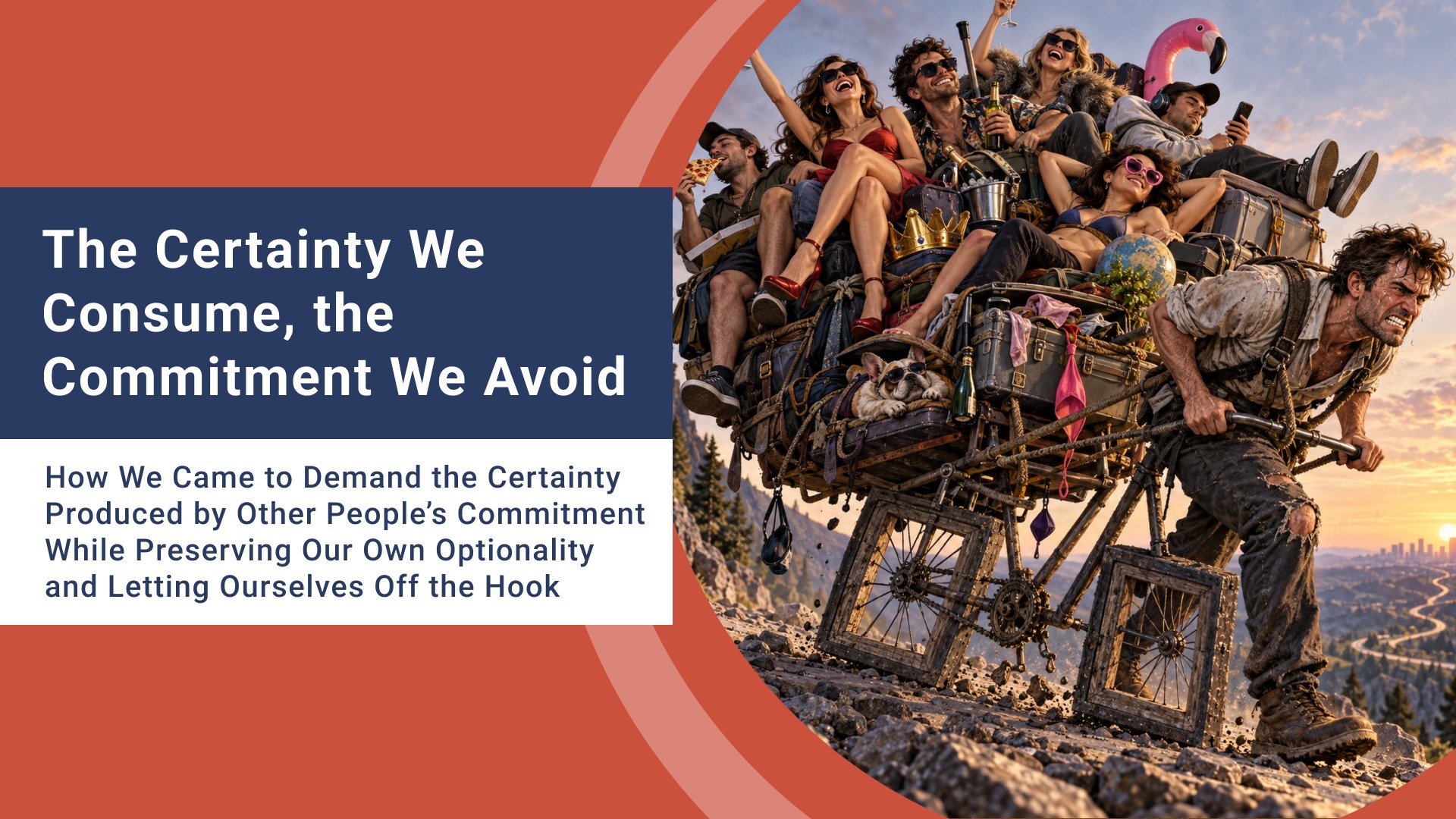
They may encourage further investment and repeatedly confirm that the shared future remains intact. Yet internally, they continue treating their own participation as optional. One person behaves as though the future is shared while the other behaves as though the future is merely available. One produces certainty while the other consumes it. One closes options while the other preserves them. One accepts responsibility for continuity while the other retains a private privilege of departure. One person’s optionality is financed by another person’s commitment. This is a hidden transfer of risk.
The committed person bears concentration risk because they organise resources around a particular future, decline alternatives and make downstream commitments. They become exposed to the consequences of failure precisely because they have treated the undertaking seriously.
The optional person enjoys much of the upside of the shared possibility while externalising a disproportionate share of the cost of its collapse. They want the fruit of commitment without its discipline. They want the relationship without being claimed by it. They want the opportunity without becoming responsible for its continuity.
They want access to the future while retaining the right to deny authorship of it. This may be the most corrosive form of entitlement in the entire phenomenon.
We increasingly want the benefits produced by other people’s commitment while preserving optionality over our own. The committed person becomes infrastructure for the uncommitted person.
Their dependability becomes something to consume. Their loyalty becomes a resource. Their consistency becomes security.
Their willingness to remain becomes the condition through which the other person can continue postponing a genuine decision. At that point, freedom becomes parasitic because one person’s optionality depends upon another person continuing to carry what they themselves refuse to carry.
This is the crisis beneath the crisis. We demand certainty from others while treating accountability for our own certainty-producing words as negotiable.
We want to be able to say “you can rely on me” when access to the opportunity depends upon it, while later reserving the right to reinterpret that sentence as “you were perhaps slightly optimistic to rely on me quite so literally”. The comedy is dark because the person paying for that reinterpretation is usually someone else.
The chain of yeses
The asymmetry becomes particularly serious when withdrawal follows repeated confirmations. A person does not merely say yes once and then unexpectedly encounter a radically transformed reality. They keep saying yes while another person builds. They keep authorising further reliance.
Are we proceeding? Yes. Should I involve these people? Yes. Should I decline the alternative offer? Yes. Should we make this public? Yes. Should I spend the money? Yes. Can I assure the team that you are with us? Yes. Are you still committed? Yes.
Each yes permits another consequence and increases reliance. Each yes expands the amount of reality organised around the person’s word. Each yes therefore increases the significance of a later no. This does not make withdrawal impossible, but it means withdrawal can no longer honestly be represented as a purely private event.
The longer I allow you to organise reality around my word, the greater my responsibility becomes for the consequences of withdrawing it. We might call this reliance accumulation. The withdrawing person experiences the final moment: I have decided not to continue. The other person experiences the entire sequence: you repeatedly authorised me to proceed.
Both statements can be true. Only one contains the history.
The ethical problem may therefore not be merely that somebody changed their mind. It may be that they continued saying yes while the cost of their eventual no was accumulating.
At some point, “I changed my mind” becomes such a radical oversimplification that it functions almost as a falsification of the relational history. The mind may have changed today, but the consequences began months or years ago.
The person withdrawing may never see what actually collapses
Part of what makes this easy to rationalise is that the person ending the commitment may never encounter most of its consequences. They experience the conversation in which they announced their decision, but not necessarily the web of effects radiating from it.
They may not see the opportunity declined six months earlier. They may not see the introduction somebody made on the strength of their involvement or the credibility another person spent.
They may not see the months of work that now have no viable destination. They may not see the promises made downstream, the family decisions shaped around the undertaking or the person who declined another role because the existing commitment appeared dependable. They may not see the team whose confidence has changed. They may not see how their withdrawal alters another person’s willingness to trust future partners. Not every consequence appears on a balance sheet. Some losses are futures that will no longer come into existence.
Some are forms of trust that become more conditional. Some are possibilities that committed people stop creating because experience has taught them that another person’s assurances cannot safely be treated as foundations. Repeated exposure to unaccountable withdrawal can alter the people most willing to build. The generous become cautious, the collaborative become contractual and the trusting become controlling.
The visionary begins demanding guarantees before creating anything. The person who once liked building with others starts wondering whether doing everything alone is, after all, the least exhausting form of teamwork. This is one of the darker social consequences of failed commitment. The damage does not stop with the thing that collapsed because it changes the architecture through which the next thing might have been built.
When enough people learn that commitment is unsafe, they begin withholding the very certainty on which cooperation depends. What begins as one person protecting their freedom can eventually reduce the freedom of everyone by making trust itself more expensive.
The Capacity question
Moral language alone, however, is not enough. Not every broken commitment begins with deception, laziness or selfishness.
A person may genuinely mean what they say when they say it. They may care deeply, intend to remain and have no conscious desire to exploit anyone.
Then reality begins to ask more of them than they anticipated. This brings us to one of the central wonderments within the Capacity discourse: despite everything we bring, why is it still not enough to meet what reality demands?
A commitment can eventually require far more than good intention. It may demand more courage, more emotional range, more ability to hold uncertainty, more stability under pressure and more willingness to remain present during conflict.
It may require more depth in confronting complexity, greater coherence between values, words and actions, more vulnerability, greater assertiveness, more resourcefulness and more ability to delay gratification. It may demand the capacity to metabolise disappointment, bear consequences and renew after depletion.
Someone can sincerely care and still discover that the demands of what they have undertaken exceed what they can presently carry. This is why commitment cannot be reduced to intention.
The question is not merely whether I meant what I said when I said it. The question is whether I possess, develop or organise sufficient capacity to continue inhabiting what I declared once reality begins making demands upon me.
This matters because a person can be sincere at the beginning and still become unreliable later. Sincerity explains the origin of the commitment, but it does not guarantee the capacity required to fulfil it.
Where commitment meets the threshold
The Threshold discourse gives us a way of seeing this more clearly. A threshold is not merely the point at which somebody decides they have had enough.
It concerns the relationship between the demands reality is presenting and the capacities presently available under the conditions that exist. The threshold appears where the demand being encountered begins to exceed what can presently be carried.
That threshold is not necessarily fixed. A person may carry the same commitment effectively under one set of conditions and reach a very different threshold when those conditions change. At the beginning of a partnership there may be energy, sufficient capital, goodwill, low conflict, reliable information, strong support and a compelling possibility. The demand remains comfortably below threshold.
Then progress slows, financial pressure increases and conflict appears. Trusted support disappears, family circumstances shift, uncertainty grows and a more attractive alternative presents itself.
Confidence may decline while fatigue rises. The demand has changed, and the capacities available to meet it may also have changed.
What had once been readily carried now approaches the person’s threshold. Capacities that previously seemed available may become harder to access precisely when they are most needed.
This can become visible through the six qualities within the Threshold discourse. Range concerns the breadth of demands, perspectives and conditions a person can hold without becoming overwhelmed or reducing the situation prematurely.
Depth concerns the extent to which someone can remain with complexity, significance and underlying structure rather than retreating to a shallow explanation. Stability concerns the ability to remain sufficiently grounded and functional as intensity increases.
Coherence concerns whether values, understanding, words and actions remain integrated rather than fragmenting under pressure. Responsiveness concerns the capacity to respond appropriately to what reality is presenting rather than becoming reactive, rigid or avoidant.
Renewal concerns the ability to replenish, recover and restore participation after sustained demand. A commitment may expose limits in any or all of these. A person may narrow their perspective, oversimplify the problem or become unstable. Their words and actions may diverge, responsiveness may deteriorate into reactivity and depletion may reduce their ability to renew.
At that point, several responsible pathways remain available. The person can develop capacity, the surrounding conditions can be supported, redistributed or redesigned or the commitment can be honestly renegotiated and, if necessary, responsibly concluded. There is also another pathway. The person can reconstruct the story so that abandoning the commitment feels entirely justified.
That is where compensatory mechanisms become important.
What we do when capacity is exceeded
People rarely announce with pristine self-awareness, “The demands of what I have undertaken have exceeded my presently available capacity, and I now need to confront this responsibly.” It would certainly make certain partnership meetings shorter.
More commonly, the person’s system begins compensating. The behaviour may look like moral failure from the outside and complete necessity from the inside.
Denial
Denial occurs when the person avoids recognising that their participation has materially changed. They insist that everything remains fine, provide reassurance without corresponding action and continue saying yes because acknowledging difficulty would require confronting consequences they do not yet feel ready to carry.
The other person therefore keeps building. Denial protects the person from discomfort now by increasing someone else’s exposure later.
Oversimplification
Oversimplification occurs when a complicated temporal and relational reality is compressed into a simple formulation such as “I changed my mind”, “I am no longer aligned”, “this does not feel right” or “I need to prioritise myself”. Any of these statements may contain truth, but the problem is not always that they are false.
The problem is that they can be radically incomplete. Months of commitments, confirmations, reliance, opportunity costs and consequences disappear behind a description of the person’s present state.
The statement explains what I feel now while quietly erasing what I authorised before. Complexity becomes inconvenient, so the story is reduced until accountability becomes easier to avoid.
Avoidance
Avoidance appears when calls are delayed, messages go unanswered, clear questions receive vague responses and difficult conversations are repeatedly postponed. The person neither provides a meaningful yes nor gives an honest no.
Ambiguity allows them to defer their own discomfort while somebody else continues carrying the uncertainty. Avoidance becomes particularly costly because the other person may keep investing precisely because a clear withdrawal has not occurred.
Commitment erosion
Some commitments are not broken dramatically. They are starved. A deadline is missed, then another. Participation decreases, initiative disappears and the person becomes progressively harder to reach.
No formal withdrawal occurs, but the burden slowly migrates to everybody else. The commitment dies through a thousand small omissions and, inconveniently, nobody receives a funeral invitation.
Dropping the commitment mid-sentence
A partnership, project or undertaking may remain very much alive in the lives of everyone involved when one participant privately stops treating it as real. They drop the commitment mid-sentence while the sentence continues for everyone else.
Teams remain employed, bills remain payable, clients remain expectant and promises remain outstanding. Other people continue organising themselves around a reality from which one participant has mentally departed.
The withdrawal is eventually discovered through consequences. Everyone else is left to infer that the agreement ended sometime earlier, apparently without the inconvenience of anybody being told.
The mental-condition wildcard
This mechanism requires particular care. Stress, burnout, anxiety, overwhelm, depression and other psychological or emotional conditions can genuinely affect capacity. They may radically change what somebody can carry. They may provide legitimate grounds for reducing, restructuring or ending an undertaking.
Recognising this matters. Yet recognition becomes distortion when an internal condition is used as an accountability-erasing wildcard. The implied argument becomes that because I am experiencing this, none of my previous commitments can now make any legitimate claim upon me and I bear no responsibility for what happens to those who relied upon them. That conclusion does not follow.
Capacity can explain why I cannot continue. It does not automatically erase responsibility for how I respond to that incapacity.
A person may genuinely be unable to carry the original undertaking and still remain responsible for honest communication, for ceasing to provide misleading assurances, for acknowledging impact and for participating in transition where reasonably possible. They can refrain from pretending that their internal condition has caused everybody else’s reality to disappear.
Explanation and exoneration are not the same thing. Compassion and accountability do not need to destroy one another.
The change-my-mind card
“I changed my mind” can become a card that ends the conversation before accountability begins. It relocates the matter into apparently inviolable private territory.
My mind belongs to me, my feelings belong to me and my preferences belong to me. Therefore, the reasoning goes, my decision to withdraw also belongs entirely to me. But a commitment does not remain confined to the mind. The moment another person reasonably acts upon it, the commitment enters shared reality.
It alters expectations and changes what actions become sensible. It changes what risks are taken, which opportunities are declined, which people become involved and which futures begin to be constructed. The change-my-mind card attempts to reclaim the commitment as though it had always remained private property. It had not, because others had already been invited to build upon it. This is why the freedom to withdraw and freedom from the consequences of withdrawal must be distinguished. A person may possess the first without possessing the second.
“I am allowed to change my mind” may be true, but it does not therefore follow that nobody may hold me accountable, that I owe no explanation or that I have no responsibility for transition. It does not mean previous assurances become irrelevant or that my internal change automatically nullifies the reality others constructed around my word.
The right to change one’s mind is not the right to behave as though one never gave one’s word. A private preference can change almost entirely inside one person, but a commitment creates relational residue.
When should a commitment be reopened?
A serious account of commitment must leave room for revision. New material information may appear, circumstances may fundamentally change or a serious violation may occur.
An ethical conflict may emerge, the undertaking may become genuinely impossible or the original agreement may have been founded on deception. Continuing may create substantial harm, or the person’s capacity may deteriorate in ways that cannot presently be restored.
These conditions matter. They are different, however, from experiences such as “I do not feel like it anymore”, “this became harder than expected”, “something else now seems more attractive”, “I am uncomfortable”, “I am less excited than I was” or “I have discovered another option”.
Those experiences may still be significant. They may reveal an approaching threshold, show that conditions require redesign or expose a problem that deserves attention.
But commitment partly exists because such experiences are foreseeable. If a promise survives only while participation remains easy, attractive and emotionally rewarding, there was very little reason for a promise in the first place.
The difficult question is not whether discomfort exists. The question is what the discomfort is revealing and what responsibility requires in response.
A reconstructive account of commitment
The reconstructive answer cannot be a return to blind loyalty. It cannot mean never changing one’s mind, never leaving, staying regardless of harm or glorifying endurance for its own sake. That would simply recover the coercive architecture from which modern ideas of autonomy rightly sought liberation. The reconstructive question is more demanding.
When reality asks more than our present capacity can carry, do we reconstruct our capacity, reconstruct the conditions, responsibly reconstruct the commitment or reconstruct the story so that abandoning it feels justified? Those are not equivalent moves.
A reconstructive account begins before the commitment is made. It asks us to consider entry, threshold, communication, capacity, consequence and repair as parts of commitment itself rather than as emergency measures after it has failed.
Enter carefully
Do not manufacture certainty because enthusiasm is high. Do not promise simply because saying no feels uncomfortable or because the opportunity appears attractive. Ask what resources, sacrifices, capacities and exclusions fulfilment may eventually require. Ask what will happen when excitement fades and when participation begins asking for courage rather than enthusiasm.
Ask what the commitment may require from you in conflict, uncertainty and disappointment, not only during possibility. A considered no can be more honourable than an enthusiastic yes that somebody else will later be required to pay for.
Recognise the threshold before collapse
Notice when the undertaking begins asking for more than is presently available. Pay attention to resentment, depletion, avoidance, fear, narrowing perspective and growing inconsistency. These are not automatically reasons to leave. They may be signals that capacity or conditions require attention.
A threshold recognised early creates room for support, development and redesign. A threshold denied tends eventually to present itself as crisis, because reality is patient like that.
Reveal difficulty while the commitment is still alive
If I know that I am wavering but continue giving you yeses while you invest further, I increase the eventual harm. This is one of the most consequential responsibilities contained within commitment.
Speak before the collapse. Saying “I am struggling to carry this”, “I am uncertain whether the current arrangement remains workable” or “we need to examine what has changed” may be uncomfortable, but it restores agency to the other person.
False reassurance removes their agency. The earlier difficulty becomes shared reality, the more possibilities remain for reconstruction.
Hold and metabolise rather than immediately flee
Within the Reconstructive Capacity Expansion Model, encounter is followed by holding and metabolising what reality presents before responding. This becomes especially important when a commitment moves towards threshold.
The person encounters pressure rather than instantly escaping it. They remain with the experience long enough to distinguish temporary discomfort from genuine impossibility. They examine fear rather than automatically obeying it. They confront disappointment without immediately converting it into a reason for withdrawal.
They stay with complexity long enough for a more adequate response to become possible. None of this guarantees continuation, but it improves the quality and sovereignty of whatever response follows.
Develop capacity or redesign conditions
Sometimes the commitment can become workable through increased capacity. At other times the conditions themselves need changing. Support might need to be added, responsibilities redistributed, timetables altered, missing capabilities developed or conflict addressed. Clearer information may restore coherence, or the demand itself may need to be redesigned without betraying the purpose.
Capacity is not synonymous with endurance. A capable response may involve changing the conditions rather than simply demanding that the individual carry more. The reconstructive question is what would allow reality to be met more adequately. Sometimes that requires development in the person, sometimes alteration in the system and often both.
Renegotiate rather than retroactively nullify
“I can no longer fulfil what I promised in its present form” is categorically different from “I changed my mind, therefore there is nothing further to discuss”. Renegotiation acknowledges that a real commitment existed. It recognises that others relied upon it. It does not pretend the past disappeared when the present changed.
A commitment may need to be modified, narrowed, delayed or concluded. Yet reconstruction begins by acknowledging the reality that already exists, not by editing history until the person departing appears never to have authored any of it.
Bear consequences
Freedom includes consequences and sovereignty includes authorship. A person cannot coherently claim authorship while the future appears attractive and then disown authorship when the consequences become difficult.
If withdrawal becomes necessary, responsibility includes facing what one’s previous word caused others to build. This does not mean assuming responsibility for every imaginable consequence, but it does mean refusing the fantasy that one’s participation left no residue.
Bearing consequences is not punishment added to freedom. It is one of the conditions that makes freedom meaningful rather than arbitrary.
Participate in repair
Repair will vary according to the commitment. It may involve notice, transition, completing particular obligations, protecting downstream people or transferring knowledge and relationships.
It may involve helping replace a role, compensating for a loss or directly acknowledging the cost imposed. Sometimes the most important repair is simply refusing to leave everyone else with both the damage and the story that nothing significant happened.
Withdrawal does not erase responsibility for the reality constructed before it. Responsible exit recognises that the way something ends can itself honour or dishonour what once existed.
Responsible discontinuation
There are times when honouring a commitment means ending it. This sounds paradoxical only if commitment is confused with permanence.
An undertaking may have become unethical, a relationship may have become destructive or the original purpose may no longer be achievable. Circumstances may have fundamentally changed or the demands may exceed available capacity in a way that cannot presently be reconstructed.
The question is not merely whether something ends. The question is how it ends.
There is a profound difference between abandonment and responsible discontinuation. A person can say, in effect, “I cannot continue in the present form. I am not going to pretend that my withdrawal is merely a private preference because I know you acted upon my word. I will acknowledge what has been built around my commitment, participate in addressing the consequences and leave in a manner consistent with the seriousness of what I undertook.” That is still withdrawal. It may still hurt and create genuine loss.
Yet it preserves authorship. The person remains related to the reality they helped create even while changing their participation in it. That is a very different human act from playing the change-my-mind card and disappearing into the moral immunity of personal preference.
Commitment is not rigidity
None of this means commitment should become motionlessness. A rigid person can remain in the same form while becoming increasingly disconnected from reality.
A committed person remains dedicated to what was genuinely undertaken while responding intelligently to changing conditions. A partnership may change roles while preserving its purpose, and a marriage may change practices while preserving its commitment.
A business may abandon a strategy while remaining committed to an outcome. An institution may alter policy without surrendering its ethical centre.
A person may change methods repeatedly while remaining faithful to what matters. Healthy commitment is therefore not the absence of change but continuity of authorship through change.
Responsiveness is what allows commitment to remain alive rather than fossilised. Commitment without responsiveness can become rigidity, while responsiveness without commitment can become endless adaptation to whatever happens to be pressing hardest today.
The civilisational cost of perpetual optionality
A society in which people cannot reliably make promises that survive changes in feeling becomes expensive. Trust must increasingly be replaced with surveillance, loyalty with incentives and partnership with elaborate contractual protection.
Community is replaced with temporary alignment, leadership with control and covenant with compliance. The less people can govern themselves across time, the more systems attempt to govern them externally. This produces an irony worth noticing. A culture intensely concerned with preserving individual freedom from commitment may eventually generate more external control because shared life cannot otherwise be coordinated.
If people cannot be trusted to carry promises, institutions require enforcement. If agreements possess little internal authority, they need external penalties. If people cannot sustain responsibility through self-discipline, systems multiply procedures, audits, controls and contingencies. Without self-governance, governance grows. There is something almost darkly comic about pursuing liberation from every self-imposed constraint until an entire compliance department is required to make us dependable. We may finally achieve absolute freedom at approximately the same moment that a twelve-page policy is required before anybody trusts us with the stationery cupboard. Sovereignty is therefore inseparable from dependable self-governance. If a human being cannot author themselves coherently through time, some larger system will increasingly attempt to do it for them.
Commitment, discipline and responsiveness are not enemies of liberty. In many contexts, they are among the capacities that prevent liberty from collapsing into disorder followed by external control.
Commitment as a Condition of Authentic Sustainability
From the perspective of Authentic Sustainability, this is not merely a problem of personal reliability. It is a sustainability crisis. Anything of enduring value, whether a relationship, organisation, institution, body of knowledge, community, enterprise or social endeavour, requires continuity of participation across time. Value may be initiated through creativity or enthusiasm, but it is sustained through commitment, responsibility, renewal and the willingness of participants to remain engaged after novelty has faded and difficulty has arrived.
A culture that treats commitment casually therefore begins consuming the very conditions required for sustainable value creation. People may still want the outcomes: strong organisations, dependable relationships, flourishing communities, meaningful work, trustworthy institutions and opportunities that endure. Yet these outcomes cannot be produced by beneficiaries alone. They require participants who carry responsibility for sustaining what they also expect to receive. When people repeatedly demand the certainty, stability and opportunity created by others while retaining unrestricted optionality for themselves, the system gradually becomes extractive. It consumes commitment faster than commitment is being replenished.
Leadership becomes particularly consequential here because leaders do not merely benefit from cultural norms. They help establish them. When a leader gives commitments casually, repeatedly revises their word without accounting for the consequences or treats responsibility as optional once circumstances become uncomfortable, others learn something about how participation works in that system. The same is true in partnerships, teams and communities. Participants continually model to one another what promises mean, how much weight a person’s word carries and whether responsibility survives difficulty. Commitment, like its absence, is socially multiplied.
This is why the phenomenon cannot be reduced to one person changing their mind. When repeated often enough, it becomes cultural. People begin protecting themselves from one another, withholding investment, building contingencies and refusing to depend deeply upon commitments that may disappear without warning. The result is not simply disappointment. The system progressively loses its ability to sustain cooperation, trust and long-term value creation.
Authentic sustainability therefore requires more than preserving resources or keeping something functioning. It requires forms of participation capable of reproducing the conditions through which value can continue to exist. Commitment is one of those conditions. When participants consume certainty without producing it, they are not merely leaving somebody else with a problem. They are depleting the relational and institutional substrate on which future possibilities depend. At sufficient scale, what appears to be a collection of private decisions becomes an epidemic of unsustainability.
Recovering commitment without recovering coercion
The answer is not to return to arranged loyalties, unquestioned authority, blind obedience or institutions from which departure is impossible. The central question is whether we can recover the binding power of commitment without recovering the coercive structures of the past.
That requires a more mature architecture of commitment. It requires free entry, serious consideration, clear promises, relational accountability, awareness of capacity and recognition of threshold. It requires responsiveness when conditions change, legitimate grounds for revision, responsible discontinuation where necessary, ownership of consequences and participation in repair. Above all, it requires enough continuity for human beings to actually build something together.
Freedom must include the right to leave, but it must also include the capacity to remain. Sovereignty must include the ability to change course, but also the coherence not to react compulsively. Responsiveness must include adaptation without becoming endless surrender to pressure. Discipline must allow what matters deeply to retain authority when something immediate becomes more attractive.
Commitment must enable a considered word to survive some of the feelings that follow it. Otherwise we have not built a culture of free people so much as a culture in which everybody is permanently available to reconsider everything.
That sounds liberating until you attempt to build anything.
Who produces the certainty you are consuming?
Perhaps this is where the inquiry eventually becomes personal. In every important relationship, partnership, institution or undertaking, certainty is being produced somewhere. Someone is making it possible for others to act without continuously protecting themselves. Someone is behaving dependably enough that other people can plan. Someone is carrying ambiguity, declining alternatives, absorbing risk and giving their word enough weight that another human being can lean some part of reality against it. The uncomfortable question is whether that certainty is reciprocal.
Am I producing the certainty I consume? Do I want other people to remain loyal while preserving my right to reconsider them?
Do I want collaborators to organise themselves around my involvement while I continue privately evaluating whether I am still interested? Do I want employees to believe in a company I am unwilling to stand behind?
Do I want a partner to close alternatives while I preserve mine? Do I want another person to bear the consequences of commitment while I retain the advantages of optionality?
These questions are more difficult than asking whether we technically possess the right to change our minds. Of course we do.
The deeper question is what kind of human being can inhabit a future they themselves have declared into existence. Can I remain present when my promise begins asking something of me?
Can I recognise that other people may have organised their reality around my word? Can I distinguish fear from clarity, responsiveness from reactiveness and sovereignty from rebellion?
Can I recognise when capacity has genuinely been exceeded without converting incapacity into immunity from accountability? Can I tell the truth while reconstruction is still possible?
Can I develop what needs developing, redesign what needs redesigning and end something responsibly when continuing is no longer workable? Can I bear some of the consequences of what I authored rather than merely the consequences I happen to prefer?
Most importantly, can I give another person certainty without secretly reserving all the privileges of optionality for myself? That may be one of the defining questions of mature participation.
A commitment is not merely an internal mental state. Once others reasonably begin coordinating their lives around it, it becomes a social and material fact.
One may retain the freedom to withdraw, but one does not thereby acquire freedom from the reality created by having committed. The right to change one’s mind is not the right to behave as though one never gave one’s word.
Nothing enduring can be built where everyone wants to consume certainty and nobody wants to produce it. Everything worth building eventually requires somebody to say, “You can build on this”, and then remain answerable to those words for longer than the feeling that produced them.