
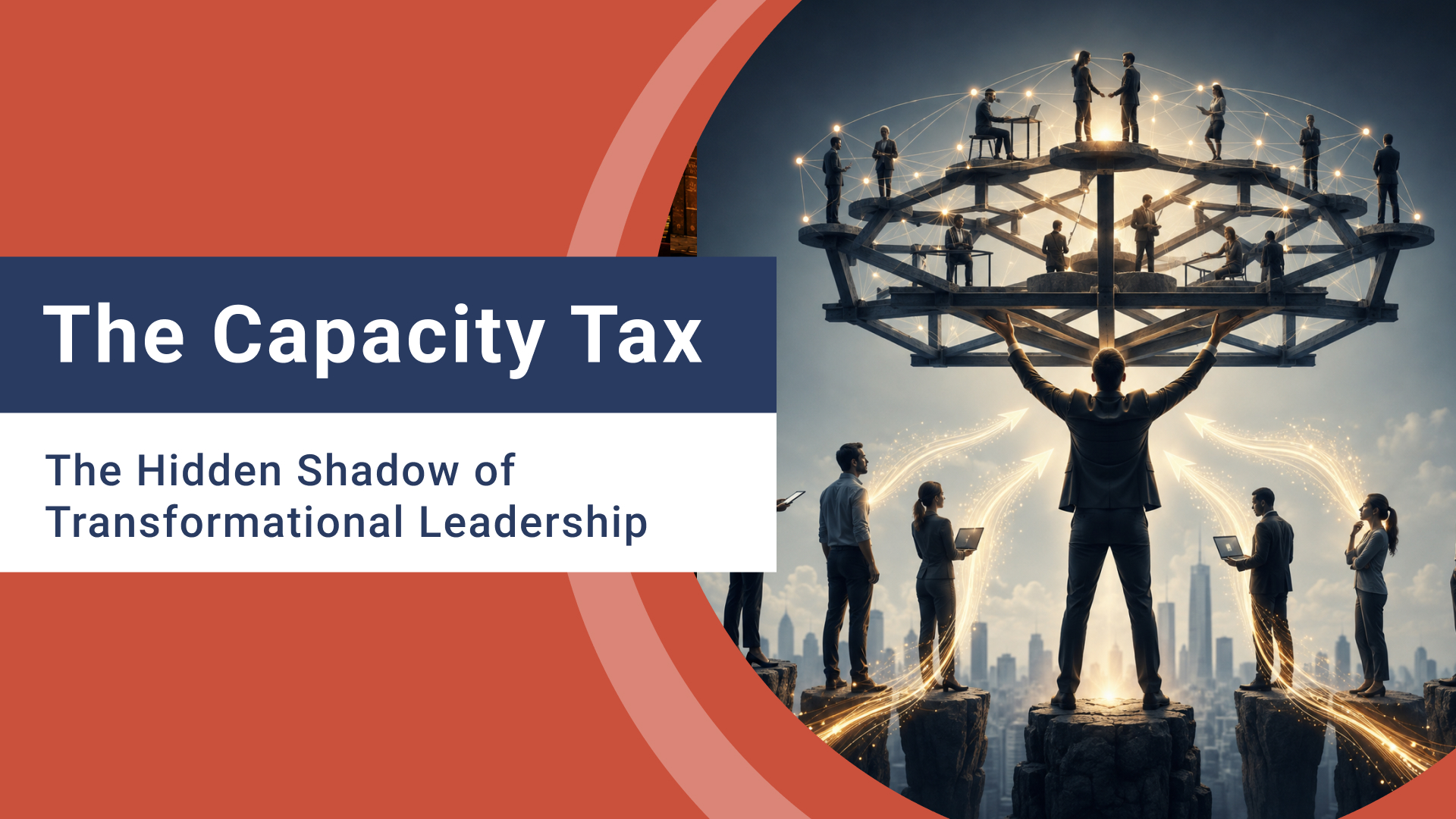
Transformational leadership has rightly been positioned as an advance over approaches built primarily around command, compliance and transactional exchange. People are not treated merely as resources to be deployed. Their potential is recognised, their development is supported and greater ownership is invited. Capacity is expected to expand rather than remain fixed.
Yet every leadership orientation casts a shadow. Where people are seen deeply, their limitations are also more easily understood. Where development is valued, present deficiencies can be interpreted as developmental opportunities. Where compassion is strong, consequences can be softened. Where a leader has unusually high personal capacity, the gaps around them can be silently absorbed.
A peculiar organisational condition can result: people may be developing while remaining insufficient for the roles they already occupy. The work still gets done, the client is still served and the deadline is still rescued, but only because additional capacity is being supplied from elsewhere.
This is where capacity tax begins.
What Is Capacity Tax?
Capacity tax is the hidden organisational cost created when the developmental capacity required to reliably carry a role exceeds the capacity presently available in the person occupying it, and the resulting gap is repeatedly absorbed elsewhere in the system. The resulting gap is repeatedly compensated for by stronger peers, senior leaders or founders.
The cost rarely appears as an obvious failure. More often, it appears as additional follow-up, repeated clarification, unnecessary escalation, delayed decisions, unresolved conflict, missed commitments, emotional load and senior intervention. Someone has to enter the situation, restore momentum, supply judgement, create clarity or carry responsibility that should already have been contained within the role.
Because the immediate outcome may still be achieved, the organisation can appear functional. The cost has simply been displaced. What looks like successful execution may partly be execution financed by borrowed capacity. This creates one of the more counterintuitive organisational paradoxes:
The stronger the senior leader, the longer insufficient capacity around them can remain hidden.
Highly capable leaders can compensate for extraordinary amounts of organisational weakness. Problems are caught before they become catastrophic, decisions are rescued, standards are restored, context is repeatedly supplied and breakdowns are metabolised before their full consequences become visible. The stronger person gradually becomes invisible infrastructure.
An organisation may therefore appear to possess a capable leadership structure while actually functioning through persistent transfers of capacity towards weaker points in the system.
What Is Meant by Capacity?
Capacity, as used here, should not be confused with skill, competence, productivity, intelligence or the amount of work a person can tolerate. In the broader developmental sense, capacity is the condition through which meaningful participation becomes possible. It shapes what a person can perceive, understand, receive, hold, integrate, act upon and sustain when engaging with reality.
Skills and competencies matter, but they operate within capacity. A person may possess considerable technical expertise while remaining unable to sustain responsibility under pressure, confront difficult realities, integrate feedback, exercise judgement under uncertainty or carry the consequences associated with a larger role. Equally, high effort or endurance should not be mistaken for capacity if performance can only be maintained through overextension, continual rescue or instability.
Capacity therefore concerns not merely whether something can be done once, but whether a person can reliably inhabit and sustain what a situation or role requires. It becomes especially visible at thresholds, where greater complexity, responsibility, uncertainty or consequence begins to exceed what can presently be carried without fragmentation, avoidance, collapse or transfer of burden to others.
This distinction matters for capacity tax. The issue is not simply that someone lacks a particular skill. A capacity gap exists when the developmental conditions required to carry the role are insufficient, causing parts of that responsibility to be repeatedly transferred elsewhere in the system.
The Shadow of Seeing People Deeply
People-oriented leadership contains a genuine strength. Behaviour is not immediately reduced to incompetence, laziness or bad intent. A failure to act may instead be understood through fear, self-protection, identity, sense-making, developmental history, interpersonal dynamics or insufficient capacity.
This can produce far better leadership. A person who procrastinates may not simply be told to work harder. A manager avoiding confrontation may be helped to recognise what makes confrontation difficult. A leader whose judgement collapses under pressure may be developed rather than immediately condemned.
The shadow appears when explanation begins to soften consequence. Once the source of a limitation is understood, the result can start to feel more acceptable simply because it has become intelligible. A critical distinction is therefore required: understanding the source of another person's limitation does not create an obligation to carry the consequences of that limitation.
A result can be understood and still be unacceptable. A person can be treated with dignity and still be held accountable. Compassion does not require standards to be lowered and accountability does not require the person to be devalued. A mature developmental culture must therefore be able to hold two realities at once: the person can be understood fully while the standard is held fully.
The Shadow of Development
A second problem appears when developmental potential becomes confused with present role capacity. These are related, but they are not the same thing. A person may be intelligent, committed, loyal, coachable and capable of significant transformation. They may even have demonstrated remarkable development over several years. None of this necessarily means they are presently capable of carrying the role they occupy. The distinction can be stated simply:
Developmental potential is not role capacity.
Potential concerns what may become possible. A role concerns what must be carried now. If an executive needs another two years of development before a role can be carried independently, the relevant organisational question is not whether that development is possible. The question is whether the organisation can afford to fund those two years through the consequences of the role itself. Sometimes it can. Sometimes it cannot. No moral judgement is required either way. The person has not necessarily failed. The role may simply exceed their present capacity.
This creates an important separation between commitment to a person's development and commitment to their continued incumbency in a particular role. Someone can be supported, respected and developed without an assumption being made that a particular organisational seat must continue to be occupied by them.
Development can continue after scope is narrowed. It can continue after repositioning and, in some cases, after a role has ended. A senior position is not a reward for loyalty, effort, alignment or personal transformation. It is an organisational responsibility that must be carried.
Participation, Contribution and Partnership
The dynamics behind capacity tax can be understood more deeply through three related but distinct concepts: Contribution, Partnership and Participation. Contribution and Partnership are distinct Ways of Being within the Being Framework, while Participation refers more broadly to the manner in which a person enters, engages with and affects reality. The distinctions matter because a developmental culture can unintentionally confuse being available to others with carrying what belongs to them, or confuse partnership with compensating for insufficient participation.
Contribution as a Way of Being
In BEING, Contribution is distinguished as follows:
“Contribution is when you are available to support and compelled to be of service to others to achieve what they are committed to and are also willingly available for others to support and serve you. It is an outward manifestation and expression of your care for others and humanity.
A healthy relationship with contribution indicates that you mostly experience being compelled to make a difference to other people and are open, receptive and comfortable in allowing others to make a difference to you. You experience satisfaction and fulfilment from being a contribution as well as being contributed to. Others may experience you as being intentionally supportive of them and what they are committed to.
An unhealthy relationship with contribution indicates that you mainly deal with challenges and breakdowns on your own. Others may experience you as unreceptive, disinterested or unavailable for support. You may lack the willingness to participate and add value to others, particularly if you know there is no immediate benefit for you. Your sphere of influence and impact on the world often occurs as narrow and limited. You may experience being unappreciated or consider that what you have to offer is of little value. You may also be resigned and cynical towards other people and question their motives. Alternatively, you may interfere instead of influence and give advice when it is neither asked for nor required. You may also pester others for help without due consideration of the impact on them.”
Tashvir, A. (2021) BEING, p. 419. Engenesis Publications.
Contribution therefore does not mean indiscriminately helping, rescuing or taking responsibility for another person's commitments. It involves being available to support what another person is committed to while remaining available to receive contribution in return. The distinction becomes especially important in leadership because support can become distorted into substitution. What begins as a genuine commitment to another person's development can gradually become the carrying of responsibilities that remain theirs to carry.
One of the shadows of highly contributive leadership is therefore over-contribution. The stronger leader repeatedly supplies judgement, courage, clarity, urgency or execution because those capacities are not yet sufficiently available elsewhere. The intervention may be experienced as generous and may even produce the desired immediate outcome, yet repeated intervention can prevent the actual state of capacity from becoming visible. Contribution has then ceased merely to support another person's participation and has begun partially to replace it.
The issue is not that too much care has been expressed. The issue is that the boundary between being a contribution to another person and becoming responsible for their contribution has been lost. Capacity tax often accumulates inside precisely this ambiguity.
Partnership as a Way of Being
Partnership is distinguished differently:
“Partnership is living from the viewpoint of being in union with others, an entity, team or organisation in the pursuit and fulfilment of a common purpose. It is when you are available to join with others who may share the same values, goals or commitments to create a disproportionate outcome in comparison to what each of you could possibly achieve alone. Partnership is the state of confluence where you embrace others and are available to influence each other. It is when you choose to powerfully collaborate and empower each other, irrespective of circumstances.
A healthy relationship with partnership indicates that you mostly experience being together, where common purpose, vision, intentions and goals are fulfilled. Others may experience you as being on the same journey with them. You appreciate the company of others and experience being connected, belonging and moving towards the same mutually fulfilling outcomes. You are steadfast in your relationships and will appropriately challenge and support others to bring out their best.
An unhealthy relationship with partnership indicates that you mostly experience being isolated and on your own. You may consider yourself independent, although you may also experience frustration and resentment around what is possible to achieve alone. Others may consider you unavailable, overly independent or a loner, and you may experience a sense of not belonging or disconnection. You may tend to initiate transactional relationships based on a trade-off (quid pro quo). You may sacrifice true intimacy and are often oblivious to the value of the contribution of others and the synergy that can be generated of a greater value than you could ever cause alone. Alternatively, you may initiate superficial relationships in the hope of instant gratification rather than investing, building, nurturing and developing long-term relationships.”
Tashvir, A. (2021) BEING, p. 432. Engenesis Publications.
Partnership therefore goes beyond cooperation or the division of labour. A state of confluence is involved in which people are joined around common purpose, remain available to influence and be influenced and generate outcomes that could not be produced independently. Appropriate challenge is as integral to partnership as support.
A shadow nevertheless appears when partnership is confused with protecting the other person from the consequences of insufficient participation. Being committed to a shared purpose does not require every gap to be silently absorbed by the more capable partner. If one participant repeatedly compensates for another in order to preserve the appearance of collective performance, confluence can gradually become dependency.
Healthy partnership requires differentiated responsibility within common purpose. Mutuality does not mean interchangeability and support does not remove authorship. Each participant must still carry what has been entrusted to them if the disproportionate outcome promised by partnership is to become possible.
Where this does not occur, what appears outwardly to be partnership may actually be a pattern of asymmetrical carrying. One participant becomes increasingly responsible not only for their own commitments but for maintaining the participation of others. Capacity tax is then paid in the name of partnership.
Participation as the Broader Field
Participation is broader than either Contribution or Partnership and should not be reduced to these two Ways of Being. Participation refers to the whole manner in which a person or system enters reality and takes part in what is occurring. It is expressed through action and inaction, interpretation, intention, attention, language, mood, courage, fear, care, neglect, presence and absence. Even withdrawal or refusal to participate does not place someone outside participation. It constitutes a particular manner of participating in what is occurring.
Contribution concerns being available to make a difference to what others are committed to and being available for others to make a difference in return. Partnership concerns being in union with others around common purpose and generating through confluence what could not be generated alone. Participation sits at a broader level. It concerns how one is present, how one engages, what one takes responsibility for, what one withholds, what one enables and what consequences are generated through that manner of involvement.
This broader distinction becomes especially important when capacity tax is considered. A leader may contribute extensively and may genuinely experience partnership with another person, but neither contribution nor partnership can replace the other person's participation. Support can be provided, capability can be developed, challenge can be offered and common purpose can be held, yet the authorship of another person's participation cannot ultimately be assumed without consequence.
When one person's participation becomes insufficient, someone else may temporarily compensate. At times this will be necessary. When compensation becomes persistent, however, the organisation begins to conceal rather than develop capacity. The stronger participant becomes responsible not merely for contributing to the other person but for sustaining the consequences of how that person is participating.
This provides a deeper way of locating capacity tax. Capacity tax is not generated simply because people have limitations. It is generated when the consequences of insufficient participation are persistently transferred to others and absorbed elsewhere in the system.
The developmental challenge is therefore not to withdraw contribution or weaken partnership. It is to preserve both without displacing authorship. People can be supported powerfully, challenged appropriately and joined around common purpose while responsibility for their participation remains fundamentally their own.
In this sense, one of the central disciplines of mature transformational leadership is learning to remain deeply contributive and genuinely partnered without taking over authorship of another person's participation. That is the point at which care can remain care, partnership can remain partnership and development can occur without being financed indefinitely through capacity tax.
How Capacity Tax Is Paid
Capacity tax is usually paid in fragments. A manager does not close an issue, so a founder follows up. A difficult conversation is delayed, so another leader intervenes. A commitment is missed, more context is supplied and the task eventually gets completed. A decision is escalated because responsibility has not been fully carried at the level where it belongs. Each intervention may appear small. Repeated across a leadership system, however, they become an accumulating tax on time, attention, judgement and emotional energy.
There are also circumstances in which capacity tax becomes quite literally financial. When insufficient capacity in one part of the organisation prevents the required result from being produced, the shortfall still has to be absorbed somewhere. A sales function that repeatedly fails to generate the revenue required to sustain the organisation provides an obvious example. If the underlying commercial capacity is not yet sufficient to produce the necessary result, founders or shareholders may continue injecting capital to cover the gap while the team is being developed. What appears to be developmental patience is therefore being financed through additional cash. The organisation is not merely paying for development through leadership attention, delayed decisions or emotional load; it is directly funding the consequences of insufficient capacity.
Similar patterns can occur through excess hiring, repeated use of consultants, unnecessary discounting, duplicated work, preventable client losses or additional working capital required to compensate for weak execution. In these cases, capacity tax ceases to be merely a metaphor. A deficiency in the capacity to produce required outcomes is converted into an actual economic cost borne elsewhere in the system. Temporary compensation may be entirely justified while capacity is being developed, but where the underlying gap persists without a credible trajectory towards greater independence, developmental investment can gradually become an indefinite organisational subsidy.
The most dangerous form is invisible substitution.
Suppose a role requires 100 units of capacity and the person occupying it reliably supplies 70. If the remaining 30 is continuously supplied by a stronger executive, the organisation appears to have a functioning 100-unit role. It does not. It has a 70-unit role-holder supported by 30 units of borrowed capacity.
If that borrowed capacity were removed, the real state of the role would become visible. This is one reason founder-dependent organisations can look stronger than they are. The founder becomes a lender of last resort for capacity, quietly covering deficits across functions that appear, on paper, to be independently led.
Capacity Building or Capacity Substitution?
Senior leaders should teach, challenge, coach and support others. Intervention is not itself evidence of a problem. The more useful distinction is between capacity building and capacity substitution. Capacity building increases the future independence of the person being supported. Capacity substitution preserves short-term performance by supplying what the role-holder is not yet able or willing to supply. The two may look almost identical in the moment.
A difficult conversation can be modelled once so that the manager becomes increasingly capable of handling similar conversations independently. That is capacity building. If the difficult conversation repeatedly has to be handled on the manager's behalf, capacity has been substituted. Strategic thinking can initially be scaffolded so that independent judgement develops. That is capacity building. If the strategy continues to be supplied from above while the role-holder mainly carries out instructions, substitution has occurred.
A breakdown can be used to improve judgement so that the same class of problem becomes less likely to recur. That is capacity building. If each breakdown is rescued, explained and then forgotten, the underlying deficit remains intact. A practical question can therefore be asked before repeated intervention: Is this intervention increasing future independence, or is it merely making present performance possible?
The distinction matters because capacity substitution can produce strong short-term outcomes while quietly weakening the long-term organisation.
The Founder as Chief Compensator
The problem becomes particularly acute in founder-led organisations. Founders often possess an unusual concentration of contextual knowledge, urgency, resilience, judgement, authority and commitment. Almost any organisational gap can therefore be drawn back towards them. A commercial problem appears and eventually returns. An interpersonal conflict stalls and eventually returns. Execution slows, strategic ambiguity remains unresolved or an executive cannot make a difficult decision and, again, the issue returns.
The founder gradually becomes the Chief Compensator.
This recurrence is often interpreted as evidence that more coaching is required. Sometimes it is. Chronic recurrence, however, may indicate something more structural: the role itself is not yet founder-independent. A useful test follows. If the founder were removed from a particular domain for several weeks, would the function continue to perform at the required level? Would decisions continue to be made, standards remain intact, problems be anticipated, conflict be resolved and commitments be met without repeated reminders or rescue?
If the answer is consistently no, the person may still be a capable manager, practitioner or emerging leader. What has not yet been demonstrated is full executive capacity. A senior executive should progressively multiply the founder's capacity, not require the founder's capacity in order to function.
When Transformational Leadership Promotes Too Early
Developmentally oriented organisations are particularly vulnerable to promoting people according to who they are becoming rather than what they can already carry. Such promotions can appear entirely reasonable. Growth has been visible, trust is strong, values are aligned, the philosophy is understood and the person appears ready for the next developmental stretch.
Stretch is valuable, but stretch has limits. A role can serve as a developmental stretch only when sufficient underlying capacity already exists to carry its essential commitments. When title and responsibility move substantially ahead of capacity, the role itself becomes the developmental programme. The organisation then begins paying for growth through operational breakdown.
This produces a more useful diagnosis than simply concluding that the wrong people were selected. Good people may have been placed into larger seats earlier than their demonstrated capacity justified because stronger leaders were able to fill the difference.
If so, the problem is not primarily one of character or even selection. It is one of leadership architecture. The answer is not necessarily to remove the people. The structure has to be redesigned so that development continues while titles and scope no longer run materially ahead of capacity.
Define the Seat Before Assessing the Person
Roles often evolve around the people already occupying them. Over time, expectations become shaped by individual strengths, weaknesses and history. This makes objective assessment increasingly difficult. A stronger discipline begins by defining the seat independently of the incumbent.
For each senior role, a small number of non-negotiable capacities should be made explicit. These may include outcome ownership, anticipatory thinking, decision quality, speed, ability to confront difficult issues, reliability around commitments, team leadership, judgement under uncertainty and the capacity to translate strategy into execution without unnecessary escalation.
The central question is not whether someone is a good person, nor even whether they are a good leader in the abstract. The question is more precise:
Does this seat function properly in this person's hands without continual compensation from above?
That question often produces a very different assessment.
Separate Assessment From Development
Strong developmental cultures are particularly vulnerable to contaminating assessment with possibility. The moment a gap is identified, attention moves towards what could be taught, coached, clarified or transformed. That developmental instinct is valuable, but assessment sometimes requires it to be suspended. A demanding test can be used:
If this person were unknown to the organisation today and only the available evidence were considered, would they be appointed to this exact role?
The question is not whether they are valuable, loyal, hard-working or capable of future development. Nor is it whether they should remain in the organisation. The question is narrower: would they be selected for this seat today? Only after that question has been answered should developmental potential re-enter the conversation.
Four Responses to Capacity Gaps
Once the role has been defined independently and present capacity has been assessed, four broad responses become available.
Keep applies where the person currently possesses sufficient capacity for the role. Development continues, but it expands already sufficient capacity rather than compensating for its absence.
Narrow applies where the person is valuable and capable, but the present scope exceeds what can reliably be carried. Responsibility is reduced until capacity and scope are brought back into alignment.
Reposition applies where genuine strengths exist, but those strengths belong in a different role. A weak executive may be an excellent functional leader. A poor people manager may be a highly capable specialist. A strategist may struggle in a role dominated by operational execution.
Replace applies where one or more essential requirements remain persistently absent and the resulting capacity tax has become too high.
These are organisational responses, not judgements of human worth. Their purpose is to restore alignment between responsibility and the capacity available to carry it.
Human Limitation Is Not Role Incapacity
Capacity should not become another language for perfectionism. Every person has limitations and no executive will reproduce another person's exact combination of drive, temperament, judgement and stamina. A leader may think more slowly but more carefully. Another may require more preparation before difficult conversations. Someone may have less stamina than a founder while still being entirely sufficient for the role. The relevant benchmark is therefore not the highest-capacity person in the organisation. It is the requirement of the seat.
This distinction is especially important around unusually capable founders. Their personal operating style can easily become an implicit minimum standard for everyone else, creating chronic disappointment and preventing differentiated strengths from being recognised.
People do not need to resemble the founder. They need to be sufficient for the role.
Developmental Runway Is Not Organisational Entitlement
Development requires time, but time can quietly become entitlement. Tenure, loyalty, cultural alignment, accumulated knowledge and demonstrated growth all matter. None creates an automatic right to a particular role. A useful distinction can therefore be made between developmental runway and organisational entitlement.
Developmental runway exists when ownership, learning velocity and observable progress justify continued investment. Organisational entitlement begins when previous investment is treated as a reason that title or scope must remain unchanged regardless of present capacity. A senior seat must ultimately be justified by the capacity required to carry it.
The Need for External Capacity
Developmentally strong organisations often prefer to grow their own leaders. The advantages are significant: trust is deeper, culture is preserved, shared language is stronger and institutional knowledge accumulates. A closed developmental ecosystem, however, can normalise its own level of functioning.
If nearly every senior leader has developed within the same system, there may be no external benchmark for what mature executive capacity looks like elsewhere. Local norms become self-reinforcing and what is considered 'senior' may partly be a product of internal comparison.
In these circumstances, one or two proven external executives can have disproportionate value. Their contribution is not limited to the work they personally produce. A different level of ownership, anticipation, judgement, escalation and decision cadence becomes visible to the wider system. The organisation acquires a new reference point. For this reason, some appointments may need to follow a different sequence. A developmentally oriented organisation may historically have progressed through:
culture → development → capability
For certain load-bearing executive roles, the sequence may need to become:
capability → cultural alignment → development
The philosophy is not abandoned. The ordering is corrected.
Do Not Replace Everyone
Discovering a systemic capacity problem can produce an equally dangerous overcorrection. If many leaders appear to be operating above their present capacity, widespread replacement may seem like the cleanest solution. It rarely is.
Institutional knowledge is capacity. Trust is capacity. Relationships, cultural continuity and historical understanding are also forms of capacity. Removing too many people simultaneously can destroy these assets faster than new executive capability can replace them. The opposite mistake is equally damaging: because everyone cannot be changed at once, nobody is changed.
A sequencing principle is therefore needed. Roles can be prioritised according to the combination of founder dependency and organisational consequence. The most urgent role is not necessarily occupied by the weakest person. It is the role where insufficient capacity creates the greatest consequence while repeatedly drawing the most senior capacity back into compensation. Those roles should be addressed first.
Make Capacity Tax Visible
Once capacity tax has been recognised, it should no longer remain anecdotal. Patterns can be observed. How often is senior intervention required? How many commitments require repeated follow-up? How frequently are decisions escalated unnecessarily? How often are deadlines achieved only after rescue? How much senior time is spent clarifying, correcting or completing work that belongs elsewhere? How frequently does the same class of breakdown recur after support has already been provided?
These are not merely indicators of poor performance. They are indicators of capacity transfer. This changes how interventions should be interpreted. When a senior leader rescues a critical outcome, the operational result may be positive while the role-readiness evidence remains negative. Both truths need to be retained.
Otherwise, rescue produces false organisational data. The organisation records that the outcome succeeded while forgetting that the role-holder could not independently produce it. Capacity tax becomes most dangerous precisely when its payment repeatedly prevents failure from becoming visible.
The Aim Is Not Less Compassion
None of this requires transformational leadership to become colder, harsher or more transactional. The stronger conclusion is that cleaner distinctions are needed between compassion, development, accountability and consequence.
A person can be understood without being excused. They can be supported without being carried. They can be developed without being retained indefinitely in an oversized role. A limitation can be accepted without its consequences being repeatedly absorbed by others. Someone can be deeply valued without being entitled to a particular seat.
This is not a retreat from transformational leadership. It is what transformational leadership may need to become as it matures. The shadow emerges not because compassion, development or transformation are misguided, but because each can exceed its proper function. Development becomes substitution. Understanding becomes excuse. Loyalty becomes entitlement. Support becomes carrying. Potential becomes premature promotion.
The corrective is not to abandon these values, but to restore the distinctions between them.
Transformation Is Not a Substitute for Capacity
An organisation is a developmental environment, but it is not only a developmental environment. It is also a vehicle through which commitments are fulfilled in the world. Clients must be served, products must work, promises must be kept, decisions must be made, resources must be allocated, problems must be confronted and standards must be protected.
If performance is repeatedly sacrificed in the name of development, the conditions that make sustained development possible will eventually be weakened. A further principle is therefore required alongside transformational leadership:
Transformation is not a substitute for capacity.
The purpose of development is not to justify indefinite insufficiency. Development should progressively increase the capacity to participate effectively in reality, carry greater responsibility and respond to greater complexity without continually transferring the burden elsewhere. Where development does not produce greater ownership, judgement, reliability, range or independence, its organisational meaning must eventually be questioned.
A Practical Leadership Reset
A serious leadership reset does not require a developmental culture to be abandoned. It requires the architecture around that culture to become more disciplined. Roles should first be redesigned from the commitments they exist to carry rather than inherited unquestioningly from the current organisational chart. Their non-negotiable capacities should then be defined before incumbents are discussed. Current leaders should be assessed against present capacity rather than future potential, with founder independence treated as a central test of executive readiness.
Repeated senior interventions should be recorded as evidence rather than forgotten once an immediate problem has been solved. Incumbents can then be kept, narrowed, repositioned or replaced according to the alignment between their demonstrated capacity and the requirement of the seat. Roles carrying the greatest combination of founder dependency and organisational consequence should be addressed first, while external executive capacity can be introduced where internal development has not yet produced the necessary level.
Development should continue throughout this process. What should disappear is the assumption that development necessarily requires title, scope and responsibility to remain unchanged. One final question can cut through years of history, loyalty and developmental narrative:
If the organisation were being designed today, with no emotional history and the leadership structure being built from first principles, would this person be appointed to this exact seat?
If the answer is no, that answer deserves to be taken seriously. It does not automatically mean the person should leave. It means the existing architecture should no longer be treated as justified simply because it already exists.
The deeper task is not to find flawless people, nor to stop believing in transformation. It is to construct organisations in which people can remain human, imperfect and developing while responsibility remains proportionate to the capacity that can actually be carried.
The strongest developmental cultures may ultimately be those in which care does not become carrying, understanding does not become excuse, potential does not become premature promotion and transformation does not become a subsidy for insufficient capacity.
That is where capacity tax becomes visible. It is also where it can begin to fall.