

Background - How Sustainability Became Something Else
Sustainability did not fail because it was wrong. It failed because it was inconvenient.
At some point, sustainability required adults to look at supply chains, industrial design, logistics, energy systems, and long-term trade-offs. It required admitting that modern convenience was structurally expensive and that fixing it would mean slower growth, lower margins, and decisions no one could market nicely on a billboard.
That version of sustainability did not survive long.
What replaced it was something far more elegant and far more profitable. Sustainabilism.
Sustainabilism is sustainability stripped of engineering and infused with morality. It does not ask how systems are built or who benefits from them. It asks how individuals behave in small, visible moments. It thrives on symbols, rituals, and gestures that look meaningful while remaining operationally irrelevant.
In Sustainabilism, the problem is never structural. It is behavioural. The planet is not collapsing because of globalised manufacturing, petrochemical dependency, or industrial-scale packaging. It is collapsing because someone, somewhere, forgot to bring a reusable bag.
This shift is not accidental. It is strategic.
Systems are expensive to change. People are cheap to condition. It is far easier to modify consumer behaviour at the checkout than to redesign packaging standards across thousands of suppliers. It is far easier to sell guilt than to dismantle complexity. And guilt, unlike infrastructure, renews itself daily.
So sustainability was repackaged into something lighter, friendlier, and far more controllable. A version where responsibility flows downward, accountability evaporates upward, and morality is measured in micro actions that never threaten the system producing the damage.
Plastic bags were not banned because they were the greatest environmental sin. They were chosen because they were visible, familiar, and emotionally effective. They could be removed without changing anything important, and their absence could be framed as progress.
What followed was not environmental reform. It was behavioural theatre.
Introduction - Where Responsibility Now Begins
The modern sustainability experience does not begin in a factory, a port, or a boardroom. It begins at the checkout.
This is the point where environmental responsibility is finally clarified for the individual. Not through information, context, or structural understanding, but through a small, mildly humiliating transaction. You are asked a question that carries far more moral weight than it deserves. Do you need a bag?
Around you is plastic in its most confident form. Plastic-wrapped produce. Plastic trays. Plastic seals. Plastic labels explaining sustainability in soothing fonts. None of this is up for discussion. None of this is negotiable. The system has already made its decisions.
But the bag is different. The bag is personal.
You are offered a paper bag that looks like a bag but behaves like a suggestion. It is thin, fragile, and priced just high enough to feel corrective. This is not a design oversight. This is the point. The bag is not there to carry groceries. It is there to carry responsibility.
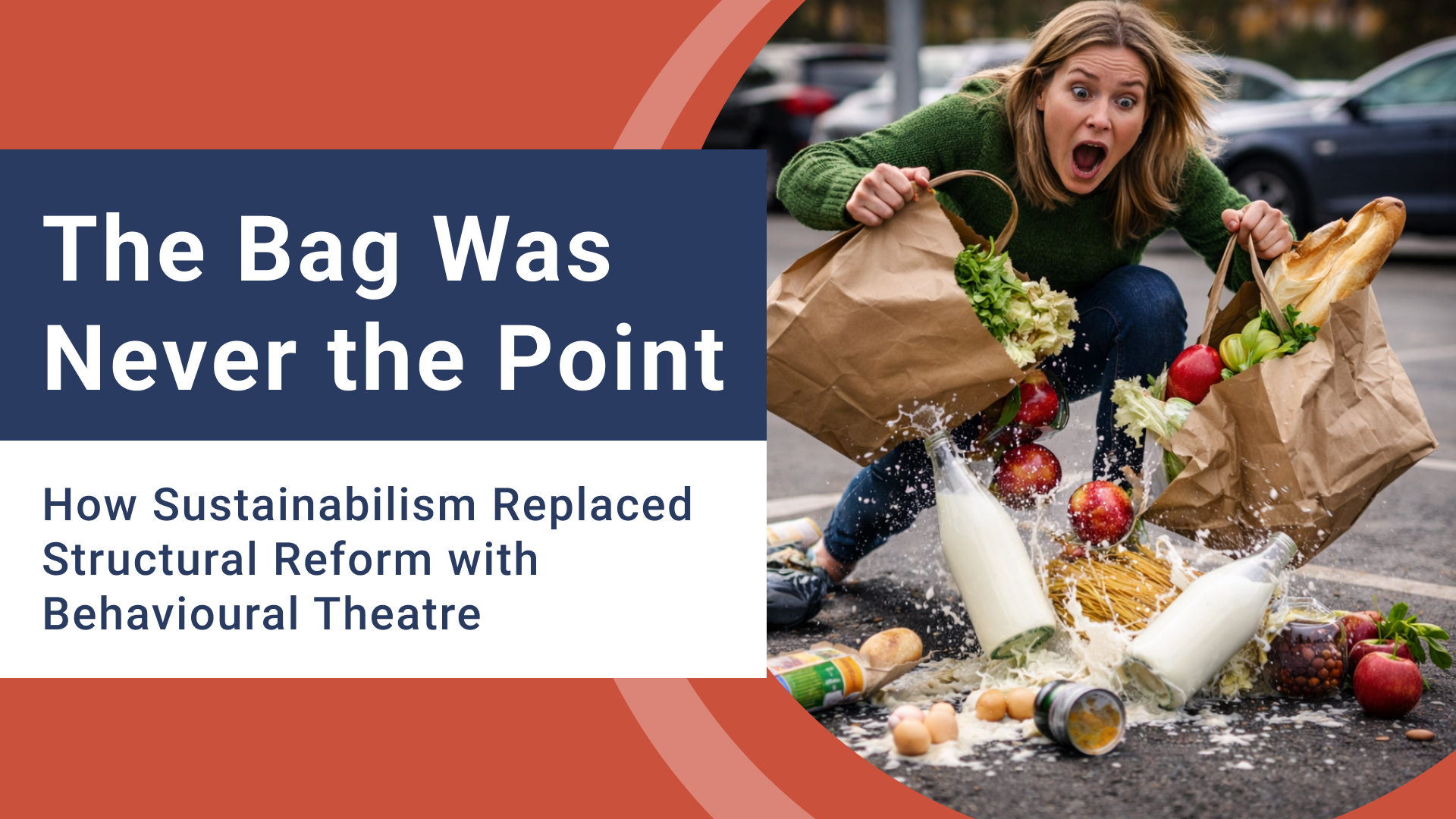
When it tears under the unbearable weight of two bottles of milk, the message is subtle but clear. You should have known better. You should have prepared. You should have brought your own bag. The system has done its part. Now it is your turn to reflect.
This moment captures the genius of Sustainabilism. Nothing meaningful has changed upstream. Packaging remains intact. Supply chains continue as before. Industrial waste flows uninterrupted. But a ritual has occurred. A lesson has been delivered. A transaction has been moralised.
This article is not about plastic bags. Plastic bags are merely the sacrament. This is about how sustainability was transformed into a behavioural script where individuals perform responsibility while systems remain untouched. It is about how guilt became cheaper than reform, symbolism replaced substance, and inconvenience was mistaken for impact.
From here, we can finally look at what Sustainabilism actually does, who it protects, and why it feels so convincing while achieving so little.
The Architecture of Guilt
Sustainabilism works because it has mastered a simple inversion. Responsibility is relocated to the point of consumption, while causality remains safely upstream and out of reach. The individual becomes the visible actor in a drama whose script was written long before they entered the shop.
This inversion is elegant. It removes the need to discuss manufacturing standards, supplier contracts, transport emissions, petrochemical incentives, or the quiet mathematics of scale. Those conversations are complex, expensive, and uncomfortable. Instead, the system offers something simpler. A choice. A small test of virtue. A moment where you can pass or fail.
The checkout becomes a confessional. Did you bring your bag? Did you refuse the plastic straw? Did you select the product with the green label and the reassuring language? Each micro decision is framed as meaningful, even heroic, while remaining safely irrelevant to the structures that actually generate harm.
This is not accidental. Guilt is a remarkably efficient technology. It requires no infrastructure, no redesign, no capital investment. It renews itself endlessly and it scales beautifully. One person at a time, it converts systemic failure into personal obligation.
The brilliance of the design is that when nothing improves, the narrative remains intact. If waste increases, if emissions rise, if oceans fill with plastic, it is not because the system failed. It is because people did not try hard enough. They forgot their bags. They bought the wrong thing. They lacked discipline.
In this way, Sustainabilism does not solve problems. It stabilises them. It creates the appearance of motion while ensuring that responsibility never travels upward. The system remains morally clean. The individual absorbs the weight. And the cycle continues, reinforced by rituals that feel corrective without ever being corrective.
Inconvenience as Impact
One of the great achievements of Sustainabilism is its ability to confuse inconvenience with effectiveness. If something feels annoying, awkward, or mildly punitive, it must be working. Discomfort becomes evidence. Frustration becomes proof.
This is why solutions are carefully designed to irritate without threatening anything important. A flimsy paper bag that tears under minimal load is not an accident. It is a signal. It teaches you a lesson while leaving the supply chain untouched. It creates a memorable failure without creating any structural change.
Real environmental reform is rarely felt at the individual level. It happens quietly in material choices, manufacturing standards, logistics optimisation, and regulatory frameworks. It is dull, technical, and largely invisible. Sustainabilism cannot survive that kind of boredom.
Instead, it offers moments you can feel. Moments where you are inconvenienced just enough to internalise responsibility. You are slowed down, charged a small fee, or made to feel unprepared. The experience is framed as growth. You are becoming a better person.
The problem is that inconvenience scales poorly as impact. A thousand torn paper bags do not offset a single unchanged packaging contract. A million guilty consumers do not outweigh a single unaltered production line. But the theatre works because it is emotionally legible. People can see their own effort even if nothing else moves.
This is how symbolic actions become sacred. They are repeatable, measurable, and easy to moralise. They give institutions something to point to and individuals something to carry. The planet, meanwhile, remains unaffected, watching patiently as society congratulates itself for being uncomfortable.
Who This Actually Serves
Sustainabilism is often presented as a collective moral awakening, but it functions far more like an insurance policy. Not for the planet, but for institutions.
By relocating responsibility to the individual, organisations protect themselves from scrutiny. They can speak the language of care while continuing business as usual. They can publish commitments, targets, and values while ensuring that none of these interfere with margins, suppliers, or scale.
Supermarkets remain efficient. Manufacturers remain optimised. Logistics remain unchanged. The system remains intact.
What changes is the story.
If environmental damage persists, the explanation is already prepared. People did not comply enough. They forgot their bags. They chose convenience. They lacked discipline. The narrative never has to look upstream because it has successfully trained everyone to look inward.
This arrangement is extremely convenient for corporations and regulators alike. It avoids conflict with the industry. It avoids expensive redesign. It avoids political resistance. It creates the appearance of action without the cost of action.
It also provides excellent data. Behaviour can be tracked, nudged, and measured. Compliance can be reported. Metrics can be generated. None of them need to correlate with actual environmental outcomes. They only need to show participation.
The public, meanwhile, is left with the impression that sustainability is something they are failing at personally. Not because the system is poorly designed, but because they did not perform correctly at the checkout.
In this way, Sustainabilism does not challenge power. It protects it. It transforms structural responsibility into individual burden and then congratulates itself for raising awareness.
This Is Not a Defence of Indifference
None of this is an argument for apathy, carelessness, or pretending that individual behaviour does not matter. Individuals are part of systems. We always have been. Our actions, habits, and choices do have consequences, especially when they scale.
Nor is this a dismissal of environmental responsibility at a personal level. Caring about the environment is not the problem. Acting thoughtfully in everyday life is not the problem. Micro actions are not meaningless.
What is being questioned here is something far more specific. The hypocrisy. The double standards. The quiet abdication of responsibility by those with the greatest capacity to change outcomes.
When consumers are disciplined for forgetting a bag while walking through aisles saturated with plastic, something is clearly misaligned. When inconvenience is imposed at the checkout but packaging decisions upstream remain untouched, the imbalance becomes impossible to ignore. The scale of plastic embedded in products, logistics, and presentation vastly outweighs the symbolic inconvenience placed on individuals, yet only one of these is moralised.
This is not shared responsibility. It is redistributed responsibility.
The issue is not that consumers are asked to care. It is that they are asked to care performatively, while corporations and systems continue to operate as before. Responsibility is framed as personal precisely where power is absent, and excused where power is concentrated.
Once you look at the volume of plastic in a typical grocery store and compare it with the fragile paper bag offered at the end, the contrast becomes unmistakable. The problem is not environmental concern. It is the mismatch between who is inconvenienced and who is accountable.
That is the critique. Not of individuals, but of a system that asks them to carry the weight of decisions they did not make.
What Authentic Sustainability Would Actually Require
Authentic sustainability would be deeply inconvenient, but not in the way Sustainabilism prefers. It would be inconvenient for institutions, not individuals. It would interfere with contracts, margins, timelines, and comfort at the level where decisions are actually made.
It would start upstream, in materials, packaging standards, supplier requirements, transport logic, and product design. It would involve fewer choices at the checkout, not more. You would not need to prove your virtue because the system would already have done its job.
Authentic sustainability would be boring. It would be technical. It would require engineers, regulators, and executives to do unglamorous work that does not photograph well and cannot be gamified. It would reduce harm quietly, without asking for applause or participation trophies.
Most importantly, it would not need you to feel guilty.
You would not be asked to perform responsibility through symbolic gestures. You would not be trained through inconvenience. You would not be blamed when structural problems persist. The system would either work or it would not, and accountability would sit where authority lives.
That is precisely why Sustainabilism exists.
Real sustainability threatens power. Sustainabilism flatters it. Real sustainability demands reform. Sustainabilism offers rituals. Real sustainability changes systems. Sustainabilism changes behaviour just enough to keep everything else the same.
So the next time your paper bag tears and your groceries spill onto the car park, take a moment. Not to feel ashamed, but to appreciate the sophistication of the performance. The system has once again avoided itself, handed you the responsibility, and walked away lighter.
The planet did not need a bag.
It needed adults willing to redesign the system.
And that, inconveniently, is still pending.
Closing Note - What the Ritual Leaves Behind
Sustainabilism will continue to feel persuasive because it feels personal. It gives people something to do, something to remember, something to forget to remember next time. It turns planetary-scale problems into small moral moments and then measures success by how uncomfortable those moments feel.
It will continue to thrive because it asks nothing of power and everything of individuals. It is lightweight, scalable, and endlessly renewable. Unlike real sustainability, it does not threaten growth, profit, or convenience. It simply reframes them.
So keep the rituals. Buy the bag. Feel the moment. Perform the care. Tell yourself this is what responsibility looks like now.
Just do not confuse the performance with progress.
Real change does not arrive with a receipt. It arrives when systems are redesigned by people who can no longer outsource responsibility to the checkout.
And until then, enjoy the paper bag. It was never meant to last.