
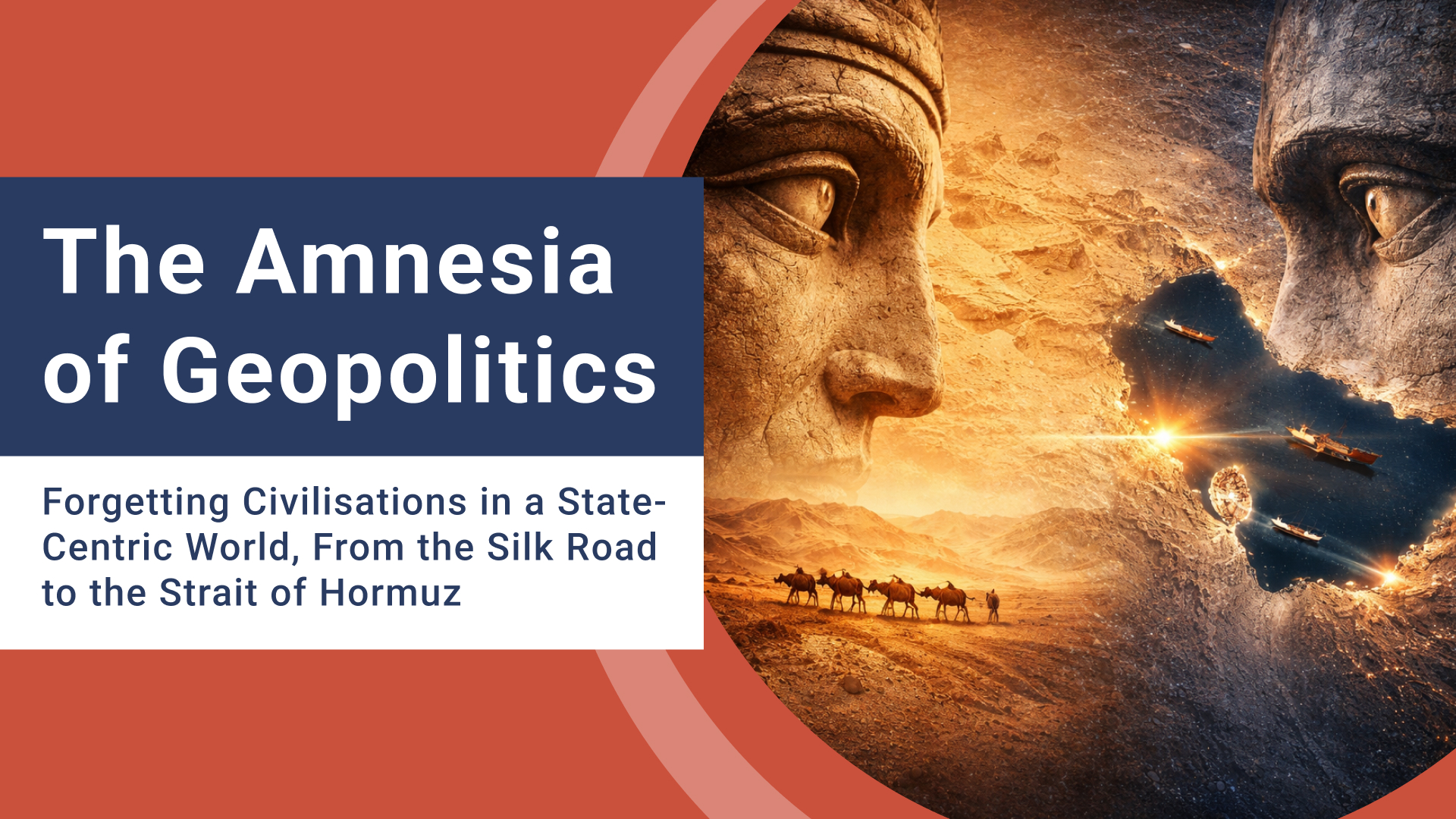

Background
Most conversations about geopolitics today begin in the present and rarely travel far beyond it. At best, they stretch back a few decades. Occasionally, they reach into the twentieth century. What is being analysed are states as they appear now, with their current borders, leadership, and alliances. The assumption, often unspoken, is that these configurations are the primary reality, and everything else is context.
This piece takes a different position.
It is not a history lesson. It is not a conventional geopolitical analysis. It is an attempt to step beneath the surface of current events and examine the deeper structures through which power, interaction, and alignment take shape over time. What is being explored here is not the behaviour of states alone, but the continuity of civilisations and the patterns through which they relate to one another across centuries.
Empires rise and fall. Civilisations remember.
When we speak today of China, Iran, or the West, we are not speaking of entities that emerged recently and began interacting within the last hundred years. We are speaking of civilisations that have been in contact, in tension, in exchange, and at times in quiet alignment for over two thousand years. What changes are the names, the governing systems, and the political expressions? What persists are deeper orientations, accumulated memory, and recurring roles within larger systems.
Around two thousand years ago, a connected world already existed across Eurasia. The Han Dynasty in the east, the Parthian Empire in the Iranian plateau, the Kushan Empire across Central Asia and northern India, and the Roman Empire in the west were not isolated powers. They formed a system. Not a unified one, and not always a stable one, but a system nonetheless, connected through movement, exchange, and mutual awareness.
At the centre of this system sat not a single empire, but a network. What is commonly referred to as the Silk Road was not one road, but a series of interconnected routes that carried goods, people, ideas, and influence across vast distances. Silk moved westward. Precious metals and glassware moved eastward. Horses, technologies, and beliefs travelled in multiple directions. What mattered was not only what moved, but how it moved, and who controlled its movement.
This is where the structure begins to reveal itself.
The Parthians did not need to dominate Rome or China to become indispensable to both. By sitting between them, they shaped the conditions of exchange. The Kushans did not merely connect regions. They enabled translation, transmission, and transformation across cultures. The Han produced goods that others desired. Rome consumed and projected influence outward. None of these roles existed in isolation. They were interdependent, held together by pathways that were as strategic then as energy corridors are today.
In the contemporary world, attention often turns to places like the Strait of Hormuz, where a significant portion of global energy supply passes through a narrow maritime channel. Control, influence, or disruption in such a location has consequences far beyond its geography. The Silk Road functioned in a similar way, not as a single chokepoint, but as a distributed system of corridors where control over flow translated directly into leverage.
When this layer is ignored, what remains is a flattened view of the present. States appear as isolated actors. Relationships seem recent. Conflicts appear sudden. Yet when the deeper continuity is brought back into view, a different picture emerges. What appears new begins to reveal lineage. What seems fragmented begins to show structure.
This is the lens through which the rest of this piece unfolds.
The System Beneath the Surface
If we step back from names, borders, and regimes, what begins to emerge is not a collection of isolated empires, but a structured system organised around roles.
Around the first and second centuries of the Common Era, Eurasia was not dominated by a single power, nor divided into disconnected regions. It was shaped by four major civilisational poles, each occupying a distinct position within a broader network.
In the east, the Han Dynasty functioned as a centre of production and internal coherence. Its administrative capacity, agricultural base, and technological output allowed it to generate goods that were both valuable and sought after far beyond its borders. Silk was the most visible of these, but it was not the only one. What mattered was not just production, but the stability and continuity that made such production possible at scale.
In the West, the Roman Empire operated with a different orientation. It absorbed, consumed, expanded, and projected. Its power extended through military reach, infrastructure, and the ability to integrate diverse territories into a broader imperial system. Demand flowed inward, while influence extended outward.
Between these two poles sat the Parthian Empire, not as a peripheral actor, but as a decisive one. Its geography placed it across the main corridors linking east and west. It did not need to replicate the production capacity of China or the expansionist drive of Rome. Its strength lay in position. By shaping access, timing, and conditions of exchange, it exercised leverage that neither producer nor consumer could easily bypass.
Further to the east of Parthia, and often overlooked in simplified accounts, the Kushan Empire occupied a different but equally important role. It was not merely a passageway. It was a civilisational bridge. Through its territories, connections extended not only between China and Persia, but also into the Indian subcontinent. Goods moved, but so did ideas, artistic forms, and religious traditions. What passed through this region was often transformed in the process.
Taken together, these four were not arranged in a straight line. They formed a network with multiple nodes, each contributing differently to the functioning of the whole. Production, consumption, mediation, and transmission were not abstract concepts. They were embodied in civilisations.
This is the layer that is often missing in contemporary analysis.
When the world is viewed only through the lens of modern states, these roles disappear. What remains are actors interacting in ways that appear fragmented and reactive. Yet when the underlying structure is brought back into view, a pattern becomes visible. Not a repetition of history in a literal sense, but a recurrence of positions within a system shaped by flow, access, and interdependence.
The Silk Road did not create this system. It revealed it.
The Artery of Flow
What held this system together was not diplomacy in the modern sense, nor formal alliances, nor a shared political framework. It was movement.
What is commonly referred to as the Silk Road was not a single route drawn across a map, but a living network of pathways through which goods, people, and ideas travelled across Eurasia. These routes shifted over time, adapted to terrain, conflict, and opportunity, yet their function remained consistent. They enabled connection between civilisations that were otherwise separated by vast distances.
Silk is often used as the symbol of this network, and with good reason. Produced in large quantities under the Han Dynasty, it became one of the most desired commodities in the Roman Empire. Yet focusing only on silk risks missing the deeper structure. Alongside it moved spices, metals, glassware, horses, and technologies. Even more significantly, beliefs, artistic traditions, and systems of thought travelled along these same pathways.
There was no single commodity equivalent to oil in the modern sense. The ancient world did not run on one resource that powered all others. Instead, it was sustained by a constellation of essentials. Grain supported life, iron enabled tools and warfare, horses provided mobility, and silk facilitated long-distance exchange. What bound these together was not their individual importance, but the routes through which they moved.
Control over these routes translated into power.
The Parthian Empire did not need to match the productive capacity of China or the military scale of Rome to become indispensable. By occupying the corridors that connected them, it influenced the terms of exchange. It could facilitate trade, delay it, tax it, or redirect it. At times, it limited direct contact between east and west, preserving its position as intermediary. The Kushan Empire extended this dynamic further east, enabling connections into the Indian subcontinent and shaping what passed between regions.
This logic is not confined to the past.
In the contemporary world, attention often turns to narrow maritime passages such as the Strait of Hormuz, through which a significant portion of global energy supply must pass. The importance of such a location does not lie in what it produces, but in what it enables and constrains. Influence over a corridor can have consequences that extend far beyond its immediate geography.
The Silk Road functioned in a similar way, not as a single chokepoint, but as a distributed system of corridors. Control was rarely absolute, yet influence was constant. Movement depended on conditions, and those conditions were shaped by the actors positioned along the routes.
This reframes how power operated across the system.
It was not held solely by those who produced or those who consumed. It was also held by those who shaped the path in between.
The Human Layer: When Civilisations Intersect
Systems, routes, and empires explain structure, but they do not fully capture how civilisations meet. That happens at a more granular level, through individuals, ideas, and the quiet ways in which cultures enter one another.
The opening of contact between the Han Dynasty and the Parthian Empire was not only the result of expanding trade routes. Under Emperor Wu of Han, envoys such as Zhang Qian moved westward, gathering knowledge and establishing early diplomatic awareness. These missions helped stabilise pathways that would later become central to the Silk Road network.
Yet the most enduring connections did not always take the form of treaties or trade agreements. They appeared in more subtle ways.
In the second century, a Parthian figure, An Shigao, travelled east and settled in Luoyang. He was not acting as a representative of state power, nor as a merchant seeking opportunity. He had renounced his royal inheritance and devoted himself to the transmission of Buddhist thought. In China, he became one of the earliest translators of Buddhist texts into Chinese, shaping how these ideas would be understood and integrated.
This movement was not unidirectional. What travelled was not simply preserved. It was interpreted, adapted, and embedded within a different civilisational context. In this sense, the Kushan and Parthian spaces were not only corridors of movement, but zones of transformation.
Traces of these encounters remain in unexpected places. The surname “An” (安), associated in early Chinese records with people from Anxi, reflects one such trace. While not all who carry this name today descend from Parthian origins, some lineages do, pointing to a moment where geography, identity, and movement intersected in ways that outlived the empires themselves.
Sometimes the connection moves through trade routes. Sometimes through theology and religion. Sometimes it settles into something as small as a surname. What we call separate nations today are often threads of a much older fabric.
This layer is easy to overlook because it does not announce itself in the language of power. It does not appear in treaties, conflicts, or official narratives. Yet it is often here that continuity is most deeply preserved.
Deep Time: Beyond Religion and Modern Identity
What becomes visible through these exchanges is not only connection, but continuity. Long before the emergence of modern states, and even before the consolidation of the religious frameworks that shape much of today’s discourse, the regions we now call China and Iran were already home to deeply rooted civilisations with established systems of governance, philosophy, and meaning.
The Iranian plateau, across successive formations, sustained one of the world’s oldest civilisational continuities. Traditions such as Zoroastrianism, among the earliest organised religious systems, developed within this context and contributed to broader currents of thought that would later intersect with other traditions. What followed in later centuries, including the rise of Islam, did not erase this foundation. It layered upon it, interacting with what was already present.
A similar continuity can be observed in China. The transition from dynasties to modern political structures did not constitute a reset. Administrative logics, philosophical traditions, and civilisational orientations evolved, but they did not begin anew. They carried forward patterns that had been shaped over centuries, adapting without fully severing their roots.
This is not a comparison of religions, nor a claim of precedence in a competitive sense. It is an observation about continuity. Civilisations do not restart when new belief systems emerge. They absorb, reinterpret, and continue. Layers accumulate. Forms change. Orientation persists.
When this depth is ignored, contemporary identities are often misread as singular and self-contained. Iran is reduced to a modern political system. China is framed only through its current governance. The West is treated as a recent configuration of alliances. Each is analysed as though it exists primarily within the timeframe of modern geopolitics.
Yet what is being observed today sits on top of much older foundations. These are not newly formed actors navigating a recent world. They are civilisations carrying forward accumulated memory, interacting within structures that extend well beyond the present moment.
Understanding this does not predict outcomes, nor does it impose determinism. It simply restores depth to analysis, allowing what appears fragmented to be seen within a longer continuum.
Rivalry and Contact: Persia and Rome
If the eastern and central parts of this system were held together through exchange and transmission, the western edge was shaped by something else. Between the Parthian Empire and the Roman Empire, the relationship was not only economic or positional. It carried a deeper layer of rivalry, one that extended beyond territory into how each understood power, order, and legitimacy.
Their frontier, stretching across Mesopotamia and regions such as Armenia, was not a fixed line but a contested zone. Control shifted, influence fluctuated, and both sides sought advantage without ever fully absorbing the other. Armenia itself became a space of indirect competition, aligned at times with one, then the other, reflecting a struggle that was as much about positioning as it was about conquest.
Encounters between them revealed not just military differences, but contrasting approaches to warfare and organisation. The Roman reliance on structured infantry formations met the mobility of Parthian cavalry, particularly in engagements such as the Battle of Carrhae, where Roman expectations of dominance were decisively challenged. What appeared as a military defeat was also an exposure of limits, a recognition that the system contained actors that could not be easily reduced or absorbed.
Yet even within this rivalry, separation was never complete. Trade continued. Goods moved. Silk that originated in the Han Dynasty passed through Parthian-controlled routes and reached Roman markets. Wealth flowed back in the opposite direction. The same corridors that enabled connection between east and west also sustained interaction between rivals.
This duality is important.
The relationship between Rome and Parthia was not one of pure opposition. It was a condition of tension within interdependence. Each constrained the other, yet neither could operate entirely outside the system they jointly occupied. Conflict and exchange coexisted, not as contradictions, but as parallel expressions of a deeper dynamic.
What makes this particularly relevant is not the surface similarity to modern conflicts, but the underlying pattern. Rivalry here was not only about territory or resources. It reflected differing civilisational orientations, ways of organising power, and approaches to engagement with the world beyond their borders.
Seen from this perspective, the system was not divided into isolated blocks. It was structured through relationships that combined competition, dependence, and mutual awareness, often at the same time.
The Present: China, Iran and the West
When this deeper structure is brought back into view, the present begins to look less like a new configuration and more like a continuation expressed through different forms.
What is today described as the relationship between China and Iran is often framed in the language of recent agreements, energy trade, and strategic alignment. These elements are real. China is a major buyer of Iranian oil. Infrastructure, logistics, and long-term cooperation have been formalised through agreements and initiatives that extend across decades. Yet to interpret this relationship only through these developments is to see the surface without the depth beneath it.
The interaction between these two regions did not begin with modern diplomacy. It sits on top of more than two millennia of contact, exchange, and indirect alignment that moved through the same corridors once occupied by the Parthian Empire, the Kushan Empire, and the Han Dynasty. What has changed are the mechanisms. What persists is the orientation toward connection through flow, trade, and strategic positioning.
At the same time, Iran’s relationship with what is now referred to as the West, often led by the United States, is marked by sustained tension. Sanctions, political confrontation, and competing interests define much of the current interaction. Yet even here, the relationship is not one of total separation. Economic realities, regional dynamics, and global systems ensure that interaction continues, even when framed as opposition.
China’s relationship with the West adds another layer. It is characterised by competition across technology, influence, and economic systems, while remaining deeply interdependent. Trade continues at scale. Supply chains remain connected. Rivalry does not eliminate exchange. It coexists with it.
When these relationships are viewed together, a triangular structure begins to appear.
China engages with Iran through cooperation shaped by energy, infrastructure, and long-term positioning. Iran engages with the West through tension, resistance, and negotiation. China and the West operate within a condition of competition intertwined with dependency. Each relationship is different in form, yet none exists in isolation.
This is not a direct repetition of earlier eras, but the pattern is recognisable.
In the past, the Roman Empire, the Parthians, and the Han occupied positions that were defined not only by what they produced or consumed but by how they related to one another within a system shaped by flow. Today, the actors have changed, the technologies have advanced, and the scale has expanded, yet the underlying structure continues to reveal itself through the same interplay of cooperation, tension, and interdependence.
Understanding the present through this lens does not simplify it. It deepens it.
The Pattern: Recurring Roles Across Time
When the surface of events is set aside and attention is directed toward structure, a pattern begins to emerge. Not a repetition in the literal sense, and not a fixed script that history follows, but a recurrence of roles within systems shaped by flow, access, and interdependence.
In the earlier Eurasian system, different civilisations occupied distinct positions. The Han Dynasty functioned as a centre of production and internal coherence. The Roman Empire projected outward, absorbing and integrating, creating demand that extended beyond its borders. The Parthian Empire shaped the conditions of exchange by controlling key corridors, while the Kushan Empire enabled connection, translation, and transmission across regions.
These were not labels attached to identity. They were functions within a system.
When the present is examined through this lens, a similar distribution of roles begins to appear, though expressed through different actors and mechanisms. The West, often led by the United States, continues to project influence across military, financial, and institutional domains. China operates with a strong orientation toward production, infrastructure, and long-horizon planning. Iran, positioned within critical geographical and strategic corridors, engages through mediation, resistance, and control of access in ways that extend beyond its immediate scale.
This is not an equivalence. It is a correspondence at the level of structure.
The actors are not the same. The conditions are not the same. The technologies and institutions are vastly different. Yet the system continues to organise itself around production, consumption, control of flow, and transmission. These functions do not disappear. They reconfigure.
The role once embodied by the Kushans, as a concentrated civilisational bridge, no longer appears in a single form. It is distributed across multiple regions, networks, and infrastructures. What was once held within a defined geography now exists as a more diffuse system of connectivity, embedded in trade routes, logistics networks, and cultural exchanges that span continents.
What this reveals is not continuity of power, but continuity of structure.
Modern analysis often focuses on events, policies, and immediate outcomes. It tracks decisions, reactions, and short-term alignments. Yet beneath this, the system continues to be shaped by deeper dynamics that do not operate on the same timeframe. These dynamics influence how actors position themselves, how they respond to pressure, and how they engage with one another within a shared space.
To recognise this is not to predict the future or impose a deterministic reading of the past. It is to acknowledge that what appears as new often emerges within an existing pattern, one that has been forming, adapting, and reconfiguring over centuries.
The names have changed. The structures have evolved. The roles continue to reappear in different forms.
The Blind Spot: When Time is Collapsed
The difficulty is not a lack of information. It is a limitation in how that information is organised and interpreted.
Modern geopolitical analysis tends to operate within compressed timeframes. It observes events, tracks policy shifts, and interprets behaviour within windows that are often measured in years, at most decades. Within this frame, states appear as primary actors, their actions understood as responses to immediate pressures or strategic calculations confined to the present.
This creates a blind spot.
When time is collapsed, continuity disappears. What remains are fragments. Relationships appear recent. Alliances seem opportunistic. Conflicts are interpreted as sudden escalations rather than expressions of longer-standing dynamics. Regions are reduced to their current political configurations, as though these configurations define the entirety of their identity.
This is not an absence of intelligence. It is a consequence of the level at which sense-making is taking place.
When analysis remains at the level of surface content, it engages with what is visible and immediate. It tracks events, statements, and outcomes, but it does not reach into the deeper layers where patterns form and persist. The result is a form of understanding that is reactive, often accurate in detail, yet limited in depth.
The interaction between China, Iran, and the West is a clear example. Examined within a short timeframe, it appears as a shifting set of strategic moves. Economic agreements are read as opportunistic alignments. Tensions are framed as ideological clashes or policy disagreements. Each development is analysed in isolation, as though it exists primarily within the current moment.
When a longer frame is applied, a different structure becomes visible.
The corridors that once connected the Han Dynasty, the Parthian Empire, and the Roman Empire have not vanished. They have transformed. Trade routes have become supply chains. Caravans have become shipping lanes. Points of passage such as the Strait of Hormuz now carry energy rather than silk, yet the logic of flow and control remains.
The actors operating within these structures are shaped not only by present incentives, but by accumulated orientations that extend beyond recent history. These orientations influence how power is projected, how relationships are formed, and how responses are calibrated under pressure.
Ignoring this layer does not make it disappear. It only removes it from view.
What follows is an interpretation of the present that is technically informed, yet structurally incomplete. It can describe what is happening, but it struggles to explain why certain patterns persist, why certain alignments recur, and why certain tensions do not resolve easily.
Restoring depth does not simplify the picture. It complicates it in a necessary way. It reconnects the present to a longer continuum, where events are not isolated points, but expressions of underlying structures that have been forming over extended periods of time.
Higher Purpose: The Loss of Horizon Beyond the Present
What sits beneath this collapse of time is not only a limitation in analysis. It reflects something deeper in how individuals and collectives relate to the future.
The difficulty is not simply that modern geopolitical discourse ignores history. It is that it increasingly struggles to hold a horizon that extends beyond immediate concerns. Attention is drawn toward what is urgent, visible, and actionable in the present. What lies beyond that horizon, whether in the past or the future, becomes secondary, fragmented, or abstract.
Within the Being Framework, this capacity is articulated through the distinction of Higher Purpose.
Higher Purpose is not an abstract ideal. It is the orientation through which individuals and societies relate to something greater than their immediate interests. It shapes priorities, informs decisions, and determines whether actions are confined to short-term outcomes or aligned with longer arcs of continuity. Where this orientation is present and healthy, it enables the ability to hold time in a more integrated way. Where it is absent or distorted, the horizon narrows.
The distinction is defined as follows:
Higher purpose is being drawn and compelled towards a future vision or cause greater than your personal concerns and beyond your immediate interests and/or comfort in such a way that it sets your priorities and worldview. It’s going beyond yourself and your time without expecting immediate gratification to identify resolutions that will drive you towards that future vision. Higher purpose is considered the source of the inspiration and charisma required to effectively influence, inspire and develop others as leaders.
A healthy relationship with higher purpose indicates that you draw yourself forward to fulfilling challenges you wouldn’t normally take on. You are resolute, willing to delay gratification and have the fortitude to go beyond your own discomfort and self-concern to fulfil your future vision. Others may consider you a charismatic leader who is visionary and committed to something meaningful and worthwhile.
An unhealthy relationship with higher purpose indicates that you may be shortsighted, narrow-minded, self-centric or selfish. You are mostly driven to fulfil immediate personal concerns and ambitions. You may be limited and constrained by your personal goals and desire for instant gratification while being oblivious to or ignoring the needs and wants of others. Others may frequently challenge and question your motives as a leader and may not experience inspirational leadership from you. Unable to zoom out and see the bigger picture, you may often get stuck in the present with a fragmented narration of the past and future. Alternatively, you may detach yourself and zoom out too much, being so captivated by and engrossed in your long-term vision that smaller, short-term progression seems insignificant to you. This may lead you to lose sight of and fail to appropriately address more immediate obstacles and barriers.
Reference: Tashvir, A. (2021). BEING (p. 341). Engenesis Publications.
When this capacity is functioning well, it draws attention beyond the immediate. It allows for continuity to be recognised, for patterns to be held across time, and for actions to be taken that are not solely driven by short-term gain. It enables a form of leadership and a form of collective sense-making that is not confined to the present moment but is informed by both inheritance and trajectory.
When this capacity is weakened or distorted, the opposite occurs.
Attention collapses into immediacy. Interpretation becomes reactive. The past is selectively referenced, often reduced to fragments that serve current narratives. The future is either ignored or engaged with superficially. What remains is a compressed field of perception in which events appear disconnected and relationships seem to form and dissolve without continuity.
This has direct implications for how civilisations are understood.
In the absence of a healthy relationship with Higher Purpose, civilisations are reduced to their current political expressions. States are treated as origins. Dynasties are seen as beginnings and endings rather than transitions. What spans centuries is compressed into decades. The deeper fabric that persists across change becomes difficult to perceive.
Empires rise and fall. Dynasties come and go. Political systems transform. Yet the civilisational substrate continues, carrying patterns, orientations, and accumulated meaning across time. To see this requires more than access to information. It requires the capacity to hold a horizon beyond the present.
Higher Purpose, in this sense, is not only a personal distinction. It is a civilisational one.
Closing: The Return of Depth
What emerges from this view is not a reclassification of current events, but a shift in how they are understood. The present is not a starting point. It is a moment within an ongoing structure, shaped by interactions that extend far beyond the timelines typically used to interpret them.
When China engages with Iran, when tensions persist between Iran and the West, when competition and interdependence define the relationship between China and the West, these are not isolated developments. They are expressions of a system that has long been organised around production, consumption, control of flow, and transmission. The actors have changed. The mechanisms have evolved. The scale has expanded. The underlying structure remains recognisable.
This does not reduce complexity. It restores it.
Empires rise and fall. Civilisations remember.
What we are observing today is not the emergence of entirely new dynamics, but the latest articulation of patterns that have been forming, adapting, and reconfiguring over centuries. Trade routes have become supply chains. Strategic corridors have shifted from land to sea. The Silk Road has given way to networks that move energy, data, and capital across the globe. Yet the central question remains unchanged. Who produces, who consumes, and who controls the path between them.
When analysis is confined to the present, these dynamics appear fragmented. When depth is restored, they begin to align into a structure that can be more coherently understood.
This is not an argument for inevitability, nor a claim that history repeats in fixed cycles. It is a call for a broader lens. One that recognises that what appears new often carries the imprint of what came before, and that understanding the present requires more than proximity to it.
The names have changed. The structures have evolved. The patterns endure.
References
Daryaee, T. (2009). Sasanian Persia: The Rise and Fall of an Empire. I.B. Tauris.
Foltz, R. (2010). Religions of the Silk Road. Palgrave Macmillan.
Frankopan, P. (2015). The Silk Roads: A New History of the World. Bloomsbury.
Garver, J. W. (2006). China and Iran: Ancient Partners in a Post-Imperial World. University of Washington Press.
Hansen, V. (2012). The Silk Road: A New History. Oxford University Press.
Liu, X. (2010). The Silk Road in World History. Oxford University Press.
Tashvir, A. (2021). BEING. Engenesis Publications.
Tashvir, A. (2023). Metacontent. Engenesis Publications.
Tashvir, A. The Exposure Probability Model (EPM). Engenesis.com
Tashvir, A. The Weight of Truth. Engenesis.com
U.S. Energy Information Administration (EIA). (2023). World Oil Transit Chokepoints.