

The Intolerable Complexity
The human mind prefers clean villains. It prefers stories where one side is clearly oppressive and the other clearly righteous. This preference is not stupidity. It is psychological efficiency. Simplicity stabilises identity. Complexity destabilises it.
But reality is rarely simple.
A political system can be internally coercive and externally resistant at the same time. It can restrict dissent within its borders while simultaneously acting as a counterweight to larger imperial structures beyond them. Those two realities can coexist. They are not mutually exclusive.
Most people cannot hold that sentence without discomfort.
If you criticise the internal repression, you are immediately assumed to be endorsing external intervention. If you criticise external domination, you are assumed to be defending internal tyranny. The space between these positions collapses. Nuance becomes betrayal.
This collapse is not accidental. It is the defence mechanism of coherence.
Every society constructs a narrative that holds it together. That narrative defines who the enemy is, what justice looks like and where legitimacy resides. When someone introduces layered analysis, when they say the regime is oppressive but the external powers circling it are not altruistic either, the narrative fractures.
And when narratives fracture, identities tremble.
Binary thinking then becomes a refuge. It restores psychological stability. It allows people to choose a camp and feel morally certain again. But that certainty is purchased at the cost of accuracy.
The intolerable complexity is this: a people can suffer under their own rulers and still be vulnerable to predation from beyond. Removing one does not automatically neutralise the other. In fact, in some cases, it strengthens it.
Holding two truths is not moral equivalence. It is structural accuracy.
This is the point most crowds refuse to examine. They are exhausted. They want a single villain. They want a single solution. They do not want to confront the possibility that they are caught inside a layered power field where both internal coercion and external strategy operate simultaneously.
To hold that complexity requires cognitive discipline. It requires resisting the emotional satisfaction of picking a side too quickly. It requires accepting that the collapse of one structure does not automatically produce sovereignty, and that resistance to empire does not automatically produce justice.
That is intolerable for many.
So the mind simplifies. The camps harden. The narrative becomes sacred. And anyone who insists on holding both truths at once becomes suspect.
The Jon Snow Problem: When the Enemy Changes
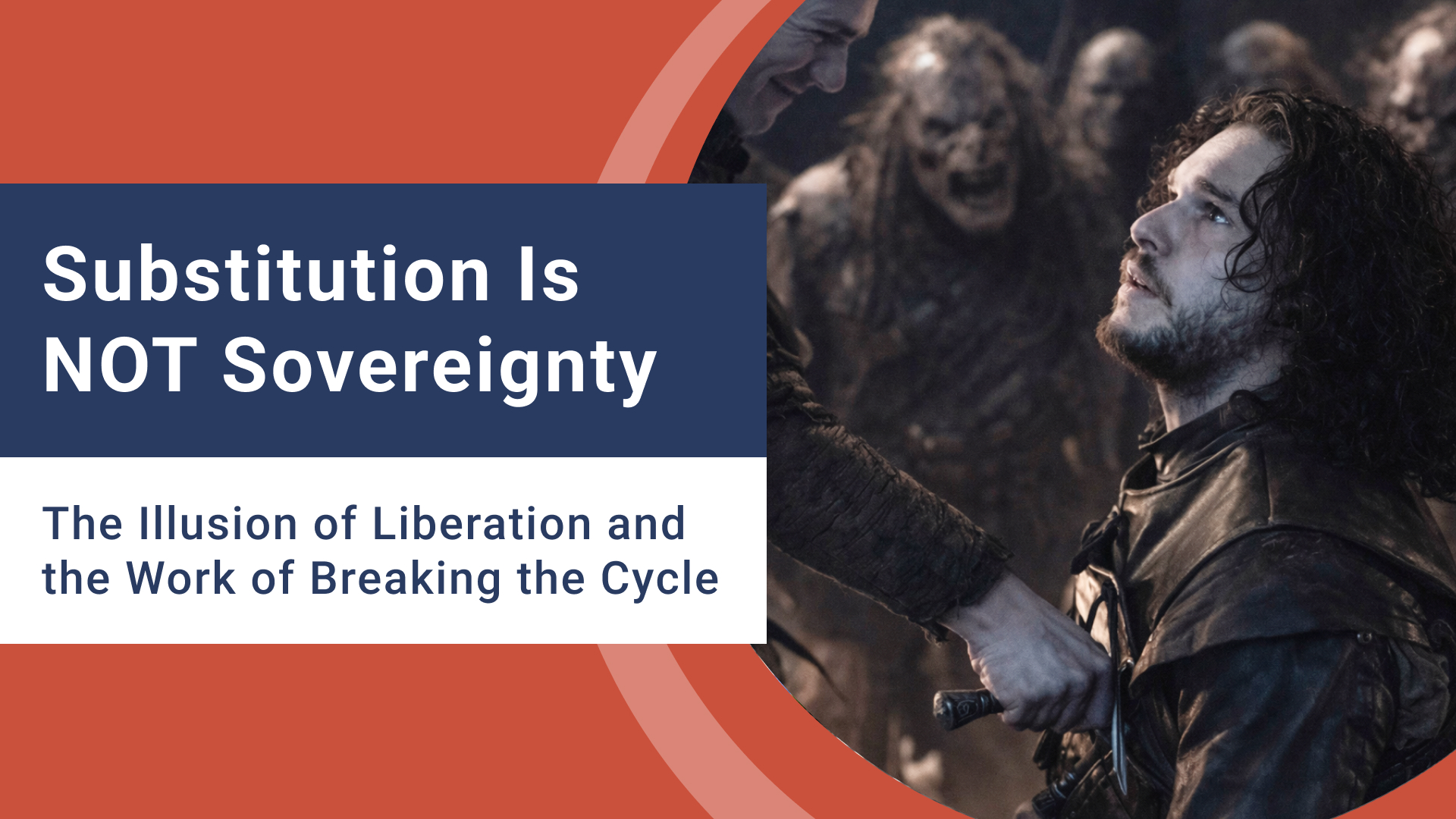
In the television series Game of Thrones, based on the novels of George R. R. Martin, Jon Snow is a military leader stationed at a frozen frontier called the Wall. The order he leads, the Night’s Watch, exists for one declared purpose: to defend civilisation from a people beyond the Wall known as the Wildlings. For generations, the Wildlings have been defined as the enemy. The moral line is simple. The identity of the Watch rests entirely on that opposition.
Jon commits what becomes a fatal act, not of treason, but of reframing. He realises that the Wildlings are not the ultimate threat. A far more dangerous force, the White Walkers, is advancing, and if the Wildlings are left outside the Wall, they will either be slaughtered or join that greater threat. So Jon makes a decision that shatters the inherited narrative. He allows the former enemy through the Wall. He allies with them.
In doing so, he collapses the binary.
For the Night’s Watch, this is existential. If the Wildlings are no longer the enemy, what have generations of sacrifice been for. What does their identity mean. What holds them together.
That is the moment Jon signs his death warrant.
His own men stab him. Not because he is corrupt. Not because he seeks power. But because he destabilises coherence. He forces a recalibration of identity that the institution cannot metabolise under stress. Notice the words they speak as they kill him: “For the Watch.” Not for hatred. Not for revenge. For preservation.
This is the psychology of coherence protection.
When a leader reframes the threat structure during crisis, those anchored in the old narrative experience it as betrayal. Trauma intensifies this reaction. One of the men (a kid called Olly) who stabs Jon had seen his parents murdered by Wildlings. For him, the enemy is not abstract. It is personal. Jon’s strategic clarity feels like moral treason.
Trauma resists reframing.
Now apply the pattern.
When someone says the regime is oppressive but the external powers pressing in are not innocent either, the crowd experiences rupture. One camp hears defence of tyranny. The other hears naïve romanticism about empire. The layered truth is rejected by both sides because it fractures the emotional clarity that sustains them.
The Jon Snow problem is not about fantasy. It is about what happens when a system built on a single enemy narrative is forced to confront a multi-layered threat field.
Most systems cannot survive that confrontation without either reforming deeply or eliminating the destabiliser.
Historically, elimination is easier.
Coherence preserved. Truth postponed.
The Comfort of Orcs
In The Lord of the Rings: The Rings of Power and in the broader mythology created by J. R. R. Tolkien, Orcs are not subtle villains. They are disfigured, aggressive and openly destructive. They burn, slaughter and conquer without pretending to be righteous. Their role in the story is clear: they are the enemy. When Orcs advance, moral alignment becomes effortless. There is no ambiguity about where one stands. Unity forms quickly because the threat is visible and unmistakable.
Obvious evil stabilises identity.
When danger looks monstrous, societies do not struggle to align against it. They do not debate its intentions or parse its incentives. They fight. The clarity of the enemy reinforces coherence. The story becomes simple: we are defending against darkness.
But modern power rarely looks like Orcs.
It does not arrive snarling at the gate. It arrives through treaties, sanctions regimes, security guarantees, reconstruction packages, military bases, intelligence partnerships and financial integration. It speaks the language of reform, stability and international order. It does not need to burn villages to reshape a region. It reshapes leverage. It restructures dependency. It redesigns incentives.
This is where the phenomenology becomes dangerous.
If a society is exhausted by internal coercion, it is primed to interpret external pressure as liberation. The harsher the domestic regime appears, the more virtuous the external actor is assumed to be. The binary returns: tyrant versus saviour, darkness versus light. The narrative simplifies again.
But power does not operate on moral sentiment. It operates on interest.
A state can be oppressive internally and still function as a counterweight within a regional balance. Remove it and the balance shifts. Not toward moral purity, but toward consolidation. When one pole faces less resistance, it does not dissolve into altruism. It expands its perimeter.
History is not generous toward unipolar concentration. Military and financial architectures rarely shrink when friction disappears. They reposition. They normalise. They embed.
The Orcs are easy to see. The strategic map behind them is not.
And here is the deeper complication. This is not simply about facts. It is about perception. Each actor experiences itself as defending against Orcs. A population under repression sees its rulers as monsters. A regime under external pressure sees imperial encirclement as existential aggression. A superpower projecting influence frames itself as defending order against chaos. In every case, the other becomes the embodiment of darkness. The metaphor travels. Everyone believes they are fighting Orcs.
Crowds prefer visible evil because it relieves them of the burden of structural analysis. They do not need to ask who benefits from destabilisation or who designs the post-collapse order. They only need to defeat what is obvious.
But the absence of obvious evil does not guarantee justice. It may simply mean that coercion has changed form.
The psychological comfort of the orc lies in moral clarity. The danger of modern dominance lies in its appearance of necessity.
And necessary power is the hardest power to question.
The ‘Western’ Self-Image and the Safe Distance
Modern Western societies have forged a powerful identity around certain ideals: human rights, democracy, individual liberty, rule of law, freedom of expression. These are not trivial achievements. They form the moral core of how the West understands itself. The narrative is clear: we are the free world. We are the guardians of rights. We are the stabilising force against disorder.
Identity matters. It shapes perception.
From that position, conflicts in the Middle East are often framed as dysfunctions of that region. Tribalism. Sectarianism. Authoritarian culture. Endless instability. The chaos is external. The order is here. The story reinforces itself.
But phenomenologically, something more complex is happening.
Western powers are not absent from these regions. They are economically entangled, militarily present, strategically invested and politically influential. Security guarantees, intelligence operations, arms sales, sanctions regimes, reconstruction contracts and diplomatic pressure are not peripheral. They are embedded. Presence shapes dynamics.
At the same time, Western populations prefer that the violence remain distant. They want stability in energy markets, containment of extremism and the assurance that conflict will not spill into their cities. They want moral clarity without domestic cost. They want intervention without blowback.
This creates a structural tension.
On one hand, Western identity is reinforced through rhetoric of rights and democracy. On the other hand, strategic decisions are often driven by interest, containment and leverage. The public narrative speaks of values. The operational architecture functions through power calculus.
Most citizens do not experience this contradiction directly. They experience safety. They experience order. The instability remains geographically elsewhere. The system appears coherent.
This distance allows moral simplification.
Conflicts are seen as local pathologies rather than entangled systems. Internal repression in those regions is condemned loudly. External strategic interference is rationalised as necessary stabilisation. The role of long-term geopolitical architecture in shaping those environments becomes abstract, technical, distant from everyday consciousness.
Phenomenologically, this produces a particular stance: we are the referees of instability, not participants in its formation.
But power structures are rarely neutral observers. Military presence alters regional balances. Economic pressure reshapes incentives. Sanctions restructure societies in ways that reverberate internally. Alignment with certain regimes and isolation of others produce long-term distortions.
None of this requires conspiracy thinking. It requires acknowledging that systems interact.
The Western psyche prefers to see itself as exporter of order rather than co-producer of instability. That preference stabilises identity. It protects the narrative of moral superiority.
At the same time, there is an implicit boundary: the conflict must not reach our streets. Refugee flows are tolerated up to a threshold. Terror is condemned when it is foreign, existential when it is domestic. Military intervention is acceptable when distant, intolerable when reciprocal.
This asymmetry reveals something deeper.
We want the authority to shape distant regions in the name of stability. We do not want the instability of those regions shaping us. We want strategic depth without moral entanglement. We want influence without consequence.
This is not uniquely Western evil. It is civilisational self-protection.
But it reveals the same coherence dynamic. Our identity as the defenders of human rights and democracy becomes difficult to reconcile with the messy realities of power projection, arms circulation, selective alliances and economic leverage.
To question that complexity feels disloyal. It feels like weakening the moral frame that underpins Western self-understanding.
So again, coherence defends itself.
The result is a double simplification: the Middle East is reduced to chronic instability, and Western involvement is reduced to necessary stewardship. The layered interaction between the two remains underexamined.
This is the same pattern as before.
Obvious tyranny is condemned.
Obvious terror is condemned.
But structural entanglement is rationalised.
And as long as instability remains externalised, the internal narrative remains intact.
The Phenomenology of Substitution
Once identity has stabilised around a visible enemy and external actors have been framed as necessary partners, a predictable pattern begins to unfold.
When an internally coercive system weakens, people assume they are approaching freedom. That assumption is emotionally understandable. Relief feels like liberation. But relief and sovereignty are not the same thing.
The pattern is older than any single country.
First, internal repression exhausts the population. Legitimacy erodes. Anger accumulates. The regime becomes the embodiment of suffocation. The narrative simplifies: remove this and we will breathe.
Second, external actors intensify pressure. They speak the language already primed within the population: human rights, reform, stability, transition. They present themselves not as architects of interest but as facilitators of freedom. The moral frame aligns.
Third, the internal structure cracks or collapses. The moment feels historic. The crowd experiences catharsis. Something heavy has been lifted. The fall itself becomes proof of progress.
Fourth, the quieter phase begins. Institutional redesign. Security frameworks renegotiated. Financial integration deepened. Military presence normalised. Regulatory alignment expanded. Policy autonomy narrows incrementally, not dramatically. Integration into broader power systems accelerates without spectacle.
At no single moment does this feel like occupation. It feels procedural. Cooperative. Modern.
But strategic autonomy rarely disappears in a single declaration. It erodes through architecture.
This is substitution.
The visible coercion of one structure is replaced by the leverage of another. The symbolism may change. The rhetoric may soften. The language becomes technical rather than ideological. But power has not dissolved. It has reconfigured.
Now widen the lens.
If the last meaningful counterweight within a region collapses, what remains? Does sovereignty expand, or does consolidation deepen? Does plural balance increase, or does a single military and financial pole face less friction?
Unbalanced power does not usually restrain itself voluntarily. Military establishments do not shrink simply because opposition disappears. Strategic influence does not retreat because moral language improves. It extends where resistance declines.
The crowd, however, measures success differently. It measures the fall of the visible regime. It does not measure the durability of autonomy five or ten years later. It is fighting today’s suffocation. It is not modelling tomorrow’s leverage structures.
And when someone asks those structural questions, they are accused of defending tyranny.
This is the Jon Snow moment in modern form. The layered analysis destabilises the moral clarity required to sustain momentum. So it is rejected.
Movements built on simplified coherence are powerful in rupture but fragile in reconstruction. Without layered vision, they are easily redirected.
The tragedy is not that internal oppression exists. The tragedy is that in dismantling it, societies may enter a configuration where external dominance becomes normalised, procedural and difficult to challenge precisely because it appears rational.
Substitution feels like victory.
Until it becomes structure.
The Resurrection Problem: When Elimination Strengthens Myth
In Game of Thrones, Jon Snow is murdered by his own men. They believe that by removing him, they have preserved the institution. The destabiliser is gone. The coherence of the Night’s Watch is restored.
But in the narrative, Jon Snow is resurrected.
In the series this occurs through magic. In human experience, resurrection does not require sorcery. It happens through myth.
When a political figure is eliminated, whether through assassination, imprisonment or symbolic destruction, the immediate assumption is that the threat has been neutralised. The face is gone. The voice is silenced. The movement will weaken.
But power is rarely located only in a person.
If the figure embodies an ideology that has already been institutionalised, ritualised and woven into collective identity, eliminating the individual may not dissolve the structure. It may intensify it. Particularly in systems where martyrdom is glorified, where sacrifice is elevated into sacred narrative, death does not erase influence. It sanctifies it.
The figure is only the visible node.
This is the load-bearing statement: the figure is a shadow. It is not the thing itself.
What reproduces that figure is civilisational architecture. Education systems. Religious symbolism. Institutional networks. Collective grievances. External pressure that validates the narrative of resistance. Remove the individual and the structure may simply produce another.
Like a mushroom after rain, it reappears because the soil remains fertile.
In some ideologies, elimination is not defeat. It is elevation. The fallen leader becomes proof of righteousness. The story deepens. The conviction hardens. The next generation inherits not a politician but a symbol.
Western civilisation understands this more than it sometimes admits. At its psychological root lies the image of a crucified man whose death did not extinguish his influence but magnified it across centuries. Whatever one believes theologically, the pattern is embedded in the cultural psyche: sacrifice can amplify meaning. Martyrdom can outlive power.
Now return to the present dynamic.
When an external force or internal faction believes that removing a single leader will collapse an entire system, it may be targeting the shadow rather than the source. The system may fracture, but if the ideological soil remains intact, if the narrative of resistance remains emotionally potent, if institutional continuity persists, the elimination can paradoxically strengthen the myth.
A hunter who fires repeatedly at the shadow of a bird crossing the sky will exhaust himself. The bullets will hit nothing. The real bird remains untouched because the hunter misidentified the target.
So too with political structures. If what sustains them is not merely the charisma of one figure but a layered matrix of ideology, grievance, identity and institutional reinforcement, then killing or removing the face may energise the very forces one seeks to extinguish.
Elimination can feel decisive.
Resurrection, however, belongs to narrative.
And narrative is harder to kill than a man.
Coherence, Truth and the Test of a Civilisation
The real crisis is not simply tyranny. It is not even empire. It is the inability of societies to hold layered truth without disintegrating.
When coherence becomes sacred, truth becomes dangerous.
A people under pressure will cling to whatever narrative stabilises them. If the regime is the villain, then removing it becomes synonymous with freedom. If an external power opposes that regime, it is framed as ally by default. The story becomes clean. The camps become defined. Moral certainty returns.
But moral certainty built on incomplete maps produces structural blindness.
A civilisation that cannot tolerate complexity will oscillate between poles. It will dismantle internal coercion and invite external leverage in the same breath. It will celebrate resistance while neglecting architecture. It will chant sovereignty while integrating into systems it does not control.
And when someone says the regime is unjust and the empire is not innocent either, that person is attacked from both sides. One calls them traitor. The other calls them naïve. This reaction is not emotional accident. It is coherence defending itself.
The test of a civilisation is not whether it can overthrow a ruler. Many can. The deeper test is whether it can reform internally without dissolving into dependency. Whether it can resist domination without sanctifying oppression. Whether it can metabolise truth without collapsing into factional panic.
That requires intellectual discipline and emotional steadiness. It requires the ability to distinguish relief from autonomy, reform from absorption, balance from submission. It requires leaders who can withstand being misunderstood, and citizens who can endure ambiguity without retreating into rage.
Most societies under strain fail here. Pain narrows vision. Urgency rewards simplification. Movements demand clarity, not nuance. Yet history does not reward simplicity. It rewards structural foresight.
The world that follows collapse is not automatically freer. It is shaped by whoever has prepared the deeper architecture.
So the real question is not only whether a regime falls. It is what replaces it, who designs it, and whether the population understands the power field it is stepping into.
Coherence is comforting. Truth destabilises. But without the discipline to privilege truth over narrative comfort, societies repeat their cycles.
They eliminate figures and leave structures intact.
They mistake substitution for sovereignty.
They mistake alignment for autonomy.
They mistake relief for freedom.
And they call it liberation.
That is the pattern.
The only open question is whether this time a civilisation can endure complexity long enough to break it.
Why Societies Choose Coherence Over Truth
Human beings are not primarily rational. We are narrative-bound. Identity precedes analysis. Belonging precedes accuracy.
A collective story does more than explain events. It stabilises fear, justifies sacrifice, defines loyalty and protects meaning. When that story is threatened, the threat is not intellectual. It is existential. This is why layered truth feels violent.
If a regime is oppressive, the narrative becomes clear: remove it and we will be free. That clarity unites the injured. It channels anger. It restores dignity through opposition. The story is emotionally efficient.
But introduce complexity and the coherence fractures. Say that the regime is oppressive and external powers are strategic. Say that removing one does not automatically neutralise the other. The simplicity collapses. The crowd feels disoriented.
And disorientation is intolerable in times of suffering.
So the psyche defends itself. It reduces the map. It selects a single villain. It elevates a single solution. It purifies the narrative. Anyone who complicates the frame becomes suspect.
This is not unique to any nation. It is structural human behaviour. In religious history, reformers are eliminated. In political revolutions, moderates are sidelined. In institutions, whistleblowers are attacked. At the Wall, Jon Snow was stabbed “for the Watch.” When identity is fragile, truth is experienced as aggression.
Now apply this to civilisations under prolonged pressure. People who have endured repression for decades develop a hunger for rupture. Change becomes sacred. Any force that promises decisive breakage appears aligned. In that emotional state, warning about external strategic interests feels like sabotage. It feels like defending the oppressor.
But that reaction reveals narrative capture.
A society capable of sovereignty must hold two realities at once: internal injustice must be confronted, and external domination must be resisted. Failing either produces distortion. Collapsing them into a binary produces disaster.
This is the phenomenological core.
The danger is not only tyrants. It is not only empire. It is a population unable to think in layers.
And layered thinking is rare in ordinary circumstances, let alone under trauma.
The Coming Concentration
If the last meaningful counterweights within a region collapse, the global order does not become neutral. It consolidates.
Power without friction expands. Military architecture does not dissolve because opposition weakens. It repositions. Financial leverage does not retreat when resistance declines. It deepens. Security arrangements do not shrink when alternatives disappear. They normalise.
A world with fewer strategic counterbalances is not automatically more peaceful. It is more centralised. And centralised power rarely becomes restrained simply because it calls itself stabilising.
When one pole sets the rules, defines the sanctions regime, controls the security perimeter, shapes the currency architecture and determines the narrative legitimacy of intervention, the system does not drift toward equilibrium. It solidifies into hierarchy.
Hierarchy without meaningful challenge hardens.
History is unambiguous here. Unipolar dominance eventually overreaches. It intervenes more freely. It polices more broadly. It justifies expansion as necessity. And because it faces limited structural resistance, its internal checks erode.
But this consolidation rarely feels dramatic in real time.
During transition, crowds experience relief. A hated regime falls. New alliances are announced. The language of modernisation fills the air. What they do not immediately perceive is dependency. That becomes visible only later, when policy autonomy narrows quietly and dissent against external alignment becomes marginalised or taboo.
Substitution feels like progress until it becomes architecture.
The deeper danger of this era is not only internal authoritarianism. It is the silent normalisation of dominance without counterweight. Once embedded into military agreements, financial systems and institutional design, it becomes difficult to challenge. Not because it appears monstrous, but because it appears procedural.
And procedural power is harder to resist than visible tyranny.
The Sense-Making Crisis Beneath the Conflict
Beneath tyranny and beneath empire, beneath substitution and consolidation, lies something more fundamental.
A crisis of sense-making.
What we are witnessing is not only a clash of powers. It is a collapse in the quality of how societies interpret reality. When collective perception narrows under pressure, when narratives replace layered analysis, when identity overrides discernment, a civilisation loses its capacity to read its own situation accurately.
This is not merely misinformation. It is misframing.
Every society operates within a field of metacontent, the intellectual substrates, the cognitive maps, stories, assumptions and interpretive lenses through which events are understood. When those lenses become rigid, when they collapse complexity into moral binaries, sense-making deteriorates. The result is predictable: people misidentify threats, misjudge alliances and miscalculate consequences.
In times of trauma, metacontent contracts. The need for coherence intensifies. Nuance feels dangerous. Questions feel destabilising. Simplification feels protective.
But simplification under pressure produces strategic blindness.
A population may correctly identify internal injustice yet fail to perceive external leverage. A regime may correctly identify foreign pressure yet fail to confront domestic decay. External powers may correctly identify instability yet ignore their own role in shaping it. Each actor holds part of the truth and absolutises it.
This is how layered reality collapses into fragmented certainty.
The deeper problem, then, is not only political architecture. It is epistemic fragility. A society that cannot refine its metacontent cannot refine its decisions. If the interpretive framework is distorted, even sincere action will produce unintended outcomes.
Sense-making precedes sovereignty.
Without disciplined sense-making, relief is mistaken for freedom, alignment for autonomy, elimination for transformation. Leaders are elevated or destroyed based on narrative utility rather than structural analysis. Power shifts are interpreted symbolically rather than architecturally.
And once a distorted frame stabilises, it reproduces itself. Media amplifies it. Institutions codify it. Education transmits it. Dissent is filtered through it. The metacontent becomes self-sealing.
This is why the crisis feels cyclical.
Until the quality of sense-making improves, the cycle will not break. The actors may change. The flags may change. The rhetoric may change. But the interpretive distortions remain.
A civilisation that cannot interrogate its own metacontent cannot escape its patterns.
And that is the quiet crisis beneath the visible one.
If what feels chaotic in this moment is not only political but interpretive, if the maps themselves seem unreliable, then the work begins at the level of sense-making. Meta-content: The Nested Theory of Sense-Making examines how cognitive maps, narratives, perspectives and paradigms shape perception long before decisions are made. It explores why distorted interpretation produces distorted outcomes and why sovereignty is impossible without epistemic discipline. That deeper framework can be explored here:
https://ashkantashvir.com/metacontent
The Being Question: Where Disintegration Actually Begins
All of this, tyranny, empire, substitution, consolidation, narrative fracture, sense-making collapse, ultimately converges on something more intimate.
Being.
The antidote to the disintegration within humanity lies upon the integrity of individuals.
This is not a slogan. It is structural.
Integrity here is not moral posturing. It is not virtue signalling. It is not adherence to ideological purity. Integrity, as we have discussed in the previous articles, is the alignment between intention, perception and action. It is the coherence of the self before it attempts to produce coherence in the world.
When individuals are internally fragmented, when intention is distorted by resentment, fear, ego or unexamined grievance, their decisions, even when dressed in moral language, reproduce instability. Institutions built by fragmented beings carry that fragmentation into policy, strategy and power.
Disintegration in civilisations begins as disintegration in persons.
We often search for systemic shortcuts. Replace the leader. Rewrite the constitution. Realign alliances. Change the flag. These moves may be necessary, but none of them substitute for the harder work of cultivating integrity within the human agents who design and operate those systems.
There is no shortcut to maturation.
Civilisations that have faced collapse and rebuilt, whether Germany after catastrophe or Japan after devastation, did not transform through symbolic substitution alone. They confronted rupture. They underwent reorientation. They rebuilt institutions alongside shifts in collective discipline and internal responsibility. That process was neither instant nor purely structural. It was existential.
And it was not achieved by eliminating a single figure.
When integrity is absent at the level of Being, ideology becomes a weapon, power becomes compensatory and narratives become defensive. When integrity is present, even flawed systems can be reformed without implosion because the actors within them are less driven by shadow.
This is the harder claim.
No geopolitical realignment will stabilise a civilisation whose individuals lack integrity. No revolution will secure sovereignty if those who inherit power reproduce the same fragmentation under a different banner.
The crisis of our era is not merely institutional. It is ontological.
We cannot outsource maturity to structures. Structures reflect the quality of Being that animates them.
And until integrity becomes the organising principle at the level of individuals, disintegration will continue to manifest collectively.
If the fracture runs through the interior of the human being before it manifests in institutions, then the work cannot remain structural alone. Human Being and Being examine the ontological foundations of integrity, leadership and responsibility. They explore how fragmentation within individuals reproduces fragmentation within systems, and why civilisational renewal requires more than reform; it requires maturation of Being itself. That inquiry continues here:
https://ashkantashvir.com/human-being
https://ashkantashvir.com/being
Stability Is Not Sustainability
Many leaders, when confronted with destabilisation, instinctively seek control. They eliminate disruptors. They silence dissent. They tighten regulation. They increase surveillance. They centralise authority. The stated objective is stability.
But stability, undefined, can become a fetish.
Stability can mean suppression. It can mean inertia. It can mean the freezing of dysfunction in place. A system can be stable and deeply unsustainable at the same time.
The deeper question is not how to preserve stability. It is how to cultivate sustainability.
Stability protects the present configuration. Sustainability examines whether that configuration can endure without collapse, coercion or decay.
This is where the distinction becomes critical.
When sustainability is reduced to technocratic management, when it becomes a project of elite design, bureaucratic optimisation and behavioural engineering, it falls into what I have called Sustainabilism. Sustainabilism assumes that systems can be engineered from above to regulate human behaviour into compliance. It assumes that if we design the right incentives, impose the right constraints and build the right monitoring architecture, human beings can be controlled into long-term equilibrium.
This is hubris.
It ignores human nature. It ignores shadow. It ignores the interior dimension of Being.
Authentic Sustainability begins elsewhere. It begins with the recognition that systems reflect the quality of the humans who animate them. If individuals are fragmented, resentful, dishonest or driven by unexamined ego, no amount of regulatory architecture will prevent distortion. The system will mirror the shadow of its participants.
Shadows produce distortions. Distortions produce misery in external conditions. That misery is experienced by sentient beings as suffering. When shadow remains unexamined, the misery reproduces itself. The experience of suffering becomes self-sustaining. Individuals entrench. Institutions harden. Narratives radicalise. Systems approach breaking point.
This pattern is visible everywhere. In relationships that deteriorate into resentment. In economies that overextend into fragility. In political systems that polarise into paralysis. In societies that fracture into camps unable to speak across difference.
Disintegration is not an event. It is a process.
Sustainabilists attempt to correct the process through design and control. Authentic Sustainability recognises that design without inner maturation is cosmetic. You cannot coerce a population into sustainability while leaving the quality of Being untouched.
For systems to become more resilient, more functional, more optimal, the people within them must become better, not morally superior, but more integrated. More capable. More self-aware. More disciplined in sense-making and intention. Only then can they both design and deserve higher-order systems.
Capability without integrity produces exploitation.
Integrity without capability produces fragility.
Sustainability requires both.
There is no shortcut.
We may be tempted to believe that replacing leaders, redrawing borders, rewriting policies or tightening control will secure the future. But unless the underlying shadows are addressed, the distortions will return in new forms. Collapse may be delayed. It will not be prevented.
Authentic Sustainability is not about freezing a system in place. It is about aligning Being, sense-making and institutional design so that the system can endure without coercion and evolve without disintegration.
Without that alignment, stability becomes repression, reform becomes substitution and progress becomes illusion.
And the cycle continues.
If stability without maturation becomes repression, and design without integrity becomes control, then sustainability must be redefined. Sustainabilism contrasts the technocratic impulse to engineer behaviour from above with a sustainability discourse grounded in systemic integrity, human maturation and long-term coherence. It examines why control cannot substitute for character, and why systems reflect the quality of those who animate them. That argument is developed further here:
https://ashkantashvir.com/sustainabilism
The Maturity Required
Breaking this cycle requires something most societies under pressure do not yet possess.
Layered sense-making and meaning-making.
A civilisation that genuinely seeks sovereignty must be capable of reforming internally while resisting absorption externally. It must criticise its rulers without romanticising foreign power. It must resist imperial leverage without sanctifying domestic oppression.
That demands intellectual discipline and emotional steadiness. It demands leaders who can withstand hostility from both camps. It demands citizens who can tolerate ambiguity without retreating into binary rage.
This is rare.
Most movements are fuelled by outrage rather than architecture. Most revolutions are emotionally coherent but strategically underdeveloped. They know what they want removed. They have not designed what they intend to build.
Mature sovereignty requires something harder than rebellion. It requires institutional imagination. It requires strategic foresight. It requires asking not only how to dismantle power, but how to distribute it, constrain it and balance it over time.
Without that depth, societies oscillate. They replace tyrants with patrons. They trade blunt coercion for elegant leverage. They celebrate transition and mistake it for transformation.
And history repeats.
The real test is not whether a regime falls. It is whether a civilisation can metabolise truth without fragmenting, reform without collapsing into dependency, and resist dominance without isolating itself into irrelevance.
That is civilisational adulthood.
Without it, the cycle does not break. It simply changes costume.
Winter Is Coming
Winter is coming.
In Game of Thrones, the House of Stark repeats this phrase not as poetry but as warning. Winter is not merely weather. It is reckoning. It is the season that exposes weakness, tests preparation and punishes illusion.
Civilisations have winters. Winters of institutional collapse, economic fragility and ideological fracture. Winters where accumulated shadow hardens into visible consequence. When narratives fail. When substitutions unravel. When concentrated power overreaches. When systems designed for stability reveal their unsustainability.
We are entering such a winter. Polarisation deepens. Trust erodes. Architectures centralise. Identities harden. Leaders eliminate destabilisers. Movements demand rupture. Empires consolidate. Regimes entrench. The cycle tightens.
If nothing changes, winter does not cleanse. It consumes.
But the Starks did not say “winter is coming” to induce paralysis. They said it to demand preparation. Winter, in their cosmology, is not apocalypse. It is discipline.
Here is the turn.
Winter is not the enemy. Unpreparedness is.
A civilisation that understands its shadows, refines its sense-making and cultivates integrity in its individuals does not fear winter. It uses winter. Cold clarifies. Scarcity disciplines. Exposure reveals what is fragile and what is real.
The darkness we are witnessing is not proof of inevitable decline. It is exposure. The distortions are visible. The substitution patterns are visible. The coherence reflex is visible. The technocratic hubris is visible. The shadow is visible.
Exposure is painful. But exposure is also opportunity.
We can outgrow these shadows. Not through elimination. Not through substitution. Not through control. But through maturation. Through disciplined sense-making. Through integrity of Being. Through authentic sustainability that aligns institutions with the quality of the humans who animate them.
There is no shortcut to enlightenment. Civilisations do not skip adolescence. They confront their fractures. Germany did. Japan did. Others have. The process is neither instant nor sentimental. It requires humility, responsibility and redesign from within.
If we refuse that work, the cycle will continue. We will oscillate between tyranny and consolidation, between outrage and control, between rupture and absorption. Winter will not end. It will harden.
But if we learn, if we embody what this moment is revealing, if we prioritise sustainability over stability, integrity over ideology and truth over coherence, winter becomes formative rather than fatal.
We will not inherit a better world because we demand it. We will inherit it when we deserve it.
Winter is coming.
The question is whether we meet it as fragmented tribes defending narratives, or as a civilisation ready to grow up.