
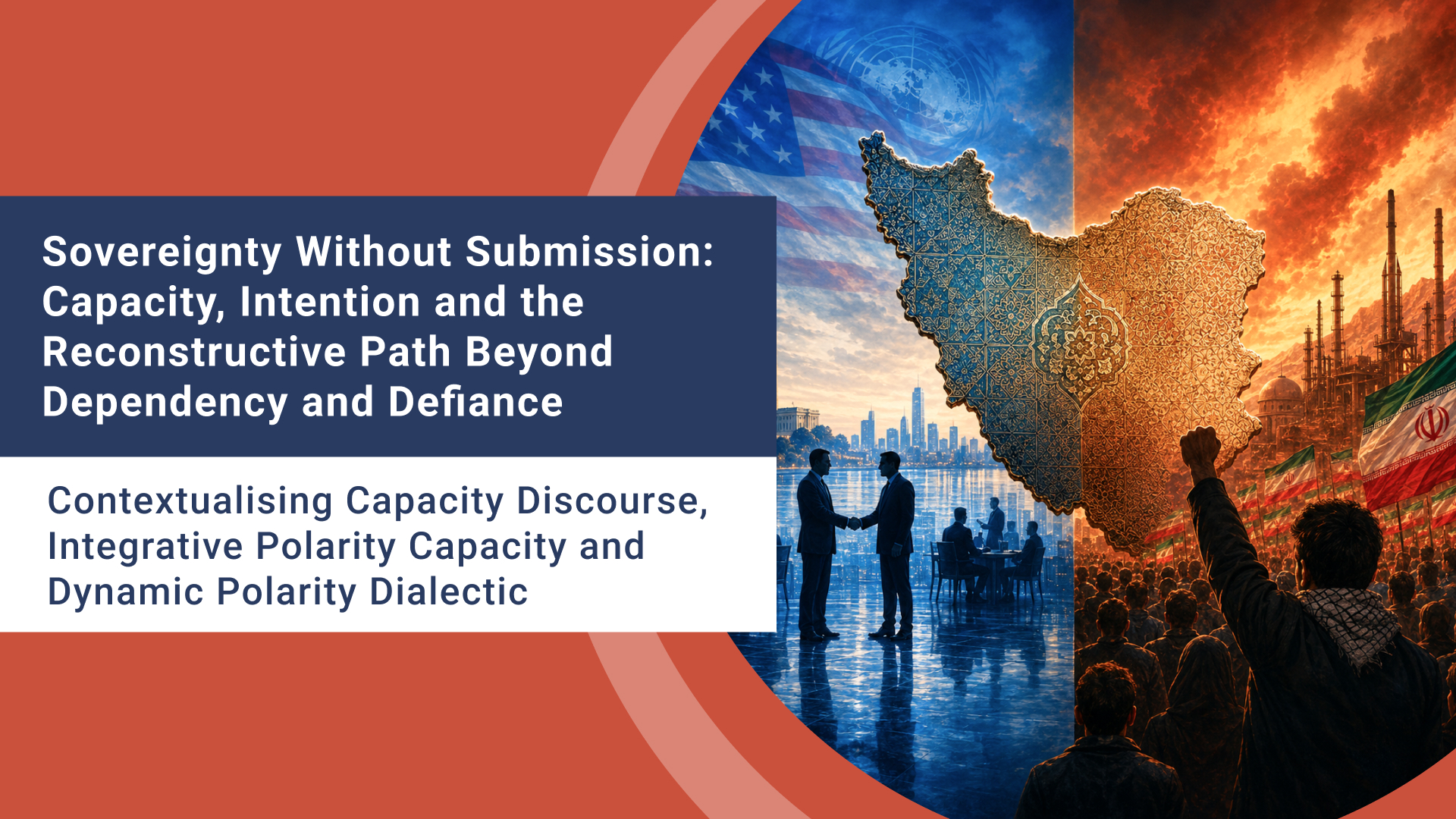
This is not a political commentary on Iran. It is not an argument for one faction against another, nor an attempt to reduce a civilisational question to the theatre of party politics, state propaganda or ideological tribalism. The Iranian case is being used here as a concrete context through which a deeper question can be examined: how a nation, a civilisation or any participant in reality relates to power, threat, dependence, sovereignty, capacity and polarity.
Background
For nearly three decades, two broad dispositions have shaped the Iranian political imagination. The first argues that Iran cannot realistically stand against the economic, military and institutional power of the United States and the wider Western order. According to this view, the rational path is negotiation, reduction of friction, strategic compromise, integration into the American-led system, connection to the dollar-based order and, ultimately, some version of externally mediated security. Its argument is simple: Iran does not have the force required to confront America, so it must adapt to the order America governs.
The second disposition argues almost the opposite. It insists that no country worthy of sovereignty can outsource its security to the same order that may threaten, sanction, contain or humiliate it. According to this view, Iran must stand on its own feet, even when the cost is severe, even when the country lacks the necessary competence, even when the road is hard and uncertain. This camp does not accept that American power is as absolute as it presents itself to be. It sees the American-led order as powerful but not invincible, intimidating but not mythical and extraordinary, expansive but not unlimited. The figure of Qasem Soleimani, the well-known Iranian major general who got assassinated by the US forces, became, for many, a symbol of this disposition: the belief that Iran had no real path except the construction of sovereign capacity, regional depth and deterrent power.
The point here is not to sanctify either camp. Both contain insight. Both contain distortion. Both carry truth and pathology. The deeper question is whether these positions should be treated as mutually exclusive ideological enemies, or whether they reveal a polarity that must be reconstructed at a higher level of capacity. This is where the capacity discourse, Integrative Polarity Capacity and Dynamic Polarity Dialectic become relevant.
The Two Groups: A More Precise Articulation
The first group may be described as the integration-through-subordination camp. Its fundamental claim is that the American-led international order is the dominant organising field of the modern world, and that Iran must reduce its resistance to that order if it wishes to survive economically and avoid unnecessary suffering. It sees military expenditure, regional confrontation and strategic defiance as costly forms of overreach. In its eyes, the sensible path is to negotiate, accommodate, trade, soften, connect and integrate. Its model is often drawn from countries that have accepted American security architecture, such as Saudi Arabia or smaller Persian Gulf states, and converted dependency into wealth, ‘stability’ and international access.
The second group may be described as the sovereign-capacity camp. Its fundamental claim is that a nation cannot borrow sovereignty from another power. Security that is granted from outside can also be withdrawn, priced, conditioned or weaponised. This group argues that Iran must develop the capacity to defend itself, secure itself and participate in the world from a position of strategic independence. It accepts that the cost of such a path is high, but considers the alternative to be more dangerous: national dependency disguised as realism. Its argument is that a people worthy of historical dignity cannot permanently live as a managed extension of another power’s order.
These two groups are not merely two policy preferences. They are two different interpretations of reality. They disagree about where power is located, how sovereignty is sustained, what security means, what dignity costs and whether survival is achieved through adaptation to the dominant order or through the reconstruction of one’s own capacity.
Two Ontologies of Power
The conflict between these dispositions is ultimately a conflict between two ontologies of power. The first assumes that power is already located elsewhere. Power belongs to the established order, the global financial system, the United States, NATO, the dollar, the military-industrial architecture and the institutions that govern access to legitimacy. From this perspective, a country like Iran survives by reducing its antagonism towards that field. Resistance is interpreted as emotional, expensive and strategically immature.
The second assumes that power must be generated through participation. Power is not merely something possessed by the dominant actor. Power is generated when a participant develops the capacity to act, resist, negotiate, build, deter and endure. From this perspective, to accept dependency as realism is to misunderstand reality itself. A country that cannot secure itself cannot meaningfully participate as a sovereign actor. It may trade, consume and enjoy temporary relief, but it does so inside conditions ultimately authored by others.
This distinction is central to the capacity discourse. Capacity is not mere force. It is not merely military capability, economic output or technological sophistication. Capacity concerns what a participant is able to bring to participation. Incapacity concerns the gap between what participation requires and what the participant can presently bring. A nation, like a person, is exposed whenever the demands of participation exceed the capacities it has developed.
The Iranian question, therefore, is not simply whether to negotiate or resist. That is too shallow. The real question is: what does the field of participation require, and what must Iran become capable of bringing to that field?
Which Group Is Closer to Reality?
The sovereign-capacity camp is closer to the deeper structure of reality. This does not mean it is always right tactically. It does not mean every action taken in its name is wise. It does not excuse incompetence, corruption, repression, strategic vanity, economic mismanagement or the use of national security as a permanent justification for domestic failure. A country cannot run on slogans. Missiles do not replace institutions. Deterrence does not replace trust. Resistance does not manufacture prosperity by magic, although political theatre often behaves as though it might.
The integration-through-subordination camp sees something real. Sanctions matter. Economic access matters. Financial systems matter. Global trade matters. Military imbalance matters. There is a real cost to confrontation. There is a real danger in confusing dignity with isolation or sovereignty with self-inflicted incapacity. Any serious doctrine of national reconstruction must take these concerns seriously.
Yet the foundational error of the first camp is profound. There is no such thing as outsourced sovereignty. There is only conditional protection, rented security or managed exposure. A country may be protected today and sacrificed tomorrow. It may be armed today and restrained tomorrow. It may be praised today and abandoned the moment its usefulness changes. Dependency can be comfortable, especially when decorated with skyscrapers, investment conferences and polite diplomatic language, but it remains dependency.
The second camp understands this deeper reality. It recognises that a country unable to defend itself becomes an object within someone else’s strategy. It recognises that American power, while immense, is not infinite. The United States can sanction, bomb, threaten, organise coalitions and dominate financial systems, but it cannot always impose political outcomes at acceptable cost. Great power is still power under constraint. It is not divine omnipotence.
The second camp is therefore closer to strategic reality, but only when it is genuinely committed to capacity-building. When resistance becomes performative, when sovereignty becomes a slogan, when military capacity grows while institutional, economic and civic capacity decay, the position begins to betray its own truth. Sovereignty without reconstruction becomes exhaustion. Defiance without competence becomes theatre. Dignity without capacity becomes poetry standing in front of artillery.
Polarity or Adulteration?
These two camps represent a real polarity, but they are also mixed with truth and falsehood. The real polarity is not between good and evil. It is between necessary dimensions of participation that have been split apart and then weaponised against each other.
On one side stands integration, diplomacy, economic openness, adaptation and the recognition of material limits. On the other side stands autonomy, deterrence, strategic independence, civilisational confidence and the refusal to outsource one’s security. Both are necessary. A serious country needs both.
The problem begins when either pole absolutises itself. The integration pole becomes corrupted when it concludes that because Iran has limits, Iran must surrender authorship. Its ‘truth’ is that no country should mistake isolation for independence. Its falsehood is that adaptation must mean subordination.
The sovereignty pole becomes corrupted when it concludes that because independence is necessary, every cost can be justified in its name. Its ‘truth is that security cannot be outsourced. Its falsehood is that defence alone can carry the whole burden of national flourishing.
This is where ordinary political analysis fails. It asks which side is right. A reconstructive analysis asks a different question: what truth is each side carrying, what falsehood has attached itself to that truth and what higher-order capacity is required to integrate the truth without preserving the distortion?
Capacity Discourse and the Iranian Field of Participation
The field in which Iran participates is not neutral. It includes military threat, sanctions, regional rivalries, technological competition, civilisational memory, economic vulnerability, resource constraints, religious identity, national pride, internal mistrust, elite fragmentation, demographic pressure and geopolitical containment. Participation in such a field requires many forms of capacity at once.
Iran requires defence capacity, but defence capacity alone is not enough. It requires economic capacity, but economic capacity without sovereignty becomes dependency. It requires diplomatic capacity, but diplomacy without leverage becomes pleading. It requires institutional capacity, because no serious civilisational project survives on charismatic memory and emergency mobilisation forever. It requires technological capacity, because contemporary sovereignty is increasingly mediated through infrastructure, data, energy, computation, manufacturing and scientific competence.
It also requires social trust. This is often the forgotten capacity. A state may claim sovereignty on behalf of a people while treating the people as objects of management. That contradiction eventually weakens the very sovereignty being defended. The people are not merely the population located inside the borders of a sovereign project. They are the living subject of that project. Defence of the nation cannot be severed from the dignity, agency, intelligence and flourishing of the people.
From the standpoint of capacity discourse, the first camp sees incapacity and proposes the reduction of ambition. The second camp sees incapacity and proposes the development of strength. The first says: the field is too demanding, so we must lower our claim. The second says: the field is demanding, so we must become capable of participating in it.
The reconstructive answer is not to romanticise hardship. It is to ask which response expands capacity. Submission may reduce immediate pressure, but it often hollows out agency. Defiance may preserve dignity, but if it does not produce real institutional, economic, technological and civic capacity, it too becomes hollow. The measure is not rhetoric. The measure is what becomes possible through participation.
Integrative Polarity Capacity
Integrative Polarity Capacity is the capacity to hold, interpret and integrate opposing poles without collapsing into one-sidedness. It is not compromise in the weak sense. It is not taking a little from each side and producing a timid middle. That is not integration. That is administrative lukewarmness, usually presented by people who have mistaken exhaustion for wisdom.
True integration requires the capacity to preserve the living truth of each pole while stripping away its pathology. In the Iranian case, the two poles are not simply ‘negotiation’ and ‘resistance’. They are more properly understood as strategic autonomy and intelligent integration, deterrence and diplomacy, sovereign capacity and economic openness, civilisational authorship and worldly participation.
The false forms are equally important to name: dependency without dignity and defiance without capacity. These are the real dangers. Not negotiation. Not resistance. A nation must be able to negotiate. A nation must be able to resist. The danger is negotiation from incapacity, where diplomacy becomes the language of surrender. The danger is resistance without reconstruction, where sovereignty becomes a costume worn by a decaying institutional body.
Integrative Polarity Capacity requires Iran to refuse both pathologies. It requires the country to develop enough defence capacity to avoid intimidation, enough economic capacity to avoid strangulation, enough diplomatic capacity to avoid isolation, enough institutional capacity to avoid internal decay and enough civic capacity to ensure that sovereignty is not merely claimed by the state but lived by the people.
Dynamic Polarity Dialectic
Dynamic Polarity Dialectic goes a step further. It does not merely identify polarities. It examines how polarities move, intensify, distort, collapse and potentially generate higher-order realities. A polarity is not static. Each pole becomes more extreme when it is threatened by the other. The more the integration camp is accused of surrender, the more it may cling to technocratic realism. The more the sovereignty camp is accused of extremism, the more it may retreat into heroic defiance. Each side then becomes a caricature in the eyes of the other.
The dialectic becomes destructive when the poles are trapped in mutual negation. One side says: your resistance has destroyed the economy. The other says: your compromise would destroy the nation. One side sees only cost. The other sees only dignity. One side worships access. The other worships endurance. The result is not synthesis but paralysis.
A dynamic polarity becomes constructive only when each pole is forced to encounter the truth of the other. The integration camp must confront the fact that no external order grants security without conditions. The sovereignty camp must confront the fact that sovereignty without competence becomes cruelty to one’s own people. The integration camp must stop treating dependency as sophistication. The sovereignty camp must stop treating hardship as proof of righteousness.
The higher movement is not towards the middle. It is towards reconstruction. The question becomes: what must be built so that Iran can negotiate without subordination and resist without exhaustion? That question opens a new field. It turns the polarity from ideological conflict into capacity architecture.
What Would a Reconstructed Coupling Look Like?
A reconstructed national doctrine would reject both Gulf-style dependency and isolated defiance. It would not seek security as a favour from the American order, but neither would it confuse permanent confrontation with strategic maturity. It would insist on sovereign defence while pursuing intelligent diplomacy. It would build deterrent power while building economic credibility. It would integrate with the world where possible, but not as a subordinate appendage of someone else’s security design.
Such a doctrine would say: Iran will not outsource its security. Iran will not pursue conflict for its own sake. It will negotiate, but not from fear. It will deter, but not worship militarisation. It will integrate economically, but not as a managed province of another order. It will build institutions, not merely weapons. It will defend sovereignty, but also defend the dignity, prosperity and agency of the Iranian people.
This is the difference between a sovereignty project and a survival reflex. A survival reflex reacts to threat. A sovereignty project builds capacity. A survival reflex asks how to avoid collapse. A sovereignty project asks what must be reconstructed so that participation becomes dignified, stable and generative.
Such a path would require investment in defence, energy, food security, advanced manufacturing, artificial intelligence, education, banking credibility, legal order, anti-corruption, regional diplomacy and public trust. None of these can substitute for the others. Defence without economy becomes strain. Economy without security becomes dependency. Diplomacy without leverage becomes performance. Social trust without strategic protection becomes vulnerability. Strategic protection without social trust becomes coercion.
Intention as the Bedrock of Reconstruction
A reconstructed coupling cannot be built by technique alone. It requires something deeper than policy architecture, strategic positioning or institutional design. It requires intention anchored in meaning. Not distorted intention, not rhetorical intention, not the temporary intention produced by fear, humiliation or tactical convenience, but a stable intention developed through a deeper relationship with Being, sovereignty, trust and the future.
This matters because reconstructive analysis only becomes practical if the relevant participants genuinely intend reconstruction. The integration-through-subordination camp, the sovereign-capacity camp, the Iranian state, the Iranian people and the United States cannot be forced into reconstruction by argument alone. No external pressure can manufacture good faith. No clever framework can substitute for the willingness to participate truthfully in reality. If the intention remains distorted, defensive or manipulative, reconstruction becomes another performance. The language changes, but the old structure continues eating at the foundations.
This is the metaphysical layer beneath the strategic one. Every serious reconstruction rests upon a bedrock of intention. A house built on sand may still look impressive for a while. It may have marble floors, large windows and an excellent public relations department. But when pressure comes, the foundation speaks. In the same way, a national doctrine built on bad faith, domination, resentment, humiliation or theatrical sovereignty will not endure the course of time. It may produce movement, but not renewal. It may produce agreements, but not trust. It may produce resistance, but not capacity. It may produce stability, but only as a temporary arrangement held together by fear, exhaustion or calculation.
Intention must therefore be reconstructed before policy can become reconstructive. This does not mean all parties must suddenly become morally pure. That is fantasy, and not a particularly useful one. It means that each party must become sufficiently truthful about what it is actually seeking. Does the integration camp intend national reconstruction, or merely relief through dependency? Does the sovereign-capacity camp intend the flourishing of the people, or merely the preservation of symbolic resistance? Does the Iranian state intend sovereignty as the lived capacity of the nation, or sovereignty as the authority of the state over the people? Does the United States intend a stable regional order in which Iran can participate without subordination, or only a managed reduction of Iranian agency? These questions cannot be avoided by diplomatic language. Reality eventually reads the footnotes.
This is why the repeated warnings of Iran’s martyred leader about the intentions of the other party should not be reduced merely to hostility towards negotiation. At their strongest, those warnings concerned the deeper condition that makes negotiation meaningful in the first place: whether the parties are entering the field with genuine intention or with bad faith concealed beneath diplomatic language. Negotiation, in this sense, is not rejected because dialogue itself is dishonourable. It becomes dangerous when one party treats dialogue as a tactic for deception, pressure, delay or managed submission. Reconstruction requires the opposite: intention that is sufficiently truthful to allow trust, however limited and cautious, to become possible. Without that, diplomacy becomes theatre, agreement becomes sand and the foundations of reconstruction cannot hold.
Meaning is essential here because intention without deep meaning becomes unstable. A nation cannot sustain reconstruction if its intention is only to survive sanctions, win a negotiation, defeat a rival faction or humiliate an adversary. Those may be immediate aims, but they are not deep enough to carry a civilisational project. Reconstruction requires a meaning rooted in the flourishing of the people, the dignity of sovereign participation, the regeneration of trust and the renewal of capacity across generations.
This is where the sustainability discourse becomes relevant. A system cannot be authentically sustainable if its actions are detached from Being, meaning, intention and participation. Sustainabilism, in its hollow form, preserves appearances while avoiding the deeper conditions of flourishing. The same danger exists in national strategy. A country can speak of sovereignty while consuming the trust of its own people. It can speak of integration while hollowing out agency. It can speak of peace while preserving humiliation. It can speak of stability while building on fear. None of this is sustainable in the authentic sense.
Trust also belongs to this foundation. Trust is not sentimental optimism. It is not naïve belief that adversaries have suddenly become benevolent. Trust, at a reconstructive level, means that the conditions of participation become reliable enough for commitment, coordination and future-building. Internal trust between state and people is indispensable. Without it, sovereignty becomes coercive and brittle. External trust between adversaries may be limited, cautious and conditional, but even limited trust requires intention that is not wholly organised around deception, domination or strategic humiliation.
Sovereignty, too, must be understood at this bedrock level. Sovereignty is not merely the refusal of external control. It is the capacity to stand in reality without becoming captive to fear, dependency or vanity. A state that refuses external domination while internally weakening trust, capacity and participation has not completed the work of sovereignty. It has defended one boundary while eroding another. Sovereignty must be lived by the people, embodied in institutions and sustained through capacity. Otherwise, it becomes a word repeated loudly over a cracked foundation.
Reconstruction is never performed in a void. It does not begin from nothingness. It begins from the fabric of current reality: existing wounds, institutions, memories, fears, mistrust, capacities, humiliations, achievements and contradictions. The task is not to pretend this fabric does not exist, nor to burn everything down and call the ashes freedom. The task is to work with what is already there, truthfully enough to repair, reorder and regenerate it. This is why intention must be developed rather than merely stated. A declared intention may begin the movement, but only a formed intention can carry reconstruction through difficulty.
For Iran, this means the deeper intention cannot be merely to resist America, nor merely to gain access to America’s order. The intention must be to reconstruct the capacities required for sovereign, dignified and intelligent participation in the world. For the United States, if it is to participate constructively, the intention cannot be the permanent management, humiliation or containment of Iran as a civilisation. It must recognise that a stable order cannot be built by demanding that major civilisational actors accept permanent diminishment. For both sides, bad faith may produce short-term tactical advantage, but it will not produce lasting reconstruction. The foundation will not hold.
What Happens If Society Reaches This Higher Coupling?
If society and its political factions reached this higher coupling, the national conversation would change. The argument would no longer be between those who want to ‘deal with the world’ and those who want to ‘stand against the world’. That framing is primitive. The real question would become: how does Iran participate in the world as a sovereign, capable and reconstructive civilisation?
This would change the meaning of negotiation. Negotiation would no longer be treated as betrayal. It would become one instrument of sovereign participation. It would also change the meaning of resistance. Resistance would no longer be treated as sacred theatre. It would become one dimension of capacity, disciplined by reality and accountable to results.
The country would begin to measure strategy not by slogans, but by generated capacity. Did this action increase Iran’s ability to participate? Did it deepen security? Did it improve institutional competence? Did it strengthen the people? Did it expand economic resilience? Did it reduce dependency? Did it improve Iran’s ability to bargain, build, deter and flourish?
This would also change Iran’s relationship to the region. Iran would not need to ask neighbours to become proxies, nor would it accept becoming a proxy of another power. It could articulate a regional doctrine based on non-subordinate participation: neither American outposts, nor Iranian forward positions, nor Israeli targets, nor frightened states surviving through the temporary moods of external patrons.
The region does not need more dependency decorated as stability. It does not need more resistance decaying into permanent emergency. It needs a security architecture in which countries are not forced to choose between submission to empire and reckless confrontation. Iran, if reconstructed at the level of capacity, could help articulate such a possibility.
Consequences of the Reconstructive Path
The positive consequences of such a path would be significant. Iran would become harder to intimidate, but also harder to isolate. Its diplomacy would carry weight because it would be backed by real capacity. Its defence would become more legitimate because it would be connected to national flourishing rather than merely regime survival. Its economy would become less vulnerable because it would not depend entirely on pleasing one external order. Its people would inherit a national project larger than consumerist surrender or endless emergency.
The country would also become more difficult to caricature. It would no longer fit neatly into the categories prepared for it by hostile powers or internal factions. It would not be reducible to ‘rogue state’, ‘victim nation’, ‘revolutionary relic’, ‘anti-Western power’ or ‘failed integration case’. It would become something more serious: a civilisation attempting to reconstruct the capacities required for sovereign participation in a hostile and shifting world.
The negative consequences must also be faced. This path is difficult. It demands discipline. It demands elite competence. It demands less corruption, less theatrical politics, less ideological laziness and less addiction to slogans. It demands that military and security institutions understand that sovereignty is weakened when the people become alienated from the national project. It demands that economic and diplomatic elites understand that prosperity without sovereignty is rented prosperity. It demands that the state understand the people not as instruments of endurance, but as the living centre of the whole project.
The reconstructive path is harder than both dependency and defiance. Dependency is easier because it transfers responsibility outward. Defiance is easier because it transfers responsibility into symbolism. Reconstruction is harder because it demands reality-aligned capacity across multiple domains at once.
Final Formulation
The first camp understands cost, but misunderstands sovereignty. The second camp understands sovereignty, but can underestimate the cost of incapacity. The reconstructive answer is not to choose dependency or defiance. It is to build the capacities without which neither negotiation nor resistance has dignity.
A nation that can only negotiate because it is afraid is not practising diplomacy. It is managing surrender. A nation that can only resist by exhausting its people is not practising sovereignty. It is consuming the very subject on whose behalf sovereignty is claimed.
The higher path is sovereign capacity joined with intelligent integration. It is deterrence joined with diplomacy. It is autonomy joined with participation. It is national dignity joined with institutional competence. This is the work of Integrative Polarity Capacity: to hold the living truth of both poles without collapsing into their corruptions. This is the work of Dynamic Polarity Dialectic: to move beyond static opposition and generate a higher-order field of reconstruction.
That higher field cannot be sustained without reconstructed intention. Intention must be anchored in meaning, trust, sovereignty and Being, otherwise the entire project rests on sand. Reconstruction does not begin from a void. It begins with the fabric of reality as it is, and asks what must be regenerated so that participation becomes truthful, dignified and sustainable.
Iran’s future, like the future of any serious civilisation, will not be secured by choosing between submission and performance. It will be secured only through the long, disciplined and difficult development of capacity.