
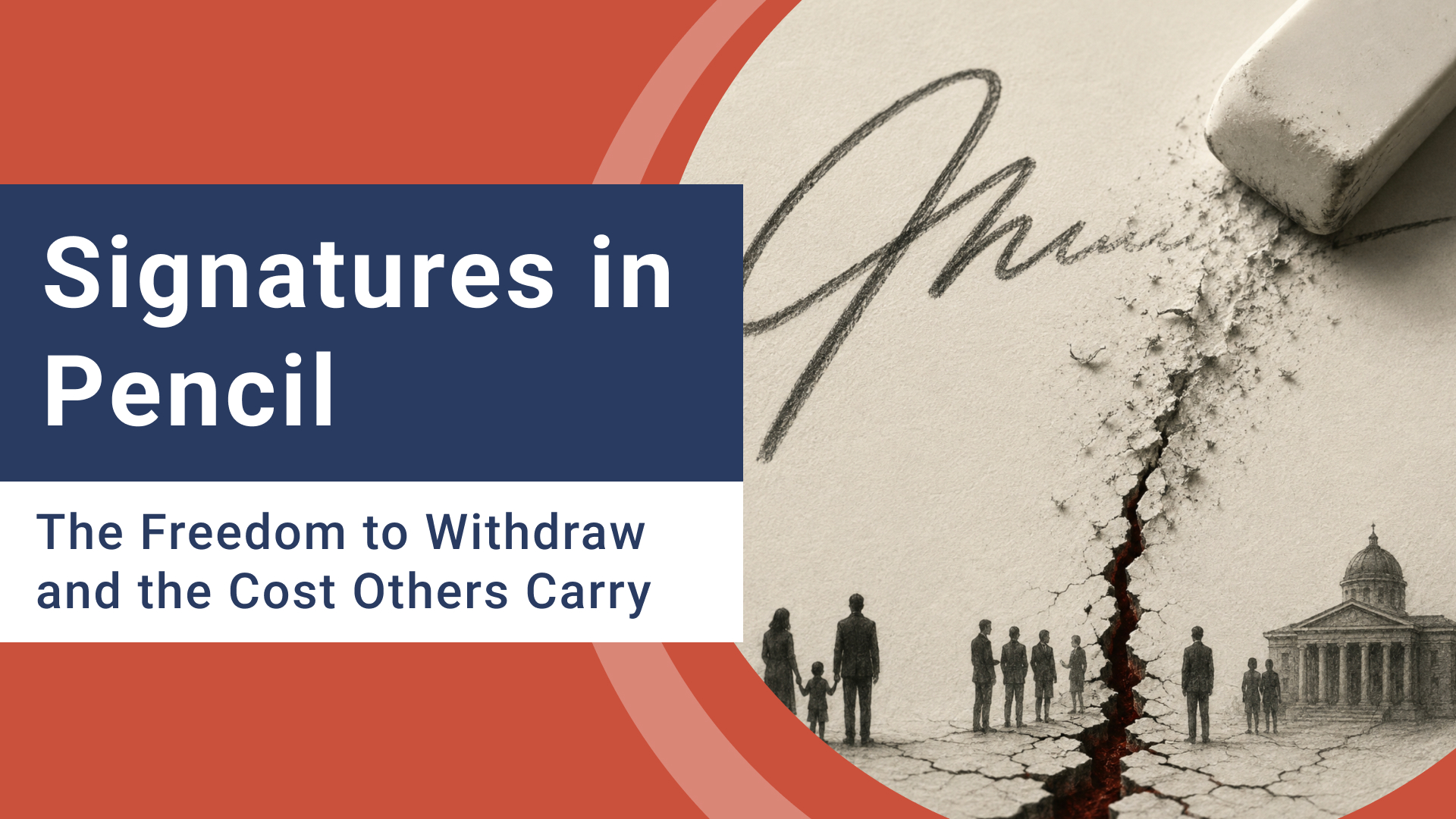

There was a time when making a consequential commitment commonly involved some visible act of binding oneself. Two people entering a marriage would take an oath before family, community, ‘God’ or some combination of the three. Business partners would shake hands with the understanding that their reputations now stood behind the agreement. Someone accepting a position would not merely acquire a title but assume the obligations attached to it. Political candidates would seek office by making promises about what they would protect, change or produce if entrusted with authority. None of these acts guaranteed integrity. Marriages still failed, business partners betrayed one another, officeholders neglected their responsibilities and politicians developed the remarkable capacity to forget their convictions shortly after an election. Yet a commitment was meant to possess weight beyond the emotional or strategic condition in which it was made.
The past should not be romanticised. Public oaths sustained some relationships that should have ended, commercial loyalty was sometimes exploited and political promises have probably been broken for as long as anyone has been available to vote. What has changed is not the discovery that human beings are unreliable. It is the growing normalisation of entering consequential commitments while privately preserving the right to withdraw whenever pressure, discomfort or inconvenience makes continued participation less attractive.
A relationship can now begin through a few edited photographs, progress through weeks of constant messaging and end through silence. A senior technician can accept a leadership title, its salary and its authority while continuing to participate as though responsible only for their own technical output. A founder can raise capital around a declared vision, then become fascinated by another opportunity once the unglamorous work of execution begins. A politician can campaign on a promise, obtain the office made possible by that promise and later explain that circumstances have changed, as though the electorate merely funded a period of exploratory thinking.
In each case, the commitment may have been sincerely expressed. The problem is not necessarily that the person lied. It is that somewhere within the agreement sat an unspoken qualification: I will remain committed for as long as this continues to suit me. We still sign our names, but increasingly we sign them in pencil.
The erasable commitment
A signature in pencil is not necessarily an outright deception. That is what makes it both attractive and difficult to confront. The person accepts the position, enters the relationship, joins the partnership, takes the investment, assumes public office or announces an ambitious undertaking. At the moment of signing, they may feel genuine enthusiasm and may experience themselves as unusually committed. Yet the back door remains open, not because they already plan to escape but because they are unwilling to relinquish escape as an immediate entitlement.
If pressure arrives, the commitment may be reconsidered. If inconvenience persists, it may be reinterpreted. If sacrifice is required, it may suddenly be discovered to conflict with the person’s ‘journey’, ‘truth’, ‘wellbeing’ or revised strategic priorities. If another opportunity appears, the original promise can be quietly erased and replaced by one offering a more flattering future.
Such withdrawals are rarely described as abandonment, failure of responsibility or refusal to honour one’s word. Those descriptions would expose the situation to moral evaluation. Instead, the individual has ‘changed direction’, ‘outgrown the situation’, ‘reconsidered their priorities’ or ‘chosen what is right for them’. An organisation has ‘adapted to emerging conditions’. A government has ‘responded pragmatically to the realities of office’. Apparently, responsibility becomes considerably more nuanced once the benefits of the original commitment have already been secured.
Sometimes these explanations are valid. People change, circumstances alter, new information becomes available and commitments entered responsibly may later become impossible, incoherent or destructive to sustain. Integrity does not require permanent loyalty to a mistake, nor should commitment become an honourable name for self-erasure, submission or participation in harm. Nevertheless, ‘I changed my mind’ is not a moral solvent. It may explain why someone withdrew, but it does not erase what they entered, what others organised around their participation or what their withdrawal has produced.
Commitment amid uncertainty
Every serious commitment is made in the presence of uncertainty. No one fully knows what a marriage, vocation, leadership position, enterprise or term of government will demand before entering it. Unknown territory cannot be made completely known through research, reflection or careful planning. Reality reveals dimensions of a commitment only through participation in it.
A person considering leadership can study the position description, speak with the outgoing leader and examine the team’s results, yet still not know how they will respond when a valued employee becomes destructive, a major client departs or the team’s hidden resentments begin shaping every decision. Someone entering a marriage cannot know who either partner will become through illness, parenthood, loss, prosperity or disappointment. A founder cannot foresee every market disruption, nor can a government predict every crisis it may encounter during its term.
A degree of uncertainty is therefore not evidence that commitment was impossible. It is one of the conditions under which commitment becomes meaningful. The person is not declaring, ‘I know everything that will occur and approve of it in advance.’ They are declaring, ‘I have seen enough to enter this reality and I am willing to remain answerable for how I participate as more of it is disclosed.’
Such a commitment is neither blind nor absolute. It does not promise to remain regardless of abuse, corruption, radical changes in circumstances or the destruction of the purpose for which the commitment was made. It does, however, mean that uncertainty cannot later be presented as though its existence were an unforeseeable breach of contract. The unknown was always part of what one entered.
The problem begins when a person wants the recognised identity, access or opportunity attached to a commitment without authentically encountering what it may entail. They examine the title but not the responsibility, the wedding but not the marriage, the investment but not the stewardship, the campaign victory but not the burden of governing. They commit to the conception they prefer while remaining unavailable to the reality that may emerge.
A crisis of sense-making
Signatures in pencil are therefore connected to a broader crisis of sense-making. The person does not merely fail to keep a commitment after entering it. They may fail to discern what they are entering before making it. Desire, excitement, social recognition and imagined identity crowd out the more demanding work of perception.
A senior software developer may understand leadership as the next rung on a professional ladder because the organisation presents it that way. The new role promises status, influence and higher remuneration, so the individual interprets it as an expanded version of technical seniority. They may never authentically encounter that leadership requires a different mode of participation, one in which they become answerable for conditions they do not directly control and results they do not personally produce.
Someone may similarly enter a relationship because they desire companionship, security, intimacy or family, while barely considering the demands of remaining with another person whose needs, limitations and development cannot be fully predicted. A founder may pursue investment because it represents validation and possibility while failing to perceive that accepting other people’s capital changes the structure of responsibility. A political candidate may desire the capacity to enact change without confronting that public authority binds personal judgement to institutional constraints, competing interests and consequences extending far beyond the election campaign.
Poor sense-making allows a person to seize an opportunity without encountering the reality that constitutes it. They respond to a selected conception rather than the fuller field of consequences, dependencies and demands. When reality later refuses to resemble the preferred conception, they experience the discrepancy as evidence that circumstances have unexpectedly changed. Often, reality has not betrayed the agreement. Reality has merely disclosed what the person was unwilling or unable to perceive when making it.
This does not mean that every consequence could have been foreseen. It means that responsible commitment requires an authentic attempt to encounter what can be known, humility regarding what remains unknown and willingness to remain answerable as the unknown becomes known. Sense-making does not eliminate uncertainty. It develops the capacity to enter uncertainty without converting every surprise into permission to withdraw.
The freedom to change and the responsibility to answer
There is no universal answer to how many times a person may legitimately change their mind. Someone may change careers several times and conduct each transition responsibly. Another may make one careless occupational decision that destabilises an entire family. A person may leave a marriage with integrity after years of sincere participation and sustained attempts at reconstruction. Another may remain physically present while withdrawing emotionally, sexually, financially and existentially, then insist they never technically left.
The issue is not merely how frequently a person changes their mind. It concerns the scale of the commitment, the depth of dependence it invited, the consequences of withdrawal and the manner in which the change is conducted. Changing one’s preferred restaurant carries little consequence. Changing one’s career can affect colleagues, clients, dependants, finances and years of accumulated effort. Changing one’s mind about a spouse affects someone who may have organised an entire life around the reality the two people jointly declared. Changing one’s mind about parenthood after children exist does not reverse their existence, despite the occasional adult appearing genuinely surprised by this administrative complication.
The larger the commitment, the more reality gathers around it. Other people make decisions based on our declared participation. They decline alternatives, take risks and invest time, money, trust and identity. Organisations create structures around the responsibilities we accept. Partners permit themselves to become vulnerable because we invite them to rely upon us. Citizens vote, invest, relocate or plan their futures based upon commitments made by those seeking authority. A signature can be erased from paper, but it cannot be erased so easily from the reality that has formed around it.
The central questions cannot therefore remain limited to whether a commitment still feels right or accords with one’s present preferences. A responsible participant must also ask what others were invited to build around their word, what became dependent upon their participation, what costs their withdrawal will transfer elsewhere and what they did to reconstruct the situation before abandoning it. If withdrawal has genuinely become necessary, they must consider what explanation, transition, repair or continuing responsibility is owed. The freedom to revise a decision does not include the freedom to revise history.
Commitment is not a mood
Another reason signatures have become erasable is that commitment is increasingly confused with an internal emotional state. We imagine that commitment exists while enthusiasm, certainty or affection is present. When those feelings diminish, we conclude that the commitment itself has disappeared. Withdrawal is then presented not as a consequential decision but as the honest recognition of a psychological fact. ‘I no longer feel committed’ quietly becomes ‘I am no longer responsible’.
Commitment, however, was never most needed when our feelings already carried us effortlessly in the same direction. Enthusiasm requires no discipline, convenience demands no courage and agreement is easy when nothing important is at stake. Commitment becomes visible when mood, comfort and immediate preference no longer perform the work on our behalf.
None of this means that people should persist blindly or remain at any cost. Commitment is not stubbornness and endurance is not automatically virtuous. A person can remain loyal to an incoherent course because admitting failure would injure their identity. Someone may use commitment as a respectable name for fear, dependency or submission. Another may demand loyalty from others while repeatedly violating the conditions under which loyalty could reasonably be expected.
The relevant distinction is that a genuinely committed person does not treat discomfort as self-validating proof that departure is warranted. Pressure becomes something to perceive, interpret and work through, not automatic permission to escape. A pencilled commitment amounts to saying, ‘I will participate while the conditions continue to support my preferred manner of participation.’ A substantive commitment goes further: ‘My participation includes engaging responsibly with changing conditions, including those that place demands upon me.’ The second does not eliminate the possibility of departure, but it changes what must occur before departure can be considered responsible.
Seizing an opportunity without inhabiting it
People enter professions because the income is attractive, accept leadership positions because the title is flattering, join boards because the association appears prestigious and acquire businesses because the opportunity looks valuable. They seize the opportunity but do not necessarily inhabit it.
To seize an opportunity is to obtain access to its benefits. To inhabit it is to become answerable to its demands. The distinction is often obscured because appointments are treated as rewards for past performance rather than entrances into a different domain of responsibility. A highly experienced software developer, for example, becomes a team leader. The new title appears, the salary increases and a cheerful announcement congratulates everyone involved. By Monday morning, however, the organisation may discover that it has not acquired a leader. It has acquired a senior developer who now attends additional meetings and is increasingly irritated by interruptions.
Leadership is not simply a role one occupies. Nor is it a theatrical performance in which the approved vocabulary is deployed during meetings before the person returns to protecting their comfort, reputation and technical territory. A movement into leadership requires a transformation in one’s mode of participation. Without that transformation, the person has accepted the title while declining the reality.
The technician is primarily answerable for what they directly produce. The leader becomes answerable for the conditions within which others produce. The technician may judge success by the quality of their own output, while the leader must confront failures they did not personally execute, tensions they did not initiate and limitations they cannot solve through technical expertise alone. Such accountability can feel profoundly unfair to someone who accepted the higher salary under the impression that leadership meant possessing more authority while remaining responsible for roughly the same things. Reality, displaying its customary insensitivity, remains unmoved by the misunderstanding.
Leadership has no spectator’s seat
A leader is demanded by reality, not merely by the organisation, to take responsibility beyond the boundaries of direct production. This includes owning their own shadows: defensiveness, avoidance, the need to appear competent, attachment to control, hunger for approval, conflict aversion and the temptation to conceal other people’s incapacity by continually compensating for it. Those shadows are not private matters once they begin shaping what a team can perceive, discuss and produce.
Leadership also involves becoming responsible for engaging the shadows active within the team. This does not mean claiming authorship of every person’s psychology or accepting blame for every failure. It means refusing to regard destructive dynamics as irrelevant merely because the leader did not personally create them. If resentment distorts communication, avoidance prevents decisions, dependency is mistaken for support or rivalry fragments the team, a leader cannot permanently retreat into the defence that these matters were absent from the formal job description.
Leadership begins where ‘That is not directly my fault’ ceases to function as a complete answer. A leader does not personally produce every result, but remains accountable for whether the conditions of participation, responsibility, sense-making, capacity and consequence are being held. This is why leadership cannot be treated as a modest promotion from one technical grade to the next. The person is not simply being asked to do more. They are being called to participate differently.
When that change in participation does not occur, the leadership commitment has been made in pencil. The salary is absorbed in ink, the title is printed permanently on LinkedIn and the authority is accepted with impressive durability. Only the obligations remain erasable.
Commitment and its metacontent
Commitments are never communicated solely through their explicit content. They also carry metacontent: the broader field of meaning through which the declared words are interpreted and made credible or incredible. A manager may say, ‘I take responsibility’, while their pattern of participation communicates, ‘provided no one attributes the failure to me’. A partner may say, ‘I am here for you’, while the manner of their presence communicates, ‘until your needs interfere with my preferred way of living’. An organisation may repeatedly declare its commitment to people while rewarding those who sacrifice people for short-term results. A government may sign a treaty while structuring every subsequent action around the convenience of withdrawal.
The content states the commitment, but the metacontent establishes what that commitment means within the reality of participation. Human beings respond not only to declarations but to patterns of presence, absence, sacrifice, evasion, consistency and consequence. A child may not understand the formal language of commitment, yet can perceive whether promises repeatedly dissolve under pressure. A team may not openly challenge its leader’s assurances, but it quickly learns which assurances survive contact with inconvenience. An electorate may not remember every policy detail, but it gradually learns whether political language is intended to bind conduct or merely secure consent.
Where content and metacontent repeatedly contradict one another, people eventually organise themselves around the metacontent. They stop trusting the announcement and begin studying the escape routes. A culture of provisional participation gradually forms in which each person avoids committing too deeply because others are unlikely to remain. Employees withhold discretionary effort, partners preserve emotional reserves, citizens become cynical and institutions multiply controls. Contracts become longer, monitoring intensifies and trust is replaced by procedure because everyone is outwardly respectful of personal freedom and privately terrified of everyone else exercising it.
Reality keeps the account
A withdrawn commitment does not eliminate its cost. It relocates it. When a parent withdraws, the cost moves into the life of the other parent and the developmental world of the child. When a leader avoids accountability, the cost moves downwards into the team. When an employee repeatedly accepts responsibility without carrying it, the cost moves sideways to colleagues who compensate. When founders occupy their positions without inhabiting them, the cost moves into capital, culture and lost opportunity. When politicians secure authority through promises they later abandon, the cost moves into public distrust, institutional legitimacy and the growing conviction that participation in democratic life is pointless.
At the organisational level, the residue of erased commitments often appears as duplicated work, delayed decisions, excessive supervision, staff exhaustion, repeated recruitment and continual injections of resources to compensate for failures of participation. Money is spent because responsibility was not held. Procedures multiply because trust was not warranted. High-capacity people become load-bearing structures for commitments made by people who have quietly withdrawn from them. Eventually, the organisation describes the situation as a resourcing problem, although it is often a participation problem wearing a budget.
At the economic level, unreliable commitments increase the cost of coordination. If words cannot be trusted, every exchange requires more verification, contingency, enforcement and protection. The society may continue celebrating flexibility, choice and personal autonomy while becoming steadily more expensive to operate. Commitment is therefore not merely a private virtue or sentimental preference. It is part of the invisible infrastructure upon which relational, organisational, political and economic life depends.
The Reconstructive account: commitment as an authorisation of reality
A Reconstructive account moves beyond understanding commitment as either a private intention or a contractual promise between separate individuals. A consequential commitment is a reality-authorising act. Through it, a person gives others reasonable grounds to organise decisions, expectations, resources and forms of dependence around their declared participation. The commitment does not merely communicate what the person presently intends to do. It authorises a future to begin forming.
When two people commit to a marriage, they authorise one another to decline alternative futures and construct a shared one. When someone accepts leadership, they authorise an organisation and its people to place responsibilities, expectations and vulnerabilities within the domain of their participation. When a founder accepts investment, they authorise others to expose capital, time and reputation to the undertaking. When a politician secures office through a promise, they authorise citizens to vote and plan on the assumption that the promise will meaningfully govern subsequent conduct. The commitment matters not only because words were spoken, but because those words altered what it became reasonable for others to do.
From this perspective, the problem with a signature in pencil is not simply weak resolve. It is the creation of asymmetrical optionality. The signatory preserves an unannounced right to withdraw whenever continued participation becomes inconvenient, while others are encouraged to behave as though the commitment is durable. One person retains the flexibility of non-commitment while receiving the trust, authority, intimacy, capital or status granted only because a commitment appeared to exist. The benefits are obtained from the apparent permanence of the signature, while the private freedom to erase it is quietly preserved.
This asymmetry explains why ‘I changed my mind’ is often radically insufficient even when it is factually true. A change of mind occurs within the individual, but the original commitment has already travelled beyond the individual. It has entered other people’s sense-making, altered their choices and become part of the architecture through which a shared reality is organised. The person may be psychologically finished with the commitment while the reality authorised by it remains materially, relationally and institutionally present.
Withdrawal therefore does not return participants to the condition that existed before the commitment. There is no simple reversal. Alternatives may have been declined, years may have passed, children may have been born, teams may have been assembled, capital may have been spent and political decisions may have been made. The person who withdraws does not restore the previous reality. They leave behind an orphaned reality: a field of expectations, dependencies and consequences that was jointly brought into existence but is no longer jointly held.
An orphaned reality does not disappear because its initiating commitment has been withdrawn. Someone must adopt its consequences. A spouse carries responsibilities once intended to be shared. Colleagues absorb work attached to an abandoned role. Investors carry exposure created by a founder’s declared intention. Citizens live within the institutional and economic consequences of political commitments that dissolved after authority was secured. What appears from the withdrawing person’s perspective as the recovery of freedom is frequently experienced elsewhere as the involuntary inheritance of responsibility.
The Reconstructive question is therefore not simply, ‘Must the person stay?’ Such a question traps the discussion between unrestricted withdrawal and absolute endurance. The more important question is: What does the person remain responsible for reconstructing if the form of participation to which they committed can no longer continue? A commitment may legitimately end without responsibility ending at precisely the same moment.
Reconstructive responsibility requires the person to encounter the reality their commitment authorised, identify the dependencies formed around it and participate in establishing a viable reality beyond their withdrawal. Depending on the circumstances, this may involve honest disclosure, renegotiation, a period of transition, redistribution of responsibility, material compensation, relational repair or the creation of genuine closure. Reconstruction cannot guarantee that no one will be harmed, but it refuses to make the affected parties carry the entire cost of a decision they did not independently produce.
This account also changes how commitments should be entered. Responsible commitment does not require pretending to possess certainty about an unknowable future. It requires being truthful about the degree of uncertainty, the limits of one’s present capacity and the conditions under which participation may need to be reconsidered. A commitment becomes deceptive when the signatory privately treats it as provisional while allowing others to treat it as dependable. If significant reservations or exit conditions already exist, they belong within the shared meaning of the commitment rather than behind the person’s private back door.
A signature in ink is therefore not a declaration of eternal sameness. It is an acceptance that one cannot unilaterally dissolve a shared reality merely by withdrawing one’s intention from it. The commitment binds the person not necessarily to remaining forever, but to remaining answerable. Even where continuation becomes impossible, the responsibility to participate in reconstruction may endure.
The deepest failure of a signature in pencil is consequently not impermanence. All human commitments exist within change and mortality. Its failure lies in obtaining the world-making power of commitment while secretly reserving the consequences of non-commitment for others. The person authorises a reality collectively, then attempts to exit it individually. Reconstruction begins when freedom to withdraw is reunited with responsibility for the world that one’s word helped bring into existence.
Reconstructive fidelity: commitment in a changing world
If commitment is treated as the obligation to preserve an original decision in its original form, then commitment will eventually become either dishonest or destructive. People develop, organisations change, knowledge expands and conditions emerge that could not have been anticipated when the commitment was made. A marriage entered at thirty cannot be inhabited at fifty as though neither person has changed. A company cannot honour its founding purpose by mechanically preserving every early strategy. A leader cannot continue applying an approach that reality has shown to be ineffective merely because consistency has been mistaken for integrity. A government should not implement an electoral promise exactly as announced if credible new information demonstrates that doing so would seriously harm the public.
The alternative, however, cannot be that every change in circumstance releases the person from what they undertook. That would make commitment little more than a statement of current preference. The practical challenge is to distinguish between changing the form through which a commitment is enacted and abandoning the reality for which one became responsible.
A Reconstructive account approaches this through what may be called reconstructive fidelity. Reconstructive fidelity is the capacity to remain answerable to the purpose, people and consequences of a commitment while allowing its form to be examined and, where necessary, changed. It is neither rigid preservation nor convenient withdrawal. It asks what must remain held, what has genuinely changed and what now needs to be reconstructed so that participation can remain coherent with reality.
Every substantial commitment contains several elements that can change at different rates. There is the underlying purpose for which the commitment was made, the people and realities made dependent upon it, the particular form through which it is currently enacted and the assumptions under which that form was chosen. Confusion arises when these are treated as though they were identical. A change to one is then taken either to invalidate everything or to permit no change at all.
A person may, for example, remain committed to a marriage while recognising that the established patterns through which the marriage has operated must be reconstructed. Roles, expectations, forms of intimacy and distributions of responsibility may need to change if the relationship is to remain alive. Preserving every existing arrangement could betray the marriage more profoundly than changing them. Reconstructive fidelity asks the partners to remain answerable to the shared reality while reconsidering the forms that no longer allow it to be inhabited coherently.
The same distinction applies within organisations. A founder may be committed to the purpose of an enterprise while abandoning a strategy that no longer works. A leader may remain committed to a team while changing its structure, replacing an incapable manager or ending a project that continually consumes capacity without producing value. Insisting that nothing change would not demonstrate commitment. It could amount to sacrificing the organisation to the leader’s need to appear consistent.
Political commitments present the same challenge. A government should not casually abandon a promise once it has obtained the authority that the promise helped secure. Nor should it continue implementing the promise when new evidence shows that the proposed action would produce serious and previously unknowable harm. Reconstructive fidelity requires the government to disclose what has changed, present the evidence, explain why the original form can no longer responsibly be maintained and remain accountable to the public purpose the promise was meant to serve. Quietly discarding the promise is not adaptation. Blindly implementing it despite reality is not integrity.
The first practical demand of reconstructive fidelity is therefore renewed perception. When pressure appears, the participant must ask whether reality has substantively changed or whether the commitment has merely become uncomfortable. These are not the same. Difficulty, boredom, sacrifice and exposure do not by themselves indicate that a commitment has become incoherent. They may reveal the precise capacities the commitment now demands. By contrast, abuse, corruption, fundamental betrayal, severe incapacity or the collapse of the original purpose may indicate that continuation in the same form is no longer responsible.
This discernment requires disciplined sense-making because people are remarkably capable of interpreting reality in ways that protect what they already want to do. Someone who wants to leave will easily discover evidence that the commitment has become impossible. Someone terrified of leaving will find reasons why endurance remains virtuous. A leader attached to an obsolete strategy will call persistence courage, while another seeking escape will call avoidance agility. Reconstructive fidelity requires that interpretations be tested against evidence, participation and consequence rather than accepted because they deliver the preferred conclusion.
The next demand is to determine what within the commitment is being preserved. Is the person protecting its purpose, the people involved and the reality it was meant to serve, or merely preserving its visible form? Conversely, is the person changing its form in order to honour its purpose more effectively, or using the language of adaptation to conceal withdrawal? The same outward change may express either integrity or evasion depending on what the person is actually holding.
Where the original form no longer serves the commitment, reconstruction should begin before abandonment. The person must engage those who have become participants in and dependent upon the commitment, disclose what they are perceiving and make the changing conditions available for shared examination. Alternatives can then be developed, consequences considered and responsibilities redistributed deliberately rather than transferred through surprise. This does not mean every affected person receives veto power. It means they are not treated as passive recipients of a decision about a reality they also inhabit.
Sometimes reconstruction will allow the commitment to continue in a new form. A leader may receive development and support rather than immediately resign. Business partners may revise their responsibilities rather than dissolve the enterprise. A government may redesign a policy while remaining faithful to the problem it promised to address. A marriage may reconstruct the patterns that are damaging it without treating the presence of difficulty as proof that the relationship itself was a mistake.
At other times, honest reconstruction will disclose that the commitment cannot responsibly continue. Its purpose may have collapsed, its conditions may have been fundamentally violated or the participants may no longer possess a viable basis for proceeding together. Reconstructive fidelity does not demand that the original arrangement be preserved after reality has rendered it destructive or empty. It demands that ending become a responsible form of participation rather than a unilateral disappearance.
A practical commitment in a changing world must therefore include the capacity to hold, question, renegotiate and, where necessary, conclude. Holding without questioning becomes rigidity. Questioning without holding becomes permanent provisionality. Renegotiation without accountability becomes convenient revision. Ending without reconstruction transfers the abandoned reality to others. Each movement becomes responsible only when it remains connected to purpose, participation and consequence.
Reconstructive fidelity also changes what it means to keep one’s word. Keeping one’s word cannot always mean performing exactly what was originally imagined, because the original conception may prove inadequate to the reality encountered. It means refusing to make the inadequacy of that conception someone else’s problem. The person remains present, makes the change intelligible, owns their participation and works to preserve or responsibly reconstruct what their word authorised.
The measure of commitment is therefore not simply duration. Some people remain for decades while refusing to participate, and others may end an arrangement while taking profound responsibility for what its ending requires. Nor is the measure merely consistency of behaviour. A changing world can make behavioural consistency incoherent. The more demanding measure is whether the person continues to hold the reality of the commitment, including its purpose, dependencies and consequences, even as its form is revised.
A commitment capable of surviving change is not one that refuses to move. It is one that does not disappear when movement becomes necessary. Its strength lies neither in remaining exactly the same nor in remaining permanently free to escape, but in the capacity to reconstruct participation without abandoning answerability. This is how a signature can remain in ink while the agreement it signifies remains alive.
A question of Being
The Being discourse allows the phenomenon to be seen more deeply than as a simple failure of discipline, manners or moral character. A signature in pencil expresses a way of Being in relation to reality: a person seeks access without exposure, benefit without binding consequence and identity without transformation. They want to be regarded as a spouse without allowing the relationship to make demands upon who they are. They want to be recognised as a leader without surrendering the narrower protections of the technician. They want public authority without becoming answerable to the people whose trust made that authority possible. They want the opportunity without becoming the person capable of holding it.
From this perspective, commitment is not merely the continuation of an action. It is a mode of Being through which someone remains available to what they have authorised into existence. Responsibility does not mean accepting blame for everything. It means recognising oneself as a participant within a reality one has helped constitute. Accountability is not merely punishment imposed after failure. It is the willingness to have one’s participation examined in relation to what it has produced, prevented, enabled or left for others to carry.
Loyalty, similarly, should not be confused with blind allegiance. It is the refusal to treat people, purposes and institutions as disposable whenever they cease to flatter immediate preference. Commitment, responsibility, accountability and loyalty are therefore not decorative values added to an otherwise functioning arrangement. They shape whether a person can be relied upon once feelings no longer provide free labour.
The capacity to remain and the capacity to leave
It may be tempting to explain provisional participation entirely through selfishness. Sometimes selfishness is an adequate explanation, but often the person lacks the capacity to hold what they have entered. They may possess the capacity to pursue an opportunity but not to sustain it. They may have the capacity to make a promise but not to metabolise the pressure produced by keeping it. They may have the capacity to fall in love but not to participate in love once the other person becomes real, complex and inconvenient. They may possess the technical capacity to qualify for leadership while lacking the ontological, relational and developmental capacity to lead.
The distinction matters because condemnation alone does not expand capacity. Commitment requires the capacity to remain present to discomfort without immediately converting it into an exit. It requires sufficient perception to recognise consequences beyond one’s immediate emotional horizon, sufficient stability to continue participating coherently while enthusiasm fluctuates and sufficient humility to reconstruct one’s way of participating when it proves inadequate. It also requires the courage to end a commitment responsibly when it can no longer be honoured.
Without these capacities, people often preserve their self-conception by revising the meaning of what they previously promised. The commitment was apparently never official, expectations were never clearly communicated, circumstances changed or everyone should have understood that nothing was guaranteed. The eraser is applied not only to the signature but to the shared account of reality. What began as a failure to hold the commitment becomes a reconstruction of history in which no meaningful commitment ever existed.
The capacity discourse also prevents commitment from being reduced to willpower. A person may sincerely want to remain and still lack the capacity to perceive, hold and respond to what the commitment demands. Yet incapacity does not remove responsibility. It changes the nature of the responsibility. The person must become willing to recognise the gap, seek support, undertake development and stop presenting aspiration as established capacity. Wanting to be a leader is not the same as being capable of leading, just as wanting a marriage is not yet the capacity to participate in one.
When withdrawal becomes responsible
Some commitments should end. Relationships can become abusive or destructive, careers can deform a person’s life, organisations can betray their purpose and leaders may discover that they are fundamentally unsuited to the roles they accepted. Business partnerships can become untenable, political commitments may become incoherent when reality changes substantially and agreements between nations may require revision. The possibility of legitimate withdrawal must remain open because commitment severed from reality becomes rigidity.
Responsible withdrawal begins by acknowledging that a real commitment existed. It does not minimise the agreement after benefiting from it or make affected parties appear foolish for having relied upon what was offered. It then requires an honest encounter with consequence. What has been created, delayed, abandoned or transferred? Who now carries the weight? What repair, transition, compensation, explanation or closure is owed?
Responsible withdrawal must also produce learning. If someone repeatedly makes commitments that they later abandon, the issue is no longer adequately explained by observing that circumstances keep changing. The pattern itself requires examination. Perhaps the person commits under the influence of excitement, confuses desire with capacity or pursues identities rather than realities. Perhaps every restriction upon personal preference is interpreted as evidence that the commitment has become unhealthy. Perhaps the person has mastered beginning because beginnings provide recognition, while remaining exposes limitations that recognition initially concealed.
Changing one’s mind may be legitimate. Repeatedly constructing worlds that others inhabit, then withdrawing as soon as those worlds begin making demands, is something else. The capacity to leave responsibly is part of the capacity to commit, but departure cannot become the unexamined solution to every encounter with pressure.
Nations that sign in pencil
The same pattern appears in geopolitics. Treaties, alliances, trade agreements and security guarantees depend upon more than documents. They depend upon the expectation that commitments will survive changes in leadership, convenience and pressure. A state that treats every signature as a temporary tactical instrument may gain flexibility in the short term, but gradually makes its own word strategically worthless.
Other states respond not only to the content of an agreement but to its metacontent. They diversify alliances, increase defence spending, demand stronger guarantees and develop policies around the possibility of abandonment. The original state may then complain that it is being treated with suspicion, which is one of history’s more persistent forms of dark comedy. It has spent years demonstrating that its commitments are conditional, then takes profound offence when others notice the conditions.
A signature in pencil will eventually be erased. The only uncertainty is whether it will be erased by the signatory, by changing circumstances or by everyone else ceasing to believe it was worth reading. National credibility, like personal credibility, accumulates when commitments survive the moments in which violating them would be easier. Power may compel short-term compliance, but reliability creates longer-term influence. A nation unable to bind its future conduct in any meaningful way may remain powerful, yet become impossible to trust.
From pencil to ink
Signing in ink does not mean promising never to change. It means that if change becomes necessary, one does not pretend nothing was written. An inked commitment may be revised, renegotiated or ended, but it cannot be casually erased without acknowledgement. It remains part of the history of the participants and part of the reality for which they must account.
The distinction is between rigidity and integrity. Rigidity insists that the original decision must continue regardless of reality. Integrity requires that any change remain answerable to the reality the original decision helped create. Rigidity imprisons people within their past words, while integrity prevents them from pretending those words carried no weight.
Perhaps the essential question before accepting a role, choosing a spouse, founding an organisation, making a public promise or signing an international agreement is not merely whether one wants it. Nor can the question be whether one possesses complete certainty, since reality grants no such luxury. The more serious question is whether one has perceived enough to enter responsibly and whether one is willing to remain answerable as the unknown territory reveals itself.
If the answer is no, declining may be the more honourable act. Not every opportunity needs to be seized, not every attraction must become a relationship, not every accomplished technician must become a leader and not every ambition must be publicly announced. A clean refusal often produces less harm than an enthusiastic commitment written in pencil. Refusal may disappoint people in the present, but provisional commitment recruits them into a future whose foundations the signatory has privately reserved the right to remove.
The crisis is not that people sometimes change their minds. Nor is the answer to demand that every commitment be maintained under every condition at any cost. The crisis is that commitments are increasingly entered as though the right to withdraw also includes immunity from consequence. We want our declarations to organise the behaviour of others without allowing those declarations to bind our own participation. We want people to trust what we say while preserving the right to treat what we said as a temporary expression of how we once felt.
Reality does not honour that arrangement. It continues to keep an account even when we prefer erasable stationery. A signature may disappear from the page, but what others built around it, what it authorised into existence and what its withdrawal left them to carry do not disappear with it.