
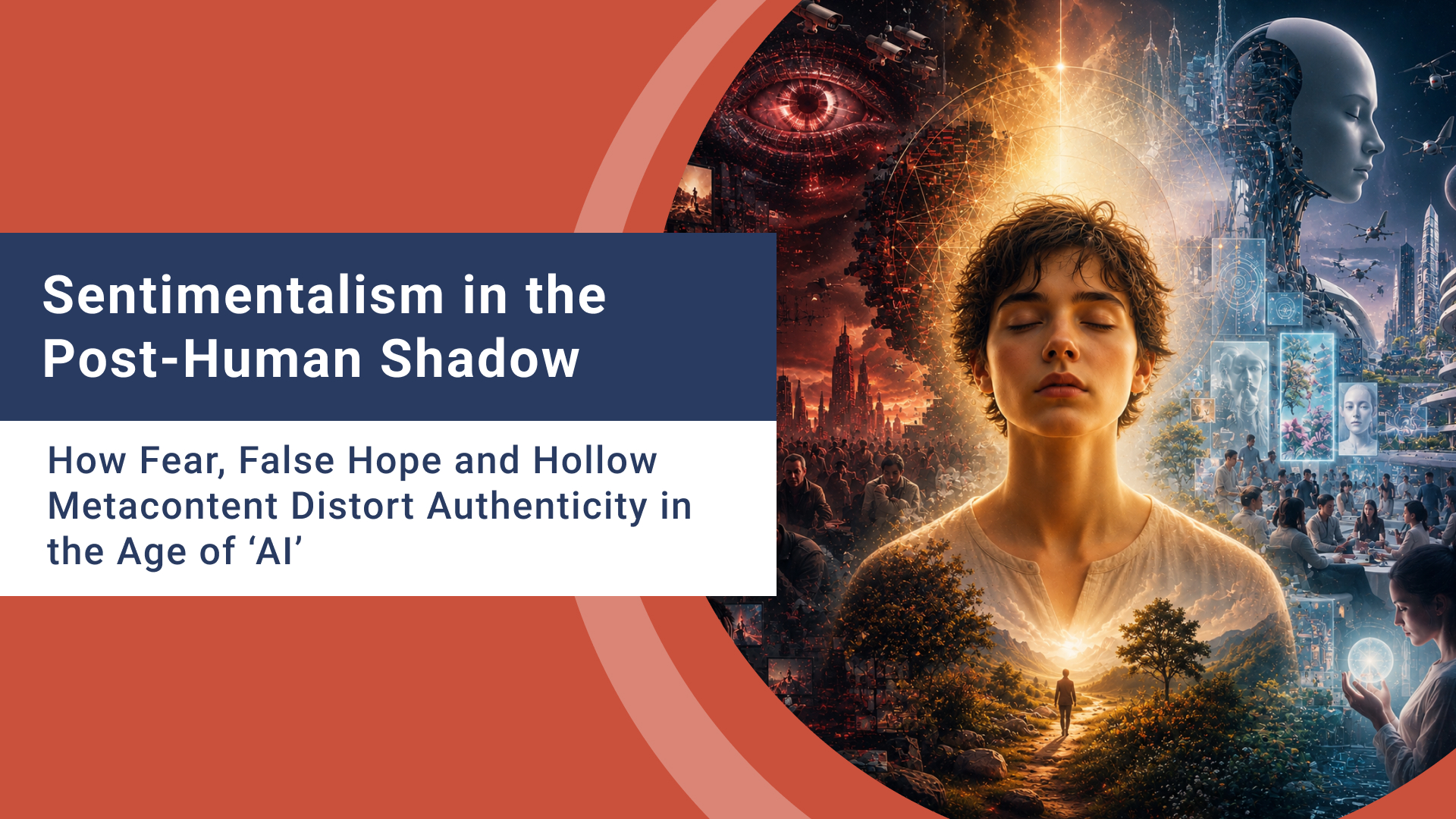

Make no mistake, the fear is no longer merely that humanity is changing. The fear is that humanity is being slowly prepared to accept its own disappearance, not through one violent blow, not through some obvious act of conquest, but through a long and patient reconditioning of the human being itself.
Once that possibility enters the mind, the world begins to rearrange itself. What once looked like separate crises start to appear as pieces of a single architecture. The weakening of the family. The quiet eviction of faith from public formation. Children raised more by institutions, screens and algorithms than by elders, stories, duties and sacred inheritance. Life compressed into vast cities, far from soil, silence, seasons and the moral intelligence of nature. Bodies made tired, inflamed and dependent by toxic food, polluted air, restless sleep and lives designed around stress.
Then comes the assault on attention. The endless scroll. The replacement of conversation with performance. The substitution of friendship with visibility. The loneliness of people who are always contactable but rarely known. The collapse of trust. The rise of suspicion. The financial machinery that keeps adults exhausted, indebted and distracted before they ever have time to ask what kind of life they are actually living. The wars that never end. The migrations that unsettle nations without healing the people who move or the people who receive them. The drugs, the alcohol, the pills, the addictions, the quiet despair dressed up as lifestyle.
And then, beneath all of it, something even more intimate begins to shift. The body itself becomes questionable. Sex becomes unstable. Gender becomes fluid. Identity becomes something to be performed, edited and declared. The inherited givens of human life are no longer received as reality, but treated as oppressive material awaiting correction. Masculinity is recoded as danger. Motherhood is treated as limitation. Childhood is politicised. Distress is medicalised. Wisdom is replaced by information. Community is replaced by platforms. Transcendence is replaced by ideology.
Seen from this angle, the last sixty years can appear almost too coherent, almost too carefully aligned to be accidental. The destabilisation of the family. The ideological capture of education. The suspicion towards the body. The dismantling of inherited meaning. The disembodiment of digital life. The severing of people from place, nature, faith, memory and moral formation. The replacement of God with appetite, of responsibility with grievance, of belonging with branding and of truth with preference.
And through it all, a certain kind of human being is produced. Weaker in body. More anxious in mind. Less rooted in family. Less anchored in faith. Less capable of silence. Less prepared for responsibility. Less formed by duty, sacrifice, patience and love. More dependent on systems. More vulnerable to manipulation. More willing to outsource judgement, memory, morality and even identity itself. This is how the post-human future begins to appear, not first as metal bodies, artificial wombs, neural implants or machines replacing flesh, but as the slow erosion of the conditions that allow human beings to remain fully human. First the person is uprooted. Then the body is destabilised. Then meaning is fragmented. Then identity is made fluid. Then reality itself becomes negotiable. Finally, what was once called human nature begins to look like an outdated limitation, while anxiety becomes normalised as a way of life.
The Seduction of a Half-True Story
This is powerful. It is meant to be powerful. It gathers fear, grief, moral exhaustion, social confusion and spiritual dislocation into one dramatic frame. It gives scattered anxiety a plot. It tells the reader that the unease they have been carrying is not random. It gives shape to what many people feel but cannot yet articulate. Something is wrong. Something has gone terribly wrong. The human being is being weakened.
This is precisely where the deeper problem begins.
The problem is not that the argument contains no truth. If it contained no truth, it would not travel far. It would be too absurd, too easy to dismiss, too obviously detached from ordinary experience. Its power comes from the fact that it contains fragments of truth. Families have weakened. Children are increasingly mediated by screens and institutions. Digital life has reshaped attention, memory, sexuality and self-understanding. Technology is not merely a tool we use; it increasingly mediates how we encounter the world, others and ourselves.
Nor should we pretend that the post-human concern is imaginary. There are genuine trajectories in our civilisation that can produce a diminished human being. A person may become more technically connected but less relationally capable, more expressive but less truthful, more stimulated but less attentive, more informed but less wise, more liberated from inherited forms but less able to carry responsibility. A society can become advanced in its tools while becoming primitive in its Being. There is nothing impossible about that. Civilisations can decay while congratulating themselves on progress.
The narrative becomes misleading not because every concern inside it is false, but because the concerns are arranged inside a distorted frame. It takes real wounds and turns them into a total explanation. It takes genuine patterns and converts them into a single hidden plot. It gathers the anxiety of the age and gives it an enemy large enough to carry the weight of everything that hurts.
That is the seduction of the half-true story. It does not need to lie completely. It only needs to organise truth badly.
Post-Phenomenology and the Mediated Human Being
We are no longer living in a merely technological age. We are living in a post-phenomenological condition, where human experience is increasingly mediated by machines, platforms, interfaces, algorithms, screens and artificial intelligence. The world no longer arrives to us simply through body, place, relationship, tradition, silence and direct participation. It arrives through systems that filter, rank, compress, amplify, predict and interpret reality before we have fully encountered it.
This changes the human being.
The issue is not only that we use technology. The deeper issue is that technology increasingly participates in the formation of perception itself. It shapes what we notice, what we ignore, what we desire, what we fear, how we compare ourselves, how we remember, how we speak, how we perform identity and how we imagine the future. The machine is no longer outside experience. It is increasingly inside the structure of experience.
In such an age, authenticity becomes far more difficult. Authenticity cannot mean merely “being true to how I feel.” That is too thin. Feelings are real, but they are not automatically truthful. Feelings can disclose reality, but they can also distort it. They can alert us to danger, but they can also make danger larger than it is. They can reveal injury, but they can also turn injury into identity. They can awaken conscience, but they can also become a theatre in which conscience is replaced by performance.
This is where sentimentalism enters.
What Sentimentalism Really Is
Sentimentalism is not the existence of sentiment. A human being without sentiment would be cold, abstract and morally deformed. Love, grief, reverence, fear, tenderness, outrage and hope all belong to the human condition. Sentimentalism begins when sentiment is no longer integrated into discernment, responsibility and truthfulness. It begins when emotion becomes the organiser of reality.
The sentimental person does not simply feel deeply. They treat the intensity of feeling as proof that their interpretation is true.
There are two dominant forms of sentimentalism in our age: pessimistic sentimentalism and optimistic sentimentalism. They appear to be opposites, but they often share the same underlying structure.
Pessimistic sentimentalism says the world is darker than it is, not because darkness is absent, but because it turns every darkness into confirmation of total collapse. It does not merely see corruption; it assumes corruption as the hidden principle behind everything. It does not merely identify danger; it needs danger to become absolute so that its fear can feel morally justified. It does not merely critique power; it imagines power as omnipotent, coordinated and almost metaphysical. Its emotional reward is the feeling of being awake among the deceived.
Optimistic sentimentalism says the world is brighter than it is, not because goodness is absent, but because it converts possibility into inevitability. It assumes progress will save us, technology will solve us, inclusion will heal us, innovation will liberate us and the future will vindicate whatever the present happens to be dismantling. It does not merely hope; it uses hope to avoid discernment. It does not merely welcome change; it baptises change as progress before asking what kind of human being the change is producing. Its emotional reward is the feeling of being morally advanced without having to face the losses hidden inside the advance.
One is intoxicated by apocalypse. The other is intoxicated by utopia. One says everything is being destroyed. The other says everything is becoming better. One sees demons everywhere. The other sees liberation everywhere. Both often avoid the discipline of reality.
The Five Crises Behind the Fear
The Reconstructive School does not need to deny the anxieties underneath these narratives. In fact, it can explain why they arise with such force. The fear of a post-human future becomes persuasive because it touches five real crises that are already shaping our age: the crisis of sense-making, the crisis of meaning, the crisis of Being and participation, the crisis of sustainability and the crisis of capacity.
The crisis of sense-making means that people increasingly struggle to understand what is happening to them. They are flooded with information, opinion, commentary, propaganda, data, emotional triggers and algorithmically curated fragments of reality. Yet more information has not produced clearer understanding. It has often produced fragmentation, suspicion and exhaustion. In such conditions, a dramatic narrative that explains everything through one hidden agenda can feel like relief. It gives coherence to chaos, even if that coherence is false.
The crisis of meaning means that many people no longer inhabit a clear horizon of purpose, transcendence, duty, belonging and moral formation. Meaning is increasingly borrowed from ideology, lifestyle, consumption, identity performance or political theatre. When inherited sources of meaning weaken, people become vulnerable to replacement narratives. Some will borrow meaning from utopian progress. Others will borrow meaning from apocalyptic collapse. Both forms can feel profound while remaining shallow.
The crisis of Being and participation means that human beings are losing contact with the deeper capacities required for truthful, responsible and embodied participation in reality. A person may have opinions, preferences, emotions, platforms and rights, yet still lack the Being required to participate well. They may speak constantly and still lack truthfulness. They may claim freedom and still lack responsibility. They may pursue identity and still lack selfhood. They may be endlessly connected and still lack relationship.
The crisis of sustainability means that our ways of living, producing, consuming, governing, educating and relating are often unable to sustain the conditions of human flourishing. This is not only ecological. It is also psychological, relational, cultural, spiritual and institutional. A society can become unsustainable when it exhausts attention, fragments families, commodifies childhood, politicises the body, corrodes trust and weakens the moral ecology required for adulthood.
The crisis of capacity means that the demands placed upon human beings now exceed what many are presently able to bring to participation. Modern life requires high discernment, emotional maturity, digital literacy, moral courage, relational depth, economic resilience, embodied responsibility and spiritual seriousness. Yet many of the same systems that demand these capacities also weaken the conditions through which they are formed. This produces a widening gap between what reality requires and what people can bring to it.
Seen through these five crises, the fear of a post-human future is not nonsense. It is a distorted response to real civilisational pressure. If these crises remain unaddressed, then many of the feared outcomes become possible. Not because one secret group controls all events with perfect precision, but because weakened people, hollow institutions, distorted technologies and collapsed meaning can produce a post-human condition without needing a single master plan.
That is far more serious than the conspiracy.
A civilisation does not need to consciously choose its own dehumanisation in order to drift towards it. It only needs to fail, repeatedly and systematically, to reconstruct the conditions that allow human beings to remain fully human.
Hollow Metacontent and the Collapse of Discernment
From a metacontent perspective, this process is very precise. It often begins with an initial insight. The person notices something real: children are anxious, families are weaker, digital life is disembodying, education has become ideological, artificial intelligence is changing human participation, the body is increasingly treated as editable material. That initial insight then becomes a cognitive map. The person starts arranging the world around that concern.
Then stories gather around the map. Every new event becomes evidence. A policy decision, a school curriculum, a corporate campaign, a social trend, a scientific development, a celebrity performance, a medical debate or a technological product is folded into the same narrative. The person is no longer asking what each thing is. They are asking how it confirms what they already suspect.
Then a mental model forms. The world is controlled. Progress is either salvation or destruction. Institutions are either holy or demonic. People are either awake or asleep. Every ambiguity becomes suspicious. Every distinction becomes inconvenient. Every challenge is reinterpreted as proof that the challenger has been captured.
Then comes perspective. The person no longer sees reality directly, but through a frame already charged with emotional certainty. Finally, a paradigm settles in. The person does not merely have an opinion. They now inhabit a world.
This is how hollow metacontent works. It does not need to be entirely false. It only needs to arrange partial truths in a way that reduces reality while feeling revelatory. A fragment of truth is lifted out of proportion. A real concern becomes a total explanation. A pattern becomes a plot. A possibility becomes an inevitability. Complexity becomes “they.” Incapacity becomes conspiracy. The person feels awakened, but their perception has actually narrowed.
Scepticism, Critical Thinking and Cynicism
This is why we must distinguish scepticism, critical thinking and cynicism.
Scepticism, properly understood, is not cynicism. Scepticism is disciplined hesitation before certainty. It asks: what do we actually know? What is being assumed? What evidence supports this? What evidence would challenge it? What are the alternative explanations? Scepticism is a protection against being captured by the first emotionally satisfying story. It does not refuse belief forever. It refuses premature certainty.
Critical thinking goes further. It does not merely doubt. It examines structure. It asks how a claim is formed, what distinctions it collapses, what evidence it includes, what evidence it excludes, what emotional need it satisfies, what consequences it produces and what kind of participant it forms in the person who believes it. Critical thinking is not the performance of intelligence. It is the discipline of truthful participation. It strengthens the person’s capacity to meet reality without needing reality to flatter their fear or their hope.
Cynicism is something else entirely. Cynicism is wounded certainty pretending to be intelligence. It already knows the answer before the inquiry begins. It assumes corruption, bad faith and hidden motive as the default explanation. It can sound sharp, but its sharpness is often a form of despair. The cynic does not simply question narratives; they become dependent on suspicion. They are not free from manipulation. They are manipulated by the need to never be seen as naïve.
The consequences are serious. Scepticism can protect discernment. Critical thinking can build capacity. Cynicism corrodes participation. A sceptical person can still love. A critical thinker can still build. A cynic usually stands outside the world, commentating on decay while becoming unable to contribute to renewal. Cynicism may begin as self-protection, but it often ends as incapacity.
The Reconstructive Question
This is where a reconstructive analysis becomes necessary. The deepest question is not whether modern civilisation contains post-human tendencies. It clearly does. The deeper question is what kind of human being our present systems are forming, and what capacities are being strengthened or weakened through that formation.
Are people becoming more capable of attention, responsibility, embodiment, truthful speech, moral judgement, relational commitment, patience, sacrifice, courage, reverence and participation? Or are they becoming more reactive, performative, anxious, fragmented, dependent and easily mobilised by fear or fantasy?
The post-human danger is not only found in biotechnology, artificial intelligence, gender ideology, surveillance systems or neural implants. It begins whenever the human being is severed from the conditions that allow humanity to mature. It begins when embodiment is treated as incidental. It begins when family becomes either disposable or idolised. It begins when education loses its formative seriousness. It begins when spirituality is replaced by ideology, when children become instruments in adult conflicts, when suffering becomes a market, when attention becomes a commodity and when identity becomes a project of endless self-editing.
But the opposite danger is also real. We cannot recover humanity by becoming hysterical about every change. We cannot defend embodiment by dehumanising people. We cannot defend children by converting them into props for our own moral theatre. We cannot defend truth by spreading half-truths. We cannot defend God by turning God into a weapon for our resentment. We cannot resist manipulation by becoming manipulable through fear.
Authenticity in the post-phenomenological age requires a more difficult posture. It requires us to notice the machine without imagining that everything is machine. It requires us to see technological mediation without becoming technologically illiterate. It requires us to critique artificial intelligence without pretending that human intelligence has remained pure, whole and uncorrupted. It requires us to defend the body without denying the suffering people experience in relation to their bodies. It requires us to defend meaning without turning meaning into propaganda.
Authenticity Beyond Sentimentalism
This is why sentimentalism must be exposed. It is not enough to ask whether a claim feels powerful. Many things feel powerful because they are arranged to bypass discernment. It is not enough to ask whether a claim contains truth. Many dangerous claims contain enough truth to gain entry. The real question is whether the claim increases our capacity for truthful participation. Does it make us more capable of perceiving clearly, acting responsibly and building what has been damaged? Or does it leave us more fearful, contemptuous, reactive and dependent on enemy stories?
A pessimistic sentimentalism will tell us that humanity is doomed unless we identify the hidden enemy. An optimistic sentimentalism will tell us that humanity is evolving and only reactionaries are afraid. Both are insufficient. Humanity is not safe. Humanity is not simply doomed. Humanity is at stake.
The task is not panic and it is not naïve trust. The task is reconstruction. We must reconstruct the conditions through which human beings become capable of being human: families that form rather than merely house, education that cultivates judgement rather than compliance, technologies that serve participation rather than addiction, economies that do not exhaust the soul, communities that restore belonging without tribal possession, spiritual traditions that deepen responsibility rather than inflame superiority and public discourse that can hold moral seriousness without collapsing into hysteria.
Sentimentalism is attractive because it spares us the burden of disciplined discernment. It lets us feel right before we have done the work of becoming truthful. But authenticity asks more from us. It asks us to bring feeling into contact with reality, to bring suspicion under the discipline of inquiry, to bring hope under the discipline of responsibility and to bring critique into the service of reconstruction.
The world does not need more frightened people who think they are awake. Nor does it need more optimistic people who mistake compliance with the future for wisdom. It needs human beings capable of perceiving what is real, grieving what is damaged, refusing what is false and building what is worthy.
That is where authenticity begins in the post-phenomenological age. Not in the intensity of our fear. Not in the comfort of our hope. But in the disciplined recovery of our capacity to participate truthfully in reality.