
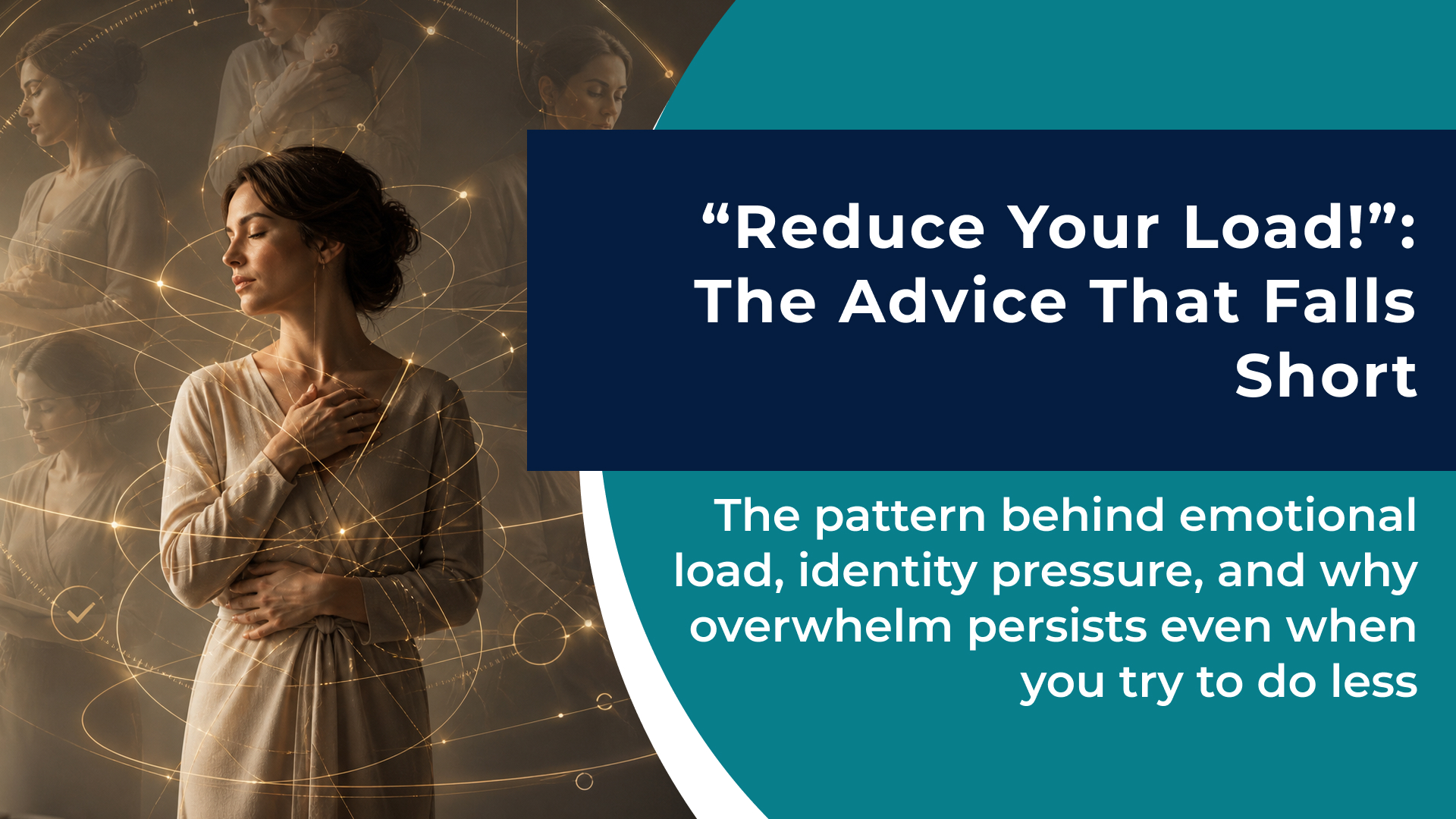

Series 3 – Legitimacy & Care
Care sits at the centre of how human beings organise their lives. It determines what we pay attention to, what we give time and energy to, and what we move toward or away from. What we care about becomes what we prioritise. What we prioritise becomes what we act on. In this sense, care is not simply a feeling or a value. It is the organising force behind how life is lived. What receives care grows, develops, and is sustained. What is not included gradually diminishes.
Yet care does not always operate with clarity. It can become diffused, overextended, or shaped by expectations that are not consciously chosen. Attention can be pulled in multiple directions. Responsibility can be taken on beyond what is ours to hold. What matters most can lose its place. This series explores how care, when it loses its structure, begins to organise experience in ways that impact wellbeing, decision-making, responsibility, and the ability to have meaningful influence. It invites a closer look at how we come to relate to what matters, and what becomes possible when care is grounded in a clear sense of value.
Why Doing Less Doesn’t Relieve Pressure
“Reduce your load.”
“Do less.”
“You’re taking on too much.”
This has become the default response to overwhelm, and on the surface, it makes sense. There is a lot being carried. There are real demands, real responsibilities, and things that matter. The pressure is not imagined. But this framing quietly assumes that the problem is volume, when in many cases it is not.
Because what is being carried is not just work. It is the ongoing, often invisible, emotional load of staying across people, situations, and undercurrents that are not immediately obvious but are felt, anticipated, and responded to anyway. It is the noticing of what is unsaid, the reading of what might go wrong, the quiet adjustments made to support, stabilise, or hold things together before they become a problem. This does not stop at home. It follows into professional life, shaping how decisions are made, how conversations are held, and how responsibility is taken on, often beyond what is formally required.
Over time, this creates a particular kind of load. Not just more to do, but more to hold. More to think about, more to anticipate, more to carry emotionally. And because much of this sits beneath the surface, it rarely registers as something that can simply be removed. It feels necessary. It feels responsible. It feels like part of who you are.
What sits underneath is not just how much is being held, but how care is organised. When care has no clear structure of what truly matters, everything begins to register as important, everything pulls for attention, and everything feels like it needs to be carried. It is here that capacity starts to distort, not because there is too much to do, but because there is no clear hierarchy for what is being responded to, and what is being taken on as personally yours to carry.
How Standards Decide What Feels Like Yours to Carry
What sits underneath this is not simply how much is being carried, but the standards through which life is being interpreted. These standards shape what is noticed, what feels important, what requires a response, and what counts as enough. Some are consciously chosen, but many are not. They are absorbed through upbringing, culture, professional environments, and the expectations that have been reinforced over time. Standards around being reliable, being thoughtful, being across everything, being the one who holds things together. They sit quietly in the background, yet they organise attention and behaviour with remarkable precision.
Through these standards, situations are not taken at face value. They are immediately assessed against what should be done, what might be needed, and what could go wrong if nothing is done. A passing comment does not stay a passing comment. It becomes something to think about, something to interpret, something to potentially respond to. A shift in someone’s tone is not neutral. It is noticed, considered, and often carried forward as something that may require care or follow-up. A task is not simply completed. It is measured against whether it was thorough enough, thoughtful enough, or whether something has been missed.
What is happening here is subtle but significant. Attention is not only on what is present, but on what sits behind it, what might emerge from it, and what responsibility it creates. This adds layers of consideration, not because the situation demands it explicitly, but because the standards being applied call for it. The result is that more is taken on internally than is actually required in the moment, and that accumulation becomes the emotional load that is later experienced as overwhelm.
Where Competence Becomes Something to Prove
What sits alongside these expectations is a pressure to demonstrate them. It is not enough to hold a standard. It needs to be visible. Capability needs to be demonstrated to feel worthy of it.
This is where comparison enters. Am I across this in the way others are? Am I handling this as well as I should? In that comparison, meeting the standard shifts. It becomes a way of reinforcing that you are competent, reliable, and able to handle what is in front of you.
Doing more begins to serve a different function. It becomes evidence. A way of confirming, to yourself and to others, that you belong and that you are who you need to be in the environment. Competence becomes part of your identity, and because identity is always in play, the need to demonstrate it moves with it.
Each situation becomes another opportunity to confirm capability. Each domain becomes another place where that identity must be proven. Within this cycle, there is no clear point where enough is reached.
What Happens When the Standard Isn’t Met
What sits underneath this goes deeper than standards as a set of preferences or personal principles. These are expectations that have been formed and reinforced over time, shaping not only what is done, but who someone comes to know themselves to be. They inform what it means to be a good partner, a reliable colleague, a thoughtful leader, a capable human being. They do not sit neatly within one area of life. They move across domains, applying just as strongly at home as they do at work, in relationships as they do in professional settings.
Because these expectations are tied to identity, they are rarely questioned. They feel given, fixed, and inherently valid. The moral and ethical frameworks they are built on are often inherited or absorbed, yet experienced as self-evident. This means they operate continuously, shaping what is noticed, what feels important, and what requires a response, without being consciously examined.
Within this structure, the question is no longer simply what needs to be done, but who one must be in relation to it. And when that standard is not met, even in small ways, it does not register as a neutral gap. It registers as a failure of self. Multiply that across roles, relationships, and responsibilities, and the pressure compounds. Not as a list of tasks, but as an ongoing sense of falling short in multiple places at once.
Because these expectations are applied so broadly and so consistently, they extend beyond what can realistically be met. Something will always sit outside of them, not because of a lack of capability, but because of how widely they are being carried. And what remains is not just what is left to do, but the internal weight of not having met the standard of who one believes they should be.
What’s Taking Up Space in Your Head
Once expectations are operating at this level, very little reaches a clear point of completion. Things might be finished in an objective sense, but when the internal standard that would allow something to feel complete has not been met, the thoughts continue to take up space in your head. A task may be done, a conversation may be over, a decision may be made, yet it doesn’t fully settle.
Instead, it lingers as an unclosed loop. A comment is revisited to check whether it was said the right way. A decision is replayed to consider what might have been missed. An interaction is held in mind to assess how it may have been received. Past events are not left behind. Past events are not left behind. They are carried forward through ongoing evaluation.
What remains is the residue of that evaluation. A sense that something still needs attention, even when there is nothing left to do. It sits there, pulling focus back in, asking to be checked again, thought through again, held onto just a little longer.
Without a clear internal point of completion, attention is not fully available for what comes next. It becomes divided. Part of it remains engaged with past events, while the rest is directed toward the present. This split is subtle, but it changes how effectively you can think, decide, and respond. What is in front of you no longer has your full capacity, because some of it is still being used elsewhere.
This is where overwhelm begins to take shape, with what is still being held sitting alongside what is in front of you. The result is a constant sense of pressure, where everything is competing and nothing fully settles. Decisions slow down. Focus fragments.
In this context, overwhelm is an accumulation. Tasks, thoughts, evaluations, and expectations that have not reached completion continue to occupy space and draw on capacity.
This Is Not Random
This is not random. It follows a pattern:
Standards shape what matters
Identity defines who you must be
Doing more becomes proof
Falling short becomes failure
The mind keeps evaluating
Overwhelm accumulates
And once you can see it, interpretation and reality are no longer confused.
The standards and expectations shaping who you believe you have to be can be observed as unexamined patterns. What once felt inherent will reveal itself as constructed, not given. It is a patterned way of relating to reality that is not congruent with reality itself, organised through an inauthentic relationship with self-image, beliefs, and opinions that carry unrealistic expectations and a need to be seen in a particular way.
It shows up in ways that are easily recognised, but not easily observed in real time, as the pattern moves through thought, feeling, and the body. The need to prove. The sense that everything is yours to carry. The pressure to hold things together. All expressions of this underlying pattern that, left unobserved, accumulates as overwhelm.
In observing them, they can no longer run as though they are reality. They lose their power. What is inauthentic becomes distinguishable from what is real. What is yours to carry separates from what you have taken on as your responsibility. The impact on your well-being becomes visible. And who you have taken yourself to be is no longer fixed, but something you can now relate to, shape, and express with intention.
Self-image is no longer driven by proving or pressure, but becomes more directly aligned with who you are and what is actually true. What has been limiting your capacity is not the volume of what is there, but the inauthenticities that remain active in your system.
Final Thoughts
What you have been experiencing is not a personal failure to manage your capacity. It is the result of a patterned way of relating to reality that has been reinforced until it feels fixed.
When that pattern is seen, something shifts. What is actually required becomes distinguishable from what you have been taking on as your responsibility, along with the emotional load that comes with it. What is taken on is no longer organised through the same patterns. Who you take yourself to be in relation to it begins to change, and how you are with yourself aligns more directly with who you are, uniquely.
If this resonates, you can follow Jeanette Mundy through Engenesis, where she shares ongoing thoughts through her articles on how identity, legitimacy, and pressure shape the way we lead, relate, and respond. Jeanette is a leadership coach (PCC), Accredited Being Profile® Practitioner, and co-founder of Relateable.Global.