

It can happen without warning. You open your mouth and hear yourself say something you have heard a thousand times before. Put a jersey on. Shut the door. Were you born in a barn? You’ll thank me when you’re older. I’m not made of money. And somewhere around the third syllable, you hear it. Sh*t. That’s my mom talking. Not literally, obviously. She has not taken possession of your body. But somehow a woman you may have spent a perfectly respectable portion of your adolescence trying not to become has emerged from your own mouth. Inheritance is strange like that.
We tend to imagine inheritance travelling through blood: her hands, her eyes, the unfortunate knees, the hair that behaved perfectly well until forty-seven and then apparently received alternative instructions. But so much of what mothers pass to daughters travels by other means. A look. A silence. A sentence repeated for thirty years. What she did when she was angry. How she spoke about her body. Whether money frightened her. What she believed a good woman should tolerate. Whether she apologised for taking up space. How she loved. What she never said.
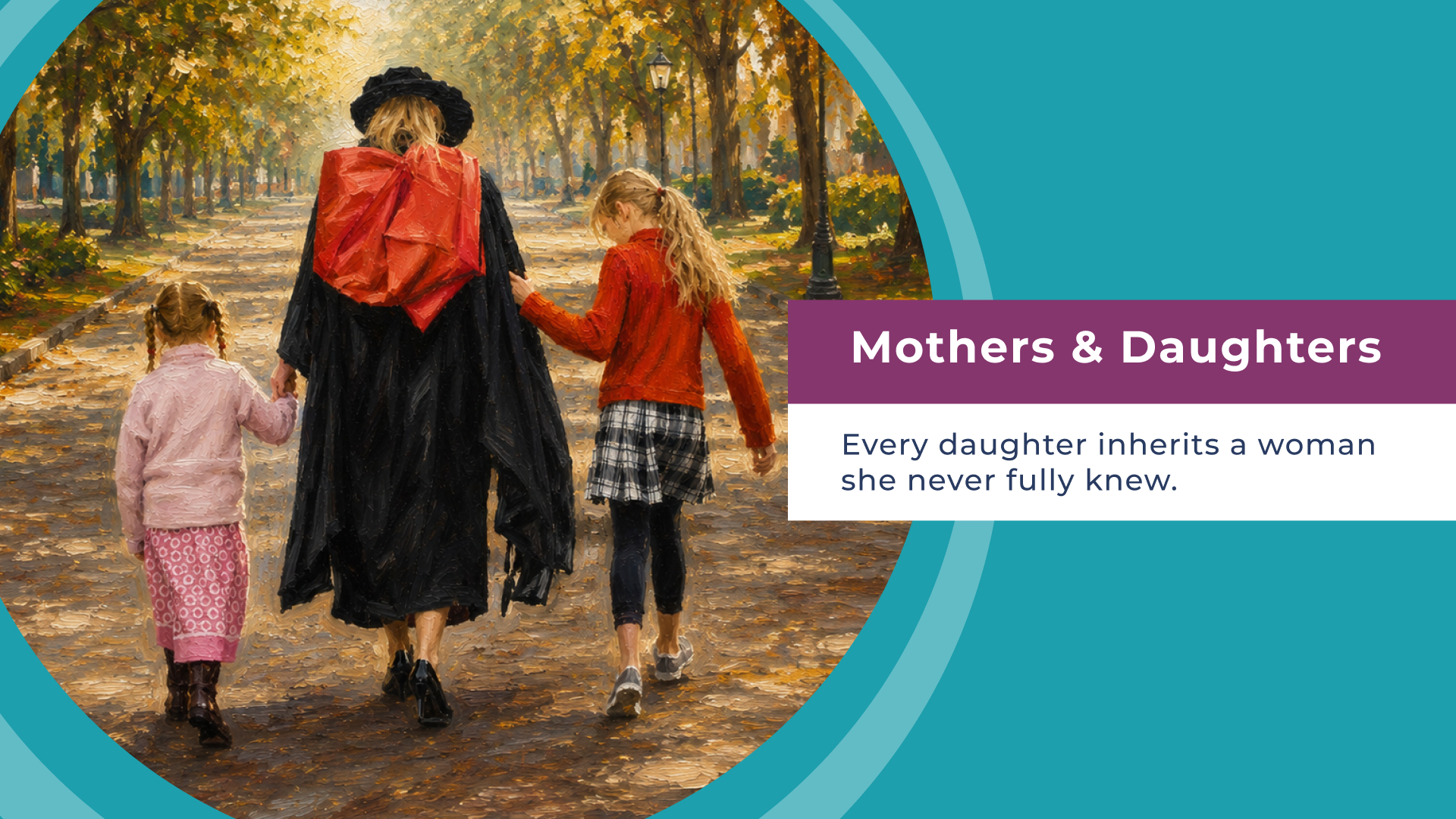
Some of these inheritances are deliberate. Many are not. Children are extraordinarily attentive students of things nobody realised they were teaching. And perhaps daughters do something equally strange. We spend years absorbing our mothers before we are old enough to realise there was a woman there to understand. Every daughter inherits a woman she never fully knew.
Before she was mom, she was someone else: a girl, a daughter, a body becoming a woman. Someone who wanted things and feared things. Someone who loved people before you existed, made choices without knowing where they would lead and gave up possibilities you will never know about. She may have imagined a completely different life. Then you arrived, and whatever else she was became partly obscured by a word so enormous that, for a child, it can swallow the woman whole: mom.
For a small child, a mother is not initially experienced as a woman with an independent history, interior life and unfinished ambitions. She is simply mom. She knows where the plasters are, which cup you like, what time ballet starts, whose birthday present has to be bought and whether the school requires a gold-coin donation tomorrow. She knows when you’re pretending to be sick and, irritatingly, when you genuinely are. She remembers things nobody else remembers.
In the early years, the asymmetry is extraordinary. A mother may know the precise circumstances of her daughter’s arrival into the world. She knows the first word, first tooth, first day of school, first friendship catastrophe. She has watched a personality assemble itself in real time. The daughter knows almost none of the equivalent things about her mother. Mom seems to have arrived in the world already mom.
We may know family stories, of course: the school she attended, the suburb she grew up in, maybe even the boy she nearly married or the job she had before children. But knowing the facts of someone’s history is not the same as understanding what it felt like to inhabit their life. What did she think about at seventeen? What did she believe would happen to her? Who broke her heart? What did she want before wanting things for us took up so much room? And what parts of her remained entirely untouched by motherhood? It takes a surprisingly long time for many daughters to understand that mom was never only mom. She was a woman all along.
The art of losing one another
Mothers and daughters have always understood something that can be difficult to say aloud: loving someone does not prevent us from having to lose versions of them. The ancient Greeks gave us one of the great stories of this in Demeter and Persephone. Persephone disappears into the underworld and Demeter, goddess of the harvest and her mother, grieves so profoundly that the earth itself becomes barren. Eventually mother and daughter are reunited. But because Persephone has eaten the seeds of a pomegranate, she cannot simply return permanently to the world she left. She will move between worlds.
The myth has endured partly as an explanation for the seasons: growth, barrenness, return. But it also gives us a remarkably enduring image of motherhood. A daughter leaves, a mother grieves and a daughter returns, but neither can simply resume the relationship they had before. Persephone has inhabited another world. She is no longer only the girl her mother lost. In later traditions she is queen of the underworld, a woman with a realm her mother does not govern. Demeter has changed too. She has encountered the limits of her power to protect, retrieve and keep her daughter. Her world has been reordered by separation.
Perhaps that is why the story still catches somewhere in us. Motherhood contains repeated acts of losing. The baby becomes a little girl. The little girl becomes an adolescent who closes the bedroom door. The adolescent disappears into friendships, lovers, study, work, travel, beliefs and worlds her mother may never fully enter. Eventually an adult woman returns. The challenge is not simply letting our daughters leave; it is allowing them to return as someone we have not met before.
There is developmental work on both sides of that door. The daughter has to ask: What is mine? What is hers? What do I think? What do I want? Who am I when I am not simply an extension of you? The mother has her own questions: Can I remain connected to you without requiring you to remain the person I already understand? Can I advise without authoring? Protect without controlling? Love you without insisting that my version of a good life become yours?
No wonder there can be friction. Popular culture has made an industry of difficult mothers and rebellious daughters: interference, judgement, slammed doors, loaded silences and conversations beginning with I’m only saying this because I love you. Some of that friction is not evidence that the relationship has failed. Sometimes what sounds like a door closing is actually the sound of two identities separating; and the door to another kind of relationship opening.
The mother has spent years being responsible for guiding, teaching, protecting and occasionally preventing catastrophe. The daughter eventually needs to become the authority in her own life. Those two requirements do not always change shifts neatly. There may be a period when mom is still giving instructions while her daughter is desperately trying to discover what she thinks without them. And there may be another period, years later, when the daughter discovers that some of those instructions have apparently taken up permanent residence in her own mouth. Put a jersey on. For the love of God.
Meeting the woman who was always there
If we are fortunate enough to have the time, something else begins to happen. Mom becomes a woman. Not because she wasn’t one before, obviously, but because we finally become capable of seeing her that way. Sometimes it happens when we become mothers ourselves. Sometimes through work, marriage, divorce, grief, ageing, caring for parents or making choices that once looked much simpler when they belonged to someone else. We reach an age our mother once was, and perspective does something peculiar. The forty-year-old mother who seemed impossibly adult when we were twelve suddenly looks startlingly young when we become forty ourselves.
Choices we once judged acquire context. Sacrifices we barely noticed become visible. Other things may become harder to understand, not easier. Seeing our mothers as women does not require us to romanticise them. Some daughters inherit wounds as well as wisdom. Some have had to create distance from mothers who could not meet them safely. Some relationships remain difficult, estranged or unresolved. Understanding is not the same as excusing.
Adulthood can offer another vantage point. Hillary Clinton once described one of the great pleasures of motherhood as watching your child become an adult you not only love, because of course you love them, but genuinely like and admire. She has also described Chelsea as one of her greatest teachers. When Chelsea was a screaming newborn and Hillary an overwhelmed new mother, Hillary remembers essentially telling her that neither of them had done this before and they were going to have to work it out together.
There is something wonderfully honest in that. We tend to imagine mothers teaching daughters, but daughters are teaching mothers how to mother them from the beginning, and the education does not stop when the daughter grows up. Chelsea Clinton has spoken about her own relationship with Hillary changing again when she became a mother herself: another role, another vantage point, another way of seeing the woman she had always known as mom.
This is one of adulthood’s quiet surprises. The mother doesn’t necessarily change in that moment; the daughter’s capacity to see her changes. Instead of asking only, What kind of mother were you?, we can sometimes begin asking much larger questions: Who were you? Who are you now?
The women our daughters become
There is a photograph I love from my PhD graduation. I am walking away from the camera in my academic gown, one small daughter holding each hand. Looking at it now, I see something I couldn’t have seen in quite the same way then. That doctorate took me ten years, two marriages and two divorces, two children, and several senior roles to complete. My daughters grew up alongside it. They saw the studying, working, parenting, succeeding, struggling and starting again. And there they were at graduation, holding my hands.
At the time, I probably thought of the photograph as my daughters being there for one of the significant moments in my life. Now I see something more reciprocal in it. They weren’t simply growing up while I raised them. They were watching me grow up too. This is another inheritance mothers give their daughters without necessarily intending to: not simply what we tell them about being women, but the woman they watch us become.
Of course, eventually the little girls become women themselves. Michelle Obama has spoken publicly about the changing relationship she has with Malia and Sasha as they have grown up. When her daughters returned home during the pandemic, she deliberately did not expect them to return to the old rules. They had left as daughters living under their parents’ authority and came back, as she put it, as young women. Their conversations had become more peer-like.
A few years later, Michelle described visiting the Los Angeles apartment the sisters shared. They invited their parents over for cocktails before dinner. There was a charcuterie board. There were martinis. Apparently rather weak martinis, which may itself be evidence that some aspects of adulthood take longer than others.
I love the ordinariness of the image. Two girls who once lived with their parents in the White House eventually had a home of their own, opened the door and hosted mom and dad for drinks. Even if you raise your daughters in the bloody White House, eventually you have to knock on their door. Michelle has described the pleasure of watching her daughters become themselves. I understand exactly what she means.
My daughters are 24 and 26 now, and my relationships with them are among the great loves of my life. One of the unexpected pleasures of this stage is that I don’t simply get to watch my daughters become women. I get to meet them there. There are now three adult women in our relationship. We can have rooftop cocktails. We can check out attractive men. We can talk about work, relationships, bodies, choices and the strange business of being a woman in ways that would have been entirely inappropriate when they were eight.
They have ideas I didn’t give them, experiences I wasn’t present for, judgements I might not share and ways of seeing the world that belong entirely to them. Thank God. There are things they teach me now. There are moments when I recognise something unmistakably mine in them, and others when I think, sometimes with genuine admiration, I would never have done that.
One of the great privileges of parenting adult daughters is discovering that their independence does not have to diminish the relationship. It can enlarge it. Mother and daughter remain, but another relationship becomes possible alongside them: woman to woman. And, of course, adulthood doesn’t only reveal our daughters to us. It reveals us to them. They too are meeting a woman they could not fully know when they were children: me, not simply mom. The woman who existed before them and the woman who continues to exist alongside motherhood. The woman who has loved and divorced, succeeded and failed, changed her mind and changed her life. The woman who writes poetry, gets things wrong, has desires, makes plans, grows older and continues becoming.
Part of the gift mothers can offer adult daughters is allowing that woman to become more visible. Not every detail. Intimacy still requires boundaries, and daughters should not become containers for their mothers’ unmet needs. But motherhood need not require the woman to remain hidden. Adulthood may offer daughters the possibility of knowing something of the woman who was there all along.
What we carry forward
So inheritance is less straightforward than we imagine. It does not simply travel from mother to daughter like a box handed neatly across generations. Mothers shape daughters. Daughters shape mothers. Girls leave and women return. Mothers change while they are gone. Sometimes daughters return and discover that the woman waiting for them is not quite the mother they remember either.
Some things we carry forward gratefully: the recipe, the laugh, the courage, the way she made Christmas, the insistence that we could support ourselves, the capacity to make a home anywhere, the ability to show up when things are difficult. Some things we alter. Some we understand differently. Some we forgive. Some we refuse. And some we put down altogether. Inheritance is not destiny.
The old mythology gives us separation and return. The deepest wisdom in the story is that return is not restoration. Persephone comes home, but the old world cannot simply be put back exactly as it was. Neither can ours. Mothers and daughters may spend a lifetime losing old versions of one another and learning how to meet the women who return. The baby becomes the little girl, the little girl the adolescent, the adolescent the woman. The young mother changes too, as does the woman her daughter thought she knew. Again and again, someone different arrives.
The great invitation is not to ask her to become who she was, but to look at the woman in front of us with enough love to recognise her and enough curiosity to discover who she is now.
There you are. Tell me who you’ve become.
Dr Jordan Marijana Alexander is a writer, executive advisor and human systems strategist exploring how identity, place, culture and living systems shape participation in the modern world. She works alongside leaders, boards and organisations navigating complex questions of leadership, change and participation, and is the co-founder of RelateAble.Global. If this article has raised questions, sparked reflection or highlighted a decision you’re carrying, you’re invited to book a confidential conversation. You can follow DrJMA on LinkedIn and Engenesis for ongoing essays, reflections and research exploring leadership, identity, belonging and participation.