

The Misdiagnosis of Systems
Most discussions about societies, economies, and governance begin at the level of opinion. Some argue for stronger governing systems, others for more freedom. Some call for tighter regulation, others for deregulation. These debates often sound sophisticated, yet they tend to circle around the same surface distinctions without reaching the deeper structure of what is actually happening.
Systems do not fail simply because they chose the wrong ideology. They fail because they lose alignment with reality and, more importantly, lose the ability to adjust themselves in a way that preserves that alignment over time.
A governing system can become more forceful and still weaken. A market can become more open and still distort. A population can become more vocal and still contribute to instability. In each case, the visible actions may differ, but the underlying pattern is often the same. The system is no longer regulating itself in a way that maintains coherence.
A simple analogy is driving on a long road. The problem is not whether the driver prefers speed or caution. The real issue is whether the driver can continuously adjust the steering in response to the road, the terrain, and the conditions. If the driver stops adjusting, the car drifts. If the driver overcorrects, the car becomes unstable. If the driver reacts too late, the correction itself becomes dangerous.
Most systems today are caught between these two failures. On one side, there is overcorrection, where interventions are excessive, imposed, or disconnected from the system’s actual condition. On the other side, there is delayed or emotional reaction, where responses come too late or are driven by pressure rather than understanding. In both cases, what is missing is not action, but the quality of action.
This is where a more precise distinction becomes necessary.
Within the Unified Ontology of Systemic Integrity, systems are understood not as static structures but as ongoing dynamics that move between coherence and breakdown. To make sense of this movement, three conditions need to be recognised: disintegration, integrity, and modulation.
Most conversations recognise the first two. We can usually tell when something is breaking down, and we can imagine what a stable or well-functioning system might look like. What is far less understood is the third condition, which is the only one that actually determines whether a system can sustain itself over time.
That condition is modulation.
Without modulation, even well-designed systems drift into disintegration. With poor modulation, attempts to fix the system become the very source of its breakdown. This is why many governing and economic systems today appear active, responsive, and engaged, yet continue to move towards instability.
The issue is not the absence of effort. It is the absence of calibrated, reality-aligned adjustment.
To understand this properly, we need to move beyond surface debates and examine how systems actually operate in motion, and how different modes of action either sustain or destabilise them.
The Three Conditions of Every System
To understand why systems drift, stabilise, or collapse, we need a simple but precise frame. Every system, whether a governing system, an economy, an organisation, or even a relationship, is always operating within three fundamental conditions. These are not theoretical constructs. They can be observed directly if we look closely enough.
Disintegration
Disintegration is the gradual loss of alignment within a system. It rarely begins with visible collapse. It starts with small fractures that accumulate over time.
In a governing system, disintegration may show up as a growing gap between what is said and what is experienced. Policies may exist, but they no longer produce the intended outcomes. Trust begins to erode, not necessarily because of one major failure, but because of repeated misalignments that are not addressed.
In an economic system, disintegration appears when value and price begin to disconnect. Products are sold, transactions occur, yet something feels off. Speculation replaces substance. Short term gains overshadow long term viability.
A useful analogy is structural fatigue in a bridge. The bridge may still be standing, and traffic may continue to flow, but micro fractures are forming within the material. The structure is no longer what it appears to be.
Disintegration, therefore, is not the moment of collapse. It is the process that makes collapse inevitable if left unaddressed.
Integrity
Integrity is often misunderstood as a moral concept, but in this context it is structural.
A system in integrity is one where its components are sufficiently aligned for it to function coherently over time. Intentions are reflected in actions. Feedback is not ignored or distorted. Adjustments can occur without breaking the system itself.
In a governing system, integrity means that authority, decision making, and lived experience are not constantly contradicting one another. People may disagree, but the system remains workable.
In an economic system, integrity means that value creation, exchange, and regulation are aligned closely enough that the system can sustain itself without constant distortion.
Returning to the bridge analogy, integrity is not about having no stress on the structure. It is about the structure being able to hold that stress without accumulating hidden fractures.
Integrity is therefore not stillness. It is coherence under movement.
Modulation
If disintegration is the drift and integrity is the state of coherence, modulation is what determines the direction of movement between the two.
Modulation is the intentional and calibrated adjustment of a system in motion. It is what allows a system to respond to change without losing alignment.
In a governing system, modulation might involve adjusting policies in response to real conditions, not in reaction to pressure or ideology. It means recognising when something is no longer working and recalibrating before the gap widens.
In an economic system, modulation can be seen in how pricing, production, and regulation respond to actual demand and supply conditions without creating artificial distortions.
A simple analogy is temperature regulation in the human body. The body does not wait until it is in crisis to act. It continuously adjusts through subtle processes. If these processes fail, the body either overheats or shuts down.
Modulation works in the same way. It is continuous, often subtle, and requires sensitivity to feedback.
Without modulation, systems drift into disintegration. With crude or excessive attempts at correction, systems may temporarily stabilise but accumulate deeper distortions.
This is why modulation is the least visible yet most decisive condition. It is not a one time action. It is an ongoing discipline that determines whether integrity can be sustained.
Modulation vs Manipulation vs Reactivity
Once the three conditions of a system are understood, a more precise distinction becomes necessary. Not all forms of action within a system are equal. In fact, many of the actions that appear corrective or responsive are, in reality, contributing to further breakdown.
To understand this, we need to clearly differentiate between modulation, manipulation, and reactivity. These are not variations of the same thing. They are fundamentally different modes of engaging with a system in motion.
Modulation
Modulation is grounded in reality. It is measured, proportional, and responsive without being driven by impulse.
It involves sensing what is actually happening within the system, and then making adjustments that are aligned with that reality. These adjustments are neither excessive nor delayed. They are timely and calibrated.
A simple analogy is steering a vehicle over a long distance. The driver is not making dramatic turns. They are making small, continuous adjustments based on the road, the wind, and the movement of the vehicle. These adjustments are often barely noticeable, yet without them, the vehicle would drift off course.
In systems, modulation works in the same way. It maintains direction without imposing force. It allows the system to adapt without distorting its structure.
Manipulation
Manipulation, on the surface, can look like strong or decisive action. It often presents itself as control, intervention, or correction. However, its defining characteristic is that it imposes an outcome regardless of the system’s actual condition.
Instead of working with feedback, manipulation overrides it.
Returning to the driving analogy, manipulation would be forcing the steering wheel sharply in one direction to correct a minor drift. The intention may be to stabilise the vehicle, but the action introduces instability.
In governing systems, manipulation appears when narratives are shaped to control perception rather than reflect reality, when force is used disproportionately, or when short term fixes are applied to suppress visible symptoms without addressing underlying misalignment.
In economic systems, manipulation can be seen in artificially inflated or suppressed prices, engineered scarcity, or interventions that prioritise immediate outcomes over systemic coherence.
Manipulation may produce temporary order, but it does so by increasing distortion within the system.
Reactivity
Reactivity is different again. It is not about imposing control, but about responding without calibration.
Reactive behaviour is driven by pressure, emotion, or immediate stimulus. It lacks timing, proportionality, and often direction.
In the driving analogy, reactivity would be overcorrecting after noticing a drift, then correcting again in the opposite direction, creating a pattern of oscillation. The driver is active, but not in control.
In governing systems, reactivity appears as sudden policy changes, inconsistent enforcement, or escalation in response to public pressure without a clear understanding of the situation.
Among populations, reactivity shows up as waves of outrage, rapid shifts in attention, and actions that are intense but short lived, often leaving the underlying issues unresolved.
Reactivity gives the impression of responsiveness, but it often amplifies instability.
Why This Distinction Matters
At a surface level, modulation, manipulation, and reactivity can all look like forms of engagement. Systems that are highly active are often perceived as responsive or effective. Yet activity alone tells us very little about the quality of what is being done.
The critical difference lies in whether the action is aligned with reality and whether it contributes to or distorts the system’s coherence.
Modulation stabilises because it is aligned and calibrated. Manipulation distorts because it overrides and imposes. Reactivity destabilises because it lacks direction and proportion.
Most modern systems are not inactive. They are saturated with action. Policies are introduced, markets are adjusted, populations respond, and interventions are constant. Yet despite this activity, instability persists.
This is because much of what is happening is either manipulation or reactivity, while true modulation remains rare.
Understanding this distinction is essential before examining how it plays out in governing systems and economic systems, where the consequences are not theoretical but lived.
Governing Systems as Relational Fields
A governing system is often spoken about as if it exists separately from the people it governs, as if it is a structure over there acting upon a population over here. This framing is convenient, but it is deeply misleading. A governing system is not an isolated entity. It is a relational field that emerges through the continuous interaction between those who hold formal authority and those who participate in, respond to, and shape that authority through their actions, expectations, and behaviours.
This means that the condition of a governing system cannot be understood by analysing institutions alone, nor by focusing only on the population. Disintegration or integrity does not originate from one side in isolation. It is co-produced through the dynamic between them. A governing system may tighten control, but if the population responds with widespread reactivity, the overall system becomes unstable. Similarly, a population may seek change, but if governing responses are manipulative or disproportionate, the system drifts further into misalignment. What we are observing is not two separate forces, but a single field of interaction that is either stabilising or destabilising depending on how both sides engage.
A useful analogy is a conversation between two people over time. If one person stops listening and only asserts, while the other reacts emotionally without clarity, the conversation deteriorates. Misunderstandings accumulate, tone escalates, and eventually communication breaks down. Yet if both participants remain attentive, adjust their responses, and stay connected to what is actually being said rather than what they assume, the conversation can remain coherent even when there is disagreement. The quality of the exchange determines the condition of the relationship. Governing systems function in a similar way, but at a much larger scale and with far greater consequences.
When viewed as a relational field, it becomes clear why many governing systems oscillate between periods of apparent order and sudden instability. The system may appear stable because control is being exercised, but if that control is disconnected from reality, it is already generating underlying disintegration. At the same time, populations may appear passive or compliant, yet unresolved tensions and distortions are accumulating beneath the surface. When pressure builds, the release is often reactive, and the system swings abruptly. What is seen as sudden breakdown is often the delayed expression of long-term misalignment within the field.
This perspective also clarifies why the language of fixing the system is often insufficient. There is no single point of intervention that can restore integrity if the relational dynamics themselves remain distorted. Policies, reforms, or structural changes may be introduced, but if they are applied manipulatively or received reactively, they do not stabilise the system. They simply shift the form of instability. What is required instead is an understanding of how modulation can occur within this relational field, where both governing systems and people adjust in ways that are grounded, proportional, and aligned with reality.
Seeing governing systems in this way expands the responsibility on both sides. It does not collapse the distinction between authority and participation, but it recognises that integrity cannot be sustained unilaterally. A governing system cannot impose coherence through force alone, and a population cannot generate stability through reaction alone. The system holds only when the interaction itself becomes more calibrated. This is where the distinction between modulation, manipulation, and reactivity becomes critical, because each side can either stabilise or destabilise the field depending on how it engages.
Understanding this relational nature sets the foundation for examining how modulation actually operates within governing systems. It allows us to move beyond simplistic narratives of control versus resistance and instead look at the quality of interaction that determines whether a system moves towards integrity or continues to drift into disintegration.
Modulation in Governing Systems
Once a governing system is understood as a relational field, the question is no longer whether authority should be stronger or weaker, or whether people should comply or resist. The more precise question is how the interaction between governing systems and people is being regulated in real time, and whether that interaction is moving towards integrity or drifting into disintegration.
This interaction is not linear. It is a continuous feedback loop. What the governing system does shapes how people respond, and how people respond shapes how the governing system acts next. Over time, this creates patterns. These patterns are not random. They follow a structure that can be observed.
If we simplify it, the system is constantly cycling through this loop:
The governing system acts
People interpret and respond
The governing system reacts to that response
People adjust again
The condition of the system depends on how each step in this loop is carried out.
When modulation is present on both sides, the loop stabilises. When manipulation or reactivity dominates on either side, the loop begins to distort and accelerate towards breakdown.
To make this tangible, consider again the analogy of a conversation, but this time extended over months or years rather than minutes. If one side speaks without listening, and the other responds emotionally without clarity, the conversation does not simply become tense in the moment. It develops a pattern. Misinterpretation feeds further misinterpretation. Tone escalates. Trust erodes. Eventually, even neutral statements are received as hostile. The conversation collapses, not because of one moment, but because of the pattern that formed over time.
Governing systems behave in the same way.
Modulation from the Governing System
When a governing system operates in modulation, it does not treat its actions as isolated decisions. It understands that every action enters the loop and shapes the next response.
This creates a different posture towards feedback. Dissent, criticism, and non-alignment are not immediately categorised as threats to be suppressed or narratives to be controlled. They are treated as signals about the state of the system. The question becomes not how do we stop this but what is this telling us about where alignment is breaking down.
This does not mean that every demand is accepted or that authority is abandoned. It means that authority is calibrated. Enforcement is applied where necessary, but proportionally. Policies are adjusted where misalignment is evident, but without overcorrection. Communication reflects reality closely enough that it does not create further distortion.
A useful analogy is balancing while walking. The body is constantly making small adjustments in response to shifts in weight and terrain. These adjustments are not dramatic, but they are continuous. Without them, balance is lost.
Modulation from the People
Modulation is not only required from the governing system. It is equally required from the people.
People operating in modulation do not simply react to what is visible on the surface. They engage with a degree of discernment. They distinguish between genuine misalignment and perceived discomfort. They apply pressure where needed, but in a way that remains connected to reality rather than driven purely by collective emotion or momentum.
This includes maintaining proportionality in action. Expression, resistance, and participation are sustained and grounded, rather than episodic bursts followed by disengagement. Ethical boundaries are not abandoned under pressure, because doing so introduces further distortion into the system.
Returning to the analogy of carrying a large object together, each person must adjust their grip in response to movement. If some overcompensate while others react unpredictably, coordination breaks down. Stability depends on the quality of adjustment across all participants.
When the Loop Distorts
The governing system and the people do not operate independently. The quality of one shapes the behaviour of the other. This is where specific patterns of disintegration begin to emerge.
When the governing system manipulates and people react, the loop escalates. Narratives are controlled or force is applied in ways that distort reality. People respond emotionally or abruptly. The governing system then reacts to that response with further control or escalation. Each cycle amplifies tension, and the system moves further from alignment.
When both sides become reactive, the system becomes erratic. Policies shift abruptly, responses surge and collapse, and neither side maintains continuity. The system is highly active, yet directionless. Oscillation replaces coherence.
When the governing system attempts to modulate, but people remain reactive, stability does not hold. Adjustments are made, but they are met with disproportionate or inconsistent responses. The system struggles to settle, and modulation on one side is not sufficient to stabilise the field.
When the governing system manipulates while people attempt to modulate, a different distortion appears. People may act with restraint and proportionality, but if their signals are consistently ignored or overridden, trust erodes. The system may appear stable for a time, but pressure accumulates beneath the surface, leading to delayed and often more disruptive breakdown.
What becomes clear is that modulation must exist on both sides of the loop. It cannot be imposed unilaterally. It must be enacted within the interaction itself.
The Condition for Integrity
Integrity in a governing system is not achieved when one side behaves correctly in isolation. It emerges when the interaction between governing systems and people becomes calibrated.
This does not eliminate disagreement, tension, or conflict. Those remain part of the system. What changes is how they are processed. Signals are not immediately distorted. Responses are not disproportionate. Adjustments are made early enough to prevent large fractures from forming.
The system remains in motion, but it does not lose its coherence.
The challenge is that modulation requires capacity on both sides. It requires the ability to perceive reality without excessive distortion, to hold tension without collapsing into reaction, and to act proportionally even when under pressure. Without this capacity, both governing systems and people default to manipulation or reactivity because they are more immediate and less demanding.
Understanding governing systems in this way shifts the focus entirely. The issue is no longer who is right or who is in control. The issue is whether the loop of interaction is being modulated or distorted.
That is what ultimately determines whether the system sustains integrity or continues its drift into disintegration.
Economic Systems as Triadic Fields
While governing systems are often misunderstood as one sided, economic systems are frequently oversimplified as two sided. They are commonly described as an interaction between producers and consumers, or supply and demand. This framing captures part of the picture, but it misses a critical dimension that fundamentally shapes how the system behaves over time.
Economic systems operate as triadic fields, involving three interdependent actors: producers, consumers, and regulators. The condition of the system emerges from the interaction between all three, not from any one in isolation. When this interaction is aligned, the system can sustain itself. When it is distorted, disintegration begins to accumulate, often beneath the surface.
To make this more tangible, consider a three legged structure such as a tripod. The stability of the structure does not depend on the strength of one leg alone. Even if one leg is exceptionally strong, instability in the other two will compromise the whole. If one leg overextends while the others weaken, the structure tilts. If all three are misaligned, collapse becomes inevitable.
In economic systems, producers represent those who create and offer value. This includes businesses, entrepreneurs, and organisations that bring goods and services into existence. Consumers represent those who engage with that value through demand, choice, and behaviour. Regulators represent those who shape the conditions under which exchange occurs, through policies, oversight, and intervention.
Each of these actors continuously influences the others. Producers respond to consumer behaviour and regulatory constraints. Consumers are influenced by what is produced and how it is presented, as well as by the rules that govern access and exchange. Regulators respond to both production and consumption patterns, attempting to stabilise or guide the system.
A useful everyday analogy is traffic flow in a busy city. Drivers represent consumers, vehicle manufacturers and service providers represent producers, and traffic authorities represent regulators. If drivers behave unpredictably, even well designed roads and regulations cannot maintain flow. If regulations are overly restrictive or poorly timed, congestion increases regardless of driver behaviour. If vehicles are designed or maintained poorly, the entire system becomes less reliable. The flow of traffic depends on the interaction between all three elements, not on any one alone.
Disintegration in economic systems often begins when this triadic balance is lost. Producers may shift from creating value to extracting it, focusing on short term gain rather than long term sustainability. Consumers may become reactive, driven by impulse, trends, or distorted perceptions rather than grounded evaluation. Regulators may either overreach, imposing heavy handed controls that distort the system, or lag behind, failing to respond to emerging misalignments.
What makes this particularly challenging is that economic systems can remain active and even appear successful while disintegration is already underway. Markets may grow, transactions may increase, and indicators may look positive, yet underlying distortions are accumulating. Prices may no longer reflect real value, incentives may encourage behaviour that undermines long term stability, and trust between actors may begin to erode.
Integrity in a triadic economic field does not mean perfect balance at all times. It means that the interaction between producers, consumers, and regulators remains sufficiently aligned with reality for the system to function coherently over time. Value creation is recognised, exchange remains meaningful, and interventions support rather than distort the system.
Understanding economic systems as triadic fields prepares us to examine how modulation, manipulation, and reactivity manifest across each of these actors. It allows us to move beyond simplistic explanations and see how patterns of distortion or coherence emerge through interaction.
Without this perspective, interventions often target one part of the system while ignoring the others, leading to unintended consequences. With it, we can begin to see how the quality of engagement across all three actors determines whether the system sustains integrity or drifts into disintegration.
Modulation in Economic Systems
Once an economic system is understood as a triadic field between producers, consumers, and regulators, the focus shifts from individual behaviour to the quality of interaction across all three. Just as in governing systems, the condition of the system does not depend on any one actor alone. It emerges from how these three continuously influence one another over time.
This interaction is not static. It forms a dynamic loop, where each actor’s behaviour reshapes the conditions for the others.
At a simple level, the loop can be seen as:
Producers create and price value
Consumers respond through demand and behaviour
Regulators observe and intervene
Producers adjust again in response to both demand and regulation
This loop is continuous. It does not pause. The stability of the economic system depends on how this loop is regulated in real time.
When modulation is present across all three actors, the system remains adaptive and coherent. When manipulation or reactivity dominates within one or more parts of the loop, distortion begins to accumulate, often quietly at first, and then more visibly over time.
Modulation from Producers
Producers operating in modulation remain aligned with real value creation. Their decisions around pricing, production, and scaling are informed by actual conditions rather than detached expectations or purely competitive pressure.
This does not mean avoiding profit or growth. It means that profit remains connected to value, and growth remains connected to the system’s capacity to sustain it. Producers read demand signals, but they do not blindly chase them. They adjust supply, quality, and positioning in ways that remain coherent over time.
The farming analogy applies here again. A farmer who modulates does not exhaust the soil for immediate yield. They pay attention to the condition of the land, rotate crops, and adjust their approach based on feedback from the environment. Yield is important, but continuity is essential.
Modulation from Consumers
Consumers are not passive participants. Their behaviour shapes the entire system.
Modulation from consumers involves discernment in demand. Choices are not driven purely by impulse, trend, or external influence. There is a degree of awareness of value, need, and consequence. Demand signals, therefore, become more reliable and less volatile.
This stabilises the system because producers can respond to signals that reflect reality rather than distortion.
The analogy of nutrition is useful here. Consumption that is aligned with actual need supports the body’s stability. Consumption driven purely by craving or convenience creates imbalance over time, even if it feels satisfying in the moment.
Modulation from Regulators
Regulators operate at a different layer. Their role is not to dominate the system, but to shape the conditions under which it can function coherently.
Modulation from regulators involves precise and proportionate intervention. This means recognising when the system is drifting and making adjustments that support alignment without overwhelming the system’s own dynamics.
The analogy of a referee remains useful. A good referee does not control the game. They intervene when necessary, with timing and proportion, so that the game remains playable. Too much intervention disrupts flow. Too little allows breakdown.
When the Triadic Loop Distorts
Just as in governing systems, the interaction between the three actors creates identifiable patterns when modulation is absent.
When producers manipulate, focusing on extraction rather than value, and consumers react, driven by hype or fear, regulators are often pulled into overcorrection. This results in heavy handed intervention that may stabilise symptoms temporarily but introduces new distortions into the system.
When consumers react strongly, creating volatile demand patterns, producers begin to chase that volatility. Production becomes inconsistent, supply chains strain, and regulators may lag behind the speed of change. The system becomes unstable not because of inactivity, but because behaviour is not grounded.
When regulators manipulate, imposing excessive or misaligned controls, producers adapt in ways that bypass or exploit the system rather than align with it. Consumers, in turn, lose trust in both pricing and availability, leading to further reactive behaviour. The system becomes distorted at all three points simultaneously.
There are also more subtle patterns. When producers attempt to modulate and remain aligned with value, but consumers remain reactive, those producers may be pushed out by competitors who exploit volatility. When regulators attempt to modulate but both producers and consumers are operating in manipulation and reactivity, their interventions may appear ineffective or inconsistent.
What becomes clear is that distortion in one part of the triad does not remain isolated. It propagates through the loop, shaping the behaviour of the other two.
The Condition for Economic Integrity
Economic integrity is not achieved when one actor behaves well in isolation. It emerges when all three actors modulate in relation to one another.
Producers remain connected to value creation, consumers express demand with discernment, and regulators intervene with precision. The loop remains active, but it does not accumulate distortion. Adjustments happen early enough and proportionately enough to prevent large imbalances from forming.
This does not eliminate fluctuation. Markets will still rise and fall. Demand will still shift. Policies will still evolve. What changes is the quality of movement. The system remains coherent even as it changes.
The difficulty is that modulation across three actors is more demanding than across two. It requires capacity at multiple levels, and misalignment in any one part can destabilise the whole. This is why economic systems often appear functional while underlying distortions are already building.
Understanding the economic system in this way shifts the focus from isolated interventions to the pattern of interaction across the triad. It becomes clear that stability is not a function of control, nor of freedom alone, but of how well the system is able to modulate its own movement.
Without this, manipulation and reactivity take over, and the system moves towards disintegration, often while appearing active and even successful on the surface.
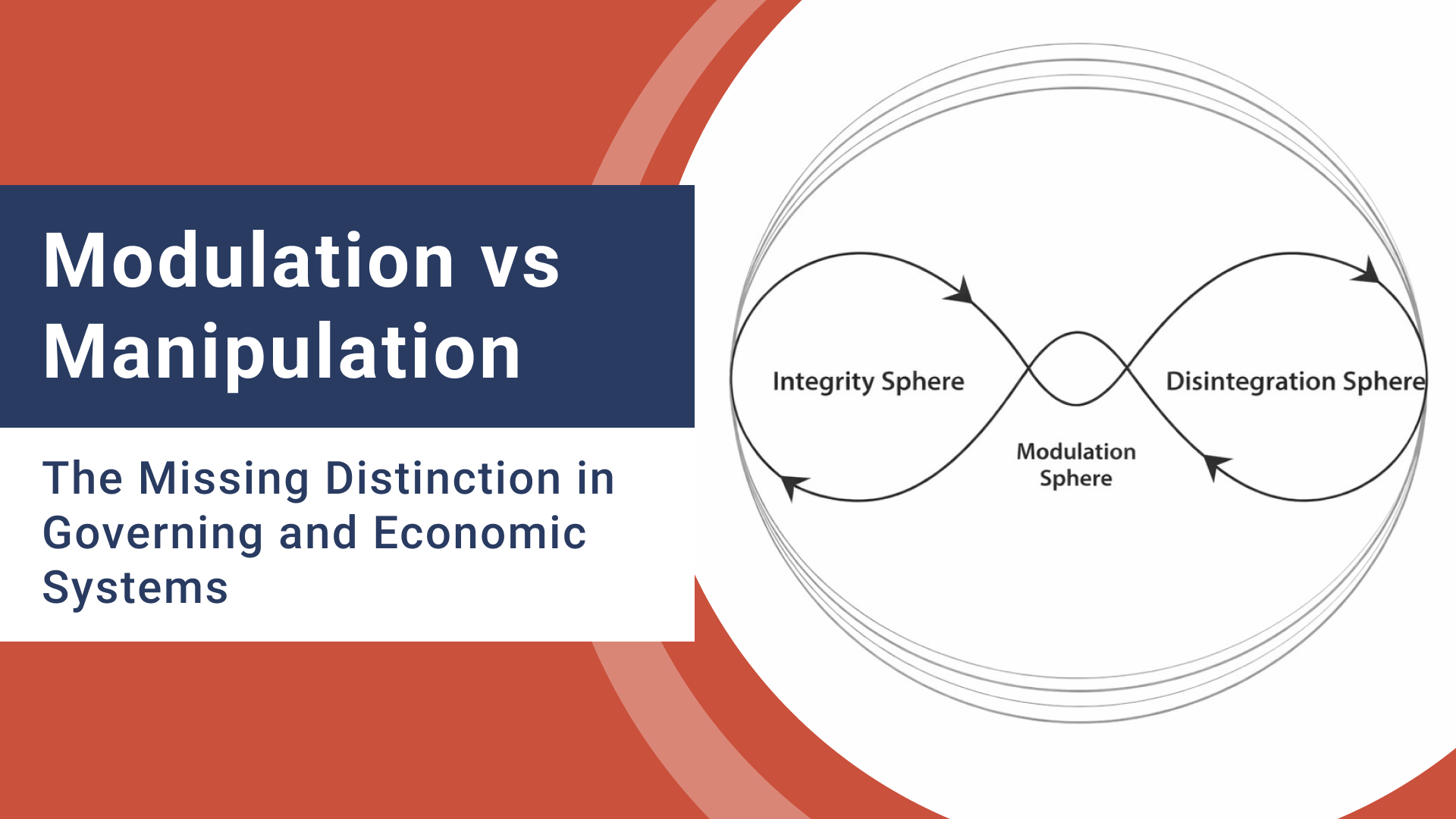
The Lemniscate of System Dynamics
So far, we have described systems as moving between disintegration and integrity, shaped by the quality of modulation within them. To deepen this understanding, it is important to recognise that this movement is not linear. Systems do not move in a straight path from stability to breakdown or from breakdown back to stability. They move in continuous loops, where periods of alignment, drift, correction, and realignment unfold over time.
A useful way to understand this is through a looping pattern, similar to the shape of a figure eight. One side of the loop represents movement towards disintegration, where misalignment accumulates. The other side represents movement towards integrity, where alignment is restored or sustained. The system is always in motion between these two tendencies.
A simple analogy is breathing. Inhale and exhale are both necessary. The system cannot remain in one phase indefinitely. What matters is not avoiding one side of the cycle, but maintaining a regulated rhythm between them. If breathing becomes shallow, erratic, or forced, the system becomes stressed. If it remains calibrated, the system sustains itself.
In the same way, systems naturally encounter pressure, tension, and moments of misalignment. These are not failures in themselves. They are part of the movement. Disintegration, in small degrees, is often a signal that something requires adjustment. The problem arises when this movement is not met with modulation, or when the response to it introduces further distortion.
Without modulation, the loop becomes a downward spiral. Small misalignments accumulate, feedback is ignored or distorted, and the system drifts further from reality. Attempts to correct the system may come too late or be applied in ways that increase instability. The movement towards disintegration accelerates, even if surface activity increases.
When manipulation dominates, the loop becomes forced and rigid. Interventions are applied to control outcomes rather than align with reality. This may temporarily push the system towards a state that appears stable, but because the underlying misalignment is not resolved, pressure builds beneath the surface. When the system eventually shifts, the movement is more abrupt and more disruptive.
When reactivity dominates, the loop becomes erratic. The system swings between extremes. Periods of inaction are followed by sudden bursts of response. Corrections overshoot, leading to further corrections in the opposite direction. The system is active, but not coherent.
Modulation, when it is present, allows the loop to remain functional and regenerative. Adjustments are made early enough to prevent large distortions from forming. Responses are proportionate, so they do not introduce new instability. The system moves, but it does not lose its coherence in the process.
An everyday example can be seen in personal health. Small fluctuations in energy, mood, or physical condition are normal. If a person pays attention and makes small adjustments, such as rest, nutrition, or activity, the body returns to balance. If these signals are ignored, or if responses are extreme, such as overexertion or neglect, the system deteriorates. The pattern is the same, whether at the level of an individual or an entire society.
Understanding this looping dynamic changes how we interpret both stability and crisis. Stability is not the absence of movement. It is the presence of regulated movement. Crisis is not always a sudden event. It is often the visible expression of a loop that has been allowed to drift without modulation.
This perspective also clarifies why many interventions fail. They attempt to fix a point in the system without understanding the movement of the system itself. They address symptoms at one moment in time, rather than influencing the ongoing dynamic that produces those symptoms.
When viewed through this lens, modulation is not an occasional act. It is a continuous discipline that shapes the trajectory of the system within this loop. It determines whether the system can move, adapt, and return to coherence, or whether it becomes trapped in cycles of distortion and breakdown.
Why Systems Fail Today
If we step back and look across governing systems and economic systems today, a striking pattern emerges. There is no shortage of action. Policies are introduced, markets are adjusted, regulations are imposed, narratives are shaped, and responses are constant. Yet despite this high level of activity, instability persists, and in many cases, intensifies.
This creates a paradox. Systems appear engaged, responsive, and even sophisticated, yet they continue to drift towards disintegration. The issue is not inactivity. It is the quality of action within the system.
A large part of the problem lies in the confusion between modulation, manipulation, and reactivity. Actions that are presented as necessary intervention are often forms of manipulation, where outcomes are imposed without sufficient grounding in reality. At the same time, what is described as responsiveness is frequently reactivity, where decisions are driven by pressure, urgency, or emotion rather than calibration.
In governing systems, this can be seen in the oscillation between control and instability. On one side, there is the tendency to increase force, tighten control, and shape narratives in order to maintain order. On the other side, there are moments of abrupt change, concessions, or reversals in response to pressure. These movements may appear different, yet they share a common characteristic. They are not grounded in sustained modulation. They are either imposing or reacting.
In economic systems, a similar pattern unfolds. Producers, under pressure to grow or compete, may shift towards extraction rather than value creation. Consumers, influenced by trends, fear, or speculation, react in ways that amplify volatility. Regulators intervene, sometimes heavily, sometimes too late, often in response to visible symptoms rather than underlying dynamics. The system becomes active, but not coherent.
A useful analogy is attempting to stabilise a structure that is already misaligned. If force is applied to hold it in place without correcting the underlying alignment, tension builds within the structure. If adjustments are made abruptly or inconsistently, the structure shifts unpredictably. In both cases, the effort to stabilise becomes part of the instability.
Another way to see this is through time horizons. Modulation requires attention to both immediate conditions and longer term consequences. Manipulation tends to prioritise short term outcomes, often at the expense of future stability. Reactivity collapses time even further, focusing almost entirely on immediate pressure. When systems operate within compressed time horizons, they lose the ability to make adjustments that sustain integrity over time.
There is also a capacity dimension to this problem. Modulation is demanding. It requires the ability to perceive reality with sufficient clarity, to hold tension without immediate reaction, and to act proportionally even when under pressure. Without this capacity, systems default to manipulation and reactivity because they are more accessible. They offer the appearance of control or responsiveness without requiring deeper alignment.
This is why many systems appear to be doing more, yet achieving less. Interventions increase, but coherence does not. Responses accelerate, but stability does not follow. The system becomes saturated with action that does not resolve the underlying misalignment.
What we are observing, therefore, is not simply poor decision making or flawed policy. It is a structural pattern where the absence of modulation is replaced by cycles of manipulation and reactivity. These cycles may temporarily shift the system, but they do not restore alignment. Instead, they accumulate distortion, making future modulation even more difficult.
Understanding this pattern is critical, because it reframes the problem. The issue is not only what actions are being taken, but how those actions relate to the system’s actual condition. Without this distinction, systems will continue to oscillate between control and breakdown, activity and instability, without ever stabilising in a meaningful way.
Towards Modulation
If the patterns we have explored hold, then the direction forward is not found in choosing between stronger control or greater freedom, nor in amplifying participation without structure. Those debates remain at the surface. The deeper shift required is towards the capacity for modulation across the system.
This applies to governing systems, to people, to producers, to consumers, and to regulators. In each case, the challenge is the same. Can the system sense what is actually happening, remain grounded under pressure, and adjust in ways that are proportionate, timely, and aligned with reality. Without this, action continues, but coherence does not follow.
Developing this capacity begins with seeing more clearly. Many distortions in systems are not the result of deliberate intent, but of misperception. Signals are misread, feedback is filtered, and narratives replace direct engagement with reality. Modulation requires a different posture. It requires the willingness to encounter what is actually present, even when it is inconvenient, uncomfortable, or contradicts prior assumptions. Without this, adjustments are made in relation to an imagined system rather than the real one.
The second element is holding tension without immediate reaction. Systems under pressure tend to collapse into reactivity because tension is difficult to sustain. Whether it is a governing system facing dissent, a business facing market shifts, or individuals facing uncertainty, the impulse is to act quickly in order to relieve that tension. Yet premature action often introduces further distortion. Modulation requires the capacity to remain with the signal long enough to understand it, without defaulting to suppression or release.
The third element is acting with proportionality. Not every signal requires a large response, and not every adjustment needs to be visible or dramatic. In many cases, the most effective modulation is subtle and continuous. Small, well-timed adjustments prevent the accumulation of larger misalignments. This is evident in well-functioning teams, resilient organisations, and stable systems, where coherence is maintained not through occasional major interventions, but through ongoing calibration.
The fourth element is respecting the limits of intervention. Modulation is not about constant interference. There are moments when the most aligned action is to allow the system to move without imposing control. Over intervention, even when well intentioned, can distort the system’s own regulatory capacity. The discipline lies in knowing when to act, how much to act, and when to refrain.
These elements are not abstract ideals. They can be observed in practice. A governing system that engages with dissent as information rather than threat is already operating differently. A business that aligns its growth with actual value rather than market hype is modulating rather than extracting. Consumers who exercise discernment rather than reacting impulsively contribute to stability. Regulators who intervene precisely rather than broadly help maintain coherence without overwhelming the system.
What becomes clear is that modulation is not a single action or policy. It is a mode of being within the system. It is expressed through how decisions are made, how feedback is processed, and how adjustments are carried out over time.
Without modulation, integrity cannot be sustained. Systems may appear stable for periods, but underlying disintegration continues to accumulate. With manipulation, the system may be forced into temporary order, but distortion increases. With reactivity, instability becomes more visible and more frequent.
The possibility that remains is neither passive nor simplistic. It is the disciplined practice of modulation, where systems remain in motion, yet do not lose their coherence in the process.
In the end, the question is not whether systems will face pressure, change, or uncertainty. They will. The question is whether they can adjust without distorting, respond without overcorrecting, and act without losing alignment.
That is what determines whether a system sustains integrity or continues its drift into disintegration.