
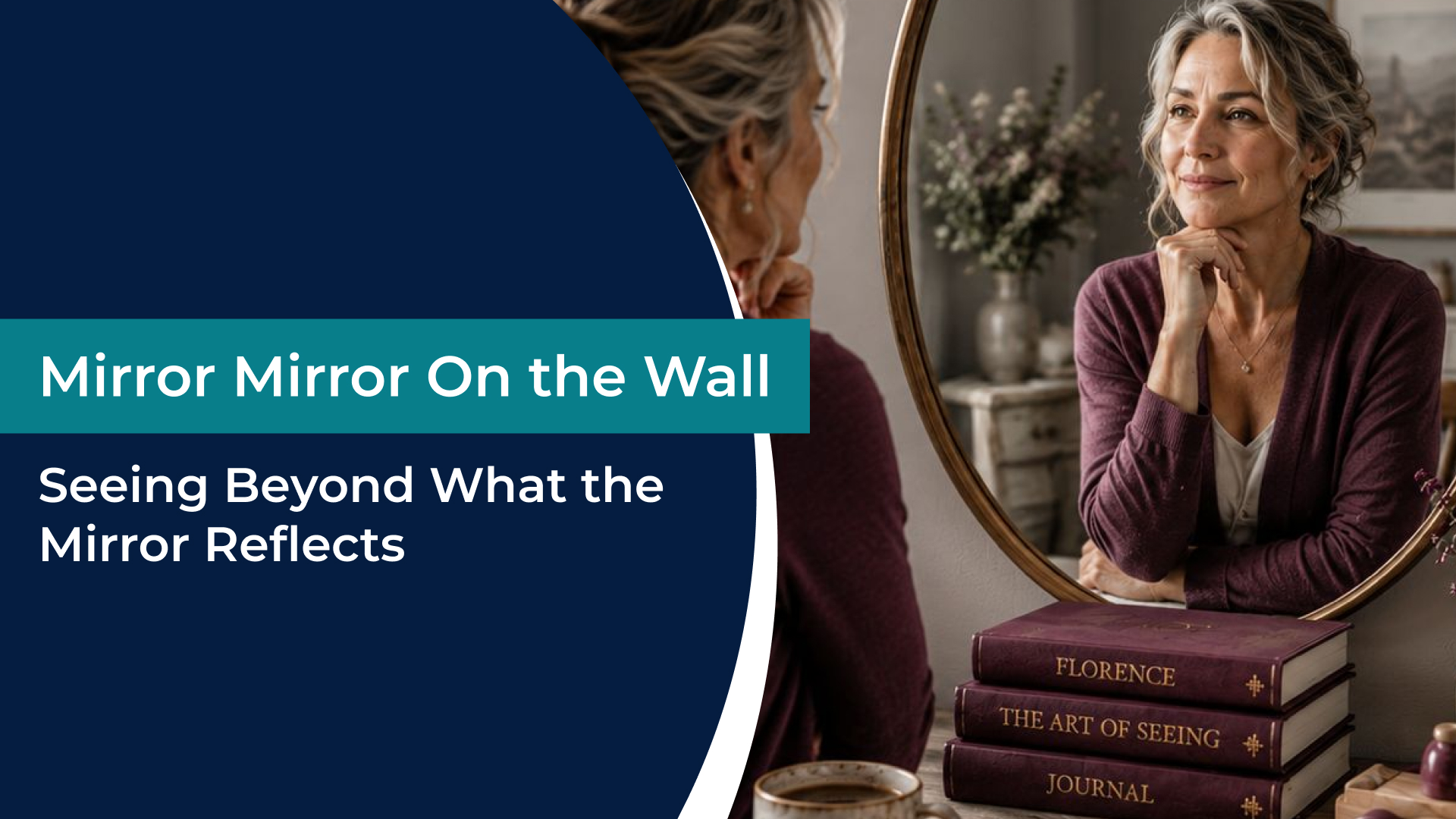

The Mirrors We Ask
Every generation since Snow White and the Seven Dwarfs knows the line, “Mirror, mirror on the wall…” We’ve come to associate it with vanity, jealousy and a queen obsessed with being the fairest of them all. But what if we’ve misunderstood the story? What if the mirror was never really about beauty? What if it has endured because it captures something much more deeply human?
The more interesting question isn’t why the Queen asked the mirror. It’s why we still do.
Why do we keep looking outside ourselves for answers to questions that feel as though they should come from within?
Perhaps we should be asking a different question. Why has this mirror archetype endured for generations? Perhaps the answer is simpler than we give it credit for. Because we keep asking it for answers. The mirror captures something profoundly human. Our longing to see ourselves. To know ourselves. To understand our place and our value. The tragedy isn’t that we want those answers. It’s that we’ve gradually come to believe the mirror can provide them. Over time, what the mirror reflects begins to shape not only what we think about ourselves, but how we feel about ourselves as well.
Somewhere along the way, we confused looking with seeing. We became fluent in looking at ourselves, yet strangely unfamiliar with seeing ourselves.
The symbol of the mirror has endured because it captures something profoundly human. We all long to know who we are. We all long to know that we matter. The mirror isn’t the problem. It’s simply become the place we’ve learnt to ask questions it can never answer.
This isn’t an argument against looking outside ourselves. There are countless moments in life when someone else’s knowledge, experience or perspective is exactly what we need. We ask doctors to diagnose illness. Teachers to expand our understanding. Mentors to challenge our thinking. There is wisdom in recognising where another person’s expertise begins.
But there are some questions that no amount of expertise can answer for us. Questions like: Who am I? What matters to me? Am I enough? What kind of life do I want to live? The moment we begin asking those questions of something or someone outside ourselves, authority becomes misplaced.
The shadow side of the Queen isn’t that she’s vain. It’s that she no longer knows how to know herself. She has to ask.
She doesn’t stand before the mirror because she’s narcissistic. She stands before it because she’s asking it to answer a question it was never designed to answer. Every day she returns, hoping it will tell her something about who she is and what she’s is worth.
Somewhere along the way, she has misplaced her authority. She has outsourced questions of worth and identity to the mirror, and in doing so has slowly lost touch with her own internal reference point.
That’s the tragedy.
Perhaps that’s why this story has endured. The Queen isn’t simply the villain of the fairy tale. She’s the archetype of something deeply human. We all have mirrors we turn to, hoping they’ll answer questions they were never meant to answer.
Through this lens, how do you see the Queen now? As a vain woman consumed by her appearance? Or as a woman who has forgotten how to know herself?
I find that a much more compassionate reading of the story. Rather than reducing her to the “vain villain”, it invites us to ask a deeper question: What happens to us when we hand over authority to define our worth to something outside ourselves?
The fairy tale may be old, but the mirrors are not.
Today, many of our mirrors aren’t made of glass at all. They live in our phones, our workplaces, our relationships, our families and in the stories we’ve inherited about who we should be.
Each one faithfully reflects something back to us. None of them are inherently good or bad. The problem begins when we ask them questions they were never designed to answer.
Am I enough?
Am I successful?
Am I worthy?
Am I loveable?
Who am I?
The Queen doesn’t simply ask, “Am I beautiful?” She asks, “Who is the fairest of them all?”
It’s a subtle distinction, but an important one. The moment she asks that question, she accepts a scale of measurement. Somewhere on that scale sits the fairest. But by implication, there must also be someone who is less fair, less beautiful, less worthy of the title. The mirror isn’t simply reflecting beauty. It’s ranking it.
Because the scale itself creates insufficiency.
There can only ever be one person who is the fairest. Everyone else is, by definition, less. Yet human beings rarely experience “less” as a ranking. We experience it as identity. We don’t think, I’m number seven. We think, I’m not enough.
Perhaps that’s the real trap.
Every scale inevitably produces its own version of “not enough.” Beauty. Success. Productivity. Popularity. Motherhood. Leadership. Intelligence. Business. Coaching. Whatever sits at the top of the scale simultaneously creates the possibility of falling short.
Yet we don’t simply inherit these scales. Through the meanings we attach to them, we participate in constructing them. Over time, those measures become so familiar that they no longer feel like interpretations. They feel like reality.
And once we’ve built the scale, we inevitably begin measuring ourselves against it.
Those are not questions a mirror can answer. Yet, like the Queen before us, we keep asking.
Every Mirror Reflects a Different Story
But mirrors don’t simply reflect images. They also reflect meanings.
Yet mirrors don’t simply reflect images. They also reflect meanings. Every mirror carries a story about what matters, what is desirable, what success looks like, who belongs and what it takes to be enough. Over time, those stories become so familiar that we stop experiencing them as stories at all. We experience them as reality.
We rarely stop to ask where those definitions came from. Instead, we spend our lives trying to measure ourselves against them.
The mirror isn’t manufacturing meaning. It’s reflecting the sense-making structures already operating within us. In the language of Ashkan Tashvir’s Nested Theory of Sense-Making, those structures quietly shape how we interpret what we see long before we become conscious of them.
Every time we ask the mirror a question, we’re not simply looking for an answer. We’re consulting the beliefs, definitions, assumptions and stories we’ve come to accept about ourselves and the world. The mirror doesn’t invent them. It simply reflects them back to us.
Which means the deeper question isn’t, “What does the mirror show me?” It’s, “What way of making sense of myself is this mirror revealing?”
Take success as one example:
Imagine you’re a business owner. Somewhere along the way you’ve come to believe that a successful business is one that is constantly growing, attracting more clients, increasing revenue and becoming more visible. You probably didn’t arrive at that definition on your own. It has been shaped by business books, social media, industry conversations, mentors, podcasts and the countless messages that tell us what a thriving business is supposed to look like.
That definition becomes a mental model. It quietly shapes what you believe success should look like.
Over time, it begins to influence how you navigate your business. You notice competitors with larger audiences. You compare your revenue with someone else’s. You feel uneasy during quieter seasons because you’ve learnt to equate constant growth with success. Your attention is drawn towards evidence that confirms the map you’ve inherited. That is your cognitive map at work. It influences what you notice, how you interpret your experiences and the direction you believe you should be heading.
Before long, the stories begin to emerge.
I’m falling behind.
I’m not doing enough.
Everyone else has figured this out except me.
Those stories feel true because the map feels true. Yet both began with a definition of success that may never have been consciously chosen.
We often assume the mirror is telling us the truth. But mirrors don’t create truth. They simply reflect whatever stands before them. Perhaps our modern mirrors are doing the same. A mirror doesn’t know what success is. It can’t define beauty. It has no opinion about what makes someone a good woman, what leadership should look like, or what makes a life meaningful. We bring those definitions with us long before we stand before the mirror. It simply reflects them back.
The reflection isn’t where the story begins. It’s where the story becomes visible.
Which means the real question isn’t, “What does this mirror say about me?” It’s, “What have I brought with me before I even looked?”
If the mirror can’t tell me who I am… then where do I look?
Perhaps the deeper question isn’t what the mirror is reflecting at all.
Perhaps it’s this: How am I deciding that what I’m seeing is true?
Most of us rarely stop to consider the ways we’re making sense of our lives. We simply assume that because a conclusion feels convincing, it must also be true. Yet every conclusion rests on a way of knowing. Every judgement, every interpretation and every story we tell ourselves has travelled a path before it arrived at certainty.
Some questions are well served by evidence. If I want to know whether a medication is effective, I look to scientific research. If I want to know whether my car needs repairing, I ask a mechanic. We instinctively recognise that some questions belong to particular kinds of expertise.
Yet we don’t always bring that same discernment to the questions that shape our lives.
Who am I?
Am I enough?
What does success mean?
What kind of woman should I become?
What makes a life meaningful?
Perhaps the real invitation isn’t to reject the mirror. It’s to become more discerning about the questions we’re asking, and who—or what—we’ve given the authority to answer them.
Take achievement, for example. We often behave as though achievement itself can tell us whether we’re successful, worthy or enough. But achievement has no agency. It can’t answer anything. Success can’t answer those questions either. Neither can beauty, status, productivity or someone else’s approval. They don’t speak. They don’t judge. They don’t decide our worth.
What gives them their apparent authority isn’t the achievement itself. It’s the authority we’ve granted to the meaning we’ve attached to it.
It’s the definition we’ve inherited, the interpretation we’ve accepted and the story we’ve come to believe. Somewhere along the way, we quietly promoted those interpretations to the status of truth.
The mirror simply reflects what we’ve already brought with us.
When the Music Grows Quiet
We rarely wake up one morning and decide to stop trusting ourselves. It doesn’t happen in a single moment, nor is it usually the result of one significant event. Something much quieter takes place over time.
We stop consulting ourselves.
Before making a decision, we consult the mirror. Before trusting our own experience, we consult the definition. Before expressing what we know, we ask what will be acceptable. We become increasingly fluent in reading the expectations around us, while slowly losing contact with the quiet knowing within us.
The shift is almost imperceptible. Yet over time it changes everything. The questions we ask become different. The choices we make become different. The way we participate in our relationships, our work and our lives begins to orient itself around external measures rather than our own lived experience. Gradually, we stop asking, What feels true for me? and start asking, What will be valued? What will be admired? What will be approved of?
It isn’t that our internal reference point disappears. It simply stops being consulted.
Over time, our lives begin to lose something of their vitality. The more consumed we become with the mirrors around us, the more our capacity begins to dull. Our self-expression quietly erodes. We stop living from the uniqueness of who we are and slowly begin packaging ourselves into the comparisons of life. Without even noticing, we become increasingly skilled at being who we’ve learnt to be, and increasingly unfamiliar with the person we already are.
And yet…
What if the internal reference point never disappeared? What if it simply became quieter beneath the noise of all the mirrors we’d learnt to consult? We know what this feels like. It’s the tiny moment when something inside us whispers, “This isn’t me.” The quiet excitement that appears when we stumble across something that feels deeply alive. The ache to create. The unexpected tears during a piece of music. The longing that surfaces when we watch someone else living with a freedom we’ve forgotten is possible.
Those moments aren’t random. Perhaps they’re reminders. Gentle invitations back into a relationship with ourselves.
I Miss Florence
For eight months, I had planned our trip through Europe.
In meticulous detail. Every destination had been chosen with care. Every attraction built into our itinerary, through Italy. Florence. Vienna. Paris. Barcelona. I knew which streets I wanted to wander, the cafés where I imagined lingering over coffee, the art I longed to stand before and the buildings I’d admired for years from the pages of books and documentaries. Piece by piece, I had built not just an itinerary, but an experience I couldn’t wait to step into.
Then life changed. Health became more important. What had taken months to build came down far more quickly than I’d ever imagined. It took me a while to realise I wasn’t mourning an itinerary. I was mourning the possibility of a life I’d quietly imagined myself living.
I’d never been to Florence, yet every time someone mentioned the city, showed a photograph of its streets or spoke about its art and history, I found myself quietly saying,
I miss Florence.
How can you miss somewhere you’ve never been?
I missed the colours. The art. The streets that seemed to invite people to linger rather than rush. I missed the feeling that somewhere in those narrow laneways I had caught a glimpse of a version of myself that felt more alive, more curious and more fully expressed.
I told myself that if I could return there, perhaps I would find her again.
But over time I’ve begun to question whether Florence was ever the point.
It took me a while to realise I wasn’t grieving my romanticised image of Florence. I was grieving the possibility I had quietly attached to it. Florence represented a symbol of the freedom I imagined would allow me to express more of who I already was. Florence had become a symbol of the freedom I imagined would allow me to express more of who I already was. I believed it would give me permission to linger. Permission to imaging. Permission to step back in time. Permission to become more fully myself. Permission to see myself in the images of the women who came before me.
Then another observation began to emerge. The self-expression I associated with Florence had never been waiting for me in Italy. It had been waiting patiently within me all along. Florence hadn’t been holding my self-expression. It had simply become the place onto which I’d projected it.
That changed everything.
I realised I wasn’t longing for a city. I was longing for a different relationship with myself—one in which I no longer needed a destination, a circumstance or a future version of my life to give me permission to become more fully who I already was.
It was waiting for me.
Somewhere along the way, I’d become so practised at consulting the mirrors around me that I’d stopped consulting the quiet knowing within me. I wasn’t lacking creativity. I wasn’t lacking curiosity. I wasn’t lacking life. I had simply become disconnected from the place from which those things naturally emerge.
Perhaps that’s why certain places, people, books, conversations or pieces of music move us so deeply. They don’t give us something we didn’t already possess. They remind us of something we’ve gradually stopped consulting.
Maybe we don’t miss the place as much as we miss the part of ourselves that the place made visible.
And perhaps that’s the hope hidden within all of this.
The internal reference point doesn’t disappear. It doesn’t need to be rebuilt from scratch. It waits patiently beneath the layers of inherited stories, misplaced authority and well-practised comparison, ready to be consulted again.
Maybe a Mirror Moment isn’t the moment we become someone new.
Maybe it’s the moment we remember the person who has been quietly waiting for us all along.
In Summary
Perhaps the greatest tragedy isn’t that we sometimes question our worth. It’s that we’ve gradually learnt to ask the wrong places to answer questions they were never designed to answer.
Mirrors can reflect our appearance. Achievement can measure outcomes. Other people can offer wisdom, feedback and perspective. But none of them can tell us who we are, what makes our lives meaningful or whether we are enough. Those are questions that can only be answered through an ongoing relationship with ourselves.
A Mirror Moment isn’t simply the moment we see ourselves differently. It’s the moment we recognise the invisible stories, inherited definitions and misplaced authority that have quietly shaped how we’ve been seeing ourselves all along. Once we can see those constructs, we are no longer bound by them. We become free to ask different questions, to consult our own lived experience once again, and to rebuild an internal reference point from which we can participate more fully in our own lives.
Perhaps that’s what it really means to see ourselves differently.
Jeanette Mundy is a writer, speaker coach and co-founder of RelateAble Global. Through Mirror Moments, she explores the quiet patterns that shape how we see ourselves, relate to others and participate in the world.
If this article has left you with more questions than answers, you’re not alone. Mirror Moments was never intended to provide neat conclusions. It exists to spark the kinds of conversations we rarely have space for in everyday life.
If this article has stirred something in you, you’re warmly invited to continue the conversation. Mirror Moments is a regular conversation where we explore these ideas together, while The Hearth Community is a place for thoughtful conversation, reflection, connection and gathering.
If you’ve been longing for conversations that help you see yourself and your life differently, we’d love to welcome you.
You can also follow Jeanette on the Engenesis Platform and LinkedIn for future Mirror Moments articles and ongoing reflections.