

Braids to brands
Kenda and I still laugh about it. We lived on the same floor in Jean Royce Hall at Queen’s University and, according to her, my arrival was memorable. She remembers standing in the hallway and seeing a young woman appear in the doorway wearing blue denim overalls, two braids and a smile.
"Hi, I’m Marijana. Who are you?"
Kenda insists I looked like I’d just stepped off a farm. I hadn’t. I grew up in a small town, not on a farm. But from the perspective of Queen’s in the late 1980s—a university fed by private schools from Canada and around the world—the distinction was probably academic. Some degree of culture shock was inevitable.
What makes us laugh now isn’t the overalls or the braids. It’s the innocence. At eighteen, I still assumed belonging and comparison had nothing to do with one another. Friendship was friendship. People were people. Belonging was something you discovered rather than something you earned.
University taught me many things. Political science. Constitutional law. Public policy. It also taught me Ralph Lauren. Nobody delivered a lecture on the social significance of polo ponies embroidered onto shirts and knitwear. Yet somewhere between orientation week and graduation I accumulated enough Ralph Lauren clothing to suggest I had become an unofficial ambassador for the brand.
Queen’s taught me other things too. How much of your family story to share. Which ambitions were admirable and which were slightly embarrassing. What counted as sophistication. What counted as success. What boys supposedly wanted. Nobody handed out a guidebook. Yet somehow the learning happened anyway.
Looking back, what fascinates me isn’t that I bought the clothes. It’s how quickly the purchase stopped feeling like a purchase and started feeling like common sense. Nobody told me friendship depended on what I wore. Nobody suggested that belonging required embroidered logos. Yet subtle associations quietly formed. Sophistication and status. Confidence and consumption. Belonging and brands. The connections felt obvious at the time. They seem considerably stranger now. This raises a question that would never have occurred to my eighteen-year-old self:
If belonging was always the need, how did comparison become the strategy?
Humans arrive in the world wired for connection. Long before we care about image, status, money, influence or achievement, we are reaching towards relationship. A toddler entering a playground is not conducting a comparative analysis of her peers. She isn’t evaluating her market value or curating a personal brand. She’s simply looking for someone to play with. Belonging is not something we invent. It is something we need. Comparison comes later.
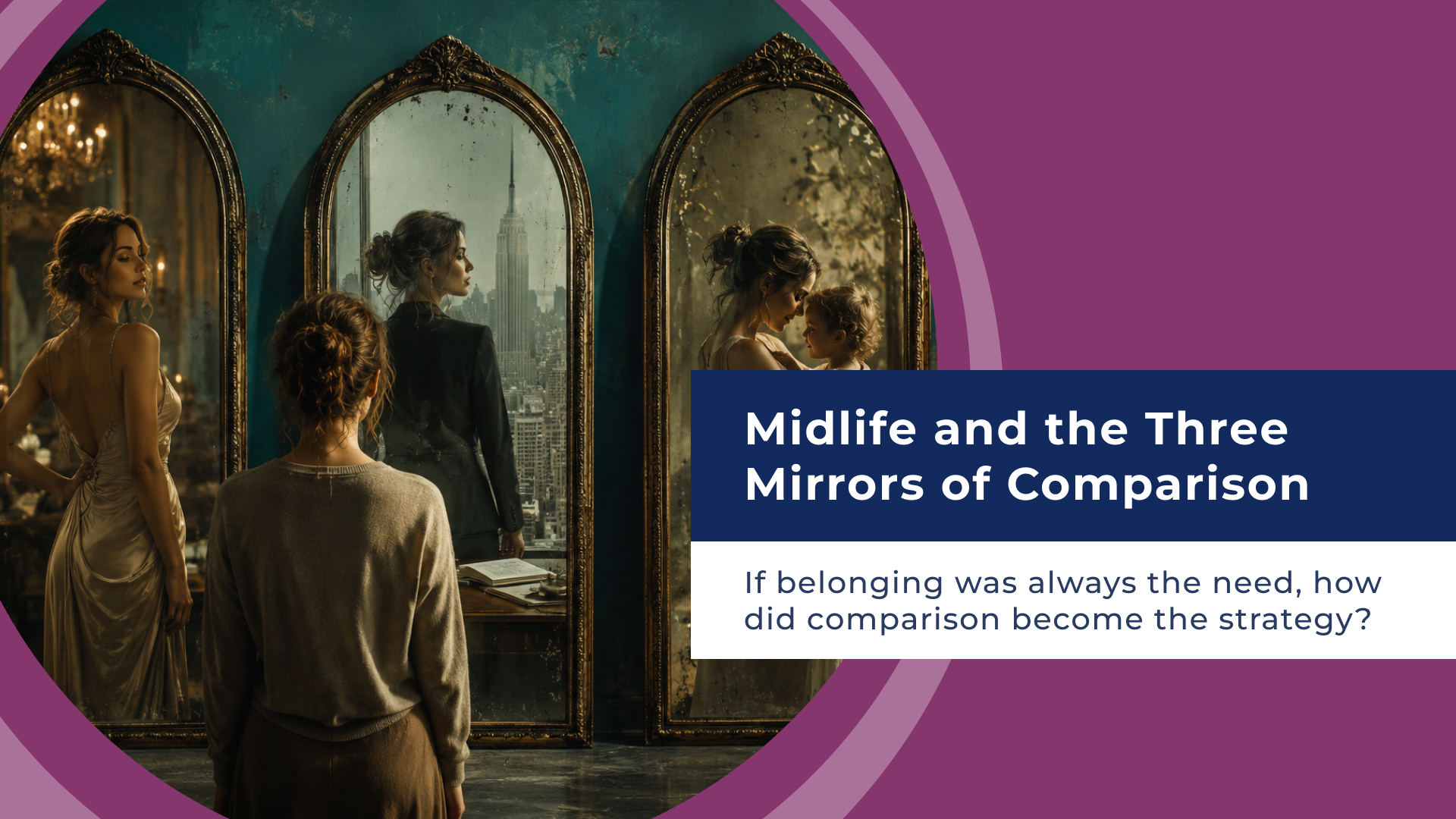
The three mirrors of comparison
Most of us do not consciously choose comparison. We learn it. We notice who receives attention. We observe what attracts admiration. We absorb signals about beauty, success and worthiness long before we have the capacity to question them. The adaptation is understandable. It helps us navigate families, schools, workplaces and communities. The difficulty begins when we forget it is an adaptation.
A question that begins with "Do you want to play with me?" somehow evolves into designer labels, executive titles, luxury vehicles, destination weddings, curated social media feeds and wardrobes full of clothes purchased for lives we may or may not actually be living. Many of us begin measuring ourselves in three familiar mirrors.
The first mirror reflects appearance. It quietly asks: Am I attractive enough?
The invitations arrive gradually. Better shoes. Better skin. Better hair. Better photographs. Better angles. Before long we find ourselves contemplating cosmetic procedures and wondering whether they represent self-care, self-improvement or something else entirely. I am not anti-Botox. I am pro-question. Who exactly are we negotiating with?
The second mirror reflects achievement. It asks: Am I successful enough?
At twenty-five it may be the degree. At thirty-five it becomes the promotion. At forty-five it is the executive role, the board appointment, the bonus or the industry recognition. Achievement can be deeply meaningful and enormously satisfying. It can also become an endless game of moving finish lines.
The Talking Heads captured the feeling perfectly decades ago. You may find yourself living in a beautiful house, with a respectable title, a healthy income and a calendar packed with commitments and suddenly hear David Byrne’s voice: "And you may ask yourself, ‘Well, how did I get here?’" The question lands differently in midlife. By then many women have accumulated a remarkable amount of evidence. Evidence of competence, success, reliability. They have done all the things they were supposed to do. And yet something still feels unfinished.
The third mirror reflects affection. It asks: Am I lovable enough?
Perhaps this is the most powerful mirror because it disguises itself as virtue. It rewards us for being agreeable, reliable and endlessly available. Many women become experts at carrying emotional labour. They smooth tensions, anticipate needs, remember birthdays, organise gatherings and quietly hold families, teams and communities together. Then one day they discover they have become essential to everyone except themselves.
The problem is not that appearance, achievement and affection matter. They do. The problem is that none of them can carry the entire weight of belonging. The deepest cost is not the money, the promotion, the cosmetic procedure or the luxury car. It is freedom. The freedom to decide for ourselves what a good life looks like. The freedom to define success, attractiveness and worth on our own terms.
Many of us outsourced that authority. Other people began deciding what counted as beautiful. What defined success. What counted as desirable. What it meant to be enough. We stopped writing the rules and started following them. That isn’t a criticism. The question is whether we ever consciously chose our version of the scorecard or if it quietly chose us.
The house of mirrors
Money complicates the story further. Not because money is inherently bad. Money creates options, relieves pressure and opens doors. Most of us would rather have enough than not enough. The challenge is that money often becomes part of a game no one can actually win.
A Joseph Ribkoff dress purchased for a one-night-only black-tie event hangs patiently in a wardrobe waiting for an occasion worthy of its second outing. A wedding celebration can cost more than a house deposit. A handbag can cost more than a family holiday. A promotion can demand years of sacrifice for a title that feels strangely ordinary within a few months of receiving it.
A Porsche and a Lada do not use different roads. They both ’arrive’ at a destination. This seems obvious. Yet entire industries have been built around helping us forget it. The spending itself is not particularly interesting. What interests me is what we imagine the dress, car, title might deliver. It’s what sits beneath them. Recognition, status, identity, and belonging.
Very few people stand in a luxury boutique having an existential crisis. Yet every now and then, beneath the purchase, there is a surprisingly childlike question hiding in plain sight. Will this help me belong?
Over time I began to wonder whether I had accidentally tangled together three very different things. Belonging is a human need. It sits alongside our need for safety, connection and participation. Comparison, on the other hand, is a social strategy. It is one of the ways we learn to navigate groups, hierarchies and cultures. Consumption is something else again. It is a commercial response that offers solutions, products and pathways for the insecurities comparison inevitably creates.
Individually, each makes a certain kind of sense. The trouble begins when we confuse them. We need belonging, so we compare. We compare, so we consume. Then we consume in the hope that the purchase, promotion, renovation, qualification or experience will finally satisfy the need that started the entire process.
Modern life has become remarkably sophisticated at profiting from this confusion. Advertising is comparison institutionalised. Social media is comparison gamified. Consumer culture is comparison monetised. The goal is not to make us miserable, it’s much more subtle. Keep people slightly uncertain. Slightly dissatisfied. Slightly behind. Just enough to keep them consulting the mirrors.
The mirrors in a carnival funhouse distort reality. One makes your head look enormous. Another makes your legs look too short. Another stretches your body into absurd proportions. We laugh because we know the reflections are not real. Outside the funhouse we often forget. We begin treating distorted reflections as objective truth. The more we consult the mirrors, the less we trust ourselves. The less we trust ourselves, the more we consult the mirrors. What began as a strategy for belonging slowly becomes a cage. Not a cage with bars. A cage made of reflections.
When midlife whispers enough
Sometimes I wonder whether midlife is simply the moment the buzz wears off. The strategies that felt motivating at twenty-five can feel demanding at forty-five and quietly exhausting by fifty-five. At some point the voice of comparison continues whispering more while life itself begins whispering: Enough. Not enough as resignation. Enough as discernment, wisdom and freedom.
Midlife exposes bargains we didn’t realise we had made. Time becomes more precious. Energy is more finite. Mortality becomes less theoretical. The future no longer stretches endlessly ahead in the way it once did. The mirrors themselves have not changed, but the economics has.
Life begins asking a different question: How much longer do I want to organise my life around rules I never consciously chose?
Alfred Adler suggested that much of human suffering emerges when we confuse our task with somebody else’s task. Their life is their task. Your life is your task. Comparison begins when we forget the difference. Freedom begins when we remember it. The wisdom of age doesn’t teach us how to play the game better. It helps us recognise that the only life we are responsible for living is our own. If wrinkles are the price of escaping the House of Mirrors, show me the exit.
Reflecting back, I have more affection for the young woman Kenda remembers standing in that university doorway. Blue denim overalls. Two braids. An awkward introduction. No strategy. No performance. No carefully curated identity. Just a simple assumption that people might be worth meeting and that she belonged in the room before she had achieved anything, purchased anything or proven anything.
What I miss most is her assumption. She walked into the room without asking a mirror for permission. She knew something I had to spend decades relearning. The child who asks, "Do you want to play with me?" is not trying to become enough. She already assumes she belongs.
This is what midlife offers us. Not the chance to become someone new. The chance to remember someone we once were. To step away from the mirrors. To stop confusing comparison with belonging. To recognise that belonging was never something we had to earn. It was never for sale. And no mirror was ever going to show us what we had been searching for all along.
Dr Jordan Marijana Alexander explores how identity, place, culture, and human systems shape participation in work, leadership, and contemporary life. She is the co-founder of RelateAble.Global. If this article has raised questions, sparked reflection, or highlighted something you're navigating as a leader or in your personal life, you're invited to book a conversation to explore it further. You can follow DrJMA on LinkedIn and Engenesis for ongoing insights, research, and practical resources.