
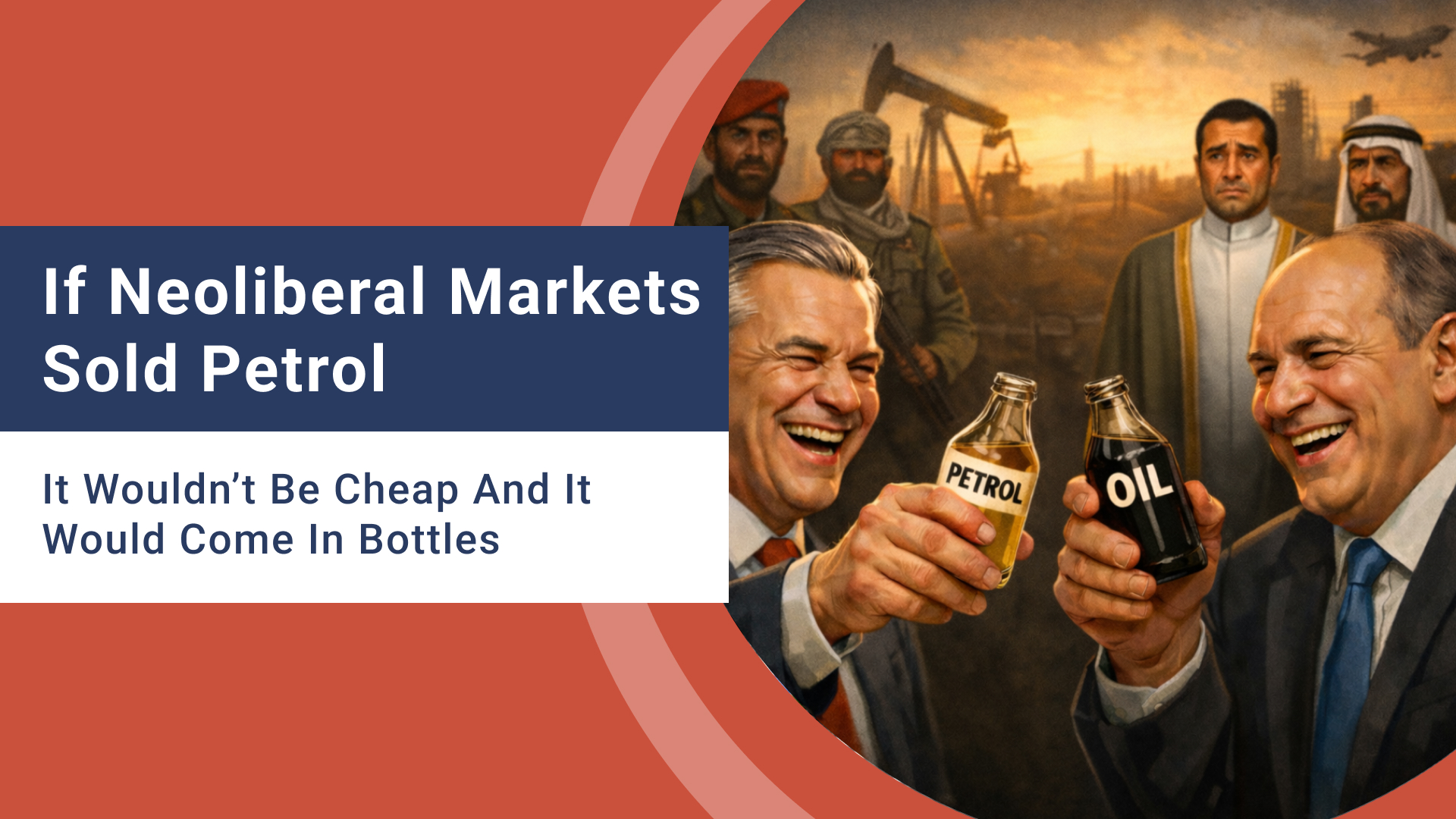

Imagine Buying Petrol in Bottles
Imagine walking into a supermarket. Not a petrol station, but a perfectly ordinary supermarket where people buy bread, milk and fruit for the week. You push your trolley past the bakery, the vegetables and the refrigerated drinks until you arrive at a brightly lit section labelled Energy Solutions. At first, it looks like any other modern retail display. Clean shelves, elegant packaging and carefully arranged bottles designed to catch the eye. But as you step closer, something feels slightly unusual. The bottles sitting neatly in rows are not sparkling water, kombucha or cold brew coffee.
They are petrol.
Each bottle contains 300 millilitres of Premium Petrol Blend, priced at $6.50. The label proudly highlights its smooth combustion profile and enhanced engine compatibility. Next to it sits a premium version called Single-Origin Arabian Reserve, marketed as a small-batch hydrocarbon experience sourced from ancient geological formations. A slightly darker bottle offers Performance Diesel, designed for drivers who appreciate superior torque delivery and refined fuel dynamics. The labels look reassuringly sophisticated, as if the engine about to burn the fuel might somehow care about the geological heritage of the hydrocarbons inside.
For environmentally conscious customers, there is even a sustainability option. A minimalist label announces Net-Zero Aligned Combustion Fuel, reassuring buyers that their petrol purchase participates in a responsible climate pathway. Customers move slowly through the aisle, comparing brands. Some pick up a six-pack for the week. Others scan a QR code linking to a subscription service delivering curated fuel selections directly to their homes. A promotional sign explains that loyal customers can track their monthly combustion footprint through a convenient mobile app, allowing them to balance their personal mobility with carefully calculated carbon offsets.
The scene sounds absurd, and of course it is. Petrol is not sold like sparkling water, and no one stands in a supermarket comparing the tasting notes of different hydrocarbons. Yet the absurdity is precisely what makes the thought experiment interesting. Because if petroleum had entered the world through the logic of modern neoliberal retail markets rather than through the industrial infrastructure of pipelines, refineries and petrol stations, it is not entirely impossible that we might have ended up buying it this way. Instead of tankers, pumps and underground storage tanks, petrol and diesel might appear in small, carefully packaged quantities designed for convenience, branding and margin optimisation.
Of course, the real story of oil is not nearly that tidy. Long before petrol reaches the pump, it travels through an industrial and political landscape far more complicated than a supermarket aisle. Oil flows through pipelines and tanker ships, but it also flows through alliances, security arrangements and strategic partnerships that help keep the global energy system functioning. Some governments become dependable allies while others become problematic adversaries, and the distinction between the two sometimes has less to do with ideology than with the steady movement of hydrocarbons beneath deserts and oceans.
None of that complexity appears on the petrol pump, and certainly not on the imaginary bottle sitting on our supermarket shelf. What the consumer ultimately sees is only a number displayed beside a nozzle or printed beneath a label. Yet modern markets have become remarkably sophisticated at one particular skill. They rarely sell abundance in its natural form. They specialise in something far more subtle: carefully packaging portions of abundance and presenting them as if scarcity had always been there. Once that pattern becomes visible, the idea of bottled petrol begins to feel less like a joke and more like a mirror held up to the strange economics of everyday life.
The Genius of Modern Packaging
To understand why the image of bottled petrol feels both ridiculous and strangely plausible, it helps to observe how many ordinary products already move through modern retail economies. Contemporary markets have developed a remarkable talent for transforming substances that once appeared abundant into carefully portioned consumer experiences. The process rarely begins with scarcity itself. Instead, it begins with packaging, presentation and the subtle reshaping of how people encounter everyday goods.
Consider water. For most of human history, it flowed freely through rivers, springs and wells. Even today, it arrives through pipes into homes across much of the world. Yet once water enters the retail environment, it becomes bottled water, often presented in elegant containers designed to evoke mountains, glaciers or pristine natural landscapes. The physical substance has not changed dramatically, but the way it appears to the consumer has been transformed. What was once a basic element of life becomes a curated product occupying valuable space on supermarket shelves.
The same pattern appears in many other parts of modern retail life. Coffee beans that once moved through markets in bulk now appear in small aluminium capsules designed for proprietary machines. Herbs that grow abundantly in gardens and farms are sold in delicate plastic containers holding just a few sprigs. A handful of dill, rosemary or chives may cost several dollars even though the plant itself grows easily in many climates. In each case, the transformation is not agricultural but economic. The substance remains relatively ordinary, yet the experience surrounding it becomes carefully designed, packaged and priced.
This shift does not necessarily arise from deception or manipulation. Retail systems operate within complex logistical realities that include transportation, storage, labour costs and the need to minimise waste. Packaging often provides convenience and helps preserve freshness, while consumers benefit from being able to purchase manageable quantities of goods without handling large volumes themselves. Yet over time, these practical considerations merge with another powerful force within modern markets: the ability to shape perception.
Once packaging, branding and distribution networks begin influencing how products appear, the boundary between abundance and scarcity can quietly blur. A product that exists plentifully in nature may begin to appear rare once it is divided into small portions and presented through the aesthetic language of modern retail. The consumer does not encounter the field, the farm or the harvest itself. They encounter the shelf, the container and the price tag.
Seen from this perspective, the earlier image of petrol sitting in elegant bottles begins to make a little more sense. If modern markets can successfully transform water, herbs and coffee into carefully curated consumer goods, there is nothing in principle preventing the same logic from being applied to energy. The refinery would still convert crude oil into petrol and diesel. Engines would still burn hydrocarbons to release energy. But the final encounter between fuel and consumer might take place not at a petrol pump but within the familiar theatre of supermarket retail.
And once that possibility is imagined, the satire begins to reveal something slightly more serious about the economic culture in which we live. The modern marketplace is not merely a system for distributing goods. It is also a system for framing how those goods appear to us, shaping the way abundance, value and necessity are perceived in everyday life.
The Entrepreneurial Gold Rush
Once petrol and diesel appeared on supermarket shelves, it would not take long for the entrepreneurial imagination to awaken. Modern neoliberal economies possess a remarkable instinct for recognising opportunities to innovate around everyday substances, particularly when those substances already support vast existing markets. Within months of bottled fuels appearing in retail stores, a new generation of startups would begin to emerge, each promising to revolutionise the way consumers experience energy. Founders would prepare pitch decks explaining that traditional petrol stations represent an outdated distribution model, while the future belongs to agile companies capable of delivering fuel in convenient, branded retail formats.
Entrepreneurs in this imagined world would not necessarily concern themselves with drilling oil wells or operating refineries. Those activities, although essential, rarely capture the excitement of startup culture. The real opportunity would lie in transforming petrol and diesel into differentiated consumer products. One company might position itself as a premium fuel brand offering small-batch petrol sourced from specific geological formations. Another might focus on environmentally conscious drivers, promoting bottled fuels accompanied by carbon offset programs and carefully prepared sustainability reports. A third startup might specialise in performance fuels, promising carefully refined combustion blends optimised for high-performance engines.
Before long, the language surrounding fuel would begin to resemble the vocabulary already familiar in other consumer industries. Petrol might be described in terms of purity, balance and performance characteristics. Diesel could be marketed as a professional-grade energy solution designed for drivers who demand reliability and torque. Online influencers might begin reviewing different fuel brands with the same seriousness normally reserved for coffee, wine or craft beer. Instead of discussing flavour notes, however, they would analyse combustion efficiency, engine responsiveness and emissions profiles.
The next wave of innovation would naturally move toward convenience. A particularly ambitious startup might introduce an on-demand fuel delivery platform designed to replace the traditional petrol station entirely. Running low on fuel at home? No problem. Simply open an app, place an order and within thirty minutes, a cheerful gig-economy courier arrives at your door carrying several bottles of premium petrol in a carefully insulated backpack. Surge pricing would apply during peak driving hours, weekends and holiday periods. Venture capitalists would enthusiastically fund the platform, explaining that it represents a revolutionary intersection of energy, logistics and digital convenience. At industry conferences, the founders would proudly explain that they are not merely delivering fuel but reimagining the mobility experience.
What began as a simple industrial commodity would gradually transform into an entire ecosystem of branding, marketing and technological innovation. The oil field and refinery would remain essential somewhere in the background, but the most visible energy within the system would no longer come from hydrocarbons alone. It would come from the entrepreneurial machinery surrounding them, constantly searching for new ways to differentiate, package and monetise one of the most ordinary yet indispensable substances in the modern world.
Investors, Patents and Public Revenue
Once entrepreneurial excitement begins to build around a new market, investors rarely remain on the sidelines for long. In modern neoliberal economies, capital has developed an extraordinary sensitivity to opportunities where everyday necessities intersect with scalable consumer markets. Petrol and diesel, once reframed as retail consumer products, would quickly attract the attention of investment funds eager to participate in what analysts might describe as the rapidly expanding consumer energy segment.
At this stage, the conversation would begin to change. Entrepreneurs often start with ideas about convenience, branding and customer experience, but investors inevitably introduce a different set of priorities. They ask how a product can be protected, how margins can be expanded and how a market position can be defended against competitors. In other words, they search for ways to build economic structures around the product that generate predictable returns. The result is often the emergence of a patent economy surrounding what was once a straightforward commodity.
Refineries would soon discover that refining techniques themselves could become proprietary technologies. Slight adjustments in chemical processing, additive combinations or filtration methods might be registered as intellectual property. Companies would begin to patent specialised fuel blends designed to improve combustion efficiency or reduce emissions. Even the bottles themselves might become objects of innovation. One firm might develop a patented nozzle that optimises the pouring of petrol into a vehicle’s tank. Another might introduce a smart cap capable of measuring fuel usage and transmitting consumption data to a mobile application.
Gradually, the petroleum sector would begin to resemble other industries where intellectual property quietly dominates the economic landscape. The real value would not necessarily lie in the crude oil extracted from the ground but in the legal frameworks surrounding its transformation and distribution. Licences would be required to use certain refining technologies. Royalties might be paid on specific fuel formulations. Corporate strategies would increasingly focus on securing patents that allow companies to control key steps in the chain between crude oil and the consumer.
Governments and policymakers, observing the rapid expansion of this innovative retail fuel marketplace, would soon recognise their own opportunities within the system. Committees would be formed, consultations announced and regulatory frameworks carefully expanded. Retail petrol bottles might begin to carry a variety of levies designed to protect public health, environmental sustainability and responsible energy consumption. A carbon stewardship fee here, a transportation infrastructure contribution there and perhaps a strategic energy resilience tax for good measure.
Different political parties would compete enthusiastically over who could regulate the new retail fuel ecosystem most responsibly. Public debates would emphasise the importance of protecting citizens from excessive petrol consumption while ensuring that companies operate within appropriate environmental frameworks. Meanwhile, the steady flow of revenue generated by these taxes would quietly find its way into government budgets. After all, when millions of consumers purchase bottled fuel every week, even modest levies can accumulate into very substantial public income.
To the consumer standing in the supermarket aisle, the bottle of petrol would still appear deceptively simple. Yet behind that modest container would sit an elaborate architecture of patents, licences, financial arrangements and regulatory frameworks ensuring that every step of the process contributes to the expansion of corporate margins and public revenue. In such an environment, the hydrocarbon inside the bottle might become almost secondary to the economic structures surrounding it.
The Science Will Confirm It
No modern economic system reaches full maturity without one final ingredient: scientific validation. Once the bottled petrol economy begins to expand, it would inevitably attract the attention of academic institutions, policy research centres and consulting groups eager to study this fascinating new development. Universities would establish research programs dedicated to understanding the behavioural dynamics of retail fuel consumption. Departments would produce white papers exploring the innovative potential of decentralised bottled energy distribution, while conferences would gather scholars to debate the future of the emerging consumer fuel sector.
Funding for these studies would arrive, quite naturally, from the very industries most interested in the outcome. Energy retailers would sponsor research examining consumer preferences around premium fuel packaging. Venture capital firms would fund studies investigating the disruptive potential of on-demand petrol delivery platforms. Policy institutes might commission reports analysing how modern retail fuel markets could contribute to sustainability goals, economic growth and energy system resilience.
The results of these studies would often prove impressively aligned with the interests of those supporting the research. Some papers might conclude that smaller petrol bottles encourage responsible consumption behaviour by helping drivers monitor their usage more carefully. Others might demonstrate that premium branding improves driver satisfaction and therefore contributes positively to the culture of responsible mobility. A few particularly enthusiastic research teams might even discover that retail fuel packaging represents an innovative pathway toward a more flexible and consumer-responsive energy system.
Of course, not every study would reach the same conclusion. Some researchers might question whether turning industrial energy into boutique retail products makes economic or logistical sense. Others might point out the inefficiencies involved in packaging and distributing fuel in such small units. Those papers would exist as well, quietly published in journals and presented at conferences, though perhaps without attracting quite the same level of public enthusiasm.
Such is the beauty of modern scientific pluralism. In time, policymakers would cite the studies supporting new regulatory frameworks, while industry leaders would reference the research demonstrating the innovative potential of the consumer fuel sector. Universities would proudly showcase their expanding portfolio of energy policy research, emphasising their role in guiding the transition toward more sophisticated energy markets.
And the public would be reassured once again that the conclusions are not ideological at all.
They are scientific.
After all, nothing settles a complicated debate quite like the comforting phrase: “according to the research.”
The Quiet Professionals
Once the bottled petrol economy reaches sufficient scale, another group of specialists inevitably enters the scene: the quiet professionals of modern governance. Lobbyists and technocrats rarely appear in promotional videos or startup pitch decks, yet their influence quietly shapes the rules within which entire industries operate. While entrepreneurs speak the language of disruption and investors speak the language of returns, lobbyists specialise in something far more subtle: translating commercial ambition into respectable public policy.
Their task would be straightforward but essential. Governments must be helped to understand the strategic importance of supporting innovation in the retail fuel sector. Policymakers, after all, may not immediately recognise the economic potential of subscription-based fuel delivery services, patented micro-refining technologies or premium petrol brands positioned within the consumer marketplace. It takes careful explanation to demonstrate how such developments contribute to national competitiveness, energy resilience and economic growth.
White papers would begin to circulate describing the need to modernise regulatory frameworks around fuel distribution. Policy roundtables would gather industry representatives, legal experts and energy consultants to discuss the barriers preventing the bottled petrol market from reaching its full potential. Technical working groups might recommend new standards governing packaging safety, fuel certification and retail licensing. Gradually, a sophisticated regulatory architecture would begin to emerge around the consumer fuel economy.
Certain companies might receive special licences recognising their innovative role in transforming energy distribution. Others might benefit from incentives designed to encourage technological progress within the sector. Compliance frameworks would grow increasingly complex, ensuring that only properly certified actors can participate in the bottled petrol marketplace. From the perspective of policymakers, this would appear as responsible governance, balancing innovation, safety and environmental considerations.
Naturally, the largest and best-resourced companies would prove particularly skilled at navigating this regulatory landscape. After all, they had participated in many of the conversations that shaped it. The public would be reassured that experienced technocrats and policy experts had carefully designed the system to protect consumers while supporting economic development. And if the resulting regulatory framework happened to favour a relatively small number of well-positioned players, that would simply reflect the remarkable efficiency of modern policy design.
From Crude Oil to Boutique Petrol
Of course, crude oil itself is not something ordinary consumers ever use directly. Before it reaches the driver, the farmer or the trucking company, it must pass through one of the most sophisticated industrial processes modern civilisation has developed: refining. Crude oil arrives at refineries as a dense mixture of hydrocarbons extracted from deep geological formations. Through carefully controlled chemical and thermal processes, these complex mixtures are separated into a family of usable products. Petrol, diesel, jet fuel, lubricants, plastics and numerous industrial inputs emerge from these facilities, quietly supporting enormous portions of the global economy.
In the real world, refineries are vast industrial installations operating continuously, transforming crude oil into fuels that power transportation networks, agricultural machinery and manufacturing systems. Their work is highly technical and largely invisible to everyday consumers. Most drivers filling their tanks rarely think about the distillation towers, catalytic cracking units and chemical processes that make petrol and diesel possible. The fuel simply appears at the pump ready to perform its function.
In the imaginary retail economy we are exploring, however, refineries would soon find themselves positioned within a rather different narrative. Instead of being understood primarily as industrial plants converting crude oil into usable fuels, they might begin to appear as energy transformation hubs producing distinctive fuel experiences for retail markets. Petrol would no longer be simply petrol. It would become a branded energy product shaped by refining techniques, additive combinations and marketing language designed to differentiate one bottle from another.
Supermarket shelves would reflect this transformation. The basic range might include Daily Petrol Blend, marketed as a dependable option for commuters and family vehicles. Nearby might sit Performance Diesel Reserve, aimed at drivers who value torque, endurance and mechanical reliability. Premium brands would emphasise the geological heritage of their crude oil, describing reservoirs formed over millions of years beneath ancient seas as if those origins somehow add character to the fuel itself.
None of this would change the underlying chemistry. Engines would still burn hydrocarbons in precisely the same way they do today. What would change is the narrative surrounding the fuel. Refining techniques that once existed quietly inside industrial facilities would now become part of the product story. A particular catalytic process might be presented as proprietary technology producing smoother combustion. A specific additive blend might be marketed as enhancing engine responsiveness or improving efficiency.
Gradually, the refinery itself would shift in the public imagination from being a purely industrial facility into something resembling a boutique production site, the birthplace of carefully crafted fuel products designed for retail markets. Consumers might begin associating particular refineries with distinctive fuel characteristics in the same way people associate vineyards with particular wines or regions with specific foods.
In reality, the industrial process would remain exactly the same. But once the logic of retail storytelling enters the system, even something as technical as petroleum refining could begin to appear as part of a carefully curated consumer experience.
Climate Narratives and Strategic Partnerships
At this point, another familiar layer of modern economic life would inevitably enter the story. Over the past two decades, the global conversation around oil, petrol and diesel has increasingly been framed through the language of climate responsibility. Governments discuss emissions targets, corporations publish sustainability reports and international agreements such as the Paris Agreement define pathways toward reducing carbon output. Terms like Net Zero, carbon offsets and ESG compliance have become common features of corporate and political discourse.
In our imagined retail world of bottled fuels, this vocabulary would quickly find its way onto the label. The same bottle of petrol sitting on the supermarket shelf would not simply promise reliable combustion. It would also reassure the buyer that their purchase participates in a responsible global transition. A small emblem might indicate that the fuel is Paris Agreement aligned, accompanied by a brief explanation that the company supports international climate commitments through a portfolio of carbon offset programs. Another brand might emphasise that every bottle contributes to a carefully designed Net Zero pathway, balancing hydrocarbon combustion with investments in renewable projects somewhere else in the world.
Corporate reports would reflect this dual narrative. On one page, executives would speak confidently about their role in supporting the global energy transition. Charts would illustrate reductions in emissions intensity and highlight investments in carbon management technologies. On the next page, the same report would celebrate expanding market share in the consumer fuel segment and the success of newly introduced premium petrol blends. Investors would nod approvingly as companies demonstrate their ability to integrate sustainability language with steady revenue growth.
At the same time, the global oil system itself would continue to depend on another layer of reality that rarely appears on consumer labels: geopolitics. Producing oil at scale requires not only drilling rigs and refineries but also stability, alliances and carefully managed diplomatic relationships. Some of the largest oil reserves in the world lie beneath regions where political arrangements can be fragile and security concerns constant.
Modern neoliberal economies have therefore developed a remarkably pragmatic approach to these relationships. Governments that speak passionately about democracy, human rights and liberal values often display admirable flexibility when maintaining strategic energy partnerships. Certain countries are described as reliable allies, pillars of regional stability or essential partners in maintaining global energy security. Their political systems may look rather different from Western democratic ideals, but they remain dependable participants in the global energy ecosystem.
No one feels the need to dwell too heavily on words like authoritarian, monarchy or dictatorship. After all, these are our decent oil-producing partners.
Wink.
Meanwhile, other governments in similar regions may suddenly become destabilising actors and subjected to sanctions, pressure or intervention. The difference between these categories can sometimes appear mysterious to outside observers, but it often becomes easier to understand once one notices the direction in which the pipelines happen to flow.
In this way, the hydrocarbon molecule inside our imaginary bottle carries more than just energy. It travels through climate narratives, corporate sustainability reports, diplomatic alliances and global power arrangements long before it reaches the driver’s engine. None of these layers appear on the label, yet all of them quietly shape the price printed beneath it.
The Art of Manufacturing Scarcity
At this point, the image of bottled petrol begins to feel strangely familiar because the modern retail economy has already mastered the art of transforming ordinary abundance into carefully measured scarcity. This transformation does not require a conspiracy or deliberate manipulation. It emerges gradually through the mechanics of packaging, logistics, pricing and presentation that shape how consumers encounter everyday goods.
Consider herbs. In many parts of the world, herbs grow generously and are traditionally sold in large bundles. When I was growing up, herbs were never treated as delicate luxury items. They were tied together in generous bunches and sold by weight. Compared with meat or grains, they were inexpensive, almost an afterthought in the kitchen. If a family needed dill, coriander or parsley, they would simply buy a large bundle and use what they needed. No one counted individual stems.
Walk through many modern supermarkets today and the experience often looks quite different. Herbs frequently appear in small plastic containers holding just a few fragile sprigs. Three stems of rosemary, a modest handful of chives or a small cluster of dill may cost several dollars. The plant itself has not become more difficult to grow. What has changed is the way the product appears once it enters the retail system.
Fresh chillies offer another revealing example. In some regions, they grow abundantly and are sold in handfuls or by the kilogram. Yet in certain supermarkets, each chilli may be priced individually, turning what was once a common ingredient into a surprisingly expensive purchase. The scarcity is not in nature but in the portioning and pricing structure through which the consumer encounters the product.
Once this pattern becomes visible, the earlier image of petrol sitting in elegant bottles begins to feel less absurd. The same economic instincts that place three sprigs of rosemary in a plastic tray could easily divide petrol into small retail containers. Abundance would quietly transform into measured portions, and the consumer would encounter energy not as a vast industrial flow but as a convenient product arranged neatly on a supermarket shelf.
Oil in the Real Economy
All of this satire becomes clearer once we step away from the supermarket shelf and return to the world where oil actually lives. At the level of the real economy, petroleum is not a lifestyle product or a curated retail experience. It is one of the foundational inputs that quietly support the functioning of modern civilisation. Long before a driver pulls into a petrol station, enormous systems are already at work extracting, transporting and refining hydrocarbons in quantities large enough to power entire societies.
Oil begins its journey deep beneath oceans and deserts, where geological formations have trapped hydrocarbons for millions of years. Engineers drill through layers of rock, often kilometres below the surface, to access these deposits. Offshore platforms operate in harsh environments where wind, waves and saltwater constantly test the durability of the equipment. Once extracted, crude oil moves through pipelines stretching across continents or travels aboard tanker ships that carry millions of barrels across oceans toward refineries and distribution networks.
Unlike herbs, bottled water or other supermarket goods, oil does not move through the world purely as a retail commodity. It travels through a dense web of infrastructure, logistics and political relationships that shape the global energy system. Some of the most important oil-producing regions sit within politically fragile environments where stability, security and diplomacy require constant negotiation. Governments whose industries depend heavily on affordable energy often find themselves maintaining pragmatic partnerships with regimes whose political systems operate rather differently from their own.
This is the part of the oil economy that rarely appears in everyday consumer experience. The price of petrol and diesel does not simply reflect geology or refining costs. It reflects decades of geopolitical bargaining, security arrangements and strategic cooperation designed to keep the global energy system functioning. Stability in certain regions becomes a strategic priority not only for local populations but also for economies thousands of kilometres away whose industries depend on steady flows of energy.
From time to time, the system reveals its complexity through moments of tension. Conflicts, sanctions or political upheavals remind the world how sensitive energy markets can be. Prices move quickly, supply chains tighten and the quiet infrastructure supporting everyday mobility suddenly becomes visible. What normally operates as a background system briefly emerges into public awareness.
Seen from this perspective, the earlier image of petrol sitting in elegant bottles appears almost comically detached from the reality of the system behind it. The supermarket shelf would hide not only the refinery and the oil field but also the entire geopolitical choreography that allows petrol to appear cheaply and conveniently at the pump. Beneath the label, the hydrocarbon inside the bottle would still belong to one of the most complex economic and political systems ever assembled.
When the Real Economy Shows Itself
Occasionally, something happens that reminds societies that, beneath the shelves, brands and financial models, the physical economy is still there. A refinery shuts down unexpectedly, a shipping route becomes unstable or geopolitical tensions disrupt the steady flow of crude oil across global markets. Within days, the consequences begin to ripple outward through the everyday systems that people normally take for granted.
Fuel prices rise, and suddenly, transportation costs increase across entire regions. Farmers reconsider planting decisions as diesel becomes more expensive. Freight companies adjust delivery schedules and revise contracts as operating costs climb. Supermarkets quietly change the prices of vegetables, bread and packaged foods as transportation expenses pass through the supply chain. What began as a disruption somewhere inside the energy system gradually reshapes the ordinary economics of daily life.
In moments like these, the distinction between the economy of presentation and the economy of substance becomes impossible to ignore. Marketing narratives do not move freight trucks. Brand identity does not harvest crops. Financial instruments do not power tractors working fields before sunrise. Beneath the sophisticated layers of modern markets, the basic mechanics of civilisation continue to operate according to simpler principles. Energy must be produced, materials must be transported and machines must run.
Oil sits directly at the centre of that reality. Petrol and diesel are not symbolic products designed primarily to express lifestyle preferences. They exist to release energy inside engines that power vehicles, machinery and infrastructure. When the flow of that energy becomes uncertain, the consequences spread quickly because so many other systems depend on it.
This is precisely why the image of bottled petrol feels humorous rather than threatening. The thought experiment exaggerates a world in which the presentation layer of the economy overwhelms the substance beneath it. Yet whenever the real economy asserts itself, the illusion quickly dissolves. A farmer preparing a field cannot rely on branding to fuel a tractor. A freight operator cannot substitute clever packaging for diesel when a truck must travel hundreds of kilometres.
In those moments, the petrol pump appears in a different light. What normally looks like an ordinary roadside fixture suddenly becomes a direct connection to the industrial backbone of civilisation. The driver standing beside the vehicle is linked, however briefly, to oil fields, refineries, tanker ships and distribution networks operating far beyond the horizon of everyday experience.
The pump quietly reminds us that, however elaborate the stories surrounding modern markets may become, the physical foundations of economic life still have the final word.
The Shelf, the Barrel and the Crowd
And so the story quietly returns to where it began: the shelf and the barrel.
The shelf is where modern economies like to tell their stories. It is the place where products appear in neat rows, each accompanied by a label explaining why it exists and what makes it different from the one beside it. Packaging, branding and pricing shape the experience, encouraging consumers to compare options and select what feels most appealing. The shelf speaks the language of convenience, choice and carefully framed value.
The barrel belongs to a different world. It represents the scale at which the real economy actually operates. Beneath oceans and deserts, crude oil continues to flow through wells, pipelines and refineries in quantities that reflect the demands of a civilisation built on movement, agriculture and industry. Tanker ships cross oceans carrying millions of barrels at a time, while refineries transform those hydrocarbons into fuels that power engines across the globe.
Most of the time, these two worlds remain separate. The shelf shapes perception while the barrel sustains infrastructure. One presents the story of the product, the other provides the substance that allows modern life to function. The humour of bottled petrol simply places those two worlds side by side and asks what might happen if the logic of the shelf were allowed to replace the logic of the barrel entirely. The answer, as the imagination quickly reveals, becomes absurd almost immediately. Tractors cannot run on decorative bottles and freight trucks cannot cross continents powered by carefully curated retail portions.
Yet the thought experiment remains useful because it exposes a subtle tension inside modern economies. Markets have become extraordinarily skilled at shaping how everyday substances appear to us. Packaging, branding and financial structures can transform even the most ordinary materials into carefully framed consumer experiences. In that process, the visible economy often becomes rich with stories, labels and price signals while the deeper systems that sustain material production continue operating quietly in the background.
For most people, the only visible point of contact with that entire system is the petrol pump. Farmers preparing tractors before sunrise, delivery drivers calculating whether another trip is still worth the fuel and families watching the numbers rise on the pump all encounter the same moment where the vast machinery of the energy system condenses into a single price per litre. Behind that number sit investors, policymakers, technocrats, research institutes, geopolitical alliances and the enormous infrastructure required to extract and refine oil. Yet for the person standing beside the vehicle, the system appears only as a number slowly ticking upward.
Which raises an uncomfortable question. If the majority of people ultimately bear the consequences of these systems, what role do they play in shaping them?
They do not need to become energy economists or geopolitical strategists. But they do need to become more attentive citizens of the systems they live inside. That means asking better questions about how markets operate, how policies are designed and how narratives about scarcity and innovation are constructed. Economic systems are not abstract machines operating somewhere far away. They are human arrangements shaped by incentives, interests and decisions. When citizens remain indifferent to those arrangements, others will happily shape them.
But when people begin to look more carefully at the structures governing their daily lives, something subtle begins to change. Narratives become harder to manipulate. Policy debates become harder to simplify. Markets become harder to frame through convenient myths. The crowd may not run the refineries, negotiate the alliances or write the policy papers.
But awareness, once it spreads widely enough, has a curious way of reshaping the conversation. And sometimes that is where real change begins.
Markets may dream in bottles and politics may move barrels, but in the end, it is the crowd at the pump who pays for the story.