

About this series
Don’t Take Health Personally is a six-part series exploring a difficult possibility: that health is not primarily personal, but systemic. Beneath behaviour, wellness culture, and individual choice lie deeper forces, identity pressure, conditional care, and inherited value systems that shape how bodies adapt over time. Across gender, culture, place, and work, the series traces a quiet exchange: bodies stabilise systems long before systems learn how to care for bodies. It asks why health continues to deteriorate despite unprecedented medical knowledge and wellbeing investment, and what becomes visible when love is treated as optional, belonging must be earned, and the body carries what systems refuse to hold.
Health is decided before behaviour
Before health becomes a medical concern, it is a cultural outcome. Long before symptoms appear, bodies are already responding to the environments they are required to function inside. They are adjusting to pace, expectation, legitimacy, and belonging. They are learning what must be endured, what can be expressed, and what will be quietly penalised.
This is why health cannot be reduced to personal responsibility or lifestyle choice. Bodies are shaped by the rules of the systems they inhabit.
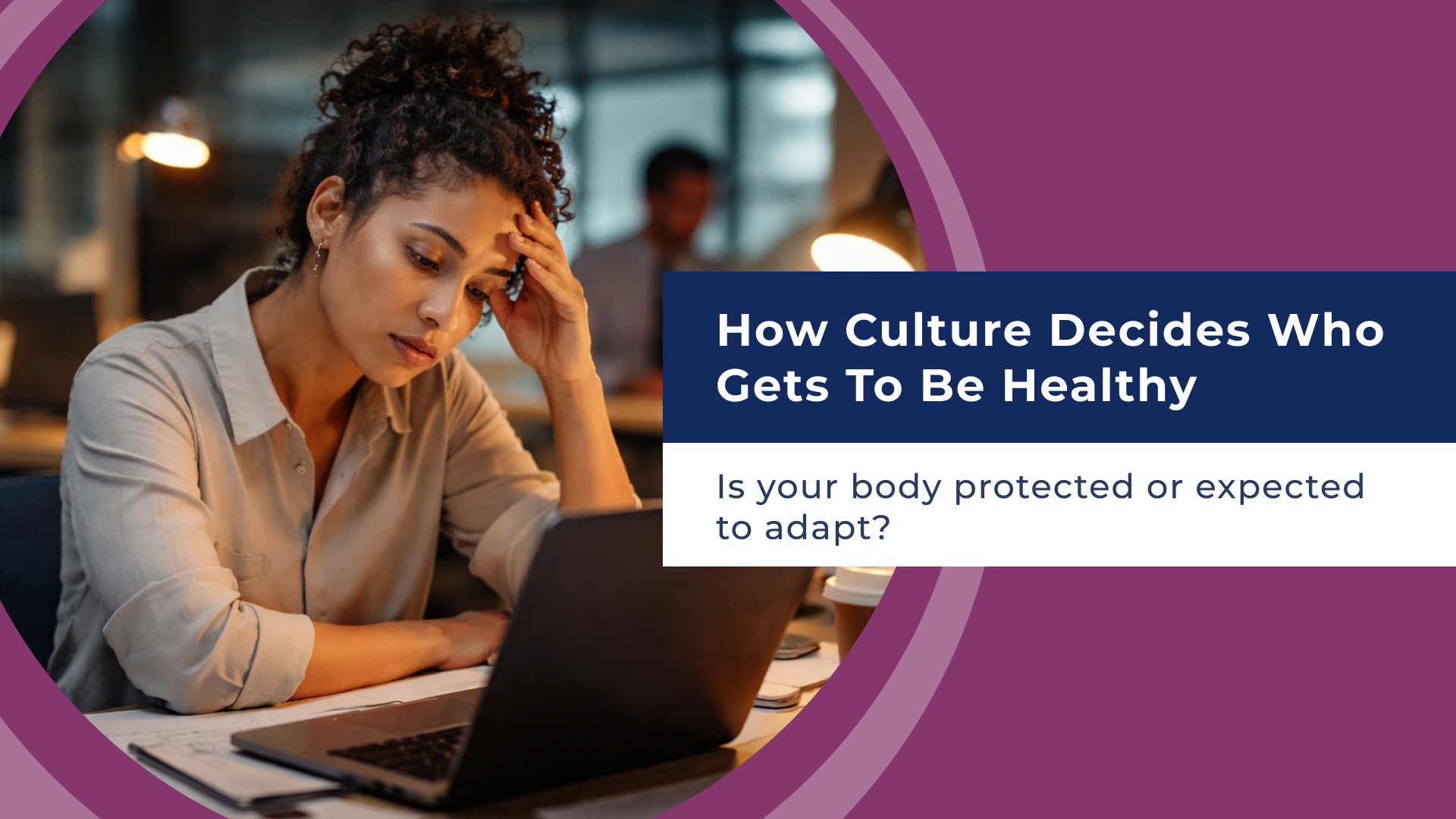
When cultures reward composure over honesty, speed over rhythm, and output over recovery, bodies comply until they cannot. Health outcomes are not randomly distributed. They cluster where adaptation is expected and protection is absent. I’ve seen this pattern in organisations that appear to be doing everything ‘right’, but inside, people are exhausted and quietly leaving.
Why good intentions don’t change outcomes
Organisations are investing more in wellbeing, inclusion, and psychological safety than ever before. And yet the lived experience often does not change. People attend wellbeing sessions and return to environments that still reward over-functioning. This is not hypocrisy. It is misalignment. Bodies do not respond to what is written. They respond to what is reinforced.
Most initiatives operate at the level of permission. Bodies respond to incentive and consequence. This is why burnout persists in organisations that are technically “doing the right things.”
On paper, people are allowed to care for themselves. In practice, systems decide when it is safe to do so.
Bodies believe the system.
Health is organised, not universal
Health is often treated as a neutral biological state, universally definable and individually achievable. In practice, it is organised.
Cultures decide:
What a healthy body should tolerate
How rest is legitimised
Whose discomfort is taken seriously
And whose is ignored
Some bodies are protected from strain. Others are expected to absorb it. Health outcomes follow this pattern. Not randomly. Systematically.
What different cultures prioritise
Some cultures organise around control. Control of time. Control of output. Control of emotion. Health becomes a matter of discipline and optimisation.
Others organise around care. Care that is assumed. Rest that is protected. Belonging that does not need to be earned. Health is relational rather than individualised, and bodies are expected to move, not punish themselves.
The difference is not knowledge. It is what is normal.
What Western culture normalises
In many modern systems, health is framed as:
a personal responsibility
a matter of willpower
a performance outcome
Bodies are expected to absorb stress quietly and remain functional. When they do not, the solution is individual correction, not systemic change.
This logic produces a predictable pattern. People override signals. They push through exhaustion. Rest only comes after collapse.
From the outside, this looks like resilience. From the inside, it feels like vigilance.
Who carries the cost
Cultural health norms do not apply evenly. Some bodies are given permission to rest, recover, or withdraw without consequence. Others are not.
Bodies shaped by:
gendered expectations of care
racialised expectations of resilience
migration histories of gratitude and compliance
roles defined by replaceability rather than protection
These bodies learn early that discomfort is negotiable, rest is conditional, and adaptation is the price of belonging.
Health reflects this.
When endurance is mistaken for health
Endurance is a short-term survival strategy.
Health is a long-term regulatory state.
Cultures that reward endurance without recovery do not build capacity and resilience. They delay collapse. Symptoms appear late, often after years of “coping.” The failure is not sudden; it is the result of accumulated cost.
When culture becomes invisible
The most powerful cultures are the ones people do not recognise as culture.
They are described as:
“just the way things are”
“professionalism”
“work ethic”
“standards”
“being realistic”
Because these norms feel neutral, bodies that struggle within them are treated as defective rather than misaligned. Health interventions then focus on fixing people rather than questioning the conditions they are adapting to. This is how cultures protect themselves at the expense of bodies.
Culture is the intervention
If culture shapes health, then no intervention that ignores culture will be sufficient.
Health improves when:
rest is protected structurally, not privately
contribution is decoupled from depletion
care is distributed rather than concentrated
belonging does not require self-erasure
These conditions cannot be downloaded or trained into existence.
They must be organised.
Why is this so hard to confront
Challenging cultural health norms threatens identity. For many leaders and organisations, productivity is not just a strategy. It is a source of self-worth. Questioning it feels destabilising. But the alternative is already destabilising bodies. Health deterioration is not a future risk. It is a present signal.
A pattern we can no longer ignore
Health is not declining because people lack discipline. It is declining because cultures demand adaptation without reciprocity. Health is selectively protected. Until cultures learn to organise care as deliberately as they organise performance, health will continue to collapse in predictable places.
What comes next
In the next article, we move into the workplace—where these cultural health contradictions play out daily. We will examine how organisations speak about care, but structurally undermine it, and how health is shaped, not in theory, but in meetings, metrics, expectations, and pace.
And the body is already responding.
Dr Jordan Marijana Alexander works at the intersection of identity, leadership, and organisational systems. She is the co-founder of RelateAble.Global.