

About this series
Who Are You Accountable To? is a six-part series exploring faith not as religion or belief, but as orientation. It examines the unspoken system that shapes how meaning, power, and responsibility are organised at work. Moving beneath purpose statements, values frameworks, and performance logic, the series explores what replaces not-knowing when certainty is demanded, how leaders justify decisions when metrics fail, and who or what ultimately becomes the reference point for action. Across age, culture, place, and history, it asks a confronting question: when outcomes are unclear and no one is watching, what are we actually answering to, and how will history read those choices?
Why these words feel dangerous
There are words that reliably disrupt professional spaces. Not because they are vague, or sentimental, but because they refuse containment. Words like God, faith, conscience, higher purpose, and history are routinely labelled inappropriate for work. Too personal. Too political. Too risky. We are told they threaten neutrality, objectivity, and psychological safety. That explanation is convenient. It is not the whole story.
These words feel dangerous because they point beyond performance, role, and incentives. They refuse to stay inside quarterly logic. They introduce accountability that cannot be managed by process or absorbed by policy. They ask who you answer to when no one can reward you. They ask what binds you when authority disappears. They ask what remains when justification runs out. That is why they unsettle rooms built on optimisation. Not because they are irrational, but because they are binding.
WHY motivates. Accountability binds. WHY asks what energises you. Accountability asks what will hold you when energy fades. WHY is aspirational. Accountability is binding. WHY survives ambiguity. Accountability is exposed by it. This difference matters most when things stop working. When plans unravel. When outcomes are unclear. When there is no obvious win. In those moments, purpose alone does not carry weight. Something deeper takes over. Orientation. Conscience. Reference points that sit beyond approval.
History is not a metaphor
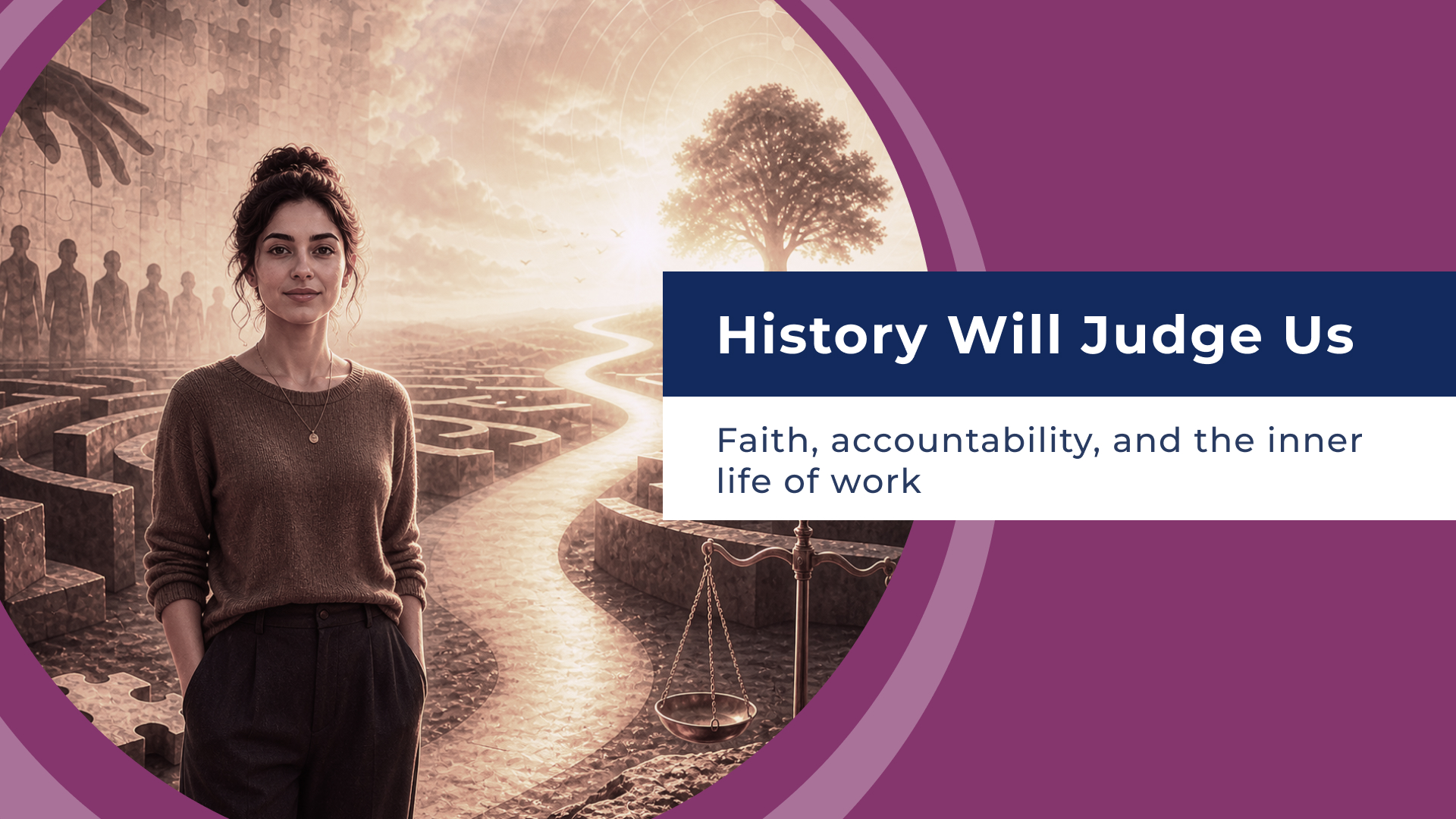
“History will judge us” is not rhetoric. It is a warning. History does not care how reasonable something seemed at the time. It does not defer to context the way organisations do. It does not excuse harm because it was efficient, legal, or widely accepted.
Colonialism was once framed as progress. Extraction was called development. Exclusion was described as order. Entire systems were built by people who believed they were acting responsibly, even virtuously, within the logic of their era. History disagreed. Not because individuals were uniquely cruel, but because the belief systems governing their decisions were never neutral. They privileged some lives, discounted others, and normalised costs that could be exported elsewhere.
History judges patterns, not intentions. It judges what was stabilised, protected, and passed on. When leaders invoke history, they are not being dramatic. They are acknowledging time as an authority that outlives titles, strategies, and reputations. That is an uncomfortable position to stand in. Which is precisely why it matters.
The lie of neutral work
Modern organisations like to imagine themselves as neutral environments. Decisions are framed as technical, data-driven, or commercially necessary. Values are described as preferences rather than commitments with consequence. This neutrality is a fiction.
Every system encodes beliefs about what matters, who matters, and what costs are acceptable. Every organisation operates with a moral architecture, whether it admits it or not. When belief is declared irrelevant at work, it does not disappear. It becomes invisible. It moves into what is rewarded without question and what is absorbed without acknowledgement. It settles into who is expected to adapt and who is protected from doing so. It hardens into norms that feel natural only because they are familiar.
Faith did not leave organisations. It went underground. And what remains unnamed begins to organise behaviour without scrutiny. It did not vanish. It relocated. It resurfaced as culture, values, leadership narrative, and unspoken codes of conduct. It reappeared in what organisations praise, tolerate, and quietly punish.
Belief systems still govern work. They are just unnamed. This is what makes them powerful. When belief operates without language, it escapes scrutiny. It presents itself as common sense, realism, or necessity. It becomes difficult to challenge without sounding naïve or disloyal. The danger is not that belief exists at work. The danger is that it operates without consent or examination.
Same human. Different accountability horizon
The same person behaves very differently depending on their accountability horizon. Short horizons produce optimisation, defensiveness, and self-protection. Long horizons produce stewardship, restraint, and responsibility across time. This is not about ethics seminars or moral superiority. It is about what you believe will outlast you.
Short horizons ask what will work now and who will notice. Long horizons ask what will still make sense later and who will bear the cost. History stretches responsibility beyond the present moment. Not everyone is willing to operate there. And not every system rewards those who do.
The violence of pretending we know
Organisations reward certainty. We forecast, model, and speak confidently about futures no one can actually predict. We confuse decisiveness with wisdom and treat hesitation as weakness. But the decisions that shape people’s lives most profoundly are often made without full information and without guarantees.
No model can calculate moral residue. No dashboard can capture the cost of normalising harm. Certainty protects authority. Not knowing demands integrity. Faith, understood broadly, is not about answers. It is about acting responsibly in the absence of them.
I often say that true leaders pick up the garbage in the parking lot when no one is watching. Not because it is efficient. Not because it will be rewarded. But because it reveals orientation. What someone does without an audience tells you far more than what they do under scrutiny. Accountability lives there. So does faith.
A quiet opening question
Before moving on, pause. Not to agree. Not to decide. Just to notice. When outcomes are unclear. When incentives disappear. When the system cannot protect you. When no one is watching. Who are you answering to? Not rhetorically. In practice. That answer is already shaping your leadership.
History will not judge our intentions. It will judge what we stabilised, what we allowed, and what we normalised. And whether we were willing to be accountable beyond the moment that rewarded us.
Dr Jordan Marijana Alexander works at the intersection of identity, leadership, and organisational systems. She is the co-founder of RelateAble.Global. If this series has surfaced questions for you as a leader, or about how to navigate similar tensions in your organisation, she welcomes thoughtful conversation and inquiry.