

Background
Throughout history, people have repeatedly mistaken disruption for transformation. Dramatic change often carries the appearance of strength. Revolutions erupt. Leaders promise decisive action. People file for divorces over a heated argument. Institutions are dismantled overnight. Policies are introduced with urgency and conviction. In the moment, these shifts can feel powerful. They appear to signal courage, determination and the will to correct injustice or failure.
Yet beneath this theatre of decisive action, a deeper question often remains unanswered. Has the system itself actually transformed, or has it merely been shocked into a new configuration of the same underlying patterns?
Human beings have a long-standing attraction to dramatic turning points. Stories of heroic revolt, sweeping reform and sudden liberation resonate deeply with our psychology. We admire the figure who promises to cut through complexity and deliver immediate change. The appeal is understandable. Slow transformation demands patience, discipline and a willingness to confront uncomfortable realities. Dramatic disruption, by contrast, offers emotional clarity. It creates villains and heroes. It promises resolution.
But systems rarely behave according to the emotional logic of narratives. Biological ecosystems, economies, institutions and cultures operate through intricate feedback loops. They evolve through gradual shifts, accumulated adaptations and structural learning. When disruption occurs without integration, the system does not necessarily transform. It often fragments.
This confusion between disruption and transformation is not confined to politics or governance. The same pattern appears in personal life, business, cultural movements and social reform. People want wealth overnight. People fall for finding their ‘soulmate’ with a swipe right on a dating app. Organisations want instant growth. Societies want immediate justice. Each time the promise of decisive correction appears, the temptation to bypass the slower discipline of transformation becomes overwhelming.
The result is a recurring cycle. Systems are shocked by dramatic interventions. Short-term outcomes are celebrated as proof of success. But unresolved structural realities soon begin to reassert themselves. When expectations fail to materialise, new narratives emerge to explain why the promise of transformation has not yet arrived.
Eventually, reality reclaims its place.
Introduction
This article examines a recurring misunderstanding that shapes personal decisions, institutional reform and civilisational change. Many forms of dramatic disruption are described as transformation. In reality, they are often expressions of chaos rather than genuine systemic transition.
Revolutions, abrupt policy shifts, externally imposed corrections and sudden social movements frequently promise decisive solutions to complex problems. They appear strong because they move quickly. They appear courageous because they break existing structures. Yet speed and disruption do not necessarily produce transformation. In many cases, they simply displace instability from one part of a system to another.
Within the Authentic Sustainability Framework and the broader Sustainabilism book, transformation is understood differently. Systems evolve through modulation. Modulation refers to the conscious and deliberate transition of a system from one state to another while preserving its structural coherence. It is neither rigid stability nor uncontrolled disruption. It is the disciplined navigation of change.
This distinction matters because the confusion between disruption and transformation has profound consequences. When societies pursue chaotic change in the name of progress, they often create new forms of suffering while believing they are correcting the past. When institutions suppress change entirely in the name of stability, they accumulate tensions that eventually erupt with far greater force.
Authentic sustainability does not emerge from either extreme. It requires the capacity to modulate systems deliberately, integrating change rather than imposing it violently or resisting it indefinitely.
The sections that follow explore why chaotic change repeatedly masquerades as transformation, how narrative and ideology sustain this illusion, and why the long-term viability of systems depends on rediscovering the discipline of modulation.
The Seduction of Decisive Change
Human beings are deeply attracted to decisive moments. Moments where something breaks, overturns or is forcefully corrected often carry the emotional signature of progress. They feel powerful. They create the impression that history has finally shifted direction.
This attraction is not confined to politics or governance. It appears everywhere in human life. The promise of overnight wealth, instant physical transformation, sudden organisational reform or rapid cultural correction all share the same emotional appeal. The faster and more dramatic the shift appears, the more convincing it can feel.
Decisive change provides psychological relief. Complexity is exhausting. Systems are messy. Causes are rarely singular and solutions rarely simple. When someone promises to act quickly and cut through complexity, many people experience a sense of clarity. Something will finally be done. A wrong will be corrected. A system will be fixed.
In this emotional atmosphere, disruption becomes easy to mistake for transformation.
The language used around these moments often reinforces the illusion. We hear calls for strong leadership, decisive intervention or necessary correction. Dramatic actions are framed as courage. Resistance to them is framed as weakness or hesitation. The urgency of the moment seems to justify the scale of the response.
Yet decisive action and systemic transformation are not the same phenomenon.
A dramatic intervention can remove a visible problem while leaving the underlying system intact. It can replace individuals without altering structures. It can change policies without transforming the assumptions that produced them. In some cases, it can even intensify the very dynamics it was meant to resolve.
This is why so many decisive moments that promise renewal eventually reproduce familiar patterns. The system has experienced disruption, but its internal architecture has not truly transformed.
The seduction of decisive change lies in its immediacy. It satisfies the human desire for visible movement. It creates the feeling that history has pivoted. But systems rarely evolve according to the emotional rhythm of decisive moments. They change through slower processes of adaptation, integration and structural learning.
When this distinction is ignored, societies and institutions repeatedly confuse forceful disruption with genuine transformation.
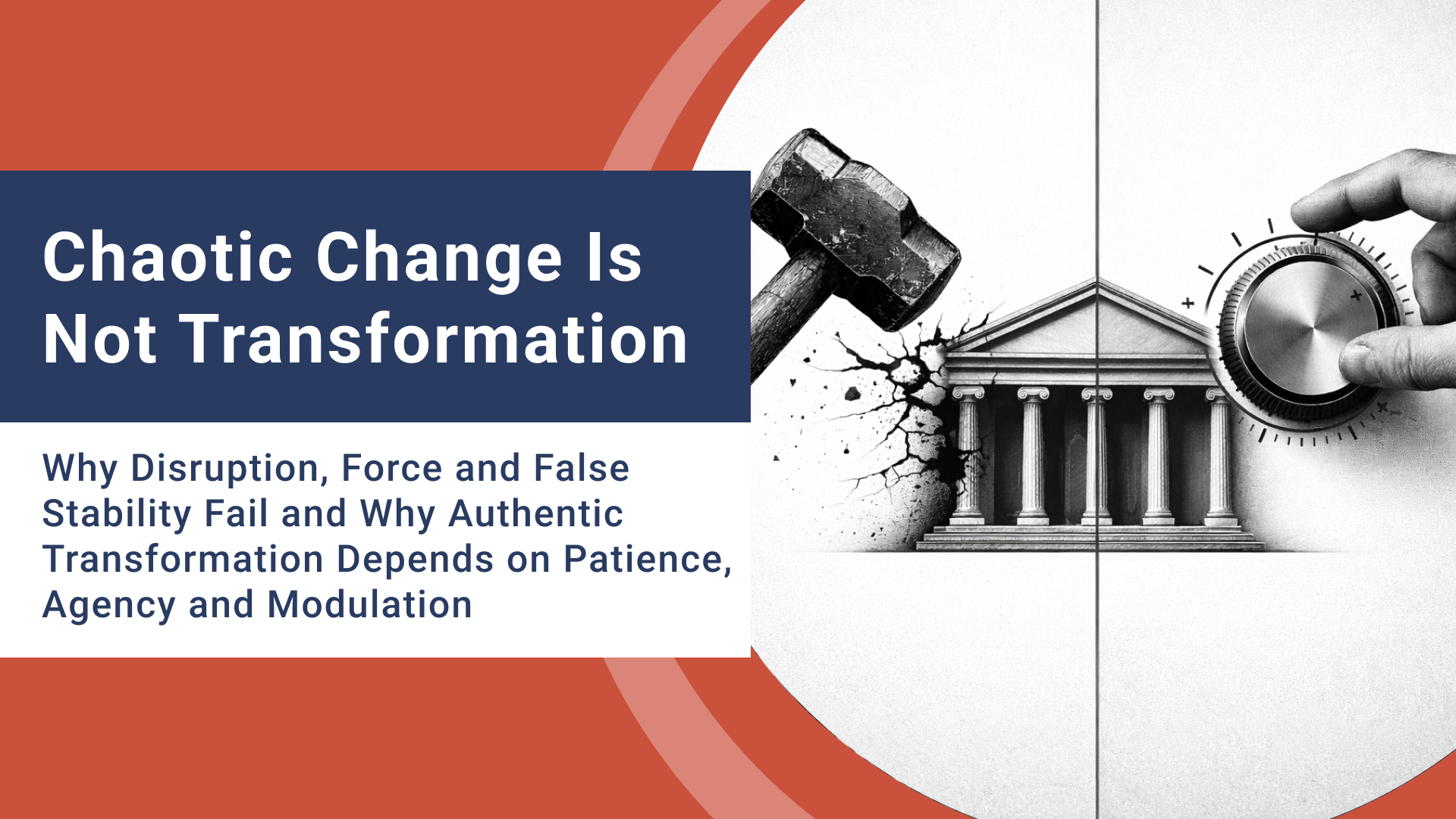
Chaotic Change Is Not Transformation
When systems are shaken by dramatic events, it is easy to believe that transformation has begun. Something visible has shifted. Institutions collapse, leaders fall, policies are overturned, movements surge. From the outside, it appears as though the old order has been replaced.
But disruption alone does not constitute transformation.
Transformation occurs when the underlying architecture of a system evolves. The relationships between its components change. Its patterns of behaviour adjust. Its assumptions and operating principles are revised and integrated into a new form of stability. In other words, transformation alters the structure of the system itself.
Chaotic change does something very different. It disturbs the surface while leaving the deeper architecture largely untouched.
In chaotic change, pressure accumulates within a system until it eventually erupts. The eruption can be dramatic. Structures may collapse. Authority may be challenged. Long-suppressed grievances may suddenly find expression. For a moment, the intensity of the disruption creates the sense that history has pivoted.
Yet after the dust settles, many of the original patterns quietly reassemble themselves. New actors step into old roles. Old assumptions continue to shape decisions. Institutional habits reappear under new language. The system has experienced turbulence but not structural transformation.
This pattern appears across many domains of life.
Individuals attempt radical lifestyle changes after years of neglect, only to find themselves returning to familiar habits once the initial intensity fades. Organisations announce sweeping reforms that alter charts and policies while leaving the underlying culture untouched. Societies experience dramatic upheavals that promise renewal but gradually reproduce the same structural tensions that existed before the rupture.
Chaotic change feels powerful because it is visible and immediate. Transformation is often slower and less dramatic because it requires the gradual reconfiguration of systems that have developed over long periods of time.
This distinction is critical. When disruption is mistaken for transformation, societies repeatedly pursue dramatic interventions in the hope that intensity alone will produce structural change. The result is a cycle of upheaval followed by disappointment, followed by another attempt at dramatic correction.
Without understanding the difference between chaotic change and genuine transformation, systems remain trapped in recurring cycles of instability rather than evolving toward sustainable forms of development.
The Illusion of Surgical Solutions
Once disruption is mistaken for transformation, another powerful illusion quickly follows. The belief emerges that complex systems can be corrected through precise and forceful interventions. Problems are framed as isolated faults that can be removed, replaced or overridden.
This belief creates the idea of surgical solutions.
If a system is failing, remove the leader. If an institution is corrupt, dismantle it. If a culture is flawed, replace its values. If a society is dysfunctional, impose a new order. If a partner is not compassionate enough in an intimate relationship, break up. If an employee is not performing well enough, fire them immediately. In this framing, the problem appears localised and the solution appears decisive.
The appeal of this approach is obvious. It promises speed. It promises clarity. It allows people to believe that complex realities can be corrected through a well-targeted act of intervention.
Yet complex systems rarely operate in such a linear manner.
Social systems, political systems, cultures and economies are not machines assembled from interchangeable parts. They are living networks of relationships, assumptions, behaviours and historical trajectories. Each visible element is connected to a web of underlying structures that have evolved over time.
When a surgical intervention is applied to such a system, the visible node may indeed change. A leader may fall. An institution may be dissolved. A policy may be overturned. But the deeper structures that produced those outcomes often remain intact.
These deeper structures then begin to reorganise themselves. New actors occupy the same structural positions. Familiar patterns of behaviour reappear under different language. The system stabilises again, often reproducing many of the same dynamics that existed before the intervention.
This is why attempts to impose rapid correction on complex systems frequently produce outcomes that diverge sharply from their original promises. The intervention targets a symptom rather than the architecture that generated it.
The illusion of surgical solutions persists because early moments of disruption create the impression that decisive progress has been made. The visible change is real. But visible change is not the same as structural transformation.
Over time, the gap between expectation and reality begins to widen. What was promised as renewal gradually reveals itself as a rearrangement of familiar patterns.
When societies repeatedly rely on surgical interventions to correct systemic problems, they often enter a cycle of disruption followed by reconfiguration rather than a path toward genuine transformation.
When Emotional Narratives Replace Structural Reality
When chaotic change fails to produce the transformation it promised, systems face a difficult moment of recognition. Expectations have been raised. Sacrifices have often been made. The belief that a decisive intervention would correct the problem has already shaped public imagination.
Yet the underlying structures remain largely unchanged.
At this point, a tension begins to emerge between expectation and reality. The outcomes that were promised do not fully materialise. Problems that were expected to disappear continue to surface. New complications appear alongside the old ones.
Rather than confronting the structural limits of the intervention, systems often respond by strengthening the narratives that justified it.
Narratives begin to fill the growing gap between promise and outcome. The disruption is reframed as a heroic struggle. Setbacks are interpreted as temporary obstacles. Suffering becomes proof of commitment. Sacrifice becomes evidence that the cause was noble and necessary.
The story grows stronger precisely because reality has not yet aligned with expectation.
This dynamic is familiar across many domains of human life. Individuals who pursue extreme solutions often reinterpret early difficulties as proof that they must push harder. Organisations that invest heavily in a strategy may double down when evidence suggests it is not producing the expected results. Societies that experience dramatic upheaval may reinterpret ongoing instability as the price that must be paid for a better future.
The narrative protects the original promise from the corrective force of reality.
Over time, these narratives can become deeply embedded in collective consciousness. They create a framework through which events are interpreted, often preventing a more sober examination of structural conditions. Evidence that contradicts the narrative is dismissed, reframed or postponed.
Yet systems cannot indefinitely sustain narratives that diverge from reality.
Eventually, structural dynamics reassert themselves. Economic constraints emerge. Institutional limitations appear. Social tensions return. The forces that were temporarily suppressed by the emotional momentum of disruption begin to reshape the system once again.
When narratives are used to defend chaotic change rather than examine its limits, societies often delay the learning required for genuine transformation. The emotional story may sustain belief for a time, but the underlying architecture of reality continues to operate according to its own laws.
Reality Cannot Be Negotiated With
At some point, every system encounters the same boundary. Reality does not adjust itself to human narratives.
Ideas, beliefs and political convictions can influence how people interpret the world, but they cannot suspend the underlying dynamics through which systems operate. Biological limits, ecological constraints, economic relationships and social structures continue to respond according to their own internal logic.
When chaotic change is pursued in the belief that intensity alone can reshape reality, systems eventually confront this boundary.
This confrontation is often uncomfortable because it reveals the limits of conviction. A movement may believe deeply in its cause. Leaders may speak with absolute certainty. Sacrifice may be framed as proof that a new order is emerging. Yet none of these elements alter the structural forces that shape outcomes.
Reality remains indifferent to belief.
Economic systems respond to incentives, productivity and distribution regardless of ideological declarations. Social systems respond to trust, legitimacy and shared norms regardless of imposed authority. Ecological systems respond to physical laws regardless of political ambition.
Attempts to override these dynamics through forceful intervention frequently produce consequences that were not anticipated by those initiating the change. Efforts to control outcomes often generate new forms of instability elsewhere in the system.
This is not because the intentions behind the change were necessarily malicious. In many cases, the intentions were driven by genuine frustration with existing problems. But frustration does not alter the structure of reality.
The deeper issue is a form of systemic arrogance. It is the belief that human determination alone can impose a desired outcome on complex systems without first understanding the architecture through which those systems function.
When this assumption proves false, the consequences can be severe. Resources are exhausted. Institutions lose legitimacy. Social trust deteriorates. The promised transformation fails to materialise, leaving behind a landscape shaped by both the original dysfunction and the disruption that attempted to correct it.
Reality eventually restores equilibrium, but the path back to stability is often far more costly than the slow discipline of transformation would have been.
Recognising that reality cannot be negotiated with is therefore not a pessimistic conclusion. It is the starting point for a more grounded understanding of how genuine transformation becomes possible.
The Pattern of Shadows, Misery, Suffering and Entrenchment
When chaotic change repeatedly collides with the structural limits of reality, systems begin to exhibit a deeper pattern. What initially appeared as a bold attempt to correct dysfunction gradually gives rise to new layers of instability. Over time, these layers accumulate and reinforce one another.
Within the broader discourse of Sustainabilism, this process can be understood through a recurring sequence that begins in the shadows of human behaviour and gradually manifests as systemic breakdown.
Shadows are the unexamined distortions within individuals and collectives. They appear as arrogance, impatience, resentment, ideological rigidity, or the desire for dominance and quick correction. These impulses often emerge in response to genuine grievances. Yet when they remain unexamined, they shape decisions in ways that distort reality rather than engage with it.
From these shadows arises misery. Misery is not simply material hardship. It is the condition that emerges when systems fail to generate meaning, trust, fairness and functional coherence. When institutions lose credibility, when economic structures fail to create dignity, and when social narratives fracture collective understanding, misery begins to spread through the system.
Misery then deepens into suffering. Suffering appears when instability becomes normalised and the consequences of dysfunction begin to affect the everyday lives of people within the system. Social fragmentation increases. Economic volatility intensifies. Trust erodes. The promises that once mobilised collective energy begin to feel hollow.
At this stage, systems often become entrenched rather than transformed.
Entrenchment occurs when institutions and actors attempt to preserve their position by reinforcing the very structures that produced the dysfunction. Instead of confronting underlying causes, systems double down on existing narratives, policies or power structures. Efforts to maintain control intensify, even as the conditions that generated instability remain unresolved.
The result is a dangerous feedback loop. Shadows produce misery. Misery deepens into suffering. Suffering encourages further entrenchment. Entrenchment prevents the structural learning required for transformation.
Over time, the system becomes increasingly rigid while simultaneously becoming more fragile. The capacity for genuine adaptation declines. The distance between narrative and reality widens. When such conditions persist, the risk of systemic disintegration begins to grow.
Understanding this pattern is essential because it reveals that chaotic change rarely resolves the deeper dynamics that produce instability. In many cases, it intensifies them. Without confronting the shadows that shape collective behaviour, disruption merely reshuffles the surface while the deeper cycle continues to unfold.
Why Shortcuts Are So Attractive
If chaotic change repeatedly fails to produce genuine transformation, an obvious question emerges. Why do individuals, organisations and societies continue to pursue it?
The answer lies partly in human psychology. Transformation requires patience, discipline and the willingness to confront uncomfortable truths about how systems actually function. It requires gradual learning, structural adjustments and the humility to recognise that complex realities cannot be corrected instantly.
Shortcuts promise something far more appealing. They promise relief from the slow work of transformation.
Across many domains of life, people are drawn to the possibility that a decisive move can bypass the difficult stages of development. Someone wants to become wealthy without building long-term value. An organisation wants rapid growth without cultivating capability. A person wants to transform their health overnight after years of neglect. A society wants to resolve deep cultural tensions through a single political moment.
The attraction is understandable. Gradual change rarely generates excitement. It does not produce dramatic headlines or heroic narratives. It often appears modest and incremental when compared to the spectacle of disruption.
When a person attempts to transform their health through extreme measures, the body often returns to its previous state once the intensity fades. When a business pursues rapid expansion without building internal capacity, early success can collapse under the weight of structural weakness. When societies attempt to impose rapid corrections on complex cultural and institutional systems, the resulting instability frequently produces new tensions rather than resolving the old ones.
Shortcuts create the illusion that the long path of development can be bypassed. In reality, they often postpone the very work that transformation requires.
The deeper problem is that shortcuts tend to amplify the same dynamics that created the original dysfunction. Impatience leads to forceful intervention. Forceful intervention produces unintended consequences. Those consequences then provoke further attempts at decisive correction.
Instead of moving toward transformation, systems become trapped in cycles of reaction.
Recognising the seductive power of shortcuts is therefore essential. Without this awareness, individuals and societies repeatedly pursue solutions that promise speed but undermine the structural learning required for genuine change.
er than to learn from emerging conditions.
In the short term, this approach can produce the appearance of stability. Order is restored. Behaviour is regulated. The system appears to function again.
Yet beneath this surface, the underlying tensions remain unresolved.
Because ensurance restricts adaptation, the system gradually loses the flexibility required to respond to changing realities. Small distortions accumulate. Feedback loops weaken. Institutional responses become increasingly rigid even as the environment surrounding the system continues to evolve.
Eventually, the very mechanisms that were designed to guarantee stability begin to undermine it.
Sustainability does not arise from forcing a system to remain unchanged. It arises from maintaining the capacity to adjust while preserving structural coherence. Systems that survive over long periods do not ensure their future through control alone. They cultivate the ability to adapt intelligently to the conditions they encounter.
When ensurance replaces adaptation, the system may appear stable for a time, but its long-term resilience quietly deteriorates.
When Impatience Masquerades as Justification
The discussion about shortcuts often produces a familiar response. When gradual transformation is proposed, some individuals or groups insist that they have already been patient. They argue that every reasonable path has been tried, every effort has been exhausted and that gradual approaches have failed. From this position, the conclusion appears obvious. If patience did not work, then only decisive disruption remains.
This reasoning is emotionally persuasive, but it is frequently incorrect.
In many cases, what is described as patience was not patience at all. It was inactivity. People waited without acting and called it patience. Others repeated the same ineffective approach over and over again and called it persistence. When frustration accumulated, they concluded that the system itself had exhausted all possibilities.
In reality, they had not exhausted possibilities. They had exhausted a limited set of ineffective responses.
To understand why this happens, we must distinguish patience from passivity, persistence from stubbornness (or insistence) and engagement with reality from reaction against it.
Persistence and Patience
To understand this confusion more clearly, it is helpful to revisit a distinction explored in my earlier book Being. The relationship between patience and persistence is frequently misunderstood. Many people interpret patience as passive waiting, or persistence as stubborn repetition. In reality, both require an active and disciplined engagement with reality. The following excerpt from Being clarifies this distinction and illustrates why genuine persistence is inseparable from a healthy relationship with patience.
Persistence and patience As mentioned, one of the prerequisites to being persistent is a healthy relationship with patience. The root of the word 'patience' comes from the Latin Patientia: patient ('suffering'). Persistence demands patience and is when you can be with suffering for the duration. This should not be confused with being oppressed or under unnecessary and avoidable pressure. It's also not about passively waiting for a miracle to happen. In fact, it's the opposite. Persistence is when you have the stamina, determination, freedom, courage, willingness, capability and capacity to not give up during the journey while repeating or trying alternative ways to finally resolve a matter. Even when you fail, persistence is about returning to the drawing board and trying again. A persistent individual lives life from the viewpoint that failure is only a temporary state and an inevitable part of achieving any goal. Therefore, they are confident that by going through several iterations of application, execution, exercise, practice or rounds of refinements, the objective will finally be reached. Their conception of acquiring things or reaching goals is that they will eventually get there, as long as they go for it and don't give up. Let's say you are a computer programmer and are tasked with implementing a new algorithm. You try the first option that comes to mind but it doesn't work, so you try a second option, but that too is unsuccessful. It is not uncommon to have to make several attempts before you finally succeed. It's an iterative process that involves going through a cycle of: Execute -> Track -> Learn -> Refine -> Execute again. This is a simple yet crucial process that is not limited to computer programmers. It is also required by engineers, inventors, athletes, martial artists, students, entrepreneurs and leaders. We will examine this process in Part 3: Being, in Action, Chapter 2, Transformation Methodology. (Tashvir, 2021)
This passage highlights a critical point. Persistence is not passive endurance and it is not stubborn repetition. It is active engagement with reality through iteration, learning and adaptation.
Yet patience itself also requires deeper understanding.
Before examining the misunderstandings around patience and persistence, it is helpful to look at a simple pattern that often shapes how individuals and societies engage with transformation. When people believe that all options have been exhausted, the underlying issue is rarely the absence of possibilities. More often, it is a breakdown in a set of capacities that allow individuals and systems to navigate change over time.
The following simplified model highlights five qualities that determine whether transformation unfolds coherently or collapses into reaction: patience, freedom, responsibility, proactivity and persistence. When these qualities are aligned, systems are able to gradually transform. When they deteriorate, impatience begins to masquerade as justification for chaotic change.
What is often missing in these situations is not patience alone, but a set of interconnected capacities that determine how individuals and societies engage with reality over time. When these capacities weaken or become distorted, people begin to interpret their own ineffective engagement with reality as proof that only disruption can produce change.

To clarify this dynamic, we can examine the relationship between five qualities that shape how transformation unfolds: patience, freedom, responsibility, proactivity and persistence. When these qualities are healthy and integrated, individuals and systems are capable of navigating complexity and gradually transforming the conditions they inhabit. When they become distorted, impatience begins to masquerade as justification for reactionary action.
Together, these five qualities form a small but powerful pattern that explains why people often conclude that all options have been exhausted when, in fact, the deeper work of transformation has not yet been fully engaged.
Patience: Regulating Action Through Time
Transformation unfolds through time. Complex systems do not change instantly. Cultural norms, institutions, economies and social trust evolve through gradual adjustments and learning processes. Patience, therefore, plays a foundational role in any genuine transformation.
When patience is present, individuals and societies are able to remain present with uncertainty, incompletion and tension without rushing prematurely toward resolution. Patience allows truth to emerge through dialogue, experimentation and refinement rather than being forced through impulsive action.
When patience deteriorates, two distortions tend to appear. On one side, patience collapses into passivity. People withdraw from engagement and wait for circumstances to change on their own. On the other side, patience collapses into impatience, where individuals attempt to force outcomes prematurely in the belief that speed alone will produce transformation.
Both distortions undermine transformation. Passivity postpones engagement, while impatience produces chaotic disruption that often destabilises systems without resolving their underlying dynamics.
Authentic Sustainability Framework: Ontological Distinction of Patience
Patience is your capacity to remain present with discomfort, uncertainty and incompletion without collapsing into reaction, avoidance or coercion. It is not the absence of action – it is the modulation of action through time. Patience does not delay for the sake of delay. It allows coherence to surface without force and truth to emerge in its own rhythm. It is a posture of steadiness that makes sustainability possible across personal, relational and systemic domains – ensuring that what unfolds is not rushed, distorted or prematurely abandoned.
A healthy relationship with patience indicates that you can be with tension, ambiguity or incompletion without rushing to fix it or flee. You are able to regulate impulse, allow trust to unfold and discern the timing of action. Others experience you as open, grounded and ethically restrained. Your patience creates environments where truth, growth and restoration can occur without manipulation or collapse – making healing, innovation and maturity sustainable over time. In wider systems, patience manifests as collectives that resist the pull of short-term gain in favour of long-term trust, as communities that allow dialogue to mature rather than forcing premature resolution, and as societies that give reform the time to take root rather than collapsing into reactionary cycles.
An unhealthy relationship with patience may show up as passivity, avoidance or enabling dysfunction. You may appear calm, but inwardly collapse under pressure or quietly disengage. You may delay necessary decisions under the guise of ‘holding space’ when you are actually deferring accountability. At the other extreme, you may abandon patience altogether – rushing decisions, forcing outcomes or prematurely discarding what needed more time to mature. In all these cases, others experience you as absent, unreliable or reactive – not because you lack concern, but because your posture is incoherent. This kind of patience is unsustainable: for you, for others and for the systems you inhabit.
Freedom: Recognising That Options Exist
Even when patience is present, transformation cannot occur if individuals believe they have no options. When people experience themselves as trapped, powerless or constrained beyond possibility, they begin to interpret disruption as the only available form of change.
Freedom in this context does not mean the absence of constraints. Human life always unfolds within limits. Social structures, economic conditions and historical realities shape the range of available actions.
Freedom instead refers to the capacity to recognise and generate options within those constraints. It is the ability to see possibilities where others see only obstacles. When individuals possess this capacity, they are able to create new pathways even within restrictive circumstances.
When the relationship with freedom deteriorates, individuals begin to experience themselves as stuck. They either resign themselves to passivity or seek liberation through dramatic rupture. In both cases, the perception of being trapped replaces the disciplined search for viable alternatives.
Being Framework Ontological Distinction of Freedom
Freedom is living life from the viewpoint that you always have options. It is your capacity to choose to be, do, say, feel and think whatever you wish without being controlled, coerced, constrained or limited by unwanted external forces while simultaneously accepting any subsequent consequences of your words or actions. You acknowledge that you have the choice to act despite constraints imposed on you while accepting that there are limitations associated with the reality of being a human being.
A healthy relationship with freedom indicates that you see options and possibilities available to you and can create opportunities when the need arises. When you are being free, you are not at the mercy of manipulative or distorting forces. Others may experience you as someone who chooses not to be restrained by situations or challenges imposed on them and communicates openly without constraint. You may actively consider self-discipline and self-imposed restrictions to prioritise what you most care about. When you have a healthy relationship with freedom, you refuse to succumb easily to the manipulation or domination of others.
An unhealthy relationship with freedom indicates that you often experience being held back and suppressed in the face of circumstances in your life due to a lack of options and may feel trapped or coerced. Others may experience that you withhold and are limited in what you can accomplish, contribute and communicate. You may wait for opportunities to be created and offered to you by others or miraculously land in your lap. You may often feel resigned and disarmed and frequently give in to others or external forces. You may feel imprisoned, stuck or frozen by your inner desires, shackled by dysfunctional habits. Alternatively, you may see and consider too many options, which often leads to paralysis. Avoiding self-imposed routines and disciplines may cause you to lack the momentum required to make progress.
Reference: Tashvir, A. (2021). BEING (p. 295). Engenesis Publications.
Responsibility: Becoming an Active Agent
Even when options exist, transformation cannot occur if individuals refuse to see themselves as agents within the system. Responsibility, therefore, determines whether people engage reality actively or position themselves as passive victims of circumstances.
Responsibility does not mean that individuals are the sole cause of every condition they encounter. Many constraints originate beyond personal control. However, responsibility determines whether individuals choose to respond intentionally to those conditions or merely react against them.
When responsibility is healthy, individuals recognise that they possess the capacity to influence outcomes within the boundaries of reality. They become active participants in shaping the future rather than passive observers of events.
When responsibility collapses, two distortions appear. On one side, individuals experience themselves as powerless victims. On the other side, they attempt to exert control over everything, believing that sheer force can override complex realities. Both distortions undermine transformation. Victimhood paralyses action, while control produces chaotic attempts to force change without understanding the system.
Being Framework Ontological Distinction of Responsibility
Responsibility is being the primary cause of the matters in your life, regardless of their source. It is the extent to which you choose to respond rather than react to them. Responsibility is distinguished by how you honour the autonomy that you have as a human being and is considered the power to influence the affairs, outcomes and consequences you are faced with. Responsibility is not about blaming or determining whose fault it is. Instead, it is to intentionally choose, own, cause and bring about outcomes that matter, work and produce results while also being answerable for the impact and consequences.
A healthy relationship with responsibility indicates that you have the power to influence the circumstances you find yourself in and/or cause. Others may consider you capable of appropriately responding to matters, which is a prerequisite to producing and bringing to fruition effective results. You fully accept ownership of both outcomes and consequences and have the capacity to make informed, uncoerced decisions. You are unquestionably the active agent in your life.
An unhealthy relationship with responsibility indicates that you may often be stuck, experience a loss of power, and are a victim of circumstances. You frequently experience being disarmed, as though you have no choice in influencing outcomes and there is an inevitability about your future. You may be inclined to self sabotage and make repetitive complaints without seeking, putting forward and implementing solutions. You frequently make excuses for your lack of accomplishments while abdicating or avoiding consequences. You may be considered ineffective in consistently fulfilling the promises you make and producing intended results. You are a passive victim in your life. Alternatively, you may live life from the viewpoint of being the sole cause of matters and exert your will onto your surroundings and others or be over-responsible and attempt to control all matters all the time. You may also expect that matters should always go your way.
Reference: Tashvir, A. (2021). BEING (p. 277). Engenesis Publications.
Proactivity: Engaging Reality Before Breakdown
Even when individuals recognise options and accept responsibility, transformation requires engagement. Proactivity determines whether people act early in response to emerging conditions or wait until breakdown forces a reaction.
When proactivity is present, individuals anticipate challenges, initiate conversations and experiment with solutions before crises escalate. This allows transformation to unfold gradually through learning and adaptation.
When proactivity deteriorates, inactivity often disguises itself as patience. People delay action, avoid difficult conversations or wait for perfect conditions before acting. Eventually, pressures accumulate until the system reaches a breaking point. At that stage, the response tends to be reactive rather than deliberate.
Reactive action frequently appears decisive, but it rarely produces sustainable transformation. It is the consequence of delayed engagement rather than disciplined intervention.
Being Framework Ontological Distinction of Proactivity
Proactivity is the quality of actively influencing, creating and contributing to a situation rather than reacting to it after it has happened. Being proactive moves you to think, plan and act in advance of an impending situation, making decisions and taking appropriate actions beforehand rather than procrastinating or waiting for the outcome. When you are being proactive, you make things happen and take the initiative to bring about a different future for yourself, your team or the organisation as a whole. Proactive individuals are willing to challenge, make suggestions and try new ways of doing things to bring about relevant change.
A healthy relationship with proactivity indicates that you tend to take the initiative to move things forward and bring about change. You are solution-oriented and actively seek opportunities to advance in any situation. Others may experience you as someone who is considered, frequently contributes, asks questions, takes action and will step up without hesitation. You may often anticipate what is needed in advance, respond rather than react to matters, and are prepared and willing to do what is required.
An unhealthy relationship with proactivity indicates that you may be unreasonably inactive or reactive. You may rely on waiting to be told what to do and procrastinate until you have everything at hand. You may only take prescribed actions and rarely plan effectively. You may often be indecisive and inactive, ignoring what you know needs to be done, leaving yourself exposed to potential breakdowns. Alternatively, you may only address matters when there is a breakdown and then react to the subsequent undesirable outcome. You may frequently be on the back foot, avoid change and defer making decisions. Others may express frustration at your apparent disinterest, lack of engagement, inaction, reactivity or your need to be fully convinced before you move forward.
Reference: Tashvir, A. (2021). BEING (p. 488). Engenesis Publications.
Persistence: Staying the Course Without Stubbornness
Even when individuals engage reality proactively, transformation still requires sustained effort. Persistence determines whether individuals remain committed to the process of transformation when difficulties inevitably arise.
Healthy persistence recognises that failure and refinement are part of progress. It allows individuals to stay the course while adjusting methods in response to feedback from reality.
When persistence deteriorates, effort tends to swing between two extremes. On one side, individuals become inconsistent, abandoning their efforts as soon as obstacles appear. On the other side, they become insistent, repeating the same ineffective approach stubbornly without learning from experience.
Neither extreme produces transformation. Inconsistency prevents progress, while insistence traps individuals in cycles of failure.
Being Framework Ontological Distinction of Persistence
Being persistent is living life from the viewpoint that you are to persevere, stay the course and not give up despite difficulties, challenges and setbacks. Persistence is a quality that determines your success in many areas of life, as intelligence and skill alone are insufficient to overcome the obstacles and challenges you face. Persistence leads to accomplishment and is the access to greater fulfilment and satisfaction in overcoming life’s challenges.
A healthy relationship with persistence indicates that you are tenacious and refuse to give up easily, especially in challenging situations. You stay on task, even when facing formidable or daunting circumstances. Others may know you to be determined, resolute, and someone who will follow through and remain focused on achieving outcomes you are committed to.
An unhealthy relationship with persistence indicates that you may be unreasonably inconsistent or insistent. You may be easily distracted, wavering, unsteady and discouraged by setbacks and may question your original decisions and lose heart. You may have many unfinished tasks and projects that you are unlikely to complete and justify yourself with excuses. Alternatively, you may be overly insistent – stubborn and dogged to the point of belligerence. You may rise to face the same obstacle time and again while refusing to consider alternatives. Others are less likely to believe that you will stay the course, and you may frequently procrastinate, become despondent, give up or change direction.
Reference: Tashvir, A. (2021). BEING (p. 505). Engenesis Publications.
When the Five Qualities Collapse
When patience, freedom, responsibility, proactivity and persistence are weakened or distorted, individuals and societies often convince themselves that they have exhausted all possible paths forward.
In reality, they have not exhausted possibilities. They have exhausted a limited set of ineffective responses shaped by distorted relationships with these five qualities.
At that point, impatience begins to masquerade as justification. Reactionary disruption appears courageous and decisive when in fact it is simply the final stage of ineffective engagement with reality.
True transformation demands something far more disciplined. It requires the patience to remain present with complexity, the freedom to recognise options, the responsibility to act as an agent within constraints, the proactivity to engage reality early and the persistence to continue refining action over time.
Without these capacities, impatience replaces reflection and chaotic change once again masquerades as transformation.
Recognising the Limits of Transformation
A clarification is necessary at this point.
The argument presented here should not be misunderstood as an invitation to remain indefinitely within systems that have reached the limits of transformation.
Not every system can be transformed.
Some systems accumulate distortions to such a degree that the structural conditions required for transformation no longer exist. Institutions may become incapable of reform. Cultural norms may harden into rigid ideological structures. Leadership may become so detached from reality that meaningful feedback cannot penetrate the system. In such cases, the possibilities for transformation gradually diminish.
Recognising this reality is not a contradiction of the argument presented in this article. It is an extension of it.
Transformation depends on certain capacities. Systems must be able to receive feedback, integrate learning, adjust structures and respond to emerging conditions. When these capacities disappear, transformation becomes increasingly difficult. At that point, individuals and communities may face a different kind of decision.
The question shifts from how to transform the system to whether the system itself has reached the limits of transformation.
This distinction matters because the absence of transformation does not automatically justify chaotic disruption. When frustration reaches its peak, people often leap directly from disappointment to reaction. They conclude that if gradual change has not succeeded, then only rupture remains.
But the choice is rarely limited to passivity or chaos.
Sometimes the more intelligent response is strategic disengagement, parallel development or the creation of alternative structures rather than the violent attempt to force transformation within a system that cannot evolve.
In another article titled When to Give Up at the Limits of Transformation, I explore this boundary in greater depth. The discussion there examines how individuals and societies can recognise when systems have reached the point where continued effort inside the existing structure is no longer productive.
Even in those situations, however, the lesson remains consistent with the argument presented here. What replaces a failing system cannot be built through chaos alone. New structures still require the same capacities described earlier in this article: patience, freedom, responsibility, proactivity and persistence.
Without these capacities, disruption merely replaces one dysfunctional structure with another.
Recognising the limits of transformation is therefore not an argument for resignation. It is an argument for clarity. It allows individuals and societies to distinguish between systems that can still evolve and those that must eventually give way to new structures built with greater awareness.
Transformation requires discipline.
But so does the wisdom to recognise when transformation within a particular structure has reached its limits.
There is also another important clarification. The disintegration of a system is not inherently a negative phenomenon. In certain contexts, collapse becomes the natural consequence of a system that has exhausted its capacity for renewal. Structures that can no longer learn, adapt or integrate feedback eventually lose the coherence required to sustain themselves. When this occurs, disintegration can open space for renewal and regeneration. Throughout history, new cultural, institutional and economic forms have often emerged from the decline of structures that had become incapable of transformation. The key question, however, is always contextual. Collapse that emerges organically from the limits of a system is very different from collapse imposed through external force or chaotic intervention. The former can create the conditions for renewal. The latter often replaces one instability with another. Understanding this distinction is essential if societies are to recognise when a system should be allowed to evolve beyond its current form and when disruption merely deepens the very suffering it claims to resolve.
False Stability Is Also Not Sustainability
If one extreme is the attempt to guarantee stability through forceful control, the opposite extreme is the attempt to preserve stability by resisting change altogether. In this case, systems do not try to ensure outcomes through tight control. Instead, they attempt to maintain the appearance of order by suppressing signals that indicate deeper structural problems.
This creates what can be called false stability.
False stability emerges when institutions, leaders or societies become more concerned with preserving the image of normality than with addressing the conditions that are quietly undermining the system. Problems are minimised, postponed or reframed as temporary disturbances. Structural weaknesses are acknowledged privately but rarely confronted openly.
For a time, this approach can appear effective. The system continues to operate. Daily life proceeds. Institutions maintain their authority and routines remain intact. To many observers, it may even appear that stability has been preserved.
But the stability is only superficial.
Because the underlying issues remain unresolved, pressure gradually accumulates beneath the surface. Economic distortions intensify. Institutional trust erodes. Cultural tensions deepen. The gap between public narratives and lived reality slowly widens.
False stability delays transformation rather than preventing disruption.
By suppressing early signals of imbalance, systems often lose the opportunity to adapt gradually. Problems that might have been addressed through careful adjustment become more severe over time. When the accumulated pressure finally breaks through, the resulting disruption is often far more intense than the gradual transformation that could have occurred earlier.
This is why the appearance of stability can be deceptive. A system that looks calm on the surface may in fact be losing its capacity to adapt. The absence of visible conflict does not necessarily indicate health. In some cases, it indicates that important signals are being ignored.
Sustainability, therefore, requires more than maintaining order. It requires the ability to recognise emerging tensions and respond to them before they escalate into crisis.
When systems cling to false stability, they postpone transformation until disruption becomes unavoidable. At that point, the opportunity for gradual adaptation has already been lost.
The Missing Principle: Modulation
If chaotic disruption is not transformation, and if neither rigid control nor false stability produces sustainability, then a deeper principle is required to understand how systems actually evolve. That principle is modulation.
Modulation refers to the conscious and deliberate adjustment of a system’s overall state while preserving its structural coherence. It is neither abrupt rupture nor rigid preservation. It is the disciplined navigation of change.
Every viable system modulates. Biological organisms continuously adjust their internal processes in response to environmental conditions. Ecosystems adapt through shifting balances between species and resources. Economies evolve through cycles of innovation, correction and reorganisation. Cultural systems gradually reinterpret traditions while maintaining continuity with their past.
These transitions rarely occur through violent correction or sudden imposition. They occur through ongoing adjustments that allow the system to respond to new realities without collapsing its underlying architecture.
Modulation requires awareness of the system as a whole. Instead of targeting isolated symptoms, it recognises the relationships between structures, behaviours and feedback loops. When pressure emerges in one part of the system, modulation adjusts other elements in order to restore balance and viability.
This process demands patience and humility. Because complex systems contain many interdependent components, meaningful change often unfolds gradually. Each adjustment creates new information that must be integrated before the next step is taken.
In contrast, chaotic change attempts to bypass this process. It seeks to impose a new state immediately without allowing the system to learn and adapt along the way. The result is often instability, because the deeper relationships that hold the system together have not been recalibrated.
Modulation, therefore, represents a fundamentally different approach to transformation. It recognises that durable change emerges from the integration of adjustments over time rather than from the shock of disruption.
Within the broader discourse of sustainability, modulation becomes essential. Systems remain viable not by freezing themselves in a fixed state and not by repeatedly shattering their structures in moments of upheaval. They remain viable by learning how to transition deliberately from one configuration to another.
Transformation, in this sense, is not an event. It is the accumulated outcome of intelligent modulation.
Conscious Transitions Versus Violent Corrections
Once the principle of modulation is understood, the difference between genuine transformation and chaotic change becomes clearer. Systems can move from one state to another through two fundamentally different pathways.
The first pathway is violent correction.
In this context, the term violent does not refer only to physical aggression or brutality. It also includes structural, institutional and ideological force. Policies imposed without integration, systems redesigned without learning, cultural corrections enforced through coercive narratives and economic interventions that attempt to override complex realities can all function as forms of violence within a system. What makes them violent is not merely the intensity of the action but the attempt to impose change without allowing the underlying relationships of the system to adapt and reorganise.
Pressure accumulates until a rupture occurs. The rupture may take the form of institutional collapse, social upheaval, abrupt policy shifts or forceful interventions intended to reset the system. Because the change is dramatic, it often appears powerful and decisive. Yet the underlying relationships within the system have not been carefully reconfigured. As a result, the disruption frequently generates new imbalances even as it attempts to correct existing ones.
Violent corrections, therefore, tend to produce cycles of instability. Each intervention attempts to fix the consequences of the previous one. Short periods of apparent improvement are followed by new tensions that emerge elsewhere in the system. The process becomes reactive rather than developmental.
The second pathway is conscious transition.
In conscious transitions, the system gradually adjusts its structures, behaviours and feedback mechanisms in response to emerging realities. Signals of imbalance are treated as information rather than as threats. Institutions evolve their practices. Cultural assumptions are reconsidered. Economic and social arrangements adapt through a series of integrated adjustments.
These transitions are rarely dramatic. They do not produce the emotional spectacle associated with disruptive moments. Yet over time, they generate far more durable transformation because the underlying architecture of the system is learning to function differently.
Conscious transition requires capacities that violent correction does not demand. It requires patience, awareness, institutional maturity and the willingness to accept gradual progress rather than immediate resolution. It requires leaders and communities that can tolerate complexity instead of seeking instant clarity through forceful action.
When these capacities are present, systems can navigate change without destroying the structures that sustain them. When they are absent, societies often oscillate between rigid preservation and sudden disruption.
The difference between these two pathways ultimately determines whether change leads to development or to recurring instability. One path repeatedly breaks the system in an attempt to repair it. The other allows the system to evolve through deliberate and integrated transitions.
Transformation as a Civilisational Discipline
When transformation is understood through the lens of modulation and conscious transition, it becomes clear that transformation is not simply an event. It is a discipline.
This discipline must exist within individuals, institutions and societies. Without it systems tend to oscillate between two familiar extremes. On one side, they resist change in order to preserve stability. On the other side, they embrace disruptive interventions in the hope of correcting accumulated problems quickly. Both responses arise when the capacity for disciplined transformation is weak.
A civilisational discipline of transformation recognises that systems are always evolving. Cultural norms shift, economic structures adapt, technologies reshape behaviour and political institutions encounter new pressures. Attempting to freeze these dynamics inevitably produces rigidity. Attempting to force them into sudden correction produces instability.
The task of transformation, therefore, lies in cultivating the capacities that allow systems to adjust intelligently over time.
These capacities include awareness of structural realities rather than reliance on ideological narratives. They require patience to allow gradual adjustments to unfold without demanding immediate resolution. They depend on institutional integrity so that feedback from within the system can be recognised rather than suppressed. They also require humility, because transformation begins with the recognition that complex systems cannot be engineered through simple acts of will.
Societies that develop these capacities gradually learn how to transition between different configurations of their systems without collapsing their coherence. Cultural change can occur without destroying continuity. Institutional reform can emerge without dismantling the foundations that allow governance to function. Economic adaptation can unfold without triggering widespread dislocation.
In contrast, when these capacities are absent, transformation becomes confused with disruption. Each moment of instability is treated as an opportunity for dramatic correction. Each failure produces frustration that fuels further attempts at decisive intervention.
Over time, this cycle weakens the structural integrity of the system itself. Instead of evolving through learning, the system repeatedly shocks itself in the hope that disruption will succeed where discipline has not been cultivated.
Recognising transformation as a civilisational discipline, therefore, reframes the entire conversation. The question is no longer how to impose change quickly. The question becomes how to develop the capacities that allow systems to change wisely.
Why This Matters Now
The confusion between chaotic change and genuine transformation is not merely a theoretical problem. It shapes the decisions that societies, institutions and individuals make when they confront instability.
Across many parts of the world, there is a growing impatience with gradual processes. When institutions appear ineffective or systems seem unjust, the demand for decisive correction quickly rises. People begin to believe that the scale of disruption must match the scale of frustration. Dramatic change starts to feel not only justified but necessary.
In this atmosphere, competing visions of order often emerge. Some advocate strong centralised structures that promise to restore stability through tighter coordination and global frameworks. Others push for forceful corrections driven by national power, ideological conviction or populist mobilisation. Both approaches claim to offer clarity in a world that feels increasingly uncertain.
Yet despite their differences, these approaches often share a similar misunderstanding of transformation.
One seeks to impose stability through overarching systems of coordination that attempt to regulate complex realities from above. The other seeks to impose correction through decisive interventions that promise to break through stagnation. Each approach believes that sufficient force, authority or determination can redirect complex systems toward a desired outcome.
What both approaches tend to overlook is the deeper requirement of modulation.
Systems cannot be sustainably transformed simply by tightening control or by breaking structures apart. When change is imposed without integrating the underlying dynamics of the system, the results often produce new imbalances rather than resolving existing ones. The appearance of decisive action may generate short-term momentum, but momentum alone does not create durable transformation.
This tension is becoming increasingly visible because many societies are experiencing simultaneous pressures across economic, cultural and institutional domains. When such pressures accumulate, the temptation to pursue dramatic corrections becomes even stronger.
Yet the more complex the system, the more dangerous shortcuts become.
Without the discipline of modulation, efforts to impose rapid change can destabilise the very structures that allow societies to function. At the same time, attempts to preserve existing arrangements through rigid stability can prevent the gradual adjustments that systems require in order to remain viable.
Understanding the difference between chaotic disruption and conscious transition, therefore, becomes essential. The future of complex systems does not depend on who can impose change most forcefully. It depends on whether societies can develop the capacity to transform themselves without destroying the coherence that sustains them.
Towards Authentic Sustainability
If chaotic disruption is not transformation, and if neither rigid control nor false stability can sustain a system, then the question becomes unavoidable. What does genuine sustainability actually require?
Within the Authentic Sustainability Framework and the broader discourse developed in Sustainabilism, sustainability is not understood as the preservation of the present state of a system. Nor is it the ability to enforce stability through authority or technological control. Sustainability refers to the long term viability of systems through their capacity to evolve without disintegrating.
This capacity emerges when systems learn how to modulate their transitions.
Authentic sustainability, therefore, begins with alignment to reality. Systems must recognise the structural conditions that shape their existence. Economic constraints cannot be overridden by ideology. Cultural legitimacy cannot be manufactured through force. Social trust cannot be commanded into existence through institutional design alone. When systems attempt to ignore these realities, the gap between narrative and lived experience widens until instability eventually returns.
The next requirement is capacity. Individuals, institutions and societies must cultivate the ability to process feedback, adapt their structures and integrate change gradually. Without this capacity, systems tend to fall back into the familiar cycle of disruption followed by disappointment.
Authentic sustainability also requires the courage to confront shadows. Arrogance, impatience, ideological rigidity and the desire for dominance often distort the way systems respond to instability. When these shadows remain unexamined, they shape decisions that prioritise short-term control or dramatic correction over long term viability.
As these distortions accumulate, the pattern described earlier begins to unfold. Shadows give rise to misery. Misery deepens into suffering. Suffering encourages entrenchment. Entrenchment prevents the learning required for transformation and gradually pushes systems toward disintegration.
Breaking this pattern requires a different orientation toward change.
Instead of attempting to guarantee outcomes through endurance, systems must cultivate adaptability. Instead of clinging to false stability, they must recognise emerging signals and respond before tensions escalate. Instead of pursuing chaotic disruption, they must develop the discipline of modulation.
Modulation allows systems to transition consciously between different states while preserving their structural coherence. It integrates change rather than imposing it violently. It allows institutions to evolve without collapsing their legitimacy and allows societies to adjust their trajectories without destroying the continuity that holds them together.
In this sense, authentic sustainability is neither conservative nor revolutionary. It is evolutionary.
It recognises that transformation is real and necessary, but that transformation must unfold through conscious transitions rather than through chaotic rupture. Systems that understand this principle develop the resilience to evolve with changing realities. Systems that ignore it repeatedly attempt to force history through dramatic interventions, only to rediscover that reality cannot be negotiated with.
The future of sustainable systems, therefore, depends not on the intensity of change, but on the intelligence with which change is navigated.
If the distinctions developed here resonate, the broader argument is explored more fully in Sustainabilism. That work does not treat sustainability as a slogan, compliance category or policy fashion, but as a deeper inquiry into the conditions that allow systems to remain viable, regenerative and coherent over time. Readers seeking a more complete account of modulation, shadows, systemic integrity, collapse, renewal and authentic sustainability will find the larger architecture there.

Conclusion
Throughout history, the language of transformation has often been attached to moments of disruption. Revolutions, dramatic interventions and decisive corrections create the appearance that systems have fundamentally changed. Yet as time passes, many of the underlying dynamics quietly return, revealing that the disruption did not alter the deeper architecture of the system.
Chaotic change can be dramatic. It can be emotionally powerful. It can even remove visible elements that symbolised dysfunction. But disruption alone does not produce transformation.
Transformation occurs when systems evolve their internal structures, relationships and feedback mechanisms in ways that allow them to function differently over time. This process rarely unfolds through sudden rupture. It emerges through disciplined transitions in which systems learn, adjust and integrate new realities.
When this distinction is ignored, societies and institutions often become trapped in cycles of instability. Frustration with existing problems fuels dramatic interventions. Those interventions produce unintended consequences. Narratives then arise to justify the disruption while reality gradually reasserts its limits. The cycle repeats itself under new language and new actors.
The deeper challenge, therefore, lies not in finding the next decisive correction but in cultivating the capacities required for transformation.
Authentic sustainability depends on the ability of systems to align themselves with reality, confront their shadows, develop adaptive capacity and modulate their transitions with awareness and integrity. Without these capacities, systems oscillate between rigid stability and chaotic disruption, neither of which can sustain long-term viability.
Reality ultimately resolves the tension between narrative and structure. The only question is whether societies learn to navigate change consciously before that correction becomes unavoidable.
Transformation is not achieved through chaos. It is achieved through the patient discipline of modulation.