

The Question Beneath Every Question
We spend much of our lives trying to become a better version of ourselves. We pursue success, confidence, recognition, influence, health, stronger relationships and meaningful work. There is nothing inherently wrong with any of those pursuits. Growth is part of being human. Yet I find myself wondering whether we’re always pursuing the thing itself, or whether we’re hoping it will give us something much deeper. We tell ourselves we’re striving for the promotion, the thriving business, the healthier body or the next achievement. But perhaps those are only the visible goals. Perhaps beneath them sits a much older question we’ve been asking for much longer. Not, Will I be successful? But, what will success finally allow me to believe about myself?
Perhaps one of the deepest human longings is not simply to be loved, but to know that we belong.
To belong is to know we have a place. That we are welcome. That we matter. That we can participate without constantly wondering whether we will be accepted or rejected. It is one of the quiet foundations upon which so much of human life is built.
When we experience belonging, we rarely stop to think about it. But when we feel we don’t belong, or fear we might lose our place, it has a remarkable way of shaping our lives. We begin searching for the conditions that will reassure us we are safe, accepted and enough. Sometimes those conditions are obvious. More often, they are so deeply woven into our lives that we no longer recognise them as conditions at all.
Perhaps that’s because the question isn’t whether belonging is conditional in reality. It’s whether we’ve gradually come to believe that it is.
If we believe belonging must be earned, then it makes perfect sense that we would spend our lives trying to earn it. Through achievement. Through beauty. Through success. Through being indispensable. Through never upsetting anyone. Through becoming whatever we believe will finally secure our place.
Perhaps the more revealing question is this:
What conditions have I attached to believing I deserve to belong?
The Strategies We Learn
Perhaps the deeper question isn’t whether we long to belong. Most of us would probably agree that we do. The more interesting question is this: How do we come to understand what belonging requires?
A young child doesn’t sit down and analyse belonging. They experience it. Through thousands of ordinary moments, they begin noticing patterns.
I get praised when…
Dad gets angry when…
Mum smiles when…
I’m included when…
I’m left out when…
They’re proud when…
Without ever consciously deciding to, the child begins making sense of the relational world they inhabit.
They’re not constructing a formal theory. They’re gradually forming an implicit understanding of how belonging seems to work here.
Not in every family.
Not in every culture.
But here.
Under what conditions am I welcomed?
Under what conditions do I feel close?
Under what conditions do I risk disconnection?
Those observations slowly become expectations. Those expectations become assumptions. Over time, they become so familiar that we no longer experience them as interpretations at all. We simply experience them as the way relationships work.
Perhaps that is where so many of our later strategies begin. Not because we consciously decide to become the good girl, the achiever, the perfectionist or the indispensable one. But because, somewhere along the way, those ways of participating appeared to answer a much quieter question:
How does belonging happen here?
Once we’ve developed an implicit model of belonging, we naturally begin participating in ways that seem most likely to preserve it. At first, these ways of participating are simply responses to the relational world we’ve come to know. Over time, however, they become so familiar that we stop experiencing them as strategies at all.
We experience them as ourselves.
I’m the good girl.
I’m funny.
I’m indispensable.
I never ask for help.
I’m successful.
I’m the one who holds everything together.
We often describe these as personality, identity or simply who I am.
But perhaps something else is happening. Perhaps these are not identities at all. They are participation strategies. Ways of entering relationships. Ways of navigating the world. Ways of preserving connection, reducing uncertainty and protecting the place we hope to occupy in the lives of others.
Many of these strategies are intelligent adaptations to the relational environments in which they were formed. They often serve us remarkably well. And that’s what makes them so difficult to recognise. Some strategies are profoundly adaptive. And some become profoundly limiting.
The remarkable thing is that the very same strategy can be both.
The strategy that says, I’ll achieve, may build a deeply meaningful career while quietly leaving someone unable to rest. The strategy that says, I’ll never upset anyone, may make someone deeply considerate while slowly teaching them to disappear. The strategy that says, I’ll be indispensable, may make someone an extraordinary leader while leaving them unable to receive care from anyone else. The point isn’t whether the strategy is healthy or unhealthy. The point is that every strategy has a cost.
Every strategy gives us something. Every strategy asks something of us in return.
The question isn’t whether we have strategies. Every human being does. The question is whether we’ve become so identified with the strategy that we’ve forgotten what it was originally trying to achieve—and whether the cost is one we’re still willing to pay.
But what if the strategy isn’t the destination?
The remarkable thing about these strategies is that they often do exactly what they were developed to do. They help us navigate relationships. They help us succeed. They help us avoid rejection, earn trust, gain approval and find our place in the world.
The Strategy Works
If the strategy works… why do so many of us still feel as though something is missing?
Here’s the uncomfortable truth. Many of the strategies we’ve developed work remarkably well. The good girl is often liked. The achiever often succeeds. The indispensable person becomes deeply valued. The perfectionist produces exceptional work. The one who never asks for help is admired for their strength.
The strategy does exactly what it was designed to do. It helps us navigate the relational world we’ve learnt to make sense of. It helps us preserve connection, reduce uncertainty and participate in ways that appear to maintain our place. It opens doors, earns trust, creates opportunities and often delivers exactly what we hoped it would.
That’s why these strategies endure. They aren’t irrational. They’re often remarkably effective. But perhaps we’ve mistaken effectiveness for truth. Just because a strategy works doesn’t necessarily mean it’s answering the question that gave rise to it.
Achievement may bring recognition. Recognition may bring admiration. Admiration may bring acceptance. But none of those can answer a question they were never designed to answer. If the deeper longing has always been to know that we belong, then no amount of achievement can finally settle it. Not because achievement has failed, but because we’ve quietly asked it to do something beyond its nature—to deliver belonging.
The deeper difficulty isn’t simply that the strategy works. It’s that, over time, it begins organising how we make sense of our experiences. Success no longer feels like something we’ve achieved; it becomes evidence that we’re enough. Failure no longer feels like something that happened; it becomes evidence that we’re not. Approval becomes evidence that we belong. Disappointment becomes evidence that we’ve failed someone. Rejection becomes evidence that we are rejectable.
Without ever realising it, the strategy ceases to be something we do. It becomes part of the sense-making structure through which we interpret ourselves, other people and the world around us. Every experience is filtered through the same architecture. When the strategy appears to work, we experience temporary relief. When it doesn’t, we judge ourselves. We judge other people. We become anxious. We defend. We explain. We withdraw. We try harder. We accuse. We give up. Not because those reactions are random, but because the strategy has quietly become the architecture through which we’re interpreting reality.
And yet the relief never lasts. Before long, the question begins to stir again. So we don’t question the strategy. We question the amount. Perhaps I need to achieve a little more. Perhaps I need to become a little better. Perhaps I need to prove myself one more time.
The strategy continues to deliver exactly what it has always delivered. Yet the answer remains strangely out of reach, because the strategy was never designed to answer the question we quietly asked it to carry.
Learning What Counts
Perhaps one of the most important questions we can ask isn’t simply whether we long to belong. Most of us would probably agree that we do. The more revealing question is something else entirely. How do we come to believe what belonging requires? At what point do we begin attaching conditions to acceptance, connection and worth? Not because someone sits us down and explains the rules, but because, somewhere along the way, we begin learning what seems to count.
I don’t think we stop to notice this because, from the inside, it doesn’t feel as though we’re learning anything at all. It simply feels like life. Yet human beings don’t just experience the world. We organise our experiences into an understanding of how life seems to work. Before long, that understanding begins organising us in return. It shapes what we notice, what feels important, what captures our attention and even what feels possible. From the inside, it doesn’t feel like an interpretation. It simply feels like reality.
Take something as ordinary as finishing a piece of work. I’ve noticed it myself while writing this article. There are times when I tell myself I can’t possibly rest until it’s finished. It feels true. Completely reasonable. I don’t stop to ask why finishing the article has become the condition for resting. I simply experience it as the way things are. Yet somewhere beneath that reaction sits a much deeper understanding about work. Perhaps I’ve learnt that responsible people finish what they start. That productive people don’t stop halfway through. That rest is something you earn rather than something you need. I don’t wake up each morning consciously repeating those ideas to myself. They have quietly become the structure through which I’m making sense of my day. Before I know it, my attention is drawn towards unfinished tasks, my body feels the tension of incompleteness, and finishing the article begins to feel less like a choice and more like a necessity. From the inside, it doesn’t feel like I’m living inside a way of understanding work. It simply feels like reality.
We don’t just do this with work. We do it with almost everything that matters. Without even noticing, we begin attaching conditions to experiences that perhaps were never meant to have conditions in the first place. Rest comes after the work is finished. Confidence arrives once we’ve proved ourselves. Success finally gives us permission to feel worthwhile. The conditions vary from person to person, but the pattern is remarkably familiar.
The fascinating thing is that those conditions rarely announce themselves. We don’t wake up one morning and decide that rest has to be earned or that our worth depends on achievement. Those understandings develop so gradually that they simply become the way we see the world. We stop experiencing them as something we’ve learnt and start experiencing them as reality.
That’s why they’re so difficult to recognise.
If I tell you I can’t rest until I’ve finished writing this article, most people would hear that as a personality trait. They might say I’m conscientious, disciplined or committed. I probably would too. Yet the more interesting question isn’t what I’m doing. It’s why finishing the article has quietly become the condition for resting. Somewhere along the way, I’ve learnt something about work. Perhaps that responsible people finish what they start. Perhaps that productive people don’t stop halfway through. Perhaps that rest is earned. Whatever the story, I no longer experience it as a story. I experience it as the way things are.
I suspect this is one of the most ordinary yet overlooked things human beings do. We don’t simply collect experiences as we move through life. We organise them into an understanding of how life seems to work. Before long, that understanding begins organising us in return. It shapes what we notice, what feels important, what creates tension and even what feels possible. We rarely stop to ask, Why does this feel so true? because from the inside, it doesn’t feel like an interpretation. It feels like reality.
Perhaps that’s why this conversation about belonging matters so much. What if we’ve done exactly the same thing here? What if belonging has also become attached to a set of conditions we’ve gradually learnt without ever realising we were learning them? Not because anyone handed us the rules, but because, over time, we quietly came to understand what seemed to count.
What We Learn to Value
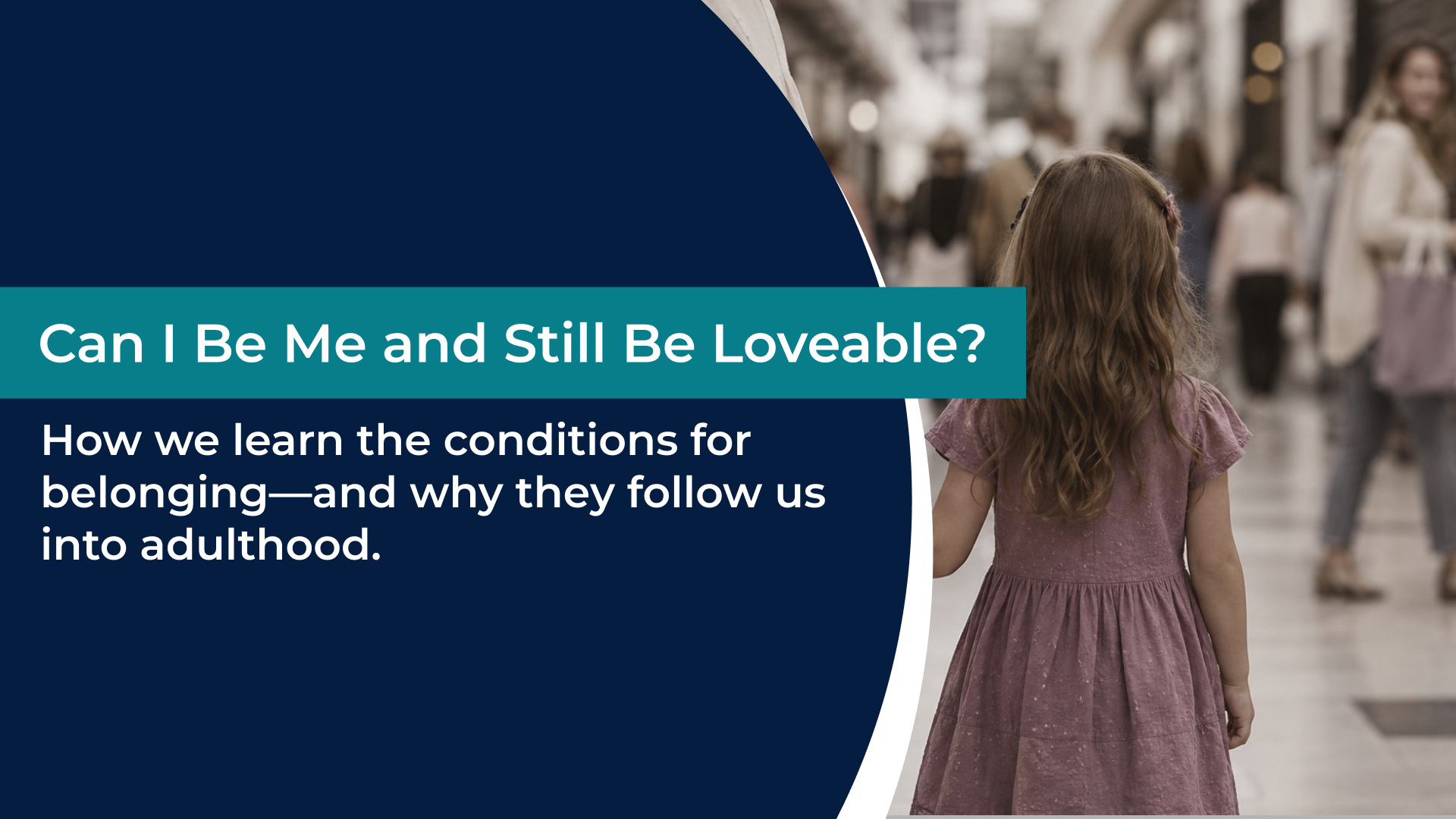
Imagine a little girl walking through a shopping centre in a new dress. An older woman smiles as she passes and says, “Don’t you look pretty.” Another smiles and says: “Oh, you’re such a good girl”. Someone else tells her she’s such a lovely little thing. Nothing remarkable has happened. No one has tried to teach her a lesson. No one has deliberately set out to shape the way she sees herself. It’s simply an ordinary human interaction, repeated thousands of times in countless places every single day.
One comment means very little. So does the next. And the one after that. Yet childhood isn’t made up of one moment. It’s made up of thousands of ordinary moments, quietly accumulating over time. A compliment here. A smile there. Someone noticing. Someone approving. Someone commenting on what they admire. Most of those moments are given with genuine warmth and kindness. Yet, little by little, they begin to reveal something much deeper. Not simply what other people appreciate, but what seems to matter. What appears to count. Without anyone intending it, those countless moments gradually become more than isolated experiences. They begin to shape the way we understand the world we’re growing up in.
That little girl isn’t standing there thinking, I should be pretty. She’s not consciously deciding that beauty is important. She’s simply participating in a world that continually reflects certain things back to her. Over time, those reflections begin to accumulate. Pretty matters. Being adorable matters. Being lovely matters. Not because anyone declared them to be the rules, but because they quietly become part of the way she comes to understand the world.
Pretty matters. Being adorable matters. Being lovely matters. She’s learning what counts.
She won’t remember this conversation when she’s thirty-five. Or the next one. Or the hundreds that follow. She won’t consciously decide that being pretty, good or lovely is the way to belong. Yet those countless ordinary moments don’t simply disappear. They gradually become part of the way she understands herself, other people and the world around her. What began as ordinary interactions quietly becomes the structure through which later experiences are understood.
Years later, when she’s deciding whether to speak up in a meeting, negotiate her salary, level up in her business or disagree with someone she loves, she won’t be responding only to that moment. She’ll also be responding to the understandings that have quietly accumulated over time. What it means to be a good woman. A likeable woman. A successful woman. A worthy woman. Those understandings don’t simply influence the way she sees the world. They shape what feels possible, what feels risky, and even who she believes she is able to become.
Perhaps this is why so many of us spend years trying to change our behaviour without ever experiencing lasting freedom. We work harder. We become more confident. We try to be more assertive, more visible or more authentic. Yet if the understandings organising those behaviours remain invisible, the struggle simply finds a new expression. We don’t need to become someone else. We need to become aware of the structures we’ve been living inside.
Perhaps this is why so many of us spend years trying to become a better version of ourselves, while never stopping to question the understandings quietly shaping what “better” even means. We change jobs, relationships, wardrobes, qualifications, businesses and behaviours, believing the next achievement or the next version of ourselves will finally settle something within us. Yet if the structures organising the way we understand ourselves remain unseen, we simply carry them into the next season of our lives. The circumstances change. The organising structure often does not.
Perhaps that is the real invitation hidden within every Mirror Moment. Not simply to notice what we’re doing, but to become curious about the understandings quietly organising why we’re doing it. To ask not only, What am I pursuing? But What have I learnt counts? Not only, Why is this so important to me? but What way of understanding myself and the world makes this feel so true?
Because the moment we can see the structure, we are no longer completely organised by it.
And perhaps that is where a different relationship with ourselves begins.
Not by trying harder to become enough.
Not by finally getting everything right.
But by recognising that many of the conditions we’ve attached to belonging, acceptance and worth were never inevitable. They were understandings that quietly formed over time.
Understandings can be examined. They can be questioned. And perhaps, they can be reorganised.
Jeanette Mundy is a speaker, writer and relational commentator, and Co-Founder of RelateAble Global. Through her writing, workshops and conversations, she explores the everyday experiences that quietly shape the way we see ourselves, our relationships and the lives we create. Mirror Moments is her ongoing invitation to pause, notice what has become invisible, and discover new ways of seeing ourselves—and the world around us.
If this article has stirred something in you, we’d love to continue the conversation.
Join us for the next Mirror Moments gathering on the Engenesis Platform, where Jeanette and Dr Marijana Alexander explore the ordinary moments that quietly shape how we understand ourselves, our relationships and the world around us.
Read. Reflect. Come and see yourself differently.