

Inherited wisdom
My late father-in-law had a saying that has stayed with me for years. “Try to come up with an eleventh commandment.” Or another proverb. Another whakataukī. Another verse from the Qur’an. Another piece of wisdom so simple, so enduring, that it could survive generations of changing cultures, technologies and ways of living. It’s harder than it sounds. Not because no new wisdom exists, but because the old wisdom has already endured something most modern ideas never will: time.
“Measure twice. Cut once.” “A stitch in time saves nine.” “Look before you leap.” “Forewarned is forearmed.” These aren’t simply quaint expressions from another era. They are observations about being human, distilled across countless ordinary lives. Somewhere, someone measured only once and regretted it. Someone postponed a small repair until it became an expensive one. Someone rushed ahead before they understood what they were walking into. Gradually those experiences became wisdom, and wisdom became sayings that quietly travelled from one generation to the next.
Every generation believes its world is more complicated than the one before it. The pace accelerates. Technology advances. Our problems appear larger, faster and more interconnected than those our grandparents faced. Yet somehow the quiet wisdom they inherited continues to speak into our lives with surprising clarity. Wisdom is rarely trying to solve the circumstances of a particular generation. It is trying to describe something enduring about the human condition.
We’ve become remarkably good at dismissing these old sayings precisely because we’ve heard them so often. Familiarity has a curious way of making profound ideas sound ordinary. We mistake repetition for irrelevance. Yet the opposite is true. These sayings have survived because they continue to describe something inherent about being human. Look closely and these old sayings all seem to point towards the same quiet practice: prepare before you need to. Preparation doesn’t guarantee success. It preserves something far more valuable: our capacity to think clearly when uncertainty arrives.
The weather we carry
What strikes me is that almost every enduring saying seems less interested in solving a particular problem than in preparing us for the changing conditions of being human. They assume uncertainty. They assume imperfect judgement. They assume there will be days when we cannot think as clearly as we would like. Their wisdom doesn’t predict the future but prepares us for it.
We understand this instinctively when the uncertainty is visible. Before leaving the house we check the weather forecast. We pack an umbrella, throw another jersey into the car or carry extra water if the day looks hot. Parents rarely leave home without tissues, snacks, plasters and a handful of small items that seem unnecessary—until they aren’t. Project managers identify risks before work begins. America’s Cup crews spend countless hours studying the wind before the starting horn sounds. These acts prepare the conditions under which success becomes possible. We don’t criticise these behaviours as pessimistic. We recognise them as sensible responses to changing conditions. Perhaps that is because the weather is easy to see. Dark clouds gather. Temperatures fall. Winds shift. We accept that changing conditions require different forms of preparation. The changing conditions we carry within ourselves are far less obvious.
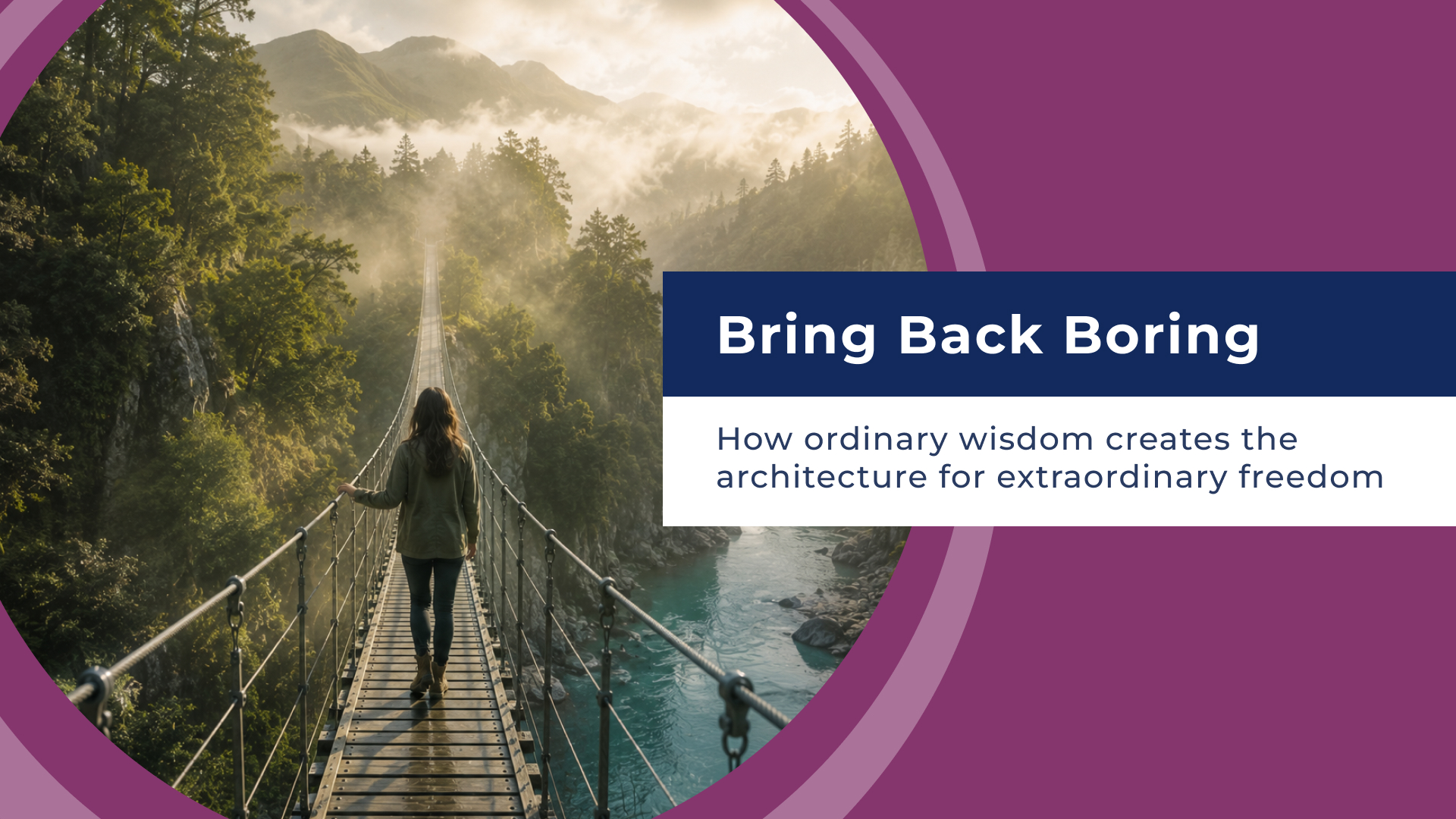
I sometimes think about the first swing bridge I crossed in Aotearoa. Before I stepped onto it, all I could see was movement. My attention wasn’t on the engineering beneath my feet. It was entirely occupied by the possibility of falling. Fear had recruited my attention. I realised the bridge wasn’t failing because it moved. It moved because it had been designed to withstand forces far greater than my fear. The bridge hadn’t changed. The emotional climate had.
The emotional climate we carry into our work, our relationships and our decisions is much harder to recognise, yet it influences our judgement just as surely. Every morning we walk into familiar places—our homes, our workplaces, our relationships—assuming that because the place is familiar, the conditions will be too. Yet they rarely are. Some mornings we arrive curious. Others discouraged. Sometimes energised. Sometimes quietly grieving. Sometimes carrying confidence. Sometimes carrying doubt. The room has not changed. We have. We act as though these inner conditions don’t matter, trusting that good judgement will simply prevail. Increasingly, I wonder whether it is the invisible conditions surrounding our thinking that shape our judgement more than intelligence alone ever can.
For years I thought I was procrastinating whenever I found myself cleaning my office instead of writing. I’d rearrange books, clear my desk or organise papers before beginning. It looked suspiciously like avoidance. Now I’m not so sure. I have started asking a different question: What uncertainty am I trying to regulate? Cleaning, I began to suspect, was never really about the office. It was my attempt to change the emotional climate before attempting something uncertain.
We often assume we make decisions in the conditions we are given. More often, we make decisions in the conditions we have created. The meeting isn’t experienced simply as it is. It is experienced through the emotional climate each of us carries into it. Preparation, I was beginning to realise, wasn’t always about changing the task. Sometimes it was about changing the conditions from which I would meet it. Maybe preparation has never been about controlling the future. Maybe it has always been about creating better conditions to support it.
Measuring twice
My Dido never explained what “measure twice, cut once” meant. He didn’t need to. Like so much inherited wisdom, it was offered almost in passing, as though everyone already knew why it mattered. Years later, I realised the measuring was never really about the ruler. A skilled carpenter is not simply confirming the length of a piece of timber. They are pausing long enough to ensure they have understood the task before committing themselves to an irreversible action. Once the cut is made, it cannot be undone. The few moments spent checking are not wasted time; they are an investment in avoiding unnecessary consequences later. The saying honours the pause before the point of no return. Seen this way, measure twice, cut once has very little to do with carpentry. It is really a philosophy of judgement.
This is where many of us have misunderstood preparation. We often reduce it to organisation or efficiency, as though its purpose is simply to make us more productive. Yet organisation is only one expression of preparation, not its purpose. Its deeper purpose is to preserve our capacity for discernment. It allows us to make important decisions while our thinking is still clear, before urgency recruits our attention, before emotion narrows our perspective, and before pressure persuades us that the first available answer must also be the right one.
The distinction that has become increasingly important to me is the difference between weather and architecture. Weather is what arrives today. It is the uncertainty we cannot control: changing markets, unexpected conversations, disappointing news, conflict, grief, fatigue, illness, success, even joy. Some days the emotional climate is calm and expansive; on others it feels turbulent and unsettled. We cannot prevent these changing conditions any more than we can prevent the rain. They are simply part of being human.
Architecture, however, is something entirely different. Architecture is the wisdom we build while the weather is clear. Think of a bridge spanning a wide river. We don’t admire it because it never experiences storms. We admire it because someone anticipated storms before the first beam was ever lifted into place. Its strength is not demonstrated on calm summer afternoons but on the days when the wind rises, the river swells and people cross without giving the structure beneath them a second thought.
I eventually appreciated how swing bridges are supposed to move. Their flexibility is part of their strength. They have been carefully designed to respond to changing conditions rather than pretend they don’t exist. My fear interpreted movement as danger. The engineers understood it as resilience. Human lives are much the same. The conversations we have, the habits we establish, the boundaries we clarify and the relationships we nurture while life is calm quietly become the structures that carry us when it isn’t. The collection of thoughtful decisions made before they become urgent. It is the routine established before life becomes busy, the friendship invested in before loneliness arrives, the savings accumulated before hardship, the conversation held before resentment takes root, the family rhythm created before crisis disrupts it. Architecture does not eliminate uncertainty. Rather, it gives uncertainty something solid to arrive upon.
This, I suspect, is what the old sayings have quietly been teaching us all along. They are less concerned with helping us perform well under pressure than they are with helping us think well before the pressure comes. The project manager who spends time understanding the problem before drafting the plan is measuring twice. The leader who listens carefully before responding to conflict is measuring twice. The parent who packs tomorrow’s lunches the night before is measuring twice. Even the writer who notices she is cleaning her office because she feels uncertain about beginning may, in that moment, be measuring twice. The outward actions differ, but the underlying practice remains the same. Each is creating conditions in which better judgement becomes more likely.
This is why so many costly mistakes appear obvious only in hindsight. We imagine they were failures of intelligence, when more often they were failures of orientation. We moved before we understood. We acted before we noticed the weather we were carrying. We mistook urgency for clarity. The old carpenter’s wisdom gently suggests another possibility: slow down long enough to understand the landscape before you begin cutting.
Freedom before the storm
If preparation is really about preserving judgement, then its purpose is far greater than simply helping us become organised. Its purpose is freedom. Not the freedom that comes from controlling the future. Life has never offered us that promise. Storms still arrive. Relationships still change. Projects fail. Bodies age. Markets shift. The weather, both around us and within us, remains wonderfully indifferent to our plans. What preparation changes is not the future itself, but the version of ourselves who eventually meets it.
Every thoughtful decision made in calm weather removes one unnecessary decision from a future moment of uncertainty. Every habit established before it is needed becomes a quiet gift to our future selves. Every conversation held early, every system created, every boundary clarified and every relationship nurtured gradually becomes part of an invisible architecture that supports us when our own judgement is under strain.
Over time, these small acts accumulate. Slowly, almost imperceptibly, preparation begins changing us. It protects our attention because fewer unnecessary demands compete for it. Protected attention makes discernment possible because we become less reactive and more able to notice what actually matters. Discernment strengthens judgement because we are responding from understanding rather than urgency. Over months and years these repeated judgements become something larger than individual decisions. They become the architecture of a life.
Freedom is so often misunderstood. We tend to imagine it as the absence of structure, the ability to do whatever we want whenever we want. Yet the forms of freedom we admire most are almost always supported by careful preparation. The accomplished musician enjoys freedom because of thousands of hours of practice. The experienced sailor appears relaxed because she has spent years learning to read the wind. The thoughtful leader can remain calm during a crisis because countless quieter decisions have already been made before the crisis began. Freedom, it turns out, is accumulated through countless ordinary decisions made while the weather is still clear.
Preparation rarely receives the same admiration because, when it succeeds, there is very little to see. We applaud the speech but rarely the months spent thinking about what truly needed to be said. We celebrate the successful project while overlooking the careful planning that prevented problems from emerging in the first place. We admire the calm leader without recognising the habits of reflection, conversation and discipline that quietly shaped that calm over many years. Preparation disappears because its success is measured by what never happened. The conflict that never escalated. The mistake that was quietly avoided. The opportunity that was recognised because someone had taken the time to understand the landscape before acting. The crisis that proved manageable because foundations had already been laid.
This is why preparation can appear so ordinary, even boring. It lacks the drama of last-minute heroics. It offers no applause, no headlines and very little recognition. Yet beneath that ordinariness lies something profoundly generous. Every act of thoughtful preparation is an act of care offered by today’s clearer self to tomorrow’s more uncertain one. It is a quiet acknowledgement that while we cannot choose tomorrow’s weather, we can choose its architecture.
What the carpenter knew
In today’s fast-paced world, preparation seems unfashionable. It is difficult to market the ordinary. We are drawn to stories of transformation, breakthrough moments and dramatic change. We celebrate the entrepreneur who built the successful company, the athlete who crossed the finish line and the leader who navigated the crisis. Is it that success has a curious habit of making preparation invisible or preparation’s unfortunate characteristic of erasing its own evidence? A bit of both maybe. Invisible preparation rarely receives recognition precisely because its greatest achievement is making future difficulties appear as though they never existed.
Performance is visible. Preparation is not. One receives applause while the other quietly shapes the conditions for good living. It is why our culture has begun to mistake visible effort for invisible wisdom. We reward responsiveness while quietly overlooking reflection. We praise busyness while forgetting that much of what appears effortless has often been carefully prepared long before anyone else noticed. The irony, of course, is that the lives we most admire are often supported by remarkably ordinary disciplines. They are built through conversations held early, routines established patiently, relationships nurtured consistently and decisions made while judgement is still clear. Together, they become the quiet architecture of life.
We may have become so attracted to extraordinary outcomes that we have forgotten the quiet practices that make them possible. We want confidence without rehearsal. Resilience without recovery. Freedom without structure. Strong relationships without regular conversation. Wise decisions without taking the time to understand what is really being asked of us. We long for the harvest while becoming strangely impatient with the slow work of tending the soil. The ordinary disciplines we are tempted to dismiss are often the very things that nourish the lives we hope to build.
Maybe the old sayings were never really asking us to become more disciplined. They were inviting us to become better custodians of our own judgement. To build in seasons of clarity the kind of architecture that can carry us through seasons of uncertainty. To recognise that while we cannot choose tomorrow’s weather, we can choose how prepared we will be to meet it.
Thinking back to the swing bridge, I realise I never really learned to trust it. I learned to trust the people who had built it. I learned that long before I arrived, someone had measured, tested, calculated and prepared for conditions they knew I would one day encounter. My courage rested upon another person’s preparation. It seems every freedom we enjoy rests upon architecture we did not build ourselves.
I also never managed to come up with an eleventh commandment to answer my father-in-law’s challenge. The old wisdom still has more to teach us than we have yet learned. Sometimes the deepest truths are not waiting to be discovered. They are waiting to be remembered.
Perhaps that is all wisdom has ever been: receiving the invisible architecture built by those who prepared the way before us, and becoming its next steward for those who come after.
Dr Jordan Marijana Alexander is a writer, executive advisor and human systems strategist exploring how identity, place, culture and living systems shape participation in the modern world. She is the co-founder of RelateAble.Global. If this article has raised questions, sparked reflection, or highlighted something you’re navigating as a leader or in your personal life, you’re invited to book a conversation to explore it further. You can follow DrJMA on LinkedIn and Engenesis for ongoing insights, research, and practical resources.