

About this series
Who Are You Accountable To? is a six-part series exploring faith not as religion or belief, but as orientation. It examines the often-unspoken systems that shape how meaning, power, and responsibility are organised at work. Moving beneath purpose statements, values frameworks, and performance culture, the series explores what replaces uncertainty when certainty is demanded, how leaders justify decisions when metrics fail, and who or what ultimately becomes the reference point for action. Across cultures, generations, and history, it asks a confronting question: when outcomes are unclear and no one is watching, what are we actually answering to, and how will those choices be remembered?
How did that become this?
Could you please update me on the project before the meeting this afternoon?
No.
Delete.
🙂 Hey! Hope your week’s going well. Just wondering how things are tracking ahead of this afternoon’s meeting? Looking forward to hearing where things are at!
How did that become this? Somewhere inside modern professional life, many people have quietly become experts at translating themselves. Sentences are softened. Opinions are padded. Directness becomes collaboration. Clarity becomes tone management. Entire emotional weather systems are negotiated invisibly through punctuation, phrasing and timing. Exclamation marks appear where certainty once lived. By the time the email is finally sent, the original thought has often been reshaped into something more socially survivable.
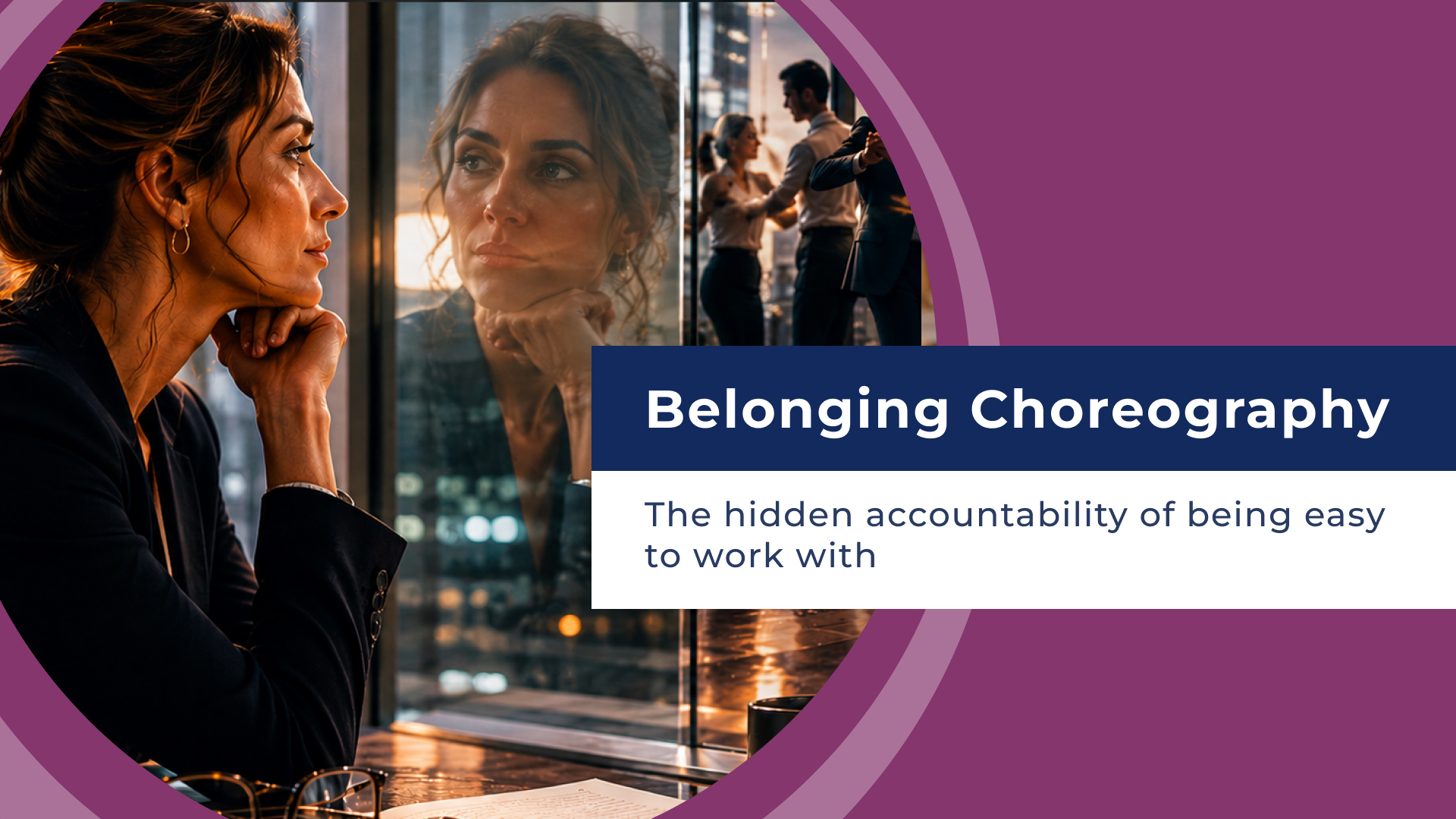
Most people do not experience this as dishonesty exactly. More often, it feels like participation: professionalism, emotional intelligence, being easy to work with. Yet over time, these small negotiations accumulate. People begin learning which parts of themselves travel well socially and which parts are better left quietly outside the room. Belonging, it turns out, is rarely noticed while it is happening. We tend to see its choreography only once we become tired of performing it.
For years, I laughed at jokes in professional environments that I would no longer laugh at now. In some of my earliest roles inside law firms, including one of the top firms in Toronto and another in my own hometown, certain forms of sexism still floated casually through workplace culture disguised as humour, tradition or personality. The expectation was rarely spoken aloud. It did not need to be. Everyone understood the choreography. Laugh lightly. Do not overreact. Be intelligent but not difficult. Attractive but not threatening. Friendly but not emotional. By the time I stopped laughing, I discovered something else quietly waiting on the other side of professional womanhood. Suddenly you risked becoming “hard work.” Humourless. Unable to take a joke.
What changes across generations is not only behaviour, but the moral atmosphere surrounding behaviour. My children would struggle to imagine tolerating some of what earlier generations of women absorbed routinely in order to belong professionally. Yet the adaptation itself has not disappeared. It has simply changed lanes.
I think about this often when language shifts culturally faster than people can metabolise comfortably. Recently I referenced Deep Throat and Watergate in conversation and watched the room go strangely still before realising many younger colleagues associated the phrase only with sexuality. Another time, I walked into a room and greeted a group casually with “hello ladies,” only to feel immediate uncertainty about how the phrase might land. Not because harm was intended, but because the social codes governing belonging are evolving rapidly, unevenly and often invisibly. Humans are increasingly required to interpret not only what they mean, but how their meaning may be interpreted through entirely different cultural frameworks.
The invisible sacred landscape
Long before we enter workplaces, institutions or leadership roles, most of us have already inherited invisible maps about belonging. My mother was Greek Orthodox. My father was Catholic. Both Christian. Both deeply shaped by faith, ritual and inherited cultural traditions. Yet even within those shared foundations, questions of marriage, legitimacy and belonging still surfaced quietly around the edges of family life. As I grew older, I became increasingly fascinated by the invisible landscapes humans carry inside them. The moral geographies. The inherited sacredness attached to place, tradition, language, family and identity. The quiet rules about what is respected, what is shameful, what remains private and what earns acceptance.
Perhaps this is partly why place matters so deeply in human identity. In te ao Māori, the Māori worldview of Aotearoa New Zealand, concepts like whenua and tūrangawaewae recognise the profound relationship between people, ancestry and place. Whenua means both land and placenta, linking identity and belonging directly to origin and life itself. Tūrangawaewae refers to a place to stand, somewhere a person belongs relationally and spiritually. Urbanisation, migration and institutional life can quietly fracture these relationships over time. Many people now live geographically, culturally and psychologically far from the places that once organised identity coherently. Modern professional life often asks humans to become increasingly portable. Transferable. Legible across contexts. Yet humans are not infinitely transferable without consequence.
Relational positioning
When I moved to Victoria, British Columbia after completing my Masters in transport planning, I entered another professional world entirely. Government ministries, engineering culture and institutional hierarchy all carried their own codes around legitimacy, gender and belonging.
One evening after work, while alone late in the office with a senior engineer, I found myself pinned against a desk while he told me that if I was “going to wear short skirts like that,” I deserved what I got. Then came the sentence that stayed with me longest: “We all talk about you.” Not I. We. The threat was never only physical. It was social. Belonging-based. A reminder that professional environments often discipline humans collectively through reputation, interpretation and shared narrative. I remember leaving the building afterwards to meet my fiancé at a public lecture on South America and barely being able to walk normally by the time I arrived.
This is also how fragmentation survives institutionally. Humans learn to keep functioning while privately reorganising around experiences they never fully metabolise aloud. The meeting still happens the next morning. The email gets sent. The project continues. Participation continues. Sometimes workplaces celebrate diversity publicly while quietly expecting certain people to become translators, educators or symbolic representatives for experiences they may still be trying to navigate privately themselves. The longer I observe professional life, the more I suspect many people are not exhausted from work itself, but from chronic self-translation.
Psychologically breathable participation
Coherent belonging is not something most workplaces are structured to sustain. I have experienced moments of it inside women’s leadership groups where care moved relationally rather than performatively. I have seen it in motherhood spaces where professional status dissolved beneath shared vulnerability and exhaustion. Strangely, I have also seen it inside a boxing academy built around youth development and Christian values. Respect was not performative. Expectations were clear. People looked each other in the eye and shook hands. The moral atmosphere required less interpretation. Something in the nervous system settles in environments like this. And that is part of why it feels so powerful when humans encounter it. In contrast, much of modern professional life requires a different kind of choreography.
Fragmentation rarely arrives dramatically. More often, it happens slowly - a kind of bonsai belonging if you will. A small trimming here. A softening there. One less opinion. One less story. One less part of yourself brought fully into the room. Like a bonsai tree carefully shaped over time, people can become socially beautiful through repeated pruning. But eventually even careful shaping raises a quieter question: at what point does adaptation begin reducing aliveness itself?
There is a deeper risk hidden underneath belonging systems. People slowly become more accountable to participation than to their own internal coherence. Questions of faith, identity, place and meaning refuse to remain private for very long. Eventually, humans begin searching for environments where what they believe, what they value and who they are no longer need to exist so far apart from one another just to belong. Exhaustion does not always come from the work itself. Sometimes it comes from the endless effort of rehearsing who you need to be before entering the room.
Dear self,
I miss the version of us that did not rehearse every sentence before speaking.
Belonging should not feel this much like editing.
Dr Jordan Marijana Alexander works at the intersection of identity, leadership, and organisational systems. She is the co-founder of RelateAble.Global. If this series has surfaced questions for you as a leader, or raised challenges you are navigating within your organisation or your own life, she welcomes thoughtful conversation or inquiry. You can follow DrJMA on LinkedIn and Engenesis.