

Introduction: Why This Distinction Matters
Few concepts are used as frequently and defined as loosely as awareness. Across psychology, leadership, coaching, philosophy, contemplative traditions and personal development, awareness is commonly presented as a hallmark of maturity, effectiveness and wisdom. Leaders are encouraged to become more aware. Coaches seek to cultivate awareness in their clients. Organisations attempt to increase awareness of culture, performance and stakeholder needs. Individuals pursue greater awareness as a pathway to growth and fulfilment.
Despite its widespread use, awareness is often treated as though it were a singular capacity. Terms such as awareness, self-awareness, mindfulness, reflection, introspection, metacognition and meta-awareness are frequently used interchangeably. While these concepts overlap, such usage often obscures important distinctions and creates confusion regarding what is actually developing. The result is that conversations about awareness frequently drift between fundamentally different phenomena without clearly distinguishing them. A person may become more aware of their emotions, more aware of other people, more aware of social dynamics or more aware of their own assumptions, yet each of these developments involves different capacities and different developmental processes.
This confusion becomes increasingly problematic when we move beyond simple self-improvement and begin examining human participation in reality. Human beings do not merely encounter reality. They participate in it. They perceive, interpret, respond, decide, act, learn and adapt. They engage physical realities, social realities and personal realities simultaneously. They navigate uncertainty, incomplete information and competing perspectives while attempting to understand themselves, others and the world around them. Yet between what occurs and how it is understood lies a complex architecture of perception, interpretation and sense-making. Two people can observe the same event and arrive at entirely different conclusions. Two leaders can possess access to the same information and make radically different decisions. Two organisations can encounter the same disruption and produce vastly different outcomes. Such differences cannot be explained solely by awareness itself. They also require an understanding of how awareness is being shaped, organised and directed.
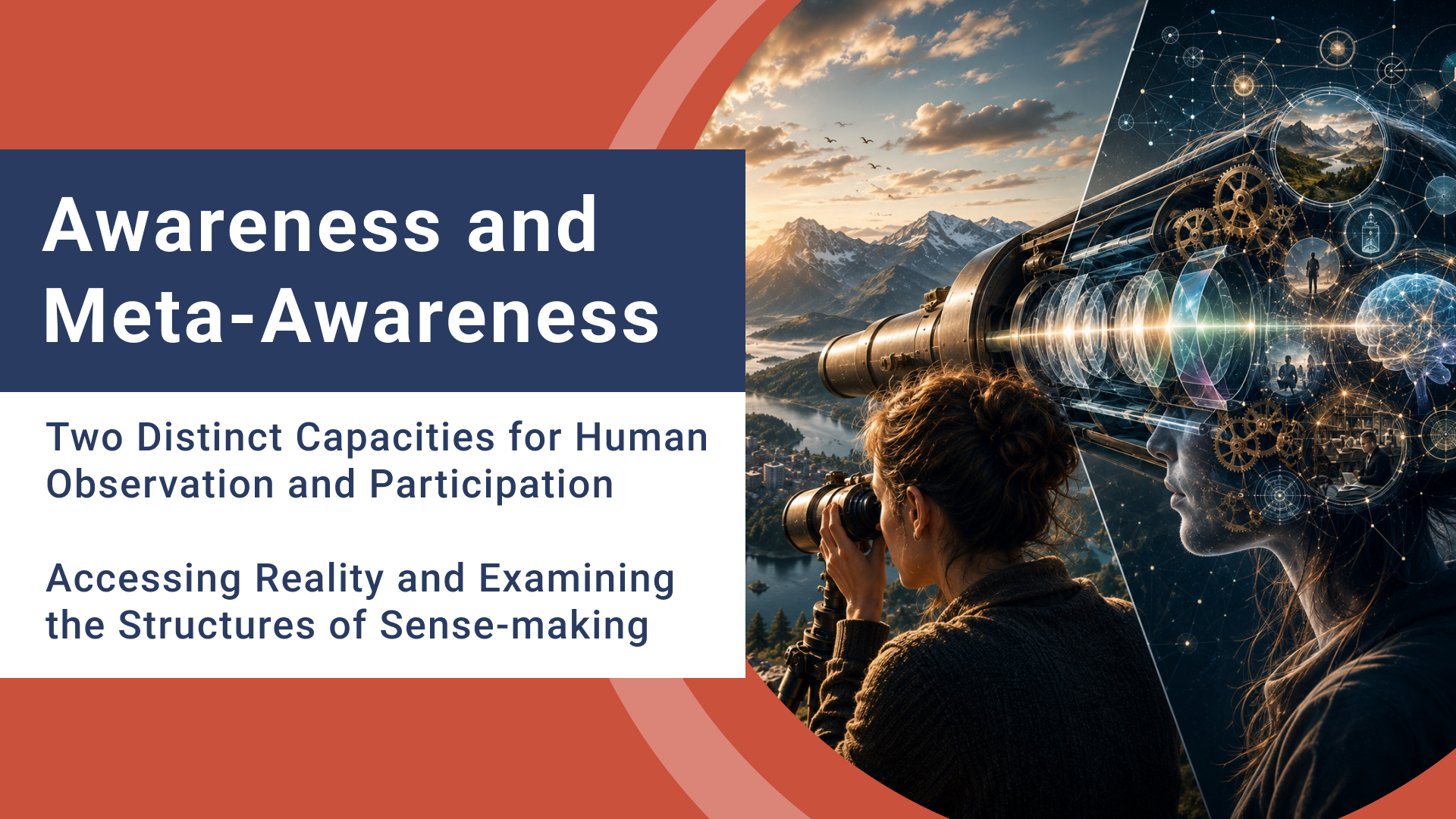
The distinction presented here proposes that awareness and meta-awareness are related but fundamentally different capacities. Awareness concerns our access to knowing and understanding. Meta-awareness concerns the quality of that access. Awareness helps us engage reality. Meta-awareness helps us examine the structures through which reality is interpreted. Although deeply interconnected, they are not the same thing. Awareness concerns what is being perceived, understood and responded to. Meta-awareness concerns how perception, understanding and response occur and develop. Understanding this distinction provides a more robust framework for understanding learning, adaptation, leadership, participation and human development.
Reality and Human Participation
Before exploring awareness and meta-awareness, it is useful to clarify the context within which they operate. As explained in Being (2021), human participation unfolds across multiple layers of reality, each requiring different forms of attention and engagement. Awareness enables individuals to engage these realities. Meta-awareness, by contrast, enables them to examine the structures through which their awareness of those realities is formed. As explored further in Metacontent (2024) and Sustainabilism (2025), these underlying structures shape how reality is interpreted, organised and understood, influencing not only individual perception but also the adaptability and sustainability of relationships, organisations and societies. Understanding the distinction between awareness and meta-awareness, therefore, begins with understanding both the nature of reality and the architecture of sense-making through which reality becomes intelligible to us.
The first layer consists of realities that appear largely independent of human interpretation. Gravity continues to operate whether we believe in it or not. Biological processes continue regardless of our preferences. The laws governing physical phenomena are not determined by personal opinion. These realities are often the concern of the natural sciences and are commonly described as objective realities. While our understanding of them may evolve, their existence is not contingent upon our agreement.
The second layer consists of shared or intersubjective realities. These realities emerge through collective human participation and agreement. Money, governments, legal systems, institutions, organisations, corporations, universities, cultural norms and social conventions do not exist in the same way gravity exists. They exist because human beings collectively participate in them and continually reproduce them through shared understanding and coordinated behaviour. A banknote only functions as money because enough people agree to treat it as such. Likewise, legal systems, organisational structures and social customs derive much of their power from collective participation rather than physical necessity.
The third layer consists of subjective reality. This includes our personal experiences, perceptions, interpretations and lived understanding of the world. Two individuals may encounter the same circumstance while experiencing it very differently. One person may interpret criticism as an attack while another interprets it as useful feedback. One person may experience uncertainty as threat while another experiences it as opportunity. The event may be shared, but the experience is not.
Human participation, therefore, requires us to navigate all three layers simultaneously. We must engage realities that exist independently of us, participate in realities that exist between us and navigate realities that exist within us. Awareness operates across all three layers. Meta-awareness operates differently. Awareness helps us recognise and engage reality. Meta-awareness helps us examine how our awareness of reality is being shaped, filtered and organised.
Awareness: Our Access to Knowing and Understanding
Within the Being Framework, awareness is one of the foundational capacities through which human beings participate in reality. It governs our relationship with what we know, what we do not know, what we understand and what remains beyond our current understanding. Awareness influences how we perceive ourselves, how we perceive others and how we engage the world around us. It is through awareness that we become capable of recognising reality, orienting ourselves within it and responding to it intentionally rather than merely reacting to circumstances.
As distincted within the Being Framework:
Awareness is the state of being intentionally conscious of your consciousness. It is how you relate to what you know and understand as well as what you don’t know and don’t understand. Awareness is always intentional and directed at something. It is to know and understand yourself, others and the world around you, in particular the impact of the world and others on you and the impact you have on the world and others. Awareness is your access to knowing and understanding and is required to fulfil your intentions.
Tashvir, A. (2021). BEING. Engenesis Publications.
Awareness is therefore fundamentally participatory. It is the capacity through which we engage reality. Through awareness, we gather information, observe events, recognise patterns, understand relationships, identify opportunities and navigate consequences. Without awareness, meaningful participation becomes impossible because we cannot respond effectively to what we do not notice. Awareness functions as our primary access to reality and enables us to orient ourselves within an environment that is often uncertain, dynamic and complex.
Awareness is not merely concerned with what is known. It is also concerned with recognising the limits of what is known. To be aware is not simply to possess information. It is also to recognise where understanding ends and uncertainty begins. Awareness, therefore, includes an important dimension of epistemic humility. Reality is always greater than our current understanding of it. No individual possesses complete knowledge, complete perspective or complete certainty. A healthy relationship with awareness, therefore, requires a willingness to remain open to learning, correction and discovery. The more aware we become, the more capable we become of recognising both what is visible and what remains beyond our current field of vision.
Within the Being Framework, awareness also concerns our relationship to perspectives. Human beings rarely encounter reality from a single vantage point. We see matters through our own perspective, through our understanding of the perspectives of others and through broader systemic perspectives that transcend any individual viewpoint. Consider a disagreement within a workplace. An individual may understand their own position clearly. They may also understand how a colleague sees the situation differently. They may further recognise how the broader team experiences the issue and how the organisation as a whole may be affected. Each additional perspective expands awareness by increasing access to dimensions of reality that would otherwise remain hidden.
Awareness also includes our relationship to the narratives through which we understand experience. Human beings naturally construct explanations for events as they unfold. We tell ourselves stories about what is happening, why it is happening and what consequences may follow. These narratives help organise experience and orient action. Similarly, awareness includes what might be described as a web of perceptions. Over time, individuals consciously and unconsciously arrive at conclusions about what various aspects of reality are for them. Concepts such as leadership, success, freedom, responsibility, marriage, education, religion or money rarely carry identical meanings across individuals. Each person develops a unique constellation of perceptions through which they engage the world.
A healthy relationship with awareness enables individuals to understand themselves, others and their environment with increasing clarity. They recognise how their actions affect others and how the actions of others affect them. They remain attentive to feedback and can navigate uncertainty without becoming immobilised by it. They are less likely to be blindsided because they are actively paying attention to what is occurring around them and within them. An unhealthy relationship with awareness produces a very different outcome. Important realities may be ignored, denied or overlooked. Individuals may repeatedly find themselves surprised by outcomes that others anticipated long before they occurred. They may become confused when people respond differently than expected because they have failed to recognise how they are being perceived. Alternatively, they may become trapped by a demand for certainty, refusing to act until every unknown has been resolved. Since complete certainty is rarely available, action becomes delayed and participation becomes constrained.
At this point, however, an important question emerges. Where do these perceptions, narratives, assumptions and perspectives come from? Awareness helps us recognise them. Meta-awareness helps us examine the structures that produce them.
Meta-awareness: Awareness Examining Awareness
While awareness provides access to knowing and understanding, meta-awareness concerns the quality of that access. If awareness enables us to engage reality, meta-awareness enables us to examine how that engagement is occurring. It draws attention not only to what we notice, understand and believe, but also to the assumptions, interpretive habits and structures that shape those understandings. In this sense, meta-awareness functions as a higher-order capacity that allows awareness itself to remain coherent, adaptive and open to revision.
As distincted within the Authentic Sustainability Framework:
Meta-awareness is the extent to which you notice and relate to awareness itself. Where awareness gives you access to knowing, meta-awareness highlights the quality of awareness and ensures that access is not distorted. It is the reflective capacity that allows awareness itself to remain coherent.
Tashvir, A. (2024). SUSTAINABILISM Engenesis Publications.
Meta-awareness is therefore not primarily concerned with what is being noticed. It is concerned with how noticing occurs. Awareness may recognise a situation. Meta-awareness investigates how that situation is being interpreted. Awareness may identify a problem. Meta-awareness investigates the assumptions and, more importantly, the structure through which the problem is being understood. Awareness may generate a conclusion. Meta-awareness examines the process through which that conclusion emerged.
This distinction is subtle, yet profound. A leader may recognise growing conflict within a team. That recognition demonstrates awareness. Meta-awareness begins when the leader examines how they are interpreting that conflict. Are they assuming malicious intent where misunderstanding may exist? Are they projecting past experiences onto present circumstances? Are they viewing disagreement as dysfunction rather than as a source of challenge and learning? Similarly, an entrepreneur may recognise a promising market opportunity. Awareness allows them to identify the opportunity. Meta-awareness examines whether enthusiasm, fear, ideology, previous success or unexamined assumptions are influencing judgment. The question is no longer whether the opportunity exists. The question becomes how the opportunity is being understood.
Human beings do not encounter reality directly and neutrally. Rather, reality is interpreted through assumptions, beliefs, habits, experiences, preferences, mental models and broader frameworks of sense-making. Meta-awareness enables us to recognise these influences rather than unconsciously becoming governed by them. It allows us to examine not only the conclusions we reach but also the processes through which those conclusions are formed.
Meta-awareness and the Architecture of Sense-making
The distinction becomes even clearer when we recognise that human beings do not simply process information. We make sense of information. Between an event occurring and a response being produced lies an entire architecture of sense-making. Experiences are interpreted. Interpretations become stories. Stories contribute to mental models. Mental models influence perspectives. Perspectives shape broader domains of understanding. Domains contribute to paradigms through which reality itself is interpreted. Most of this process occurs automatically and largely outside conscious attention.
Meta-awareness enables us to bring these processes into view. Within the Metacontent discourse, these deeper structures of sense-making are explored through what is referred to as the Nested Theory of Sense-making. As the term was coined in Metacontent (2024), Metacontent concerns that which sits beneath content. While content refers to what we think, believe, perceive, interpret or understand, metacontent refers to the underlying structures that shape and organise those thoughts, beliefs, perceptions, interpretations and understandings. Rather than focusing on the conclusions we reach, the Metacontent discourse focuses on the architecture through which those conclusions are formed. It therefore shifts attention from the outputs of sense-making to the structures that make sense-making possible in the first place.

The Nested Theory proposes that awareness is shaped through multiple layers of sense-making extending from Initial Insight through Cognitive Maps, Stories, Mental Models, Perspectives, Domains and Paradigms. Each layer influences how reality is perceived, organised and understood. Meta-awareness enables us to examine these structures rather than unconsciously being governed by them.
In simplified form, these layers may be understood as follows:
Initial Insight: The raw observations, first encounters, impressions, intuitions and recognitions that arise through experience.
Cognitive Maps: The internal organising structures through which observations and experiences are connected into a coherent understanding of reality. Cognitive maps influence what things are understood to be for a person.
Stories: The narratives through which experiences, events, relationships and circumstances are explained, interpreted and communicated.
Mental Models: The underlying explanatory frameworks through which reality is interpreted and cause-and-effect relationships are understood. Mental models influence how things are understood to work for a person.
Perspectives: Particular vantage points from which reality is observed, interpreted and approached. Perspectives influence what is noticed, prioritised and considered relevant.
Domains: Broader fields of knowledge, understanding and practice within which perspectives, concepts and expertise become organised.
Paradigms (within domains): The deepest organising assumptions, worldviews and orienting frameworks that shape what is considered real, true, possible, valuable and worth pursuing.
Each layer influences how reality is perceived, organised and understood. Meta-awareness enables us to examine these structures rather than unconsciously being governed by them.
This distinction is particularly important because some often confuse awareness and meta-awareness when discussing perceptions, narratives and perspectives. Awareness concerns recognising the perception, narrative or perspective. Meta-awareness concerns examining how that perception, narrative or perspective came to exist. Awareness may recognise that a person views leadership as authority. Meta-awareness investigates the assumptions, experiences, stories, mental models and paradigms that produced that understanding of leadership. Awareness may recognise that two people hold different perspectives. Meta-awareness investigates the deeper structures that generated those perspectives. Awareness illuminates the outcome. Meta-awareness investigates the architecture that produced the outcome.
Meta-awareness and Metacognition
Given the reflective nature of Meta-awareness, some may wonder how it differs from the well-established concept of metacognition. The two are certainly related and share important common ground. However, they are not synonymous. Metacognition can be understood as one important expression of Meta-awareness rather than its equivalent.
Metacognition emerged primarily within cognitive psychology and is generally concerned with thinking about thinking. It refers to the capacity to examine, monitor and regulate cognitive processes such as reasoning, learning, memory, problem-solving and decision-making. Questions associated with metacognition include: How am I thinking about this problem? Is my reasoning sound? What assumptions are influencing my conclusion? Have I overlooked important information? The primary concern is the quality and effectiveness of cognition.
Meta-awareness, as it is used here, operates at a broader level. Rather than focusing solely on thinking, it concerns awareness itself and the structures through which awareness is formed, organised and refined. It encompasses cognition but extends beyond it to include emotions, perceptions, assumptions, habits, narratives, mental models, perspectives, paradigms and contextual influences. Meta-awareness is concerned not only with what we think, but with how we come to see, interpret and make sense of ourselves, others and reality in the first place.
The distinction can be illustrated through a simple example. Imagine a leader evaluating a significant organisational decision. A metacognitive inquiry may lead them to ask whether they have analysed the available data correctly, whether their reasoning is logically sound or whether they have overlooked relevant evidence. These are valuable questions that improve the quality of thinking.
A meta-aware inquiry moves to a deeper level. The leader may begin asking why they are interpreting the situation in a particular way, what assumptions about leadership are shaping their judgement, which organisational narratives they are operating within, what mental models are guiding their decisions or what broader paradigm informs their understanding of success, performance and effectiveness. The inquiry is no longer limited to cognition. It extends to the broader architecture of sense-making.
This distinction becomes particularly important when viewed through the Nested Theory of Sense-making. Metacognition primarily concerns the examination of cognitive processes and the structures immediately associated with them. Meta-awareness, by contrast, is capable of examining the entire ecology of sense-making, including insights, cognitive maps, narratives, mental models, perspectives, domains, paradigms and the contextual influences surrounding them. It therefore provides a wider and more comprehensive capacity for reflection, adaptation and learning.
The distinction is not merely one of breadth but also one of orientation. Metacognition is generally concerned with improving cognitive performance. Its focus is on helping individuals think more effectively, learn more efficiently and make better decisions. Meta-awareness is concerned with something broader. It seeks to improve the quality of participation in reality. Its concern is not only whether individuals think well, but whether they are making sense of themselves, others and the world in ways that are coherent, adaptive and aligned with reality.
This broader orientation places Meta-awareness at the intersection of several traditions, including metacognition, reflective practice, developmental theory, systems thinking, double-loop learning, triple-loop learning, phenomenology and hermeneutics. While each of these traditions contributes important insights, Meta-awareness as presented here seeks to integrate them within a coherent framework concerned with sense-making and participation.
This broader scope is one of the reasons Meta-awareness occupies a central place within UOSI. Human beings are not shaped by cognition alone. They are influenced by culture, history, identity, emotions, relationships, institutions and countless contextual variables that influence how reality is perceived and interpreted. A person may possess strong metacognitive abilities and still remain constrained by unexamined assumptions, inherited narratives or paradigmatic blind spots. Good thinking does not automatically guarantee good sense-making.
Meta-awareness addresses this challenge by directing attention towards the conditions through which awareness itself is formed. It enables individuals to recognise distortions in their understanding, examine assumptions that have become invisible through familiarity and refine the interpretive structures through which they participate in reality. In this sense, Meta-awareness functions as a reconstructive capacity. It supports the ongoing examination and refinement of awareness and the sense-making structures that shape participation.
In its simplest form, the distinction can be summarised as follows: metacognition improves thinking, while Meta-awareness improves sense-making. Metacognition helps individuals examine how they think. Meta-awareness helps them examine how their awareness is being formed, organised and shaped. As such, metacognition can be understood as a valuable subset of Meta-awareness, while Meta-awareness remains the broader capacity concerned with the coherence, integrity and reconstruction of awareness itself.
When Awareness Outpaces Meta-awareness
One of the most common misunderstandings is the assumption that awareness automatically produces meta-awareness. Experience suggests otherwise. A person may possess extraordinary awareness while possessing relatively little meta-awareness.
Consider a senior executive who understands their industry exceptionally well. They recognise market trends, understand competitors, anticipate stakeholder responses and possess strong situational awareness. Their awareness is highly developed. Yet they may simultaneously remain unaware that many of their decisions are being shaped by assumptions formed decades earlier under very different conditions. They can see the environment clearly, yet they cannot see the framework through which they are seeing the environment. As circumstances change, information continues to be gathered, but learning begins to slow. New information is continually forced into old categories. Eventually, the individual becomes increasingly informed yet decreasingly adaptive. The problem is not a lack of awareness. The problem is an inability to examine the structures through which awareness is being organised.
The same pattern appears in personal relationships. A person may accurately observe that conflict keeps emerging in their marriage. They notice recurring arguments, recognise emotional distance and understand many of the behavioural dynamics involved. Their awareness is functioning. Yet they may remain unaware that every disagreement is being interpreted through assumptions inherited from childhood experiences, previous relationships or deeply embedded beliefs regarding intimacy, trust or vulnerability. Again, the issue is not that reality cannot be seen. The issue is that the process through which reality is being interpreted remains largely invisible.
Many organisational, political and institutional failures emerge from precisely this pattern. Awareness remains active while the structures shaping awareness remain hidden. Information continues to accumulate, yet adaptation becomes increasingly difficult because the assumptions governing interpretation remain unquestioned.
When Meta-awareness Outpaces Awareness
The opposite pattern can also occur. An individual may become highly reflective and deeply interested in examining their own thinking. They question assumptions, analyse beliefs and continually evaluate their interpretations. Yet they struggle to translate insight into meaningful participation. Reflection becomes disconnected from reality.
Such individuals may become exceptionally skilled at analysing their own sense-making while remaining ineffective at responding to actual circumstances. Every decision becomes subject to further examination. Every interpretation generates another layer of analysis. Action is delayed in favour of continued reflection. Rather than supporting participation, meta-awareness becomes detached from it. Just as awareness without meta-awareness can produce rigidity, meta-awareness without awareness can produce paralysis. In both cases, one capacity develops at the expense of the other.
Neither condition supports effective participation in reality. Effective participation, sustainable development and lasting transformation all require both capacities operating together.
The Relationship Between Awareness and Meta-awareness
Although awareness and meta-awareness are distinct, they are deeply interconnected. Awareness provides access to reality, while meta-awareness helps ensure that access remains coherent. Awareness enables participation, while meta-awareness enables the ongoing refinement of participation. Awareness allows us to engage the world, while meta-awareness allows us to examine the structures through which that engagement occurs.
Together they form a continuous developmental process. Awareness generates experience. Meta-awareness examines how awareness contributed to that experience and identifies the assumptions, filters and interpretive patterns involved. The insights generated through meta-awareness then refine awareness itself, leading to more coherent participation. The cycle repeats continuously, enabling learning, adaptation and growth.

Seen in this way, awareness and meta-awareness are not competing capacities. They are complementary dimensions of human participation. Awareness enables us to know, understand and respond. Meta-awareness enables us to examine the quality of that knowing, understanding and responding. Awareness without meta-awareness lacks the capacity for ongoing self-correction. Meta-awareness without awareness lacks grounding in lived participation. Together they create the conditions for discernment, adaptability, wisdom and transformation.
Conclusion
The distinction between awareness and meta-awareness offers more than a refinement of terminology. It provides a framework for understanding how human beings participate in reality and how that participation can continually improve.
Awareness enables us to engage reality across its objective, intersubjective and subjective dimensions. It helps us recognise what is occurring, what we know, what we do not know and how we are participating within the world around us. Meta-awareness enables us to examine the deeper structures through which awareness itself is shaped. It illuminates the assumptions, cognitive maps, stories, mental models, perspectives, domains and paradigms that influence how reality is interpreted. It allows us to investigate not only what we are noticing but also how our noticing has become organised.
In an increasingly complex world, access to information alone is no longer sufficient. Human flourishing depends not only upon what we know but also upon our capacity to understand how our knowing is being shaped. Awareness and meta-awareness together provide the foundation for that possibility. Awareness expands participation by increasing access to reality, while meta-awareness improves the quality of participation by illuminating the structures through which reality is interpreted. Together they create the conditions for learning, adaptation, discernment and the ongoing reconstruction of human participation in reality.