
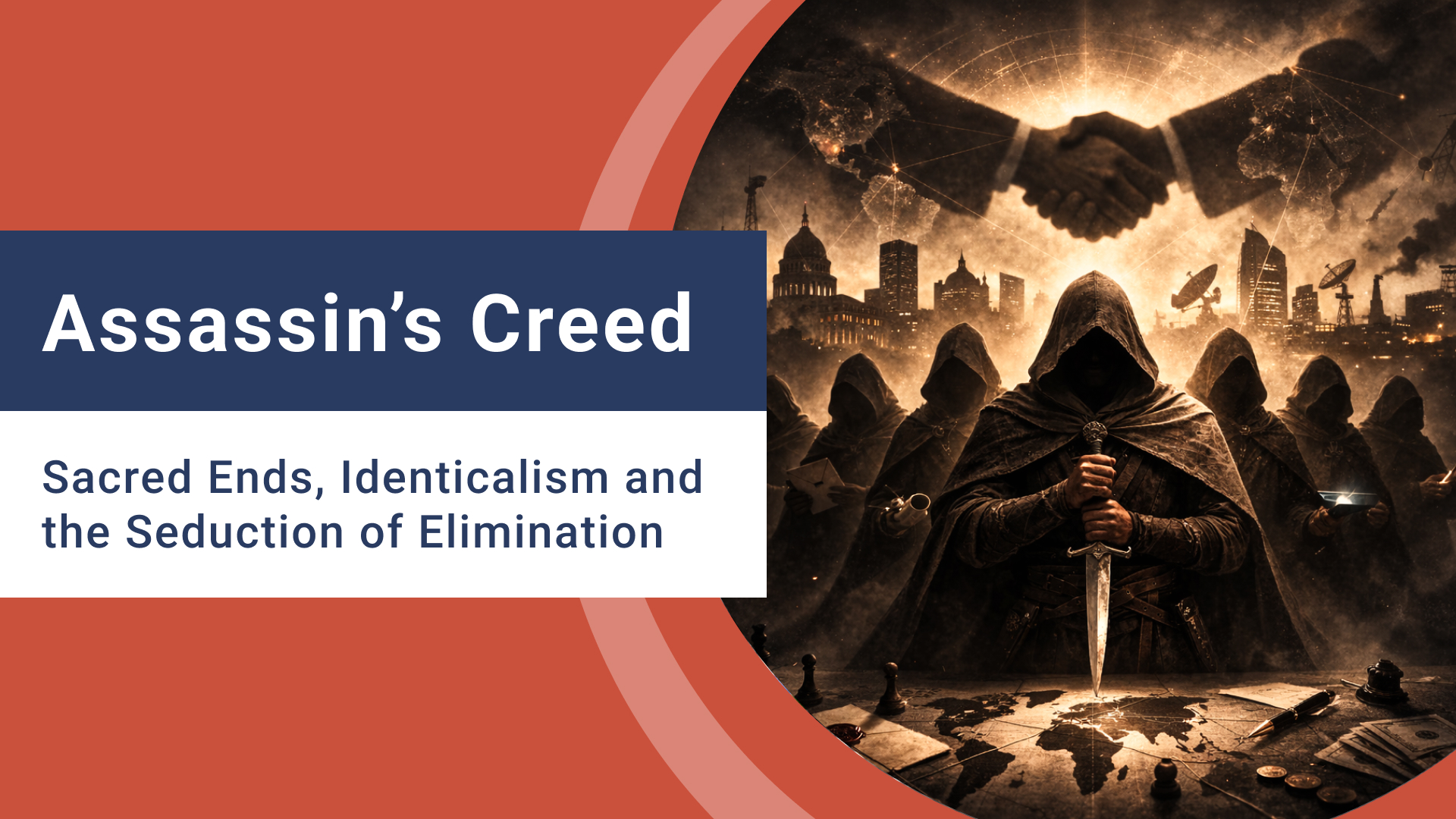

Before the Creed
There was a time when civilisations laboured to institutionalise disagreement.
Debate replaced duel. Negotiation replaced vendetta. Law replaced private retribution. Parliaments, courts and diplomatic channels were not built because human beings became morally superior. They were built because unrestrained elimination proved destabilising.
Dialogue was not idealism. It was structural intelligence.
Over centuries, societies learned that perpetual retaliation produces cycles, not order. They constructed processes through which conflict could be metabolised rather than annihilated. Disputes could be argued. Rivals could be constrained. Power could be limited by procedure.
None of these mechanisms eliminated violence entirely. But they signalled an aspiration toward maturity. Toward containing force within boundaries rather than allowing force to define the boundary.
Yet under pressure, regression is always possible.
When fear intensifies, when identity hardens, when threats are amplified, systems can begin to view negotiation as weakness and restraint as naïveté. Dialogue becomes slow. Debate becomes obstruction. Due process becomes inconvenience.
And when patience erodes, elimination reappears as efficiency.
Assassination is not innovation. It is regression. It is the reactivation of an older logic that predates institutions of deliberation. It bypasses complexity and restores immediacy. Remove the obstacle. Silence the rival. Neutralise the threat.
The irony is sharp. The more sophisticated a civilisation’s tools become, the more retrograde its instincts can appear when fear dominates.
This essay is not a defence of passivity. It is an inquiry into what happens when systems abandon the hard work of integration and return to the simplicity of eradication.
The creed does not begin with the blade.
It begins when dialogue is no longer trusted.
The Ontology of Elimination
This article is not about a single assassin.
It is about a pattern.
Across history, certain systems do more than eliminate threats. They normalise elimination as a legitimate instrument of order. Over time, what begins as exception becomes policy. What begins as emergency becomes doctrine. What begins as defence becomes identity.
The assassin is not merely an individual with a blade. He is the visible edge of a deeper ontology. An ontology in which tension is intolerable, polarity is destabilising and difference is experienced as contamination.
In such systems, elimination is not perceived as violence. It is perceived as restoration. Removing the obstacle feels like restoring coherence. Silencing the dissenter feels like stabilising unity. Neutralising the rival feels like protecting the future.
The act is not aberration. It is structural expression.
More dangerously, once elimination proves effective, systems begin to rely on it. Each removal produces temporary clarity. Each neutralisation simplifies the field. Each act of suppression narrows complexity.
And systems, like organisms, gravitate toward what produces short-term relief.
Over time, elimination ceases to be reluctant. It becomes efficient. Then justified. Then strategic. Eventually, it becomes instinctive. The creed no longer needs to persuade. It is assumed.
At that stage, a civilisation does not merely permit assassination. It metabolises it. It integrates it into governance, narrative and self-conception. It becomes addicted to the simplicity that elimination provides.
Because integration is hard. Constraint is demanding. Hosting polarity requires capacity. Elimination is faster.
The assassin, then, is not the anomaly. He is the symptom of a deeper structure that has chosen simplicity over maturity.
To understand assassination, one must understand the ontology that makes it feel normal.
Only then does the blade make sense.
The Blade and the Dream
The word assassin did not begin as metaphor. It entered European languages through encounters with a medieval sect often referred to as the Hashashin. The term is frequently linked to the Arabic word hashish, though historians debate whether this association was literal, polemical or exaggerated by adversaries. Whether or not narcotics were truly central to their practice, the myth endured because it captured something psychologically potent.

The legend describes young recruits taken to the mountain fortress of Alamut under the leadership of Hassan-i Sabbah. There, it is said, they were intoxicated, transported into lush gardens, surrounded by music, beauty and sensual abundance. They were made to believe they had glimpsed paradise itself. When they awoke outside that environment, they were told that obedience, sacrifice and targeted killing would secure their permanent return.
Even if embellished, the architecture of the story is revealing.
Intoxication.
Revelation.
Promise.
Obedience.
Elimination.
Whether the intoxication was chemical or symbolic is secondary. What matters is that consciousness was altered. The recruit did not merely receive instruction. He underwent transformation. He believed he had touched eternity.
In that altered state, killing ceased to be moral rupture. It became passage. The blade was no longer an instrument of violence. It was a key.
This is why the etymology matters. The association with hashish, whether historically precise or not, encodes the idea that moral inhibition can be softened, blurred or suspended. The recruit was not simply trained. He was numbed. Mesmerised. Reoriented toward a transcendent end.
The enemy, once human, became obstacle. The act, once brutal, became sacred duty.
Alamut is not important because of medieval intrigue. It is important because it reveals how systems convert elimination into devotion. The promise of paradise anesthetises conscience. The sacred future reframes present violence as moral obedience.
Once the end is elevated beyond question, the means are no longer evaluated as means. They are absorbed into destiny.
The assassin, in this architecture, does not feel criminal. He feels purified.
And that transformation is the hinge upon which elimination becomes creed.
The Logic of Sacred Ends
At the core of every assassination lies a deceptively simple proposition: the end is sacred.
Once that premise is accepted, everything else begins to bend around it.
If the future we are building is holy, then obstruction becomes profane. If the threat is existential, then hesitation becomes betrayal. If survival is at stake, then restraint becomes weakness. Slowly, almost imperceptibly, moral scrutiny shifts from means to outcome.
The reasoning follows a familiar progression.
First, the cause is elevated beyond dispute. It is not merely preferable. It is necessary. It is not merely strategic. It is righteous.
Second, the threat is amplified. It is not a competitor. It is an enemy. It is not a disagreement. It is a danger. It is not a divergence. It is a corruption.
Third, proportionality dissolves. When the stakes are absolute, limits appear naïve. Constraints appear irresponsible. Caution appears immoral.
The conclusion then feels inevitable. If the end is sacred enough, the means become negotiable.
This is the infection.
The language changes across contexts. In one setting it may be divine promise. In another, national destiny. In another, ideological purity. In another, economic salvation. The vocabulary shifts, but the structure remains intact.
The sacred future suspends moral hesitation in the present.
Under this logic, assassination is not cruelty. It is necessity. Collateral damage is not tragedy. It is sacrifice. Suppression is not oppression. It is protection. Elimination is not violence. It is stability.
The problem is not only ethical. It is structural.
When ends are absolutised, they detach from the integrity of means. And when means are detached from integrity, the end itself becomes corrupted. A future achieved through desecrated means carries the imprint of those means within it. Violence used to secure civilisation imprints violence into civilisation.
The assassin believes he is preserving order. Yet the logic he adopts erodes the very moral architecture that order depends upon.
Civilisational maturity is measured not by the scale of its ambitions, but by the discipline of its constraints. When power begins to justify itself solely by outcome, it has already crossed a threshold.
Sacred ends do not purify contaminated means. They conceal them.
And concealment is the first step toward normalisation.
The most dangerous aspect of this logic is not its brutality. It is its sincerity. Those who act within it rarely perceive themselves as villains. They see themselves as guardians. They experience elimination as defence. They feel morally elevated precisely when they are morally compromised.
The infection spreads because it feels virtuous.
And once a society internalises this reasoning, assassination ceases to be exceptional. It becomes policy, culture, even identity.
The creed does not begin with the blade.
It begins with the sanctification of the future.
The Evolution of Assassination
The medieval assassin carried a blade. Modern systems rarely do. Assassination has evolved. It has refined itself. It has bureaucratised itself. It has learned to wear the language of security, order and inevitability.
Physical elimination still exists. It is now framed as targeted action, preventative defence, necessary neutralisation. The terminology is sterile. The moral discomfort is minimised. The act is described as surgical.
But the blade is no longer the only instrument.
Reputation can be assassinated.
A person can be socially exiled without imprisonment. A professional can be neutralised without trial. A leader can be dismantled through narrative warfare rather than bullets. Economic suffocation can replace open conflict. Institutional isolation can replace overt execution.
The form changes. The creed remains.
Throughout modern geopolitics, intelligence architectures have refined elimination into policy. In organisational life, elimination appears as strategic sidelining. In political systems, it appears as coordinated delegitimisation. In digital ecosystems, it manifests as reputational annihilation at scale.
What once required a fortress now requires infrastructure.
The logic is identical to Alamut.
An obstacle exists.
The obstacle threatens the sacred future.
The obstacle must be removed.
The removal may be physical. It may be legal. It may be financial. It may be reputational. It may be psychological.
The method is less important than the justification.
In high-capacity systems, opposition is integrated into process. In low-capacity systems, opposition is reframed as sabotage. Once reframed as sabotage, elimination becomes morally defensible.
This is how assassination migrates from extremism into governance.
It no longer feels like fanaticism. It feels like prudence.
And because it is dispersed across institutions rather than concentrated in a single dramatic act, it becomes harder to see. No single event appears catastrophic. No single decision appears monstrous. Yet over time, dissent narrows, fear increases and the range of permissible thought contracts.
The assassin’s creed adapts to modernity not by becoming more violent, but by becoming more administratively acceptable.
The blade is replaced by procedure.
The fortress is replaced by narrative.
The garden of paradise is replaced by the promise of stability, prosperity or restored greatness.
The architecture is the same. Only the tools are updated.
And the most unsettling realisation is this: systems that rely on elimination rarely perceive themselves as extreme. They perceive themselves as responsible.
The creed survives because it feels reasonable.
Feeding the Youth the Dream
No assassin’s creed sustains itself without recruitment. Power alone cannot maintain elimination. It requires belief. And belief is most easily cultivated where identity is still forming.
Youth carry intensity. They carry grievance more viscerally. They hunger for meaning, belonging and transcendence. A system that wishes to mobilise elimination does not begin by training cruelty. It begins by offering significance.
First, grievance is amplified. Historical wounds are curated. Injustices are highlighted. Humiliations are rehearsed. The young are taught not merely what happened, but how to feel about what happened.
Second, identity is simplified. You are not complex. You are chosen. You belong to the righteous side of history. Doubt becomes weakness. Ambivalence becomes betrayal.
Third, the future is aestheticised. It is luminous. It is restored greatness. It is purified faith. It is secure prosperity. It is destiny fulfilled. The dream is not presented as possibility. It is presented as inevitability that only requires courage.
Then comes desensitisation. The enemy is reduced to abstraction. Faces disappear. Stories vanish. The other becomes obstacle, infection or threat. Once dehumanised, elimination no longer feels like violence. It feels like maintenance.
The brilliance of this architecture is that the recruit does not experience manipulation. He experiences awakening. He feels elevated, not used. He believes he is defending civilisation, not feeding it.
The medieval myth promised paradise after sacrifice. Modern systems promise legacy, honour, belonging or the restoration of a threatened way of life. The language differs. The psychology is constant.
The most dangerous recruits are not the angry alone. They are the idealistic. Those who believe they are building heaven are capable of extraordinary obedience. Once the sacred future is internalised, moral hesitation appears almost immoral.
And this is how elimination becomes normalised across generations. Not through coercion alone, but through inspiration.
The creed is sustained not by hatred alone, but by hope directed toward a sanctified end.
The Vampire Archetype and the Hunger for Purity
From a Jungian perspective, archetypes reveal recurring psychic patterns that outlive historical forms. One of the most enduring is the vampire. Not merely the creature of folklore, but the symbol of a force that survives by feeding on the life of others while preserving an image of refinement, superiority or immortality.
The vampire does not see itself as parasitic. It sees itself as entitled. Its hunger is rationalised. Its survival is elevated above the vitality of its victims. It drains quietly, often seductively, often under the cover of necessity.
In psychological terms, the vampire represents a structure that cannot generate life from within. It must extract it from without. It cannot integrate difference, so it consumes it. It cannot metabolise polarity, so it eradicates it.
When applied to systems of power, the archetype becomes revealing. A low-capacity system that sanctifies its ends begins to feed on its own youth. It feeds on their idealism, their energy, their outrage, their longing for meaning. It directs that vitality outward toward enemies and inward toward conformity.
The vampire promises protection. It promises belonging. It promises transcendence. But what it extracts is autonomy. What it dulls is conscience. What it numbs is complexity.
Unlike the assassin who strikes once, the vampire sustains itself through ongoing depletion. It requires perpetual threat to justify perpetual feeding. It cannot allow true peace, because peace would remove the justification for its hunger.
Jung described the Shadow as the rejected part of the psyche that, when unacknowledged, returns in distorted form. The vampire archetype is shadow unintegrated. It is the part of the system that cannot tolerate limitation and therefore consumes whatever resists it.
When a civilisation absolutises its future, it begins to drain its present. When a movement sanctifies its destiny, it may begin to consume the very people it claims to defend.
The most unsettling feature of the vampire is that it often appears elegant. It speaks the language of virtue. It frames its feeding as guardianship. It calls its hunger responsibility.
And like the assassin’s creed, it does not begin with fangs. It begins with a story about necessity.
The Inability to Host Polarity
Behind the assassin and beneath the vampire lies a more fundamental deficiency: the inability to host polarity.
Polarity is the condition of coexistence between competing truths, interests, identities and visions of the future. Mature systems do not eliminate polarity. They metabolise it. They sustain tension without collapsing into fragmentation or domination.
Low-capacity systems cannot do this.
When confronted with difference, they experience threat rather than friction. When faced with opposition, they interpret sabotage rather than divergence. When encountering alternative preferences, they perceive contamination rather than plurality.
Because they lack the internal architecture to integrate tension, they externalise it. The problem is no longer complexity. The problem becomes the person. The dissenter. The rival. The competitor. The critic.
Elimination then appears as simplification.
If the opposing pole disappears, coherence is restored. If the critic is silenced, unity returns. If the rival is neutralised, stability is achieved.
But this coherence is artificial. It is brittle. It depends on suppression rather than integration. It requires constant vigilance and often constant enemies.
High-capacity systems understand something subtler. Tension is not a flaw in the structure. It is evidence of vitality. Disagreement does not automatically signal disloyalty. Competition does not inherently require annihilation.
When capacity is present, constraint becomes strength. Power disciplines itself. Means remain tethered to integrity even under pressure.
When capacity is absent, sacred ends rush in to fill the void. The future becomes inflated because the present cannot tolerate complexity. Assassination becomes attractive because integration feels exhausting.
The creed survives where capacity collapses.
The assassin eliminates because he cannot host. The vampire drains because it cannot generate. The system that sanctifies its ends does so because it cannot withstand ambiguity.
The true crisis is not merely moral. It is structural.
A civilisation that cannot host polarity will always drift toward elimination. It will justify it, aestheticise it and normalise it. And it will call this prudence.
The Vacuum of Transformation and Identicalism
Behind elimination often lies not hatred alone, but despair.
It is not always a clash of civilisations, nor simply a clash of ideologies. More often, it is the collapse of hope that the other can transform, even on their own terms. When a system no longer believes that change is possible, elimination begins to feel realistic.
This is not about pacifism. It is not sentimental optimism. It is not naïve universalism. It is an acknowledgment of limits.
We cannot make everyone else think like us. We cannot force others to adopt our moral vocabulary, our cultural preferences or our political models. Transformation is not conversion of the other into us. It is not assimilation into our likeness. And transformation itself is not guaranteed. It is not an exact science. It does not follow a predictable formula. Some actors will not change. Some tensions will endure.
But the absence of certainty does not justify identicalism.
The urge to enforce alikeness, what we might call identicalism, emerges from insecurity rather than strength. Identicalism assumes that safety requires sameness. It confuses unity with uniformity. It treats difference not as tension to host, but as anomaly to correct.
Identicalism, as it is coined here, refers to the compulsion to enforce sameness as a precondition for safety, legitimacy or coexistence. It is not merely preference for shared norms, but the structural intolerance of sustained difference. It is the belief that unity requires likeness, and that stability demands convergence.
It often hides behind respectable language. It calls itself assimilation. It misuses the word integration. Yet integration, properly understood, means participation without erasure. When integration is distorted into “forget your past, dilute your culture, mute your faith and soften your distinctiveness so we feel comfortable,” it is no longer integration. It is enforced convergence. It is identicalism with polite vocabulary.
In immigration debates, for example, it is easy to reduce a human being to mere functionality. A software engineer is welcomed for productivity, innovation and tax contribution. But then comes the quiet instruction: do not bring your unfamiliar food, do not warm it in the office kitchen because the smell unsettles us, do not speak your language too loudly, pray discreetly if at all, soften your accent, dress differently, adjust your customs, forget certain loyalties, tone down respect rituals toward your elders if they seem excessive. In short, contribute your utility but do not bring yourself. We call this integration. Occasionally, we even call it inclusion. The phrase human resource suddenly sounds less metaphorical than intended.
It does not stop there. In corporate environments, identicalism can take subtler forms. A woman may be welcomed into leadership, encouraged to lean in, to compete, to perform at scale. Yet beneath the encouragement there can be an unspoken condition: bring your competence, but not your motherhood. Structure your life as though caregiving does not exist. Do not allow maternal priorities to influence your rhythm, your availability or your ambition. Do not signal that biology and responsibility shape you differently. Adapt to the template already defined. This too is identicalism. It does not empower women by expanding structure to host difference. It invites them in on the condition that they compress parts of themselves to fit a pre-existing mould. True empowerment is not the erasure of motherhood, but the expansion of capacity so leadership and motherhood can coexist without penalty.
Elimination is not always total. Sometimes it is partial. A culture may not remove the person, but it trims identity and being. It may not silence the voice entirely, but it narrows what may be said. It may not expel the individual, but it pressures them to amputate dimensions of self in order to remain acceptable. Partial elimination can be more subtle and therefore more sustainable. The body remains. The distinctiveness recedes.
When hope for transformation disappears, and when identicalism takes hold, pluralism collapses. The imagination narrows. If the other will not become like us, then the other must be constrained, neutralised or removed.
This is the vacuum in which elimination thrives.
Realism does not require uniformity. It requires clarity about limitation. We can recognise that not all conflicts will resolve. Not all values will synthesise. Not all worldviews will converge. Pluralism does not mean relativism. It does not mean every position is equally valid. It means we develop the capacity to host contradiction without immediate collapse.
Some differences are enduring. Some contradictions will remain unresolved. Maturity lies not in dissolving them, but in sustaining them without violence.
The absence of hope for transformation produces urgency. Urgency produces force. Force, once normalised, erodes the very possibility of future transformation.
When a civilisation cannot imagine coexistence without assimilation, it begins to default to elimination.
Capacity expands not by converting everyone into likeness, but by strengthening the ability to coexist without identicalism. Not everything must be resolved. Not every contradiction must be synthesised. Some tensions must simply be contained.
And containment requires strength.
When Sacred Ends Corrupt Themselves
The phrase is familiar across centuries. The end justifies the means. It rarely appears in that blunt form, yet it governs far more decisions than most admit.
Once the end is declared sacred, means become instruments rather than moral acts. They are evaluated by efficiency, not integrity. They are judged by outcome, not by coherence with principle. What matters is success, security, survival, victory.
But means are never neutral.
Means shape the character of those who employ them. They shape institutions. They shape culture. They imprint themselves into the very future they claim to build.
A system that lies to secure stability builds stability upon distortion. A movement that dehumanises to defend dignity embeds dehumanisation into its own moral fabric. A nation that eliminates in the name of safety teaches itself that safety outranks humanity.
The sacred end begins to hollow.
There is a paradox here. The more intensely a future is sanctified, the more likely its defenders are to contaminate it. Because once restraint is framed as weakness, limits dissolve. And once limits dissolve, the system no longer distinguishes between defence and domination.
At that point, assassination is no longer exceptional. It is rational.
The infection is subtle because it feels responsible. Leaders tell themselves that hard decisions require hard measures. Institutions tell themselves that extraordinary threats require extraordinary responses. Communities tell themselves that unity requires discipline.
Each step seems pragmatic. Yet over time the moral threshold lowers. What was once unthinkable becomes arguable. What was arguable becomes acceptable. What was acceptable becomes policy.
The tragedy is not only that victims suffer. It is that the very civilisation being defended begins to resemble the threat it feared.
Sacred ends achieved through desecrated means do not produce sanctity. They produce cycles. Cycles of retaliation. Cycles of suspicion. Cycles of escalating justification.
The assassin believes he has removed instability. Often he has merely postponed it.
The vampire believes it has secured survival. Often it has ensured dependency.
The creed promises resolution. It delivers repetition.
When Confrontation Is Necessary
A common objection arises at this point. What of those who deliberately seek destruction? What of violent extremists who reject dialogue entirely? What of actors who openly target civilians? Are we to debate indefinitely while harm unfolds?
This is a serious question.
The argument here is not that force should never be used. Civilisations retain the right to defend themselves. There are moments when an immediate threat must be contained. There are genuine culprits whose actions are not misunderstandings but deliberate harm.
But confronting a culprit and building identity around elimination are not the same.
A high-capacity system distinguishes between necessary force and addiction to eradication. It acts proportionally, reluctantly and within constraint. It identifies the culprit precisely rather than expanding the category of enemy. It does not sanctify the act of elimination. It does not mythologise it. It does not allow the language of necessity to become permanent doctrine.
The distinction lies not only in what is done, but in how it is metabolised.
When force is used within a framework of integrity, it remains bounded. It is subject to review, limitation and moral scrutiny. It is not aestheticised as virtue. It is not used to silence dissent or consolidate unrelated power. The culprit is addressed, but the system does not become what it confronts.
When force becomes sanctified, however, the category of culprit widens. Suspicion replaces precision. The threshold lowers. What began as defence against genuine harm drifts into elimination of inconvenience, opposition or discomfort.
There is an irony here that is rarely confronted. Many violent actors do not merely seek casualties. They seek transformation. They aim to provoke overreaction, to destabilise norms, to distort the way their adversary lives, governs and relates to itself. When a civilisation, in confronting such culprits, descends into their level of indiscriminate logic, erosion of restraint or moral absolutism, it begins to grant them what they could not achieve alone. The terrorist does not only want to kill. He wants to alter the character of the enemy. When fear drives a system to abandon its own discipline, the damage exceeds the immediate harm. It reshapes the very way of life that was being defended.
The question, then, is not whether one ever confronts violent actors. The question is whether confrontation remains anchored in integrity or drifts into intoxication.
In the language of Capacity, low-capacity systems collapse complexity into permanent emergency. High-capacity systems act decisively when necessary but return to discipline once the threat subsides. They do not build coherence around perpetual eradication. They do not allow the existence of a culprit to justify the erosion of constraint.
Defence may sometimes be unavoidable. Addiction never is.
A civilisation proves its maturity not by whether it identifies culprits, but by whether it limits what it permits itself to become while doing so.
The Culture of Elimination
Assassination is only the most visible expression of a wider logic. The creed does not live solely in covert operations or extremist cells. It migrates quietly into culture.
Elimination is not confined to violence. It becomes a way of organising competition.
In sport, the opponent is not merely rival but obstacle. In business, competitors are not challengers but targets to be crushed. On the corporate ladder, colleagues become threats to advancement rather than collaborators in value creation. In politics, opposition is framed not as an alternative vision but as an existential danger. Within parties, internal dissenters are neutralised to preserve unity. In digital culture, reputations are dismantled rather than debated.
The language shifts. The structure remains.
Win by removing.
Advance by sidelining.
Stabilise by silencing.
Succeed by erasing.
The literature of elimination saturates our metaphors. We speak of killing the competition, destroying rivals, annihilating markets, and wiping out opposition. Over time, such metaphors cease to be figurative. They become psychological orientation.
When elimination becomes the dominant lens of competition, capacity narrows. Dialogue weakens. Trust erodes. Innovation declines because dissent feels dangerous. Institutions become fragile because conformity replaces friction.
Even in nonviolent arenas, the logic carries consequences. When success is defined primarily by the removal of others rather than the generation of value, systems become zero-sum. Scarcity replaces creativity. Fear replaces collaboration.
This is why the ontology of elimination matters beyond security contexts. It shapes corporate culture, academic life, political discourse and even personal relationships. It influences how we perceive disagreement. It determines whether we interpret difference as stimulus or as threat.
In high-capacity environments, competition refines. It does not eradicate. Opponents sharpen each other. Dissent exposes blind spots. Rivalry increases standards.
In low-capacity environments, competition collapses into personal destruction. Advancement requires exclusion. Victory requires humiliation. Stability requires silence.
The creed adapts easily to these spaces because it promises simplicity. Remove the other and the path clears.
But what clears in the short term often hollows in the long term. Systems built on elimination must constantly search for the next rival. Without an enemy, they lose coherence. Without tension, they lack identity.
A culture addicted to elimination does not need assassins in every room. It only needs the belief that progress requires removal rather than integration.
Once that belief takes root, the blade is no longer exceptional. It is merely the most dramatic expression of a familiar instinct.
Cancellation as Modern Elimination
In contemporary culture, elimination rarely requires physical force. It often requires narrative force.
Cancellation has emerged as a modern instrument of removal. Instead of assassinating a body, it dismantles credibility. Instead of spilling blood, it erodes reputation. Instead of public execution, it performs public delegitimisation.
At its most responsible, accountability is necessary. Genuine misconduct should not be shielded. Harm should not be excused. There are real culprits in public life who must face consequence.
But cancellation becomes something else when it shifts from accountability to eradication.
The logic mirrors the creed. The individual is no longer a participant in discourse but a contaminant within it. Their ideas are not debated but disqualified. Their character is not examined but reduced. The aim is not correction but removal from relevance.
Narrative amplification becomes the modern blade. Selective framing, viral outrage, reputational distortion, coordinated denunciation and social pressure replace physical violence. Deception, exaggeration or coercion may enter the process, justified by the belief that the target’s presence itself is harmful.
The elimination is symbolic, but its consequences are real. Livelihoods collapse. Social networks fracture. Dialogue narrows.
Cancellation operates through moral absolutism. Once a person is framed as irredeemable, nuance dissolves. Complexity becomes complicity. Association becomes guilt. Silence becomes endorsement.
This mechanism is particularly seductive because it feels participatory. It gives individuals the sensation of moral agency. By joining the removal, one feels aligned with virtue.
Yet when cancellation becomes reflex rather than measured response, it reinforces the ontology of elimination. Disagreement becomes threat. Offence becomes existential harm. Difference becomes danger.
A culture that defaults to cancellation weakens its own cognitive resilience. It loses the ability to host difficult ideas. It narrows permissible thought. It trains its members to fear deviation rather than refine argument.
The assassin removes the body. Cancellation removes the voice.
Both can emerge from the same belief that elimination restores order.
In high-capacity cultures, accountability coexists with dialogue. Proportionality governs response. Rehabilitation remains possible. In low-capacity cultures, removal becomes the fastest path to coherence.
The form is modern. The logic is ancient.
The Scapegoat Mechanism
The logic of elimination is older than the assassin and subtler than cancellation. It is embedded in one of humanity’s oldest rituals: the scapegoat.
The word itself originates in the Hebrew Bible. On the Day of Atonement, two goats were selected. One was sacrificed. The other, symbolically burdened with the sins of the community, was driven into the wilderness. The animal carried away collective guilt. The community was cleansed.
The ritual was not merely religious theatre. It was psychological architecture. Instead of confronting the complexity of shared responsibility, tension was concentrated onto a single figure. Instead of metabolising conflict internally, it was expelled externally. The goat became the container of what the group could not tolerate within itself.
Over time, the ritual transformed into metaphor. The scapegoat no longer needed horns. It became a person, a minority, a dissenter, a rival faction or an outsider.
The mechanism remains consistent. When a system experiences instability, it searches for concentration. When anxiety rises, it seeks a focal point. When coherence weakens, it identifies a culprit large enough to carry the burden.
Elimination then appears as purification.
The scapegoat is rarely the true source of dysfunction. It is the symbolic solution to unresolved tension. By removing it, the group regains temporary unity. Conflict subsides. Identity solidifies. But the underlying fractures remain.
In the context of the assassin’s creed, the scapegoat mechanism provides moral fuel. The identified enemy becomes more than adversary. It becomes the embodiment of disorder itself. Violence against it feels restorative. Suppression feels cleansing.
This is why sacred ends and scapegoating intertwine so easily. Once the future is sanctified, obstacles are not merely strategic challenges. They are moral contaminants. The elimination of the scapegoat feels like defence of purity.
Yet the relief is temporary. Systems that rely on scapegoats must continually produce them. Each removal resolves anxiety only briefly. Soon another figure must be burdened with the weight of collective discomfort.
High-capacity systems resist this reflex. They examine internal fracture before projecting external blame. They distribute responsibility rather than concentrating it. They confront dysfunction without requiring sacrificial figures.
Low-capacity systems stabilise themselves through expulsion.
The assassin eliminates a target. The culture of elimination produces scapegoats. The structure is the same. Remove the bearer of tension and coherence will return. It rarely does.
The Mirror Closer Than We Think
It is easy to recognise assassination in war. It is harder to recognise it in a meeting room.
Yet the creed does not live only in geopolitics. It appears wherever difference becomes intolerable.
In organisations, dissenters are sometimes neutralised rather than engaged. Instead of addressing structural tension, leadership may sideline the person who articulates it. The problem appears resolved. The tension disappears. But only because the pole was removed.
In political parties, internal critics are framed as traitors rather than interlocutors. Unity is preserved through expulsion. Stability is restored through narrowing.
In universities, reputations can be dismantled through coordinated narrative pressure. In movements, ideological deviation is punished not through debate but through exclusion. In digital spaces, character assassination can unfold at scale in hours.
Even in families, the pattern appears. One member becomes the designated problem. The tension of complexity is collapsed into a single scapegoat. If that person changes or leaves, harmony will return.
The creed whispers the same logic everywhere. Remove the obstacle and coherence will return.
But the obstacle is rarely the true source of instability. It is often the carrier of tension the system does not know how to host.
When we cancel instead of confront, when we smear instead of clarify, when we exile instead of integrate, we participate in the same architecture we critique in larger arenas.
The assassin’s blade becomes a policy. The policy becomes a culture. The culture becomes habit.
The uncomfortable truth is this. Elimination is psychologically easier than integration. It requires less patience. Less nuance. Less capacity.
To host polarity demands maturity. It demands restraint under pressure. It demands the ability to experience threat without collapsing into eradication.
The creed survives not because it is rare, but because it is convenient.
And that is why it is dangerous.
The Harder Strength
Rejecting the assassin’s creed does not mean denying threat. It does not mean abandoning defence. It does not mean dissolving borders, standards or accountability.
It means refusing the intoxication of sacred ends.
The harder strength is not elimination. It is containment. It is discipline. It is the refusal to allow urgency to corrupt integrity.
High-capacity systems understand that power must restrain itself precisely when it feels most justified. They recognise that the legitimacy of a future depends on the coherence of the path taken toward it. They know that once means are desecrated, trust erodes. And without trust, no civilisation sustains itself for long.
To host polarity is not weakness. It is structural maturity. It is the ability to endure disagreement without collapsing into annihilation. It is the ability to confront threat without becoming indistinguishable from it. It is the ability to defend without dehumanising.
The assassin eliminates tension. The mature system integrates it.
The vampire drains vitality. The mature system generates it.
The creed of sacred ends promises clarity. Capacity offers complexity. And complexity is harder to govern, harder to communicate, harder to sell.
But it is more stable.
The real question is not whether assassination exists. It always will. The real question is whether we recognise the creed when it begins to speak through the language of virtue, security and destiny.
When we hear that something is too sacred to question, too urgent to restrain, too necessary to limit, we are already near the threshold.
Civilisations do not collapse only from external attack. They erode when they abandon the discipline of their own means.
The blade is rarely the beginning.
The beginning is the belief that we are righteous enough to wield it without consequence.